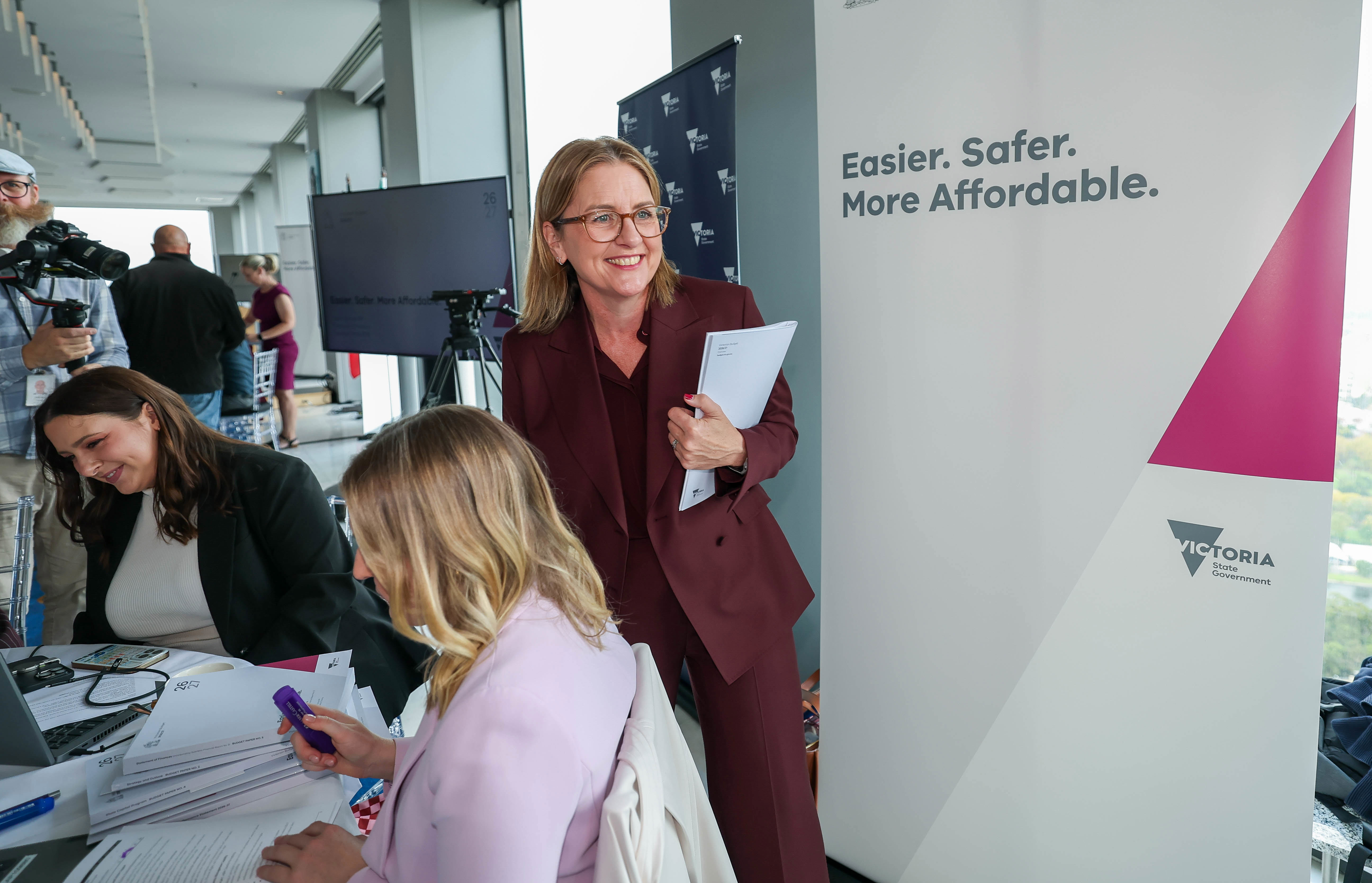
Unveiling Victoria's 2026/27 budget papers today, Premier Jacinta Allan and Treasurer Jaclyn Symes were all smiles as they announced the state's first operating surplus in seven years, ahead of a crucial election campaign.
This year's budget put forth a $727 million surplus in 2025-26 and estimated $1 billion in 2026-27, with an average $1.7 billion surplus over the forward estimate.
"I am proud to confirm Victoria's first operating surplus in seven years," Symes said in her budget address.
READ MORE: All the winners and losers from this year's Victorian budget
But behind the polished veil of an operating surplus, budget papers reveal that when project spending is factored in, Victoria's spending is about $7 billion more a year than the revenue it is bringing in.
Figures in the budget reveal a record tax take and a $2 billion GST windfall from the Commonwealth is to thank for this year's operating surplus.
That allowed the state to deliver a raft of sweeteners, including free public transport until the end of May and 20 per cent off vehicle registration.
"We can afford it because our budget is in surplus," Allan wrote in a budget media release.
LIVE UPDATES: UAE intercepts Iranian missiles in first strikes since ceasefire
Shadow Treasurer James Newbury was quick to label Labor's fiscal strategy a "fake surplus" during question time, while Nationals leader Danny O'Brien also criticised the budget.
"The only thing we see in this budget that's in surplus … is a surplus of spin," O'Brien said.
Net debt in Victoria is hurtling towards $200 billion and is projected to take up a 24.4 per cent share of the state's economy by 2030.
"We have seen net debt soar towards $200 billion in Victoria. When the Coalition left office in 2014, it was $20 billion," Opposition Leader Jess Wilson said.
"Victorians now will be paying an interest bill that could fund police, ambos and kindergartens and leave a billion dollars in change."
Victoria's interest bill is expected to almost double by 2029/30, rising from $6.774 billion in 2024/25 to $11.82 billion in 2029/30 – the equivalent of $32.38 million per day.
But Symes argued the state's rising interest bill was "helping to grow the economy".
"The reason you pay interest predominantly is because you've borrowed to build productive infrastructure … the alternative is you don't build infrastructure, you stop. And all of those jobs I just talked about go," she said.
"You might have less debt, you might have less interest, but you don't have a productive society.
"Borrowing for infrastructure is what a strong economy needs."
READ MORE: Washington shooter opened fire after Secret Service confrontation

Today's budget also failed to reveal the impact of Labor's promise to spend an extra $11.5 billion on the Suburban Rail Loop.
The $34 billion project is supposed to be equally funded by the state, the Commonwealth and "value capture".
But in January the government committed to funding that final third through "up-front debt" which will be recouped over 40 years via localised taxes, raising major concerns over potential interest implications.
In an effort to rake in additional revenue, the Allan government will end its motor vehicle duty concession for luxury vehicles, which is expected to bring an extra $12.6 million into the state's coffers in 2027/28.
Victoria will also collect more revenue from fines, which is expected to rise more than 15 per cent from $886 million in 2026/27 to $997 million in 2029/30.
Some of those extra funds will flow to rising public sector wages, which are tipped to pass $41 billion in the next year – $1.3 billion higher than forecast.
By 2030, those figures will hit $45 billion, which Symes said was evidence of the government's endeavour to recruit more teachers and healthcare workers.
"We back our teachers, our nurses, our police. We want more of those people employed, that's why the figures go up," Symes said.
NEVER MISS A STORY: Get your breaking news and exclusive stories first by following us across all platforms.
- Download the 9NEWS App here via Apple and Google Play
- Make 9News your preferred source on Google by ticking this box here
- Sign up to our breaking newsletter here