(CNN) Less than 10 weeks out from the postponed start to the Tokyo 2020 Olympics, organizers have promised athletes they are doing everything they can to ensure the Games take place safely.
Speaking at a meeting of the coordination committee Wednesday, International Olympic Committee President Thomas Bach said Japanese and Tokyo 2020 officials would make the right decision on managing the situation, and the risks had been managed well so far.
Bach and other officials — both from the IOC and Japanese sporting bodies — pushed back against critics, with the IOC President saying his organization has offered to provide additional medical personnel to help pull off strict anti-Covid measures alongside the Tokyo government.
He added that 75% of people who plan on being in the Olympic Village have already been vaccinated, while organizers hope the final number will be more than 80%.
Bach said the existing plans have been tested with foreign athletes in several test events — none of which turned into super spreader events.
Tokyo 2020 President Seiko Hashimoto, also speaking at the opening of the meeting, said the purpose of Wednesday’s session was to focus on the protection of athletes and the public. She said the two main focuses would be the frequent testing of athletes and separating them from the Japanese public.
“Stop Tokyo Olympics” campaign organizer Kenji Utsunomiya said the event should take place only when Japan can welcome visitors and athletes wholeheartedly.
“We are not in that situation and therefore the Games should be canceled,” he told a news conference, according to Reuters. “Precious medical resources would need to be diverted to the Olympics if it’s held.”
Speaking to CNN this week, World Athletics president Seb Coe said he was confident the Games could be held safely.
“Should we have the Games? Yes, we should. Can we have them safely and secure? I believe we can,” Coe said. “I’m not cavalier about that. But I do think there are systems that are now tried and tested. We know so much more about these systems than we did a year ago.”
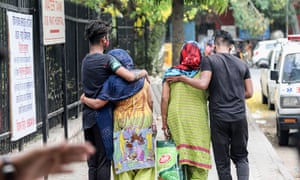
India has suffered a world record one-day death toll, surpassing the previous highest toll, recorded in the US, of 4,475.
According to the health ministry, 4,529 people were confirmed dead in the last 24 hours. It is the highest daily toll of any country on earth over the course of the pandemic and the first time India has seen a figure over 4,500.
Ireland expects most adults to be fully vaccinated by end-September
Ireland hopes to have the vast majority of its adult population fully vaccinated against the coronavirus by the end of September, deputy prime minister Leo Varadkar has said.
The government’s current target is to administer one dose to at least 80% of the population by the end of June.
“We hope to have the vast majority of our adult population vaccinated at least once by the end of June and fully by the end of September,” Varadkar told a parliamentary committee, reports Conor Humphries for Reuters.
============================================
Singapore
There’s been a diplomatic spat as Singapore has criticized an Indian politician for making unfounded claims on social media that a new Covid-19 variant in Singapore was particularly harmful to children and could cause a fresh surge of infections in India.
Singapore’s Foreign Ministry said it summoned India’s high commissioner over the comments made by Arvind Kejriwal, the chief minister of Delhi. Kejriwal called for a halt in air traffic between the two nations because of the new “Singapore variant.”
Associated Press rather dryly point out that it was unclear why he made such a call because Singapore has already banned flights from India over the high number of cases there.
Singapore’s Foreign Ministry said in a statement that it was “disappointed that a prominent political figure had failed to ascertain the facts before making such claims.”
It noted that Singapore’s Health Ministry has said there was “no Singapore variant” and that the strain prevalent in many cases in the city-state in recent weeks was the one first detected in India.
Taiwan a ‘victim of its own success’ over lack of access to vaccines
Helen Davidson
Prof Chunhuei Chi, the director of Oregon State University’s center for global health, has said that Taiwan was “a victim of its own success”. Having locally eliminated the virus in early 2020 it did not get prioritised vaccination orders, and then failed to stay up to date with the changing science, such as the increased transmissibility and high asymptomatic rates of new variants like the UK one now spreading, he said.
“Taiwan is one of the few countries that never experienced a second, third, or fourth wave,” said Chi. “It basically resumed normal life so … most people including some government officials were lagging behind updated knowledge.”
The government in Taiwan remains opposed to mass testing on the grounds that false positives could waste resources. Chi said Taiwan did not have the capacity for mass testing because it never needed it before, and establishing it could take weeks. Rapid testing stations were established in Wanhua – where Taipei’s cases are concentrated – in order to encourage patrons of the hostess bars at the centre of infections to come forward alongside the rest of the community. But there have been reports of stations hitting capacity and turning people away.
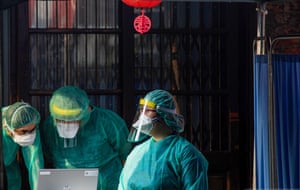
Medical staff at one of the rapid test stations in Wanhua District. Photograph: Annabelle Chih/SOPA Images/REX/Shutterstock
On Wednesday, the CECC said further stations would be set up in other hotspots, but continued to discourage people from getting tested unless they had symptoms and case connection.
“The virus is really vicious,” said Prof Chen Chien-jen from Academia Sinica genomics research centre, who was Taiwan’s health minister during the 2003 Sars outbreak, and sometimes consults current authorities. “Just one day [after we thought we’d controlled the Yilan outbreak], we found, oh my God, the Wanhua teahouse outbreak. Then the cases surged rapidly.”
Several of the experts the Guardian spoke to said the government was largely relying on the community to restrict their own movements voluntarily rather than impose lockdowns.