Biden’s 70% vaccination target by Fourth of July likely to fall short as efforts to entice people to get shots have lost their initial impact
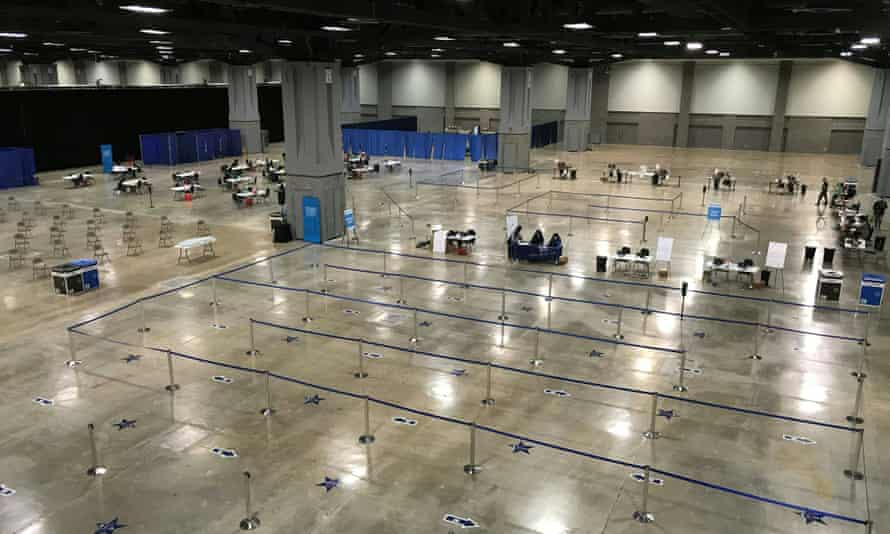
With Covid vaccination penetration in the US likely to fall short of Joe Biden’s 70% by Fourth of July target, pandemic analysts are warning that vaccine incentives are losing traction and that “two Americas” may emerge as the aggressive Delta variant becomes the dominant US strain.
Yet, US deaths from Covid-19 have dipped below 300 a day for the first time since March last year during the first wave of the pandemic.
Data from federal sources also showed the drive to put shots in arms at home approaching an encouraging milestone: 150 million Americans fully vaccinated.
Joe Biden was however expected to fall short of his commitment to shipping 80m Covid-19 vaccine doses abroad by the end of June, because of regulatory and other hurdles.
Jen Psaki, the White House press secretary, told reporters getting the shots shipped was proving to be “a Herculean logistical challenge” – which the administration has been unable to meet.
The US death toll from Covid-19 stands at more than 601,000. The worldwide count is close to 3.9m. The real figures in both cases are believed to be markedly higher.
About 45% of the US population has been fully vaccinated, according to the federal Centers for Disease Control and Prevention. More than 53% of Americans have received at least one dose, the CDC also said on Monday.
The coronavirus was the third-leading cause of death in the US in 2020, behind heart disease and cancer, according to the CDC. Now CDC data suggests more Americans are dying every day from accidents, chronic lower respiratory diseases, strokes or Alzheimer’s disease than from Covid-19.
Efforts to boost vaccination rates have come through a variety of incentives, from free hamburgers to free beer, college scholarships and even million-dollar lottery prizes. But of the efforts to entice people to get their shots some have lost their initial impact, or failed to land effectively at all.
“It’s just not working,” Irwin Redlener at the Pandemic Resource and Response Initiative at Columbia University, told Politico. “People aren’t buying it. The incentives don’t seem to be working – whether it’s a doughnut, a car or a million dollars.”
In Ohio, a program offering five adults the chance to win $1m boosted vaccination rates 40% for over a week. A month later, the rate had dropped to below what it had been before the incentive was introduced, Politico found.
Oregon followed Ohio’s cash-prize lead but saw a less dramatic uptick. Preliminary data from a similar lottery in North Carolina, launched last week, suggests the incentive is also not boosting vaccination rates there.
Public officials are sounding alarms that the window between improving vaccination penetration and the threat from the more severe Delta variant, which accounts for about 10% of US cases, is beginning to close. The Delta variant appears to be much more contagious than the original strain of Covid-19 and has wreaked havoc in countries like India and the United Kingdom.
“I certainly don’t see things getting any better if we don’t increase our vaccination rate,” Scott Allen of the county health unit in Webster, Missouri, told Politico. The state has seen daily infections and hospitalizations to nearly double over the last two weeks.
Overall, new US Covid cases have plateaued to a daily average of around 15,000 for after falling off as the nation’s vaccination program ramped up. But the number of first-dose vaccinations has dropped to 360,000 from 2m in mid-April. A quarter of those are newly eligible 12- to 15-year-olds.
Separately, pandemic researchers are warning that a picture of “two Americas” is emerging – the vaccinated and unvaccinated – that in many ways might reflect red state and blue state political divides.
Only 52% of Republicans said they were partially or fully vaccinated, and 29% said they have no intention of getting a vaccine, according to a CBS News/YouGov poll. 77% of Democrats said they were already vaccinated, with just 5% responding that were resisting the vaccine.
“I call it two Covid nations,” Peter Hotez, a vaccine researcher at Baylor College of Medicine in Houston, told BuzzFeed News.
Bette Korber, a computational biologist at the Los Alamos National Laboratory in New Mexico, said she expected variant Delta to become the most common variant in the US within weeks. “It’s really moving quickly,” Korber told Buzzfeed.
On Friday, Joe Biden issued a plea to Americans who have not yet received a vaccine to do so as soon as possible.
“Even while we’re making incredible progress, it remains a serious and deadly threat,” Biden said in remarks from the White House, saying that the Delta variant leaves unvaccinated people “even more vulnerable than they were a month ago”.
“We’re heading into, God willing, the summer of joy, the summer of freedom,” Biden said. “On July 4, we are going to celebrate our independence from the virus as we celebrate our independence of our nation. We want everyone to be able to do that.”
============================================
Colombia’s COVID-19 deaths pass 100,000 in unrelenting third wave


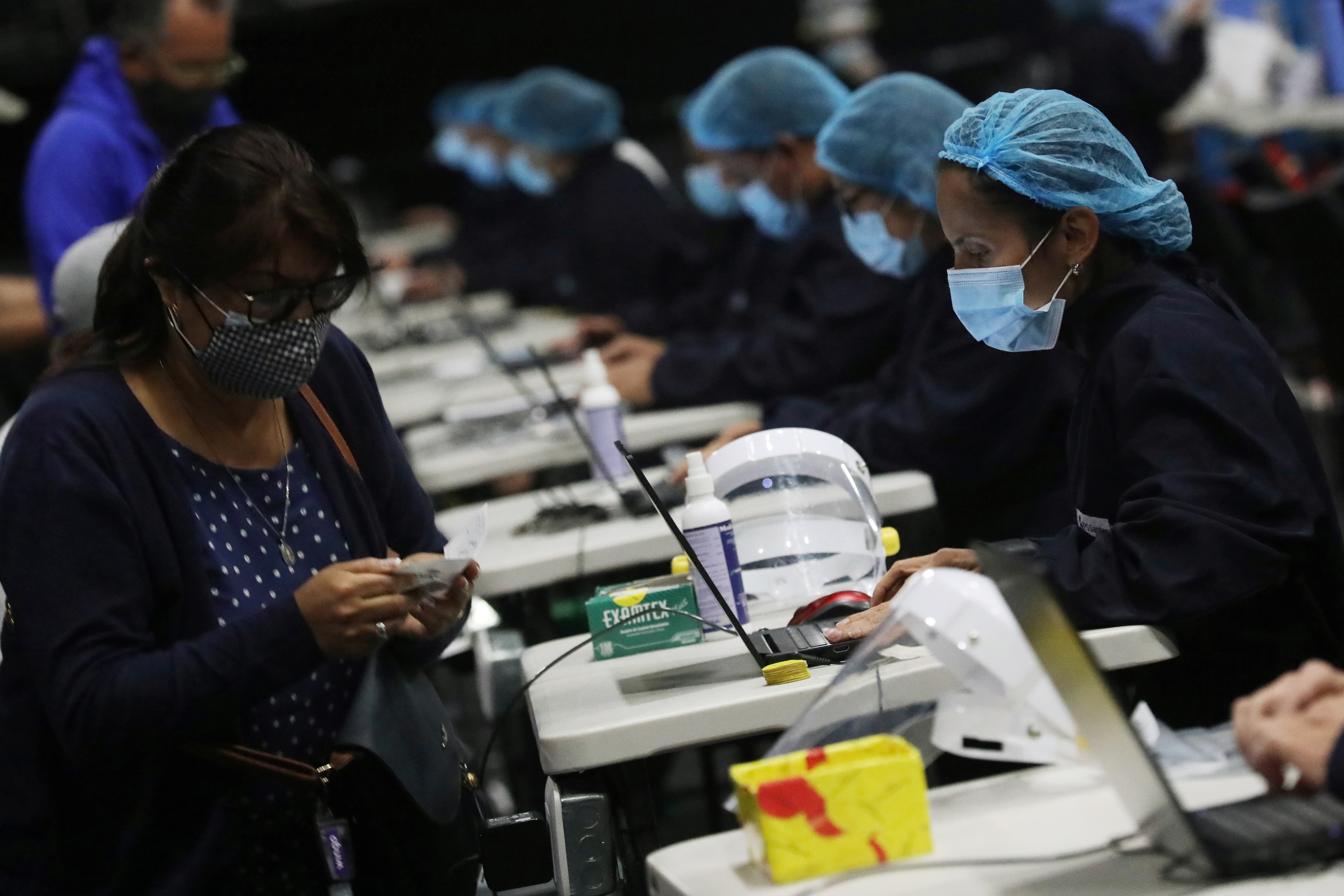
BOGOTA, June 21 (Reuters) – Reported deaths from COVID-19 in Colombia passed 100,000 on Monday, the country’s health ministry said, amid warnings of potential scarcity of treatment drugs and oxygen in hospitals during a long and brutal third peak of infections and deaths.
The country of 50 million people has reported more than 3.9 million cases of coronavirus infections, as well as 100,582 deaths.
Colombia has seen record numbers of coronavirus infections and deaths in recent weeks, with some medical officials warning certain medical supplies are running low.
Intensive care units (ICUs) in major cities are operating at near full capacity, according to information published by local health authorities in capital Bogota, as well as in Medellin and Cali, Colombia’s second-largest and third-largest cities respectively.
“We’re starting to see scarcity of certain resources everywhere,” Cesar Enciso, medical coordinator for intensive care at the University Children’s Hospital of San Jose in Bogota, told Reuters, citing a lack of sedatives and oxygen supplies.
“If the situation continues with this number of cases every day, resources are going to run out,” he added.
The government has blamed weeks of anti-government protests for extending the third peak, which began after Easter. The country hit a record of 30,000 daily reported cases earlier this month, while Monday saw a new high of 648 daily deaths.
“Crowds are the main breeding ground for this disease to spread exponentially,” President Ivan Duque said in a ceremony to mark Colombia’s COVID-19 deaths.
Despite the peak, the South American country has lifted many of the restrictions it imposed in March last year to control coronavirus, in a bid to bolster the economy and amid widespread frustration with social distancing measures.
Colombia has administered over 14.9 million vaccine doses, of which more than 4.7 million are second doses. The country hopes to vaccinate some 35 million people – 70% of its population – this year.
Venezuela Asks Banks to Foot Cost of Vaccines
CARACAS, June 21 (Reuters) – With its access to the global financial system restricted by U.S. sanctions, Venezuela managed to make some payments for the country’s coronavirus vaccines by asking a handful of private local banks to pay on the government’s behalf, two sources familiar with the matter said.
The banks have used foreign currency obtained through transactions with international credit and debit cards within Venezuela to pay COVAX, an initiative that provides vaccines to poor countries, said the people, who spoke on the conditions of anonymity and that the participating banks not be named.
It was not clear how or if the banks were compensated, nor what portion of the payments to COVAX have been made by the banks. So far, Venezuela has paid about $109 million to COVAX, about $10 million shy of what it owes, Venezuelan officials said earlier this month.
The tactic is the latest sign of how President Nicolas Maduro often finds ways around the obstacles created by the U.S. sanctions, aimed at ousting him over accusations of vote-rigging and rights violations.
That does not mean it has been easy. Government officials have said for months that the sanctions were impeding its ability to make the international bank transfers necessary to pay for the COVAX doses.
Venezuelan officials have said they expect to receive some 5 million vaccine doses through COVAX. But so far the country has received none, although most regional neighbors from Nicaragua to Colombia having already received hundreds of thousands of doses under the program.
Venezuela, with a population of some 30 million, has received vaccines only from allies Russia and China and its rollout of those 3.5 million doses has been slow and plagued by confusion.
Years of economic crisis and a collapse in oil production – by far the OPEC nation’s biggest export – has left the country perilously short of foreign currency reserves. But in April, officials said they had made the payments for the COVAX vaccines, without explaining how the transactions took place.
Some of the payments were made by local banks at the central bank’s request, the people said. Transactions with international cards have ballooned in inflation-stricken Venezuela since the government loosened exchange controls in 2019, leaving the banks that process the payments with a store of foreign currency.
Neither Venezuela’s central bank nor the information ministry, which handles media inquiries on the government’s behalf, responded to requests for comment.
The strategy has not been seamless. While the U.S. sanctions apply only to government institutions, including the central bank, some companies are wary of dealing with even non-sanctioned private Venezuelan institutions for fear of punishment by Washington – a trend known as “overcompliance.”
Venezuelan Foreign Minister Jorge Arreaza earlier this month posted on Twitter a letter from COVAX indicating that four of the 16 transactions made in Venezuela’s name, totaling some $4.6 million, had been “blocked.”
“Since there are various transfers from different banks, the operations are reviewed more closely,” one of the people familiar with the operations said.
Washington on Thursday issued an exemption to its sanctions on Venezuela, as well as on Syria and Iran, clarifying that financial transactions related to COVID-19 treatment and testing were permitted. U.S. officials have long argued that the sanctions do not prohibit humanitarian relief efforts.
The post ‘Two Americas’ May Emerge as Vax Rate & Death Rate Drop; Colombia -100k Dead, Venezuela Turns to Banks appeared first on The St Kitts Nevis Observer.