(CNN) Haiti’s President Jovenel Moise was killed during an attack on his private residence early on Wednesday, according to the country’s acting Prime Minister Claude Joseph.
Speaking on a local radio station, the prime minister, Claude Joseph, confirmed the killing of Moïse, saying the attack had been carried out by an “armed commando group” that included foreign elements.
“Around one o’clock in the morning, during the night of Tuesday 6 to Wednesday 7 July 2021, a group of unidentified individuals, including some speaking Spanish, attacked the private residence of the president and fatally injured the head of state,” Joseph said in a statement quoted in the media.
Condemning “this odious, inhuman and barbaric act”, Joseph sought to reassure Haitians, saying the security situation in the country remained calm.
He added that Moïse’s wife, Martine, had been seriously injured in the attack. An official speaking anonymously to the Associated Press also confirmed Moïse’s death.
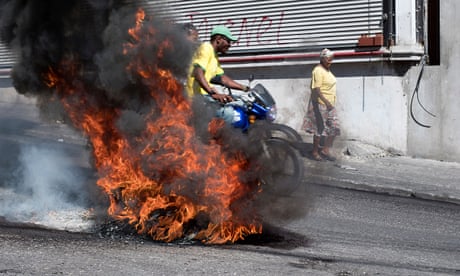
The assassination is likely to plunge the impoverished Caribbean nation into further turmoil after several years marked by political unrest and violence. Moïse’s time in office had been marked by an increase in political instability, allegations of corruption and a long-running dispute about when Moïse’s period in office should end.
There have been intermittent periods of protests and street violence and a rise in gang violence, some of it tied to the country’s political parties. At the centre of the crisis has been the question of when Moïse’s presidential term was due to end – and whether he was governing unconstitutionally.
Haiti’s opposition claims Moïse should have stepped down on 7 February to coincide with the fifth anniversary of 2015 elections that were cancelled and then re-run a year later because of allegations of fraud.
They further allege that because Moïse failed to hold legislative elections in 2019 – and has since ruled by decree after parliament was left without lawmakers – he had violated the country’s 1987 constitution.
Moïse and his supporters rejected that argument, saying he only took power in 2017 after winning the re-run.
Instability has been exacerbated by the Petrocaribe scandal, a controversy that arose from a scheme to buy discounted oil from Venezuela on cheap credit. The idea was to free up funds for social schemes, but the money was pocketed by politicians.
Earlier this year amid allegations by Moïse of a coup attempt that planned to “murder him” and fresh protests – Moïse moved to protect his position, ordering the arrest of 23 people including a supreme court judge and a senior police official, while declaring that he was “not a dictator”.
The Caribbean country – the world’s first black republic after its revolution against French rule – has a history marked by poverty, authoritarian rule, political instability and external interference including a long US occupation. It has struggled to rebuild since the devastating earthquake in 2010 and Hurricane Matthew in 2016.

The post Haiti President Jovenel Moise Assassinated in Attack on His Residence appeared first on The St Kitts Nevis Observer.