,Newsweek- The World Health Organization (WHO) has granted emergency use authorization to a COVID-19 vaccine, Covaxin, co-developed by India’s medical research agency and drugmaker Bharat Biotech. This is India’s first homegrown COVID vaccine.
The decision could be a major boon for the COVAX initiative to supply poorer countries,
The vaccine is the seventh to win WHO backing following two mRNA shots from Pfizer and Moderna, adenovirus vector vaccines by AstraZeneca and J&J and inactivated vaccines from Sinovac. Covaxin was approved by India’s drug regulator in January even before clearing the third-stage clinical trials, sparking criticism and concern around the jab.
The vaccine was approved for use in two doses in all age groups 18 and above. The WHO’s nod has paved the way for the first “Made-in-India” vaccine to be accepted as a valid vaccine by other countries and for its widespread distribution around the world. The approval on the eve of India’s largest festival, Diwali, is welcome news for both Bharat Biotech as well as for the nation’s prime minister whose government had heavily promoted the vaccine.
What happens now? Following the approval, the U.S. has given a green light to travelers vaccinated with Covaxin, and the revised rules will come into effect from November 8. It will also clear the way for India to commit to supplies to the global COVAX vaccine sharing program.
===========================================
COVID-19 has retreated across the Americas, regional health agency says
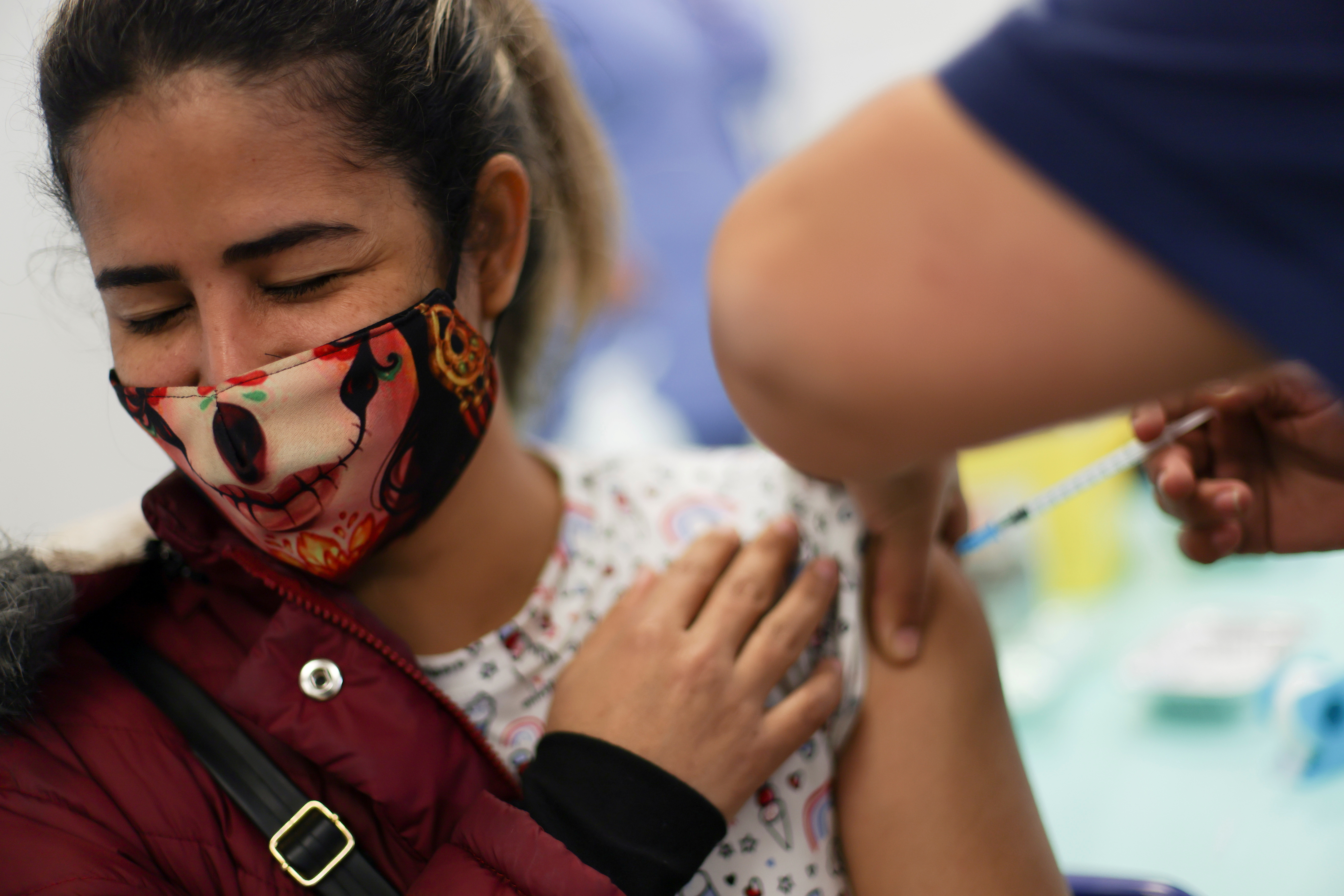
A woman receives a dose of Pfizer/BioNTech coronavirus disease (COVID-19) vaccine during a vaccination campaign inside the University of Santiago, Chile June 30, 2021. REUTERS/Ivan Alvarado
BRASILIA, Nov 3 (Reuters) – COVID-19 deaths and infections have declined across the Americas for the 8th consecutive week, the Pan American Health Organization (PAHO) said on Wednesday, warning that a very high percentage of hospitalized cases now are unvaccinated people.
In North America, all three countries reported drops in weekly cases and deaths, and there has been a notable decline in hospitalizations in the United States and Canada, PAHO said, with similar declines in South and Central America.
The regional health branch of the World Health Organization said 46% of the Latin American and Caribbean population have been fully vaccinated, and a majority of countries have already reached the WHO’s 40% vaccination coverage target set for the end of the year.
“Vaccine inequity remains the biggest barrier to reaching our coverage targets,” PAHO Assistant Director Jarbas Barbosa said in a briefing.
Given the limited supply of vaccines, he urged authorities to prioritize the elderly, frontline workers, and people with pre-existing conditions, to protect them and also to prevent health systems from becoming overburdened with severe cases.
PAHO recommends providing booster doses to people who are immunocompromised, including cancer patients, HIV positive individuals, patients on corticoids and transplant recipients.
PAHO said people over the age of 60 who received inactivated virus vaccines made by China’s Sinovac Biotech (SVA.O) and Sinopharm should also get booster shots.
Barbosa dismissed as “fake news” the view that people who had coronavirus are immune to COVID-19 and do not need to get vaccinated. He pointed to a U.S. Centers for Disease Control study published on Friday that found people who are not vaccinated but previously tested positive are 5.49 times more likely to get reinfected than those who are fully vaccinated.
In Brazil, far-right President Jair Bolsonaro, a vaccine skeptic who caught COVID-19 in July 2020, has said he is immune and has no need for a vaccine.
“That is not true. It is fake news,” Barbosa said. “The protection the disease gives you naturally is insufficient and people can get infected with the new variants,” he said.
Here’s what you need to know about the coronavirus right now from Reuters
China keeps close vigil at ports of entry
China is on high alert at its ports of entry as strict policies on travel in and out of the country are enforced to reduce COVID-19 risks amid a fresh domestic outbreak, less than 100 days from the start of the Beijing Winter Olympics.
The National Immigration Administration (NIA) said on Thursday it would continue to guide citizens not to go abroad for non-urgent and non-essential reasons. While some countries have removed quarantine requirements for vaccinated inbound travellers, China still insists that most people arriving from outside the mainland to be quarantined for weeks, regardless of their vaccination status. read more
England sees record COVID prevalence in Oct -Imperial study
COVID-19 prevalence in England rose to its highest level on record in October, Imperial College London said on Thursday, led by a high numbers of cases in children and a surge in the south-west of the country. Researchers said rates had doubled in older groups compared to September, a concerning sign as the government races to give booster shots to the most vulnerable. read more
The Imperial study found there was nearly a four-fold increase in prevalence in the southwest, the area impacted by an error at a private lab that resulted in an estimated 43,000 people wrongly being given negative PCR test results. read more
Asia tourism reopens with big-spending Chinese stuck at home
Asia’s gradual easing of international travel curbs is proving a welcome relief for the region’s hard-hit tourism operators – with one giant exception. China, previously the world’s largest outbound tourism market, is keeping international air capacity at just 2% of pre-pandemic levels and has yet to relax tight travel restrictions as it sticks to zero tolerance for COVID-19, leaving a $255 billion annual spending hole in the global tourism market.
Many experts expect China to keep such stringent measures such as up to a three-week quarantine for those returning home until at least the second quarter of next year and possibly then open gradually on a country-by-country basis. An emerging trend in surveys of Chinese travellers is a preference for natural scenery, and tourism operators will need to adapt accordingly, experts say. read more
Mothers’ COVID-19 antibodies provide unexpected benefit
COVID-19 antibodies passed from infected mothers to their breastfeeding newborns provide more benefit to the baby than researchers expected, according to a report published on Wednesday in JAMA Network Open. Researchers studied 21 babies born to mothers who were infected with the coronavirus at the time of delivery. Two months later, the researchers found a class of immune molecule in the breast milk, known as IgA antibodies, had stimulated active immunity in the newborns, triggering their immune systems to produce their own IgA antibodies.
“We have shown for the first time that the mother can also trigger the active immune response of the newborn through the transfer of (immune molecules) in breast milk resulting in the production of salivary antibodies,” Dr. Rita Carsetti of Bambino Gesu Children Hospital and Dr. Gianluca Terrin of Sapienza University, both in Rome, said in an email. They are performing further studies to see whether vaccine-induced antibodies in breast milk have the same effect. read more
Move to vaccinate young U.S. children gets going
U.S. President Joe Biden said on Wednesday after the United States started administering the COVID-19 vaccine to children aged 5 to 11 that there will be enough COVID-19 vaccines by next week for children and the shots will be available at about 20,000 locations around the country. read more
A Kaiser Family Foundation poll in August found that about a quarter of parents want their young children vaccinated “right away,” with another quarter in the “definitely not” camp. In interviews, pediatricians and public health experts said parents appear to be growing less hesitant as time goes on. read more
The post WHO Okays India’s Own COVID-19 Vaccine, COVID Rate Down in Americas, More appeared first on The St Kitts Nevis Observer.