All posts by FreeNews

Dominica Gets China COVID Vaccine Shipment

A handover ceremony for the Sinopharm COVID-19 vaccines donated by China to Dominica was held in Dominica’s capital Roseau on Thursday, after the vaccines arrived in the Caribbean country late Wednesday, according to reports reaching here.

Since Dominica and China established diplomatic relations 17 years ago, the two countries have always been true friends, Dominican Prime Minister Roosevelt Skerrit said during the ceremony, adding that today, the precious gifts from Chinese friends once again confirm that China is a reliable and sincere partner of Dominica.

He praised China’s contributions to making Chinese COVID-19 vaccines a global public good accessible and affordable to developing countries.

China’s vaccine technology is mature and stable, and its safety and effectiveness have been widely confirmed, he added.

Charge d’Affaires of the Chinese Embassy in Dominica Luo Songtao said that facing the challenges posed by the COVID-19 pandemic, the Chinese government has always upheld the vision of a community with a shared future for mankind, and has been dedicated to making vaccines accessible and affordable to developing countries.

China and Dominica have always been supporting each other to overcome difficulties together in the fight against the pandemic, Luo said, adding that China will continue to provide assistance within its capacity for Dominica.

The post Dominica Gets China COVID Vaccine Shipment appeared first on The St Kitts Nevis Observer.

Cuba on Verge of Own COVID Vaccine as Cases Soar

(CNN) Cuba may be on the verge of a coronavirus vaccine breakthrough and not a moment too soon, as deaths and cases spike on the communist-run island.

Starting in March, two of the island’s four homegrown vaccine candidates will begin their third and final trials, the Cuban government has announced.

While other developing countries compete with richer nations for a limited supply of doses, Cuba has gambled everything on producing their own vaccines, as much an exercise in national pride as a response to a public health crisis.

Two of the vaccines are named Soberana — Spanish for sovereignty. The remaining two are called Abdala, the name of a poem written by Cuban revolutionary icon Jose Marti, and Mambisa, referring to Cuban guerillas who fought a bloody war for freedom against the Spanish.

Cuban scientists will start the final trials for their Soberana-02 and Abdala vaccines this month, as the island experiences a surge in new cases. For much of 2020, Cuba was able to keep the spread of the pandemic under control but a bungled reopening to international travelers in December led to a surge in cases.

February has been the deadliest month to date for the Caribbean nation with 108 deaths and 7642 new cases, according to the Cuban government’s statistics.

Cuban scientists say they expect their vaccines to be a game changer — not just against the rising Covid numbers but also for the disastrous impacts of the pandemic on their economy.

“The main object of this clinical trial is to show the clinical efficacy of our vaccine candidate,” said Dagmar Garcia Rivera, a researcher with the government-run Finlay Institute for Vaccines. “After that we could be in conditions to start massive vaccination in Cuba and some other countries in the world.”

With the third trial of Soberana-02, Cuban doctors say, starting in March they will vaccinate 44,000 trial participants in Cuba. Researchers told CNN they have already made more than 300,000 doses of that vaccine and will ramp up production with the expectation that trials will show Soberana-02 to be safe and effective.

Abroad, Iran has already begun widespread trials of Soberana-02 and Mexico is in talks with Cuba to begin trials soon. Suriname and Ghana are reportedly interested in buying Cuban vaccines when the drugs are ready.

Rafael Hernandez, 73, took part in the vaccine’s second trial and said the side effects were mild.

“Before applying the first dose, the doctor told me they had not registered, among the hundreds of patients vaccinated, a single adverse reaction, beyond light pain, raised temperature, stiffness in the vaccinated arm, fever or mild discomfort,” Hernandez told CNN.

Cuba’s most-tested vaccine candidate, Soberana 02 is a conjugate vaccine which carries part of the spike protein from the virus, binding it to human cells.

Researchers will not know how effective the vaccine is until they complete the Phase 3 trials and they are currently studying whether vaccinating with Soberana 02 will require giving patients three doses of the vaccine.

“We need many vaccines to vaccinate 11 million Cubans. If we are estimating that Cubans will need one or two or three doses, we are estimating that Cuba will need 30 million doses,” said Dr. Tania Crombet Ramos, the director for the government-run Center for Molecular Immunology in Havana.

Crombet said she was confident that Cuba would end up with more than one approved vaccine which would give the island greater flexibility to fight the pandemic.

“I think at the end we might be able to implement what we call ‘prime and boost,’” she said, “which is using some vaccines for the first dose and boostering and reimmunizing.”

In addition to finishing its vaccine trials, Cuba still needs to show that it can handle the massive ramp up in production that will be required to make tens of millions of doses.

This would be no small feat for any country but a particularly daunting one for an island where the economy has been battered by the pandemic and increase in US sanctions under the Trump administration. Many Cubans currently have difficulty finding basic painkillers and antibiotics much less a cutting-edge vaccine.

Nevertheless, Cuban health officials have said they expect to vaccinate the island’s entire population by the end of the year and could even sell or donate additional doses abroad or even market ‘vaccination vacations’ to help Cuba’s hard hit tourism industry to rebound.

“We have productive capacity for millions of doses of the vaccine,” Garcia said. “Probably more of the vaccine than Cuba needs. At some moment we have will some vaccine or some level of doses available for other countries in the world.”

Dr. Jose Moya, a Peruvian health expert based in Havana for the World Health Organization and Pan American Health Organization, said he was encouraged that Cuban vaccine researchers were complying with international protocols and providing updates on their progress.

“We are following these results carefully first because the Cuban population will directly benefit from their vaccine candidates and this at some point could control the transmission in the country,” Moya said. “The fact that Cuba has four vaccine candidates is very good news not just

The post Cuba on Verge of Own COVID Vaccine as Cases Soar appeared first on The St Kitts Nevis Observer.

US: Legislation for Caribbean ‘Dreamers’ to Earn Green Card,Citizenship

Caribbean American Democratic Congresswoman Yvette D. Clarke (contributed photo)


WASHINGTON, CMC – Caribbean American Democratic Congresswoman Yvette D Clarke has introduced legislation in the United States House of Representatives that would allow Caribbean and other “Dreamers” to earn lawful permanent residence, or green card, and US citizenship.

The Development, Relief, and Education for Alien Minors Act, known as the DREAM Act, is a United States legislative proposal to grant temporary conditional residency, with the right to work, to unauthorised Caribbean and other immigrants who entered the US as minors—and, if they later satisfy further qualifications, they would attain permanent residency.

In April 2001, United States Senators Dick Durbin (D-Illinois) and Orrin Hatch (R-Utah) first introduced the bill in the Senate as S. 1291, but it did not pass.

The proposal has since been reintroduced several times, but has not been approved by majorities in either House of the United States Congress.

Caribbean American Democratic Congresswoman Yvette D. Clarke

On Wednesday, Clarke, the daughter of Jamaican immigrants, who represents the 9th Congressional District in Brooklyn, New York,  introduced H.R. 6, the Dream and Promise Act of 2021.

The bill, co-authored by New York Democratic Congresswoman Nydia Velázquez and her California counterpart Lucille Roybal-Allard, will enable US-raised immigrant youth, known as “Dreamers”, to earn lawful permanent residence and American citizenship.

In addition to “Dreamers”, the Dream and Promise Act includes protections and a path to citizenship for Temporary Protected Status (TPS) recipients, such as hundreds of undocumented Haitians living in the US, and Deferred Enforced Departure (DED) beneficiaries.

H.R 6, The Dream and Promise Act, provides a pathway to citizenship for “Dreamers”, those individuals who entered the US under the age of 18.

The legislation also provides “Dreamers” with access to equitable higher education.

For TPS and DED holders, H.R. 6, will secure permanent residency and allow them to apply for citizenship after five years.

The legislation goes even further to prevent immediate deportations, establish the right to judicial review, and impose penalties on those who use application data for immigration enforcement purposes.

“I am proud to co-lead H.R.6, the Dream and Promise Act, which provides 2.5 million ‘Dreamers’ Temporary Protected Status and Deferred Enforcement Departure recipients with a pathway to citizenship – 2.5 million people who already call America home and are contributing to our society,” Clarke said.

“As chair of the Congressional Black Caucus Immigration Task Force, it is my passion and my duty to stand up for immigrants,” she added. “H.R. 6 is the right thing to do for ‘Dreamers’ and TPS and DED holders. Immigrants greatly contribute to our economy, our community and our culture.

“Reversing the policies of the last four years is not enough,” continued Clarke, referring to the last four years of the previous President Donald J. Trump administration. “We must reimagine the immigration system in a manner that is humane, just and fair. The time has come for the values of our nation to be reflected in our immigration policies.”

In 2012, former US President Barack Obama enacted a temporary program, called the Deferred Action for Childhood Arrivals (DACA), which provided temporary protection from deportation and work permits for eligible “Dreamers”.

But, in 2017, the Trump administration rescinded the program, taking DACA protections away from its 800,000 recipients.

“This unlawful act by the Trump administration was part of a larger effort to advance their anti-immigrant agenda,” Clarke said. “The Dream and Promise Act seeks to remedy these actions and do right by the immigrants in our country.”

In 2019, H.R. 6, the Dream and Promise Act was passed in the House, but it was not signed into law.

Clarke, therefore, co-leads the legislation’s 2021 re-introduction, with co-sponsorship by 134 members of Congress.

The reintroduction of H.R. 6 comes as momentum continues to build for long-overdue US immigration reform.

Earlier this year, Clarke co-led the House’s version of President Joe Biden’s US Citizenship Act of 2021, along with six of her colleagues known as the “Closers”.

“This comprehensive legislation would restore humanity and American values to our immigration system,” said Clarke, stating that, among many provisions, it would allow “qualified, hardworking immigrants who contribute to our country and enrich their communities with a pathway to citizenship.

The post US: Legislation for Caribbean ‘Dreamers’ to Earn Green Card,Citizenship appeared first on The St Kitts Nevis Observer.

Pope Francis arrives in Iraq for first papal visit

Pope Francis arrived in Baghdad on Friday to kick off the first-ever papal visit to Iraq and marking his first international trip since the start of the COVID-19 pandemic.

Francis' plane touched down at Baghdad's airport just before 2pm local time (10pm AEDT).

The 84-year-old will urge the country's dwindling number of Christians to stay put and help rebuild the country after years of war and persecution, brushing aside coronavirus and security concerns.
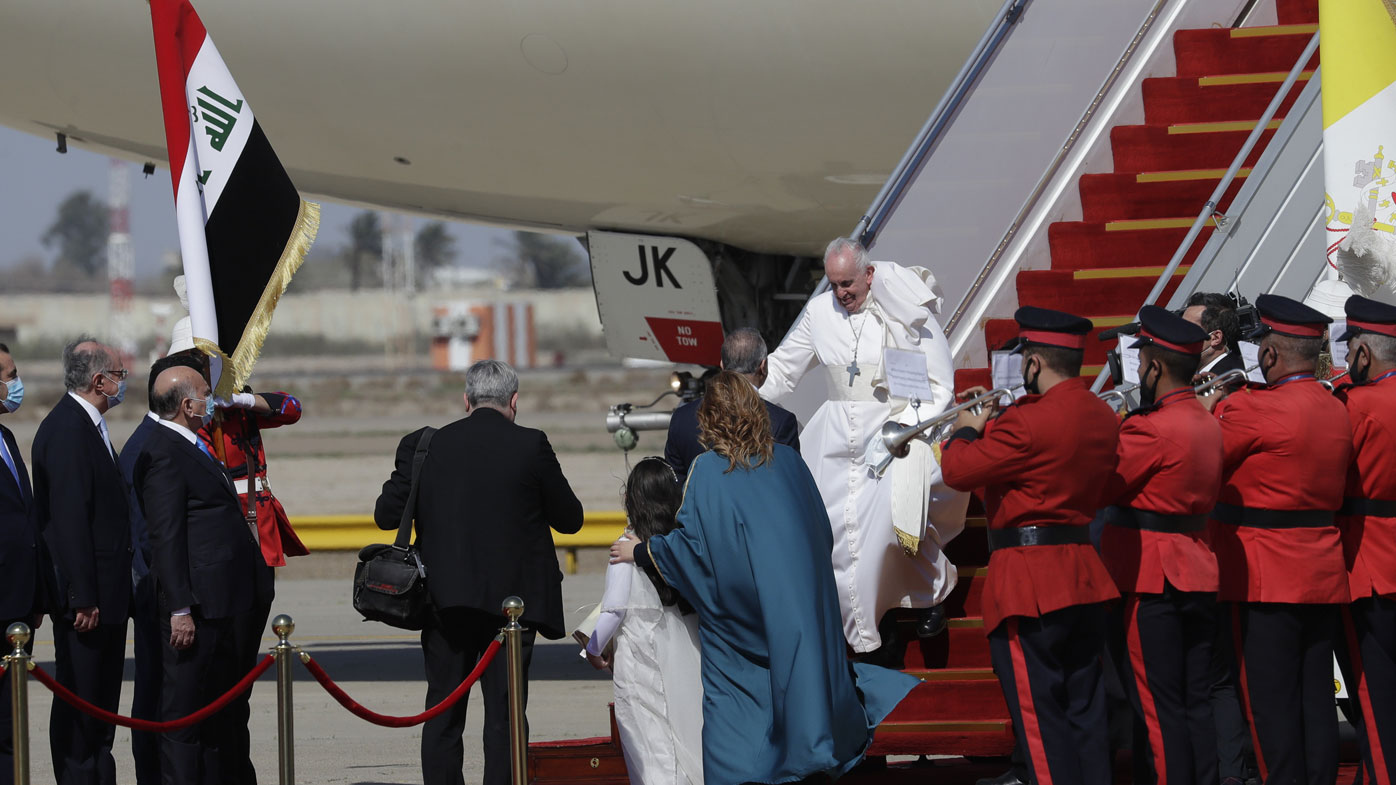
Pope Francis walks down the steps of an airplane as he arrives at Baghdad international airport, Iraq, Friday, March 5, 2021

Iraqis were keen to welcome him and the global attention his visit will bring, with banners and posters hanging high in central Baghdad, and billboards depicting Francis with the slogan "We are all Brothers" decorating the main thoroughfare.

In central Tahrir square, a mock tree was erected emblazoned with the Vatican emblem, while Iraqi and Vatican flags lined empty streets.

Iraqi Foreign Minister Fuad Hussein said Iraqis were eager to welcome Francis' "message of peace and tolerance" and described the visit as a historic meeting between the "minaret and the bells."

Among the highlights of the three-day visit is Francis' private meeting Saturday with the country's top Shiite cleric, Grand Ayatollah Ali al-Sistani, a revered figure in Iraq and beyond.
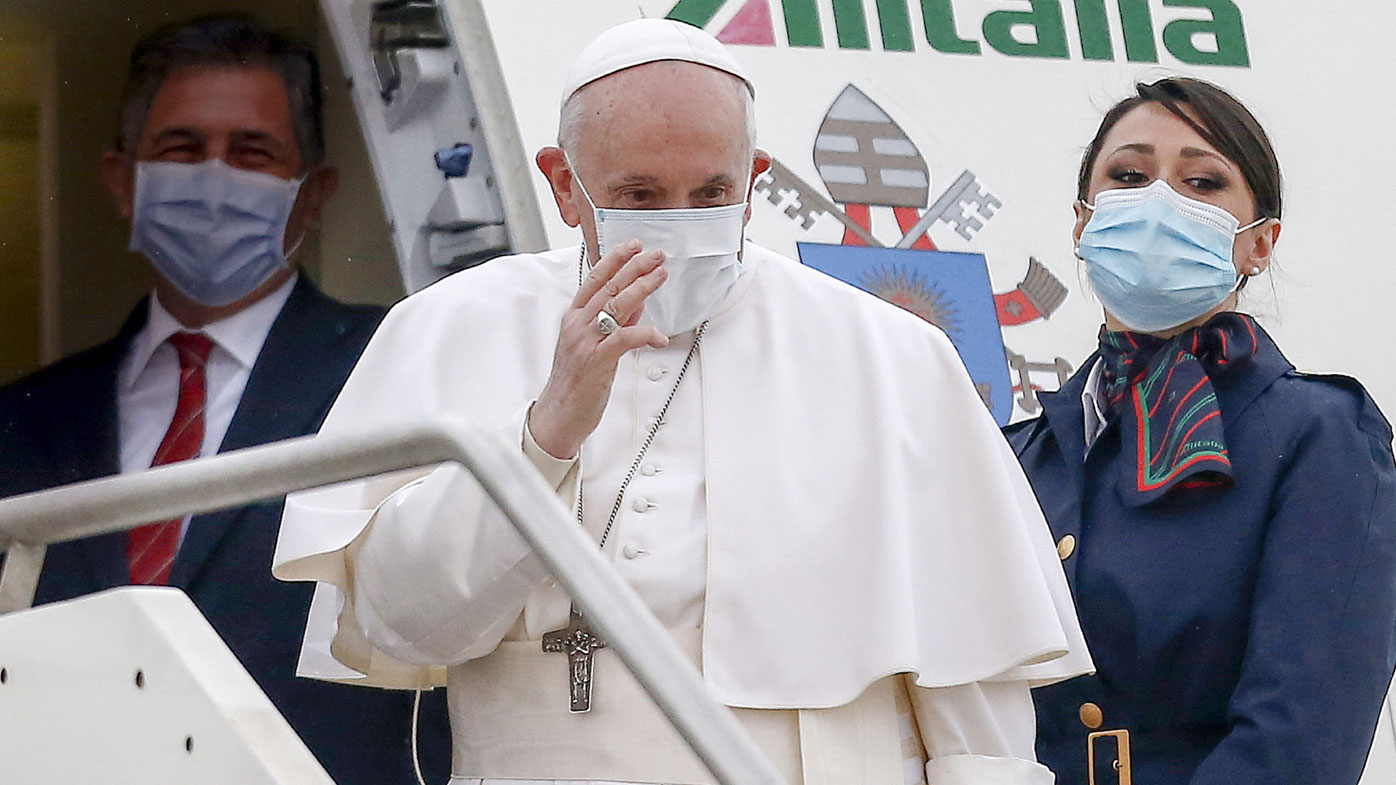
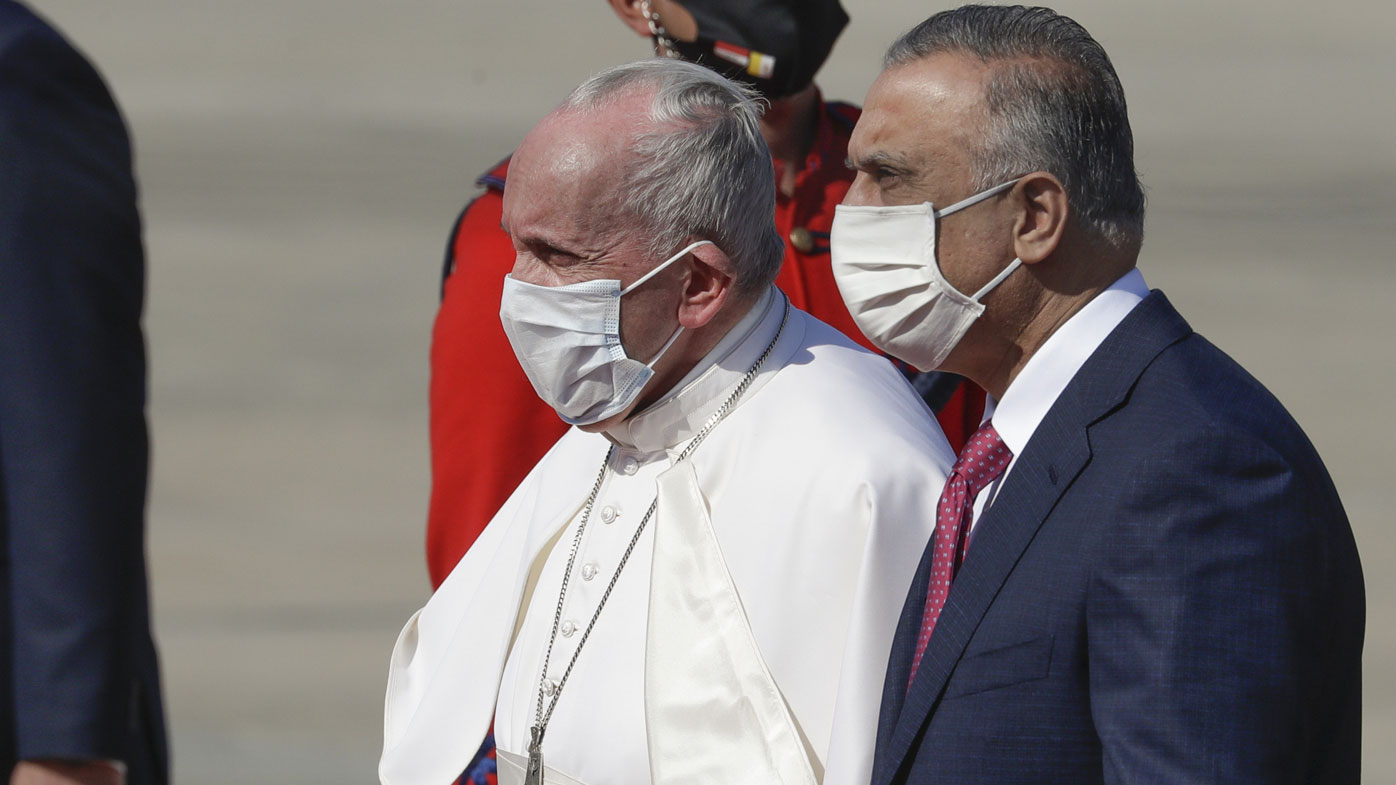
Pope Francis gives his blessing as he prepares to leave from Fiumicino's International airport Leonardo da Vinci, near Rome, for Baghdad, Iraq, Friday, March 5, 2021.Pope Francis is flanked by Iraqi Prime Minister Mustafa al-Kadhimi upon hi arrival at Baghdad's international airport, Iraq, Friday, March 5, 2021

The government is eager to show off the relative security it has achieved after years of wars and militant attacks that nevertheless continue even today. Francis and the Vatican delegation are relying on Iraqi security forces to protect them, including with the expected first use of an armoured car for the pope-mobile-loving pontiff.

Tahsin al-Khafaji, spokesman for Iraq's joint operations, said security forces had been increased.

"This visit is really important to us and provides a good perspective of Iraq because the whole world will be watching," he said. The high stakes will give Iraqi forces "motivation to achieve this visit with safety and peace."

Francis is breaking his year-long COVID-19 lockdown to refocus the world's attention on a largely neglected people whose northern Christian communities, which date from the time of Christ, were largely emptied during the violent Islamic State reign from 2014-2017.

For the pope, who has often travelled to places where Christians are a persecuted minority, Iraq's beleaguered Christians are the epitome of the "martyred church" that he has admired ever since he was a young Jesuit seeking to be a missionary in Asia.
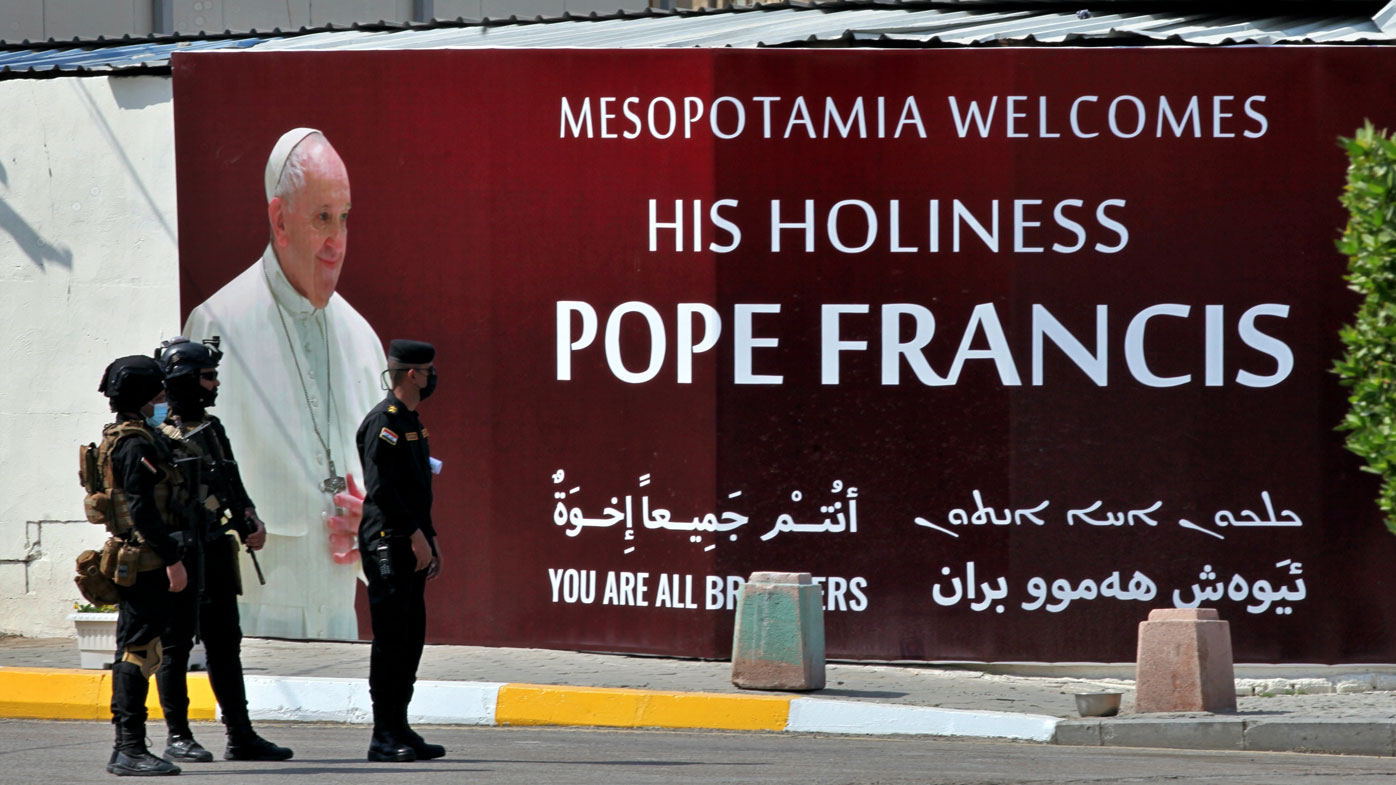
Iraqi security forces stand guard by a mural depicting Pope Francis outside of Our Lady of Salvation Church in Baghdad, Iraq, Friday, March 5, 2021

In Iraq, Francis is seeking to not only honour its martyrs but deliver a message of reconciliation and fraternity. The few Christians who remain in Iraq harbour a lingering mistrust of their Muslim neighbours and face structural discrimination long predating both IS and the 2003 US-led invasion that plunged the country into chaos.

"The Pope's visit is to support the Christians in Iraq to stay, and to say that they are not forgotten," the Chaldean patriarch, Cardinal Luis Sako, told reporters in Baghdad this week. The aim of Francis' visit, he said, is to encourage them to "hold onto hope."

The visit comes as Iraq is seeing a new spike in coronavirus infections, with most new cases traced to the highly contagious variant first identified in Britain. The 84-year-old pope, the Vatican delegation and travelling media have been vaccinated; most Iraqis have not.
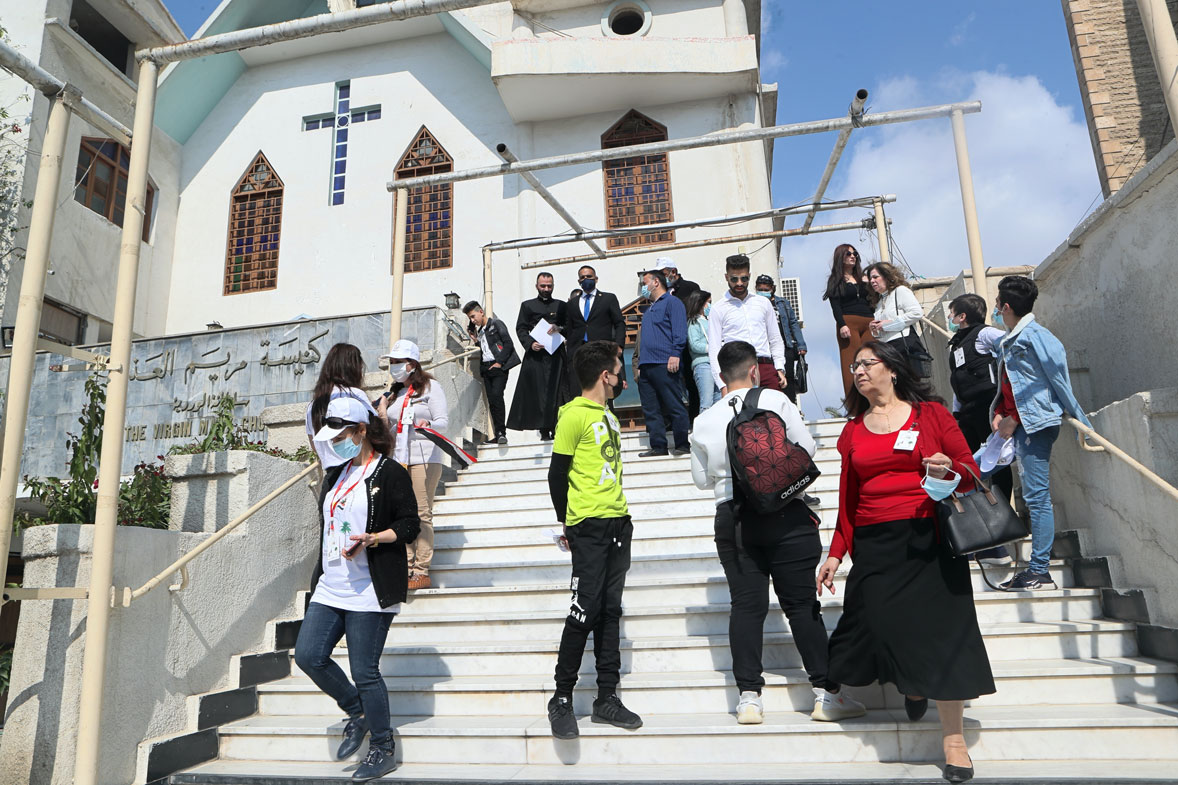
Iraqi Christians gather at the Church of the Virgin Mary before going to the airport to welcome the Pope in Baghdad, Iraq, Friday, March 5, 2021

Ahead of the pope's arrival Friday, dozens of men, women and children gathered in a Baghdad church, many not wearing masks or observing social distancing, before boarding buses to the airport to welcome the pontiff.

The Vatican and Iraqi authorities have downplayed the threat of the virus and insisted that social distancing, crowd control and other health care measures will be enforced. The Vatican spokesman, Matteo Bruni, said this week the important thing is for Iraqis to know that the pope came to Iraq as an "act of love."

"I come among you as a pilgrim of peace, to repeat 'you are all brothers,'" Francis said in a video-message to the Iraqi people on the eve of his visit. "I come as a pilgrim of peace in search of fraternity, animated by the desire to pray together and walk together, also with brothers and sisters of other religious traditions."

Christians once constituted a sizeable minority in Iraq but their numbers began dwindling after the 2003 US-led invasion. They fell further when IS militants in 2014 swept through traditionally Christian towns across the Nineveh plains. Their extremist brand of Islam forced residents to flee to the neighbouring Kurdish region or further afield.
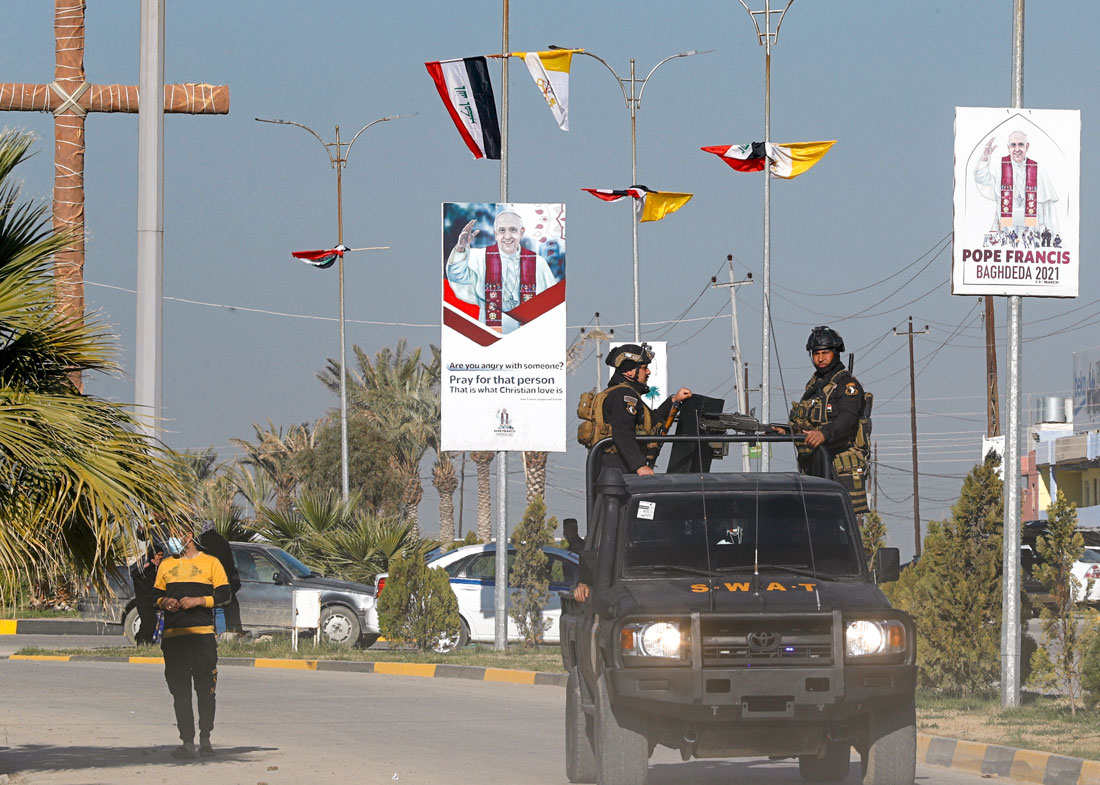
Iraqi security forces pass by Iraqi and Vatican flags and posters in a street in Qaraqosh, Iraq, Monday, Feb. 22, 2021, announcing the visit of the Pope Francis.

Few have returned, and those who have found their homes and churches destroyed.

Returnees have had to contend with more struggles. Many cannot find work and blame discriminatory practices in the public sector, Iraq's largest employer. Since 2003, public jobs have been mostly controlled by majority Shiite political elites, leaving Christians feeling marginalised.

While hard numbers are hard to come by, there were an estimated 1.4 million Christians in Iraq in 2003. Today the number is believed to be around 250,000.

During his visit, Francis will pray in the Baghdad church that was the site of one of the worst massacres of Christians, the 2010 attack by Islamic militants that left 58 people dead. He will honour the dead in a Mosul square surrounded by shells of destroyed churches and meet with the small Christian community that returned to Qaraqosh. He will bless their church, which was used as a firing range by IS.
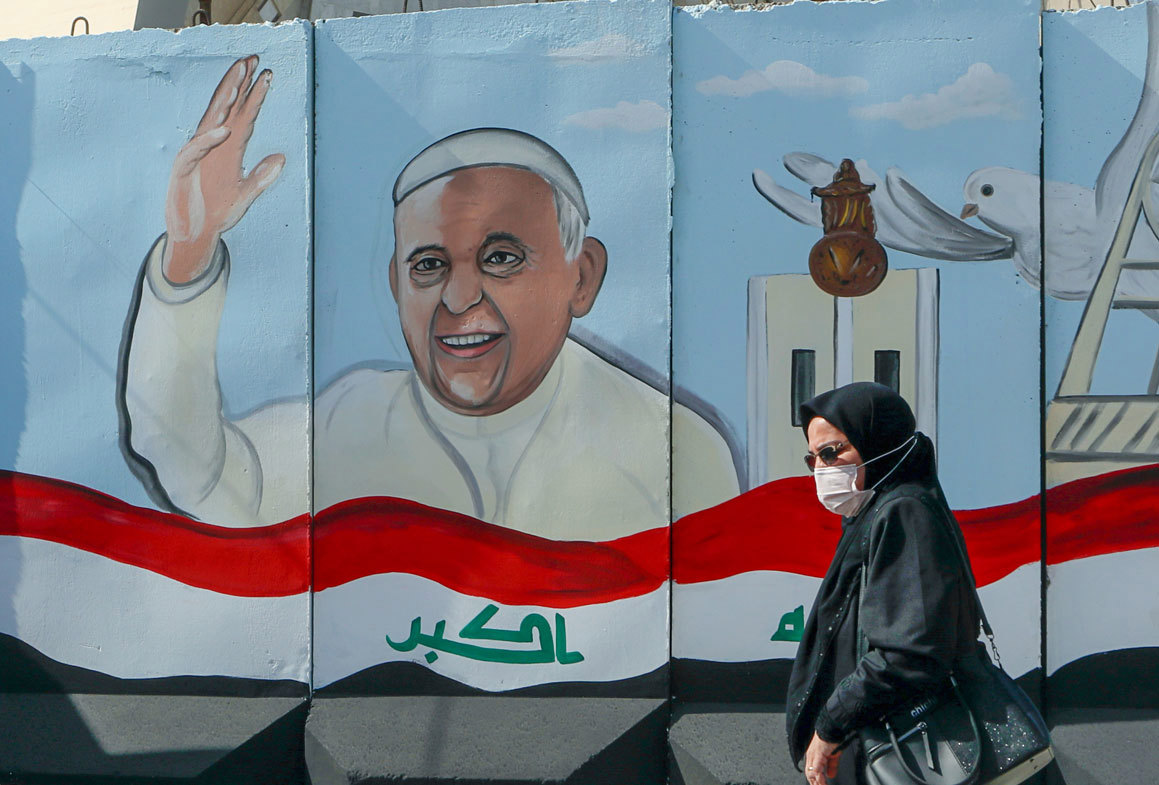
A woman walks past a mural depicting Pope Francis on a concrete wall placed by Iraqi security forces to surround the Our Lady of Salvation Church during preparations for the Pope's visit in Baghdad, Iraq, Monday, March 1, 2021

The Vatican and the pope have frequently insisted on the need to preserve Iraq's ancient Christian communities and create the security, economic and social conditions for those who have left to return. But that hasn't necessarily translated into reality.

"I am the only priest in Mosul. Every Sunday I hold mass at 9 a.m., and only around 70 people attend," said the Rev. Raed Adil Kelo, parish priest of the Church of the Annunciation in the onetime de-facto IS capital.

Before 2003, the Christian population was 50,000, he said. It had dwindled to 2,000 before IS overran northern Iraq.

He doesn't expect more to return, but he said Francis' visit would have immeasurable importance for those who stayed.

"This visit will bring peace to Iraq" he said.
US Capitol: Cops Want Guard to Stay, Pelosi Wants Better Security

US House Speaker Nancy Pelosi (D-Calif.) called for more funding for Capitol security, citing the ongoing threat of violence from “all the president’s men” — a reference to the mob of former President Trump‘s supporters who ransacked the Capitol on Jan. 6.

“Between COVID — where we need to have vaccinations more broadly in the Capitol so that many more people can come here and do their jobs — [and] the threat of all the president’s men out there, we have to ensure with our security that we are safe enough to do our job, but not impeding [that work],” Pelosi told reporters at a press briefing.

Also, Capitol Police on Thursday requested the National Guard extend its deployment of National Guardsmen at the Capitol amid heightened security concerns almost two months after the Jan. 6 attack.

“Today, US Capitol Police Acting Chief Yogananda Pittman formally asked the Department of Defense to extend the support provided by the National Guard to remain at the Capitol beyond March 12th,” the police said in a statement.

Earlier in the day, a Defense Department official said the Pentagon was reviewing a draft request from Capitol Police to extend the deployment, which started after the Jan. 6 insurrection.

Details of the potential extension “are still being worked out,” the Pentagon official said.

Capitol Police provided few other details.

The security issue has been front and center since the mob overwhelmed law enforcement officers and forced the evacuation of lawmakers who were certifying President Biden‘s victory in the Electoral College.

On Wednesday, the House moved up a vote because Capitol Police and the FBI had warned that some of the militia groups participating in the Jan. 6 rampage had designs on a second attack on March 4 — a symbolic date which marked the inauguration of presidents until the early 1930s.

Those conservative conspiracy theorists, law enforcers warned, believed Trump would somehow return to the White House on that day.

The threat of another violent attack on the Capitol had unnerved many lawmakers who were targeted on Jan. 6.

Pelosi on Thursday, however, downplayed the significance of the new security threat in the decision to keep the House out of session on Thursday. She noted that Republicans launch their annual issues retreat Thursday afternoon, and the House had a short floor schedule already in place to accommodate that event.

“I don’t think anybody should take any encouragement that, because some trouble-makers might show up, that we changed our whole schedule,” Pelosi said. “No, we just moved it a few hours, and it largely will accommodate the Republicans going to their own [conference].

Yet a number of Democrats — lawmakers and leadership aides alike — had said Wednesday that the schedule change was a direct result of the violent threats. And Pelosi on Thursday acknowledged that security concerns were a factor, noting that the logistics of keeping 435 House lawmakers safe is a taller order than ensuring the safety of 100 senators, who remain in session Thursday.

“Frankly, there are a lot of us,” she said. “The Senate is in, and they should be. We’re at least four times more people, and therefore all that that implies in terms of numbers of people in the Capitol — if in fact there’s any troublemakers around.”

The comments come as the Capitol Police have asked the Pentagon to extend the deployment of thousands of National Guard troops, who have been stationed around the Capitol complex since Jan. 6.

Pelosi declined to comment on the prospect of keeping those troops around for another two months, deflecting questions of Capitol security to the officials in ch

The post US Capitol: Cops Want Guard to Stay, Pelosi Wants Better Security appeared first on The St Kitts Nevis Observer.

New device to revolutionise cancer scans

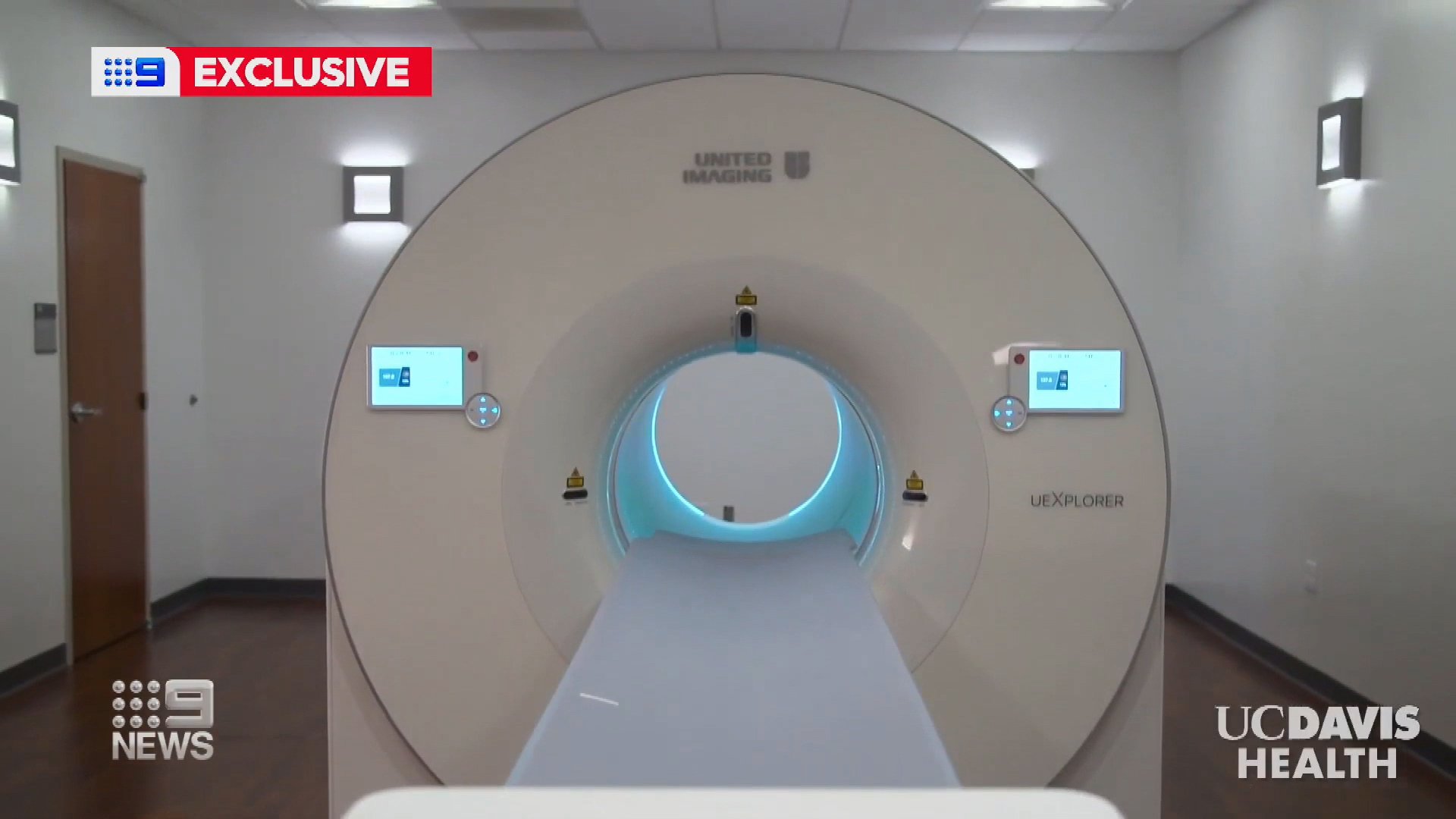
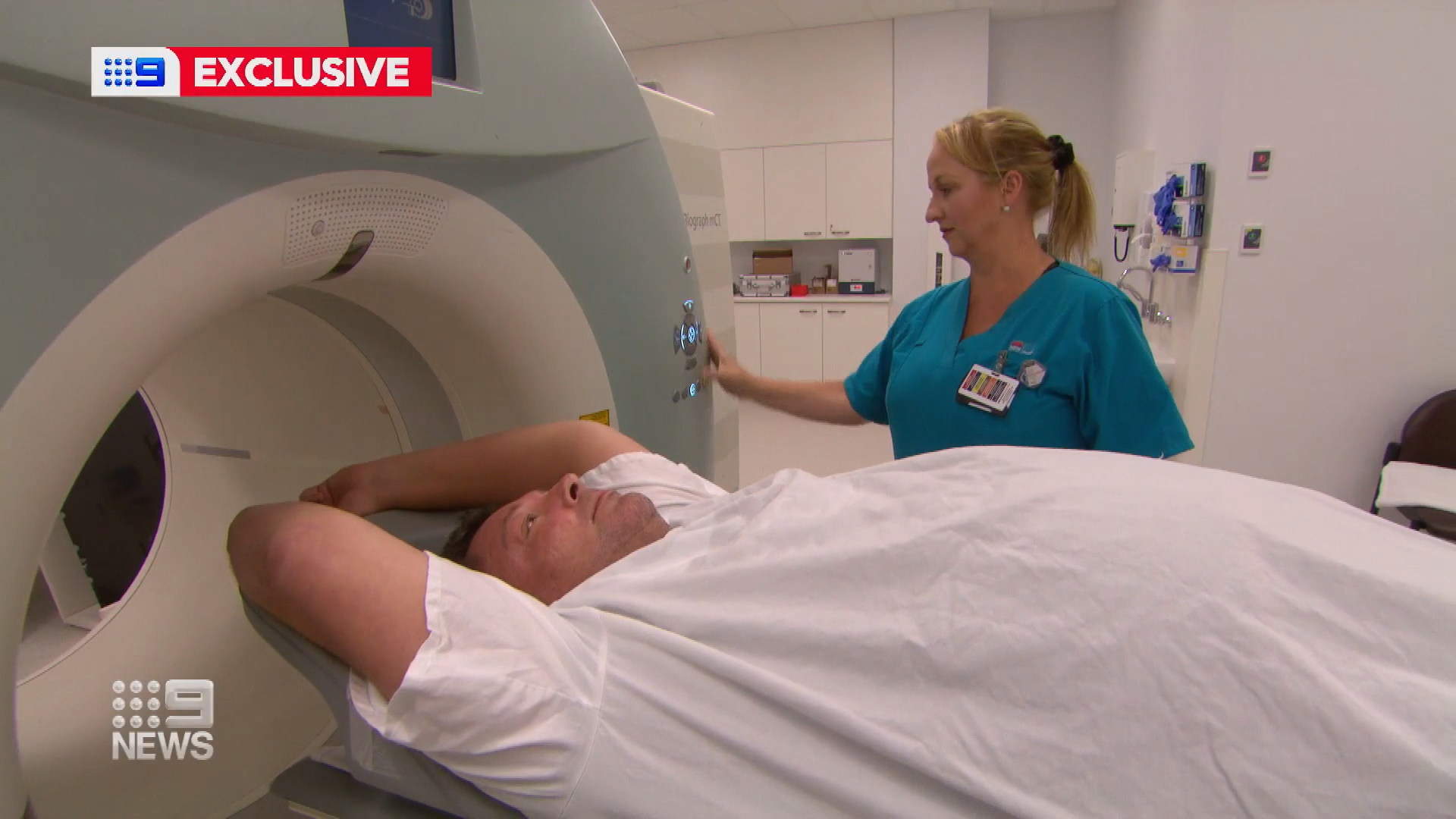
Cancer patients are set to benefit from a new PET scanner, the first of its kind in Australia which will revolutionise the way tumours are targeted and tracked.

Conventional PET scans require patients to lie on a bed for 20 to 30 minutes, but the new whole-body imaging machine can perform scans in a quarter of that time.

Instead of having to take a series of images, the scanner can capture the body's tissues and organs from head to toe in one single scan.

READ MORE: Revolutionary melanoma treatment offers new lease on life

It will also mean patients will be exposed to less radiation.

"We're going to be able to reduce the radiation dose to about half of what we currently do," said Associate Professor Paul Roach, director of nuclear medicine at Royal North Shore Hospital.

The technology will mostly benefit cancer patients to monitor their progress and guide treatments, but it can also assess people who've had a heart attack or those with brain disorders.

The scanner, which is called Total Body Positron Emission Tomography (TB-PET), will be acquired by Royal North Shore Hospital and the University of Sydney as part of a $15 million project to boost Australia's imaging capabilities.

The Federal Government, through the National Imaging Facility, has funded half of project so that researchers across the country can also use it to make discoveries.

READ MORE: Woman on working holiday finds out cough is terminal lung cancer

They could investigate a range of conditions such as motor neurone disease, which leads to paralysis.

"The problem there is we don't know what causes the disease, we don't whether it originates in the brain or in the spine or in the muscles themselves," said Professor Steven Meikle, head of the Imaging Physics Laboratory at the University of Sydney's Brain and Mind Centre.

"So this total-body PET would allow us to study that disease and try to find out where the breakdown in the molecular signalling is occurring."

Professor Roach said the scanner will be operational within a year.

It has been 30 years since the first PET scanner arrived in Australia and the latest announcement is set to further enhance medical diagnostics and research.

Sputnik V Spreading Over Latin America, Brazil Pres: “Stop Whining,” World Stats

(CNN)- Russia’s Sputnik V has seen rising popularity across Latin America as more countries announce shipments and deals to purchase the Covid-19 vaccine.

Nine Latin American countries so far have approved usage of the Sputnik V vaccine — Argentina, Bolivia, Guatemala, Guyana, Honduras, Mexico, Nicaragua, Paraguay and Venezuela. Distribution of the vaccine has also begun in Argentina, Bolivia, Mexico, Nicaragua, Paraguay and Venezuela.
The vaccine has been approved in 39 countries around the world, according to the Russian Direct Investment Fund (RDIF), which handles the marketing of the vaccine.

Millions of doses of Sputnik V are already being produced each month at the Generium Pharmaceutical plant.

Millions of doses of Sputnik V are already being produced each month at the Generium Pharmaceutical plant.

The Sputnik V vaccine has a cheaper list price and can be stored at higher temperatures than the Pfizer vaccine, which has made it appealing to Latin American countries with less-developed economies and infrastructures. It requires two doses taken 21 days apart to be effective.

Argentina became the first Latin American country to distribute the Sputnik V vaccine in late December, with the purchase of up to 25 million doses. The country has already distributed over 600,000 doses.

Since then, Venezuela and Mexico both received shipments of 100,000 and 200,000, respectively, in early February. Nicaragua began distributing the vaccine on March 2 after receiving a donation of an undisclosed amount of doses.

As Russia struggles to keep up with demand, some countries have received only very small shipments. Bolivia received 20,000 Sputnik V doses in January, though it expects enough to eventually vaccinate 2.6 million people. Paraguay announced the purchase of one million doses, but has so far only received 4,000.

A nurse Injects the Sputnik V vaccine to the first doctor as part of the vaccination plan against COVID-19 at Hospital del Norte in El Alto, Bolivia. (Photo by Gaston Brito/Getty Images)

Russia has acknowledged the production squeeze and has considered launching regional production hubs in several countries, including Brazil, according to Kremlin spokesman Dmitry Peskov.

Some interest has been expressed in producing the Sputnik V vaccine locally in Latin America. The RDIF recently announced an agreement with Argentina’s Richmond Laboratories to begin producing the vaccine in the country, though it has not yet provided a timeframe for delivery.

Experts have repeatedly voiced concern over transparency around Sputnik’s testing and its accelerated authorization in Russia. However, the vaccine was found 91.6% effective against symptomatic Covid-19 and 100% effective against severe and moderate disease, in an interim analysis of the vaccine’s Phase 3 trial results published in The Lancet.

Reporting contributed by Mitchell McCluskey in Atlanta, Stefano Pozzebon in Bogota, Tatiana Arias in Atlanta and Tim Lister in Spain.

==================================================

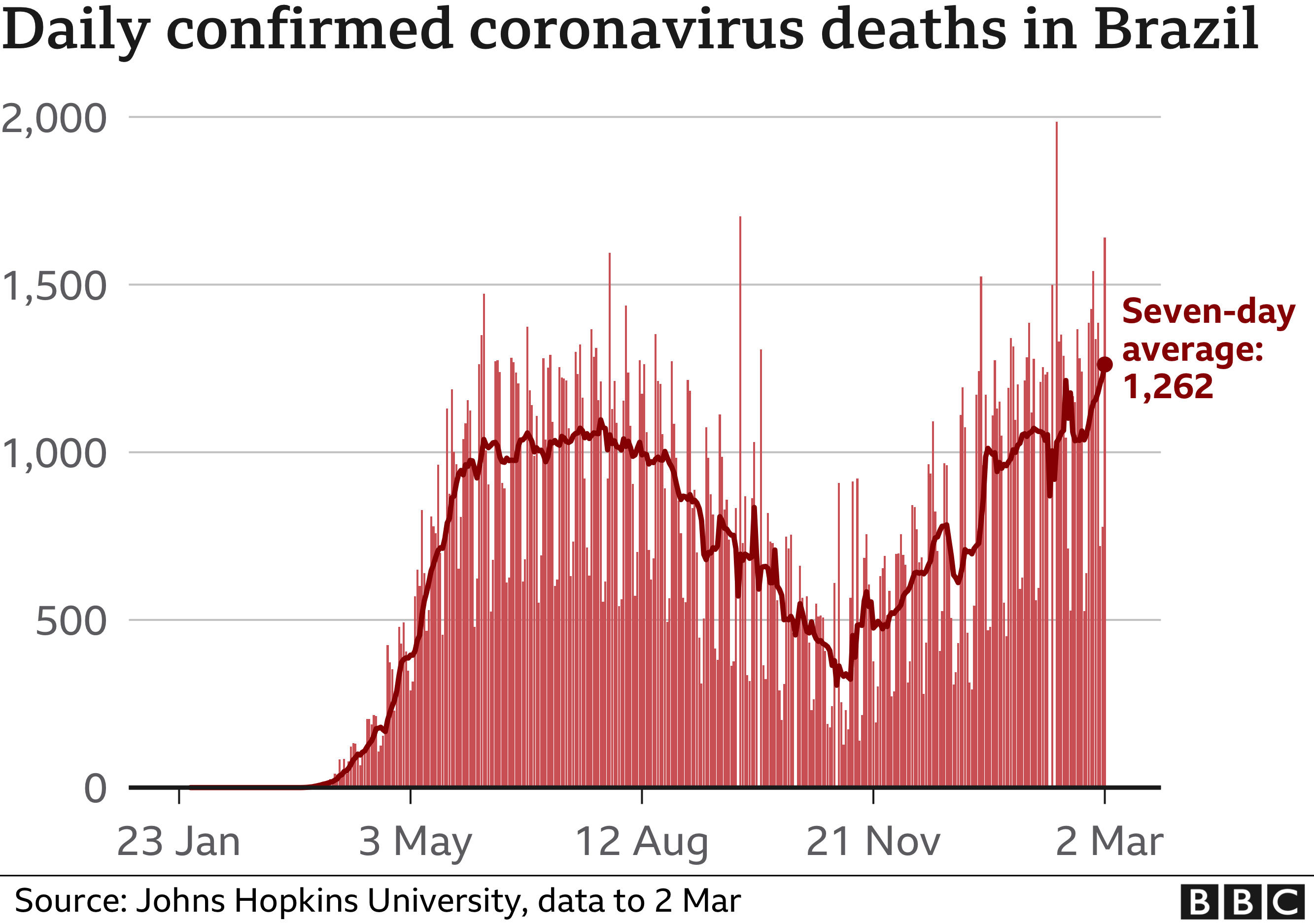
President Jair Bolsonaro has told Brazilians to “stop whining” about Covid-19, as he criticised measures to curb the virus despite a surge in cases and deaths.

His comments came a day after Brazil saw a record rise in deaths over a 24-hour period.

Brazil is facing its worst phase of the pandemic yet, leaving its health system in crisis.

In response some cities and states have imposed their own restrictions.

Brazil’s health ministry says more than 260,000 people have died with Covid-19, the second-highest pandemic death toll in the world after the US.

On Thursday, another 1,699 deaths were added to that tally, a slight decrease on Wednesday’s record 1,910. Meanwhile, a further 75,102 cases of coronavirus were reported, the second-highest daily rise on record.

The explosion of cases has been attributed to the spread of a highly contagious variant of the virus thought to have originated in the Amazon city of Manaus.

Yet on Thursday Mr Bolsonaro continued to downplay the threat posed by the virus.

“Stop whining. How long are you going to keep crying about it?” Mr Bolsonaro said at an event. “How much longer will you stay at home and close everything? No one can stand it anymore. We regret the deaths, again, but we need a solution.”

What reaction has there been to President Bolsonaro’s comments?

The comments were met with a furious response from São Paulo’s governor, João Doria, who has been particularly scathing of Mr Bolsonaro’s handling of the pandemic.

Speaking to the BBC, Mr Doria called President Bolsonaro “a crazy guy” for attacking “governors and mayors who want to buy vaccines and help the country to end this pandemic”.

“How can we face the problem, seeing people die every day? The health system in Brazil is on the verge of collapse,” Mr Doria said

President Bolsonaro has consistently opposed quarantine measures introduced by governors, arguing that the collateral damage to the economy will be worse than the effects of the virus itself.

“Unfortunately, Brazil has to fight, at this moment, two viruses: the coronavirus and Bolsonaro virus. This is a sadness for the Brazilians,” Mr Doria said.

Chart showing daily confirmed deaths
line

What measures are cities and states introducing?

Concerned about the strain on hospitals, mayors and state governors have taken matters into their own hands in recent days.

Rio de Janeiro is the latest city to announce a partial lockdown, placing restrictions on bars, restaurants and beaches.

The measures, which will take effect on Friday for one week, will require bars and restaurants to shut early and suspend commercial activity on the city’s famed beaches.

The measures come after São Paulo state – Brazil’s largest, with 46 million people – declared a “code red” situation, ordering non-essential businesses closed for two weeks starting Saturday.

Frustrated state governors announced on Tuesday that they would join forces to buy vaccines directly from manufacturers rather than wait for the federal government to deliver them.

Brazil, the worst-affected country by Covid in Latin America, has lagged behind in its roll-out of Covid vaccines.

What do we know about the new variant?

Researchers from the University of São Paulo working with their colleagues at Imperial College London and Oxford University think that the second wave may be linked to the emergence of a new variant of coronavirus which has been traced to the city of Manaus.

The new variant, named P.1, was first detected in people who had travelled from Manaus to Japan in January. The researchers studying it think it first emerged in Manaus in early November and has been spreading there quickly since.

Their data – which is still preliminary – suggests that the P.1 variant could be up to twice as transmittable as the original version of the virus.

It also suggests that the new variant could evade immunity built up by having had the original version of Covid. They put the chance of reinfection at between 25% and 60%.

Manaus, in the Amazon region, was one of the hardest hit cities in the first wave of the pandemic.

It was expected that the people infected in the first wave would have acquired some degree of protection or immunity. And yet, the city has seen a second wave of infections.

Researchers think this may be because a new variant has emerged which may be evading immunity provided by past infections.

===================================================

Covid: Italy ‘blocks’ AstraZeneca vaccine shipment to Australia

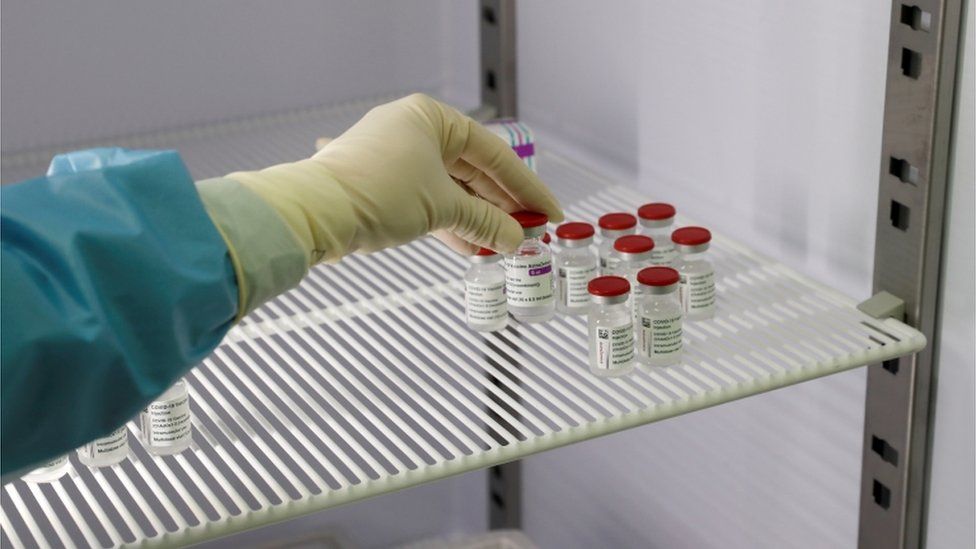
A medical worker in Italy holds a vial of the Oxford-AstraZeneca vaccineimage copyrightReuters

The Italian government has blocked the export of an Oxford-AstraZeneca vaccine shipment to Australia.

The decision affects 250,000 doses of the vaccine produced at an AstraZeneca facility in Italy.

Italy is the first EU country to use the bloc’s new regulations allowing exports to be stopped if the company providing the vaccines has failed to meet its obligations to the EU.

Australia said losing “one shipment” would not badly affect its rollout.

But it has asked the European Commission, which reportedly backs Italy’s move, to review the decision.

AstraZeneca is on track to provide only 40% of the agreed supply to member states in the first three months of the year. It has cited production problems for the shortfall.

In January, then Italian Prime Minister Giuseppe Conte described delays in vaccine supplies by both AstraZeneca and Pfizer as “unacceptable” and accused the companies of violating their contracts.

The EU has been widely criticised for the slow pace of its vaccination programme.

Under the EU vaccine scheme, which was established in June last year, the bloc has negotiated the purchase of vaccines on behalf of member states.

There has been no official comment on the Italian move by the EU or AstraZeneca.

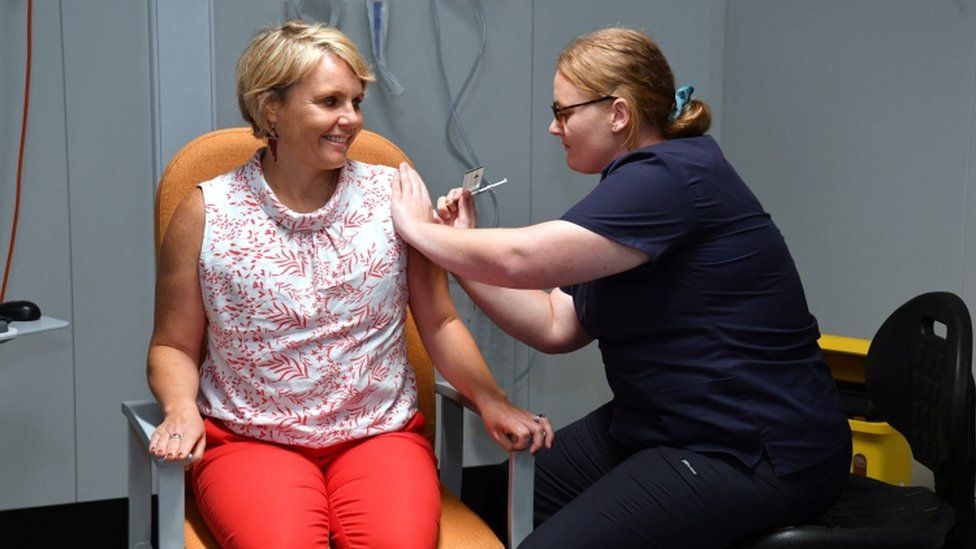
Australian Labor MP Peta Murphy gets vaccinated - 23 Februaryimage copyrightEPA
image captionVaccinations began in Australia last week using the Pfizer jab

Australia began its vaccination programme last week using the Pfizer/BioNTech vaccine. It was due to start inoculations with the AstraZeneca jab on Friday.

What does Italy say?

The Italian government approached the European Commission last week to say that it was its intention to block the shipment.

In a statement on Thursday, the foreign ministry explained the move, saying it had received the request for authorisation on 24 February.

It said that previous requests had been given the green light as they included limited numbers of samples for scientific research, but the latest one – being much larger, for more than 250,000 doses – was rejected.

It explained the move by saying that Australia was not on a list of “vulnerable” countries, that there was a permanent shortage of vaccines in the EU and Italy, and that the number of doses was high compared with the amount given to Italy and to the EU as a whole.

What does Australia say?

“Australia has raised the issue with the European Commission through multiple channels, and in particular we have asked the European Commission to review this decision,” Health Minister Greg Hunt said.

Australia said it had already received a shipment of 300,000 doses and planned to begin local production next month.

“Domestic production starts with 1 million [doses] per week of deliveries from late March and is on track,” Mr Hunt said.

“This [Italy] shipment was not factored into our distribution plan for coming weeks.”

==============================================

Summary (Guardian (UK)

Paris will not be put under weekend lockdowns, the French prime minister, Jean Castex, announced at his weekly Covid-19 round-up on Thursday evening, reports the Guardian’s Paris correspondent, Kim Willsher.

The news came as a relief to Parisians, who feared they were heading for yet another restriction after the city and surrounding areas became one of more than 20 French departments on high alert following a rise in coronavirus contaminations and deaths. City mayor Anne Hidalgo had vigorously argued against a weekend lockdown, saying it was “inhumane” not to allow residents, many of them living in small flats, to spend time outside.

Nice, in the south of France, and Dunkirk, in the north, remain under weekend lockdown, which has been extended to the department around the Channel port.

The whole of France remains under a daily 6pm to 6am curfew.

Castex also announced a speeding up of France’s much-criticised vaccine rollout with pharmacies being allowed to vaccinate from 15 March. Vaccines will even be administered at weekends, he said, in the hope of getting 30 million French people inoculated by the summer.

However, there is concern that only 40% of France’s health workers have been vaccinated, despite having been eligible for the jab for weeks. French media reported that president Emmanuel Macron had suggested it be made obligatory for health workers, but Castex and the French health minister, Olivier Véran, stopped short of this and urged those in the health sector to get vaccinated to protect “themselves, their families and the people they care for”.

Castex warned another lockdown was “not inevitable” but also not ruled out if the situation worsens.

During a council of ministers meeting on Thursday – the equivalent to a Cabinet meeting in the UK – Macron was reported to have had a dig at the sluggish pace of vaccinations in France that has seen millions of doses still unused, telling ministers: “You’re great, but as long as there are vaccines sitting in fridges, I’m not locking people down again.”

Some people with asthma have been ‘refused’ the Covid-19 vaccine

The main UK story from overnight this morning is that Cyprus will allow British tourists who have been fully vaccinated against Covid-19 into the country without restrictions from 1 May.

Visitors would need to be inoculated with vaccines approved by the European Medicines Agency (EMA) and the second dose of a vaccine should be administered at the latest seven days before travel. Authorities would still reserve the right to carry out random tests on arrivals.

The post Sputnik V Spreading Over Latin America, Brazil Pres: “Stop Whining,” World Stats appeared first on The St Kitts Nevis Observer.

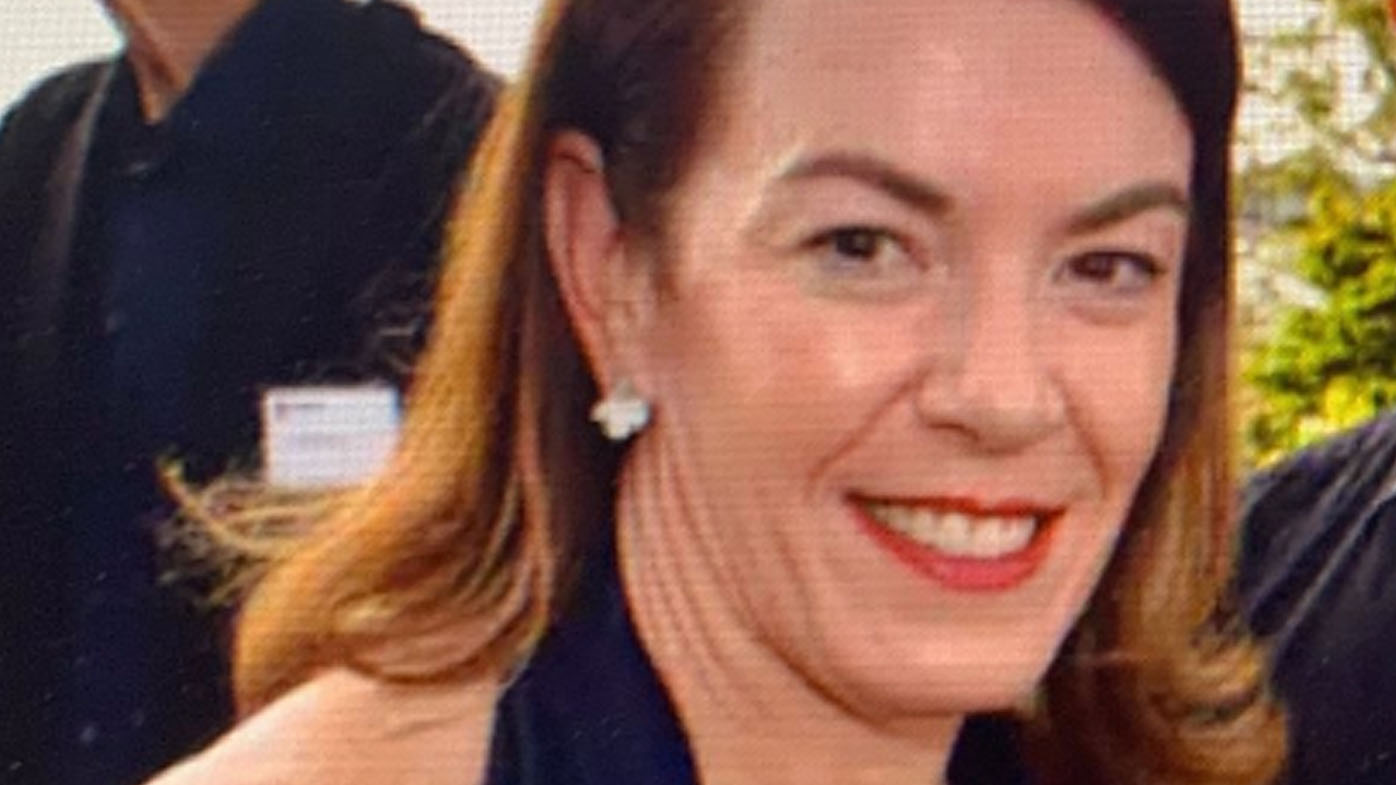
Ocean search for missing woman Melissa Caddick called off

Police have called off the ocean search for missing businesswoman Melissa Caddick.

Divers today searched 6000 square metres of ocean floor at Dover Heights in Sydney, just a few hundred metres from Caddick's home.

Nothing of interest was found.

READ MORE: Police divers search waters near Melissa Caddick's home

An Asics shoe found near Tarthra on the NSW South Coast has been confirmed to contain the 49-year-old's remains, but police say they've been unable to link any other discoveries to the missing businesswoman.

Investigators said they wouldn't be conducting any further searches in the Dover Heights area.

Ms Caddick disappeared on November 12 last year after leaving her home for what her husband believed was a morning run at 5.30am.

She had been under investigation for allegedly running a Ponzi scheme, using millions from investors to make lavish personal purchases.

The Australian Federal Police (AFP) raided her home as part of an ASIC investigation the day before she disappeared.