The slaughter of two goats in a small suburban property sparked a black magic allegation and counter-claims of mischief and religious misunderstandings.A religious scholar said she was “flabbergasted” animal sacrifices were happening…
All posts by FreeNews
Letters: Donald Trump, conservatives, inauguration, vaccine and C F Goldie
No cause to boast Donald Trump is very proud of being the first US president to have not started any new wars in decades. I would suggest that, given his well-known love of a good deal, he is a lot more proud of the arms dealing…
Herald morning quiz: January 22
Test your brains with the Herald’s morning quiz. Be sure to check back on nzherald.co.nz at 3pm for the afternoon quiz. To challenge yourself with more quizzes, CLICK HERE.
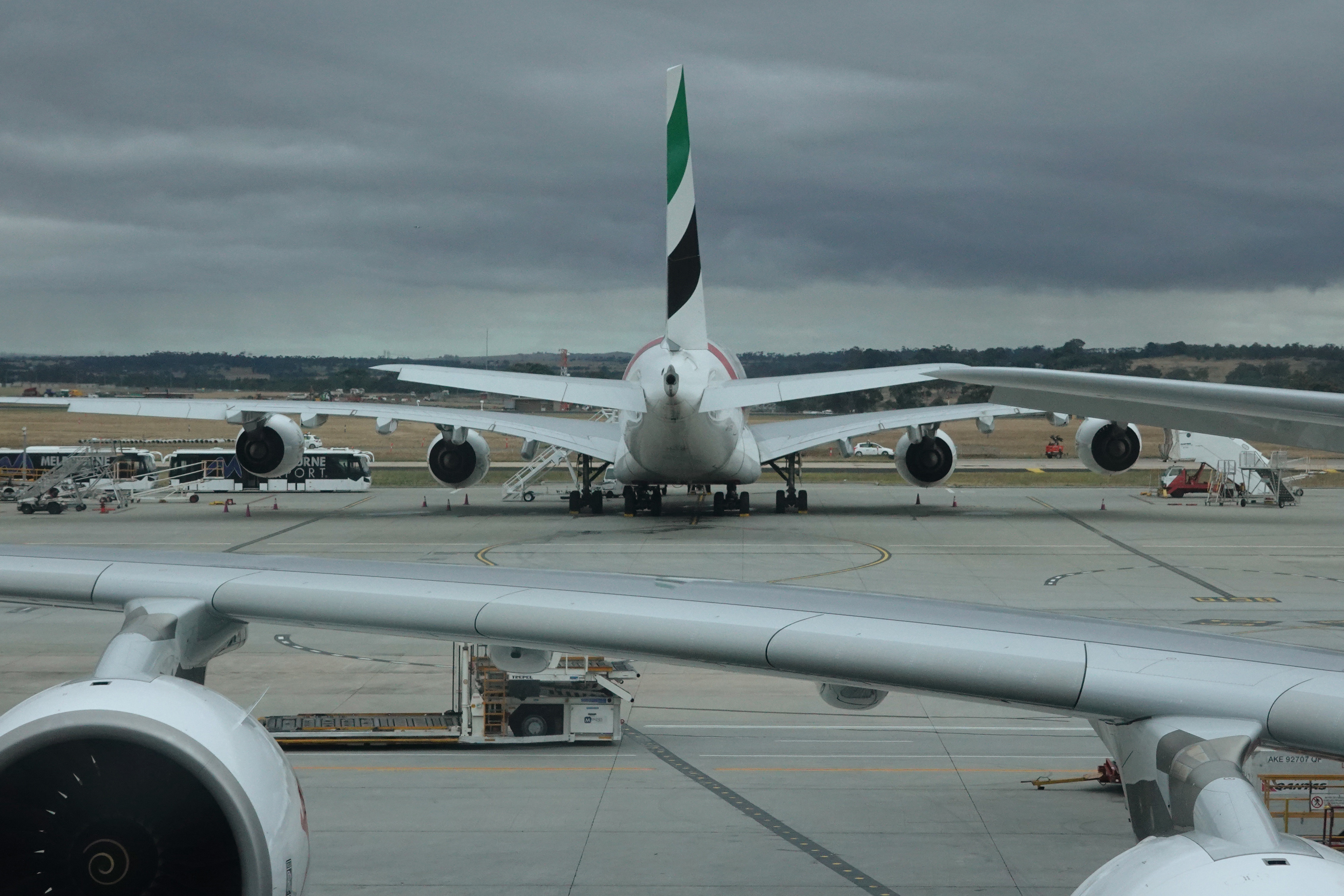
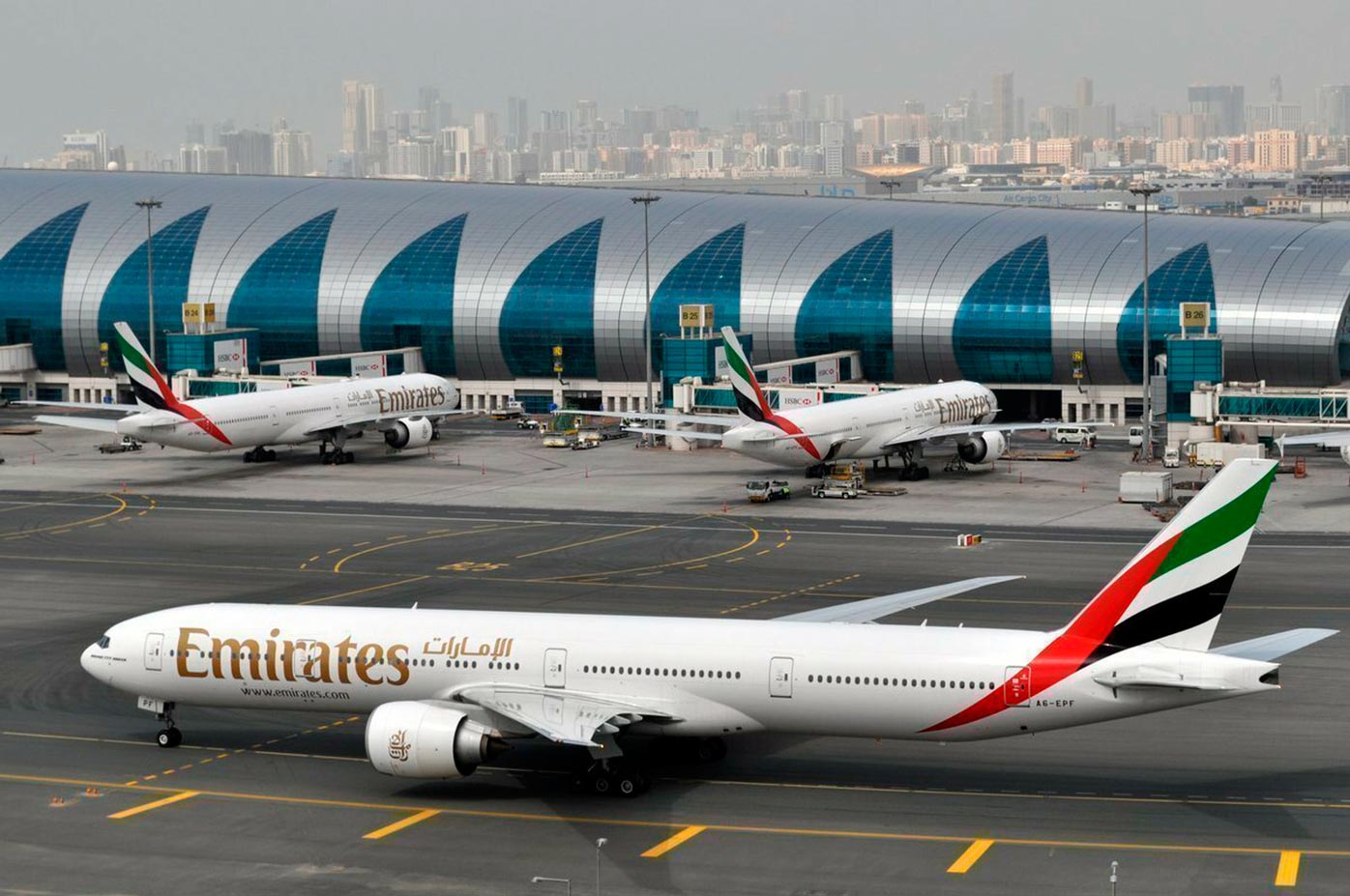
Emirates to resume flights to Brisbane, Sydney, Melbourne
Emirates has announced it will resume a number of flights in and out of Australia, reversing a decision it made only a week earlier.
The Dubai-based airline made a shock announcement on Saturday that it would suspend services "until further notice" to Brisbane, Sydney and Melbourne.
Overnight, Emirates said passenger flights to Sydney would resume from January 25, with Melbourne flights to follow from January 26 and Brisbane flights from January 28. The airline's Perth flights had remained in place, with their twice-a-week services unaffected.
READ MORE: China's new travel restrictions ahead of Luna New Year
While the initial suspension of flights from Australia's east coast only cited "operational reasons", today's announcement shed further light on the matter.
"The pandemic has made international flying incredibly challenging, and the dynamic restrictions and requirements implemented by the different state authorities in Australia had added complexity and burden to our operations," the airline said in a statement.
"This led us to temporarily suspend passenger services while we engaged with various stakeholders regarding crew protocols and other operational details."
The airline also pointed to the government's heightened restrictions coming into effect today.
New mask regulations mean travellers on domestic flights and inside airports will need to wear a mask at all times, while travellers will be required to show a negative COVID-19 test from no more than the 72 hours prior to boarding.
READ MORE: Dire warning on future of tourism industry
International air crews must undergo a COVID-19 test in Australia every seven days, will have their own specialist quarantine location, and are not allowed to move around.
Emirates says the ramped up testing and quarantine situation will be "an added burden for our crew".
"All our crew (cabin crew and pilots) operating on Australian flights were already mandated to take a PCR test 48 hours prior to the scheduled flight departure from Dubai. With the latest adjustments, these tests will be administered in their homes, and our crew will also observe self-quarantine in their homes from the moment of testing until their flight.
"Combined with the hotel quarantine and tests on arrival in Australia, this effectively means that our crew are in a 'bubble' from 48 hours before their flight, until they return to Dubai. This is an added burden for our crew as individuals, for our rostering, and operating costs, and therefore this decision was made after careful review and consideration.
"We are grateful that our wonderful crew teams are very understanding and supportive, which has enabled us to quickly restart passenger services."
The news of the services resuming will be a welcome relief for some of the 38,000 Aussies still stranded overseas, hoping to get home shortly as international arrival caps are almost halved.
Prime Minister Scott Morrison announced the changes to arrival numbers following the most recent National Cabinet meeting earlier this month.
Mr Morrison said there will be reduced caps on international travellers entering Australia. These are as follows:
- NSW – 1505 travellers a week
- Western Australia – 512 travellers a week
- Queensland – 500 travellers a week
- Victoria – no change
- South Australia – no change (currently 490)
These cap numbers are set to be reviewed by February 15.
Federation’s National Report highlighted during UNHRC Review
BASSETERRE, St. Kitts — St. Kitts and Nevis participated in the January 19 virtual session of the Third Universal Periodic Review (UPR) at the 37th Session of the United Nations Human Rights Council (UNHRC), based in Geneva.
Ms. Kaye Bass, Permanent Secretary in the Ministry of Foreign Affairs, head of the delegation, introduced St. Kitts and Nevis’ National Report and highlighted, inter alia, St Kitts and Nevis’ response to Covid19.
In her intervention during the interactive dialogue, Ms. Bass highlighted human rights-related initiatives the government has undertaken within the last four-and-a-half-years on social protection, gender empowerment, education, health, and its fulfilment to obligations under Human Rights Instruments which it has ratified.
At the end of the review, St. Kitts and Nevis received recommendations from 63 UN Member states which will be considered.
“The timely submission and content of our current National Report and our participation in this important review, reiterate St Kitts and Nevis’ commitment not only to this process but to human rights in general,” said Mrs. Bass.
“This is evidenced by St. Kitts and Nevis’s diligent efforts and subsequent success in implementing more than half of the recommendations of its previous review,” she said. “This is a significant achievement for the smallest country in the Western Hemisphere and considering the ongoing exogenous and economic challenges it continues to face.”
This unique UPR process involves a periodic review of the human rights records of all 193 UN Member States. It began in April 2008 to 2011 (First Cycle) followed by another from 2011-2016 (2nd Cycle). At each successive cycle, states are expected to highlight the steps they have taken to implement recommendations supported during their previous reviews, as well as to highlight recent human rights developments in the country.
Other members of the delegation included: Ms. Janelle Lewis, Permanent Secretary in the Ministry of Community Development, Gender Affairs and Social Services; Ms. Asha DeSuza, Second Secretary at the Permanent Mission of St. Kitts and Nevis to the UN; Mr. Sheldon Henry, and Mrs. Natasha Burt, Foreign Service Officers.
The post Federation’s National Report highlighted during UNHRC Review appeared first on The St Kitts Nevis Observer.
In Pictures: How the world's newspapers hailed the new President
Front pages of newspapers across the globe have marked the inauguration of the 46th President Joe Biden and Vice President Kamala Harris with messages of hope and unity as the Trump era comes to an end.
First weekly initial jobless claims of Biden era fall to 900,000
“Millions are exhausting one unemployment program and rolling onto another, underscoring that the coronavirus is still actively damaging large swaths of the economy,” one labor economist said.
Joe Biden redecorates Oval Office for first day on the job
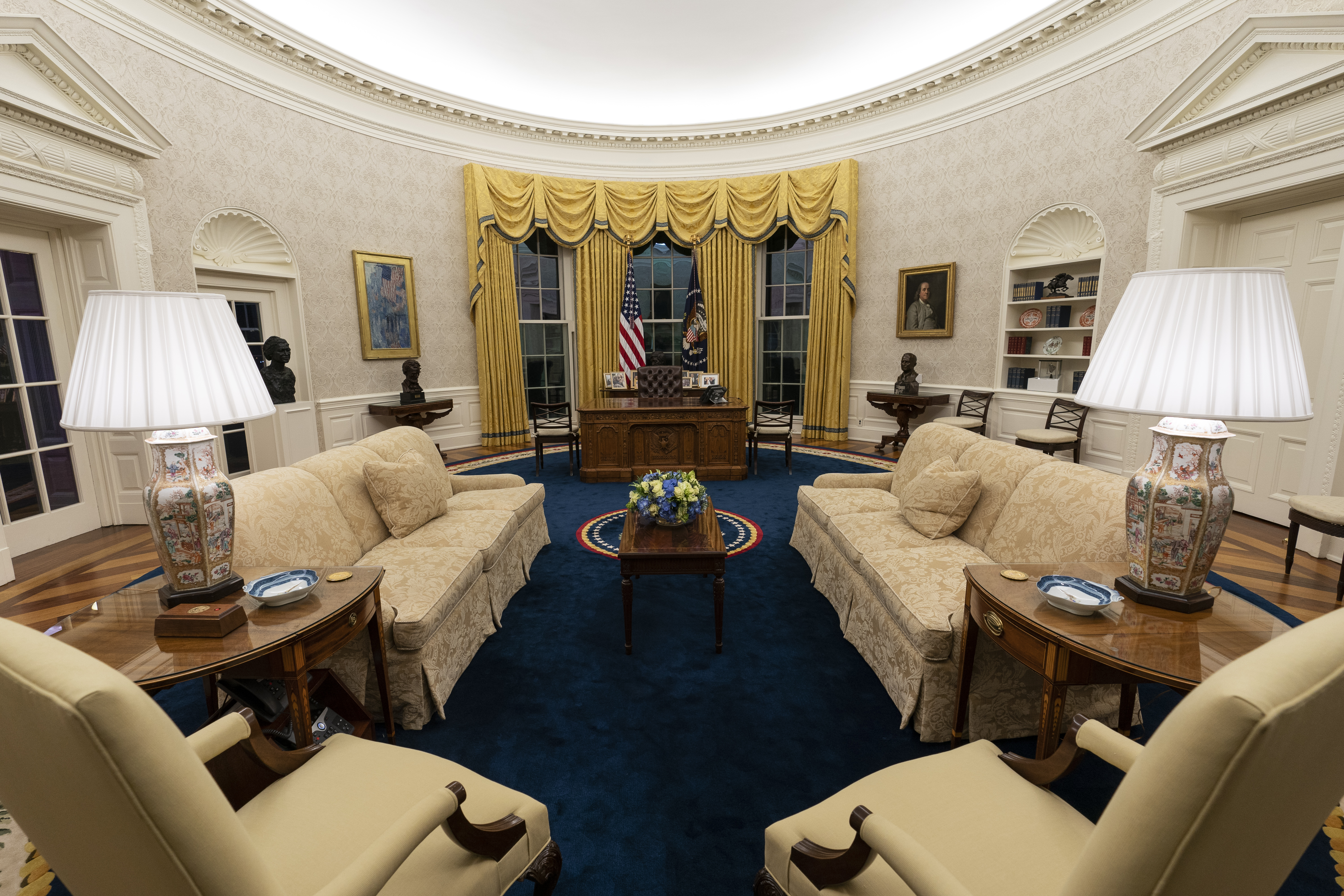
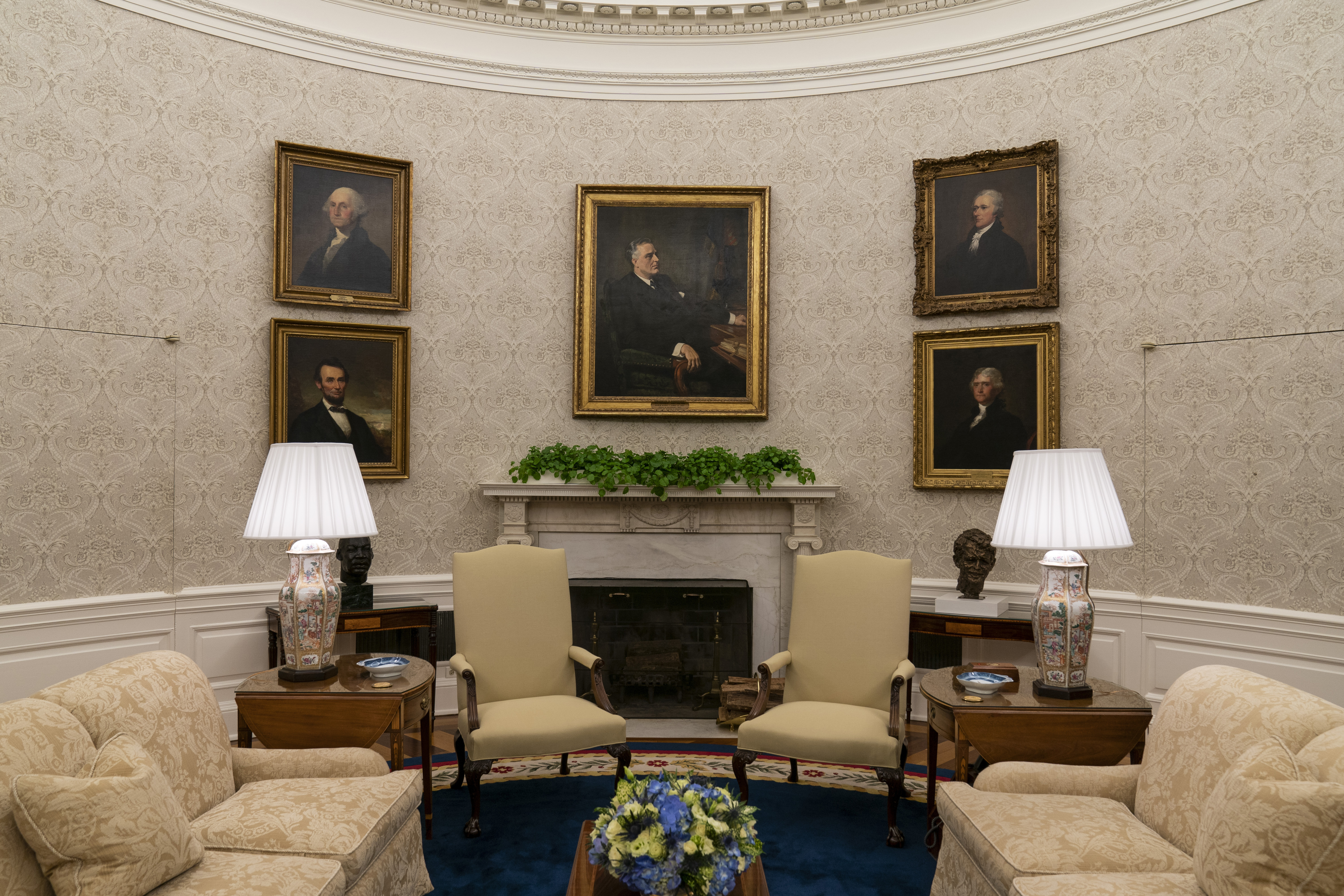
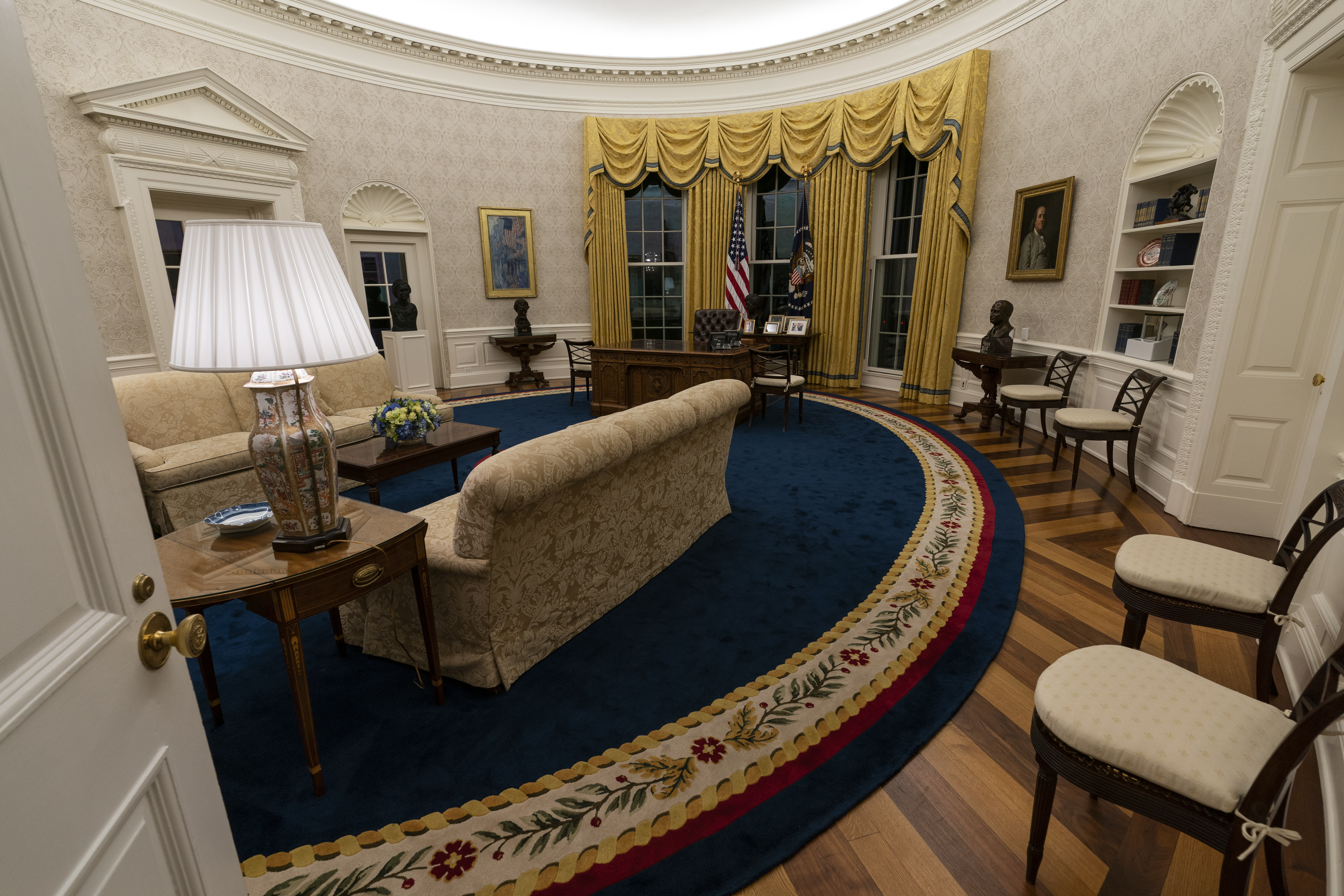
The press has gotten its first glimpse of US President Joe Biden's Oval Office, showing how in a matter of hours the office has visibly transformed in both dramatic and subtle ways to reflect the taste and politics of the officeholder.
Most keep an eye on what's happening inside the office — what agreements are made, what policies are announced and which foreign dignitaries stop by. But with every inch of the space on display, US presidents, their families and their staffs also meticulously choose which pieces of art are installed, what furniture is hauled in, and even which tchotchkes are placed on shelves.
Here's how Biden has chosen to change the Oval Office.
READ MORE: Trump issues one last pardon in 11th hour as president
Artwork
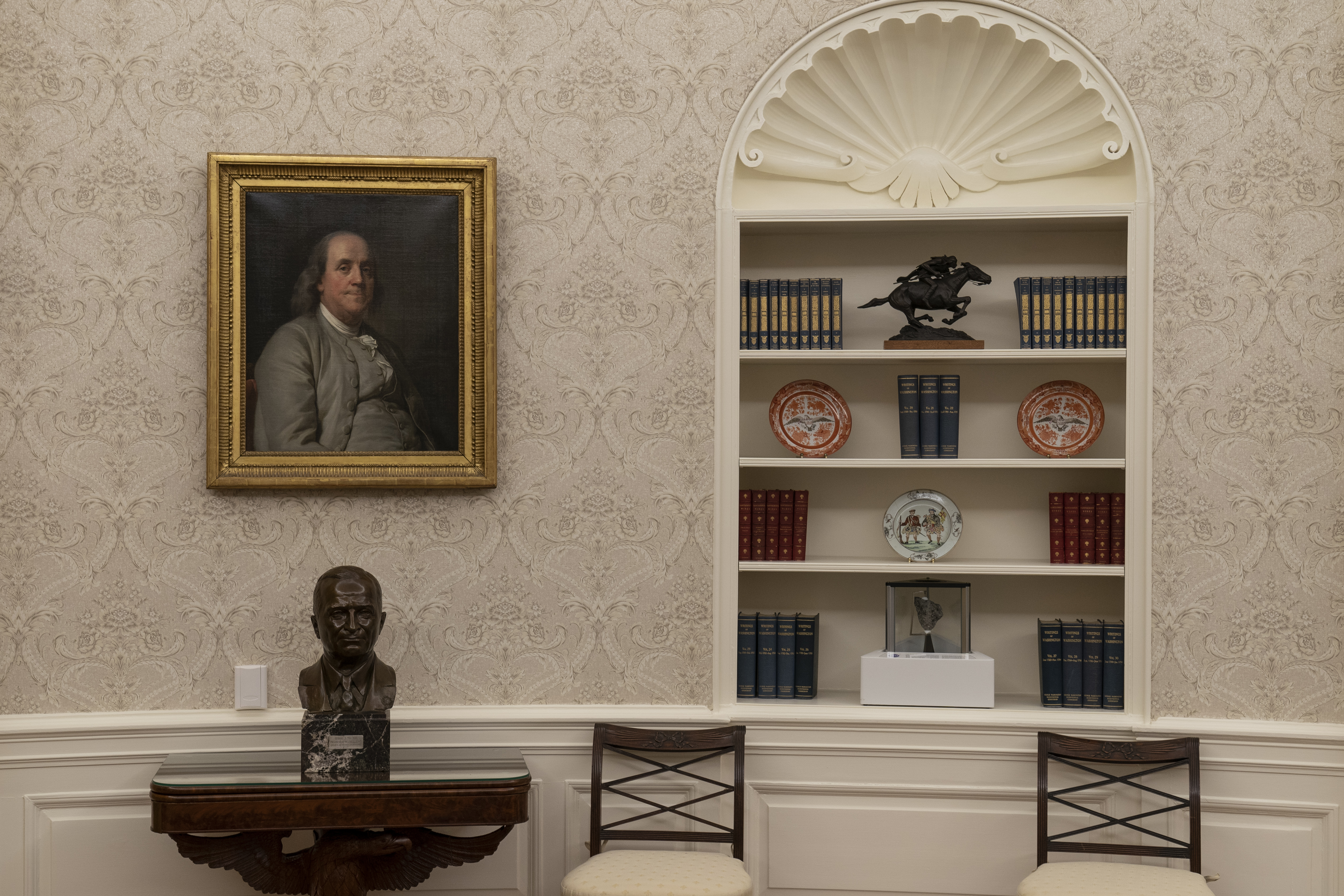
A portrait of Andrew Jackson, to the left of the seat at the Resolute Desk, has been replaced with a portrait of Benjamin Franklin by Joseph Duplessis. Like other works routinely lent to the White House, the portrait appears to be on loan from the Smithsonian Institution's National Gallery of Art.
Trump drew criticism in 2017 after holding an event in the Oval Office honouring Navajo veterans while standing in front of the portrait of Jackson — the President who signed legislation that eventually led to the "Trail of Tears."
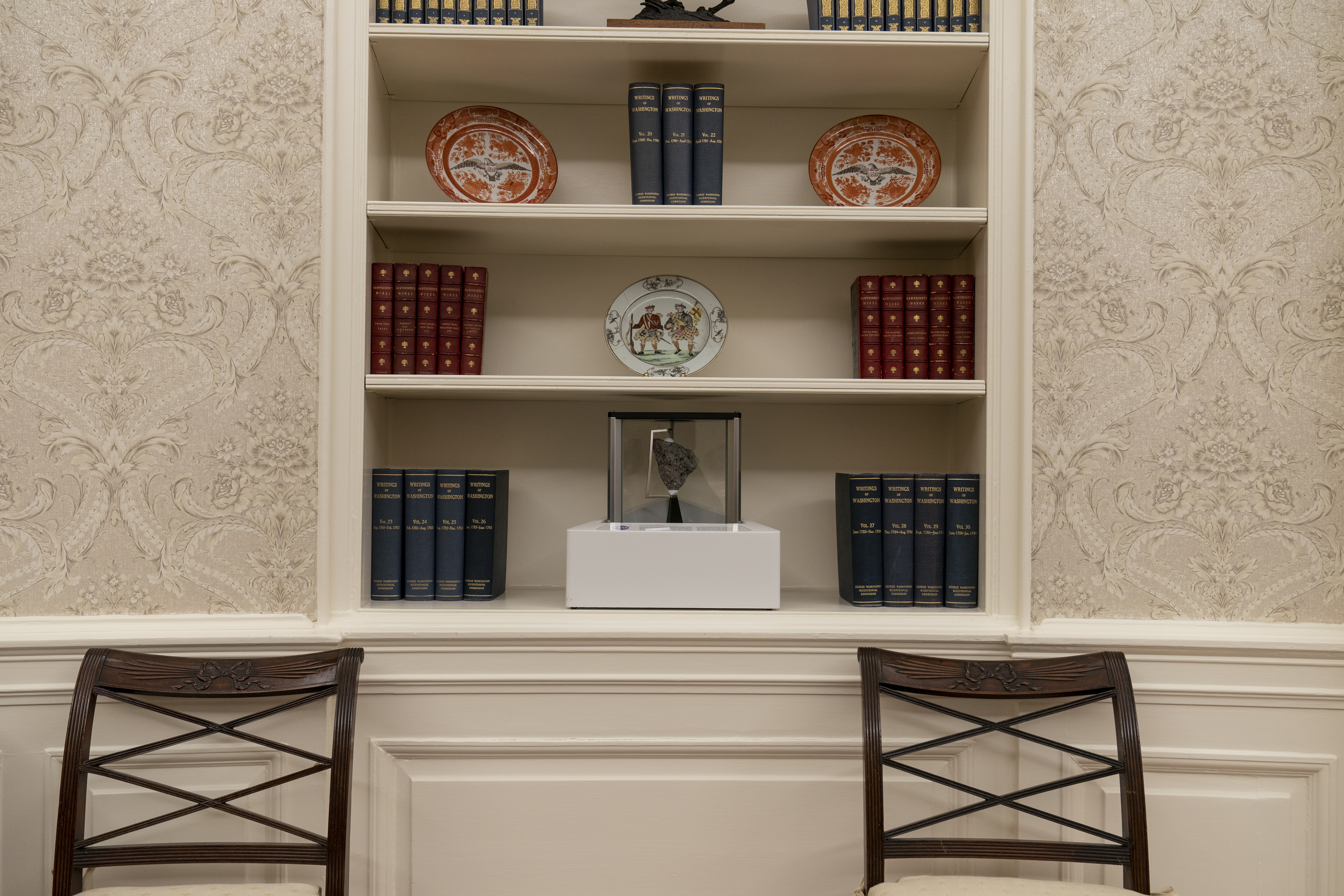
The Washington Post, which got a first look at the Oval's new interior decorations, reported that the Franklin portrait and a nearby moon rock set are meant to represent Biden's interest in science.
MORE: In pictures: How the world's newspapers hailed the new President
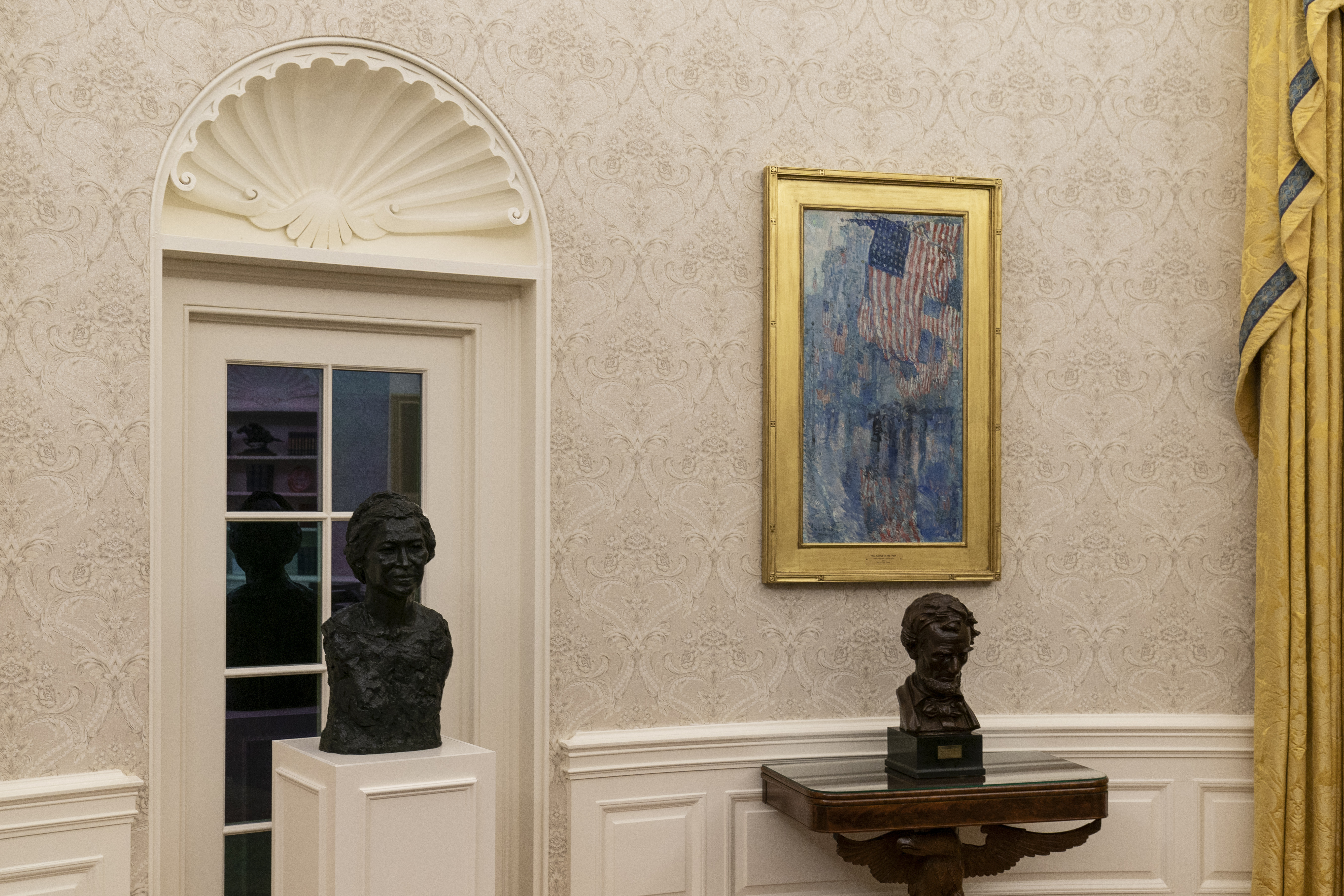
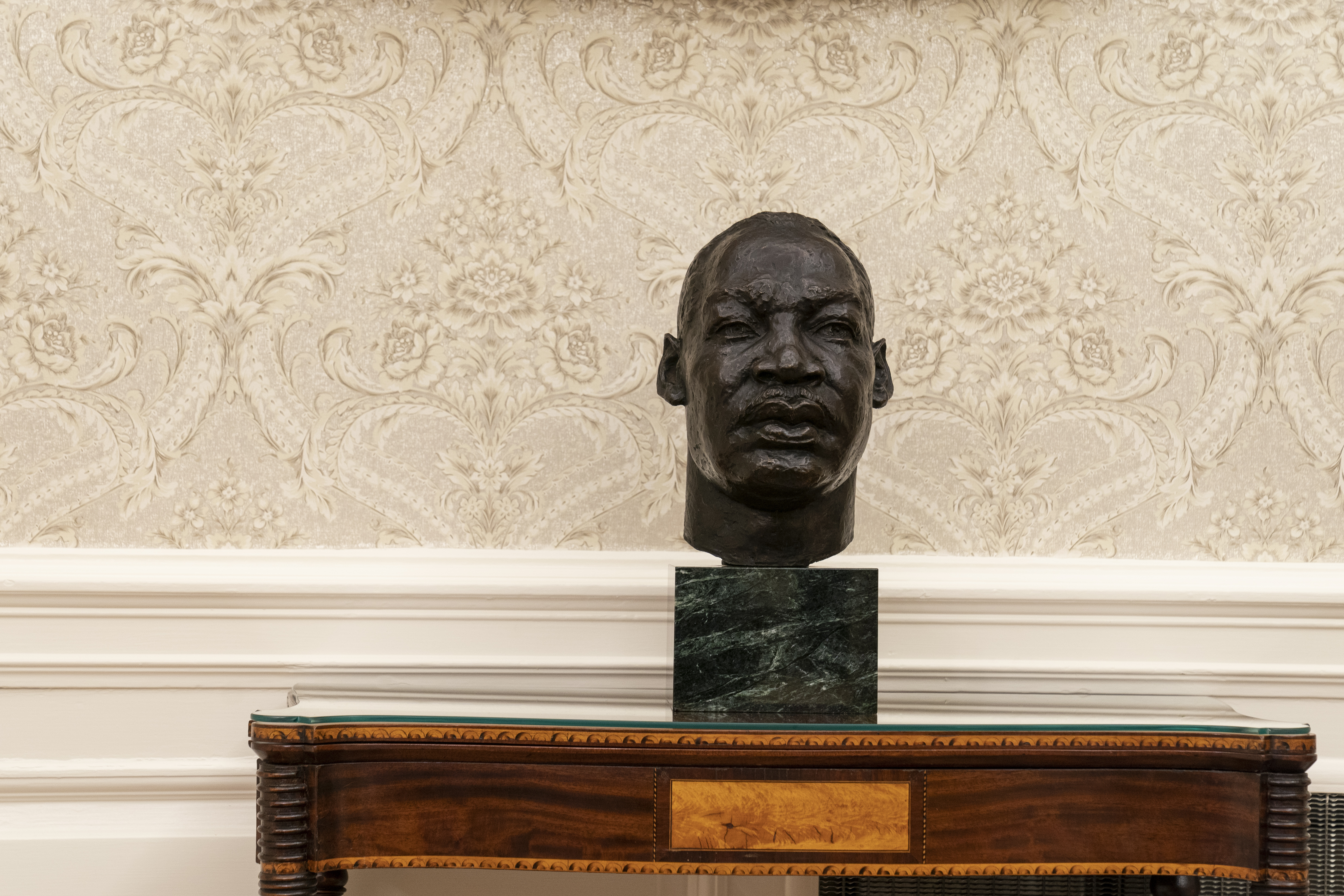
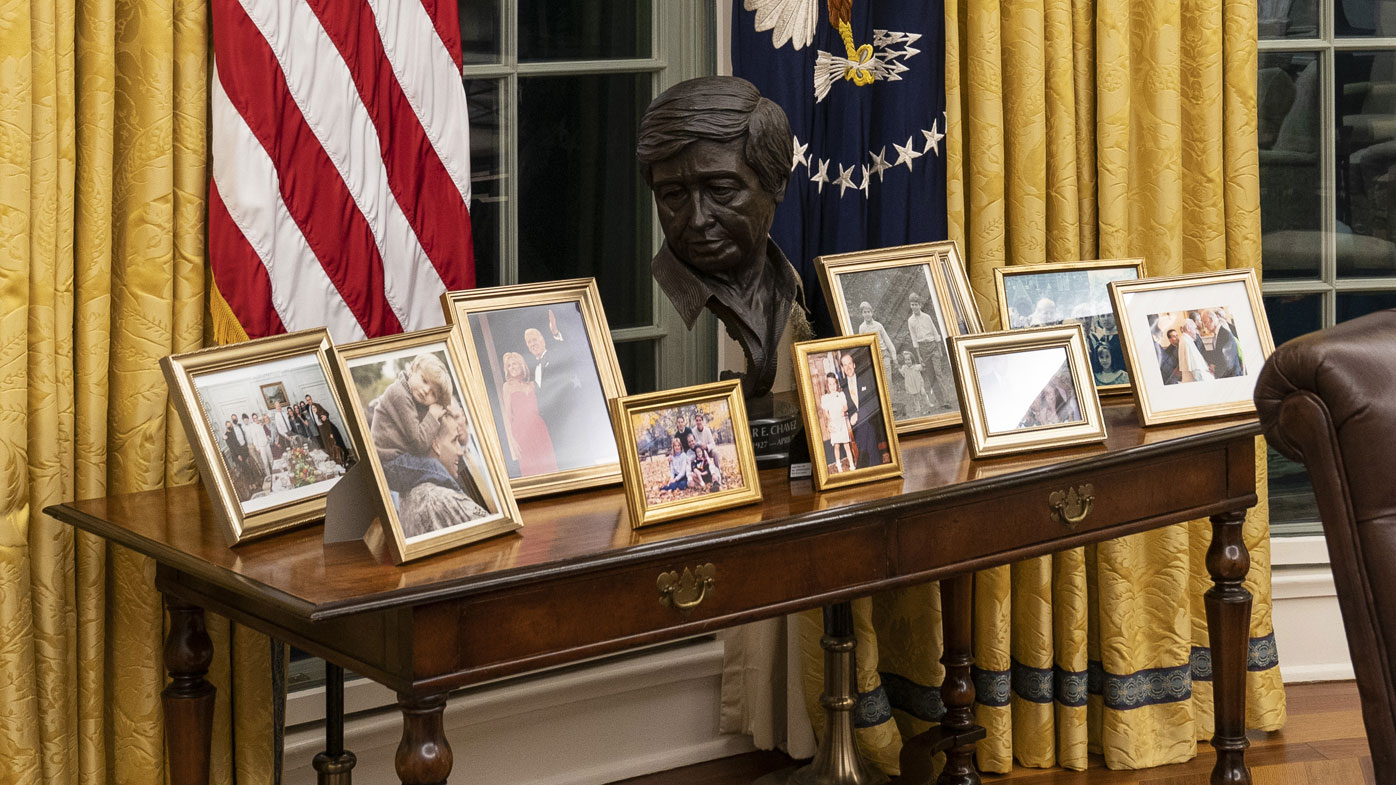
A bronze bust of Latino civil rights leader Cesar Chavez, created by artist Paul Suarez, was also placed on the credenza behind his desk.
Chavez sought to bring awareness to the harsh conditions of farmworkers in the US and fight for better wages. The prominent inclusion of his bust in the West Wing came the same day that Biden proposed immigration legislation that would allow undocumented farmworkers to qualify to apply for green cards immediately.
Julie Chavez Rodriguez, the labor leader's granddaughter, is Biden's director of the White House Office of Intergovernmental Affairs.
Elizabeth Strater, spokeswoman for the United Farm Workers — a labor group Chavez helped found — told the Fresno Bee that the bust was previously on display in the Visitor Centre of the Cesar E. Chavez National Monument in California. Strater told the publication that Biden's transition team worked with the Cesar Chavez Foundation to ship the piece.
Biden also prominently placed the White House collection painting "Avenue in the Rain" to the right of the seat at the Resolute Desk.
The artwork, rife for metaphors, was on display in the Oval under Trump, but switched out during his term.
The oil painting, created in 1917, was also in the Oval Office during the Obama and Clinton administrations.
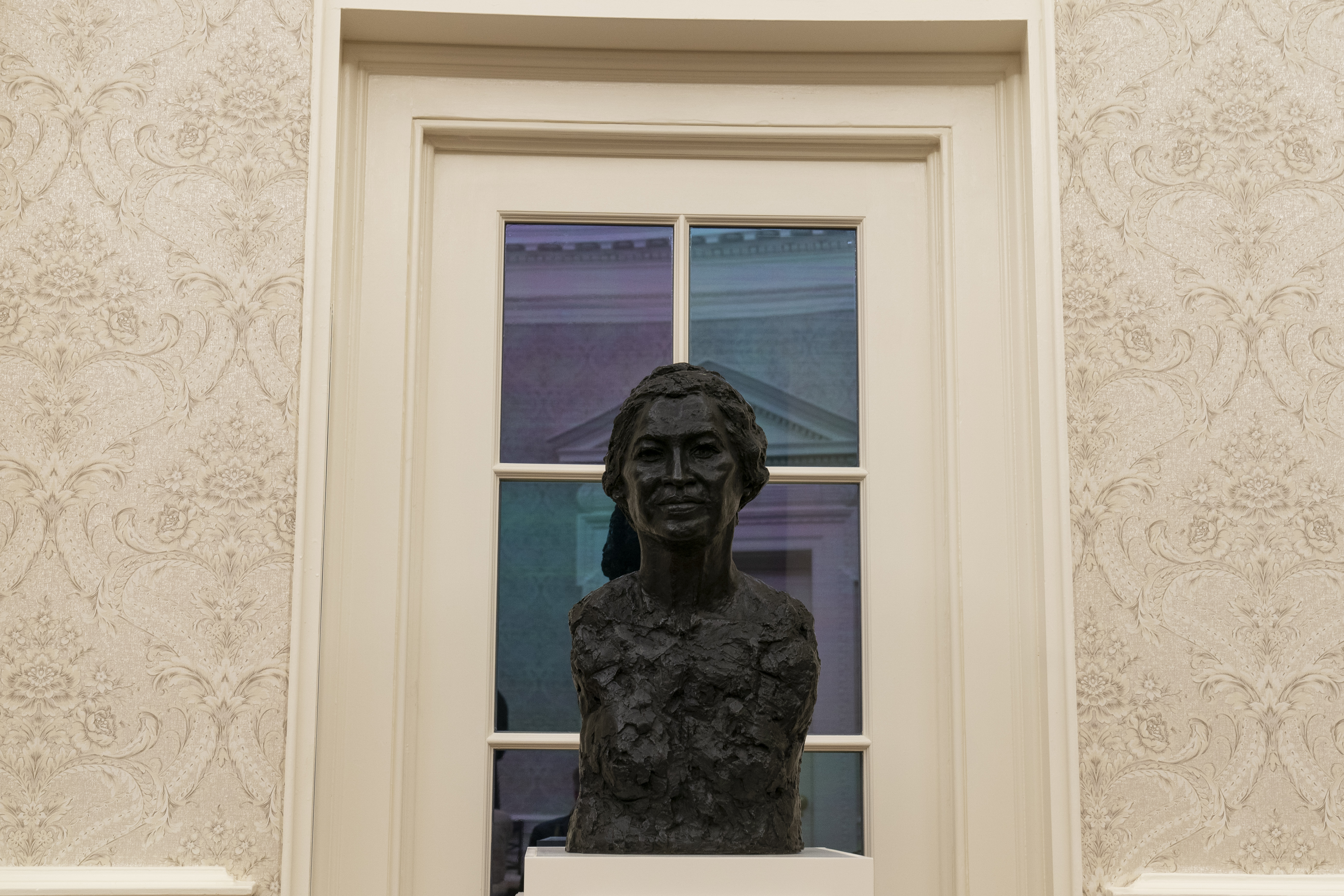
Though not entirely visible to television cameras, the Post reported that "busts of the Rev. Martin Luther King Jr. and Robert F. Kennedy flank a fireplace in the office" — in an apparent nod to their efforts in the civil rights movement. There are also busts of Rosa Parks, Eleanor Roosevelt and an Allan Houser sculpture depicting a horse and Chiricahua Apache rider. The sculpture, the Post said, once belonged to the late Sen. Daniel Inouye, a Democrat representing Hawaii.
The Post report says other parts of the office now feature paintings of George Washington, Abraham Lincoln, Franklin D. Roosevelt, Thomas Jefferson and Alexander Hamilton and a bust of Daniel Webster, a former senator who defended the Union. A bust of Winston Churchill has been removed from display.
On the Resolute Desk
There were two sets of objects spotted on the Resolute Desk when Biden took office that definitely reflect a transition of power: a cup and saucer set, as well as a box of pens to sign the orders.
Trump was a Diet Coke drinker, who reportedly had a button in the Oval to summon someone to bring him soda. He was rarely photographed with a tea or coffee cup at his side.
Trump has also long loved using thick, black markers to sign his name on official government documents — celebrity autograph style. He originally stuck to the traditional pens used by other presidents, but at some point, switched to the Sharpie-style markers, with his golden signature printed onto its barrel.
Interior decorating
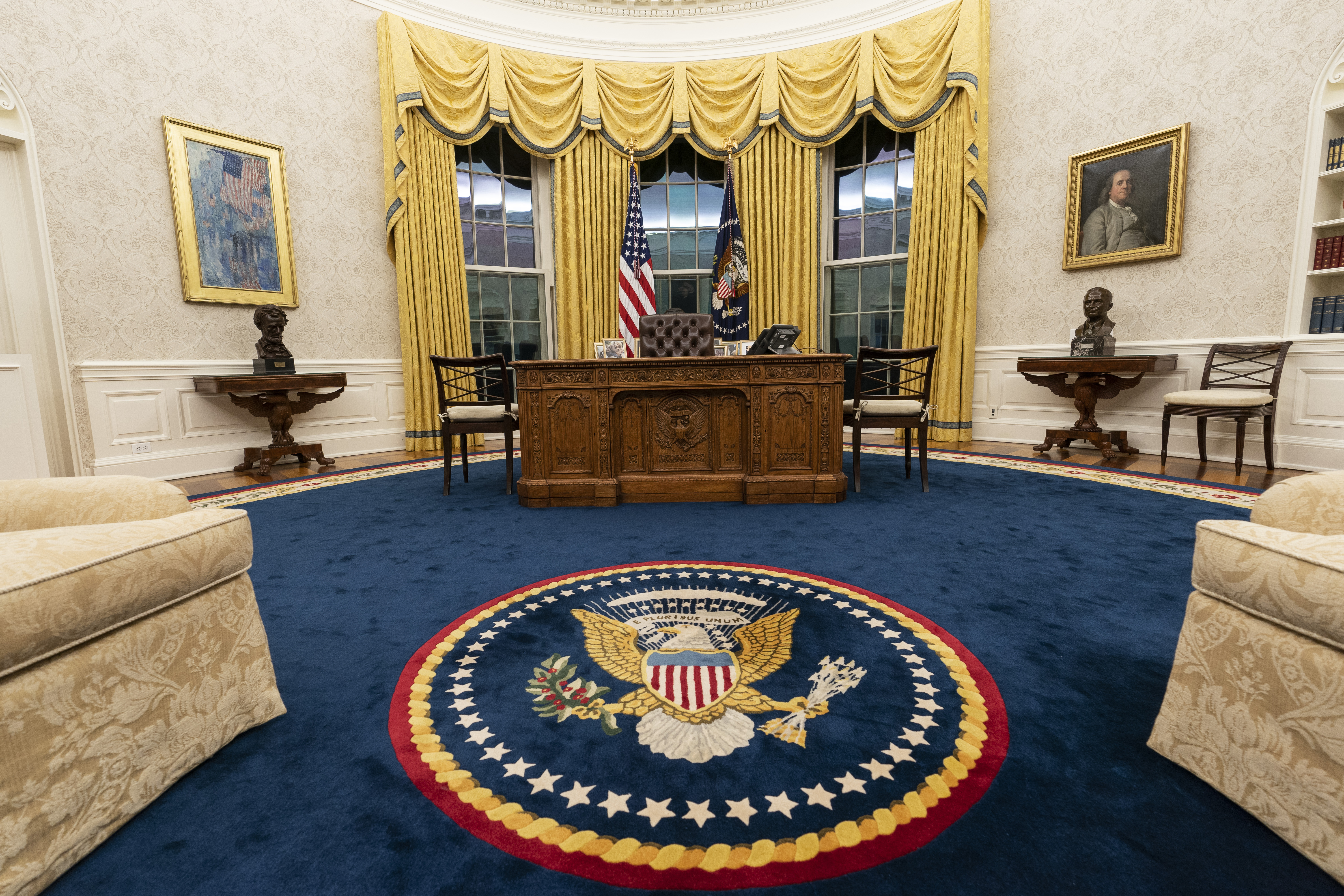
During the executive order signing on Wednesday, Biden was seated in a tufted, dark brown leather chair — a switch from the thick, reddish brown executive seat Trump was last photographed sitting on inside the Oval Office. It was extremely similar, if not identical to the seat Trump used in his private office before becoming president.
The Bidens selected at least two Clinton-era furnishings to replace Trump's selections — a blue Oval Office rug with a floral trim and darker gold curtains, according to the Post. Other items, which may look familiar, were chosen from the White House collection, the Post says.
Subtle changes
Flags of the US military branches, which Trump originally added to the decor of the room, have been removed.
Photographs behind the President typically displayed on the credenza were switched out to feature Biden's family. Many of the images show just how large the President's family is, and the images include many of the family members who accompanied him in Washington on Inauguration Day. At least one photograph features his late son, Beau.
Trump's Challenge Coin collection, often placed on the credenza, is gone as well.
Late Butch Stewart’s Son Takes Over Sandals Resorts
Adam Stewart, the son of late Jamaican tourism pioneer and businessman Gordon ‘Butch’ Stewart, has succeeded his father as executive chairman of Sandals Resorts International.
He assumes the role after working alongside his father for more than two decades, during which time he served as chief executive officer and most recently deputy chairman.
Stewart, who becomes just the second chairman in the company’s 40-year history, said he was committed to honouring his father’s legacy of innovation.
“Some people are dreamers, and some are doers; my dad was the magical combination of both. He was fiercely passionate about offering a product that would exceed expectations, and we are incredibly honoured to continue his pursuit of innovation, raising the bar, and creating landmark moments for our valued guests,” said Stewart.
Sandals Resorts International has plans to extend throughout the Caribbean, including the recent announcement of two new island resort destinations – the future Sandals Curaçao and Beaches Resorts in St. Vincent.
Stewart also assumes Executive Chairmanship of the Jamaica-based ATL Group, one of the largest private-sector groups in the Caribbean.
“My father’s shoes are impossible to fill, but we will follow in his ground-breaking footsteps to continue the important work we all set out to do together. As a company and as a team, we are poised for the future. We are already leading the industry in recovering from the greatest setback in the history of travel. We will continue to lead not just by saying, but by doing. And at the heart of it all, we are solely focused on what we do best: delighting our guests,” he concluded.
Stewart will also continue to serve as President of the Sandals Foundation which he launched in 2009, with a mission to lift communities through education, healthcare, and environmental protection.
He has been recognized by several organizations for his leadership in the travel industry and his substantial contributions to the destinations where Sandals Resorts International operates. In 2016, he was bestowed the national honour of the Order of Distinction, Commander Class by the Government of Jamaica for outstanding contribution to tourism.
CMC
The post Late Butch Stewart’s Son Takes Over Sandals Resorts appeared first on The St Kitts Nevis Observer.
Entire Cuban Population to Get Homegrown Corona Vaccine
Cuba is aiming to vaccinate its population this year with its own vaccine, which would be the first developed in Latin America.
The country claims it can make 100 million doses of Soberana 2, its most advanced vaccine candidate, in 2021.
“If all goes well, this year the entire Cuban population will be vaccinated,” said Dr Vicente Vérez, director of the Finlay Vaccination Institute.
Cuba has got off relatively lightly compared to many of its neighbours so far in the pandemic, with 19,122 cases and 180 deaths confirmed by the government.
This week Soberana 2 moved onto phase two testing, involving 900 volunteers, and if successful will move onto phase III with 150,000 volunteers in March.
Dr Vérez said the aim was to launch a vaccination campaign in the first half of the year, and it could also be offered as an “option” to tourists.
Cuba “was the first candidate in Latin America and the Caribbean to have a vaccine in the clinical phase,” said José Moya, local representative of the World Health Organization (WHO), who is “optimistic”.
The reason for his optimism is that “Cuba has more than 30 years’ experience in producing its own vaccines and almost 80% of the vaccines in the national immunisation programme are produced in the country.
Under a US embargo since 1962, Cuba has often had to find its own remedies.
As early as the 1980s, it relied on biotechnologies, discovering in particular the first vaccine against meningococcus B,” says Nils Graber, a researcher in health anthropology at the University of Lausanne.
“The aim was both to improve the national health system and to be exported,” he added, citing the shipment of Cuban treatments to Latin America, Asia and Africa.
The post Entire Cuban Population to Get Homegrown Corona Vaccine appeared first on The St Kitts Nevis Observer.