All posts by FreeNews

Fire hits building at world's largest vaccine maker in India

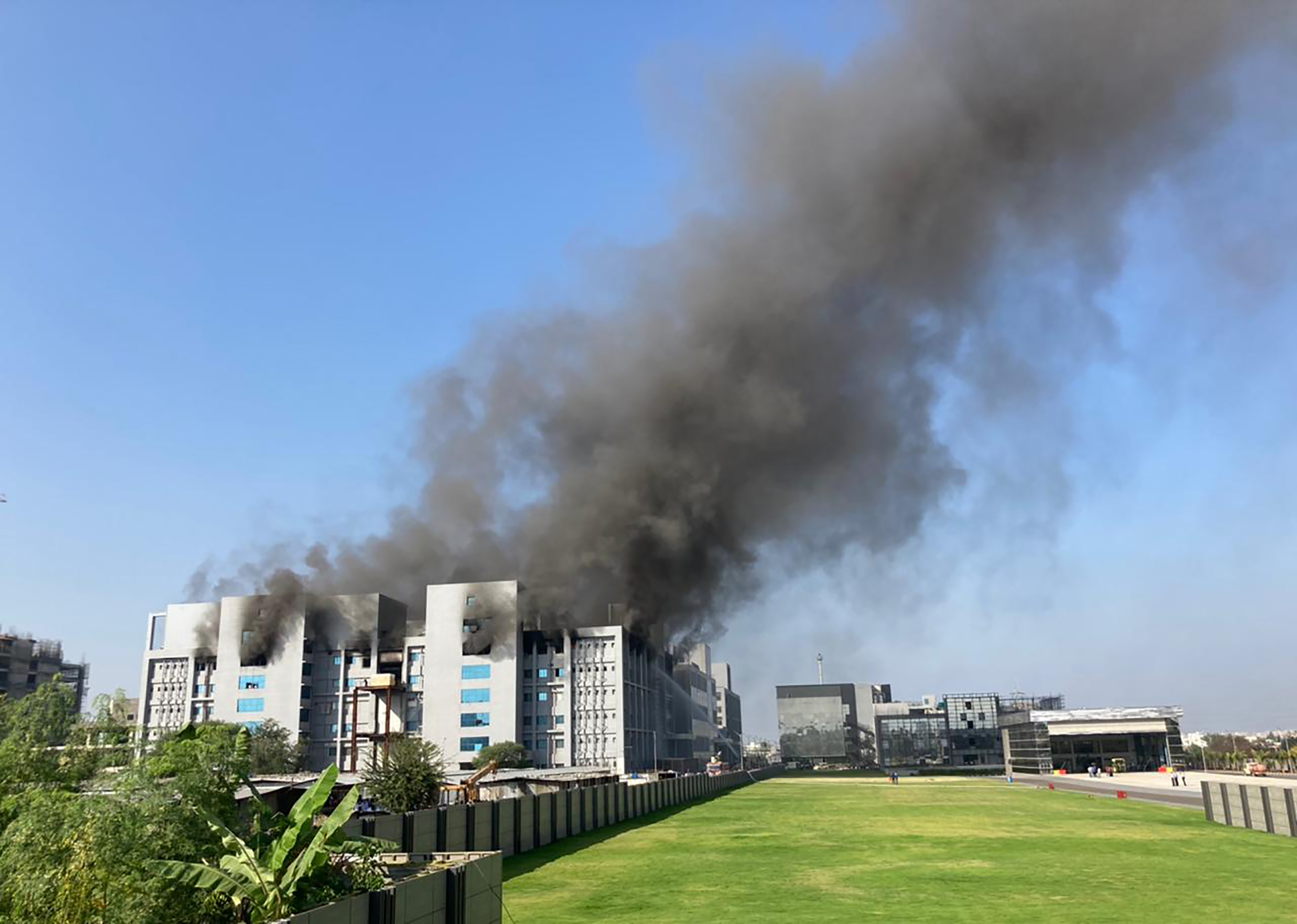
A fire broke out Thursday at a building under construction at Serum Institute of India, the world's largest vaccine manufacturer, possibly affecting its future expansion of COVID-19 vaccine production.

Firefighters were extinguishing the flames, the fire office in Pune city in southern Maharashtra state said. The cause of the fire and extent of damage were not immediately clear.

The company said the fire was restricted to a new facility it is constructing to increase production of COVID-19 vaccines and ensure it is better prepared for future pandemics.

READ MORE: Australia has enough doses to treat population three times

It said the fire did not affect existing facilities making COVID-19 vaccines or a stockpile of around 50 million doses. No injuries were reported, it said.

Images showed huge plumes of smoke billowing from the building as firefighters worked to extinguish the blaze.

Serum Institute of India is the world's largest maker of vaccines and has been contracted to manufacture a billion doses of the AstraZeneca/Oxford University vaccine.

READ MORE: Italy ponders suing Pfizer for COVID-19 vaccine delays

Its CEO, Adar Poonawalla, said in an interview with The Associated Press last month that it hopes to increase production capacity from 1.5 billion doses to 2.5 billion doses per year by the end of 2021. The new facility is key to the expansion.

Of the more than 12 billion coronavirus vaccine doses expected to be produced this year, rich countries have already bought about 9 billion, and many have options to buy even more. As a result, Serum Institute is likely to make most of the vaccines that will be used by developing nations.

US States Slow to Promote Getting Corona Vaccination

By Steve Miller, RealClearInvestigations

HUNTSVILLE, Ala. — On Interstate 59, a neon billboard used by the Alabama Department of Public Health advises motorists to get their flu and pneumonia vaccines. Placards placed atop gas pumps around the state also promote the flu vaccine.

The state of Alabama’s pitch on vaccination … but for the flu, not covid.

But the vaccine that will quell COVID-19, a virus that has killed 400,000 nationwide, crippled businesses and prompted governments to force onerous restrictions the public, gets no mention.

Karen Landers, a spokeswoman for the Alabama Department of Health, said the state has “no specific marketing campaign going on” because “the vaccine supply is less than the demand, here and nationwide.”

Alabama, though, has plenty of medicine and many residents wondering how to get it.  Records show that the state has received 444,000 doses of the vaccine as of Friday, and has vaccinated 100,000 people, using around 23% of its allotted doses.

Across the U.S., 31 million doses of the COVID vaccine have been distributed as of Friday, according to the Centers for Disease Control and Prevention, while states have administered 12 million, around 38%.  The vaccine produced by pharma giants Moderna and Pfizer are two-dose treatments that provide up to 95% protection.

The failure of Alabama and other states around the country to launch vaccine advertising campaigns – touting the medicine’s efficacy and informing people how and where they can receive it – is creating potentially life-threatening confusion.

President-elect Joe Biden has pledged to spend more money on vaccinations, allocating $400 billion in a plan that includes using local pharmacies (a feature borrowed from the Trump administration) and mass vaccination centers.  Biden said the push will include a public awareness campaign aimed at promoting the importance of getting inoculated.

But for now the lack of advertising is striking because local and federal government agencies routinely spend large sums on public health campaigns – including warning people how to behave in response to COVID-19.

The Obama administration spent $684 million driving awareness of the Affordable Care Act starting in 2013, although it was dogged by the rollout of a federal web portal widely viewed as disastrous. The pharmaceutical industry spent $9.5 billion on digital advertising alone in 2020, according to researcher eMarketer.

Hard-to-Reach Audiences

One of the challenges of the covid vaccine, as with Obamacare, is connecting with people who are hard to reach, including those without Internet service or who aren’t avid news followers.

Yet while the vaccine is in the early stages of distribution, information on what it does and how to get it can only be found at the websites of state and county health departments.

By contrast, when the virus emerged last spring, local governments quickly took to the airwaves with ads urging people to “stay home, stay safe,” collectively spending millions of dollars on multi-platform announcements, including government-produced signage distributed to businesses notifying  patrons that masks were required for entry.

A lucky recipient at the Louisville, Ky., Walgreens that found itself sitting on vaccine ready to expire. A lack of information about vaccine availability is contributing to supply and demand mismatches.

The lack of comparable information about the vaccine is contributing to supply and demand mismatches.

When a Walgreens in Louisville, Ky., found itself sitting on vaccine ready to expire, it made a public announcement that anyone could get the vaccine. The store was subsequently overwhelmed.

For that last-minute move, the store was criticized by Democratic Gov. Andy Beshear, who said the vaccine needed to be held for people who deserve it in accordance with CDC guidelines.

In Michigan, under some of the most onerous shutdowns in the U.S. ordered by Democratic Gov. Gretchen Whitmer, the lack of an information campaign has confused the public.

“No one here even knows that there is a vaccine available,” said Joel Fragomeni, a Detroit-based comedian who volunteered for AstraZeneca’s clinical trial of its COVID vaccine, which is expected to be approved in the spring. “People are still mostly locked down waiting for the weekly cases report to see what can be opened and closed.”

States were presented in October with a 57-page guide to prepare distribute the vaccine, including two pages devoted to how to drive awareness among the public.

Among the suggestions: “Keep the public, public health partners, and healthcare providers well-informed about COVID-19 vaccine(s) development, recommendations, and public health’s efforts.”

It is not clear why the states or the federal government have been slow to advertise availability. Some experts say the unprecedented speed with which the medicine was developed may have caught authorities unprepared as they were preoccupied with other aspects of the pandemic.

In addition, broad confusion over who should get the first available doses has made messaging difficult.

Scant Spending on Vaccine Awareness

In Illinois, Gov. J.B. Pritzker’s office in August signed off on a $5 million ad campaign to promote masking. But the governor’s website homepage makes no mention of the vaccine, listing only new positive case rates.  The state is sitting on 43% of the 1 million vaccine doses it has received and has yet to spend anything on vaccine awareness.

New York City in April launched a $10 million campaign advising residents how to behave as the virus spread. The state launched an additional campaign in July urging residents to wear masks.

New York has used less than half the vaccine it has been given, as people seek information on how and where to sign up to receive a dose.

Dearth of public information: Waiting in vain for vaccine this week in Paterson, N.J.

California spent millions on billboards, social media and broadcast spots in July telling people to wear masks and keep away from each other, promoting the campaign in a press release on Gov. Gavin Newsom’s home page.

Newsom’s office last issued a statement on the vaccine in late December, noting that California would partner with CVS and Walgreens to inoculate residents of long-term care facilities. Since then, information has been so scarce that residents have begun to crowdsource details.

The Ad Council and the CDC continue to run 60-second announcements on CNN’s Headline News urging people to stay home, avoid businesses like restaurants and bars and distance from each other.

National television spots urging viewers to get a vaccine for shingles – which kills roughly 100 people a year — are in full rotation in places like the Weather Channel.

The Ad Council, a consortium of private firms started during World War II that produces ads for the public good, has co-produced ads since the beginning of the pandemic advising people to stay home, keep away from each other and wear masks. In November it promised a $50 million campaign to drive awareness of the vaccine.

Last week, the council announced it had not yet met that goal, although it promised a campaign was forthcoming.

In an email, Ad Council spokesman Ben Dorf said that “even while many Americans have already started the vaccination process – we recognize that there is currently a lack of confidence and credible resources for people to go to, leading to mass hesitation, fear, misinformation and complacency.”

Polls contend many Americans are reluctant to take a vaccine, with the perhaps most politically opportunistic naysayer being Vice President-elect Kamala Harris, who in October said she wouldn’t take it if President Trump were telling her to. She was vaccinated in December.

Dorf promised advertising in the future, although he specified no time.

“This is the biggest issue of our lifetime and it requires an effort like never before, in terms of size, scale, speed and urgency,” he wrote.

Emails to the CDC were referred to the U.S. Department of Health & Human Services, which did not respond.

Pfizer, Moderna, Walgreens and CVS did not respond to calls and emails requesting information on marketing plans for the vaccine.

Comment

Show comments

You must be logged in to comment.

Register

The post US States Slow to Promote Getting Corona Vaccination appeared first on The St Kitts Nevis Observer.
Singer Robbie Williams Gets COVID Holidaying at St. Barts

“He’s confined to the villa where he is staying with his family. He will have to remain in quarantine for up to 14 days.”

Robbie Williams has contracted Covid-19 while on holiday in the Caribbean. The English singer has been on holiday in St. Bart’s since December with his wife and kids. He reportedly contracted the virus while over there and is currently in quarantine.

The ‘Angels’ singer has apparently had a rough dose of Covid with one source close to the Robbie saying he’s “been fairly sick” with it. There’s no word on how he got the virus or if any of his family have it too.

The source told The Sun: “He’s confined to the villa where he is staying with his family. He will have to remain in quarantine for up to 14 days.”

This is Robbie’s second Covid-19 scare. Last year he thought he may have had the virus when he returned back to LA from Australia.

The 46 year old self-isolated from his family at the time, “when I landed back in LA it was unusually cloudy and grey, and what with everything going on it did feel very apocalyptic,” he said.

“I was in quarantine in an Airbnb down the road from my family and started worrying about food, about my medication running out, about Beau and my family, and was just very fearful for a couple of days.”

He was reunited with his family after he was sure he was clear from Covid-19. His wife, Ayda, shared the video at the time which showed the kids running up to their dad with excitement.

Robbie has been pretty quiet on social media lately so no word on how he’s feeling, but we wish him a speedy recovery.

The post Singer Robbie Williams Gets COVID Holidaying at St. Barts appeared first on The St Kitts Nevis Observer.

COVID Latest: UK with Daily Record 1,820 Deaths, US-415,800 Total Deaths as Biden Acts

Prime Minister Boris Johnson has warned “there will be more to come” as the UK recorded its highest number of coronavirus deaths in a single day, 1,820.

The number of new cases rose sharply to 38,905, after a fall earlier in the week which inspired optimism that lockdown restrictions were working, The Guardian reported.

For the second day in a row, the UK recorded the biggest increase in COVID-19 deaths within 28 days of testing positive, up on Tuesday’s high of 1,610. The number of new coronavirus cases within 24 hours dropped to 33,355 on Tuesday.

Prime Minister Boris Johnson said the record daily death toll was “appalling” and warned “there will be more to come”.

The prime minister added, “These figures are appalling, and of course we think of the suffering that each one of those deaths represents to their families and to their friends. I’ve got to tell you … there will be more to come”.

He stated that the new variant was now in virtually all parts of the UK.

“It’s true that it looks as though the rates of infection in the country overall may now be peaking or flattening but they’re not flattening very fast and it’s clear that we must keep a grip on this. We must maintain discipline, formation, keep observing the lockdown,” he noted.

Upon news of the latest death figures, palliative care doctor Rachel Clarke tweeted, “Another 1,820 UK COVID deaths. This figure makes me want to weep, scream, punch a wall, smash furniture. As if the deaths alone weren’t devastating, knowing many were avoidable crushes me. These are mass casualties caused by the failure of government. Heartbreaking.”

The Home Secretary, Priti Patel, was asked on Good Morning Britain about why the UK had the worst death rate in the world from coronavirus. She replied that it “has to be put into context” and she did not think there was one simple “factor or cause as to why so many people have died in the UK”.

Separate figures published by the UK’s statistics agencies for deaths where COVID-19 has been mentioned on the death certificate, together with additional data on deaths that have occurred in recent days, show there have been 110,000 deaths involving COVID-19 in the UK.

Government data up to January 19 shows that of the 5,070,365 vaccinations that have been given in the UK so far, 4,609,740 were first doses – a rise of 343,163 on the previous day’s figures – while 460,625 were second doses, an increase of 3,759 on figures released the previous day.

The seven-day rolling average of first doses given in the UK is now 281,490. Based on the latest figures, an average of 399,625 first doses of vaccine would be needed each day in order to meet the government’s target of 15mln first doses by February 15.

As few as 20% of staff in some care homes have received a coronavirus vaccine, the NHS national clinical director for older people has announced.

Dr. Adrian Hayter noted those involved in the vaccination programme must do “better and more” to ensure care home staff got a jab as soon as possible.

While some care homes have seen 70-80% of their staff vaccinated, which he called “fantastic”, others have rates as low as 20%. Overall 45% of care home staff had received a jab, he continued.

Hayter acknowledged there had been delays and that some care homes had found the process difficult.

The latest figures bring the total number of cases in the UK to 3,505,754.

====================================================

President Biden to use the Defense Production Act in COVID Fight

President Biden will issue an executive order Thursday directing agencies to use the Defense Production Act (DPA) and other powers to speed up the manufacturing of testing and vaccine supplies and other items needed to fight COVID-19.

Biden administration officials signaled they would be more aggressive than the previous administration in invoking the DPA, which allows the federal government to force companies to increase production of critical supplies during national emergencies.

“Where we can produce more, we will. Where we need to use the Defense Production Act to help more be made, we’ll do that too,” said Tim Manning, Biden’s COVID-19 supply coordinator, in a call with reporters Wednesday.

Manning said his team has identified 12 immediate supply shortfalls, including for n95 masks, isolation gowns, gloves and swabs needed for tests.

The administration will also use the DPA to accelerate production of syringes, raw materials used in vaccines, and other items needed to quickly get shots in arms, officials said.

“The team will work with the states and the manufacturers to ensure that we’re using the DPA as aggressively as needed to accelerate the supply of the vaccine,” said Bechara Choucair, Biden’s COVID-19 vaccine coordinator.

While the Trump administration used the DPA to increase the supply of ventilators, masks and other supplies, critics argued he was not being aggressive enough to close shortages.

=====================================================

Coronavirus Cases:

97,381,947

Deaths:

2,085,494

Recovered:

69,943,019
Highlighted in green
= all cases have recovered from the infection
Highlighted in grey
= all cases have had an outcome (there are no active cases)

[back to top ↑]

Latest News

January 21 (GMT)

Updates

  • 7,152 new cases and 419 new deaths in Poland [source]
  • 169 new cases and 1 new death in Oman [source]
  • 21,887 new cases and 612 new deaths in Russia [source]
  • 20,548 new cases and 1,539 new deaths in Mexico [source]


The post COVID Latest: UK with Daily Record 1,820 Deaths, US-415,800 Total Deaths as Biden Acts appeared first on The St Kitts Nevis Observer.

Four-day heatwave will be 'shock to the system'

Parts of Australia are set to endure a four-day heatwave with temperatures set to reach the high 30s and early 40s over the weekend.

Authorities are on high alert as the Australia Day long weekend approaches with people's health at risk in the sweltering temperatures.

NSW Health Acting Director of Environmental Health Aditya Vyas warned there was risk of heat-related illness in coming days and urged people to take extra care.

https://twitter.com/BOM_NSW/status/1352047401717137411?ref_src=twsrc%5Etfw

READ MORE: WA on alert as cyclone develops off the coast

"Hot weather puts a lot of strain on the body, including dehydration, and can make underlying health conditions worse," Dr Vyas said.

"Protect yourself during the heatwave by postponing or rescheduling your outdoor activities.

From tomorrow, a mass of hot air from central Australia will sweep down between now and Australia Day, increasing temperatures for large parts of eastern Australia.

The Bureau of Meteorology's (BOM) Gabrielle Woodhouse said the heat will be "a shock to the system" and will definitely be noticed after a cooler than usual start to summer.

"We haven't really been experiencing this kind of heat, compared to say last summer," Ms Woodhouse said.

"It's going to be a bit of a shock to the system for many people, so it is quite significant because we haven't been seeing these temperatures recently."

Ms Woodhouse said the risk of fires would be elevated and temperatures would be "eight to 16 degrees above average in some areas".

The intensity and persistence of the impending hot weather will see it classified as a severe heatwave for parts of WA, South Australia, NSW, Victoria, Tasmania and the ACT.

Some places will even endure an extreme heatwave, which is the highest category used by the Bureau of Meteorology.

Extreme heatwaves are considered rare in Australia and anyone living in impacted areas are urged to take precautions to protect themselves to avoid heatstroke.

So how hot and sweaty are things about to get in your part of the country?

South Australia

Adelaide hasn't yet had a 40C day this year but that is likely to change this weekend, with tops forecast of 39C on Saturday and 41C on Sunday.

Temperatures will be several degrees warmer in the north of the state, with areas like Oodnadatta – which recorded Australia's highest ever temperature of 50.7C in January 1960 – heading for at least five straight days of maximums in the low to mid-forties.

https://twitter.com/BOM_SA/status/1351770722746720260

Victoria

Melbourne has had only two days above 30C so far this January, making it a relatively cool start to the year in comparison with 2020.

It will miss the worst of this heatwave, with a top of 38C predicted on Sunday but no other days of very hot weather.

Areas in the north of the state will be much hotter for much longer. Mildura in the state's northwest will likely see three consecutive days of temps of 40C or higher, peaking at 45C on Sunday.

READ MORE: Victoria records zero local cases, just one in hotel quarantine

https://twitter.com/BOM_Vic/status/1351781371715477504

Tasmania

There's nothing too drastic in the forecast for Hobart, with several days in the mid-twenties predicted. But the north and northeast of Tasmania could see much hotter conditions, especially around Monday, with temperatures tipped to reach the low to mid-thirties.

ACT

Canberra is heading for tops of 37C, 38C and 39C on Saturday, Sunday and Monday respectively.

That's still a far cry from January 2020, when Canberra recorded its hottest ever temperature of 44C. But it will be easily the warmest spell to date in a month when the hottest temp has been just 34.4C .

New South Wales

Sydney's west will bear the brunt of the upcoming heatwave with temperatures expected to be significantly hotter inland than on the coast.

The city and eastern parts of the city should reach tops of 30C, 32C and 33C on Saturday, Sunday and Monday respectively.

In the city's west, those tops will be much closer to 40C, and could even reach 41C in Penrith and other outer western suburbs.

READ MORE: NSW to lift restrictions to 'pre-Avalon cluster' conditions

Further west in NSW, a prolonged spell of at least four days of very hot weather can be expected across a wide area of the state, with maximums around or above 40C in many towns.

The far south coast of NSW will also cop some extreme heat, with Bega likely to see 42C on Monday.

Western Australia

This heatwave will largely bypass Perth after a particularly hot January.

The WA capital's hottest weather of the week will be on Thursday and Friday, with tops of 34C and 36C respectively.

Perth's average top temp so far has been 33.9C – nearly three degrees above the long-term average.

The heatwave will, however, touch the state's southeast, with Eucla tipped to reach 42C on Saturday.

Mass killer breaks his silence

At 24 years of age in September 1988, a baby-faced Dennis Rostron had just made the biggest mistake of his life.

In a blind rage at an outstation near Gunbalanya, in a remote part of the Northern Territory, Rostron had shot and killed his two sons, Preston, two, and Zarack, one, his wife Cecily, and her parents, Dick and Dolly Murrumurru.

He's broken his silence after decades behind bars for one of the Northern Territory's worst mass murders on record.

READ MORE: The frightening history of Long Bay jail revealed

After the murders, Rostron fled into the bush and was on the run for 10 days.

He saw his mother and she gave him some food, but after learning of his crimes she walked into the bush and was never seen again.

Rostron had trekked almost 200 kilometres on foot by the time he reached Maningrida where he eventually handed himself in.

He was convicted of all five murders – initially sentenced without the prospect of parole until laws changed in 2003 and his term was later fixed to a non-parole period of 28 years.

At the time, Justice Judith Kelly said she would have given him a longer non-parole period if he wasn't an Aboriginal man, due to the shorter average life expectancy of Indigenous Australians.

TODAY IN HISTORY: Louis XVI of France is executed by guillotine

She also commented on his situation leading up to the horrific mass shooting.

"His marriage was breaking down; he was being treated badly by his wife and in-laws and excluded from the family; and his parental right to his two children was being challenged."

New chance at life

In 2019, Rostron was given a second chance at life after convincing an eight-member parole panel he had changed.

"When I first got out at the airport and all the family – all the tribe was there, you know, to welcome me back home, yeah, give me a big hug at the airport. That was very happy," Rostron told 9News.

After more than three decades behind bars, the world wasn't as Rostron knew it.

"I lost all my brothers and my aunty – all that. They all gone. I'm the only person left," the now-57-year-old said.

In prison, he learned to read and write, and taught other inmates how to paint – a talent he had in 1988 and is still with him today.

Rostron sells his artwork right across the Territory – a passion that kept him occupied during the darkest days.

He said he saw "a lot of people" take their lives in prison.

"When I was in jail, I was fighting all my life, you know, to be with family."

He said he often thought about how old his sons would have been when seeing other families visiting fellow inmates.

"I done my time for what I done wrong," Rostron said.

Now, he lives in an outstation near Maningrida with his extended family.

A family relation who refers to him as "grandpa" said they all felt extremely happy when Dennis came home.

"He's happy everyday. He's happy (being) with us families and he lives with us," Tara Rostron said.

"Sometimes we take him out fishing just down the beach."

He's now employed doing "activity work" and has fallen in love with a woman also artistically minded.

"They're both going well and they're both happy," Tara said.

Rostron is now trying to put his unforgettable past behind him – one that is forever etched in Territory history.

"Some people maybe think I'm dangerous," he said.

"I'm a good person. I'm a cultural person and I'm not dangerous."

Readers seeking support can contact Lifeline on 13 11 14 or beyond blue on 1300 22 4636.

Suicide Call Back Service: 1300 659 467.

MensLine Australia: 1300 78 99 78.

Multicultural Mental Health Australia: www.mmha.org.au.

National Domestic Violence Service: 1800 RESPECT (1800 737 732). If you are in immediate danger call triple zero (000).