Category Archives: headline

“You Can Count On Us All” – 2021 CSS Graduating Class Valedictorian Jahkéla Barrett Tells Nevis

NIA CHARLESTOWN NEVIS– Jahkéla Barrett, Valedictorian of the Charlestown Secondary School (CSS) Graduating Class of 2021, says the 103 graduands have emerged a formidable and reliable group.

Ms. Barrett‘s comment came while delivering the valedictory speech at the graduation ceremony at the Nevis Cultural Village on March 02, 2022. The theme was “Adapt to Succeed.”

“The Charlestown Secondary School Class of 2021 would like to assure you that the future of Nevis is in good hands.

“We have proven to you all that we are strong, resilient, intelligent, determined, diligent and highly motivated. We declare that industry and virtue are in us and you can count on us all!” she said.

Ms. Barrett deemed it an honour to represent the Class of 2021. She acknowledged that they are a dynamic group of young people who possess diverse skills and abilities in areas including leadership, creativity, technical skills, hairstyling, baking, entrepreneurship, farming, athletics and sports.

She acknowledged her fellow graduands who all demonstrated their ability to adapt quickly, follow an uncharted path and plan ahead even when it seems like a futile undertaking.

“Preparing for [Caribbean Secondary Education Certificate] CSEC exams in an environment where there were shut downs and lock downs, isolations and quarantines and where even the time of the exams was uncertain, out of all of this though, came amazing results!” she said.

The Class of 2021 valedictorian singled out three of her fellow classmates whom she described as extraordinary young persons who stand out among them.

“Toot! Toot! Omarion Bartlette, an outstanding footballer! In addition to his skills on the field, he has proven to be an exceptional student. Having done extremely well at [Caribbean Certificate of Secondary Level Competence] CCSLC exams, he returned to 4th Form to begin the CSEC programme that most of us would have started in 3rd Form. He then went on to pass all of the subjects he attempted. Truly remarkable! Congratulations Omarion!

“Toot! Toot!  Carlon Bowen-Tuckett! While getting ready for exams, Carlon was also training to make the West Indies Under-19 Cricket Team, and so many mornings and afternoons Carlon was at the gym or in the park training. For him, it was a great balancing act to get the study time in along with the training. The end result, however, was his passing all of his subjects and making the Under-19 Cricket Would Cup Team! A lesson for all of us, that sports and academics can be a perfect match.

“Toot! Toot! Alexander Caines is an extremely dedicated and determined young athlete! We have all witnessed Xander training in and out of season. It doesn’t matter if it’s the middle of December, as I witnessed this pass December, or if it’s during sports season. He would have also represented St. Kitts and Nevis in several regional athletic events. In addition to his many achievements in athletics, he holds the distinction of being our salutatorian today. This truly remarkable feat was only possible with great discipline and hard work,” she said.

Ms. Bartlett also expressed gratitude to the teachers for their investment of time, knowledge, money and love. She also thanked their principals, past and present, for their care, thoughtfulness and guidance through the COVID-19 pandemic.

She also thanked their parents for their sustained support throughout their studies at CSS. Ms. Barrett also showed public appreciation to her family.

“I would like to take this opportunity to thank my parents Kevin and Laverne Barrett. Mommy and Daddy, thank you for your love, support, encouragement and prayers. To my brother Jahvian, thank you for encouraging me to relax…Thanks also to all my aunties, uncles, cousins and grandparents who supported me. I also want to thank my church family at Shiloh Baptist Church for their prayers and encouragement,” she said.

The post “You Can Count On Us All” – 2021 CSS Graduating Class Valedictorian Jahkéla Barrett Tells Nevis appeared first on The St Kitts Nevis Observer.

Florida Against Covid Vaccine for Healthy Children, US-Pandemic Isn’t Over, Study: Brain Function Affected by Covid

Florida to advise against coronavirus vaccine for healthy children


© The Associated Press

The Florida COVID wars are taking a new turn.

Florida’s Department of Health will recommend against coronavirus vaccination for “healthy children,” the state’s surgeon general said Monday, contradicting the guidance from the Centers for Disease Control and Prevention (CDC) and other experts.

Florida “is going to be the first state to officially recommend against the COVID-19 vaccines for healthy children,” state surgeon general Joseph Ladapo said at the end of a roundtable discussion on the virus response.

Ladapo did not provide details such as who would qualify as a healthy child, or go into the reasoning for his decision.

The move is an escalation in the divide of Florida’s pandemic response under Gov. Ron DeSantis (R) from that of national experts.

From the experts: The CDC recommends that everyone aged 5 and older get the coronavirus vaccine. Existing vaccines are not yet approved for those younger than 5.

While COVID-19 is generally worse in older age groups, the CDC noted that as of mid-October 2021, there were “more than 8,300 COVID-19 related hospitalizations and nearly 100 deaths from COVID-19″ among children 5-11, and the coronavirus is one of the top 10 causes of death in that age group.

Getting the vaccine helps prevent children from getting seriously ill with the virus if they do contract it and also protects people of other ages in the surrounding community, the CDC noted.

“Before recommending COVID-19 vaccination for children, scientists conducted clinical trials with thousands of children and no serious safety concerns were identified,” the CDC adds.

The American Academy of Pediatrics also recommends that children get vaccinated.

Biden administration blasts the move: White House press secretary Jen Psaki on Monday called it “deeply disturbing” for the Florida Department of Health to advise against vaccinating “healthy children” against COVID-19.

“Absolutely not,” Psaki said when asked if the Florida recommendation was a good policy. “Let me just note that we know the science. We know the data and what works and what the most effective steps are in protecting people of a range of ages from hospitalization and even death. The FDA [Food and Drug Administration] and CDC have already weighed in on the safety and efficacy of COVID-19 vaccines for those 5 and older.”

“We also know through the data that unvaccinated teenagers are three times as likely to be hospitalized if they get COVID than vaccinated teenagers,” Psaki continued. “So it’s deeply disturbing that there are politicians peddling conspiracy theories out there and casting doubt on vaccinations when it is our best tool against the virus and the best tool to prevent even teenagers from being hospitalized.”

Long-running disputes: Psaki has previously criticized DeSantis for his rejection of ventilators from the federal government, his embrace of antibody therapies that have not proved to be effective against the omicron variant and his opposition to masking children while in school.

========================================

Ex-Biden COVID advisers call for more action

coronavirus CDC U.S. Centers for Disease Control and Prevention COVID-19 community spread biden administration president joe transportation public masks requirement extend january 18 2022 cruise ships airplanes FAA bus cars subways trains reuters


© Joe Raedle/Getty Images

A group of 53 authors — some of whom served on President Biden’s coronavirus task force before he entered the White House — have released a roadmap for the “next normal,” arguing for further action as the country prepares to live with COVID-19.

In their report released Monday, the authors acknowledged the sense of fatigue that many people are now experiencing as the pandemic stretches into its third year.

“Americans are beyond tired of waking up to uncertainty about what the future holds thanks to a COVID pandemic that feels never-ending,” said Ezekiel Emanuel, vice provost for global initiatives at the University of Pennsylvania, who coordinated the report.

“As the threat of Omicron fades and Americans are looking for direction, it’s time the country maps out a way forward so that people can start to live their lives in a next normal,” he added.

What they said: They advised that going forward, focus should be shifted from COVID-19 to encompass all respiratory viral illnesses such as the flu. This shift in focus should be accompanied by a goal of keeping annual deaths from respiratory viral illnesses below the worst flu season seen in the past decade, the authors wrote.

The authors also called on the federal government to support the production of at-home tests, develop standards to improve indoor air quality and support the development of new therapeutics. They also voiced support for a test-to-treat approach to treatment, which Biden announced during his State of the Union address last week.

According to the authors, the next phase of living with COVID-19 has the potential to be an “improvement over life before the virus emerged,” with a better work-life balance developing due to the rising prevalence of teleworking; the reimagining of education systems; and the development of more effective vaccines and therapeutics.

===========================================

AMERICANS SIGNIFICANTLY LESS WORRIED ABOUT CONTRACTING COVID-19: GALLUP

A new Gallup poll shows that concerns about the pandemic have fallen, with just over a third of respondents saying they are now worried about contracting COVID-19.

Americans questioned in the survey released Monday are more optimistic about the state of the pandemic than they have been since June, before the pandemic’s delta and omicron variants contributed to a significant uptick in infections, according to the survey giant.

For example, just 34 percent of people said they are worried about contracting COVID-19, compared to 50 percent in January.

Meanwhile, 63 percent of U.S. adults said the situation is getting better, 46 percent said it is getting worse and 25 percent said things are about the same.

In January, 58 percent of people said the pandemic was getting worse, 20 percent said it was getting better and 22 percent said it was the same.

The latest results, however, are still quite far from the 89 percent of people who said the pandemic was improving in June.

STUDY FINDS COVID-ASSOCIATED BRAIN DAMAGE MONTHS AFTER INFECTION

Contracting the coronavirus may result in damage to brain tissue and cognitive decline, according to a new study released on Monday.

Researchers from the University of Oxford looked into brain changes in 785 participants, who each received two brain scans, in the long-term UK Biobank study. Among the participants, 401 contracted the coronavirus between the two scans, giving researchers an opportunity to see changes between the first and second scans.

Their findings: Researchers observed a reduction in grey matter thickness in both the orbitofrontal cortex, the part of the brain believed to be associated with decision-making, as well as the parahippocampal gyrus, which plays a part in the brain’s emotional and behavioral responses.

The participants in this study were aged between 51 and 81.

Greater markers of tissue damage were also observed in the primary olfactory cortex, which is a part of the brain that receives information from smells. A common symptom of COVID-19 is a loss of taste or smell that can last long after a person has recovered from their infection.

The participants who contracted the virus were observed to have experienced a larger reduction in global brain size and were also found to have a greater average cognitive decline. Participants who tested positive for COVID-19 were found to take longer to complete a cognitive test, indicating a worsening of executive function.

The post Florida Against Covid Vaccine for Healthy Children, US-Pandemic Isn’t Over, Study: Brain Function Affected by Covid appeared first on The St Kitts Nevis Observer.

How the US is Helping Ukraine Fight Russia for a Short & Long War

By Jordan Williams

The Hill

The U.S. has contributed more than $1 billion to help Ukraine’s military over the past year and has pledged more aid as Russia’s war against the country continues.

Washington has reportedly sent hundreds of Stinger missiles as part of the latest package of defensive aid, while the White House on Wednesday asked Congress to authorize an additional $10 billion in security, humanitarian and economic assistance for Ukraine.

But as the war presses on, the U.S will have to change its strategy on how to get that aid to Ukraine, as well as evaluate how to help Ukraine survive a longer-term conflict through security and humanitarian aid.

Over the past six months, President Biden has used his presidential drawdown authority three times, a power that allows a president to respond to unforeseen emergencies without legislative sign-off.

The most recent use of this authority was the Feb. 26 approval of $350 million in security assistance.

Jessica Lewis, assistant secretary of State for political-military affairs, told the House Armed Services Committee on Tuesday that the package included Javelin anti-tank missiles, which can be carried and launched by a single person.

“Those are probably the most impactful weapons that we can provide the Ukrainians because they can be used by individuals from ambush positions or in lots of different circumstances and they can pretty reliably kill Russian tanks,” said Frederick Kagan, director of the Critical Threats Project at the American Enterprise Institute.

The U.S. has also reportedly sent Ukraine hundreds of Stinger anti-aircraft missile defense systems, which can be deployed by ground forces to shoot at targets in the air.

Kagan said it’s harder to take down Russian aircraft with the anti-aircraft systems, but they can “absolutely become a nightmare for Russian helicopters.”

Secretary of State Antony Blinken said Wednesday that the U.S. continues to work with bilateral partners to rush defensive equipment to Ukraine and that such equipment is being delivered to troops fighting Russia.

But sending additional equipment to Ukraine will get harder as Russia continues its invasion.

Due to time constraints, the Ukrainian military will need things that it can train on quickly — things like ammunition, Javelins and Stingers.

“That puts a significant constraint on what we can provide, you know, because it has to be very short-term focused,” said Mark Cancian, a senior adviser to the Center for Strategic and International Studies’ International Security Program.

“I think as time goes on, you’re probably going to see a lot more munitions flowing because modern wars just use up a lot of ammunition — militaries tend not to stockpile a lot of it,” he continued. “So some of it’s just going to be bullets and things like that.”

The U.S. has also had to reconsider how it delivers weapons, as it cannot fly planes directly over Ukrainian airspace due to the conflict. But smaller weapons systems can still be sent via ground transportation.

Leah Scheunemann, a former Pentagon official now at the Atlantic Council, pointed out that some of the ground routes being used to deliver security aid are also being used by Ukrainians looking to flee the conflict.

“No one is better at logistics than the U.S. military,” she said. “So we can help sustaining these key land routes so that when we’re talking about all these aid packages that are under consideration right now in Congress, that aid actually needs to be able to get into the country.”

The Biden administration has been clear about not sending troops directly into the conflict, though it has sent roughly 15,000 troops to bolster NATO’s eastern flank over the past couple of months.

And the idea of establishing a no-fly zone over Ukrainian airspace has been shot down as a non-starter in Washington — as doing so would involve U.S. troops possibly shooting down Russian aircraft, raising fears of rapid escalation.

Short of sending troops directly into the conflict, there’s still other options on the table for helping Ukraine resist Russia’s invasion, experts say.

“If the war goes on for a long time, then there are other things you could do,” Cancian said. “We could train Ukrainians outside of Ukraine. We could think about introducing a new type of equipment, but you know, that’s if the war goes months.”

It will be just as important to send humanitarian assistance, including food, medicines and fuel supplies, to help the Ukrainian people cope with the war.

“I think as we focus on getting weapons to Ukrainians, we also need to be really focused on getting all of the life support to the Ukrainians that they’re going to need to make it through his conflict, and then be okay on the other side of it,” Kagan said.


The post How the US is Helping Ukraine Fight Russia for a Short & Long War appeared first on The St Kitts Nevis Observer.

Russia sets Ukraine key demands for end of fighting

Russia has set Ukraine a list of conditions it must meet to halt the fighting as a third round of peace talks between the two sides ended without a resolution overnight.

In order to stop the bloody conflict, the Kremlin says Ukraine must cease military action, agree to acknowledge Crimea as Russian territory and never to join NATO. Russia also demanded Ukraine recognise the separatist republics of Donetsk and Lugansk as independent states.

All these conditions have previously been rejected by the Ukrainian Government.

READ MORE: Russia snubs UN court hearings in case brought by Ukraine
Kremlin spokesman Denis Peskov said on Monday it was "not true" that Russia was demanding the capital Kyiv is handed over, Reuters reports.

He said: "We really are finishing the de-militarisation of Ukraine. We will finish it. But the main thing is that Ukraine ceases its military action. They should stop their military action and then no one will shoot."

Peskov said that Ukraine was aware of the conditions. "And they were told that all this can be stopped in a moment."

There was no immediate reaction from the Ukrainian side after the end of the peace talks in Belarus.

Kremlin evacuation plan slammed

While about 2000 Ukrainian civilians have been safely evacuated from Kyiv, there is concern how long a temporary ceasefire will continue.

Russia announced yet another limited cease-fire and the establishment of safe corridors to allow civilians to flee some besieged Ukrainian cities on Monday. But the evacuation routes led mostly to Russia and its ally Belarus, drawing withering criticism from Ukraine and others.

Ukrainian officials on Monday accused Moscow of resorting to "medieval siege" tactics in some places, and in one encircled city, Mariupol, there was no sign yet of an evacuation.

Russian forces continued to pummel some Ukrainian cities with rockets even after the new announcement of corridors and fierce fighting continued in some areas, indicating there would be no wider cessation of hostilities.

READ MORE: Russian attacks halt plans to evacuate Ukrainian civilians

Efforts to set up safe passages for civilians to leave besieged areas over the weekend fell apart. But the Russian Defence Ministry announced a new push on Monday, saying civilians would be allowed to leave the capital of Kyiv, the southern port city of Mariupol, and the cities of Kharkiv and Sumy.

The two sides also planned to meet for talks again Monday, even though hopes were dim that they would yield any breakthrough. Their foreign ministers are scheduled to meet in Turkey on Thursday, according to that country's top diplomat.

In Mariupol, where an estimated 200,000 people hoping to flee were becoming increasingly desperate, Red Cross officials waited to hear when a safe humanitarian corridor would be established. The city is short on water, food and power, and mobile phone networks are down. Shops have been looted as residents search for essential goods.

Police moved through the city advising people to remain in shelters until they heard official messages broadcast over loudspeakers to evacuate. Russia and Ukraine traded blame after a planned evacuation mostly failed over the weekend there.

READ MORE: Russian attacks halt plans to evacuate Ukrainian civilians
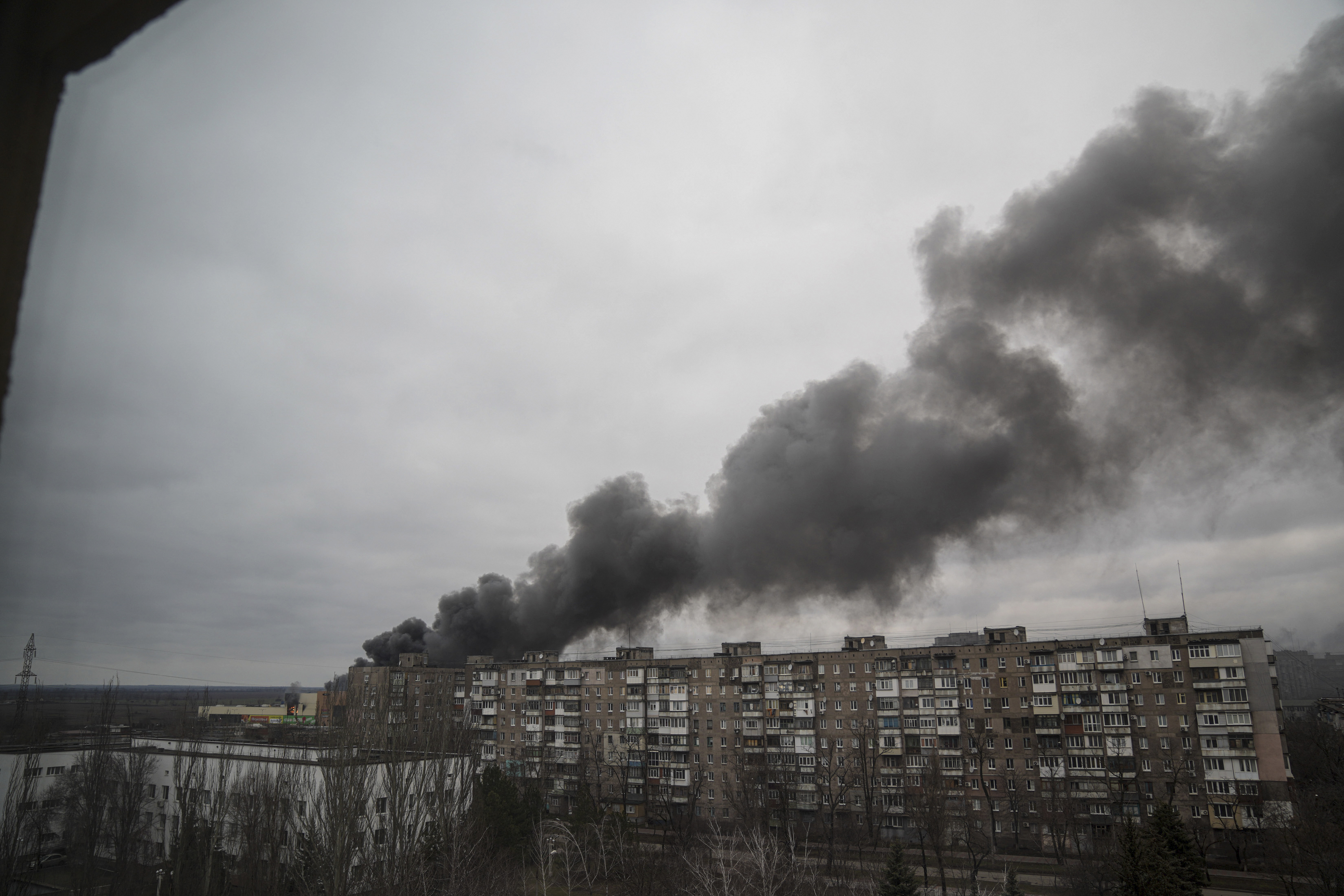
Smoke rise after shelling by Russian forces in Mariupol, Ukraine, Friday, March 4, 2022.

Shelling appeared to be mostly on the city's outskirts, but on Sunday, cars of people hoping to leave in an evacuation convoy were gathered in a central square when shells landed nearby. All fled immediately.

Even hospitals in Mariupol suffered shortages of antibiotics and painkillers, and doctors performed some emergency procedures without them.

The lack of phone networks has left anxious citizens approaching strangers to ask if they knew whether relatives living in other parts of the city and whether they were safe.

At the International Court of Justice, Ukraine pleaded for an order to halt Russia's invasion, saying Moscow is already committing widespread war crimes and "resorting to tactics reminiscent of medieval siege warfare." Russia snubbed Monday's hearings, leaving its seats in the Great Hall of Justice empty.

READ MORE: Netflix, TikTok block services in Russia to avoid crackdown
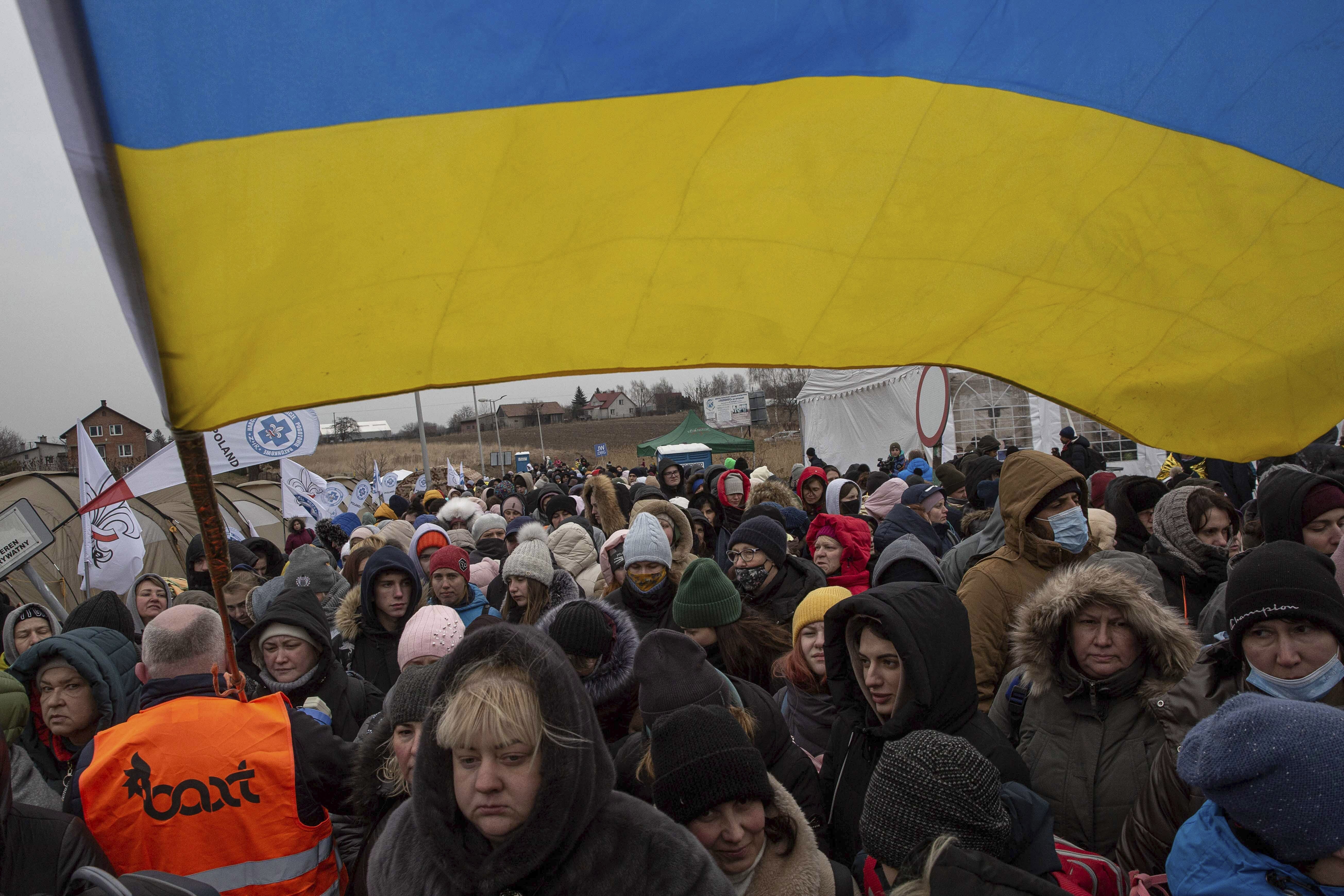
Well into the second week of war, Russia's plan to quickly overrun the country has been stymied by fierce resistance. Its troops have made significant advances in southern Ukraine and along the coast, but many of its efforts have become stalled, including an immense military convoy that has been almost motionless for days north of Kyiv.

The battle for Mariupol, in particular, is crucial because its capture could allow Moscow to establish a land corridor to Crimea, which Russia annexed from Ukraine in 2014 in a move that most other countries considered illegal.

The fighting has sent energy prices surging worldwide, stocks plummeting, and is threatening the food supply and livelihoods of people around the globe who rely on farmland in the Black Sea region.

READ MORE: The secret airfield being used to get weapons into Ukraine

The death toll, meanwhile, remains unclear. The UN has confirmed a few hundred civilian deaths but also warned the number is a vast undercount. Police for the Kharkiv region said Monday that 209 people have died there alone, 133 of them civilians.

The Russian invasion has also sent 1.7 million people fleeing Ukraine, creating what the head of the UN refugee agency called "the fastest-growing refugee crisis in Europe since World War II."

In the latest cease-fire proposal, most of the evacuation routes were toward Russia or its ally Belarus, a move Ukrainian Deputy Prime Minister Irina Vereshchuk called "unacceptable" and French President Emmanuel Macron said was "hypocrisy". Belarus served as a launching ground for the invasion.

"I don't know many Ukrainians who want to seek refuge in Russia. That's hypocrisy," Macron said in an interview on French news broadcaster LCI.

"Humanitarian actors need to be able to intervene so we must get full cease-fires when they intervene," Macron said.

The issue won't be solved via "corridors which are being threatened right away (by Russia)," he added.

The Ukrainian government instead proposed eight routes allowing civilians to travel to western regions of Ukraine where there is no shelling.
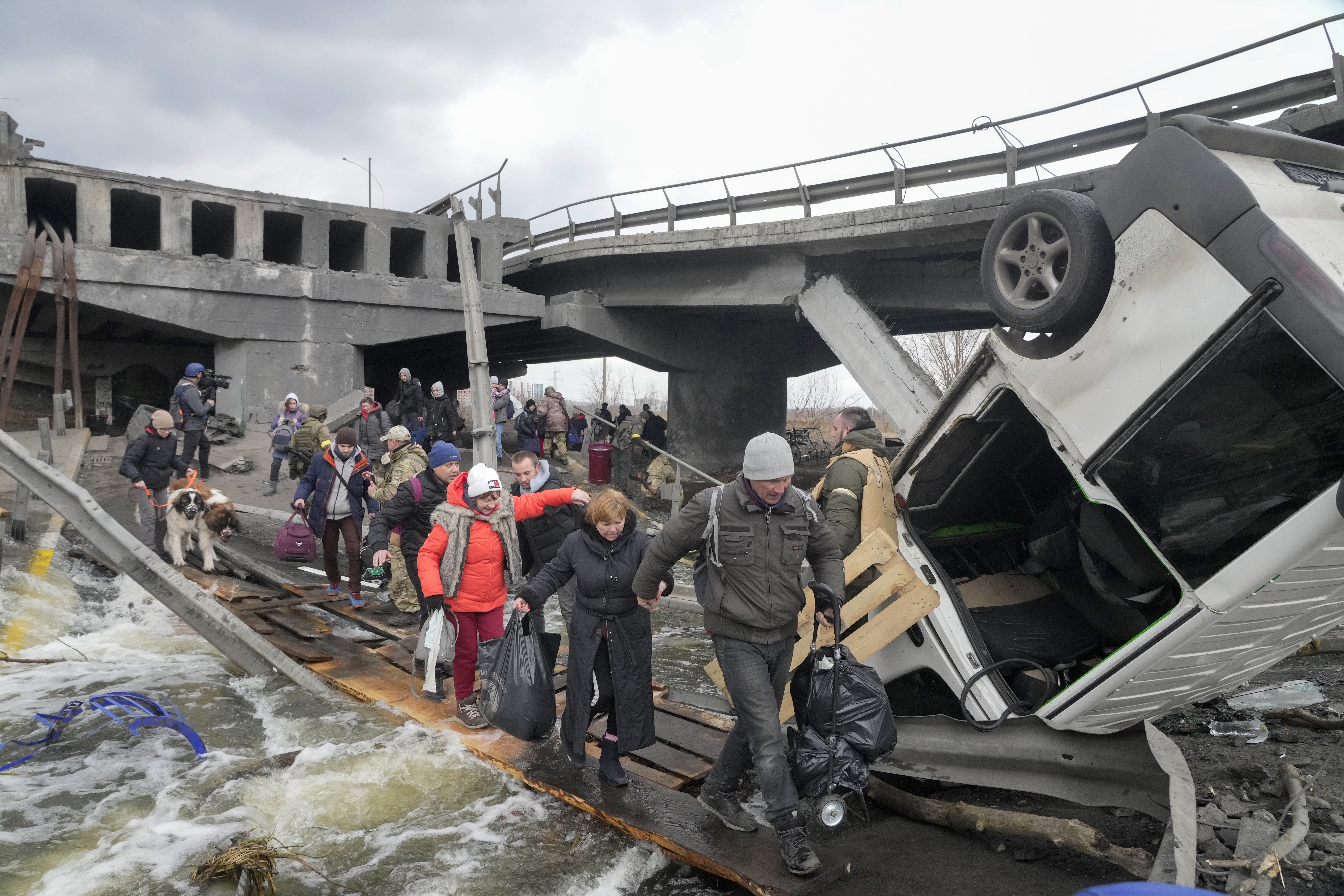
Meanwhile, Kyiv mayor Vitali Klitschko said in a Telegram video address that "fierce battles" continued Monday in the Kyiv region, notably around Bucha, Hostomel, Vorzel and Irpin — areas away from the humanitarian corridors — and were hitting civilians.

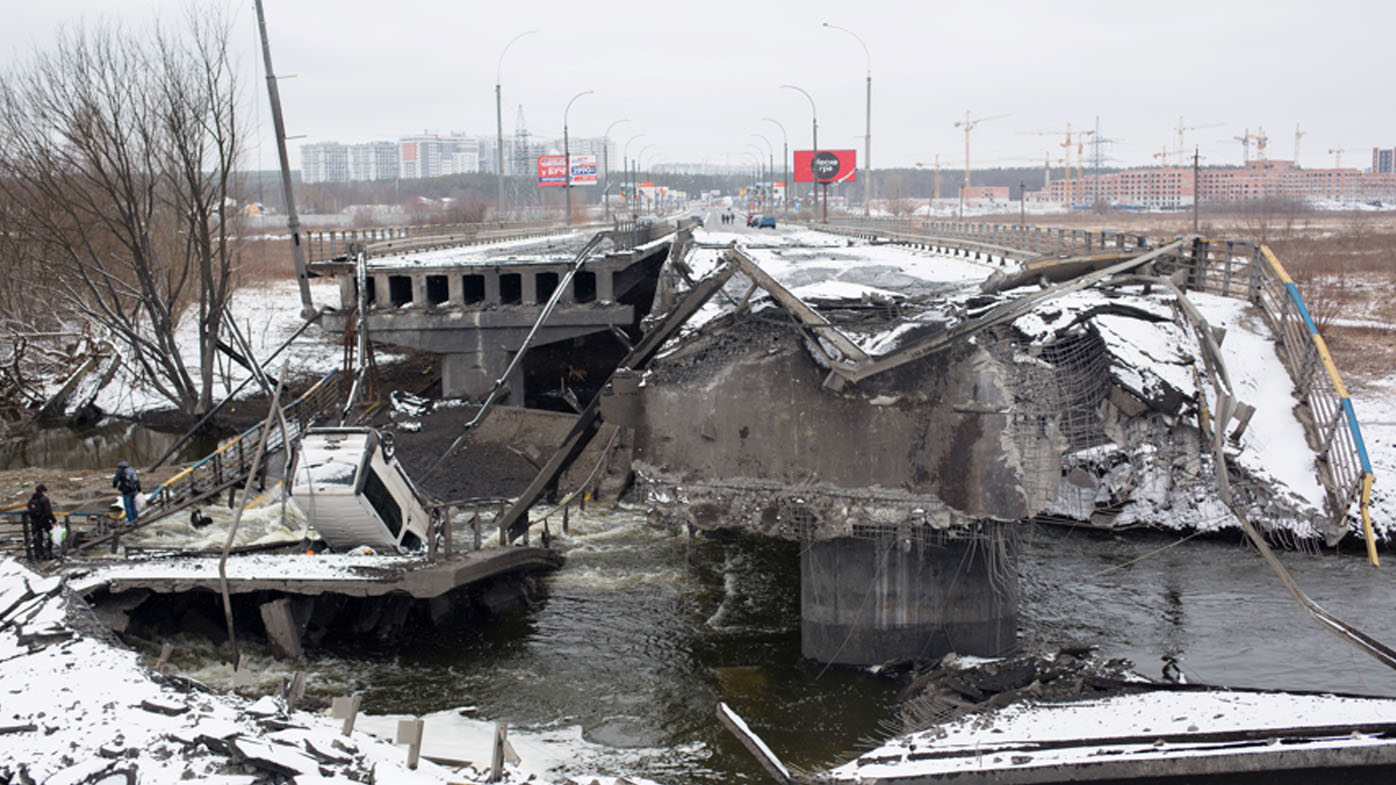
In the Irpin area, which has been cut off from electricity, water and heating for three days, witnesses Monday saw at least three tanks and that Russian soldiers were seizing houses and cars, while explosions could be heard.

Russian forces continued their offensive in Mykolaiv, opening fire on the city some 480km south of Kyiv, according to Ukraine's General Staff. Rescuers said they were putting out fires caused by rocket attacks in residential areas.

Emergency officials in the Kharkiv region said overnight shelling killed at least eight people and wrecked residential buildings, medical and education facilities and administrative buildings.

"Russia continues to carry out rocket, bomb and artillery strikes on the cities and settlements of Ukraine," the General Staff said, and repeated earlier Ukrainian accusations that Russia has targeted humanitarian corridors.

The statement also accused Russian forces of taking women and children hostage and placing weapons in residential areas of cities — though it did not elaborate or provide evidence.

The West has broadly backed Ukraine, offering aid and weapon shipments and slapping Russia with vast sanctions. But no NATO troops have been sent to Ukraine.

Ukrainian President Volodomyr Zelenskyy has criticised Western leaders for not responding with more force to Russia. He appealed again on Monday for a no-fly zone over Ukraine or warplanes.

"How do peaceful people in Kharkiv or Mykolaiv differ from (people in) Hamburg or Vienna?" Mr Zelenskyy asked.

NATO so far has ruled out policing a no-fly zone because of concerns such an action would lead to a far wider war.

Man dies from mosquito-borne virus Japanese encephalitis

A Victorian man has been found to have died from the mosquito-borne virus Japanese encephalitis (JEV), the Victorian Department of Health has revealed.

The announcement comes after Australia's acting chief medical officer declared a national alert about the spread of JEV in multiple states on Friday.

The Victorian man, who was from the state's north and was aged in his 60s, died on February 28, according to health authorities.

READ MORE: National alert declared amid fears of Japanese encephalitis virus spread

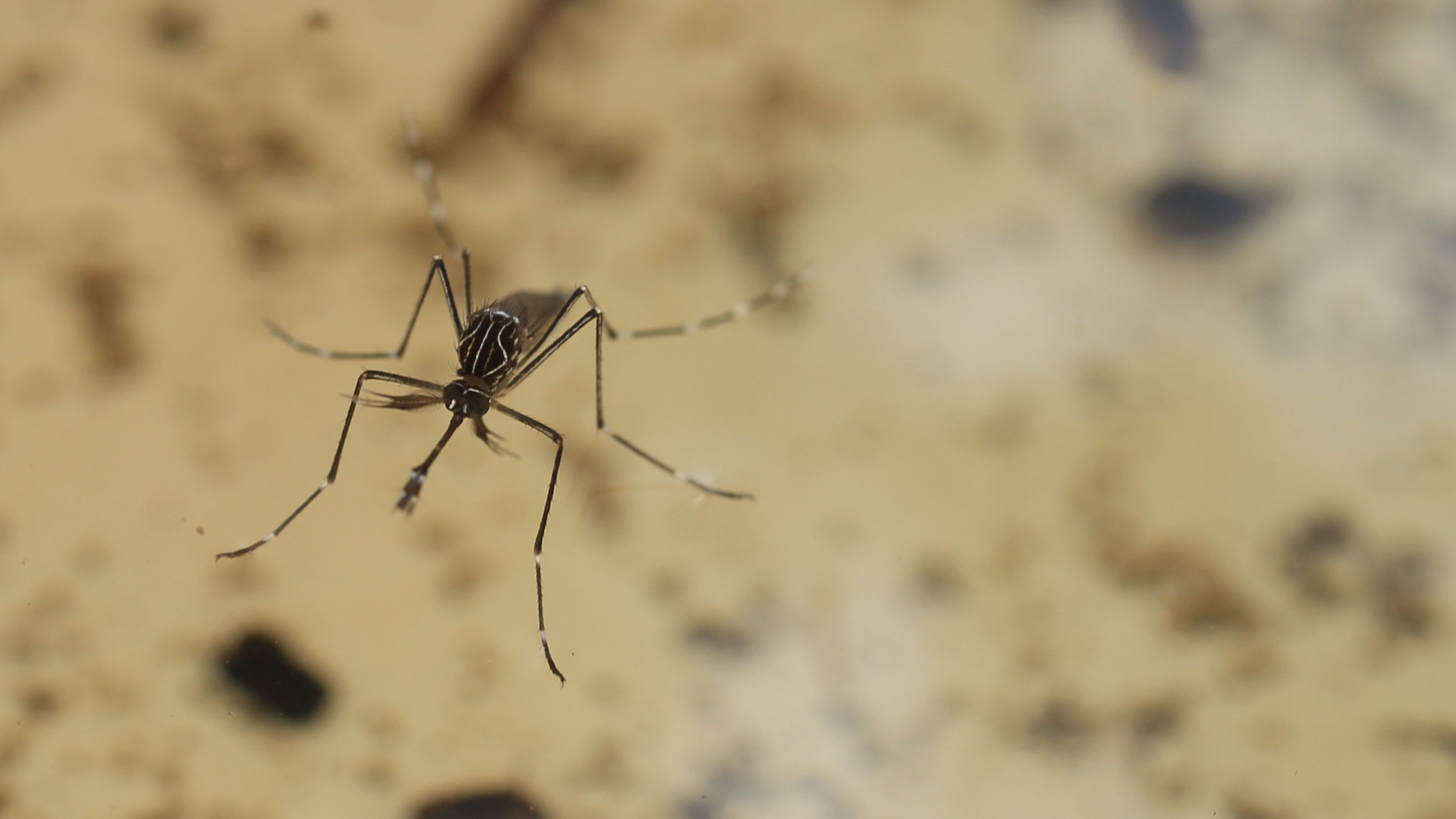
A male 'Australian backyard mosquito' (Aedes notoscriptus) getting ready to take flight.

An autopsy has since revealed JEV was the case of his death, with investigations into how he contracted the virus now underway.

The man's death is the first JEV death in the state, while seven cases have been found in the state this year.

JEV is spread through the bite of an infected mosquito.

The virus also infects pigs and horses.

Most humans who contract the virus do not experience any symptoms, or mild symptoms like headaches or fever.

A person with severe disease may suffer inflammation of the brain, sudden onset of vomiting, high fever and chills, severe headaches, sensitivity to light, neck stiffness and nausea.

READ MORE: Two in hospital as mosquito-borne disease spreads in NSW

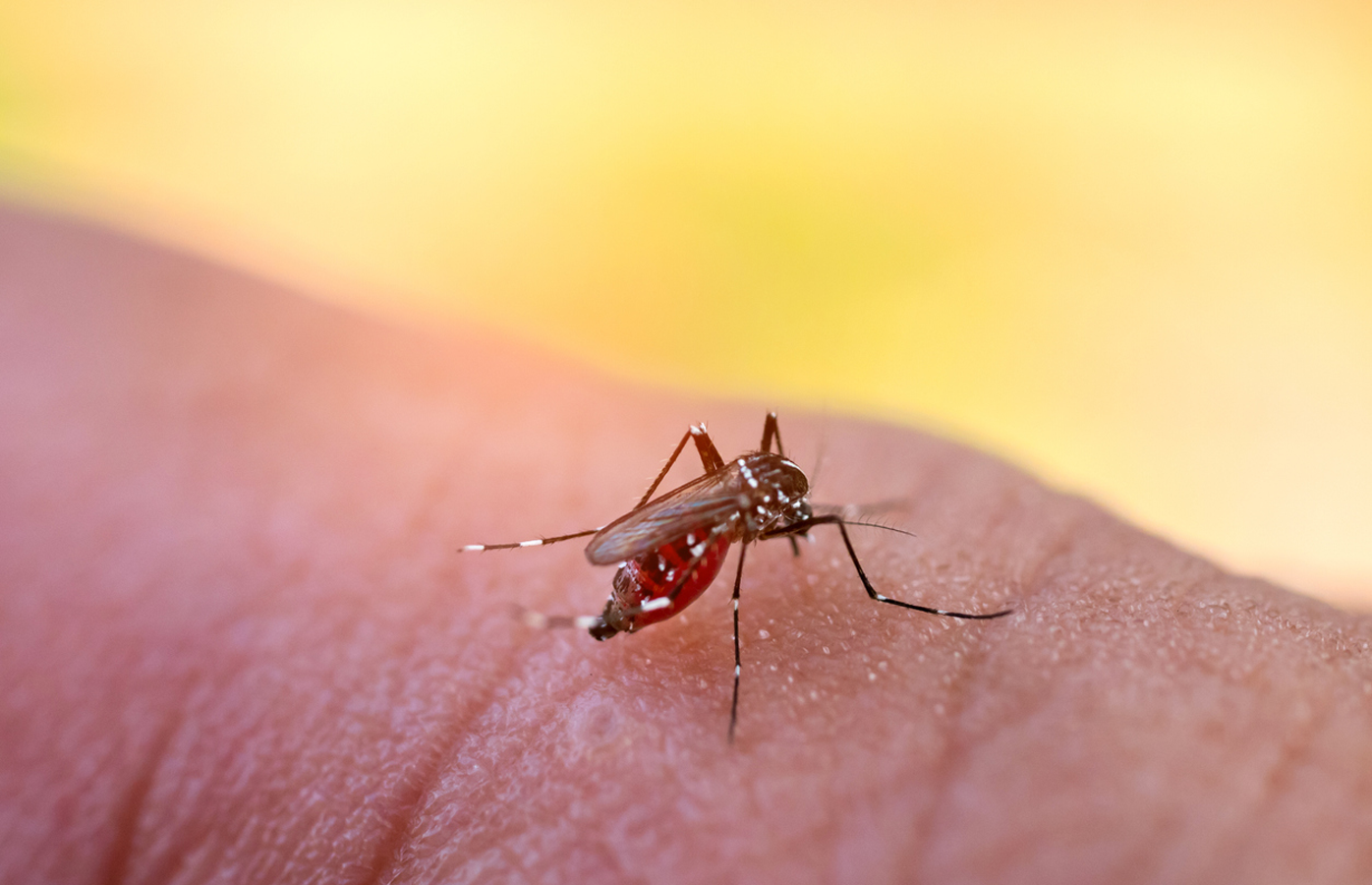
Mosquito sucking blood

Japanese encephalitis cannot be spread from person to person.

The Department of Health is strongly advising people limit their exposure to mosquitoes and avoid mosquito habitats such as stagnant water.

The department has warned mosquito numbers are high in many parts of northern Victoria, and that people with increased exposure to mosquitoes may be at a higher risk of infection, particularly people working or living on pig farms, or working or spending time outdoors.

A Japanese encephalitis vaccine is available and is recommended for people who work with or around pigs.

Two New South Wales residents are seriously ill in hospital with the virus, while the virus has also been detected in Queensland.