Category Archives: headline

Coles to deliver groceries by drone

Shoppers will soon be able to get their groceries delivered by drone in an Australian-first trial by Coles.

The supermarket will conduct the trial for customers living in select ACT suburbs, In partnership with drone delivery service Wing,

More than 250 items will be available to be delivered via drone, including bread, fresh produce, snacks, healthcare items, toilet paper and kitchen essentials.

They will arrive in as little as ten minutes.

READ MORE: Prime Minister Scott Morrison tests positive for COVID-19

The drone delivery pilot will only be available to customers in the suburbs of: Crace (2911), Palmerston (2913), Franklin (2913), Harrison (2914), Mitchell (2911), Giralang (2617), and Kaleen (2617).

READ MORE: COVID-19 costs Coles more than $150 million in six months

Customers will be asked to order via the Wing app, after which the order will be picked and packed for delivery by the drone.

When the drone arrives at the customer's address, it will hover in the air and slowly lower the package to the ground for what Coles says will be a "contactless delivery".

It's estimated most deliveries will typically take about 10 minutes or less.

READ MORE: Redbacks found in grapes bought at two different Coles stores

Coles' Chief Executive of eCommerce Ben Hassing said the adoption of drones will reduce the workload currently placed on delivery trucks.

"We are passionate about finding innovative ways to help our customers to shop with us and we aim to deliver anytime, anywhere, anyhow shopping," Mr Hassing said.

"By partnering with Wing, we're able to offer our online customers another convenient option to purchase the Coles items they know and love and get them delivered straight to their door."

READ MORE: Relief for shoppers as RAT supplies swell in supermarkets

While there will be no minimum spend and no delivery fee, there will be time constraints: Wing only operates its drone between 8am and 4:30pm on weekdays and Saturday, and 9am to 4pm on Sundays.

Not all products available in Coles supermarkets will be available for drone delivery.

Simon Rossi, General Manager of Wing Australia, said drone deliveries are on the rise around the nation.

READ MORE: Coles' hugely popular second-hand iPhone sale returns

"Whether you've run out of milk and eggs for breakfast, forgotten to pick up a loaf of bread for school lunches, or are just after a fresh 'grab and go' snack, customers in our delivery service area in Canberra can now get those urgent items they need in a hurry, delivered by drone," Mr Rossi said.

"In the last year we've seen a significant increase in use of our on-demand drone delivery service, with many customers finding the service especially useful as they stayed home, and relied on our contactless delivery service to deliver the items they needed.

"Wing made more than 100,000 deliveries in Australia in 2021, and strong demand for drone delivery has continued in 2022. Wing has already made more than 30,000 deliveries in Australia this year."

REUTERS WORLD NEWS:Ukraine Fighting Intense, War Crimes by Russia?, Markets Hit Hard, More

Reuters
The Reuters Daily Briefing

Tuesday, March 1, 2022

by Linda Noakes

u

Hello

Here’s what you need to know.

  • Human rights groups say Russia has used cluster and vacuum bombs
  • Visa and Mastercard block Russian financial institutions
  • The exodus of Western companies continues.

Today’s biggest stories

A satellite image shows the northern end of a convoy of logistics and resupply vehicles, southeast of Ivankiv, Ukraine, February 28

RUSSIA-UKRAINE WAR

A man uses his smartphone near a board showing currency exchange rates in Saint Petersburg, Russia February 28, 2022

BUSINESS & MARKETS

Shipping giant Maersk will temporarily halt all container shipping to and from Russia, deepening the country’s isolation as its invasion of Ukraine sparks an exodus of Western companies. Here’s how corporate ties to Russia have been uprooted.

U.S. payment card firms Visa and Mastercard have blocked multiple Russian financial institutions from their network and major investors, including hedge fund Man Group and British asset manager abrdn, said they were cutting their positions in Russia.

Bitcoin has leapt since Russia’s invasion of Ukraine, bolstered by people in those countries looking to store and move money in anonymous and decentralized crypto. Bitcoin trading denominated in the Russian rouble went into overdrive when the invasion began on Thursday, with daily volumes rising 259% from a day earlier.

Global supply chains, already hit hard by the pandemic, are facing further disruption and cost inflation as airspace closures affect the air freight industry. Transport between Europe and north Asian destinations like Japan, South Korea and China has become particularly problematic.

Russian billionaires Mikhail Fridman and Pyotr Aven said they would contest the “spurious and unfounded basis” of European Union sanctions. The EU said “Aven is one of Vladimir Putin’s closest oligarchs” and that Fridman had been “referred to as a top Russian financier and enabler of Putin’s inner circle.”

U.S. President Joe Biden steps from Marine One upon his return to the White House, February 28, 2022

IN OTHER NEWS

U.S. President Joe Biden, who has earned praise for his efforts to rally European allies and other nations against the Russian invasion of Ukraine, will turn to uniting Americans in the State of the Union speech today. Public opinion polls have shown Biden out of favor with the majority of Americans for months.

A delegation of former senior U.S. defense and security officials sent by Biden arrived in Taipei on a visit denounced by China. The visit, led by one-time chairman of the Joint Chiefs of Staff Mike Mullen, comes at a time when Taiwan has stepped up its alert level, wary of China taking advantage of a distracted West to move against it.

Hong Kong residents braced for a city-wide lockdown, emptying supermarkets and pharmacies, even as leader Carrie Lam called for calm and appealed for the public not to worry over a compulsory mass COVID-19 testing plan.

Military helicopters airlifted stranded people from rooftops of flooded neighborhoods in eastern Australia and a tenth victim was found following days of torrential rain as the wild weather slowly shifts south toward Sydney.

Iran said efforts to revive a 2015 nuclear deal could succeed if the United States took a political decision to meet Tehran’s remaining demands, as months of negotiations enter what one Iranian diplomat called a “now or never” stage. Iran’s Supreme Leader Ali Khamenei criticized the U.S. over the Ukraine crisis and described homosexuality as part of the “moral deprivation” widespread in Western civilization, during a televised speech.

BREAKINGVIEWS

Agenda-setting insight from the international commentary brand of Reuters

Read Dasha Afanasieva on how a Russian economic collapse will be hard to avoid, Peter Thal Larsen on investors in Russia facing a mark-to-no-market problem, and Yawen Chen on how oil is lubricating Beijing’s Russian tightrope

Sponsored by Nomura The global reset is an opportunity

Presenting actionable insights to rethink your financial strategy

Find out more

Quote of the day

“No one can avert their gaze, abstention is not an option”

Nicolas de Riviere

French U.N. ambassador

U.N. General Assembly set to isolate Russia

The post REUTERS WORLD NEWS:Ukraine Fighting Intense, War Crimes by Russia?, Markets Hit Hard, More appeared first on The St Kitts Nevis Observer.

Americans,Canadians Answering Zelensky’s Call for an International Legion to Fight for Ukraine

Feb 28 (Reuters) – A Texas software developer and a cook in British Columbia are among dozens of Americans and Canadians answering Ukraine’s call for foreign volunteers to fight Russia’s invasion.

With their governments refusing to send troops to Ukraine out of fear of sparking a world war, Americans and Canadians told Reuters they were inspired by Ukrainians’ fierce resistance. Many believe their democratic rights will be threatened at home if they do nothing to defend Europe.

Ukrainian President Volodymyr Zelensky called on Sunday for the formation of an “international legion.” Some young volunteers are travelling straight to Ukraine to enlist.

Others are applying at Ukrainian embassies and consulates before quitting jobs or dropping out of university.

The mobilization was taking place as Russian artillery bombarded Ukraine’s second largest city Kharkiv on Monday, the fifth day of conflict. read more a

“I feel guilty to not go,” said Dax, 26, a veteran of the elite U.S. 82nd Airborne Division infantry, who planned to deploy with other former U.S. military personnel. Like many volunteers, the Alabama native declined to give his full name amid discussion on social media of the need to keep their identities and movements secret for security reasons.

Canadian Bryson Woolsey quit his job as a cook on Sunday after seeing Zelenskiy’s appeal. He has no military training and plans to buy a plane ticket to Poland, cross into Ukraine and volunteer for combat.

“I felt like I had to do something,” said Woolsey, 33, of Powell River, British Columbia, who became restless as he watched images of wounded women and children in Ukraine.

Canada’s Foreign Minister Melanie Joly on Sunday told reporters it was up to individual Canadians to decide whether they wanted to join Ukraine’s international brigade. The U.S. Department of State did not immediately respond to a request for comment.

Not all volunteers want to fight.

In Quebec, 35-year-old physician Julien Auger was preparing to leave his young family to become a medic with Ukraine’s health ministry and provide “neutral” humanitarian aid.

“Global opinion and support is the key right now to solving the conflict,” said Auger, a father of two who provides palliative care at a hospital in Saint-Jérôme.

In online groups, military veterans warned volunteers with no combat training they were heading into a conflict where inexperience could be a liability for themselves and others.

That did not stop those like Tai B., 23, who studied journalism in New York.

“I’m not looking to be a hero, or a martyr, I just want to finally do something right,” said Tai, who can cook, do basic mechanics and knows how to handle a firearm. He has contacted Ukraine’s U.S. Embassy about enlisting in Zelenskiy’s “international legion.”

Hyde, a 28-year-old from the U.S. Midwest, said he was already in Kyiv and expected to start military training on Tuesday.

“I cannot bear the thought of Europe once again being plunged into warfare,” said Hyde, who described himself as a gun enthusiast and avid survivalist with no combat experience. He expects to be given a helmet, body armor, knee pads and eventually a rifle.

In Austin, Texas, a software developer said he would draw on his experience as a U.S. Army cadet to fight for Ukraine.

“If they’re willing to defend democracy then I think those that benefit from a democratic society are duty bound to support them,” said the 25-year-old, who asked that his name not be used. “I’m not telling my parents until I head to the airport.”

Reporting by Andrew Hay in New Mexico and Rod Nickel in Winnipeg; Additional reporting by Barbara Goldberg in New York; Editing by Donna Bryson and Sandra Maler

The post Americans,Canadians Answering Zelensky’s Call for an International Legion to Fight for Ukraine appeared first on The St Kitts Nevis Observer.

Jamaica: Teen Pleads Guilty to 2 Murders, 5 Other Charges

Livern Barrett/Senior Staff Reporter

Gleaner

A teenage killer has described for police investigators how he fired a bullet into the body of a former associate in a brazen daylight double-murder, then blamed his action on pressure from other members of their gang.

Eighteen-year-old Michael Black also detailed how he was enlisted by the same members of the Bloods gang, based in Clarendon, to carry out a $1.7-million robbery at the Lasco MoneyGram outlet in the town of Chapelton.

He is believed to be a member of the gang.

Black pleaded guilty in the Home Circuit Court last Thursday to a seven-count indictment that includes two counts of murder, two counts of illegal possession of firearm, and three counts of robbery with aggravation.

He is scheduled to be sentenced on May 4.

Akeem Murray, also called ‘Kemo’, and Kamar Ramatar, also called ‘Kaftan’, were travelling on a motorcycle when they were shot repeatedly about 3:30 p.m. near the intersection of Race Course and Hayes Field roads in Clarendon on November 18, 2020.

“Bare headshot,” one eyewitness told investigators, describing the men’s injuries.

Murray and Ramatar were also members of the Bloods gang.

Following his arrest, Black told investigators he was at home on the day of the double-murder when a man he identified as ‘Killa’ came to see him, according to a caution statement he dictated to detectives.

He said Killa told him they were “going on the road” and he followed him to a white Toyota Axio motor car.

Two other men, identified as ‘Zaggy’ and ‘Tassian’, were already in the car before they picked up a fourth man, identified as ‘Jay’, in the community of Race Course, the teen disclosed.

Shortly after, he said Jay said, “See dem there.”

“Killa jumped out the car and shoot dem off the bike,” Black said, referring to the double killing.

The 18-year-old said after Killa returned to the vehicle, he took a Smith & Wesson pistol from the drawstring bag he was carrying and went to the spot where Murray and Ramatar lay wounded.

He said he fired two shot, “but none never ketch dem”.

“And den me shoot the left one in him shoulder, and di two a dem did already dead,” he said during an interview with detectives.

One of the detectives asked why he shot the men.

“Fada, mi don’t even really understand how to explain it to you, but as I can say, it’s force,” he responded, according to the statement.

“Killa come to the yard and seh come mek we go on the road, and when me go on the road, a suh mi get the gun in my hands.”

Black disclosed that on the day of the robbery he, Killa and a man identified as ‘Suffera’ were travelling to Chapelton when they told him what was about to happen.

He said Killa and Suffera announced the robbery, but acknowledged that he searched three persons inside the remittance outlet and took away their phones.

The teen admitted, too, that he went over the counter and saw “a lot of cash, more than $200,000”.

The robbers made off with $1.7 million in cash, employees told the investigators.

li************@*******jm.com

The post Jamaica: Teen Pleads Guilty to 2 Murders, 5 Other Charges appeared first on The St Kitts Nevis Observer.

Canada to Supply Anti-Tank Weapons to Ukraine, Ban Russian Oil Imports

OTTAWA, Feb 28 (Reuters) – Canada will supply anti-tank weapons and upgraded ammunition to Ukraine to support its fight against a Russian invasion, Prime Minister Justin Trudeau said on Monday, and it will ban imports of Russian crude oil.

“Canada will continue to deliver support for Ukraine’s heroic defense against the Russian military,” Trudeau told reporters in Ottawa. “We are announcing our intention to ban all imports of crude oil from Russia, an industry that has benefited President Putin and his oligarchs greatly.”

Canada has already sent weapons and non-lethal support to Ukraine, and has backed a number of sanctions, including supporting the removal of Russia from the SWIFT system for international bank payments.

“We are providing even more lethal aid to Ukraine, and we’ll be sending 100 Carl Gustaf anti-tank weapon systems and 2,000 rockets, which we will be working to deliver as quickly as possible,” Defence Minister Anita Anand said.

Canada imported C$289 million ($228 million) worth of Russian energy products in 2021, according to Statistics Canada.

Canada is the world’s fourth-largest oil producer, but the vast majority comes from Alberta, far from eastern Canadian refineries owned by Irving Oil, Suncor Energy (SU.TO), Valero Energy Corp (VLO.N) and Cresta Fund Management.

Eastern refiners import oil on the spot market when needed, as well as fuels to meet demand during maintenance shutdowns, said David Schick, a vice-president with the Canadian Fuels Association.

The Russian oil ban applies only to crude oil for now, but the government is looking at oil derivative products next, a government source said.

In 2021, shipments included naphtha and diesel to Valero’s Quebec refinery and deliveries of diesel and gasoline to a refinery in Newfoundland & Labrador, now owned by Cresta Fund Management, said Jim Mitchell, head of Americas Oil Analysts at Refinitiv.

Cresta is repurposing the idled Newfoundland refinery to produce renewable fuel.

Irving does not import Russian oil, a spokeswoman said. A Suncor spokeswoman said the company does not process Russian crude in any of its refineries. Valero and Cresta did not immediately respond.

Canada also played a role in restricting Russia’s central bank from being able to access its foreign reserves.

Trudeau said his government has asked the independent Canadian Radio-television and Telecommunications regulator to drop Russian state-owned broadcaster RT, saying that “it is important that Canadians and people around the world be faced with accurate information.” Canadian cable operators said on Sunday they would voluntarily drop RT.

Earlier on Monday, Foreign Minister Melanie Joly said the G7 group of nations would bring more sanctions against Russia.

($1 = 1.2673 Canadian dollars)

Reporting by Steve Scherer and Julie Gordon in Ottawa, Ismail Shakil in Bengaluru, Rod Nickel in Winnipeg, Nia Williams in Calgary; Editing by Alistair Bell and Rosalba O’Brien

The post Canada to Supply Anti-Tank Weapons to Ukraine, Ban Russian Oil Imports appeared first on The St Kitts Nevis Observer.

Three Bodies Recovered After Trinidad & Tobago Pipeline Accident

PORT OF SPAIN, Feb 28 (Reuters) – Rescuers in Trinidad and Tobago recovered the bodies of three welders, the country’s state energy company said on Monday, four days after the workers were sucked into an underwater 30-inch (76-cm) U-shaped pipeline.

The body of another worker remains missing, according to a statement issued by state-owned Paria Trading Fuel Company.

Five welders were carrying out underwater maintenance at the project when the accident occurred last Friday.

One of the five men was rescued from inside the pipeline four hours after the incident, and the company said they were searching for the body of the missing worker.

The government announced that an independent investigation has been launched to determine what the cause of the accident, and it will include experts from multinational energy companies.

“I want to give the assurance to the families that nothing will stand in the way of determining how this tragedy occurred,” Prime Minister Keith Rowley said in a separate statement.

Reporting by Linda Hutchinson-Jafar; Writing by Carolina Pulice; Editing by Stefanie Eschenbacher and Sandra Maler

The post Three Bodies Recovered After Trinidad & Tobago Pipeline Accident appeared first on The St Kitts Nevis Observer.
Palm Oil Becomes Costliest Vegoil as Ukraine War Halts Sunoil Supply

  • Buyers struggle to replace sunoil quickly
  • Huge demand lifts palm oil prices to a record high
  • Soyoil supply limited as drought hits South America
  • Palm’s premium could fade as buyers shift to soyoil

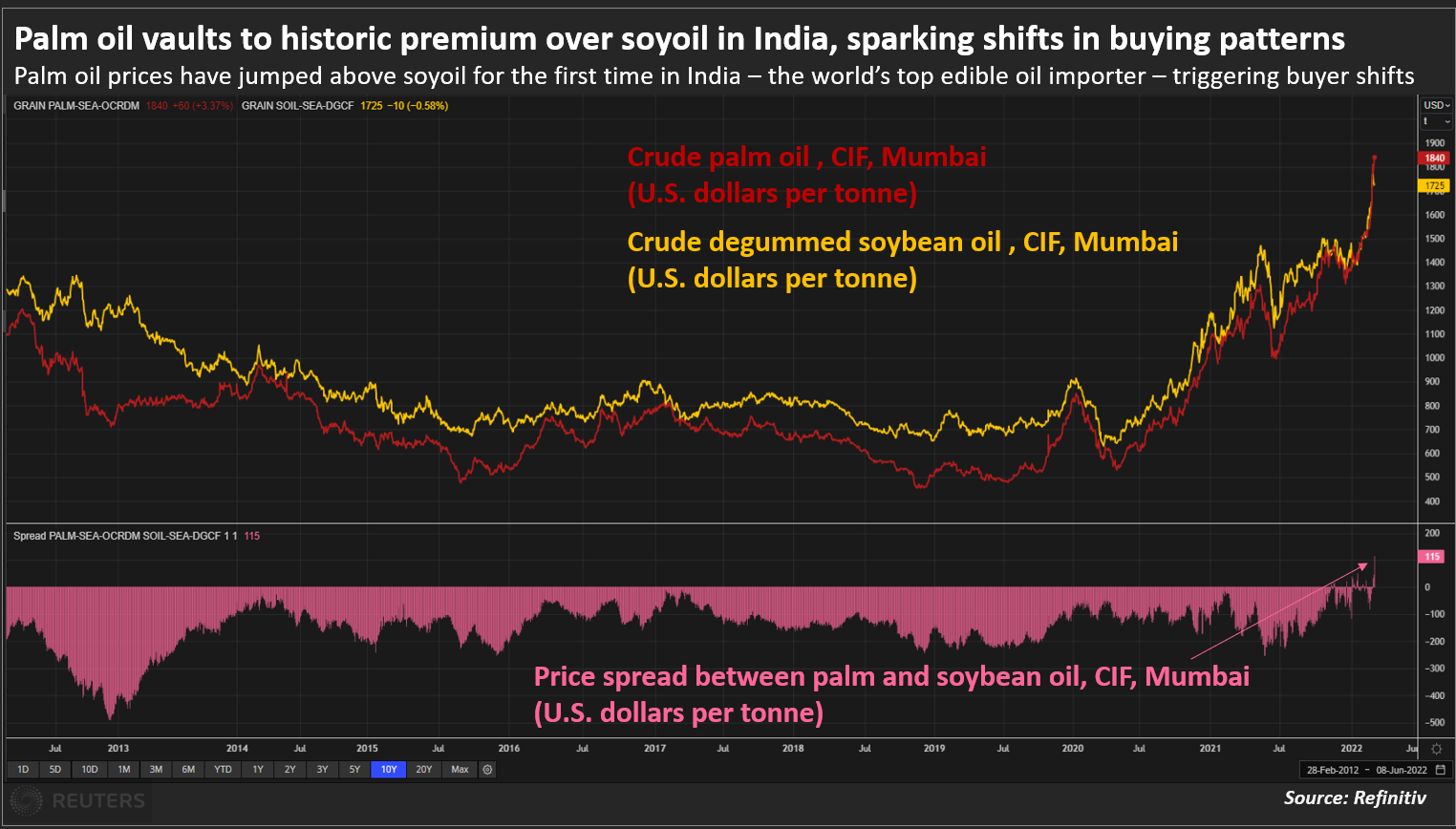
MUMBAI, March 1 (Reuters) – Palm oil has become the costliest among the four major edible oils for the first time as buyers rush to secure replacements for sunflower oil shipments from the top exporting Black Sea region that were disrupted by Russia’s invasion of Ukraine.

Palm oil’s record premium over rival oils could squeeze price-sensitive Asian and African consumers already reeling from spiralling fuel and food costs, and force them to curtail consumption and shift to rival soyoil , dealers said.

Crude palm oil (CPO) is being offered at about $1,925 a tonne, including cost, insurance and freight (CIF), in India for March shipments, compared with $1,865 for crude soybean oil.

Crude rapeseed oil was offered at around $1,900, while traders were not offering crude sunflower oil as ports are closed due to the Ukraine crisis.

Palm oil vaults to historic premium over soyoil in India, sparking shifts in buying patterns

The Black Sea accounts for 60% of world sunflower oil output and 76% of exports. Ports in Ukraine will remain closed until the invasion ends. read more

“Asian and European refiners have raised palm oil purchases for near-month shipments to replace sunoil. This buying has lifted palm oil to irrational price level,” said a Mumbai-based dealer with a global trading firm.

“They have the option of buying soyoil as well. But prompt soyoil shipments are limited and they take much longer to land in Asia compared to palm oil,” he said.

Soybean production in Argentina, Brazil and Paraguay is expected to fall because of dry weather.

Price-sensitive Asian buyers traditionally relied on palm oil because of low costs and quick shipping times, but now they are paying more than $50 per tonne premium over soyoil and sunoil, said a Kuala Lumpur-based edible oil dealer.

Palm oil’s price premium is temporary, however, and could fade in the next few weeks as buyers shift to soyoil for April shipments, the dealer said.

Most of the incremental demand for palm oil is fulfilled by Malaysia, as Indonesia has put restriction on the exports, said an Indian refiner.

“Malaysian stocks are depleting fast because of the surge in demand. It is the biggest beneficiary of the current geopolitical situation,” he said.

Reporting by Rajendra Jadhav Editing by Shri Navaratnam

Our Standards: The Thomson Reuters Trust Principles.

The post Palm Oil Becomes Costliest Vegoil as Ukraine War Halts Sunoil Supply appeared first on The St Kitts Nevis Observer.

U.S. Set to Announce Increased Staffing at Havana Embassy to Process Visas

WASHINGTON, Feb 28 (Reuters) – The Biden administration is expected to announce as soon as this week a plan to beef up its skeletal staffing in the U.S. embassy in Havana to restore visa processing for Cubans that had been largely suspended since the Trump era, people familiar with the matter told Reuters.

The deployment of additional consular officers to Havana, a result of President Joe Biden’s ongoing year-long review of policy on communist-led Cuba, would mark an initial phase of easing strict limits on visas imposed under former President Donald Trump.

The State Department under Trump sharply scaled back embassy staff in 2017 following a spate of “anomalous health incidents” that came to be known as “Havana syndrome.” The unexplained illnesses first affected U.S. employees in the Cuban capital and later cropped up in other parts of the world.

There have been no recent reports of incidents in Havana.

The drawdown all but halted visa processing for Cubans who in many cases seek to emigrate or travel to the United States to reunite with families. It coincided with Trump’s rollback of a historic rapprochement that his predecessor, Barack Obama, oversaw between the United States and Cuba, Washington’s old Cold War foe.

The two people familiar with the matter declined to be identified because they were not authorized to disclose details. One said the plan was expected to be announced as early as Thursday by senior U.S. diplomats in Havana.

A State Department spokesperson said the administration was committed “to exploring options to ensure appropriate staffing at U.S. Embassy Havana” while maintaining security. “These options could include sending both temporary and longer-term personnel,” the official added, declining to elaborate.

The Cuban government did not immediately respond to a request for comment.

It was not immediately known how many staffers would be added and how soon they would arrive, but the sources said they would focus on a huge backlog of visa requests. There were more than 90,000 Cubans on the “immigration waiting list” as of November, according to the State Department’s latest figures.

In the Trump era, the processing of Cubans’ visas had been transferred to the U.S. embassy in Guyana, where few Cubans could afford to travel.

Assistant Secretary of State for the Western Hemisphere Brian Nichols told lawmakers during a Feb. 3 hearing that the administration would send “temporary duty consular officers to Havana in the not-too-distant future” but he did not offer any details.

REMITTANCES

Even with this week’s expected embassy announcement, the Biden administration is not likely to provide any further clarity for now on any plans for easing the flow of remittances to Cuba that were severely restricted under Trump. Money sent by Cuban Americans to families on the island had served as a financial lifeline for them.

“That decision is still on hold,” one of the sources said.

Nichols testified last month that recommendations on remittances were in the White House’s hands and “we await their decision.”

Biden, who served as Obama’s vice president, had promised during the 2020 election campaign against Trump to re-engage with Cuba’s government.

But the Biden administration slapped sanctions on Cuban officials and security force in response to Havana’s crackdown on protesters in July, and has since imposed further measures over Cuba’s prosecution of hundreds of jailed protesters.

Biden officials are mindful that any easing of restrictions on Cuba could lead to political fallout from conservative Cuban Americans. The latter make up a large voting bloc in south Florida and mostly backed Trump’s tough policies toward Cuba, helping him to win the important swing state last year.

But the resumption of visa processing at the embassy is less likely to spur a serious political backlash since a number of Cuban American lawmakers, both Democrats and Republicans, have backed the idea.

Reporting by Patricia Zengerle, Matt Spetalnick and Brian Ellsworth; Additional reporting by Dave Sherwood in Havana; Writing by Matt Spetalnick; Editing by Kenneth Maxwell

The post U.S. Set to Announce Increased Staffing at Havana Embassy to Process Visas appeared first on The St Kitts Nevis Observer.

Mexico: Reports of Cold Blooded Wake Massacre, Search for Bodies

MEXICO CITY, Feb 28 (Reuters) – Mexico is investigating reports that around 17 people were executed after gunmen barged into a funeral wake over the weekend and dragged mourners away to be killed, Mexico’s President Andres Manuel Lopez Obrador said on Monday.

A video widely-shared over social media showed a group of people lined up against a wall, most of them holding their hands behind their heads, before apparently being shot by a barrage of bullets fired by surrounding gunmen.

Mexican media reported the mourners were killed in the town of San Jose de Gracia, some 200 kilometers (125 miles) west of Morelia, the state capital of Michoacan, where turf battles between rival drug cartels has sent violence soaring.

The Michoacan chief prosecutor’s office (FGE) late on Sunday said no bodies have been found, but investigators discovered firearms cartridges at the site where the video was suspected to have been filmed as well as “cleaning products” in a bag, saying the “site had recently been washed”.

Lopez Obrador urged patience for the FGE investigation to unearth the facts behind the events, saying that he hoped “with all of his soul” that the events were not true.

“We still don’t have information,” Lopez Obrador added in his daily morning press conference on Monday morning.

The video shared on social media appears to have been filmed by a nearby neighbor through a window with a high vantage point, showing a group of people lined up against a white wall.

Several gunmen are seen pointing rifles at the purported mourners until gunfire prompts the person filming to hide for a couple of seconds.

When the uninterrupted video returns to show the same spot on the street again, the purported mourners can no longer be seen and there is only smoke and dust rising in the air.

In recent years targeting funeral wakes has become part of the internecine violence that has plagued certain parts of Mexico, where cartels battle for control of trafficking routes and territory to extort residents.

Earlier this month nine people were killed in a single day when gunmen in the northern border city of Ciudad Juarez killed three people at a wake of a man who died in prison, and then another six at the same man’s funeral later in the day.

In January last year, gunmen burst into a wake in the central Mexican city of Celaya and shot dead nine people.

Reporting by Raul Cortes Writing by Drazen Jorgic; Editing by Frank Jack Daniel


The post Mexico: Reports of Cold Blooded Wake Massacre, Search for Bodies appeared first on The St Kitts Nevis Observer.

Leveraging Web 3.0 to Boost Trade & Investment in the Orange Economy

By Chelcee Brathwaite and Nikolai Layne

A decline in tourism due to the COVID-19 pandemic reminded the Caribbean of their need for economic diversification. An area for consideration is the “orange” economy which, given the region’s rich cultural assets, presents endless opportunities. However, comparative advantage alone is not sufficient to fully capitalise on the sector’s emerging trends. In this SRC Trading Thoughts we explore how Web 3.0 can be leveraged in the orange economy.

An Economic Engine with Strong Susceptibility to Disruptive Innovation

The orange economy includes several linked activities which transform cultural, artistic and heritage-based ideas into creative goods and services whose value is determined by intellectual property rights (IPRs).

Pre-crisis forecasts indicate that the creative economy could account for 10% of global GDP before 2030. Previous estimates indicated that the orange economy generated 30 million jobs worldwide (employing a greater share of youth, women and minority groups in developing countries than in advanced economies) and contributed 3% of global GDP in 2013, with even bigger contributions in some Caribbean states (8% of St. Lucia’s GDP in 2012 and 5% of Jamaica’s GDP in 2007). UNCTAD found that the creative economy’s export trade growth averaged 7% between 2002 and 2015, demonstrating faster and more resilient growth than other industries even during the 2008 global financial crisis. The orange economy presents a unique opportunity for the Caribbean to leverage its dynamic cultural elements as a comparative advantage to achieve stronger economic growth and diversification, while contributing to several SDGs.

Creative disruption is prevalent in the orange economy, with digitization already significantly reducing costs for creating, accessing, and distributing creative works, and replacing physical products that embody these works with digital products. Dr. Keith Nurse attributes the growth of the digital creative sector to rapid techno-economic change, increasing commercialization of IP in the digital world, growth of social networking and synergies among value enhancing activities.

Leveraging Web 3.0 to Overcome Barriers in the Orange Economy

Web 3.0 is generally accepted as a new iteration of the world wide web that is based on the blockchain. Blockchains are supported by multiple layers of technological innovation which are critical to its decentralisation. Each layer underpinning Web 3.0 plays a critical role in processing data and distributing value in a frictionless way. Although the potential of such disruptive technologies cannot be fully conceived, what is evident is that leveraging areas such as artificial intelligence, big data, distributed ledger technology and digital identity can create an inclusive and connected environment where people, businesses and countries can participate and share resources.

Let’s briefly explore Web 3.0’s predecessors. Web 1.0 surfaced as the first stage of the internet in 1989 but was very limited in its capabilities with content shared in a read-only form and static pages hosted on ISP-run web servers. Web 2.0 (early 2000s) upgraded the read-only format to encompass both a read and write environment allowing users to interact with content. However, this environment became highly censored and centralised with permission requirements. Participation on multiple platforms meant that users were required to share personal information and data which could be exchanged or sold to other parties. Web 3.0 purports to remedy these issues by building an inclusive, secure, decentralised, permissionless, censorship-resistant and interoperable digital environment.

We cannot fully explore Web 3.0 here, but we highlight three developments beneficial for growing the Caribbean’s orange economy.

Smart Contracts

IPRs protect and promote creativity by allowing creators to earn recognition and financial benefit for their works. UNCTAD’s Deputy Secretary General, Isabelle Durant, found some developing countries lacked legal and regulatory frameworks and/or implementation capacity for systematic enforcement, collection and distribution of royalties. Another challenge is the applicability of traditional IP regimes in the digital realm.

Blockchain technology is a practical solution that can fill in the gaps that exist in traditional IP regimes with the use of smart contracts. Smarts contracts are self-executing contracts on the Blockchain network where the terms of agreement are structured by code and can be used for effective management or maintenance of patents, copyrights and trademarks. Non-fungible tokens (NFTs) are powered by smart contracts and are best understood as unique cryptographic digital tokens that are linked to creative goods like art, music and collectables. There are two practical considerations for NFTs in relation to intellectual property rights. The purchase of an NFT is the right to claim ownership for the NFT only. However, the author or creator of these digital assets owns the actual copyright to their work unless they decide to transfer ownership of the copyright to another party.

Examples of NFTs currently exist in the developing world and Barbados has a good illustration of how these assets can be distributed. Music artist, Shontelle Layne launched a project in 2021 using NFTs to directly connect with her fans. Her vision involved releasing music in the form of collectables via an online auction with the highest bidder receiving an NFT and special rights to her content. The owner of this unique NFT can redeem it for several exclusive items, including a cameo in the video for Shontelle’s song, “House Party” and his/her name included in the lyrics of another version to the song.

Asset Tokenization

The S4YE Coalition identified access to finance as a major impediment for entrepreneurs and MSMEs in the orange economy. The lack of tangible assets and weak IP frameworks to verify economic value of intangible assets, high uncertainty of market demand and a longer period for value generation, removes most traditional financing schemes from the reach of these entrepreneurs.

Asset tokenization is the process of fractionalizing ownership of physical assets through digital tokens. Security token offerings (STOs) are a means of asset tokenization combining blockchain technology with the regulatory approval of asset transferability in the securities market. This process provides support for the liquidity of assets whilst creating wider availability for finance. The tokenization of Orange Development Areas (ODAs) as geographical spaces which support economic and creative activities can attract domestic and international investment. ODAs are a perfect medium to assist entrepreneurs and MSMEs that seek to occupy spaces for the development and promotion of their goods and services. The inclusion of a governance protocol for the purpose of providing token holders with voting rights and setting parameters around various creative activities will add tremendous value. Additionally, tax benefits can be explored by the government to continuously attract investors. Ernst & Young cites some of the advantages of STO-based financing compared to traditional fundraising methods as the global reach to a digital distribution of tokens and quick realisation.

Metaverse

According to UNCTADStat, CARICOM recorded US$54million in exports of creative goods in 2015, accounting for 0.011% of global creative goods exports; the value of creative services exports are unknown. Greater efforts are needed to bolster the sector’s productive capacity, enhance their access to global markets and capture relevant data. Research found that creative MSMEs often lack resources and networks for marketing and building a brand in non-domestic markets where they face high entry barriers.

The metaverse represents a persistent virtual or augmented space which can be supported by blockchain technology and used to create a fair market environment. Although still in its infancy, the metaverse is open to any party interested in connecting or interacting in an inclusive environment for entertainment or enterprise purposes. A virtual world eliminates geographic constraints and reduces expenditures which exist in traditional channels for small islands to have an international presence. CARICOM member states can leverage the metaverse to establish a trade presence globally and display cultural and creative goods that are linked to real world assets. Privileges can be determined at a national level in relation to the real-world utility of these virtual assets outside of the metaverse. Barbados became the first sovereign nation to announce the development of an embassy in the Metaverse through an agreement with Decentraland. The aim of this strategic arrangement is to approach global diplomacy in a cost-effective way whilst building an efficient infrastructure to promote the island’s unique cultural aspects. In this form creative goods and services can be offered around the world without the traditional limitations of doing international business.

Concluding Thoughts

Emerging technologies offer solutions to several challenges even in areas beyond the orange economy. However, careful mitigation of risks and the development of an enabling environment will be key to unlocking the potential of Web 3.0 for the Caribbean and other developing regions. In our next piece, we address some of these risks and frameworks.

Mrs. Chelcee Brathwaite is a Trade Researcher at the Shridath Ramphal Centre for International Trade Law, Policy and Services, of the University of the West Indies’ Cave Hill Campus (Barbados) and Mr. Nikolai Layne is a Financial Strategist at Laissez Faire Associates.

The post Leveraging Web 3.0 to Boost Trade & Investment in the Orange Economy appeared first on The St Kitts Nevis Observer.