Category Archives: headline

Higher Prices On Way Thanks to Russian Invasion

By Makeida Antonio

A&B Observer- The Caribbean will undoubtedly be affected by an increase in prices for food and petroleum products if the escalating conflict between Russia and Ukraine continues.

Almost immediately following the news of the Russian military invasion of Ukraine on Thursday, the world began experiencing higher gas prices.

The price of oil has surged past $100 for the first time since 2014 when Russian President Vladimir Putin launched a military attack on his European neighbour, Ukraine, which led to widespread condemnation of the blatant disregard for international law.

Due to these developments, A&B Prime Minister Gaston Browne has notified residents about the potential increase of local gas prices in the event that the war in Eastern Europe shows no signs of de-escalation.

“Now, I believe that within the last few days petroleum prices are about $100 per barrel and potentially it could get up to maybe $120 within the next week or two, especially if this conflict continues. So, here is the implication of potentially where we have been subsidising the pricing and would have kept the pricing of petroleum products stable for the last few years, we could have a situation where we are forced to increase the price at the pump,” Browne explained on local radio over the weekend.

Further explaining the economic fallout which could arise out of the emerging conflict, the Prime Minister noted that the government may no longer be able to shield consumers from high prices at gas station pumps across the country.

“If petroleum prices continue to increase, then there may be a time when we cannot continue to hold the price of $12.50 or whatever it is for gas and then in that case, they may have to be a pass through at some point. Again, the whole idea is to reduce the price at the pump but if it gets to the stage in which the government consumption tax is totally wiped out and then it’s going into negative ground then we may have to pass on the increase in price to consumers,” he said.

Additionally, the price of utilities, such as electricity could also rise as a result of the price of oil skyrocketing because of the closed borders and sanctions because of the war.

“Petrol and food, those contribute to co-inflation and the thing about it is that these increases in those prices affect the poor disproportionately and that is why Antigua and Barbuda has had this price equalisation mechanism in place to control the price at the pump.”

With regards to international relations, Browne believes that larger countries tend to throw democracy out of the window due to sheer power and size of both land mass and economy.

“We have to be careful not to get involved in their rhetoric but at the same time stand on those principles that will defend our interests. These powerful countries, whenever it is convenient for them, they speak about defending democracy but whenever they believe their so-called national interest is at stake, then might becomes right and that is precisely what is happening right now in Russia,” he said.

The post Higher Prices On Way Thanks to Russian Invasion appeared first on The St Kitts Nevis Observer.

Some Latin American Nations Call for Russian Withdrawal from Ukraine

BOGOTA/BUENOS AIRES/SANTIAGO, Feb 24 (Reuters) – Colombia, Argentina and Chile have called for swift withdrawal of Russian troops from Ukraine, as other Latin American countries rejected the use of force but stopped short of calling for a Russian exit.

Russia invaded Ukraine by land, sea and air in the early morning, in the biggest attack by one state against another in Europe since World War Two. Russian President Vladimir Putin said the attack is an effort to ‘denazify’ Ukraine. read more

“We categorically reject war and we join all the voices of the international community who today clamor for the speedy withdrawal of Russian troops from Ukrainian territory,” Colombia’s centre-right President Ivan Duque said in a video statement.

“This premeditated and unjustified aggression is a threat to world peace,” he said. Vice-President and Foreign Minister Marta Lucia Ramirez branded the invasion “absurd colonialist nostalgia” on Twitter.

Argentina’s foreign ministry in a statement called on Russia to cease military actions in Ukraine, while Chile said it would support sanctions approved by the United Nations Security Council.

“Our country calls for Russia to withdraw its troops and especially for it to respect the territorial integrity and sovereignty of Ukraine,” Chile’s Foreign Minister Carolina Valdivia said.

Ecuador’s Foreign Minister Juan Carlos Holguin also condemned Russia, saying it had violated international law, and called for an end to fighting.

Brazilian President Jair Bolsonaro, who recently met with Putin in Moscow, did not mention the Ukraine crisis in a Thursday address to supporters. Bolsonaro came under strong U.S. criticism for saying during his visit that he was “in solidarity with Russia,” without elaborating. read more

Demonstrators stick a portrait of Vladimir Putin during an anti-war protest in front of the Russian embassy, after Russia launched a massive military operation against Ukraine, in Santiago Chile, February 24, 2022. REUTERS/Ivan Alvarado

But his Vice President Hamilton Mourao said economic sanctions may not be enough and the West may need to use force against Russia.

Mourao’s comments went well beyond a statement by the foreign ministry calling for a halt to Russian hostilities and saying it would act as a member of the Security Council to find a peaceful solution.

Argentina’s President Alberto Fernandez has also recently visited Moscow, prompting some analysts to suggest Russia has courted Latin America amid the Ukraine tensions.

Some Latin American countries were less pointed in their criticism.

Mexican President Andres Manuel Lopez Obrador called for dialogue, while Foreign Minister Marcelo Ebrard later took a tougher stance, condemning the invasion and demanding Russia end its military operations in Ukraine.

Peru’s foreign ministry expressed concern and appealed for an end to hostilities, and Paraguay’s foreign minister urged dialogue and a ceasefire.

Russia’s strongest allies in the region – Cuba and Venezuela – had yet to directly address the invasion early on Thursday morning.

Venezuela’s foreign minister Felix Plasencia on Wednesday backed Putin’s fight against what he said was North Atlantic Treaty Organization’s (NATO) desire for war.

Cuba on Wednesday criticized the United States for imposing “the progressive expansion of NATO towards the borders of the Russian Federation” and called for a diplomatic solution. read more

Reporting by Julia Symmes Cobb in Bogota, Adam Jourdan in Buenos Aires and Fabian Cambero in Santiago, additional reporting by Lisandra Paraguassu in Brasilia and Gabriel Stargardter in Rio de Janeiro, Dave Sherwood in Havana, Ana Isabel Martinez and Daina Beth Solomon in Mexico City, Vivian Sequera in Caracas, Marco Aquino in Lima, Alexandra Valencia in Quito and Daniela Desantis in Asuncion; Editing by Diane Craft and Kenneth Maxwell

The post Some Latin American Nations Call for Russian Withdrawal from Ukraine appeared first on The St Kitts Nevis Observer.

Despite Bolsonaro Reluctance, Brazil Votes Against Russia at UN

BRASILIA, Feb 25 (Reuters) – Brazil voted on Friday for a draft U.N. Security Council resolution that would have deplored the Russian invasion of Ukraine, despite some reluctance by Brazilian President Jair Bolsonaro to condemn Russia.

The South American country was among the 11 council members that voted in favor of the resolution, while China, India and the United Arab Emirates abstained from the vote on the U.S.-drafted text. read more =

The draft was vetoed by Russia and is now expected to be taken up by the 193-member U.N. General Assembly.

Reuters reported earlier on Friday that Brazil would vote in favor of the resolution despite doubts of its far-right president.

Bolsonaro, who recently met with President Vladimir Putin in Moscow, on Thursday scolded his Vice President Hamilton Mourao for condemning the Russian invasion, saying it was not Mourao’s job to speak about the crisis in eastern Europe.

Brazil’s foreign ministry on Thursday expressed concern about Russia’s military operations and urged a diplomatic solution, but stopped short of condemning the invasion.

Just days before the invasion, standing alongside Putin at the Kremlin, Bolsonaro said he was “in solidarity with Russia,” without elaborating. He later told reporters Putin had peaceful intentions.

The U.S. State Department deplored Bolsonaro’s comments and said they undermined diplomatic efforts to avert a disaster as well as Brazil’s own calls for a peaceful resolution.

Ukraine’s diplomatic representative in Brasilia, Anatoliy Tkach, called again on Friday for a strong Brazilian condemnation of Russia’s “aggression” against his country.

Reporting by Lisandra Paraguassu; Writing by Gabriel Araujo, Anthony Boadle and Peter Frontini; Editing by Rosalba O’Brien

The post Despite Bolsonaro Reluctance, Brazil Votes Against Russia at UN appeared first on The St Kitts Nevis Observer.

Peace Talks Reported Between Russia, Ukraine- US Not Surprised by Putin’s Nuke Threat

Multiple media organizations are reporting that Ukraine and Russia will hold peace talks on the border of Ukraine and Belarus.

Ukrainian President Volodymyr Zelensky confirmed to Sky News that the two sides would hold the talks on the border of Ukraine and Belarus, where some of the Russian troops invading his country had been held.

Zelensky had refused to agree to an earlier request for talks in Belarus, arguing it was not neutral territory.

Sunday was the fourth day of the Russian invasion of Ukraine, which has been slowed by fierce resistance from Ukrainian troops and private citizens.

Several cities, including the capital of Kyiv, have been bombarded by Russia, and there has been fighting in the streets.

Sky News, referring to a statement from Zelensky’s office, said the two delegations will meet “without preconditions” near the Pripyat River.Earlier in the day, Zelensky had spoken with Belarusian President Alexander Lukashenko, an ally of Russian President Vladimir Putin.

“Alexander Lukashenko has taken responsibility for ensuring that all planes, helicopters and missiles stationed on Belarusian territory remain on the ground during the Ukrainian delegation’s travel, talks and return,” the statement said, according to Sky News.

=====================================

US ambassador not surprised by Putin’s threat of nuclear deterrence

Linda Thomas-Greenfield, the U.S. ambassador to the United Nations, said on Sunday that she is not surprised by Russian President Vladimir Putin‘s apparent threats of nuclear deterrence in response to the international condemnation for invading Ukraine.

Thomas-Greenfield was asked during an appearance on CBS’s “Face the Nation” about Putin’s order earlier Sunday to put Russia’s nuclear deterrent forces on high alert.

“It means that President Putin is continuing to escalate this war in a manner that is totally unacceptable, and we have to continue to condemn his actions in the strongest possible way,” said Thomas-Greenfield.

“Our voices have been unified with the Europeans and with the world that he needs to cease his aggressive actions toward Ukraine,” Thomas-Greenfield added. “And we will continue here at the United Nations and around the world to use every possible lever we have at our disposal to expose his actions.”

Host Margaret Brennan also asked the ambassador whether she believes the rhetoric from Putin is “loose talk” or if there is a readiness that was cause for concern.

“I’m just hearing this from you, Margaret, but I’m not surprised at this information because Putin has tried every means possible to actually put fear in the world in terms of his action, and it just means that we have to ramp up our efforts here at the United Nations and elsewhere to hold him accountable,” said Thomas-Greenfield.

In his announcement, Putin cited supposed threats from NATO for his decision to put Russia’s nuclear deterrents on high alert.

“Senior officials of the leading NATO countries also allow aggressive statements against our country, therefore I order the minister of Defense and the chief of the general staff [of the Russian armed forces] to transfer the deterrence forces of the Russian army to a special mode of combat duty,” Putin said, according to The Guardian.

“Western countries aren’t only taking unfriendly actions against our country in the economic sphere, but top officials from leading NATO members made aggressive statements regarding our country,” he added

The post Peace Talks Reported Between Russia, Ukraine- US Not Surprised by Putin’s Nuke Threat appeared first on The St Kitts Nevis Observer.

Five Million Kids Lose Parents to Virus, Variant Proof Vaccine?, World Covid Stats

Study: 5M kids have lost parent, caregiver

A study newly published in The Lancet medical journal shows that from March 1, 2020, to April 30, 2021, about 5.2 million children globally lost a parent or guardian to COVID-19.

The study does not include deaths related to the omicron variant of COVID-19, which would likely increase the number of children who have lost a parent to the virus.

Of the parents who died of COVID-19, about 77 percent of them were fathers, or male guardians, compared to about 23 percent of mothers, or female caregivers, lost, the study reports.

The estimates were reached by gathering data available on COVID-19 mortality from 21 countries — including the United States, Brazil, England, Russia, Mexico, France, Italy, Kenya, and more — which represent 76 percent of coronavirus deaths, in order for the researchers to “model global minimum estimates of children affected by COVID-19-associated orphanhood and caregiver death.”

Grandparents were included as caregivers in the study as the researchers acknowledged the pivotal role that grandparents play in children’s lives, especially in lower-income settings. Children who live in households that home extended family members, including grandparents, is about 40 percent worldwide and almost 50 percent in the Asia-Pacific, the study notes.


This week the UK government announced additional vaccine booster jabs for the over-75s and suggested a further shot is likely to be needed in the autumn. But imagine if the next Covid vaccine jab you have were the last you would ever need.

That’s a dream being actively pursued now by researchers, who feel it could be possible to make a “universal” vaccine against the Sars-CoV-2 virus that would work well not only against all existing variants but any that the virus could plausibly mutate into in the future.

Some are thinking even bigger. In January, Joe Biden’s chief medical adviser, Anthony Fauci, and two other experts called for more research into “universal coronavirus vaccines” that would work not only against Sars-CoV-2 but against the many other coronaviruses in animal populations that have the potential to spill over into humans and cause future pandemics. “We need a research approach that can characterise the global ‘coronaviral universe’ in multiple species,” Fauci and colleagues wrote in the New England Journal of Medicine, “and apply this information in developing broadly protective ‘universal’ vaccines against all [coronaviruses].”

Is that just a fantasy? Not necessarily. After all, many considered it fanciful, when the pandemic began, that we’d have a vaccine against Covid-19 in less than a year. But experience has proved that “we as a research community can pull together and do remarkable things,” says Larry Corey, a virologist and vaccine expert at the University of Washington in Seattle.

The current vaccines were developed against the original “ancestral” variant of Sars-CoV-2. They still work remarkably well against the new variants in preventing severe disease – Corey says that even against Delta there seems to be about a 90-fold difference in the death rate between vaccinated and unvaccinated individuals. But the Omicron variant has caused alarm by its ability to transmit faster than the others and to infect vaccinated people. Although very few such individuals develop serious symptoms from Omicron, it can actively suppress the immune defences that vaccination (as well as natural infection) activate.

A woman receives a Covid jab in Bangkok, Thailand, last month
A woman receives a Covid jab in Bangkok, Thailand, last month. The country is battling a spike in Omicron cases. Photograph: Anusak Laowilas/NurPhoto/REX/Shutterstock

Variants acquire changes to the chemical structure of the viral proteins, through random mutations when the virus replicates, that give them some competitive advantage – improved transmissibility, say. Many of these changes happen on the so-called spike protein, which sticks out of the virus shell and latches on to proteins in the membranes of human cells, creating a point of attachment and attack. Omicron has an alarming number of such mutations, showing how much capacity Sars-CoV-2 has to spring surprises.

One answer is to adapt the vaccines to the variants. The mRNA vaccines made by Pfizer/BioNTech and Moderna contain RNA molecules that act as templates for our cells to make harmless fragments of the spike protein. This is the vaccine’s antigen, provoking the immune system to find antibody molecules that will recognise the viral protein and mobilise immune cells against it. Then if the actual virus gets into our bodies, our immune system is primed to identify and destroy it. Other vaccines, such as AstraZeneca’s, use other methods to elicit the same immune priming. If the spike protein of a variant has a slightly different structure, in principle we can change the RNA molecule to one that encodes part of this new protein.

If, as widely expected, Sars-CoV-2 eventually becomes endemic in the population, constantly circulating at a low level like flu and cold viruses but with the potential to produce an epidemic outbreak, the vaccines could be tailored to whatever variants are currently in circulation. This is more or less what happens with flu: each season’s flu vaccine is based on a best guess of what that season’s strains are likely to be.

That’s all very well – except that Omicron has shown how rapidly a significantly new variant of the coronavirus can appear and spread globally. Pfizer and Moderna are now working on a vaccine tailored to Omicron. But even if this can be made and tested within a few months, that may be too late. So a universal vaccine that can protect against all variants could be preferable. “We need a vaccine that has potential to protect broadly and proactively against multiple coronavirus species and strains,” says Kayvon Modjarrad, who leads a team seeking to develop one at the Walter Reed Army Institute of Research in Silver Spring, Maryland.


At the moment we have no pan-variant vaccine for any endemic virus. Researchers have long dreamed of a universal vaccine that would make flu epidemics less lethal, and there are now promising signs that it could be possible. The design principle for a universal Covid vaccine would follow similar lines.

One option might be to prime the immune system to recognise not just one bit of a viral protein, but lots of bits – not all of which are likely to change (or change significantly) at once in any new variant. We’d give the immune system many different ways to spot, and then suppress, the invader, in the hope that one will work. This might involve, for example, making an mRNA vaccine that contains many different RNA molecules, each encoding as a different protein fragment. Or a single particle in the vaccine could hold several different fragments.

Alternatively, you can look for parts of the virus that seem to be “conserved” across variants: proteins (or bits of them) that don’t mutate much at all, presumably because such changes would be too detrimental to the virus. But how can you know what those will be, even for variants that haven’t emerged yet? One way is to see if highly conserved protein regions exist already among a whole family of related coronaviruses. “If you can find things that are in common between Sars-CoV-2, Sars [the related respiratory virus that caused alarm in 2003], and a bunch of other animal coronaviruses, then the likelihood is that the next variant of Sars-CoV-2 will have them too,” says Skip Virgin, chief scientific officer of San Francisco-based Vir Biotechnologies, which is working with GlaxoSmithKline on vaccine development – a collaboration that has already produced the monoclonal antibody sotrovimab for alleviating Covid symptoms.

At the moment, researchers are mostly striving for the relatively modest target of hitting just a subset of the coronavirus universe: typically, to stimulate an immune response against a part of the spike protein, called the receptor binding domain (RBD), shared by Sars, Sars-CoV-2 and closely related bat coronaviruses. The RBD is the part of the spike protein that latches on to the host cells. Although some of the variants have small mutations in their RBD, its chemical structure doesn’t change much: create a strong immune response to the RBD and it should work against any virus in this family.

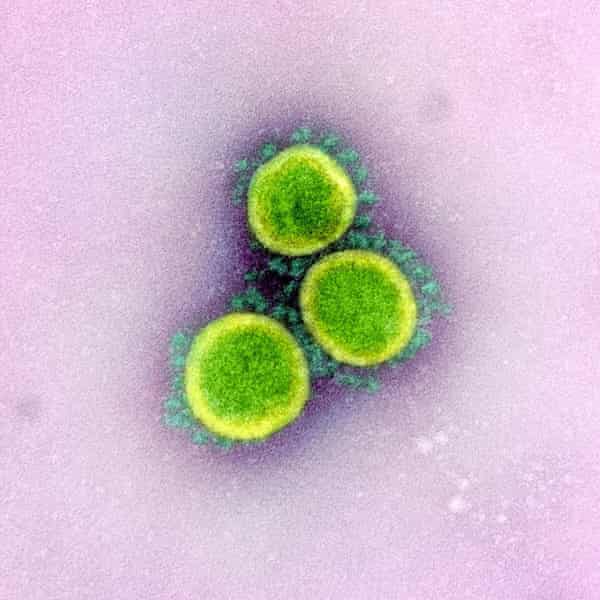
Sars-CoV-2 particles captured by a transmission electron micrograph.
Sars-CoV-2 particles captured by a transmission electron micrograph. Photograph: Alamy
Modjarrad’s team began Phase I clinical trials (looking just at the safety) of their pan-variant vaccine in April 2021. It uses a tiny nanoparticle called ferritin – a natural protein that stores iron atoms in the body – studded with many copies of the Sars-CoV-2 RBD.

It has been long known that many copies of an antigen in a single vaccine particle elicit a stronger immune response than a single copy does. The institute is cagey about releasing details of its progress until its clinical trial data has been published. In December, however, the team published results showing that their ferritin vaccine confers good protection in macaques not only against the ancestral form of Sars-CoV-2 but also against the Alpha, Beta, Gamma and Delta variants, and the original Sars virus.

Barton Haynes of the Duke University School of Medicine in North Carolina is taking a similar approach with RBD-studded ferritin-based nanoparticles. Last May he and his coworkers reported a candidate vaccine that protected macaques against Sars-CoV-2, Sars, and some Sars-like bat coronaviruses. Very recently they showed that it generates a good immune response against the Delta and Omicron variants too.

Haynes says they hope to start human clinical trials at the end of 2022. If they work out, he thinks that it might take a year or two before the vaccine is ready to use, depending on whether it’s deemed different enough from those we have already to warrant another large-scale Phase III clinical trial before being approved.

These efforts might yield a vaccine resistant to all SARS-CoV-2 variants – but in principle such approaches might have an even wider scope, offering the universal coronavirus vaccines that Fauci and colleagues have called for. Haynes says that would probably entail finding the crucial RBDs for other families and adding those on to the particles too. That’s the beauty of the nanoparticle approach: it can readily incorporate a variety of protein fragments into a so-called multivalent vaccine.

Finding the right protein fragments could mean combing through the thousands of coronaviruses known to infect wild animals such as bats, civet cats and raccoon dogs, as well as the four coronaviruses already endemic in human populations and which cause mild cold-like respiratory symptoms. It would be a huge task. But now we know the awful dangers such coronaviruses (which include those that caused outbreaks of Sars in 2003 and Mers in 2012) pose, the investment would be cheap compared with the economic and social harm it might prevent. Haynes hopes it might ultimately be possible for a single jab to protect against all coronaviruses for five to 10 years.

Of course, no one can be sure what the fiendishly ingenious Covid-19 virus has in store for the future. “The first axiom of infectious disease is, never underestimate your pathogen,” says Corey. “The rapidity with which we’ve got four major variants in two and a half years is unprecedented and surprising. One wouldn’t bet against this virus.”

But even viruses have limits. For example, despite Omicron’s extensive set of mutations, Vir’s sotrovimab still works against it. “Viruses can change some things but have a really hard time changing others,” says Virgin. “There are some things a virus just can’t get away with changing.” If you can find them, you’re in business. “I am optimistic that we can generate a vaccine that will give truly broad protection,” he says.

Even the current vaccines still do well at preventing deaths, and we’re building up an arsenal of antivirals and other treatments too. What might be more important now, Corey says, is a vaccine that does better against all variants at blocking transmission. Even when death rates are reduced, “we are seeing the fabric of our lives, our travel, the things that make modern culture, be interfered with enormously,” he says. So we need second-generation vaccines that can prevent widespread infection – a goal that Corey says is widely regarded as tougher, and which would be hard to assess until they are rolled out.

It’s tempting to think that we need to solve this pandemic before preparing for the next one, says Virgin, but “there’s absolutely no reason that your pandemic response can’t prepare you for the next”. And after all, he adds, it’s easier to persuade governments to spend on solving an existing problem than on one that hasn’t happened yet.

“We really want to get to the point where we’re preventing the next pandemic, not responding to it,” says Neil King of the University of Washington in Seattle, who is also developing a universal nanoparticle-based coronavirus vaccine. “The only way to do that is through broadly protective vaccines.” How marvellous it would be if, in developing a variant-proof Covid vaccine, we end up with one that can avoid the next pandemic too.

=====================================================

WORLD COVID STATS

Coronavirus Cases:

436,122,374

Deaths:

5,969,082

Recovered:

366,695,655
Highlighted in green
= all cases have recovered from the infection
Highlighted in grey
= all cases have had an outcome (there are no active cases)

[back to top ↑]

Latest News

February 28 (GMT)

Updates

  • 106,920 new cases and 733 new deaths in Russia [source]


The post Five Million Kids Lose Parents to Virus, Variant Proof Vaccine?, World Covid Stats appeared first on The St Kitts Nevis Observer.

NSW flood rescues continue into the night

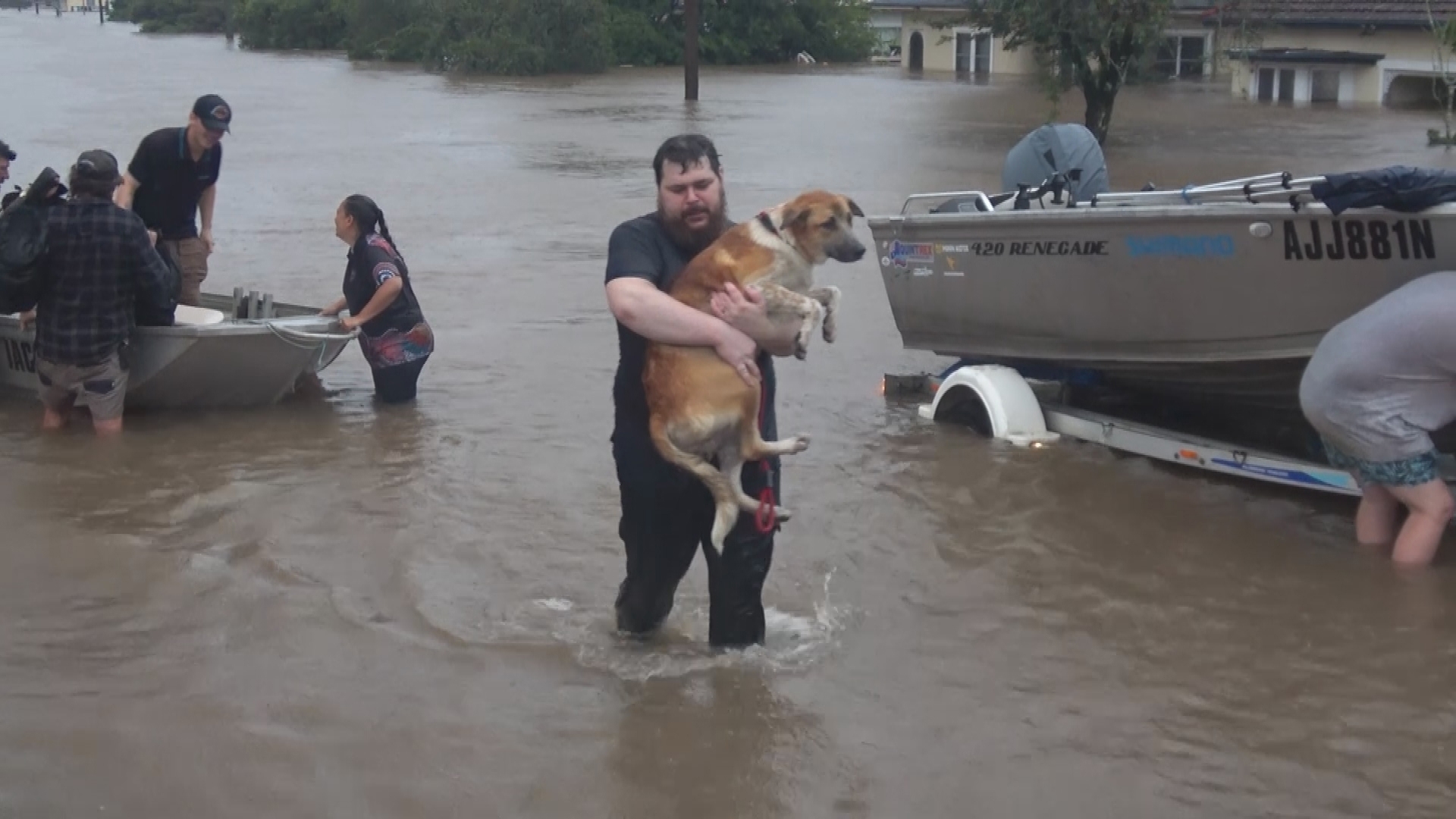
Rescue efforts across northern New South Wales have been nonstop but hundreds of people are still unaccounted for as the state is gripped by a flood crisis.

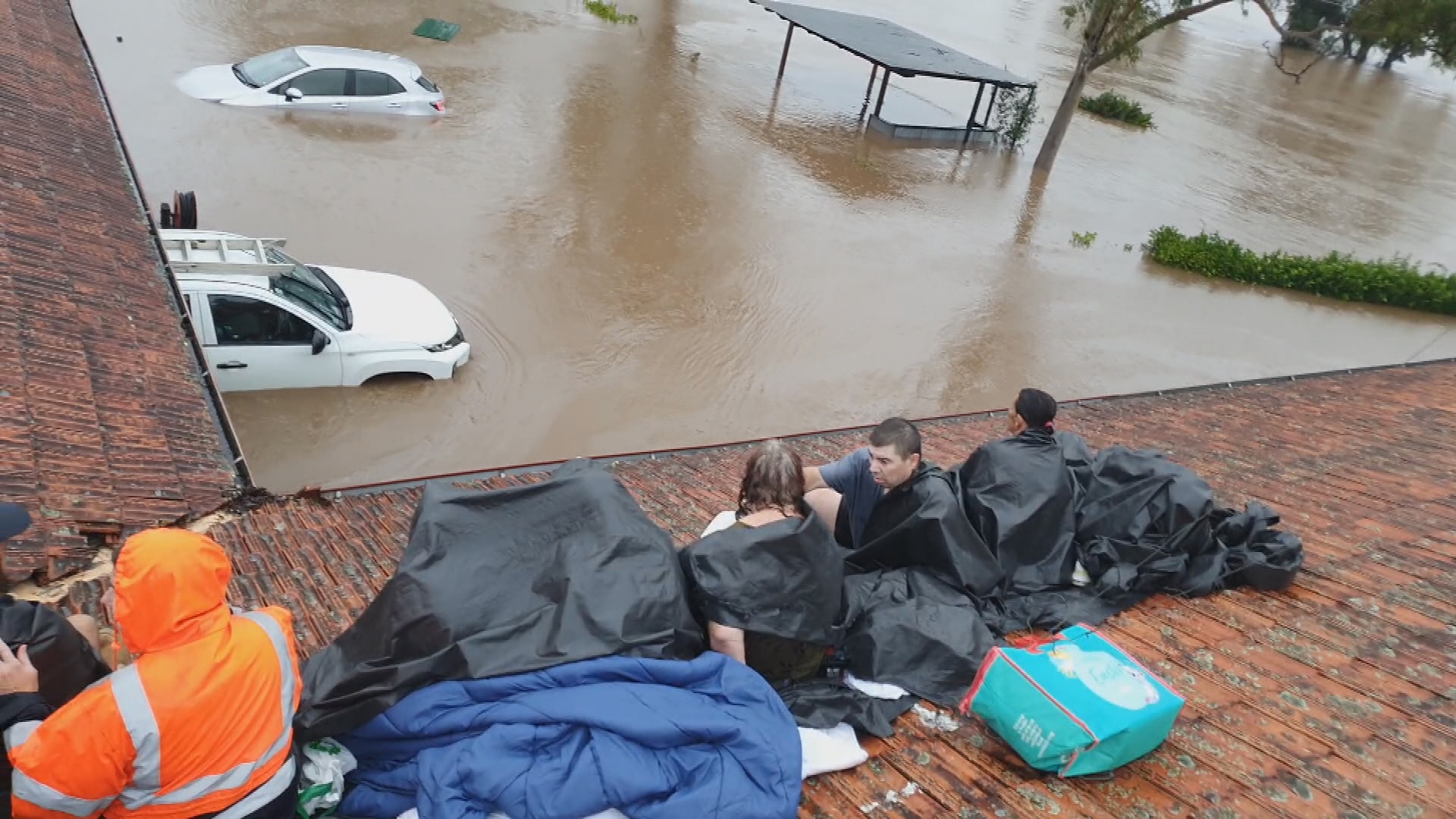
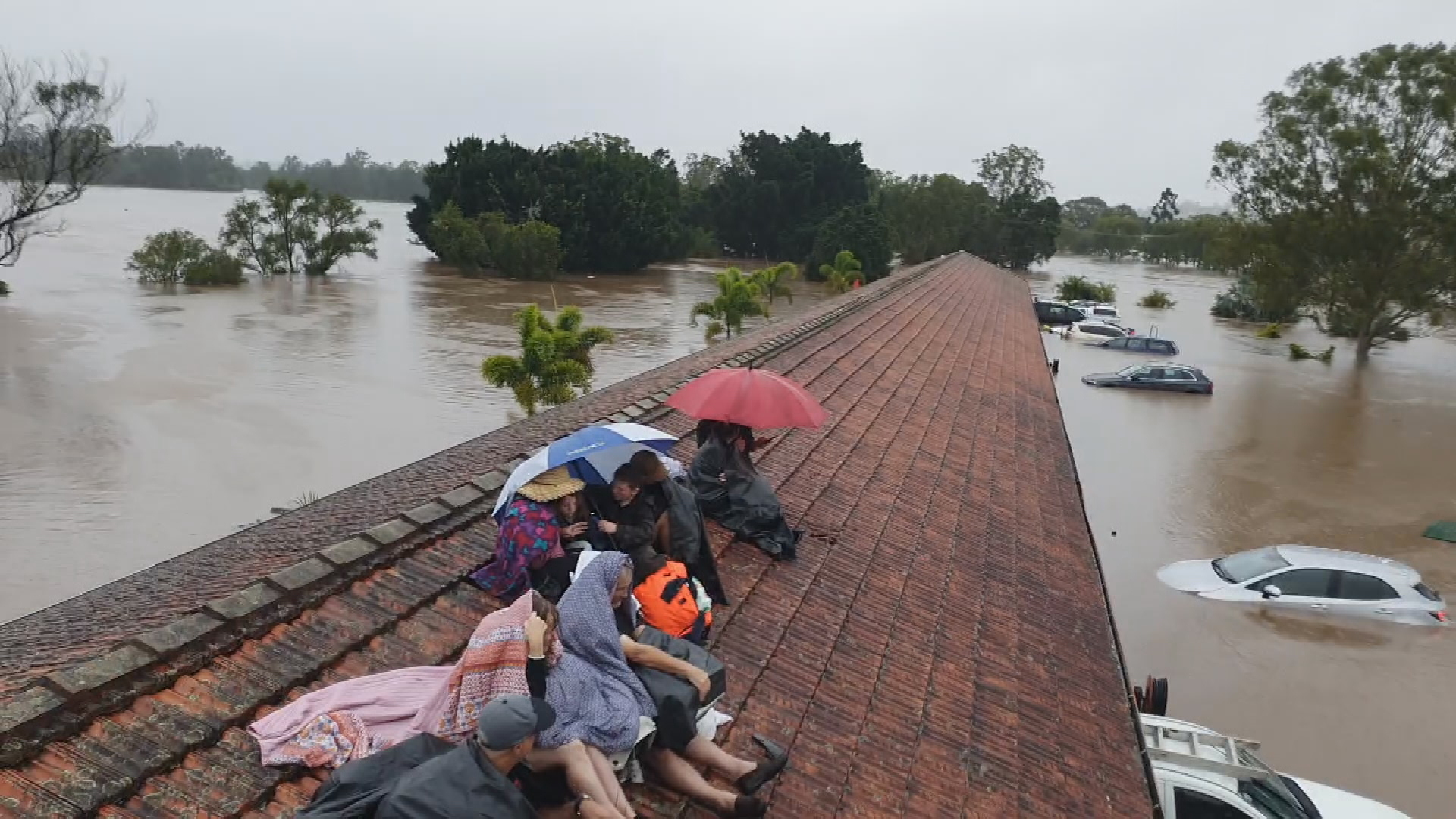
"Right now there are around 400 people unaccounted for, trapped in their ceilings and on their roofs, waiting to be rescued," 9News reporter Sophie Walsh said just after 6pm.

The rescue mission is expected to continue well into the night and follows hours of exhausting operations to reach people inundated by floodwaters on Monday.

https://twitter.com/9NewsSyd/status/1498202398430486529

A frantic rescue unfolded in the afternoon at a nursing home at Lismore.

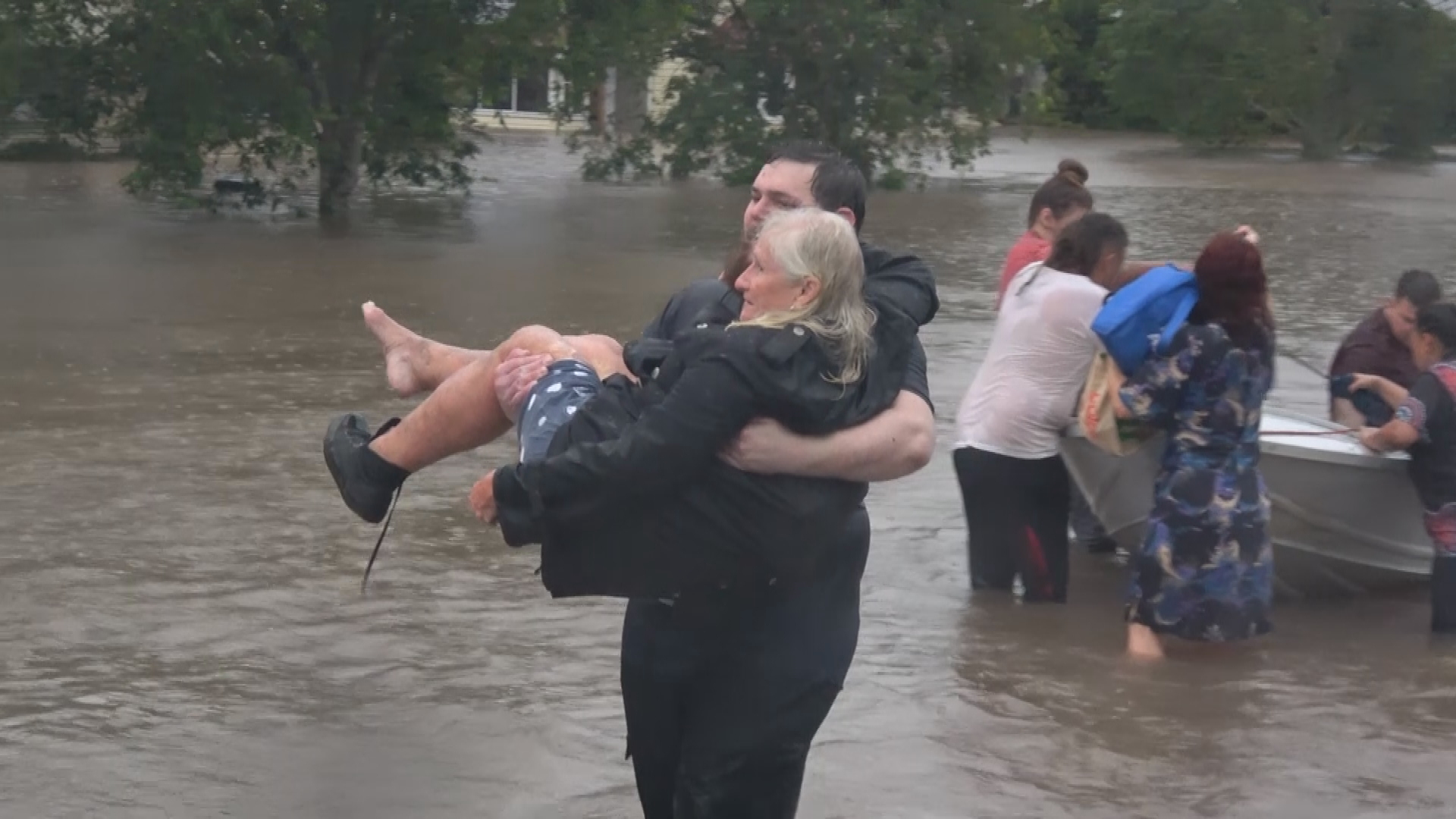
A group of Fijian abattoir workers who arrived in Australia this month helped the State Emergency Services (SES) get to more than 60 residents who were stranded at the nursing home.

While the rain has started to ease and the river has peaked, residents are expected to find out the extent of the damage tomorrow.

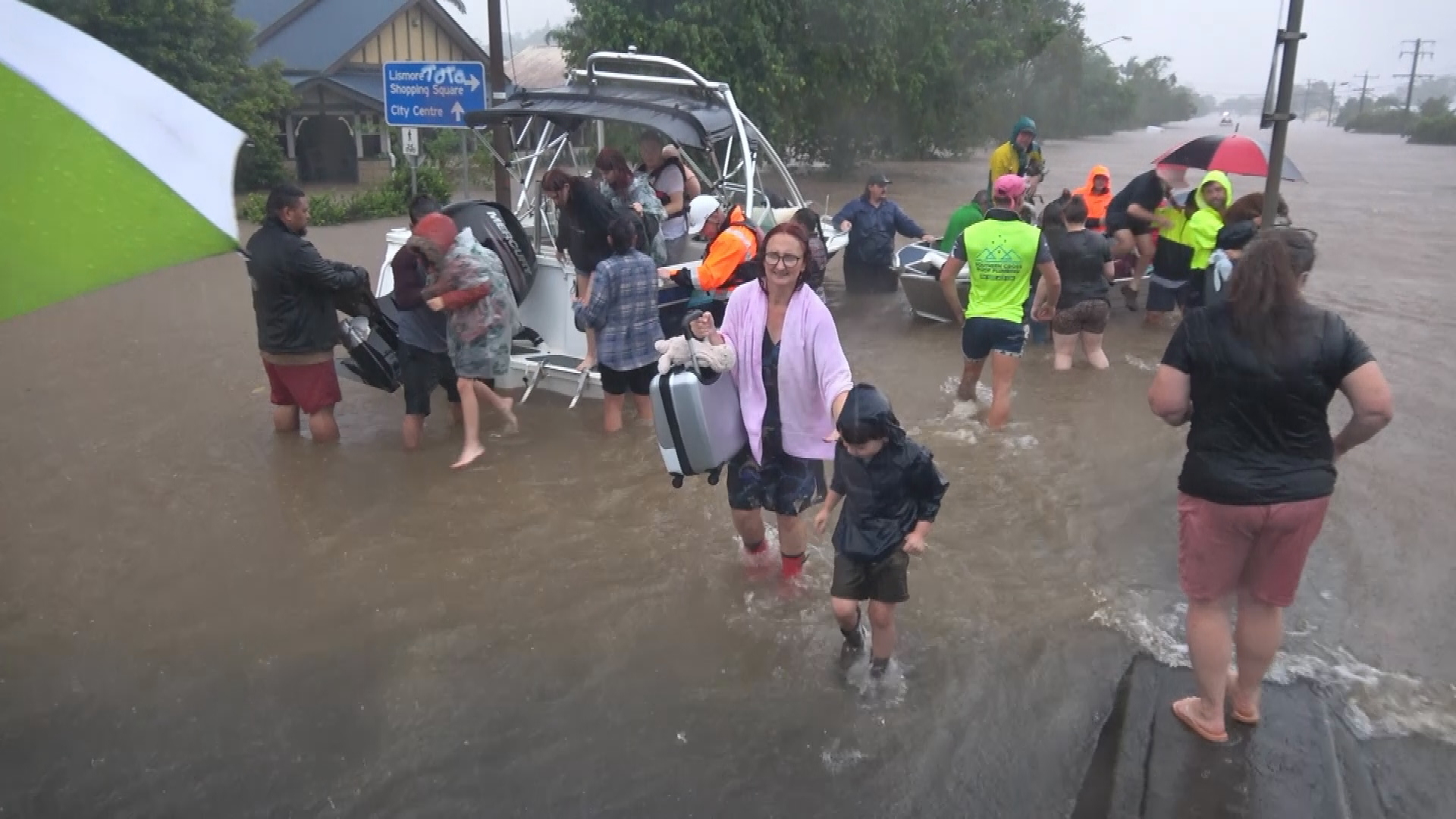
Streets turn to rivers

9News reporter James Wilson captured the devastating impacts of the emergency, travelling through the CBD on a boat, where houses and businesses have submerged.

The city's roads have turned into rivers, with vision capturing the Audi dealership and a Hungry Jack's underwater on the main street.

"This is a hotel right here which is completely underwater," Wilson said.

"The local Audi is completely destroyed. The water is going up the roof and this is what's left of the roof and this is what's left of the local Hungry Jack's.

"This would normally be the main street here. This is the street where people drive and they go and do their shopping and we are driving boats right now, right over the top.

"We're having to duck underneath power lines. That is how high the water is right now."

There are about 400 people still yet to be accounted for in Lismore as emergency services rush to save people before it gets dark.

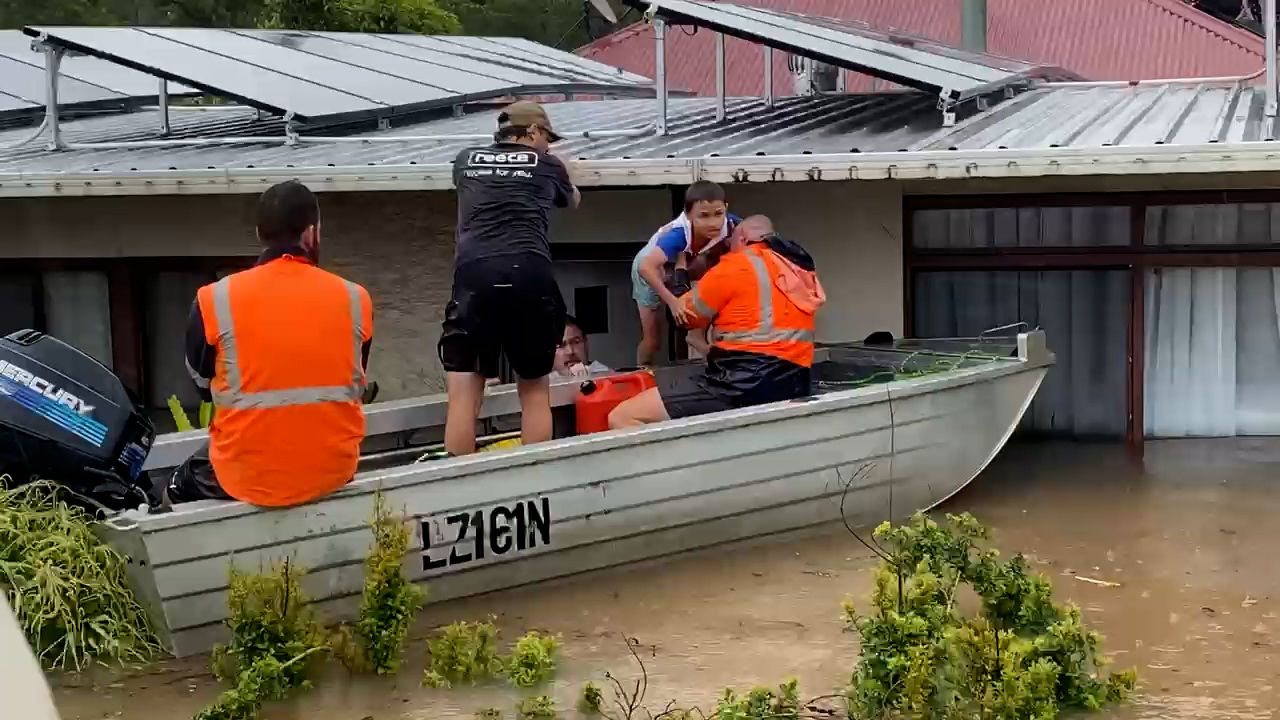
Dozens of people are trapped- unable to escape unless they are rescued by boat – with some people being forced to cut through their roofs to survive the flooding.

READ MORE: Seven deaths in Queensland floods as millions told to stay home

A constant stream of vessels are cruising down the main road, rescuing residents from properties, however, the number of people stranded outnumbers the number of emergency vessels on hand.

A young boy and his two parents have been rescued after being trapped inside their home, with floodwaters almost reaching the ceiling.

While a pregnant woman has been trapped inside a Booerie Creek roof since 5am, waiting to be rescued.

https://twitter.com/livgracecurran/status/1498103300176035845

A family is also stranded with their two-month-old baby at Lismore Showgrounds and has made a desperate plea for help.

"I'm in a van, my work van. I have my son and girlfriend with the baby," resident Michael told 9News.

"We were evacuated from the house this morning. They rung SES and they took a while, probably around two to three hours before they even got us.

"No one even got us then. We tried calling again. I knew they were busy. A mate down the road has seen our distress call and came and got us, brought us over to the Showground.

"We have been here since 8am this morning. Haven't had anything to eat. We're both hungry, the baby is hungry. All we're pleading is to try and get the baby out."

Michael said the water was "up to (their) armpits" in their home.

IN PICTURES: Catastrophic flooding hits Queensland and Far North Queensland

The Bureau of Meteorology has warned floodwaters may peak at 14.2 metres later today, which is almost two metres higher than the area's worst-ever floods in 1954.

Meanwhile, the Wilsons River surged past 14 metres after 10am today.

"It is really a very, very dangerous and very, very volatile weather system that's hit here and there are real concerns for residents," Wilson said.

READ MORE: Today helps flood-stranded family stuck on roof get help

Mother and boys rescued thanks to Facebook post

A mother and her two young sons trapped by floodwaters in their NSW home have been rescued thanks to a Facebook post.

The South Lismore woman and her boys, one of them just three years old, were attempting to escape floodwaters around 10am when they realised it was too dangerous to climb onto the slippery roof of their Edward Street home.

The mother had no phone signal and, losing hope, she sent a distress message on the internet to a family friend overseas.

At the time, the trio was considering sheltering in the roof cavity of their home.

https://twitter.com/FRNSW/status/1498194976966168584

The overseas friend sought help via Sydney's Narellan Fire Station Facebook page, writing the message: "Please small child in house TRAPPED GET HELP OUT THERE NOW PLEASE."

An off-duty FRNSW firefighter, returning home after a holiday with her own family, received the message alert on her phone.

Triple Zero was finally reached and first responders were guided to the property to rescue the woman and her sons.

The family friend received news of the rescue and sent a follow-up message to the firefighter: "Daughter just made contact…they got them out…Thank you so much, guys/girls…God bless you."

The incredible rescue was shared online by Fire and Rescue NSW.

They said people should always call Triple Zero in times of emergency.

Queensland flood toll rises, relief as missing man found alive

The south-east Queensland flooding crisis has claimed yet another life, bringing the death toll to eight.

A 50-year-old man and his dog have died after the car they were travelling in became submerged in floodwaters in Currumbin Valley near the Gold Coast.

Police say the man drove his car into floodwaters around 3am before it was washed away and later discovered by Gold Coast surf life savers.

LIVE COVERAGE: Flood emergency gripping Queensland and northern NSW
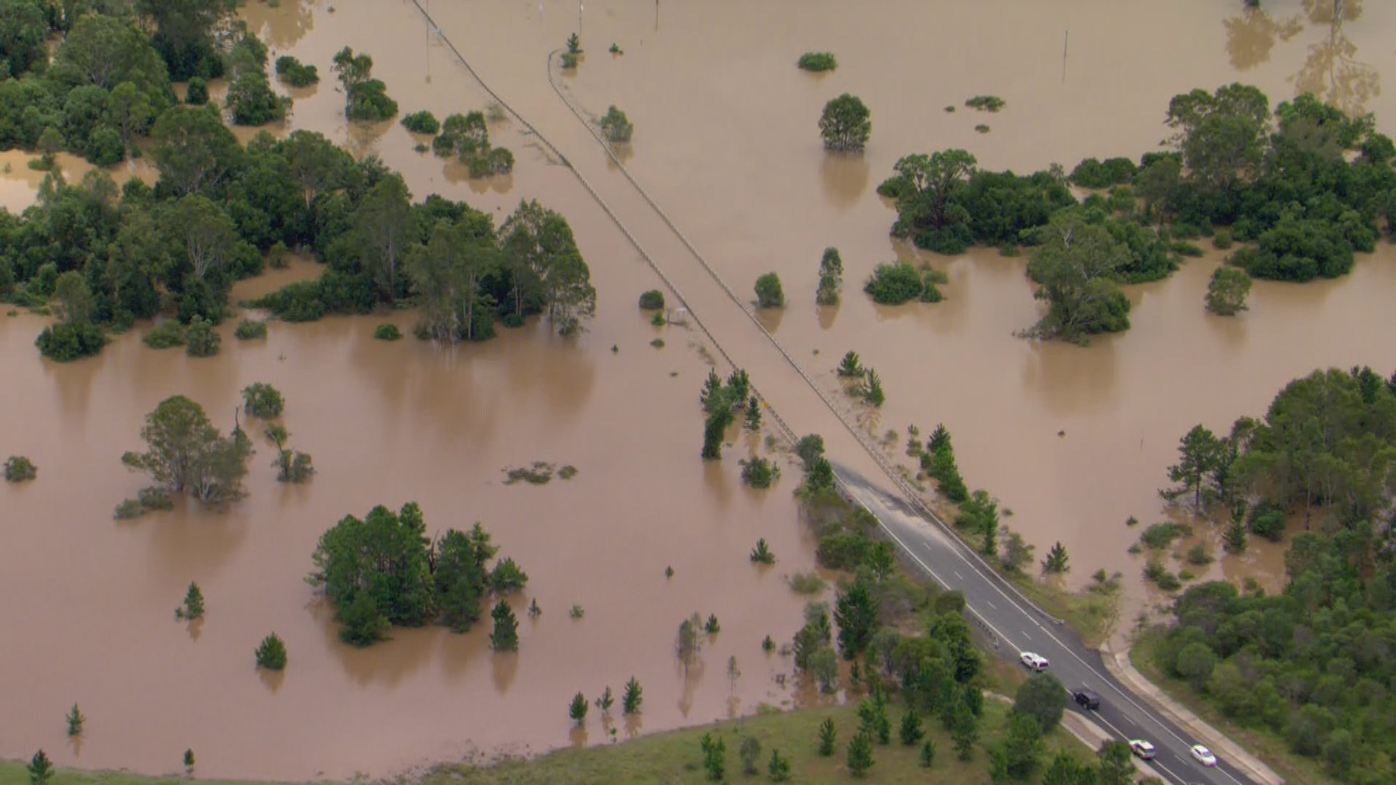
The state is in the grips of a major flooding emergency, with thousands of schools closed, homes underwater and without power and houseboats seen ripped from their moorings.

Queensland Premier Annastacia Palaszczuk this morning said there were 1544 people in evacuation centres across the south-east as floodwaters continue to rise.

More than 1000 schools are now closed and more than 18,000 homes have been impacted.

"The QFES alone had 2200 requests for assistance overnight," Ms Palaszczuk said.

"And 113 water rescues around Brisbane, the Gold Coast and Beenleigh.

"We have around 51,000 people without power. As you can see by this, this is a really big event, and the event is not over," she added.

"In Gympie, we have about 3600 homes that have been impacted.

"In Brisbane, we're estimating there could be up to 15,000 houses that are impacted and as I said, we are going to be monitoring very closely what happens during the rest of the day."
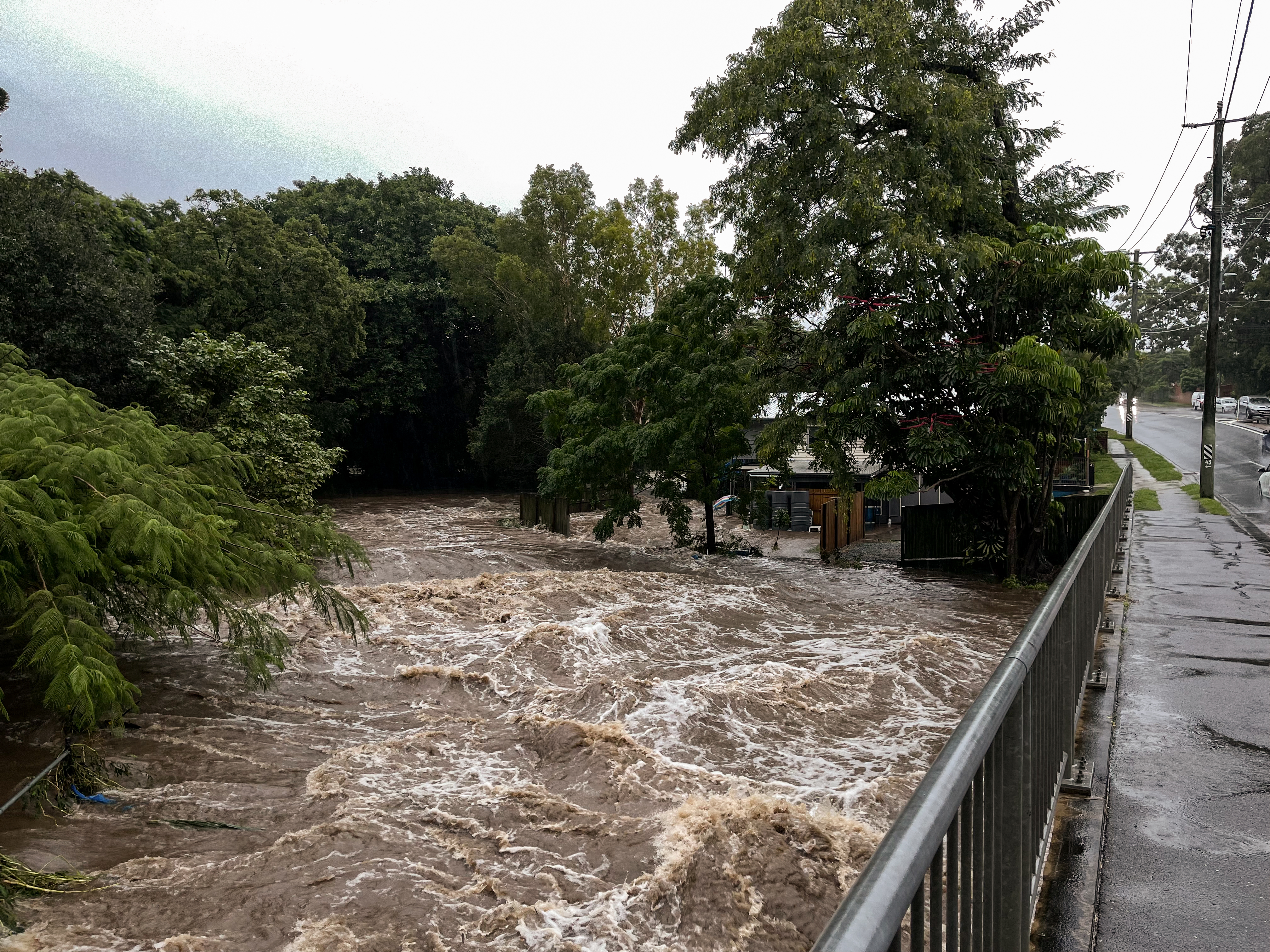
Flooding along Ithaca Creek in Bardon and Red Hill on Sunday, February 27, 2022. Credit: Matt Dennien

Good news for missing Goodna man

Missing man Cameron Rogers has been found safe and sound after his family reported him missing from Goodna last night.

Mr Rogers parked his car at the railway station and went to meet a friend after helping his fiancée and child leave their flooded Goodna home, but never arrived.

Police today confirmed Mr Rogers was found "safe and well".

https://twitter.com/QldPolice/status/1498122610340950016?ref_src=twsrc%5Etfw

A seventh man was killed in floodwaters yesterday, on Cabbage Tree Creek Road when he was swept away on foot by floodwaters.

"Two members of the public raised the alarm, calling police and emergency services and went to the man's aid, conducting CPR," police said.

"Despite the best efforts of attending paramedics, the man died at the scene."

Police said they hold concerns for several people believed missing in floodwaters in the state's south-east.

"There was reports of a missing vehicle swept into floodwaters at Yatala this morning that we are currently investigating," Commissioner Katarina Carroll said.

"As I came in, (there was) a report of a missing person also near Esk, and as you would recall some two days ago a male person had fallen from a vessel in the Brisbane River that we are also following up on."

Debris scattered as damage revealed

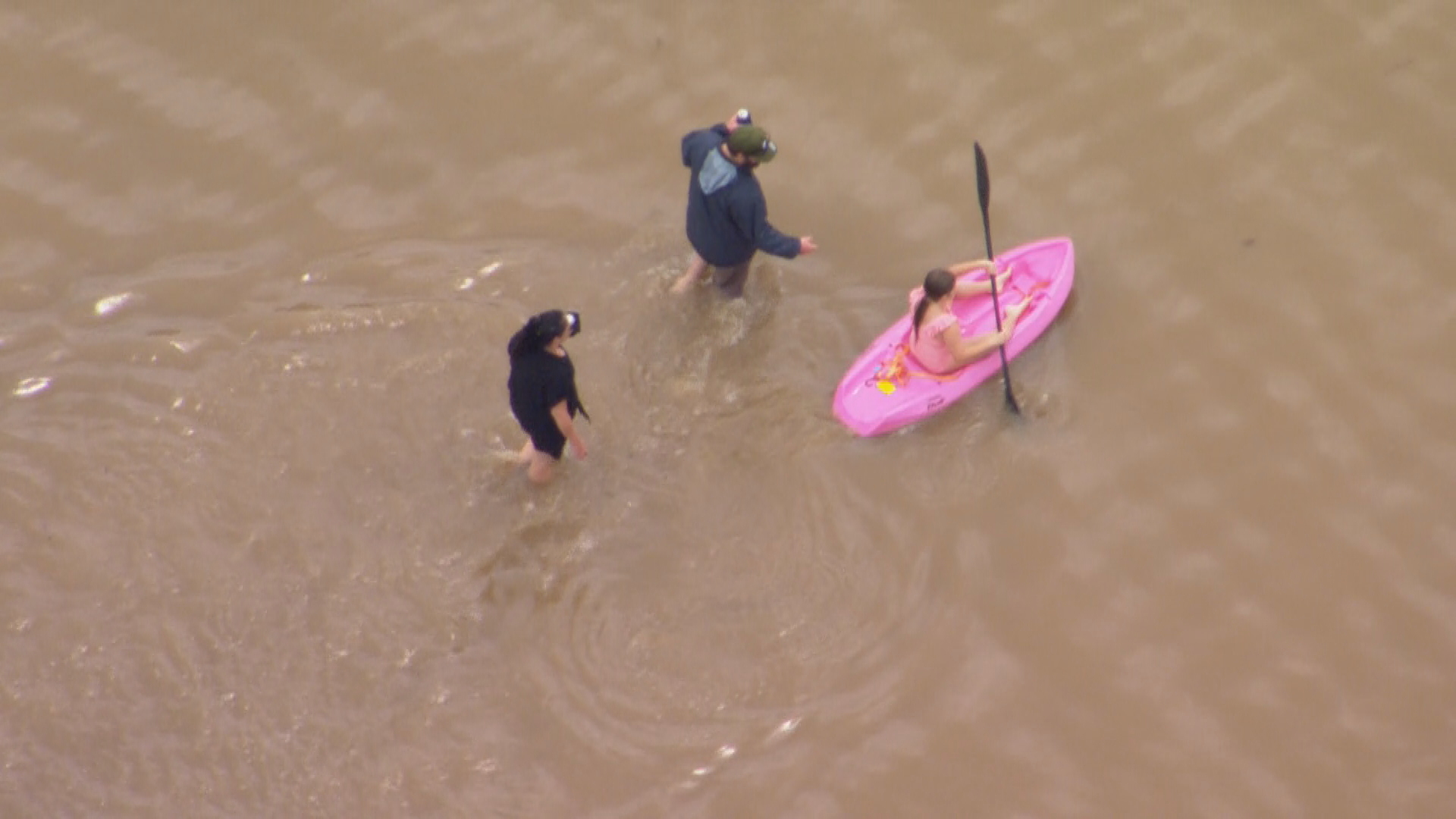
In Brisbane, residents have taken their own kayaks out to assess the damage being done to their properties.

The Brisbane River is expected to peak at four metres later this morning.

This is slightly below the peak of 4.46 metres recorded in 2011.

https://twitter.com/SylviaJeffreys/status/1498057990938578944

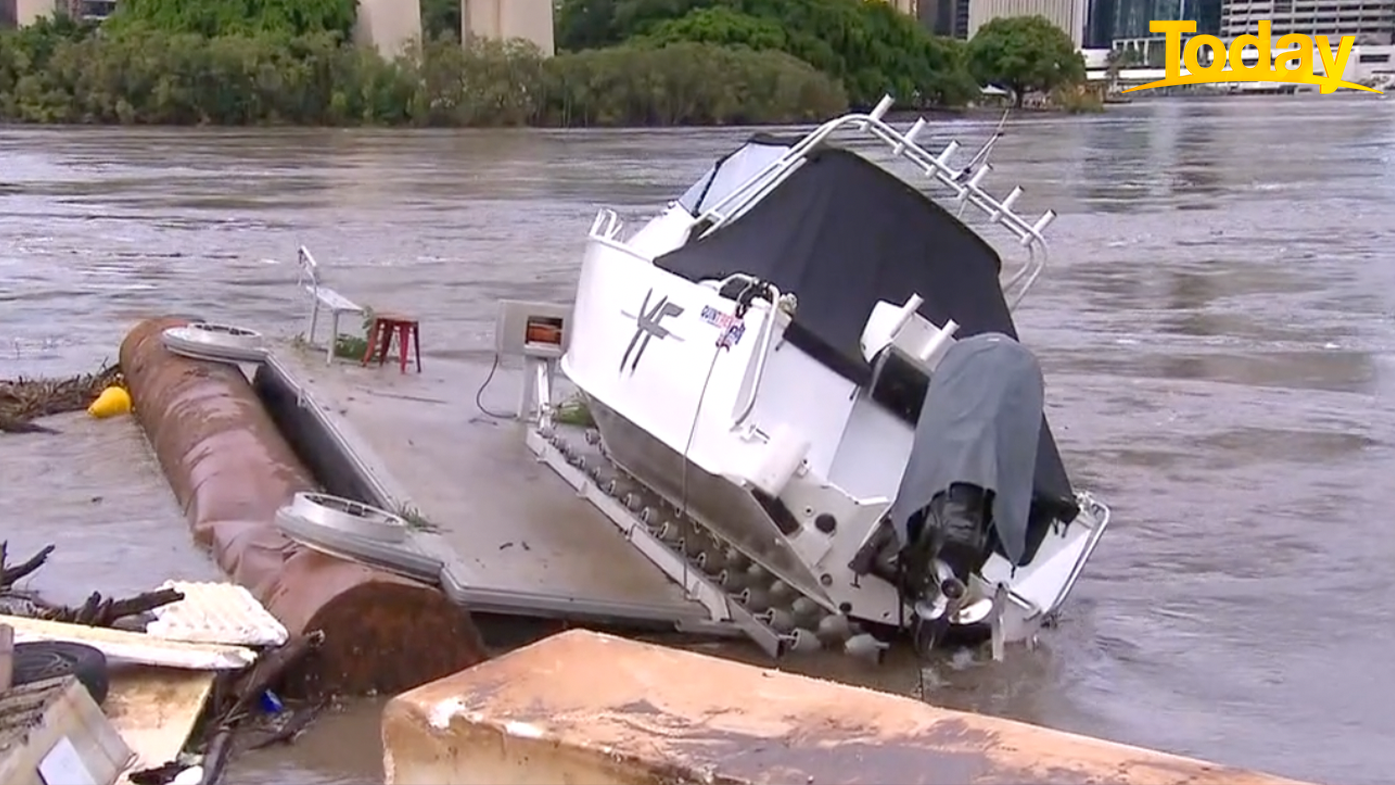
Swirling floodwaters is causing debris to build-up along the banks of the Brisbane River.

Items from emergency beacons, buoys, to pylons and boats have been photographed flung along the shoreline.

LIVE UPDATES: Putin orders strategic nuclear forces to be placed on high alert
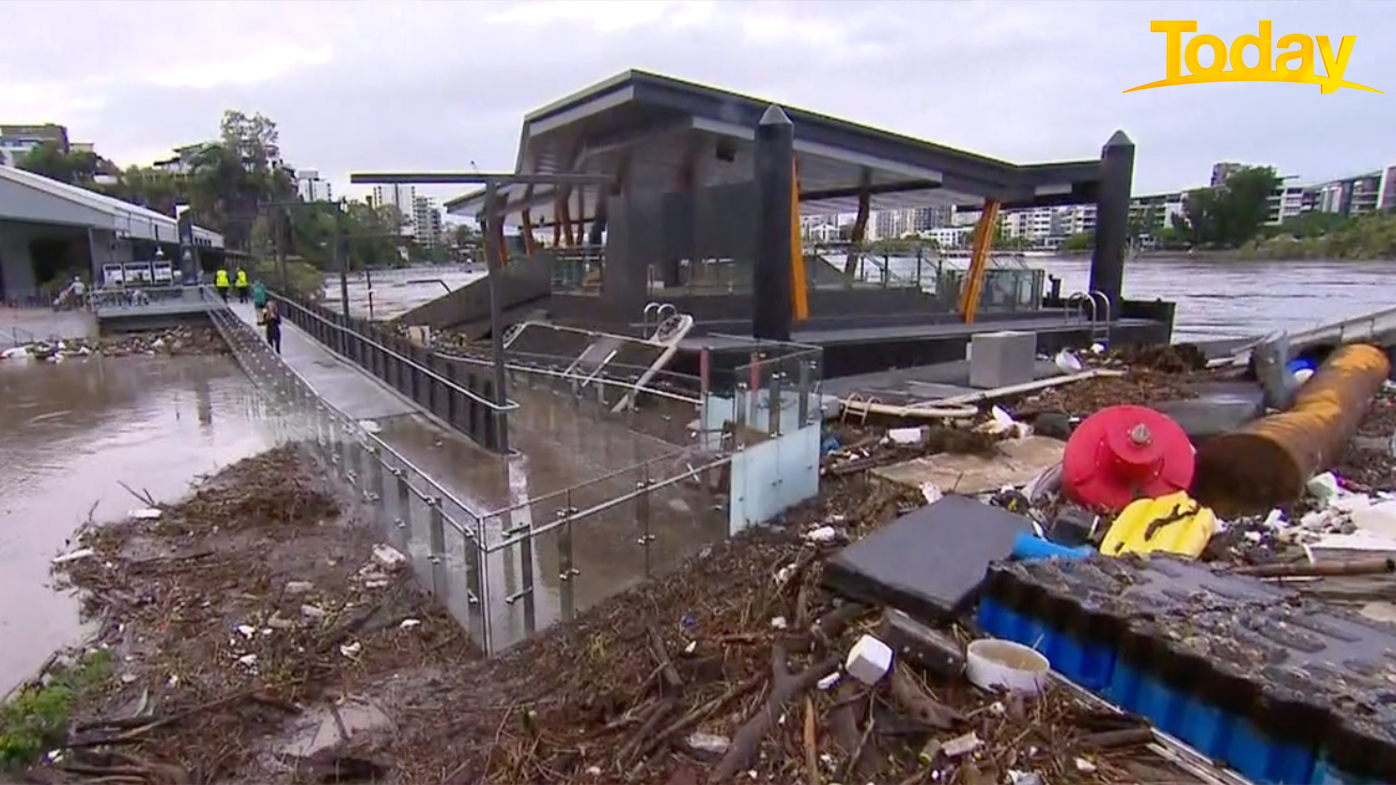
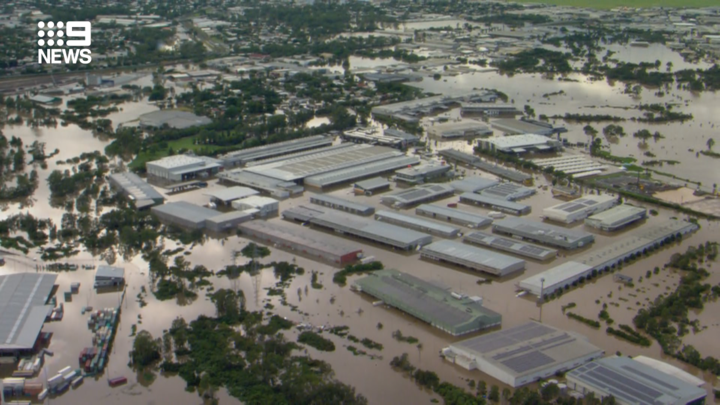
Flood debris is mounting at Howard Smith Wharves.A small boat lies washed up along the banks of the Brisbane river.Queensland flooding from above shows extent of Brisbane river spillage.

Witnesses told Today the river is audibly "roaring" like an ocean.

A helicopter has captured the extent of the devastation, with brown water extending as far as the eye can see.

The waters have torn a large houseboat from its moorings.

The barge is being swept down the river towards the Goodwill Bridge.
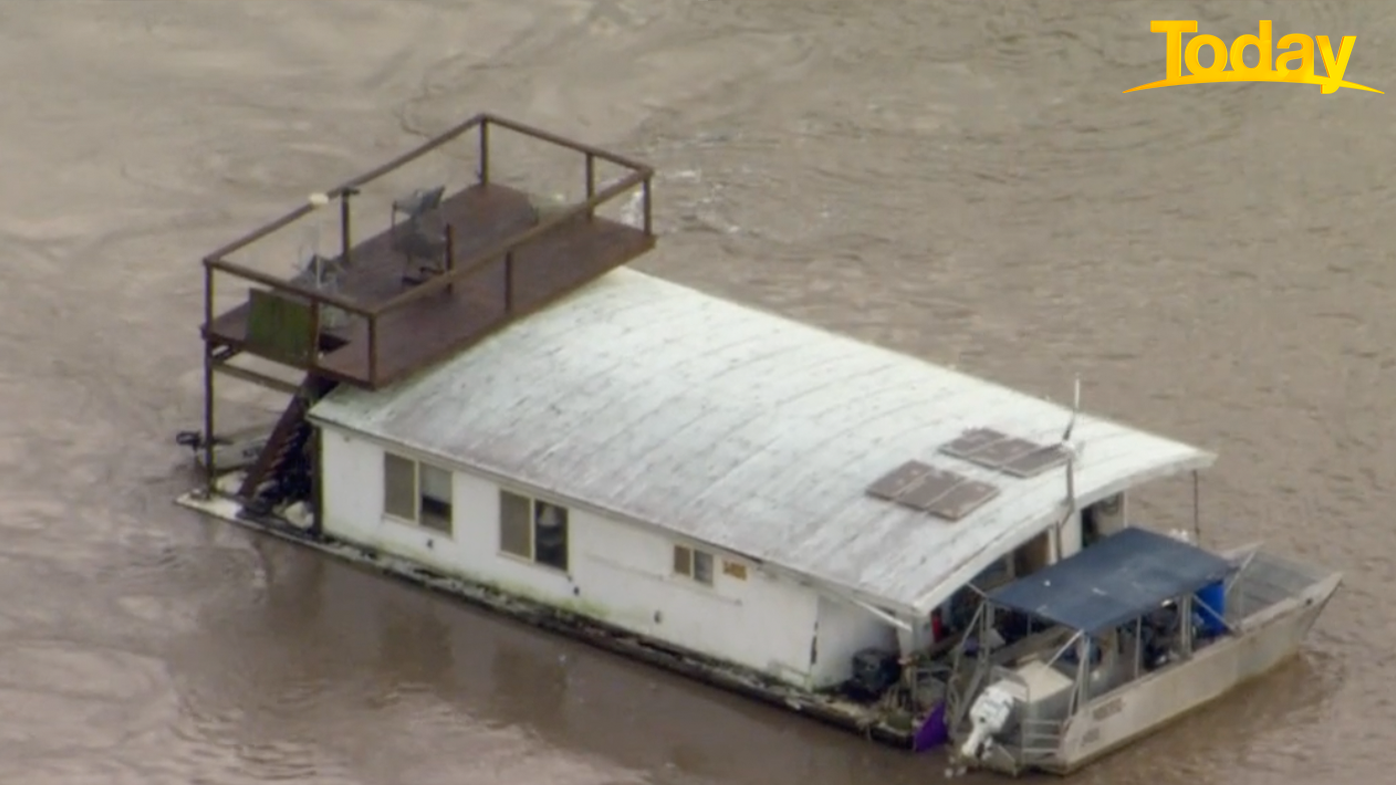
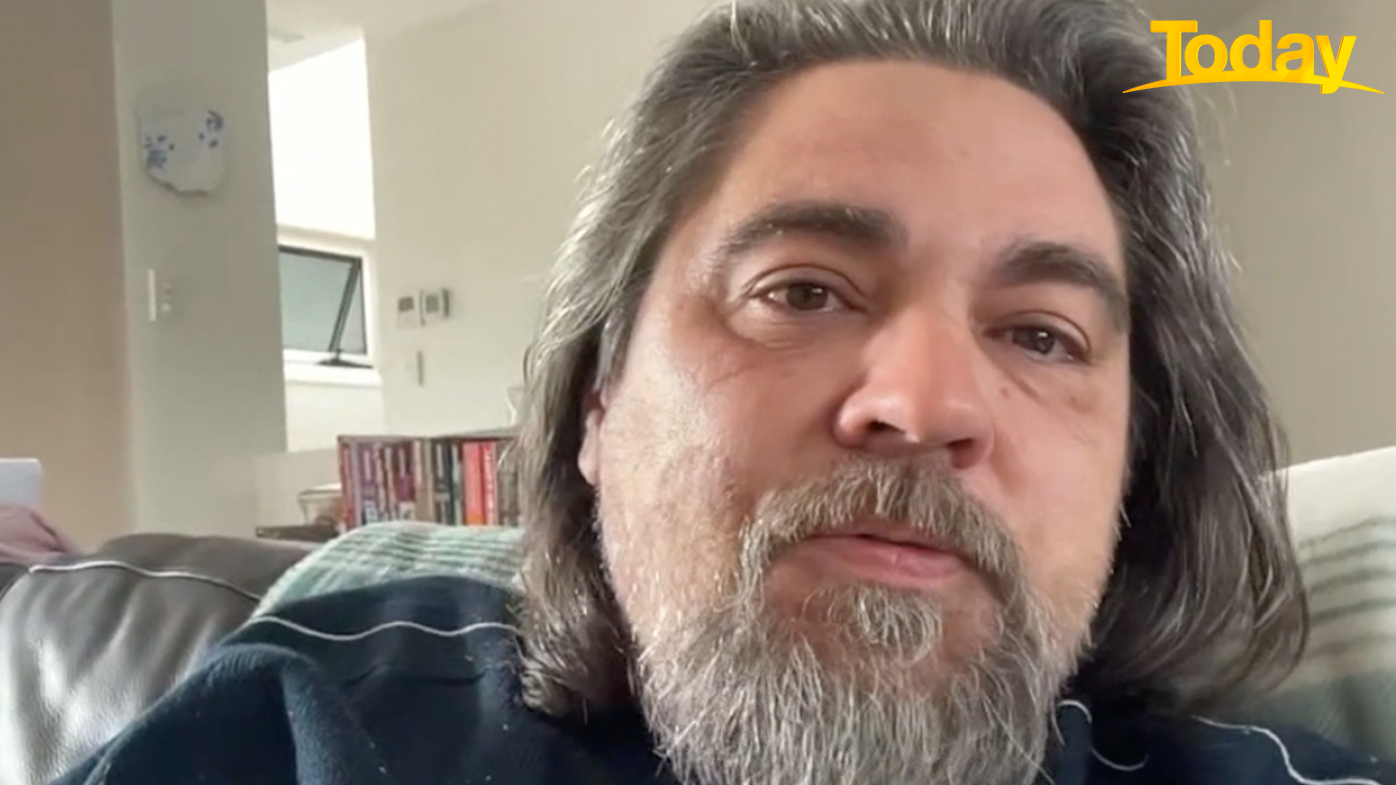
The large houseboat has a smaller boat attached to the back. The barges are used for oyster-farming and are worth 'quite a lot of money'.Houseboat owner Steve Jackson said he's 'heartbroken' at the loss of his home.

Steve Jackson, owner of the houseboat, tearfully spoke to Today, explaining the boat has been his home for seven years.

"It's been a couple of bad days," Mr Jackson said.

"I got rescued by the Water Police yesterday morning because I couldn't stay on the boat any longer.

"I thought it would hang on through the whole thing. Unfortunately it let go this morning.

"My home… My kids have lived with me 50 per cent on and off there as well. It's got a lot of memories and a lot of stuff in there.

"I only managed to get out passport and keys and important stuff before I managed to bail-out yesterday with the dog on the police boat.

"It's very sad, mate."

Intense weather continues to lash state

Millions of Queenslanders have been told to stay home today, as intense weather continues to lash the state.

More than 900 schools have been closed for the start of the week and people are being asked to work from home amid fresh flood warnings from the Bureau of Meteorology (BoM) last night.

With rain now easing in Brisbane, focus is now shifting to rivers and creeks, with multiple on flood watch.

READ MORE: Gympie smashed by largest flood in more than a century

Just before midnight, a severe thunderstorm warning was also issued for the south-east Queensland region, for "intense rainfall that may lead to dangerous & life-threatening flash flooding".

Areas impacted include Logan, Sunnybank Hills and Beenleigh.

This comes in addition to earlier warnings for parts of the Gold Coast, Redland City and Brisbane City Council areas.

https://twitter.com/BOM_Qld/status/1497917728165969922?ref_src=twsrc%5Etfw

The Bureau of Meteorology (BoM) has warned intense rainfall is likely on the southern Gold Coast, and over the border, for the next few hours.

"106mm in the last 2 hours at Tallebudgera Valley," it said.

Wind gusts could exceed 90km/h in some parts, the BoM warns, especially in coastal areas.
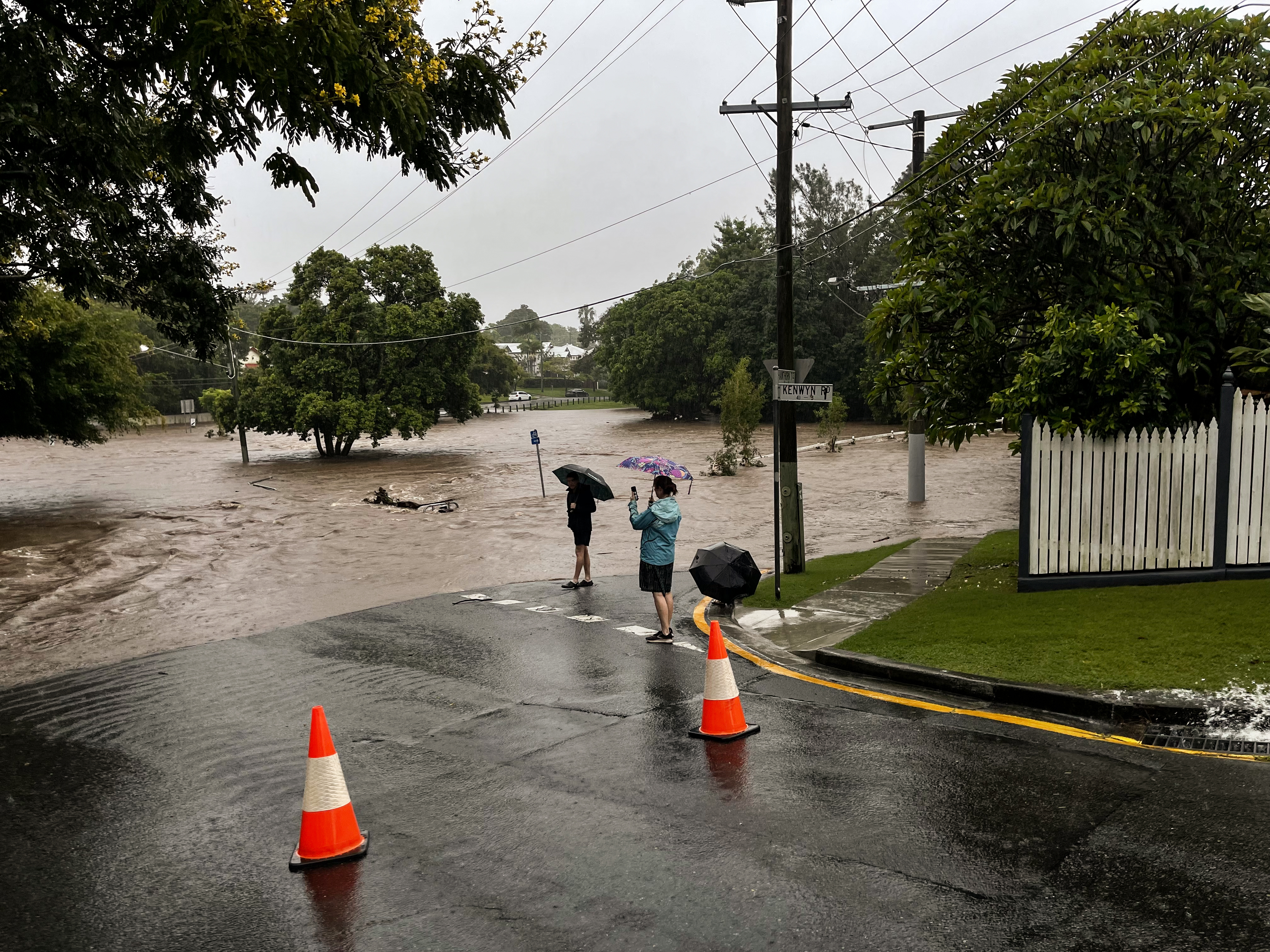
Flooding along Ithaca Creek in Bardon and Red Hill on Sunday, February 27, 2022. Credit: Matt Dennien

Forecast for more rain and 'life-threatening flash flooding'

The hazardous conditions are being brought about by a low pressure system currently centred near Brisbane.

A man managed to escape uninjured after a house boat swept away by currents in the Brisbane River collided with a ferry terminal at Kangaroo Point yesterday morning.

READ MORE: Today helps flood-stranded family stuck on roof get help
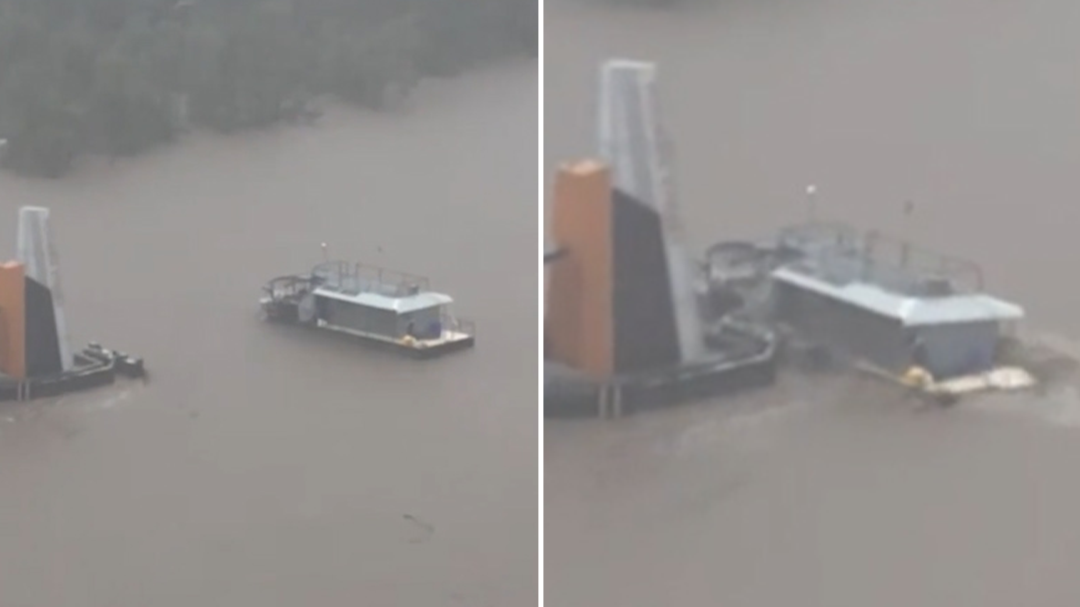
Houseboat collides with ferry terminal on raging Brisbane river

"Police tracked the man in the fast-moving water for approximately 500m before reaching the ferry terminal at Howard Smith Wharves," police said.

"Water and onshore police observed members of the public being able to pull the man from the water and onto the terminal."
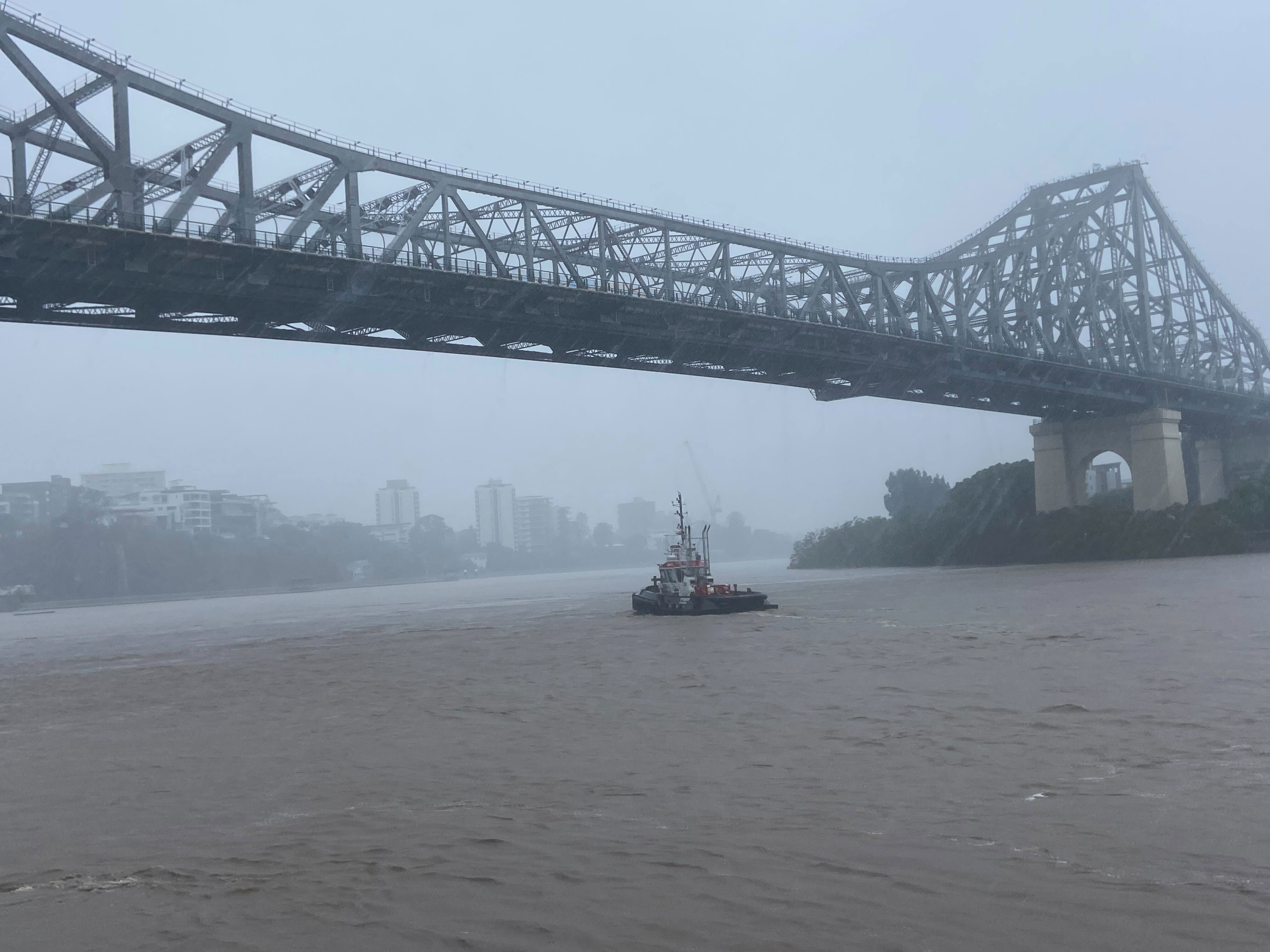
Brisbane floods 2022

The BoM has upgraded its flood warnings to "major" for the lower Brisbane River around the central business district and the Logan and Albert rivers, following continued rain throughout Sunday.

"With these conditions, multiple homes may be inundated by water, bridges and traffic routes are likely to be cut and significant overland flooding is expected," it said.

The Brisbane River also reached major flood levels of 3.50m on the high tide yesterday, falling to 3.35m with the tide.

https://twitter.com/BOM_Qld/status/1497930226927644678?ref_src=twsrc%5Etfwhttps://twitter.com/brisbanecityqld/status/1497792223999500291?ref_src=twsrc%5Etfw

More than 400mm of rainfall was recorded in the Brisbane area yesterday.

This has contributed to Wivenhoe Dam utilising flood storage compartment as it currently sits at 183.7 per cent above capacity, according to Seqwater.

This comes despite staged releases of water, which began on Friday night, with the first of these expected to reach Brisbane today.

Queensland residents are also being asked to conserve drinking water, with treatment plant impacted by the weather event.

Brisbane Airport remains open but localised flooding has blocked some point access to and from the airport, with flooding also resulting in the closure of the Skygate and DFO precincts.

https://twitter.com/BrisbaneAirport/status/1497885460391071744?ref_src=twsrc%5Etfw

Further north, the Bruce Highway remains closed between Caloundra and Caboolture.

System likened to 'an unpredictable cyclone'

Ms Palaszczuk yesterday likened the system smashing the state's south-east to "an unpredictable cyclone" and urged caution.

"No one expected this rain bomb to be sitting over the south-east of our state for such a long period of time," she said.

"This is like an unpredictable cyclone and it is levels that we never expected or could never have been forecast."

She today said the weather system shared similarities to Cyclone Debbie in 2017.

"If everyone can remember, ex-tropical cyclone Debbie went across the coast around Airlie Beach came to the south-east, then went into northern NSW and ended up in New Zealand," she said.

"And what we're seeing with this system at the moment is pushing further south, down into Logan, the Albert, the Gold Coast, and now we're seeing some of the tragedies unfolding down in northern NSW."

While the "rain bomb" is expected to move south into NSW today, floodwaters are expected to linger for the following three-to-five days.

Prime Minister Scott Morrison announced the Federal Government had activated disaster recovery payments of $1000 per eligible adult and $400 per eligible child to support those impacted.

The payments will be available for people in the local government areas of Gympie and North Burnett from today, but are expected to be made more widely available as other areas are declared disaster zones.

The Australian Defence Force said personnel will continue to support the emergency response efforts and will do more once the water recedes and the recovery effort starts.

Gastro alert as cases spike at Victorian childcare centres

Victoria's Department of Health has issued an urgent gastro alert following a summer spike in cases at childcare centres.

There have been 104 outbreaks of viral gastroenteritis in Victorian childcare centres up to February 23 this year.

The average for the same period over the past five years is 63.

LIVE UPDATES: Major flood emergency gripping Queensland and NSW

Childcare industry is at breaking point, according to Cass Duff

Viral gastroenteritis is highly infectious and the symptoms include nausea, vomiting, diarrhoea, fever, abdominal pain, headache and muscle aches.

Symptoms sometimes can take up to three days to develop and usually last between one or two days, sometimes longer.

In rare cases, gastro can develop into a more serious illness.

Chief Health Officer Professor Brett Sutton said "good old-fashioned" handwashing with soap and water was the best defence against the bug.

"Gastroenteritis can spread quickly through settings such as early childhood education and care services, where children play and interact closely with each other and their carers and can readily spread their bugs," he said.

"It is important that early childhood services have good hygiene practices in place and to respond quickly with thorough and appropriate cleaning and disinfection if any children become ill."

Professor Sutton said hand-sanitiser had become increasingly popular due to the COVID-19 pandemic, but handwashing with soap and warm water was still the best hygiene method to minimise the chance of spreading the virus.

READ MORE: Gastro cases surge by 97 per cent in NSW childcare centres

https://twitter.com/VicGovDH/status/1498181881988534273

"A good old-fashioned scrub with soap and warm water is the best way to remove the gastro virus from our hands and prevent passing it on to infect others," he said.

Children with gastro should be kept home from early childhood services until 48 hours after they recover.

Cases of gastro surged last year, with 56 outbreaks detected in the six weeks to mid-December.

At the start of 2021, after a COVID lockdown was eased, 389 outbreaks were detected in childcare settings up to the end of April.

The figure is four times higher than the average for that time of year.

Anyone recovering from gastroenteritis should avoid visiting hospitals, early childhood services and aged care facilities to avoid spreading the infection to vulnerable people.

People should see a GP for advice and testing if their symptoms are severe or persist.