A leading epidemiologist says Kiwi journalist Charlotte Bellis’ battle to return to New Zealand to give birth highlights the delicate balancing act governments face in a pandemic.Otago University epidemiologist Professor Michael…
Category Archives: headline
For Some Cubans, Haitians The Bahamas is a Stepping Stone to the Promised Land
AP- A capsized boat likely came from the Bahamas, but Cubans and Haitians often are the ones fleeing to America.
Little is known about the 40 people believed to have been aboard a boat that capsized and was found this week near Florida’s coast with just one survivor. But they were on a route often traveled by migrants trying to enter the U.S. clandestinely, and authorities suspect the trip was organized by smugglers.
Apprehensions of migrants in the Florida-Caribbean region appear to be on pace to surpass numbers from last year, with more Cubans and Haitians taking to sea despite the dangers and stricter U.S. refugee policies.
The sole survivor told a good Samaritan and authorities that the boat capsized late Saturday after he and 39 others had set out for Florida from Bimini, a chain of islands in the Bahamas about 55 miles east of Miami.
Officials say the Bahamas is a common route for smuggling migrants. Both the Coast Guard and Homeland Security say they are treating this as a human smuggling case.
Why the Bahamas?
The Bahamas is seen as a steppingstone to reach Florida and the United States.
For the most part, the migrants are from Haiti and Cuba, but the Royal Bahamas Defense Force has reported apprehending migrants from other parts of the world, including from Colombia and Ecuador.
Refugee aid groups say some migrants opt for the longer route to avoid the increasing law enforcement along the Florida Straits. “They may island hop,” said Randy McGrorty, executive director of Catholic Legal Services.
The defense force said that last Friday it rescued 31 migrants who were on another overcrowded boat that also capsized. Those migrants had also departed from Bimini.
The Bahamas and nearby Turks and Caicos Islands have stepped up their anti-smuggling enforcement efforts in cooperation with the Coast Guard in recent years.
How many are making the journey?
From Oct. 1, 2020, to Sept. 30 of last year, the Coast Guard says that in the region that includes Florida and the Caribbean its crews apprehended 838 Cubans; 1,527 Haitians; and 742 Dominicans.
In less than four months since last October, crews have apprehended 686 Cubans; 802 Haitians and 685 Dominicans.
In May, a Canadian man was sentenced to two years and eight months in prison in U.S. federal court for his role in an operation that smuggled people from Sri Lanka by plane to Haiti, then by boat to the Turks and Caicos and the Bahamas to South Florida.
The total number of people making the journey is impossible to know as many try to arrive undetected and thousands have died over the years.
Why are they coming?
Reasons vary, with some migrants seeking better economic opportunity and some escaping political turbulence or violence.
Cuba is facing an economic crisis that has been exacerbated by the pandemic, increased U.S. sanctions and cutbacks in aid from Venezuela. The crisis has led to shortages in many goods and a series of protests that shook the island on July 11.
Legal ways to leave Cuba were strained by former President Donald Trump’s near-closure of the U.S. Embassy in 2017. The United States had been providing 22,000 visas a year to Cuba for two decades until 2017. And President Joe Biden has not resumed dialogue with the communist nation.
McGrorty, of Catholic Legal Services, says his office is seeing “very meritorious asylum claims.”
In Haiti, violence has spiked since the July assassination of President Jovenel Moise. The political instability and a 7.2 magnitude earthquake in August have deepened a growing humanitarian crisis in the impoverished Caribbean nation.
Can they stay?
The U.S. Coast Guard often repatriates people found at sea; it did so earlier this month when it sent back 119 Cuban migrants.
At the beginning of 2017, President Barack Obama eliminated a policy known as “wet foot-dry foot” that allowed Cubans who reached U.S. shores to remain, usually as refugees, while those caught at sea were sent back.
Typically Cubans would obtain parole cards that allowed them to apply for residency a year afterward. But right now the system is in disarray, with lawsuits challenging how the government treats Cuban asylum seekers. A 56-year-old law has given Cubans a virtually guaranteed path to legal residency and eventual citizenship.
Thousands of Cubans are subject of deportation, but Immigration and Customs Enforcement still lists the communist nation as uncooperative or “recalcitrant” in accepting deportees.
The U.S. government has been called out for expelling thousands of Haitians. A U.N. report estimated about 9,000 Haitians were expelled between Sept. 19, 2021, and late November. Most had arrived at the U.S.-Mexico border in September.
The post For Some Cubans, Haitians The Bahamas is a Stepping Stone to the Promised Land appeared first on The St Kitts Nevis Observer.
Jamaican to Relax Curfew and Other COVID Measures in Coming Months
Sheri-Kae McLeod
Jamaica’s Prime Minister Andrew Holness has signaled his intention to further relax the island’s curfew and other COVID-19 measures in the coming months.
For the last few months, Holness has been urging Jamaicans to take personal responsibility to protect themselves from the virus by getting vaccinated, wearing a mask in public spaces, and staying home if sick. He has also been adamant that the government will not be reverting to lockdowns as it looks to return the country to normality.
While addressing business leaders at the Jamaica Stock Exchange Conference on January 25, the Prime Minister again called on Jamaicans to accept that the country, like the rest of the world, must learn to live with the coronavirus.
“Our society must adapt to living with COVID-19. Almost two years into the pandemic, we have both the knowledge and the means to protect ourselves. Citizens have access to enough reliable information and resources to access their health and risks as well as their economic circumstances and make their own decisions,” Holness said.
The Prime Minister also put the country on notice that some of the existing COVID-19 measures will soon end, barring any extreme spike in cases. He stated that at this stage in the pandemic, the government could not afford the restrictions to impede economic recovery.
“It is no longer appropriate or necessary for the government to use crude, blanket measures such as lockdowns to shield the population from the virus. These restrictions are designed to restrict movement but ultimately put a stranglehold on economic and social activity. They keep our children out of school. They have a devastating impact on livelihoods and have severe psycho-social impacts. Therefore, barring any extreme change in circumstances, our approach will be to gradually scale back the measures once we get out of the fourth wave that we are now experiencing. We will not keep the measures longer than is necessary,” Holness explained.
The island currently has a 10:00 p.m. to 5:00 a.m. curfew in place. Spectators have been prohibited from attending various sporting events, and other major social events, like concerts, are also banned.
Albeit the restrictions, Jamaica is still in the midst of a massive fourth wave of COVID-19, which saw a one-day record of 1,968 new cases at its peak on January 16.
The country also has one of the lowest vaccination rates in the Caribbean, with just 22 percent of the population fully vaccinated. When the Ministry of Health and Wellness launched the vaccination campaign in 2021, the goal was to have 65 percent of the population immunized by March 2022.
While the target is unlikely to be met, Prime Minister Holness said the government is still planning to move forward.
“If it is that our vaccination rates don’t rise to the level where we can be guaranteed herd immunity, then the government can only help our citizens by providing information and encouraging them to get vaccinated. But we cannot keep our economy under restrictions. I’m saying this to prepare both the business community and society generally that in the coming months, we will have to take down more of the restrictions that are in place,” he stated.
Prime Minister Holness said Jamaicans should start visualizing the end of the Disaster Risk Management Act and the various COVID-19 protocols and restrictions that it underpins.
The post Jamaican to Relax Curfew and Other COVID Measures in Coming Months appeared first on The St Kitts Nevis Observer.
WORLD VIEW: US Unmasks Rus Ukraine Fake News, Where is Peng Shuai?, Biden Predicts Invasion, Caribbean Human Smuggling, More
Jan 28, 2022
The Associated Press
|
|
The Rundown
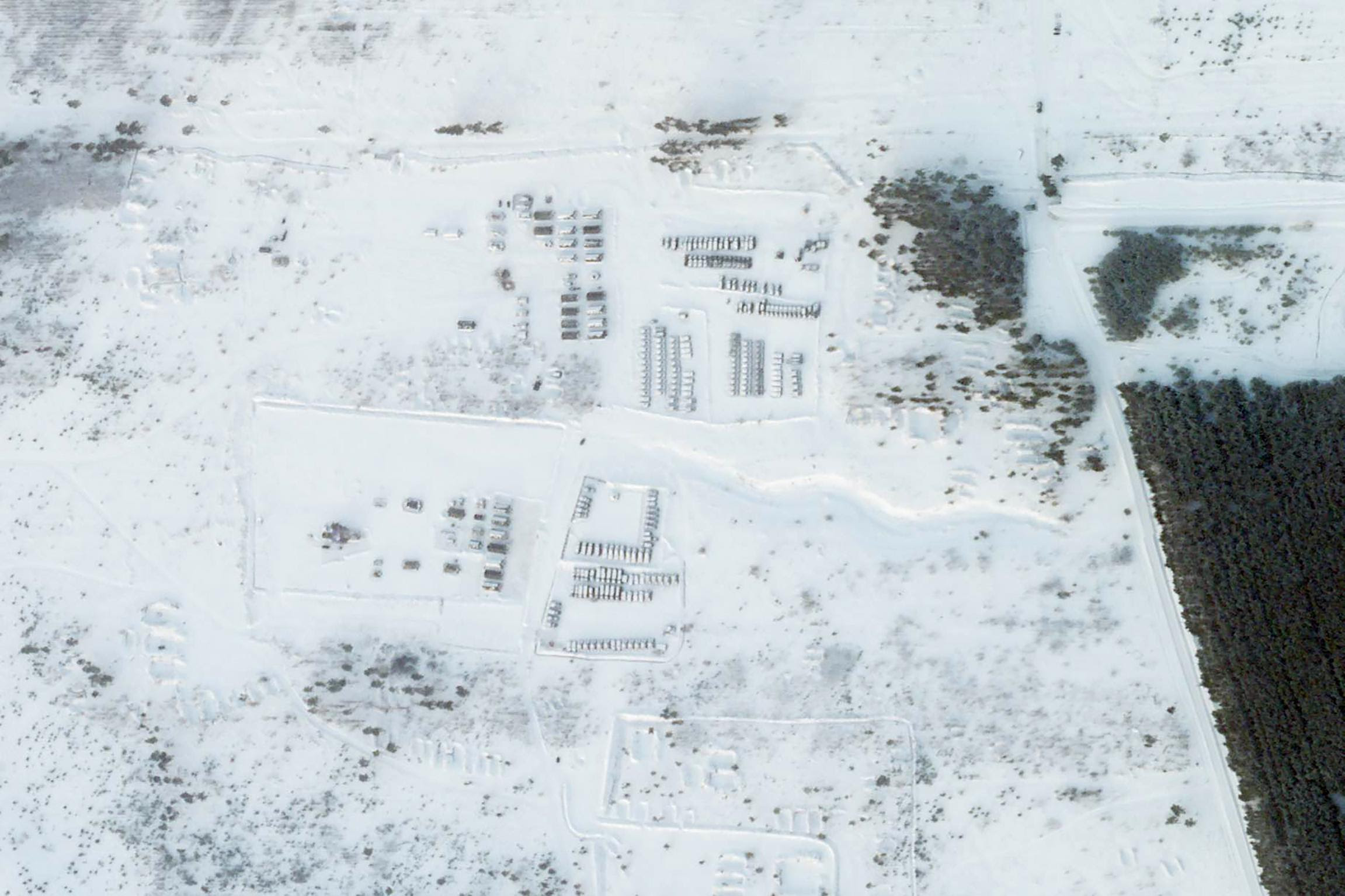
WASHINGTON (AP) — In a break from the past, the U.S. and its allies are increasingly revealing their intelligence findings as they confront Russian preparations for invading Ukraine, looking to undercut Russian President Vladimir Putin’s plans by…Read More
 *****@
 *****@
 *****@
MELBOURNE, Australia (AP) — Even as he was being ejected from the Australian Open for wearing a white T-shirt with a “Where is Peng Shuai?” slogan in black letters, Max Mok saw an opportunity to amplify the message of concern for the Grand Slam d…Read More
 *****@
 *****@
 *****@
MOSCOW (AP) — The U.S. rejection of Russia’s main demands to resolve the crisis over Ukraine leaves little ground for optimism, the Kremlin spokesman said Thursday, while adding that dialogue was still possible. The Kremlin likewise sounded a gr…Read More
 *****@
 *****@
 *****@
TOKYO (AP) — Toyota is working with Japan’s space agency on a vehicle to explore the lunar surface, with ambitions to help people live on the moon by 2040 and then go live on Mars, company officials said Friday….Read More
 *****@
 *****@
 *****@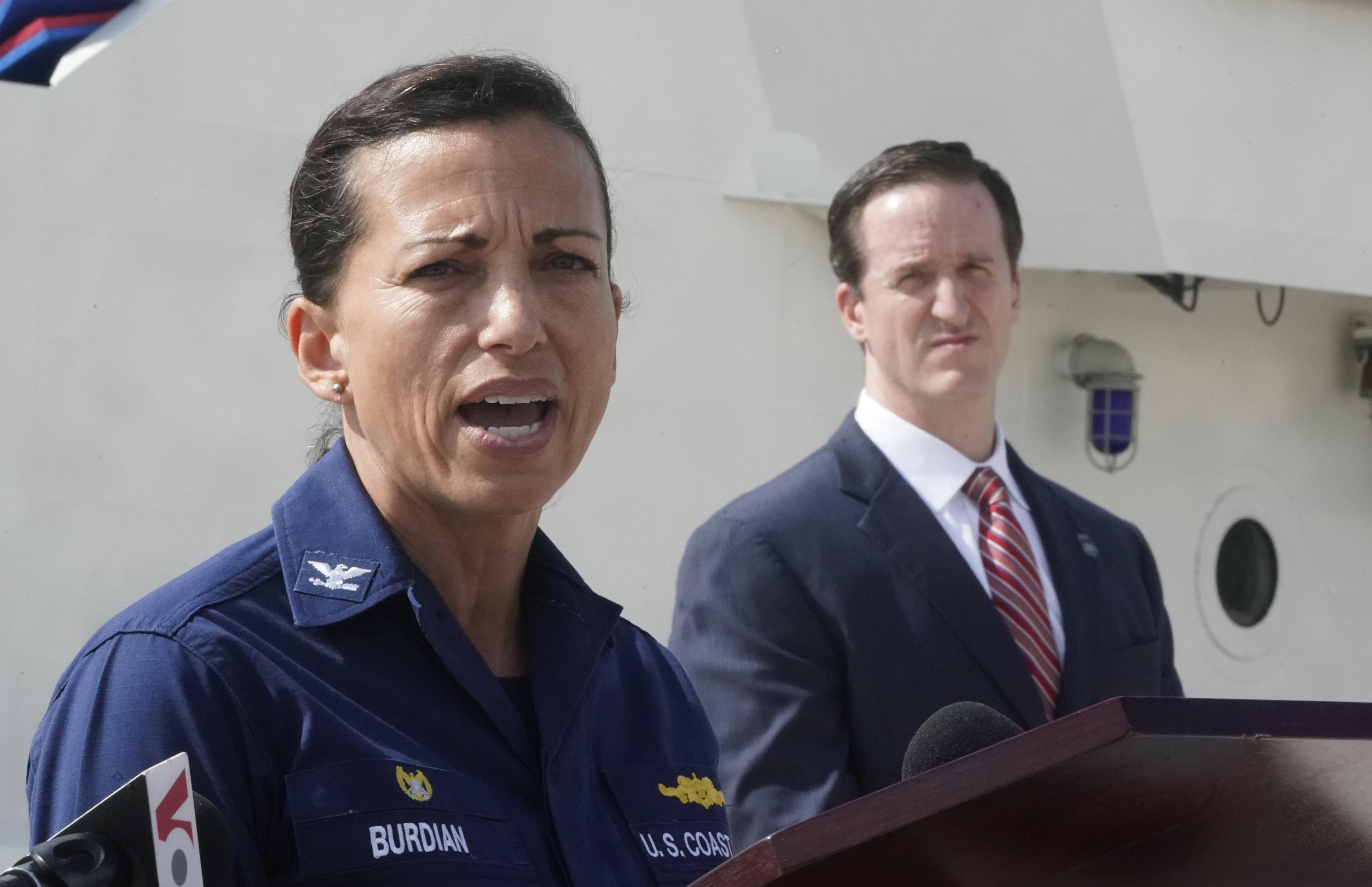
MIAMI (AP) — Little is known about the 40 people believed to have been aboard a boat that capsized and was found this week near Florida’s coast with just one survivor. But they were on a route often traveled by migrants trying to enter the U.S. c…Read More
|
|
|
|
OTHER TOP STORIES
OKLAHOMA CITY (AP) — A federal judge is set to decide a new sentence Friday for “Tiger King” Joe Exotic after an appeals court ruled last year that the prison term he’s serv…Read More
BEIJING (AP) — Holding his skis beside a bunny slope, Li Wei enthuses over his winter job as a farmer-turned-ski coach on the northwestern outskirts of Beijing. The tall, ta…Read More
MADISON, Wis. (AP) — A Wisconsin judge was set to hear arguments Friday on whether prosecutors should return to Kyle Rittenhouse the assault-style rifle he used to shoot thr…Read More
Settling into a new home can be tough for anyone. So scientists have come up with some tricks to make transplanted burrowing owls feel like they are not alone in their new d…Read More
The post WORLD VIEW: US Unmasks Rus Ukraine Fake News, Where is Peng Shuai?, Biden Predicts Invasion, Caribbean Human Smuggling, More appeared first on The St Kitts Nevis Observer.
Proportional Representation in elections – key to democratic representation
By Sir Ronald Sanders
(The writer is Antigua and Barbuda’s Ambassador to the United States and the OAS. He is a Senior Fellow at the Institute of Commonwealth Studies, University of London and Massey College in the University of Toronto. The views expressed are his own)
The second consecutive general elections in Barbados on January 19, at which Mia Mottley’s Barbados Labour Party (BLP) won all 30 seats in the House of Representatives, were hailed as historic. They certainly were for Barbados, but not for the English-speaking sub-region of the Caribbean.
The New National Party (NNP) of Dr Keith Mitchell achieved this feat three times in Grenada. Under the system of constituency divisions andfirst-past-the-post, which also exists in Barbados, the NNP won all 15-seats in 1999, 2013 and 2018.
Winning all the seats in both Grenada and Barbados left opposition political parties without representation in the legislature, and, therefore, unable to question the laws being proposed or the policies bring pursued by the governing political party. Thus, an important check on the actions of the ruling party does not exist.
Usually in the liberal democratic system which English-speaking Caribbean countries inherited from the British, there is a separation of the powers of the executive, the legislature, and the judiciary: the legislature makes the laws; the executive puts the laws into operation; and the judiciary interprets the laws. The powers and functions of each are separate and are expected to be carried out by separate personnel – in the case of the legislature, by elected representatives of governing and opposition parties. The theory is that power, so divided, should prevent the exercise of absolute power by a single group.
In Grenada and Barbados, since the executive and the legislature are both fully controlled by the ruling political party, notwithstanding Senates comprising a majority or persons appointed by the leader of the governing political party, the executive and the legislature are effectively not separated.
However, these conditions have arisen in Grenada and Barbados as a result of democratic elections in which the majority of the electorate decided who should govern their affairs. There was no question that the five elections in both countries were free, fair and transparent. Subsequently, the results reflected the desire of the majority of the electorate not to install a political party in which they had no confidence or trust.
When these circumstances occur, particularly in small countries such as Grenada and Barbados, checks and balances fall primarily on an independent judiciary which is the custodian of the rights set out in national constitutions. In Barbados and Grenada, the independence of their Courts from the political system is not in question. The Barbados Courts and its highest court of Appeal, the Caribbean Court of Justice, are as independent as the Eastern Caribbean Courts and the British Privy Council which serve Grenada.
But the day-to-day vigilance relies more particularly on a free and vigilant media – these days the social media platforms on which information, commentaries and views are widely shared, whether or not they are accurate. Governing parties, wishing to be re-elected, follow the criticisms on these unbridled social media platforms carefully.
Notwithstanding, the role of the judiciary and the media – both traditional and social – as checks on ruling political parties with no elected oppositions, the question arises as to whether the electoral system of multiple constituencies and first-past-the-poll should not now be changed constitutionally to always allow for an elected opposition.
It is universally accepted in Caribbean countries that candidates for elections have less appeal than political parties and their leaders. Electors vote for the party and leader they believe could best serve them and the country. It is only in exceptional circumstances that an outstanding candidate could win a constituency where the majority reject the party and leader concerned.
Further, in small countries, divisions between communities in terms of their needs, aspirations and interests have dissolved with modern road transportation, instant telecommunications, and shared expectations. With the disappearance of these divisions, the electorate votes less for individual candidates and much more for parties and their leaders.
If these two realities are recognised, perhaps the time has come to consider a change of the electoral system to one of proportional representation in which the entire country becomes one constituency to elect contending parties to the House of Representatives. This system would be guaranteed to elect both a ruling party and its leader as well as opposition parties in accordance with the proportion of votes they receive. Each of the party leaders would submit, in advance of the elections, names that would serve in the House of Representatives or National Assembly.
Had such a system been in place in Barbados for the 2020 general elections, based on preliminary published results, the BLP would have won 21 seats in the 30-member Assembly (roughly 71% of the vote) with Mia Mottley as Prime Minister as the majority of the electorate clearly intended; and the Democratic Labour Party would have won 9 seats (28%).
The majority of the electorate would still choose the leader and governing party they prefer, but the minority would have a voice in the national legislature and the leader of the opposition would exist with all the rights, duties and obligations which the Constitution of the nation confers upon that office.
In Guyana, the only English-speaking Caribbean country in which the British changed the electoral system to proportional representation, elections return representatives of several political parties, giving the governing party a majority in Parliament and ensuring opposition representation.
Electoral reform in the English-speaking Caribbean has been discussed for decades without any attempt to reform the Constitution to make it possible. Now that many countries are again considering constitutional reform in the context of changing from Monarchical to Republican status, perhaps it is also time to consult the people of these countries on reforming the electoral system to ensure that all votes result in representation in Parliament as government and opposition.
Responses and previous commentaries: www.sirronaldsanders.com
The post Proportional Representation in elections – key to democratic representation appeared first on The St Kitts Nevis Observer.
High Inflation to Stick This Year, Denting Global Growth: Reuters poll
BENGALURU, Jan 28 (Reuters) – Persistently high inflation will haunt the world economy this year, according to a Reuters poll of economists who trimmed their global growth outlook on worries of slowing demand and the risk interest rates would rise faster than assumed so far.
This represents a sea change from just three months ago, when most economists were siding with central bankers in their then-prevalent view that a surge in inflation, driven in part by pandemic-related supply bottlenecks, would be transitory.
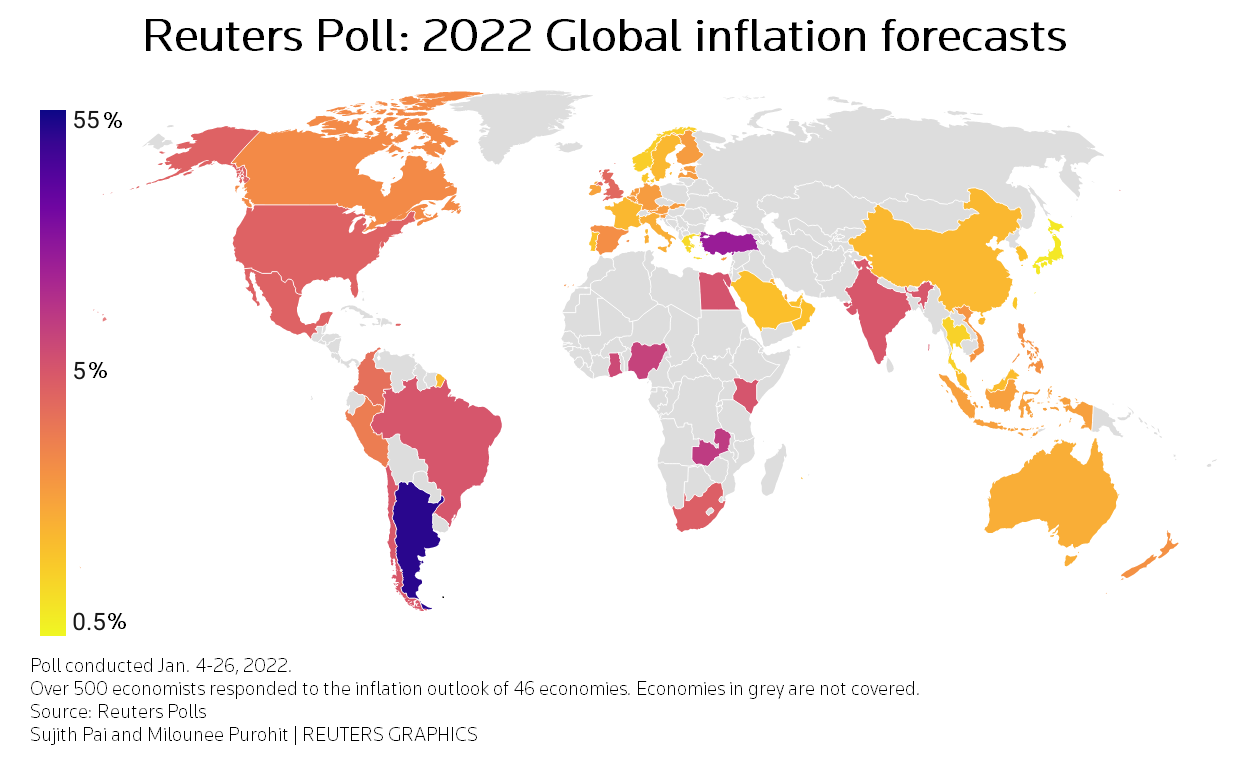
In the latest quarterly Reuters surveys of over 500 economists taken throughout January, economists raised their 2022 inflation forecasts for most of the 46 economies covered.
While price pressures are still expected to ease in 2023, the inflation outlook is much stickier than three months ago.
At the same time, economists downgraded their global growth forecasts. After expanding 5.8% last year, the world economy is expected to slow to 4.3% growth in 2022, down from 4.5% predicted in October, in part because of higher interest rates and costs of living. Growth is seen slowing further to 3.6% and 3.2% in 2023 and 2024, respectively.
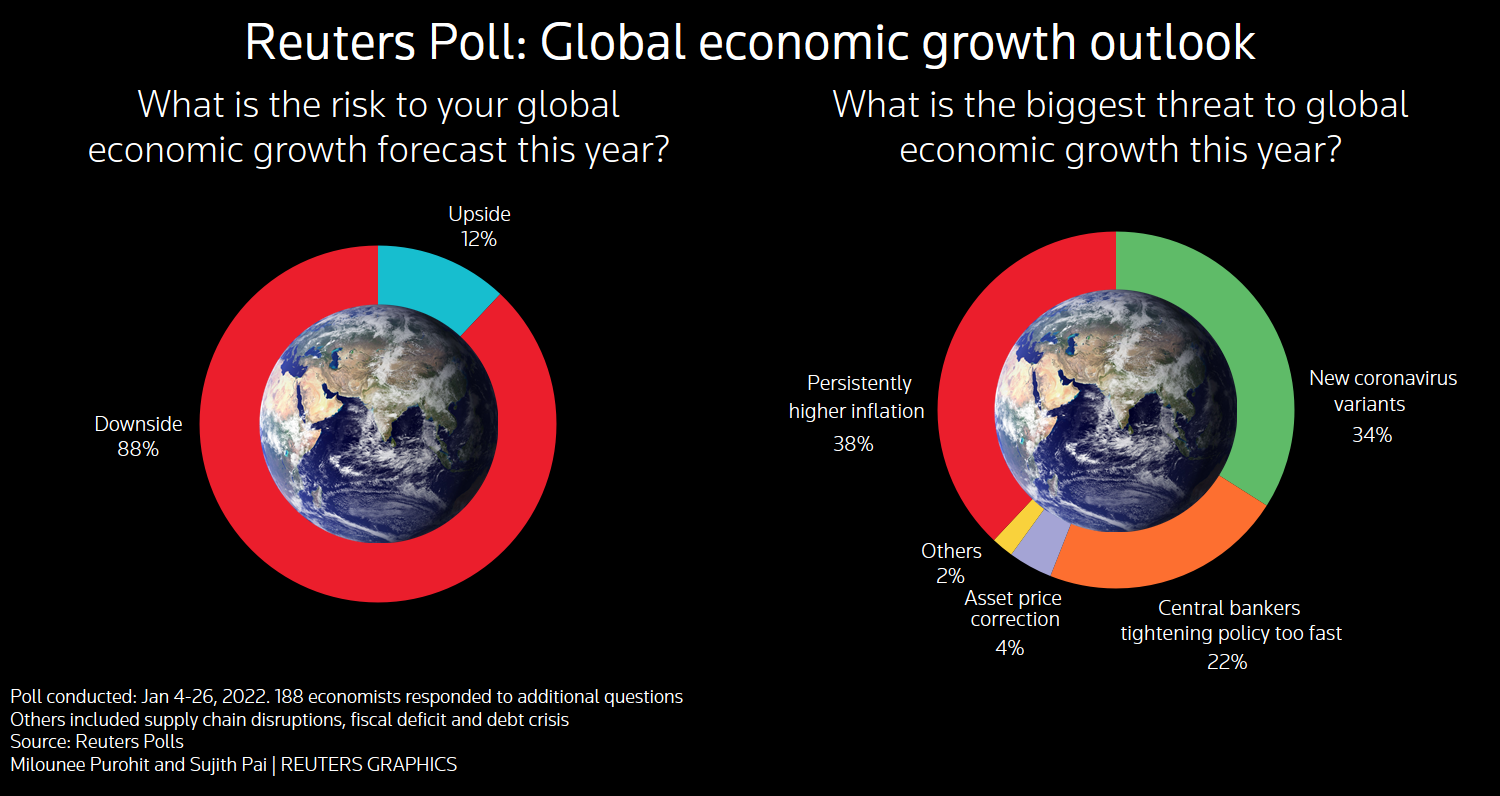
Nearly 40% of those who answered an additional question singled out inflation as the top risk to the global economy this year, with nearly 35% picking coronavirus variants, and 22% worried about central banks moving too quickly.
“The odds of an accident have risen and the likelihood of a soft landing in 2022 requires some favourable assumptions and a modicum of good luck,” Deutsche Bank group chief economist David Folkerts-Landau said, noting high inflation, the persistence of supply chain strains and the pandemic, as well as international political tensions.
This month’s Reuters polls found 18 of 24 major central banks were expected to lift rates at least once this year, compared to 11 in the October poll.
The U.S. Federal Reserve on Wednesday signaled it would raise the benchmark federal funds rate from a record low of 0-0.25% in March after shuttering its bond purchase programme.
The Bank of England was the first major central bank to raise rates since the pandemic started and is expected to act again, the Bank of Canada is also seen hiking soon.
In contrast, most economists expect the European Central Bank and the Bank of Japan to stay put at least until the end of next year.
While the tightening cycle is in early days in developed markets, many emerging market central banks, with a few notable exceptions like Brazil and China, are waiting for the Fed’s cue while grappling with the pandemic and their own economic challenges.
“Over the past three decades, developed market central banks led by the Fed have been inclined to see supply shocks boosting inflation as a drag on growth that should be cushioned,” noted Joseph Lupton, global economist at J.P. Morgan.
However, with major central banks showing concern about bringing inflation expectations close to their targets, emerging economies face a similar challenge.
“Pressure on emerging market central banks to act to anchor inflationary expectations is likely to intensify,” Lupton said.
The growth outlook for over 60% of the 46 economies covered in the polls was either downgraded or left unchanged for 2022 and about 90% of respondents, 144 of 163, said there was a downside risk to their forecasts.
While most countries saw cuts in growth forecasts for the fourth quarter and the current one, largely due to the spread of the Omicron coronavirus variant, they were expected to rebound next quarter.
(For other stories from the Reuters global long-term economic outlook polls package read more )
Reporting by Shrutee Sarkar; Analysis by Sarupya Ganguly, Anant Chandak, Vijayalakshmi Srinivasan, Milounee Purohit and Indradip Ghosh; Polling and additional reporting by the Reuters Polls team in Bengaluru and bureaus in Buenos Aires, Istanbul, Johannesburg, London, Shanghai, and Tokyo; Editing by Ross Finley and Tomasz Janowski
The post High Inflation to Stick This Year, Denting Global Growth: Reuters poll appeared first on The St Kitts Nevis Observer.
Russia, Cuba Leaders Express Close Ties
MOSCOW, Jan 28 (Reuters) – Russia and Cuba will continue developing their cooperation in the technical military sphere, the RIA news agency cited Moscow’s ambassador in Havana as saying on Friday.
Contact between the two countries has increased this month, with Russian President Vladimir Putin and his Cuban counterpart Miguel Diaz-Canel previously discussing a strategic partnership and agreeing to strengthen bilateral ties. read more
Reporting by Anton Kolodyazhnyy; Writing by Alexander Marrow Editing by Andrew Osborn
The post Russia, Cuba Leaders Express Close Ties appeared first on The St Kitts Nevis Observer.
Brazil’s Top Court Subpoenas Bolsonaro in Leaked Documents Case
BRASILIA, Jan 27 (Reuters) – A Supreme Court justice on Thursday subpoenaed Brazil’s President Jair Bolsonaro and ordered police to question him in an investigation into leaked documents in which he has resisted testifying.
Justice Alexandre de Moraes had given Bolsonaro 60 days to testify that have expired, and decided that the far-right president appear at federal police headquarters in Brasilia on Friday afternoon to be questioned.
The case involves the leaking by the president of a secret police investigation into a hacking attack against the Superior Electoral Court (TSE), Brazil’s top electoral authority, a few months before the presidential election that he won in 2018.
Bolsonaro used the information on his social media accounts to argue that Brazil’s electronic voting system was vulnerable to tampering and fraud, a charge dismissed by the country’s electoral authorities.
Bolsonaro’s critics at the time said he was preparing the ground to question the election outcome if he lost the second-round run-off against a leftist candidate.
Reporting by Ricardo Brito and Anthony Boadle; Editing by Daniel Wallis
The post Brazil’s Top Court Subpoenas Bolsonaro in Leaked Documents Case appeared first on The St Kitts Nevis Observer.
Experts Accuse UK PM Johnson of Being Reckless in Lifting Covid Restrictions, US Poll…Pandemic Not Over, World Stats, More
Boris Johnson has been accused of taking a reckless approach to public health by lifting all plan B Covid restrictions in England while failing to take enough action to get jabs to 3 billion unvaccinated people in poorer countries.

The prime minister has robustly defended his record on the pandemic this week while awaiting the findings of the Sue Gray report on the “partygate” scandal, insisting he “got the big calls right” on the biggest global health crisis in a century.
But now more than 300 leading scientists, health experts and academics have said his failure to take sufficient action to boost vaccination levels worldwide means it is more likely new variants will put thousands of lives at risk across the UK.
“We write to you as scientists, academics, and public health experts concerned about the emergence of the Omicron variant and the threat that future variants may pose to public health, the NHS, and the UK’s vaccination programme,” they said in a two-page letter delivered to 10 Downing Street.
“Vaccinating the vast majority of the world’s population is the best way to prevent Sars-CoV-2 from mutating. However, as the UK has provided booster doses to up to 1 million people every day, more than 3 billion people across the world have yet to receive their first dose. More boosters have been delivered in rich countries than the total number of all doses administered so far in poorer nations.
“Allowing huge numbers of people in low- and middle-income countries to remain unvaccinated is a reckless approach to public health that creates conditions where new Sars-CoV-2 variants of concern are more likely to develop.”
The letter has been signed in a personal capacity by 13 members of Johnson’s Sage committee and subcommittees, a fellow at the UK Health Security Agency and an adviser to the Joint Committee on Vaccination and Immunisation.
Nigel Crisp, the former chief executive of the NHS in England, Nobel prize winner Sir Richard Roberts, and several World Health Organization advisers are also among the signatories.
They called on Johnson to allow low- and middle-income countries to manufacture Covid vaccines, tests, and treatments for themselves. Vaccinating the vast majority of the world’s population was the best way to prevent further coronavirus variants of concern, they added, including variants that could be more infectious or render current vaccines less effective.
They urged the prime minister to put public health before the interests of the pharmaceutical industry “to prevent another year of uncertainty and tragedy” by supporting international efforts to suspend intellectual property rules that stop lower-income nations from manufacturing vaccines, tests, and treatments.
Vaccines will not be effective at stopping new variants of concern from arising “unless we share this technology with the world and increase global vaccination coverage”, they added in the letter coordinated by science and health experts working with groups including Global Justice Now.
Crisp said: “Throughout this pandemic, the government has pledged that it will follow the science. The scientific evidence has been clear since the start of the pandemic that the best way to keep ourselves and our NHS safe from new variants is to vaccinate the world.
“However laudable donations of vaccines might be, they will never be enough to end the pandemic. There is untapped manufacturing capacity in the very nations that need vaccines and treatments most. For the sake of people’s lives in those countries and our own, we must use it.”
Laura Merson, associate director of the Infectious Diseases Data Observatory at the University of Oxford, said protection provided by boosters would be “critically limited” while most of the world remained unvaccinated.
“The easing of plan B restrictions may give the impression that the pandemic is coming to an end,” she said. “But this won’t be over until we address the risk of new variants at the root – in populations that have not had access to vaccines.”
Maryam Shahmanesh, professor of global health at UCL, added: “By ignoring the demands of low- and middle-income countries and stifling global vaccine production with arbitrary intellectual property rules, the government risks prolonging the pandemic and endangering countless lives. We need a complete step-change if we are to bring this pandemic to an end for everyone.”
=====================================
US POLL: PANDEMIC WON’T BE OVER UNTIL DISEASE MILD FOR EVERYONE
A majority of Americans surveyed in a new Associated Press-NORC Center for Public Affairs Research poll say they believe they’re going to be stuck with the coronavirus for a long time.
The poll found 83 percent of Americans say they’ll feel the pandemic is over when COVID-19 is largely a mild illness, according to The AP. Only 15 percent say they will consider the pandemic over when the disease is eliminated.
Regarding vaccinations, 59 percent of individuals said that they think it is crucial to be inoculated against COVID-19 to safely participate in public activities. However, only 37 percent of parents said that it is essential to vaccinate their children before returning to normal life.
===================================================
India with 250,000 New Infections, But Pandemic May be Plateauing
====================================================
Highlighted in green
= all cases have recovered from the infection
Highlighted in grey
= all cases have had an outcome (there are no active cases)
Latest News
January 28 (GMT)
Updates
- 18,638 new cases and 68 new deaths in the Philippines [source]
- 740 new cases in New Caledonia [source]
- 26 new cases in Saint Pierre and Miquelon [source]
- 1,186 new cases and 3 new deaths in Uzbekistan [source]
- 356 new cases and 5 new deaths in Kyrgyzstan [source]
- 12,558 new cases and 17 new deaths in Kazakhstan [source]
- 26 new cases in Sint Maarten [source]
- 19 new cases in the Turks and Caicos Islands [source]
- 16,085 new cases and 24 new deaths in South Korea [source]
- 149 new cases in New Zealand [source]
The post Experts Accuse UK PM Johnson of Being Reckless in Lifting Covid Restrictions, US Poll…Pandemic Not Over, World Stats, More appeared first on The St Kitts Nevis Observer.
Honduras Inaugurates First Female President, Harris Vows Closer U.S. Ties
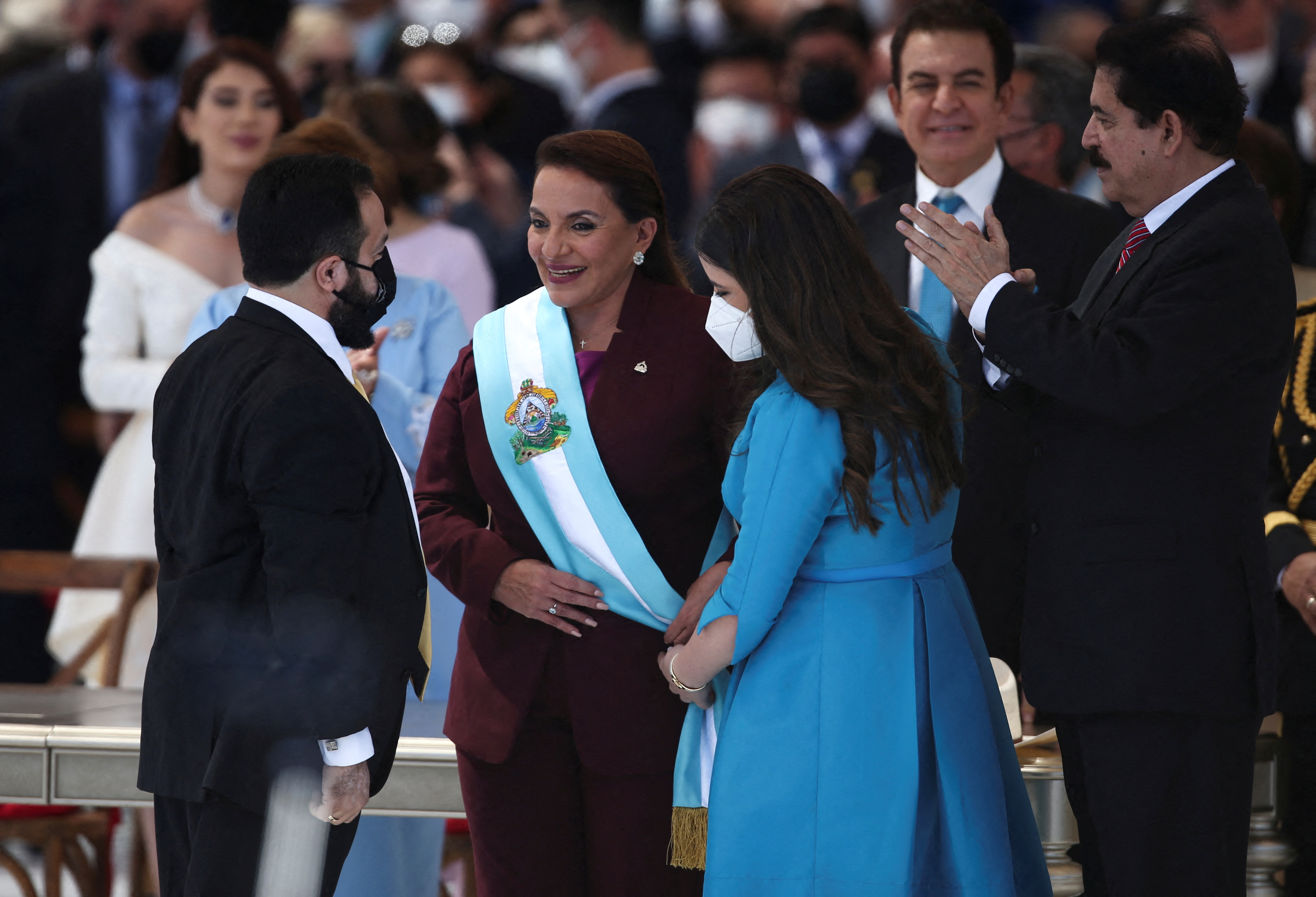
TEGUCIGALPA, Jan 27 (Reuters) – Xiomara Castro was sworn in as Honduras’ first woman president on Thursday in front of a cheering crowd including U.S. Vice President Kamala Harris, who pledged U.S. government support to stem migration and fight corruption.
Castro’s inauguration ends the eight-year rule of Juan Orlando Hernandez, a one-time U.S. ally who has been accused in U.S. courts of corruption and links to drug traffickers. Even as Hernandez left office a U.S. congresswoman called for him to be indicted, and for requests to be made for his extradition.
Castro, flanked by her husband, former President Manuel Zelaya, was sworn in at a packed soccer stadium where supporters applauded her vows to fix the country’s massive debt burden.
“The economic catastrophe that I’m inheriting is unparalleled in the history of our country,” a somber Castro said in her inaugural address.
Her government also faces tests over a sharply divided Congress, and relations with China due to Honduras maintaining diplomatic ties with Taiwan.
Harris, who was loudly applauded when introduced during the inauguration, congratulated Castro over her “democratic election.”
In a meeting shortly after the ceremony, Harris promised to collaborate on migration issues, economic development and fighting impunity, and said she welcomed Castro’s plans to request United Nations help to establish an anti-corruption commission.
Harris has been tasked with addressing the “root causes” of migration in Central America’s impoverished Northern Triangle of countries, but her trip comes as U.S. President Joe Biden’s popularity at home has waned and his immigration strategy has stalled.
“We do very much want and intend to do what we can to support this new president,” said one administration official.
Castro tweeted that she appreciated Harris’ visit and the Biden administration’s willingness to support the Honduran government.
Harris also pledged to send Honduras several hundred thousand more COVID-19 vaccine doses along with 500,000 syringes and $1.3 million for health and educational facilities.
The two did not discuss China, she told reporters.
U.S. officials want to work with Castro both to curb illegal immigration from Central America and shore up international support for Taiwan as part of its efforts to stem China’s influence.
Honduras is one of the few countries maintaining diplomatic ties with Taipei instead of Beijing, and Castro during her campaign backtracked on comments that she might switch allegiance to China as president.
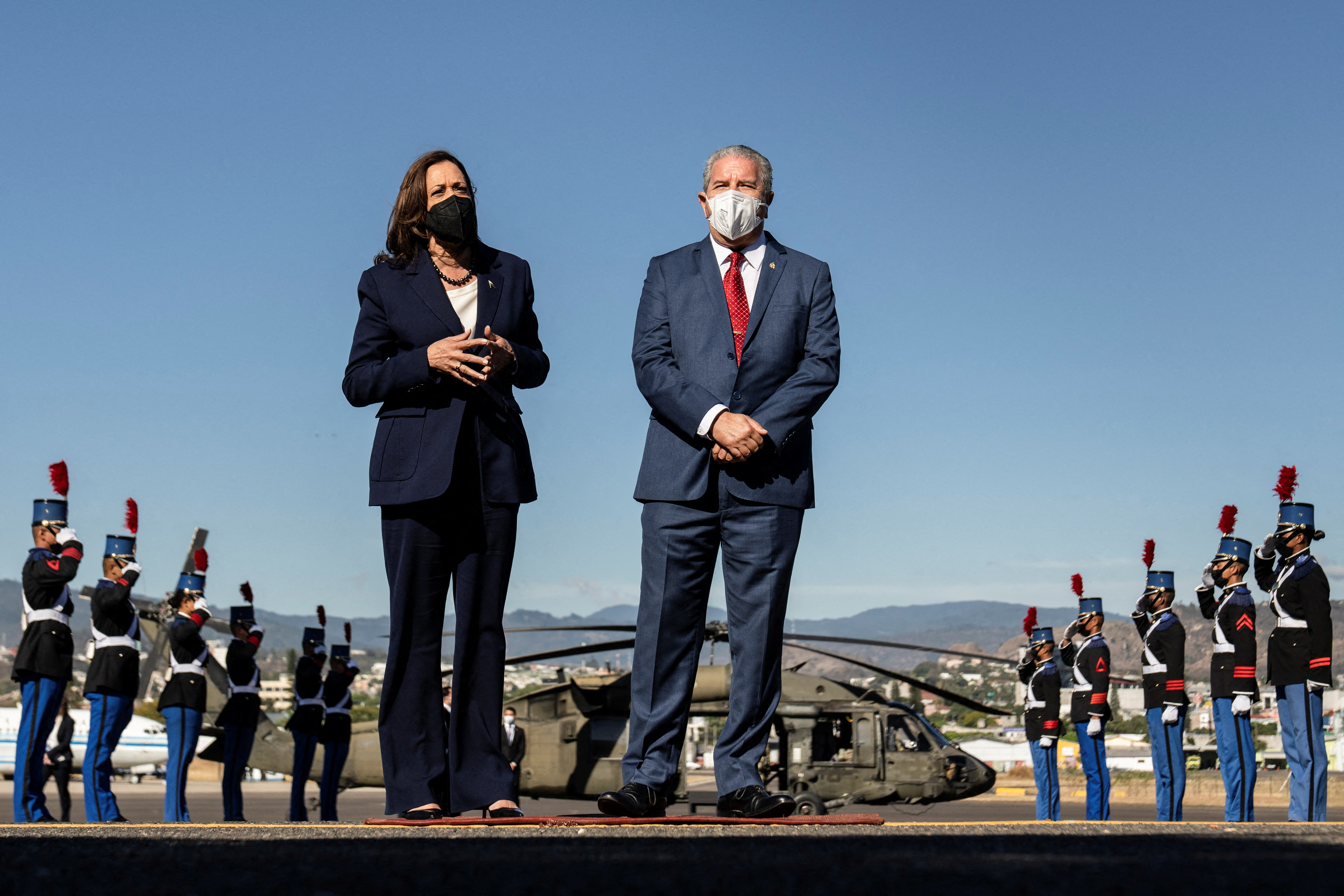
Taiwanese Vice President William Lai attended the inauguration in a bid to bolster ties with Castro’s government. Harris said the two spoke over their common interest in Central America.
Luis Leon, director of the Netherlands Institute for Multiparty Democracy in Central America, said Harris’ arrival was a boost for Castro in the dispute over control of Congress and in addressing Honduras’ weak economy.
“MAELSTROM OF LOOTING”
Castro said it was “practically impossible” to make current debt payments without a restructuring, after debt jumped sevenfold under her two conservative predecessors.
The country’s total debt stands at about $15.5 billion, or nearly 60% of gross domestic product, an economic problem Castro frequently highlighted ahead of her landslide win in November.
“My government will not continue the maelstrom of looting that has condemned generations of young people to pay the debt they incurred behind their back,” she added.
She vowed to immediately give more than 1 million poor Hondurans free electricity, with bigger consumers subsidizing the cost.
Castro, who describes herself as a democratic socialist, has vowed to tackle corruption, poverty and violence, chronic problems that have fueled U.S.-bound migrants.
But her legislative program has been jeopardized by renegade politicians from her leftist Libre party who allied with the opposition National Party to vote for one of its members to head Congress, breaking a pact with a key electoral ally.
Castro also takes office at a time of controversy for her predecessor Hernandez, who had served a maximum two consecutive terms as president and had been a longstanding U.S. ally in immigration and anti-narcotics operations.
U.S. Congresswoman Norma Torres has called for Hernandez’s indictment on drug charges, and for U.S. officials to request his extradition.
But Hernandez may be shielded from extradition for up to four years, as he was sworn in as a member of the Central American parliament shortly after Castro’s inauguration.
He has repeatedly denied accusations of corruption and links to drug traffickers.
Hernandez’s brother last year was sentenced by a U.S. judge to life in prison plus 30 years for drug trafficking.
Additional reporting by Nandita Bose, Michael Martina and Ben Blanchard in Taipei; Writing by Daina Beth Solomon, Editing by Alistair Bell, Daniel Flynn, Jonathan Oatis, Richard Chang & Simon Cameron-Moore
The post Honduras Inaugurates First Female President, Harris Vows Closer U.S. Ties appeared first on The St Kitts Nevis Observer.