Health officials will not be releasing latest case numbers today, in spite of the growing number of Omicron cases at the border and fears it will be days before infections spill into the community.The Ministry of Health has elected…
Category Archives: headline
Paraglider in hospital after crash near Queenstown
A paraglider is in hospital after a crash north of Queenstown this morning. A police spokesperson confirmed officers received a report of a paraglider crash from St John Ambulance shortly before 10.30am at an address on Malaghans…
One person dies in medical incident at Oji Fibre Solutions Kinleith Mill
A person has died following a medical incident at the Oji Fibre Solutions Kinleith Mill.Emergency services responded to the incident this morning including two ambulances and one helicopter.A spokesperson at Oji Fibre Solutions…
Motorist dies after car crashes into tree near Hastings
A motorist has died after a car crashed into a tree in a single vehicle incident in Hawke’s Bay this morning.Emergency services were alerted to the accident on Waimarama Road, east of Hastings, at about 3.30am.One person died…
Covid 19 Omicron: Hospital doctor on respecting the 'emergency' in Emergency Department visits
A New Zealand doctor has spoken out about the harsh reality on the front lines of our hospitals, revealing what you need to know before you visit one of our busy emergency departments.The advice appeared on Reddit, where someone…
Search underway for swimmer missing in surf at Karioitahi beach
A search is resuming for a swimmer who went missing at Karioitahi Beach last night.Police say emergency services were notified at 8.15pm that a person was missing in the water at Karioitahi Beach.Aerial and water searches were…
Police urge vigilance over fake bank notes in South Taranaki
By RNZ Counterfeit bank notes are circulating around South Taranaki, police say.The fake notes were presented at businesses recently, prompting police to make inquiries about the source.Police say it is an offence to make,…
'Wild intrigue': The truth about the curse of the Hope Diamond
The Hope Diamond is one of the most valuable diamonds in the world and the curse has only added to its worth.
The 45-carat blue diamond is said to possess a curse where anyone who owns the stone or even touches it will befall bad luck and even death.
However, to the dismay of anyone who is interested in the curse, historians said it is simply a story to add to the intrigue and value of the diamond.
READ MORE: New armoured dinosaur found in Chile had bizarre weaponised tail

"The story is a lot of fun, it is a lot of playfulness among the extraordinarily wealthy people who have owned it," Louise Burnet, co-owner of the French Jewel Box, said.
The distinctive diamond is about two-thirds of the size of a matchbox and is a phenomenal "dark greyish blue".
"It's very mysterious and magnificent," Ms Burnet said.
The diamond has been sold to many wealthy historical figures however the story of the curse started when it was sold to Pierre Cartier, one of the famed Cartier jewellers, in 1910.
Cartier wanted to sell it to Evalyn Walsh McLean, the daughter of a successful gold miner, and told her a wild story about a curse to convince her to buy it.
According to Cartier's story, a French merchant traveller, Jean Baptiste Tavernier, stole the blue diamond from the eye of a statue of the Hindu goddess Situ in India.
Tavernier was apparently torn apart by wild dogs in Russia after he sold the diamond.
Cartier went on to say there were many deaths for anyone who owned the diamond, including French officials, it even caused the beheading of Louis XIV and Marie Antoinette.
READ MORE: Aussie Bitcoin pioneer wins battle for $71 billion fortune
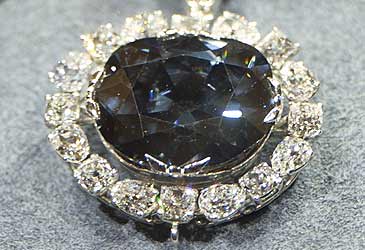
From French royalty to Russian counts and actresses, Cartier said bad fates befell them all due to the diamond.
Cartier's story convinced Ms McLean to buy the diamond where she kept it until her death in 1947.
Harry Winston Inc. of New York City purchased Ms McLean's entire jewellery collection, including the Hope Diamond, where it was then donated to the Smithsonian Institute in Washington where it is on display today.
Ms Burnet said, "everybody loves a story" but the truth about where the diamond came from does not hold such "wild intrigue".
Tavernier most likely obtained the diamond from Golconda in India, Ms Burnet said.
"It came from Golconda where all the amazing diamonds that you see the incredible royal families through the Georgian era," she said.
He purchased it uncut then sold it to King Louis XIV of France in 1668 where it was cut to 67 carats.
READ MORE: Brave family help save teen shark attack victims

"It disappeared from the French turned up to London being cut to what it is now at 45 carats," Ms Burnet said.
"The embellishment of the story comes from Cartier."
Trevor Hancock, from the Australian Antique & Art Dealers Association, said the curse of the hope diamond is just a story that made the stone more valuable and desirable.
"What is really valuable about diamonds is the story behind them," he said.
"Anything like the curse gives it an ambience and a history and people love to buy that."
Many other jewels like the Hope Diamond possess romantic stories to add to their value however the Hope Diamond is unique as its story is a deathly curse.
The diamond is one of the premier attractions at the Smithsonian Institute.
Djokovic's fans in Serbia protest his detention in Australia
Hundreds of Novak Djokovic's supporters gathered at a rally in downtown Belgrade on Friday to protest his confinement in Australia after his entry was denied by border authorities because of COVID-19 vaccination regulations.
The top-ranked Serb, who hopes to defend his title at the Australian Open and win a men's record 21st Grand Slam singles title, was denied entry when he arrived at Melbourne's airport on Wednesday and was still in an immigration detention hotel awaiting a court hearing scheduled for Monday to challenge his deportation.
The detention has triggered anger among Djokovic's fans in his native Serbia, with his family calling for protests until he is released.
READ MORE: Novak Djokovic breaks silence on Instagram, thanks fans for support

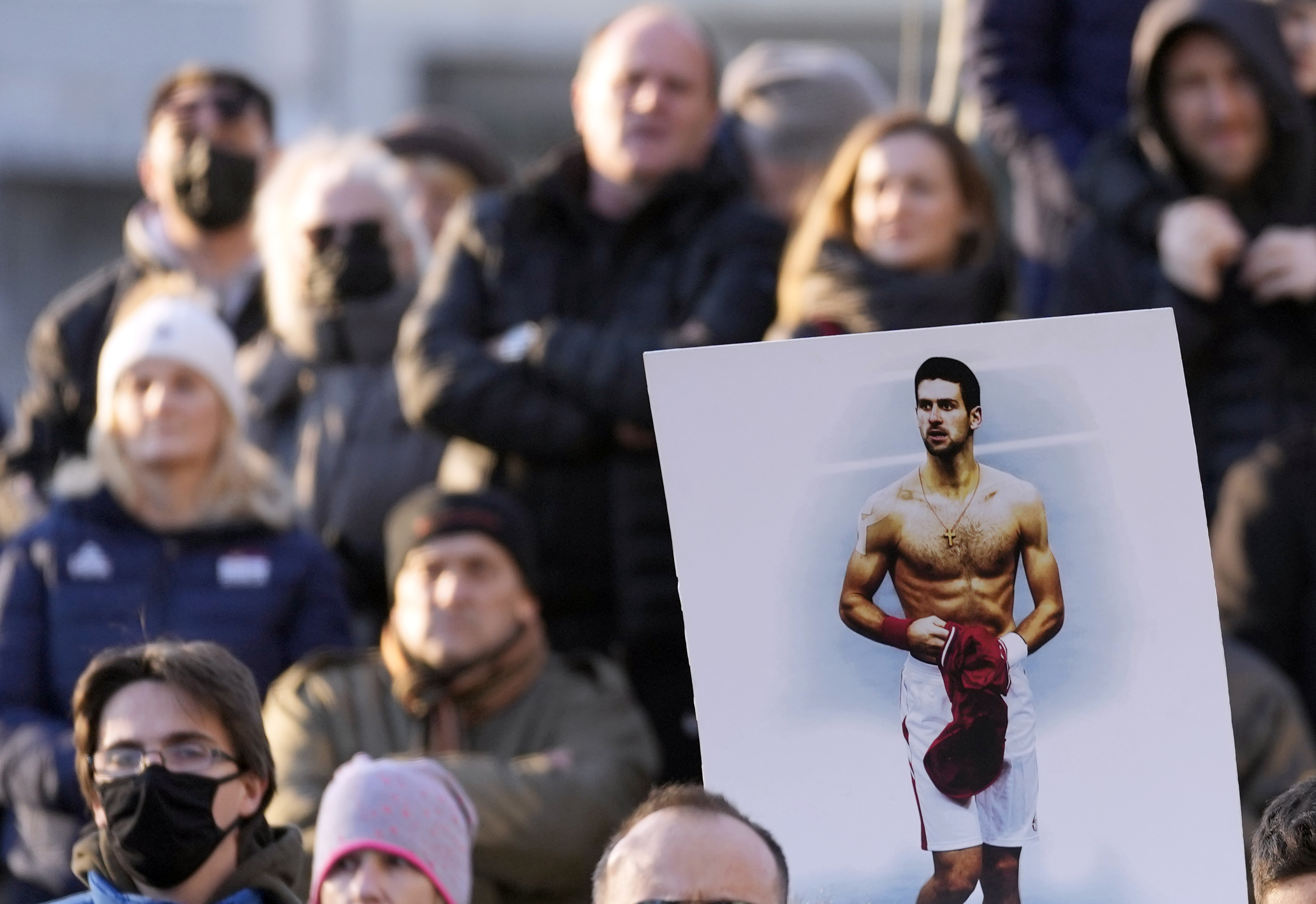
Speaking at the rally, Srdjan Djokovic described his son's struggle to play at the Australian Open as a fight against "globalists who want to ruin everything."
READ MORE: Djokovic fans, refugee supporters and anti-vaxxers protest in Melbourne
"He is fighting for himself, his people and all freedom-loving nations in the world," said Srdjan Djokovic, an outspoken critic of the West and supporter of Serbia's traditional Slavic ally Russia.


"They hate him because Australian politicians have put pressure on people to hate him because he thinks with his own brain."
Djokovic's father also said Australians "have been in captivity for two years" in reference to the strict lockdown coronavirus measures that have been in place in Melbourne.
"He (Djokovic) is in prison, not in custody, not in a hotel. They took away all his things, took away his wallet, and returned it to him after a few hours," Srdjan Djokovic said as the crowd chanted "Monsters, Monsters."


He said the Australian authorities "wanted to humiliate and throw him to his knees."
Australian officials initially said Djokovic, a vocal sceptic of vaccines who has refused to say if he has gotten the COVID-19 shot, would be given an exemption to stringent vaccine rules by state authorities and be able to participate in the Australian Open.
But when he landed, his visa was cancelled by federal border officials and he is now in an immigration detention hotel while he fights the decision.
Bahamian Sidney Poitier, First Black Man to Win Best Actor Oscar, Dies at 94
WASHINGTON, Jan 7 (Reuters) – Sidney Poitier, who broke through racial barriers as the first Black winner of the best actor Oscar for his role in “Lilies of the Field,” and inspired a generation during the civil rights movement, has died at age 94, an official from the Bahamian Ministry of Foreign Affairs said on Friday.
Eugene Torchon-Newry, acting director general of the Ministry of Foreign Affairs, confirmed Poitier’s death.
Poitier created a distinguished film legacy in a single year with three 1967 films at a time when segregation prevailed in much of the United States.
In “Guess Who’s Coming to Dinner” he played a Black man with a white fiancee and “In the Heat of the Night” he was Virgil Tibbs, a Black police officer confronting racism during a murder investigation. He also played a teacher in a tough London school that year in “To Sir, With Love.”
Poitier had won his history-making best actor Oscar for “Lilies of the Field” in 1963, playing a handyman who helps German nuns build a chapel in the desert. Five years before that Poitier had been the first Black man nominated for a lead actor Oscar for his role in “The Defiant Ones.”
His Tibbs character from “In the Heat of the Night” was immortalized in two sequels – “They Call Me Mister Tibbs!” in 1970 and “The Organization” in 1971 – and became the basis of the television series “In the Heat of the Night” starring Carroll O’Connor and Howard Rollins.
His other classic films of that era included “A Patch of Blue” in 1965 in which his character ias befriended by a blind white girl, “The Blackboard Jungle” and “A Raisin in the Sun,” which Poitier also performed on Broadway.
Poitier was born in Miami on Feb. 20, 1927, and raised on a tomato farm in the Bahamas, and had just one year of formal schooling. He struggled against poverty, illiteracy and prejudice to become one of the first Black actors to be known and accepted in major roles by mainstream audiences.
Poitier picked his roles with care, burying the old Hollywood idea that Black actors could appear only in demeaning contexts as shoeshine boys, train conductors and maids.
“I love you, I respect you, I imitate you,” Denzel Washington, another Oscar winner, once told Poitier at a public ceremony.
As a director, Poitier worked with his friend Harry Belafonte and Bill Cosby in “Uptown Saturday Night” in 1974 and Richard Pryor and Gene Wilder in 1980’s “Stir Crazy.”
STARTED ON STAGE
Poitier grew up in the small Bahamian village of Cat Island and in Nassau before he moved to New York at 16, lying about his age to sign up for a short stint in the Army and then working at odd jobs, including dishwasher, while taking acting lessons.
The young actor got his first break when he met the casting director of the American Negro Theater. He was an understudy in “Days of Our Youth” and took over when the star, Belafonte, who also would become a pioneering Black actor, fell ill.
Poitier went on to success on Broadway in “Anna Lucasta” in 1948 and, two years later, got his first movie role in “No Way Out” with Richard Widmark.
In all, he acted in more than 50 films and directed nine, starting in 1972 with “Buck and the Preacher” in which he co-starred with Belafonte.
In 1992, Poitier was given the Life Achievement Award by the American Film Institute, the most prestigious honor after the Oscar, joining recipients such as Bette Davis, Alfred Hitchcock, Fred Astaire, James Cagney and Orson Welles.
“I must also pay thanks to an elderly Jewish waiter who took time to help a young Black dishwasher learn to read,” Poitier told the audience. “I cannot tell you his name. I never knew it. But I read pretty good now.”
In 2002, an honorary Oscar recognized “his remarkable accomplishments as an artist and as a human being.”
Poitier married actress Joanna Shimkus, his second wife, in the mid-1970s. He had six daughters with his two wives and wrote three books – “This Life” (1980), “The Measure of a Man: A Spiritual Autobiography” (2000) and “Life Beyond Measure: Letters to My Great-Granddaughter” (2008).
“If you apply reason and logic to this career of mine, you’re not going to get very far,” he told the Washington Post. “The journey has been incredible from its beginning. So much of life, it seems to me, is determined by pure randomness.”
Poitier wrote three autobiographical books and in 2013 published “Montaro Caine,” a novel that was described as part mystery, part science fiction.
Poitier was knighted by Britain’s Queen Elizabeth II in 1974 and served as the Bahamian ambassador to Japan and to UNESCO, the U.N. cultural agency. He also sat on Walt Disney Co’s board of directors from 1994 to 2003.
In 2009, Poitier was awarded the highest U.S. civilian honor, the Presidential Medal of Freedom, by President Barack Obama.
The 2014 Academy Awards ceremony marked the 50th anniversary of Poitier’s historic Oscar and he was there to present the award for best director.
Reporting by Katharine Jackson; Editing by Doina Chiacu and Howard Goller
The post Bahamian Sidney Poitier, First Black Man to Win Best Actor Oscar, Dies at 94 appeared first on The St Kitts Nevis Observer.