BASSETERRE, ST. KITTS, November 10, 2021 (MMS-SKN) — Thirteenth, and final, segment of play in the single round of play in the 26th edition of Constituency Number Seven Dr the Hon Timothy Harris Domino League came off on Tuesday November 9 at the new Lodge-Ottley’s Community Centre, but final four teams are yet to be named as a result of a disputed game.
However, three teams are secure in the last four on the points standing table, with former defending champion team Unity Domino Club safely in top position with 59 points, followed by defending champion team Tabernacle Domino Club and Mansion Domino Club tied at 48 points each.
Fourth position will be determined after the game between Sylvers Domino Club and former champion team Lodge Domino Club that ended up in dispute on Thursday November 4 is arbitrated. The game ended with Sylvers leading 11-9, when it is reported that Lodge players walked off the tables.
While Sylvers captain, Octavia Huggins-Sewell, maintains that her team should be awarded the maximum points after Lodge players would have walked off, the committee voted that the game should resume at 11-9, but she has petitioned that ruling.
As for the games played on Tuesday evening, defending champion team Tabernacle Domino Club beat Small Corner Bar Domino Club 13-8; and Christ Church Domino Club beat Ottley’s Domino Club 13-6.
Unity Domino Club’s Captain, Desmond ‘Fergie’ Rawlins, in cation as his team beat Phillips Domino Club 13-10.
Ryan St. Marie of defending champion team, Tabernacle Domino Club, makes a calculated move on the board for this game where his team beat Small Corner Bar Domino Club 13-8.
In the battle of two former champion teams, Marc Williams of Parsons Domino Club shows how it is done as they been Lodge Domino Club 13-10.
Leader in points standing, Unity Domino Club, beat Phillips Domino Club 13-10; Guinness Domino Club beat Molineux Domino Club 13-4; and Sylvers Domino Club beat Saddlers Domino Club 13-10.
When two former defending champion teams faced each other, Parsons Domino Club beat Lodge Domino Club 13-10; while in the last game Mansion Domino Club beat Unstoppable Domino Club 13-7.
Points standing table has Unity leading with 59 points, Tabernacle 48 points, Mansion 48 points, Phillips 47 points, Lodge 45* points, Christ Church 45 points, Molineux 44, Parsons 43 points, Sylvers 41* points, Saddlers 37 points, Guinness 27 points, Unstoppable 23 points, Small Corner Bar 20 points, and Ottley’s 12 points.
Constituency Number Seven Dr the Hon Timothy Harris Domino League, which is the longest running such league in the Federation of St. Kitts and Nevis, is sponsored by Prime Minister and Area Parliamentary Representative for St. Christopher Seven (Bellevue to Ottley’s), Dr the Hon Timothy Harris.
After the Executive Committee of the league would have made the final ruling as to when the outstanding game between Sylvers and Lodge will be played, if it will, a fixture for the final four play-offs will be released for games that will be held at the new Lodge-Ottley’s Community Centre.
Post expires at 8:55pm on Wednesday November 10th, 2021
Poland has massed thousands of troops on its border with Belarus to keep out Middle Eastern migrants who have set up camp there, as Western officials accuse Belarus’s leader of intentionally trying to create a new migrant crisis in Europe.
The standoff along the razor-wire fence separating the two countries has intensified a long-simmering confrontation between Belarus, a repressive former Soviet republic, and the European Union, which includes Poland.
Western officials say that President Aleksandr G. Lukashenko of Belarus is allowing asylum seekers from the Middle East into his country by the thousands and then funneling them westward toward Poland and the E.U., and has escalated that strategy this week. They say he is retaliating against sanctions imposed after his disputed 2020 election victory.
The sharp increase in tensions has rattled European officials, with images of desperate migrants evoking the refugee crisis of 2015. The confrontation with Belarus, a close Russian ally, also raises new security concerns.
E.U. leaders are scrambling to strike a balance between protecting the bloc’s external borders and preventing a worsening humanitarian crisis among the migrants camped along the edge of a forest in freezing weather.
On Tuesday, Polish authorities said, at least 3,000 people who hoped to enter the European Union were gathered near the Kuznica border crossing, near the Belarusian city of Grodno. Hundreds could be seen camped just feet away from the border fence in video footage provided by both sides. In response to the growing numbers, Poland increased its forces in the area to more than 17,000 soldiers, border guards and police, Polish officials said.
Rising tension at the border with Belarus.
“This is a hybrid action carried out by the Belarusian regime against Poland and the E.U.,” said President Andrzej Duda of Poland, describing an operation that he said was orchestrated by Belarusian security forces to bring thousands of migrants into the forest near the border. “These are just aggressive actions that we have to resist.”
Poland has prevented journalists, aid organizations and E.U. officials from traveling to the border area, making reports from the scene difficult to verify. Polish authorities said eight people have died so far trying to cross the border.
Poland’s government recently passed legislation legalizing pushbacks, which has been criticized by human rights groups and is being analyzed by the European Commission. For years, the nationalist governing party has cast migration from the Middle East as a threat to Polish culture and sovereignty.
Still, a show of support for Poland from E.U. countries and top officials suggested that Europe’s security concerns were trumping human rights.
Jens Stoltenberg, the secretary general of NATO, said he spoke with Mr. Duda and pledged the alliance’s “solidarity.” Peter Stano, a spokesman for the E.U.’s executive arm, said Mr. Lukashenko was behaving like “a gangster” and that unspecified additional sanctions against Belarus were on their way.
But it did not appear that Mr. Lukashenko, an autocrat who has ruled his country since 1994, was prepared to change course. His government denies creating a refugee crisis, but he has hinted for months that he could do just that. In May, he warned the West: “We stopped drugs and migrants for you — now you’ll have to eat them and catch them yourselves.”
Until recently, migrants were scattered the length of the border, but now Belarusian authorities are collecting them at the Kuznica crossing, said Anna Alboth of the Minority Rights Group in Poland.
On Tuesday, Belarus’s border service released a video showing a tent camp squeezed into a narrow strip of land just a few yards from a line of Polish security forces in white helmets. The video showed a low-flying helicopter, military vehicles and a water cannon truck on the Polish side, and a thicket of tents and smoky bonfires on the Belarusian side.
“We have not seen any violations of the law by the migrants,” said Ivan Kubrakov, the interior minister of Belarus. “As a hospitable country, we are always ready to welcome everyone.”
A video posted by the Polish Ministry of Defense on Monday showed a crowd of people trying to break down the razor wire border fence with long sticks.
Police manning a checkpoint on the road leading to the Polish-Belarusian border crossing in Kuznica, in eastern Poland.Credit…Artur Reszko/EPA, via Shutterstock
“There is not enough water and food,” the Belarus border service said in a statement, describing the people in the camp as mainly Kurds. “The situation is complicated by a significant number of pregnant women and infants among the refugees.”
E.U. officials said they were analyzing air traffic to Minsk, the Belarusian capital, as potential evidence that Mr. Lukashenko was effectively orchestrating a flow of migrants toward E.U. countries. The timetable for the Minsk airport, effective Oct. 31, shows at least 47 scheduled flights per week from Middle Eastern locations, compared with no more than 23 flights per week on its previous schedule. The additional flights include a new daily route from Damascus on an Airbus A320 operated by the Syrian airline Cham Wings.
Travel agencies in the Kurdistan Region of Iraq, where many of the migrants come from, have been offering packages that include visas to Belarus and airfare either through Turkey or the United Arab Emirates for about $3,000.
Mr. Stano, the E.U. spokesman, said officials were monitoring flights from around two dozen countries that were ferrying migrants into Minsk — including Morocco, Syria, South Africa, Somalia, India, Sri Lanka, Algeria, Libya and Yemen. The European commissioner for home affairs, Ylva Johansson, said the E.U. was stepping up “outreach with partner countries” to prevent migrants from coming to Belarus in the first place.
“Our urgent priority is to turn off the supply coming into Minsk airport,” she said in a tweet.
The E.U.’s standoff with Mr. Lukashenko has been intensifying ever since he crushed street protests against election fraud last year. Mr. Lukashenko claims the West is trying to topple him by supporting the opposition, and has imprisoned thousands of dissidents and journalists, while many others have left the country.
In May, Belarus diverted a RyanAir flight from Greece to Lithuania as it flew through Belarusian airspace, forcing it to land in Minsk, and arrested a passenger, Roman Protasevich, a dissident Belarusian journalist living in exile.
European leaders decried the move as an act of piracy, and it provoked a new round of Western sanctions against Belarus.President Vladimir V. Putin of Russia has emerged as Mr. Lukashenko’s most important backer. The two spoke by phone on Tuesday, the Kremlin said, and discussed the situation at the Polish border. Mr. Putin’s foreign minister, Sergey V. Lavrov, blamed the West for stoking the migration crisis and said the E.U. should pay Belarus to help contain it — just as the bloc sent financial aid to Turkey to do so in 2016“We see that the Belarusian specialists are working very responsibly,” Dmitri S. Peskov, the Kremlin spokesman, told reporters.
Polish officials said that in addition to those at the border, more than 10,000 migrants were elsewhere in Belarus, also hoping to get to the E.U. On Monday, Piotr Müller, a Polish government spokesman, said the country’s borders were “under attack in an organized manner.” A top security official, Maciej Wasik, said a “real battle” had taken place against people trying to enter Poland illegally near Kuznica.
The standoff comes at a particularly difficult moment in Poland’s relations with the E.U., and in the country’s domestic politics. The conservative Polish government’s longstanding feud with the European Commission, the bloc’s executive arm, over the independence of Poland’s judiciary escalated in recent weeks, and the commission has been withholding the payment of the country’s $41 billion share of the E.U. coronavirus fund.
At home, the Polish governing party, Law and Justice, has seized on the image of a nation besieged by migrants to parade its nationalist credentials and brand its critics as unpatriotic at a time of national crisis. Both the opposition and nationalist groups that support the government are scheduled to rally in the center of the capital on Thursday, Poland’s Independence Day.
Anton Troianovski reported from Moscow, Monika Pronczuk from Brussels, and Tolek Magdziarz from Warsaw. Oleg Matsnev contributed reporting from Moscow, Jane Arraf from Suleimaniya, Iraq, and Andrew Higgins from Cluj, Romania.
MEXICO CITY, Nov 10 (Reuters) – U.S. President Joe Biden, Mexican President Andres Manuel Lopez Obrador and Canadian Prime Minister Justin Trudeau will hold their first in-person meeting in Washington on Nov. 18, Mexico’s foreign minister said on Wednesday.
The meeting, which will be the first summit held by the three countries in five years, will address issues including the COVID-19 pandemic and boosting the competitiveness of supply chains in North America, foreign minister Marcelo Ebrard said.
Mexico will also be focusing on economic development in southern Mexico and Central America, Ebrard told a regular government news conference alongside Lopez Obrador.
It also came a day after the U.S. ambassador to Mexico, Ken Salazar, said that he hoped concerns could be resolved which the United States and private companies have expressed over a Mexican legislative initiative to reform the electricity market.
The bill still in Congress championed by Lopez Obrador seeks to give precedence to Mexico’s state-owned energy companies over private firms, and the leftist president was asked at the news conference if he would address the matter in Washington.
Lopez Obrador said it was not on the agenda, but that if it did come up, he would explain to Biden that Mexico was taking steps to ensure consumers were not subjected to price hikes.
The president argues that past Mexican governments rigged the electricity market in favor of private capital at the expense of consumers and the Mexican state.
Aside from taking part in the leaders’ three-way meeting, Lopez Obrador would also hold bilateral talks with Biden and Trudeau in Washington, Ebrard said.
Mexico was scheduled to host the following summit of the North American leaders in 2023, he added.
The leaders started holding what is informally known as the Three Amigos summit in 2005 and met most years until 2016. The practice ended when U.S. President Donald Trump took office in January 2017.
The countries are bound together by the United States-Mexico-Canada (USMCA) free trade agreement that governs some $1.5 trillion in North American trade annually.
Reporting by Dave Graham and Cassandra Garrison; Editing by Angus MacSwan and Nick Macfie
Dozens of Jamaican nationals have been taken off a removal flight in the days and hours before it was due to set off, raising renewed questions around the legality and efficacy of the Home Office’s deportation policy.
Campaigners say just four deportees were on board the charter plane, which left Birmingham Airport in the early hours of Tuesday morning and is said to have had capacity to seat 350 people. Around 50 people were originally due to fly.
The Home Office removed an unknown number of deportees from the flight list due to the fact that there has been a Covid outbreak at Colnbrook, an immigration removal centre near Heathrow, where they were being held.
At least five also had their removal deferred because they have been identified as potential victims of trafficking, with indicators that they have been groomed by county lines gangs and that this played a role in crimes they have committed.
Among those taken off the flight list include a man, 23, who has lived in the UK since he was three-months-old and another, 29, who has been in the country since he was a year old. Neither have any memory of Jamaica and both have been identified as potential county lines victims.
The Home Office also took a man with HIV off the flight list. The department was threatened with legal action over the failure to provide him with life-saving treatment in the detention centre, as reported by The Independent.
A judge halted the removal of another detainee on Tuesday, raising concerns about the fact that people who have been in the UK since they were under 12 were being deported, despite the fact the Home Office appeared to have a policy of not removing these people last year.
Judge Blundell said: “The conclusion at ‘ministerial level’ less than 12 months ago was that there were very compelling circumstances such that the Applicant could not be deported; there have been no relevant factual or legal developments in the last 12 months that could account for a departure from the previous position.”
Last week, it emerged that the Home Office was planning to deport non-criminals to Jamaica for the first time since the Windrush scandal broke, in what was described as an “affront to the Windrush generation”.
Among them was a 20-year-old woman with no criminal convictions who has been in the country since she was 13 and has no relatives in Jamaica. She was due to be deported with her mother, 56, who also has no convictions. Both were taken off the flight list within hours of The Independent publishing an article about the situation
OAKLAND, Calif. (AP) — U.S. food banks already dealing with increased demand from families sidelined by the pandemic now face a new challenge — surging food prices and supply chain issues walloping the nation….Read More
GLASGOW, Scotland (AP) — Negotiators at the United Nations climate talks are considering a draft decision that highlights “alarm and concern” about global warming the planet already is experiencing and continu…Read More
TOKYO (AP) — Fumio Kishida was reelected as Japan’s prime minister Wednesday after his governing party scored a major victory in key parliamentary elections….Read More
TAIPEI, Taiwan (AP) — Wang Lijie planned to spend three days in the Gobi Desert last month to take in the area’s famous poplar forest as its trees turned a golden yellow….Read More
WASHINGTON (AP) — A federal judge rejected former President Donald Trump’s request to block the release of documents to the House committee investigating the Jan. 6 Capitol riot….Read More
JAKARTA, Indonesia (AP) — From the southern border of Germany to the highest peaks in Africa, glaciers around the world have served as moneymaking tourist attractions, natura…Read More
WARSAW, Poland (AP) — Polish authorities said Wednesday that two groups of migrants managed to cross the border from Belarus into Poland but that all the people in the groups…Read More
BEIRUT (AP) — George Kordahi was popular among TV viewers in the Middle East for his dapper charm. He schmoozed with beautiful women, dropped jokes and recited lines of Arabi…Read More
LOS ANGELES (AP) — Paul Rudd has been crowned as 2021’s Sexiest Man Alive by People magazine . Rudd, known for his starring roles in Marvel’s “Ant-Man” films, “This is 40” an…Read More
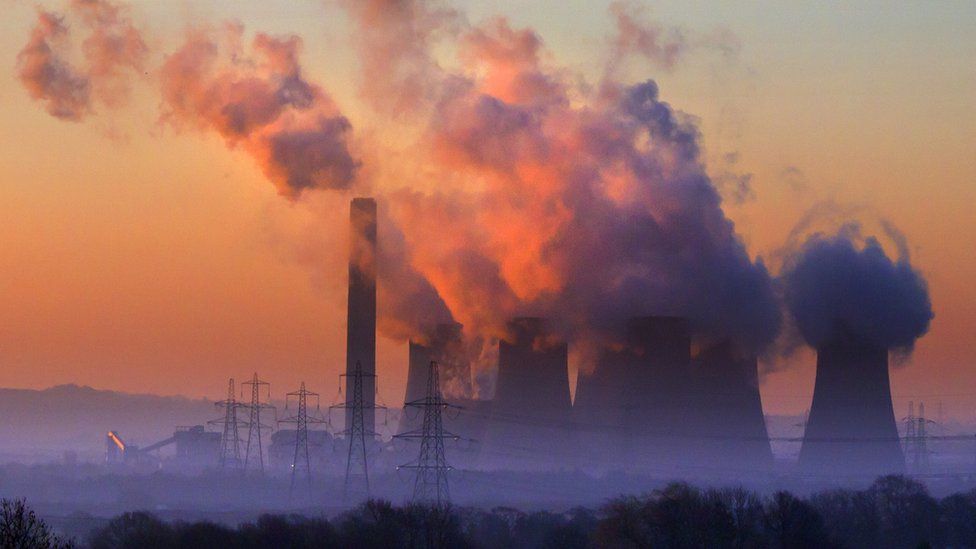
Countries are being urged to strengthen their carbon-cutting targets by the end of 2022 in a draft agreement published at the COP26 Glasgow climate summit.
The document says vulnerable nations must get more help to cope with the deadly impacts of global warming.
It also says countries should submit long-term strategies for reaching net-zero by the end of next year.
Critics have said the draft pact does not go far enough but others welcomed its focus on the 1.5C target.
The document, which has been published by the UK COP26 presidency, will have to be negotiated and agreed by countries attending the talks.
The document may be just seven pages long but it attempts to steer COP26 towards a series of significant steps that will prevent global temperature rises going above 1.5C this century.
Perhaps the most important part of that is getting countries to improve their carbon cutting plans.
To that end this draft decision urges parties to “revisit and strengthen the 2030 targets in their nationally-determined contributions, as necessary to align with the Paris Agreement temperature goal by the end of 2022”.
It will be interesting to see how countries such as China, India, Brazil and Saudi Arabia respond to this request to put new plans on the table by the end of next year.
There is some comfort for developing countries to see that their financial needs are recognised as countries are asked to mobilise climate finance “beyond $100bn a year” and the draft welcomes steps to put in place a much larger, though as yet unspecified, figure for support from 2025.
Loss and damage, an issue of key importance to the developing world, is included in the draft with encouragement to richer countries to scale up their action and support including finance for poorer nations.
The document also calls on countries to accelerate the phase out of coal and subsidies for fossil fuels – but has no firm dates or targets on this issue. Campaigners will welcome the inclusion and will hope it survives into the final text.
Scientists have warned that keeping temperature rises to 1.5C – beyond which the worst impacts of climate change will be felt – requires global emissions to be cut by 45% by 2030 and to zero overall by mid-century.
The draft agreement proposes an annual high-level ministerial round table on pre-2030 ambition, beginning at next year’s COP conference, likely to be in Egypt.
To further underline the importance of the 2030 target, it also asks UN secretary general Antonio Guterres to convene world leaders in 2023 to consider how efforts are shaping up.
David Waskow, from the World Resources Institute, said there would be opposition to the idea of coming back with new plans next year from a range of countries.
“On the question of the revisiting and strengthening of targets, there are certainly parties who have been pushing back, the Saudis and Russians have been quite clear on that, others have been less blunt,” he said.
“The other countries who are pushing back are many of the vulnerable countries, who don’t comprise that large percentage of global emissions often or have very limited resources to develop nationally-determined contributions and then to implement them.”
‘Cross our fingers and hope’
Loss and damage – an issue of key importance to the developing world – has been included in the draft, with richer countries encouraged to scale up their action and support, including finance for poorer nations.
But campaigners said these parts of the text were weak and were essentially a “box ticking exercise”.
The document also calls on countries to accelerate the phasing out of coal and subsidies for fossil fuels – but has no firm dates or targets on this issue.
“This draft deal is not a plan to solve the climate crisis, it’s an agreement that we’ll all cross our fingers and hope for the best,” said Jennifer Morgan from Greenpeace International.
Prime Minister Boris Johnson is returning to the COP26 climate summit in Glasgow later and will urge nations to “pull out all the stops” to limit warming.
Speaking ahead of his appearance, Mr Johnson said: “This is bigger than any one country and it is time for nations to put aside differences and come together for our planet and our people,” he said.
“We need to pull out all the stops if we’re going to keep 1.5C within our grasp.”
Research published at the summit on Tuesday indicated the short-term plans put in place by countries would see a rise of 2.4C.
While about 140 nations have pledged to reach net zero emissions by around the middle of the century, scientists have said their short-term plans for 2030 are not strong enough to limit the rise in temperatures.
WASHINGTON, Nov 9 (Reuters) – The Biden administration plans to announce new U.S. sanctions and other punitive actions “very soon” in response to Nicaraguan President Daniel Ortega’s re-election in a vote that Washington has denounced as a sham, a senior State Department official told Reuters on Tuesday.
The official, speaking on condition of anonymity, said the measures would be the first in a series of steps that the U.S. government will “ramp up over time.”
Washington expects a strong resolution against Ortega when the Organization of American States meets this week in Guatemala but is not likely to use the event to formally seek Nicaragua’s suspension from the bloc, the official said.
President Joe Biden is expected in the coming days or hours to sign congressional legislation aimed at ratcheting up pressure on Nicaragua, the official said.
Ortega, a former Marxist guerrilla leader, clinched a fourth consecutive term in Sunday’s election after jailing political rivals ahead of a vote that drew international condemnation.
U.S. Secretary of State Antony Blinken said on Monday that Washington will coordinate with other governments and was ready to use a range of tools, including sanctions and visa restrictions against those complicit in “undemocratic acts.”
“We’ll see some actions we take very soon,” the State Department official said. “I don’t want to leave people the impression that it’s going to be kind of one announcement and done… This will continue to go over time.”
The official declined to elaborate on the types of sanctions in the works. But a U.S. government source last week said initial targets would likely be individuals, security force members and government-controlled companies.
Ricardo Zuniga, U.S. special envoy for Central America, told reporters the United States was evaluating measures to hold Ortega’s government accountable. He declined to say whether Ortega might be personally sanctioned.
Ortega on Monday night derided his U.S. critics as “Yankee imperialists” and accused them of trying to undermine Nicaragua’s electoral process. Cuba, Venezuela and Russia all have offered Ortega their backing.
U.S. SEEKS OAS UNITED FRONT
Twenty-six OAS members voted last month on a resolution that expressed alarm at Ortega’s actions but seven countries abstained. Washington is working to forge a more united stand at the bloc’s general assembly.
The State Department official said “realistically, in terms of the votes,” now is not the time to seek Nicaragua’s suspension.
Asked if Nicaragua could be kicked out, Zuniga said it would be important for OAS members to jointly define next steps, calling expulsion a “very serious matter.” Biden’s aides are wary because such action against Cuba in the 1960s failed to change Havana’s course.
Biden is poised to sign into law the so-called RENACER Act, which received bipartisan approval last week in the U.S. House of Representatives, the official said.
The legislation calls for sanctions on Nicaraguans deemed responsible for unfair elections, increased coordination of such measures with the European Union and Canada, and expanded U.S. oversight of international lending to Managua.
Zuniga said elements of the bill correspond well to the administration’s views. It would also require U.S. government reports on alleged corruption by the Ortega family, human rights abuses by security forces and Russian activities in the country, including military sales.
In addition, the administration is asked to review Nicaragua’s participation in the Central America Free Trade Agreement, which gives preferential treatment to exports to the United States.
Reporting by Matt Spetalnick in Washington and Daina Beth Solomon in San Jose, Costa Rica; Editing by Howard Goller and Rosalba O’Brien
SANTIAGO, Nov 9 (Reuters) – Latin America’s largest airline, LATAM Airlines (LTM.SN), reported losses of some $692 million in the third quarter on Tuesday, as the indebted company said it was still battling challenges from the coronavirus pandemic.
LATAM’s total revenue climbed to $1.31 billion in the July-September quarter, an increase of 156% compared with the same period last year, but only around half the level compared with before the pandemic struck in early 2020.
“Despite the pandemic, which is not over yet and that is still having an impact, we have managed to close a third quarter with better operational performance in all businesses,” Finance Vice President Ramiro Alfonsín told reporters.
The result was supported by a better performance in the domestic travel market and solid cargo business, balancing weaker performance on international routes hit by global travel restrictions that are still in flux.
The operating capacity for the quarter averaged close to half the pre-pandemic level and the airline said it expected to reach around 65% of that level by the end of the year. Alfonsín said he expected the airline’s key Brazilian operation to recover to pre-pandemic levels by the end of 2021 or early 2022.
In May 2020, LATAM filed for bankruptcy protection in the United States, due to the impact of the restrictions related to the pandemic. Alfonsín said on Tuesday that the airline would present the reorganization plan this month.
“Now we are finalizing the last details of our reorganization plan, for that we are meeting with stakeholders and we hope to present by November 26,” he said.
The airline, born from the merger of Chile’s LAN with Brazilian rival TAM in 2012, has operating units in Chile, Brazil, Colombia and Peru.
Reporting by Fabián Andrés Cambero in Santiago Editing by Matthew Lewis
Nov 9 (Reuters) – Mexican President Andres Manuel Lopez Obrador on Tuesday pitched a global anti-poverty plan that seeks to uplift some 750 million poor people who live on less than $2 a day and would be financed largely by wealthy nations.
In a speech to the United Nations, Lopez Obrador stressed that the plan could give the world’s poor masses “a dignified life” thanks to voluntary contributions from the richest individuals, corporations and countries.
Lopez Obrador proposed that the program be funded by an annual 4% contribution from the fortunes of the 1,000 richest people and corporations, plus a donation from G20 countries equivalent to 0.2% of their economies.
“The resources of this fund must reach the beneficiaries directly, without any intermediaries, by means of a personalized card or electronic wallet,” he said, adding that the World Bank and the International Monetary Fund could help design the fund.
Mexico holds the rotating presidency of the 15-member U.N. Security Council and Lopez Obrador spoke at the session at the body’s New York headquarters. The leftist leader made the comments on only his second trip outside Mexico during his first three years as president.
Reporting by Mexico City newsroom; Editing by David Alire Garcia and Dan Grebler
NOGALES, Mexico, Nov 9 (Reuters) – Leo fled his hometown in southern Mexico after his uncle was murdered by gang members and he received death threats. Earlier this year, he, his wife and their two children headed to the U.S.-Mexico border hoping to claim asylum.
After months of waiting, he hoped he would finally get his chance on Monday. But even as U.S. borders opened for travelers vaccinated against COVID-19, they remained closed to asylum seekers.
When Leo, 23, and his family approached the port of entry in Nogales, Mexico with his and his wife’s vaccination cards in hand, they were told by a border official they could not enter and seek asylum.
“I feel dispirited and sad,” said Leo, who asked his last name not be published for fear of reprisals from the gang he fled. President Joe Biden “is just continuing the same policies of Donald Trump.”
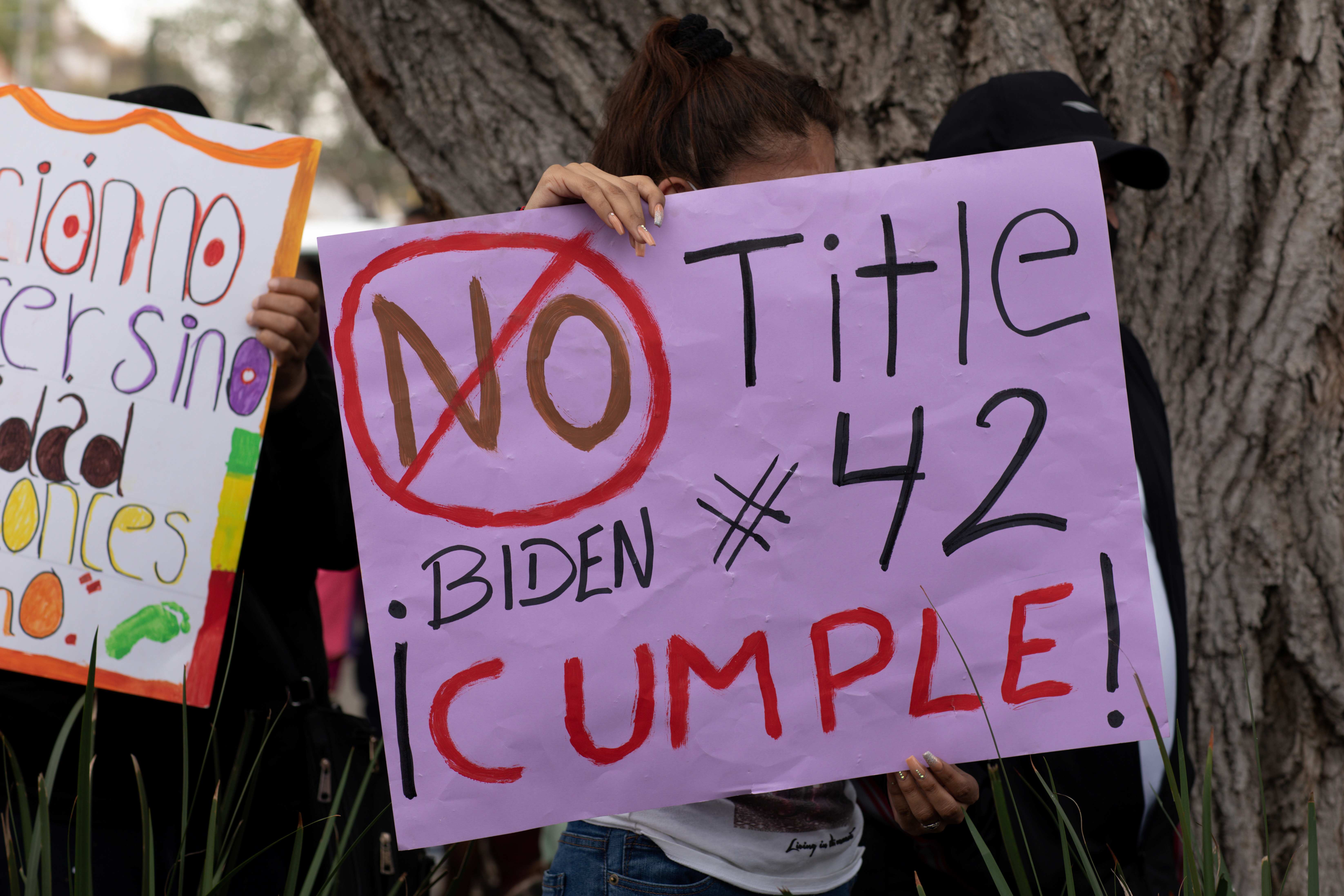
Biden has kept in place a controversial U.S. Centers for Disease Control and Prevention (CDC) order, first implemented by his Republican predecessor Trump in March 2020, that allows migrants to be immediately expelled without an opportunity to seek asylum.
The Biden administration has said the CDC’s order, known as Title 42, remains necessary to prevent the spread of COVID-19, as asylum seekers are processed in crowded settings at the border.
Any foreign national attempting to enter the United States without proper documentation will be subject to expulsion regardless of vaccination status, according to the Department of Homeland Security.
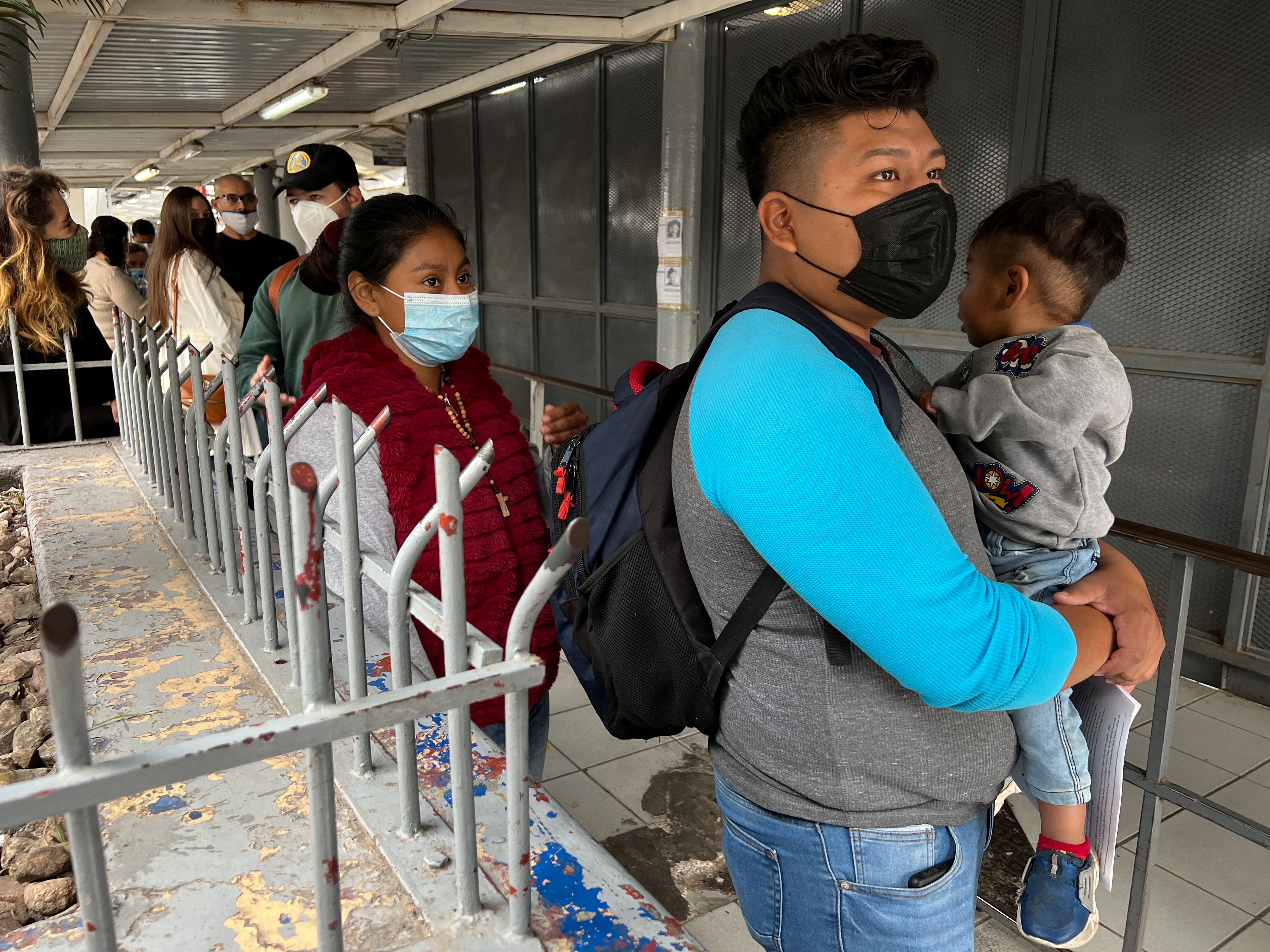
Leo and Nancy, fully vaccinated migrants from southern Mexico and their sons Alexander, 2, and Gael, 1, wait in line before their attempt to seek asylum after the U.S. reopened land borders to vaccinated travelers for the first time since coronavirus disease (COVID-19) restrictions were imposed, in Nogales, Mexico November 8, 2021. Picture taken November 8, 2021. REUTERS/Caitlin O’Hara
Advocates have criticized the Biden administration’s continuation of the expulsion policy as borders reopen.
The idea that a vaccinated asylum seeker is more of a risk than a vaccinated tourist is laughable, said Noah Gottschalk, global policy lead with Oxfam America, one of the advocacy groups suing the Biden administration to overturn the Title 42 order. Gottschalk said the exclusion of vaccinated asylum seekers strengthens the group’s argument that the policy isn’t about public health.
In September, a federal judge ordered the Biden administration to stop expelling family units – parents or legal guardians arriving with their children – under the Title 42 order. The administration appealed, and a higher court put the judge’s ruling on hold as the case moves forward.
Last month, more than 1,300 medical professionals signed letters to the CDC urging it to end the border expulsions order, saying it lacked epidemiological evidence to justify it and put migrants at risk.
New York-based nonprofit Human Rights First has documented more than 7,600 kidnappings and other attacks on migrants stuck in Mexico who were blocked from entering the United States since Biden took office in January.
Leo has been working in construction to pay rent in Nogales, but he says his earnings are not enough to support his family. “They abuse you because they know you are not from here, they pay you what they want,” he said.
He is also worried about his children getting hit by a stray bullet when gunshots ring out at night. The U.S. State Department recommends Americans reconsider travel to the Mexican state of Sonora, where Nogales is located, due to crime and kidnapping.
“We were fleeing a place that was dangerous,” said Leo. “And here it is the same.”
Reporting by Kristina Cooke in San Francisco, Mica Rosenberg in New York and Caitlin O’Hara in Nogales, Mexico; Editing by Mary Milliken and Karishma


 The Associated Press
 *****@
 *****@
 *****@
 *****@
 *****@
 *****@
 *****@
 *****@
 *****@
 *****@
 *****@
 *****@