Category Archives: headline

US with 99K Labor Day Spike in COVID Cases

  • COVID-19 cases, deaths and hospitalizations skyrocketed this Labor Day in comparison to Labor Day 2020.

The Washington Post COVID-19 tracker found that hospitalizations on Labor Day in 2021 reached 99,270 individuals, up from 38,192 people in 2020.

That is a 160-percent increase in hospitalization over the past year, despite the U.S. having more than half of the country vaccinated.

Johns Hopkins University data showed there was a 316-percent increase in COVID-19 cases between the two Labor Days, USA Today reported. COVID-19 deaths were also twice as high on the federal holiday compared to last year.

The rise in cases also caused the U.S. to surpass more than 40 million total COVID-19 cases throughout the pandemic, with more than 680,000 deaths.

What’s different: Millions of Americans have received the vaccine this year, which offers them protection. But at the same time, the delta variant has become the dominant strain in recent months, spreading more easily than previous versions of the virus.

The post US with 99K Labor Day Spike in COVID Cases appeared first on The St Kitts Nevis Observer.

Travel to the Caribbean During Covid-19: What You Need to Know

by CNN Staff
Coronavirus cases remain in flux across the globe. Health officials caution that travel increases your chances of getting and spreading the Covid-19 virus. Unless you’re fully vaccinated, staying home is the best way to stem transmission. Below is information on what to know if you still plan to travel, current as of September 6.
(CNN) — If you’re planning to travel to the islands of the Caribbean, here’s what you’ll need to know and expect if you want to visit during the Covid-19 pandemic.
The first thing to keep in mind is the Caribbean Sea region consists of 13 independent island nations. There are even more overseas territories. Each of them has its own rules, subject to frequent change.
Some of the islands opened back up to travel in the summer and fall of 2020. Others reopened more recently. Restrictions can vary. Some islands require quarantines, even for vaccinated travelers, while others don’t even request a Covid-19 test. Rules vary depending on your country of origin.
With the spread of the Delta variant, the US Centers of Disease Control and Prevention has added more destinations to its highest risk category — Level 4. That includes places in the Caribbean.
Also remember that hurricane season continues through November 30. Typically, the worst part of the season is mid-August through September. Islands in the southern part of the Caribbean are usually less affected by hurricanes than their more northerly neighbors. Get updates at CNN Weather.
Here’s a roundup of key highlights on 10 popular Caribbean destinations, with the latest information in bold. Follow the links provided so you can find out all the crucial details and check for updates before you book a trip. Rules might change between updates to this article:

Aruba

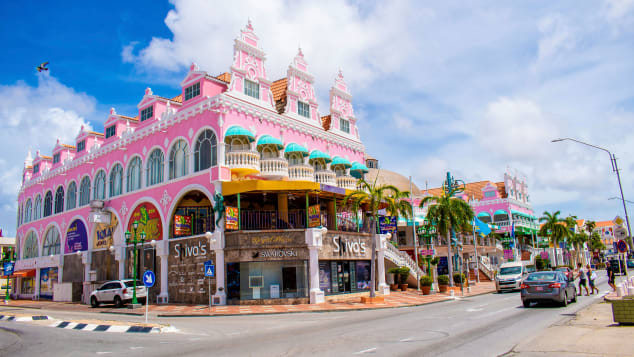
Aruba is known for its white beaches and colorful buildings in the capital city of Oranjestad.

Aruba is known for its white beaches and colorful buildings in the capital city of Oranjestad.
DPPA/Sipa USA/AP
What’s on offer: Days are usually dry and sunny. Arikok National Park features caves, desert landscapes and giant lizards. Wide beaches bordering clear jade water are the big draw.
Who can go? Citizens of all countries can enter with the exception of Venezuela.
Entry requirements: All visitors 12 and older must have a negative result from a molecular Covid-19 test taken within 72 hours of arrival if coming from a high-risk country, regardless of vaccination status. This list is on Aruba’s tourism website and is subject to change.
Aruba visitors health insurance is mandatory. No quarantine is in place. Travelers who test positive for Covid-19 are required to stay in mandatory isolation, however.
US CDC travel advisory: Level 4: Very high. Avoid travel to Aruba.

The Bahamas

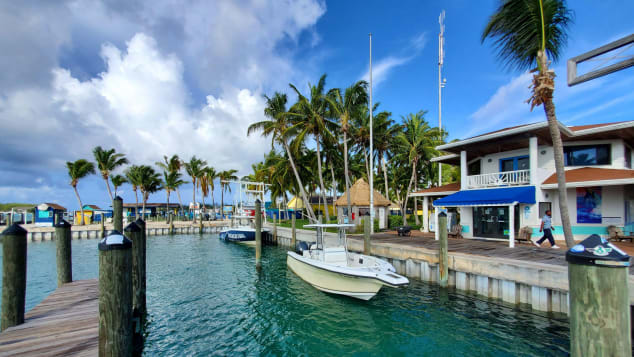
You'll find Bimini Big Game Club and Marina on North Bimini, which is off the coast from Miami, Florida.

You’ll find Bimini Big Game Club and Marina on North Bimini, which is off the coast from Miami, Florida.
Francisco Blanco/Alamy
What’s on offer: The chain has 700 islands — from the hustle and funky beats of the capital city, Nassau, on New Providence, to the peaceful beaches on many less-visited islands. You can swim with pigs or dive with sharks.
Who can go? The Bahamas is open to all international travelers.
Entry requirements: All travelers must present a negative result from a PCR test taken no more than five days before arrival, even if you’re fully vaccinated. Children younger than 2 are exempt. You must fill out a health visa application and opt in to the Bahamas’ Covid-19 health insurance. Unvaccinated travelers staying longer than four nights and five days must also take a rapid antigen test on day five and fill out a daily health questionnaire. You must also test for travel between various island within the Bahamas chain.
US CDC travel advisory: Level 4: Very high. Avoid travel to the Bahamas.

Barbados

Charles Fort was built in 1650 to protect Carlisle Bay on Barbados from pirates.

Charles Fort was built in 1650 to protect Carlisle Bay on Barbados from pirates.
Jon G. Fuller/VWPics/AP
What’s on offer: Golf, history and architecture get visitors beyond the beach on the most easterly island in the Caribbean. Rum distilleries offer tours and the local cuisine — a blend of African, Indian, Irish, British and Creole flavors — will soak up the spirit.
Who can go? The island is welcoming visitors from around the world. Barbados has discontinued its Caribbean travel bubble.
Entry requirements: Both fully vaccinated travelers and the unvaccinated must present a negative result from a Covid-19 PCR test taken no more than three days before travel. You must upload results to the BIMSafe app.
Vaccinated travelers also take a rapid test upon arrival and quarantine for one or two days awaiting results. Unvaccinated travelers must quarantine for five days, take another PCR test and remain in quarantine until receiving results. You must book your room ahead of time at a government-approved accommodation (scroll down for list).
US CDC travel advisory: Level 3: High. Unvaccinated travelers should avoid nonessential travel to the Bahamas.

Cuba

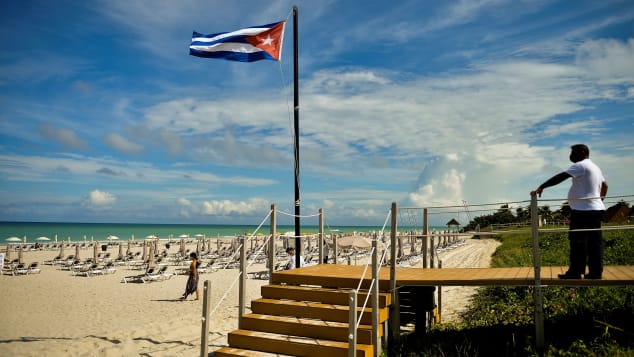
The Cuban flag at the Melia Varadero International Hotel in Matanzas Province, east of Havana on Cuba's north coast.

The Cuban flag at the Melia Varadero International Hotel in Matanzas Province, east of Havana on Cuba’s north coast.
Yamil Lage/AFP/Getty Images
What’s on offer: The largest island in the Caribbean, Cuba has a plethora of beaches. The romantic charm and mystique of Old Havana and the lush Viñales Valley, both UNESCO World Heritage sites, set this destination apart.
Who can go? Cuba is allowing visitors from around the world to enter. The US government doesn’t allow its citizens to visit Cuba for general tourism purposes. However, there are a variety of permitted reasons to visit.
Entry requirements: Visitors are required to show proof of a negative result from a Covid-19 PCR test taken within three days of arrival. They must take another PCR Covid-19 test upon arrival in Cuba and quarantine at a government-approved hotel. On day five, they take another Covid-19 test. No exemptions for the fully vaccinated. Cuba remains on lockdown as it has for much of the pandemic.
US CDC travel advisory: Level 4: Very high. Avoid travel to Cuba.

Curaçao

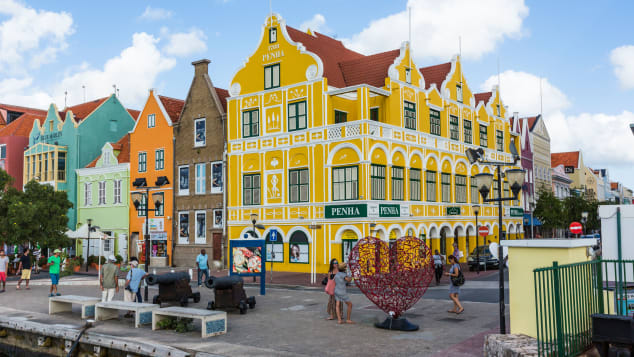
The Penha Building was built in 1708 in the Dutch colonial style and is now a department store in Willemstad, the capital of the island.

The Penha Building was built in 1708 in the Dutch colonial style and is now a department store in Willemstad, the capital of the island.
Jon G. Fuller/VWPics/AP
What’s on offer: The island’s coral reefs and sunken ships are accessible via scuba and snorkeling outings. Willemstad, the capital and a UNESCO World Heritage site, is a don’t-miss for history buffs. Nature lovers will find orchids and birds at Christoffelpark.
Who can go? Curaçao divides countries and territories — and the travelers arriving from them — into four categories: very low risk, low risk, high risk and very high risk. You need to check which category you’re in as they may have varying requirements.
Entry requirements: All visitors except those coming from “very low risk” destinations must have negative results from a Covid-19 PCR test that’s no more than 48 hours old before your flight to the island. There are no exemptions for the fully vaccinated. All travelers must fill out the passenger locator card 48 hours before arrival. No quarantines are in place unless you test positive for Covid-19 during your stay.
US CDC travel advisory: Level 4: Very high. Avoid travel to Curaçao.

Dominican Republic

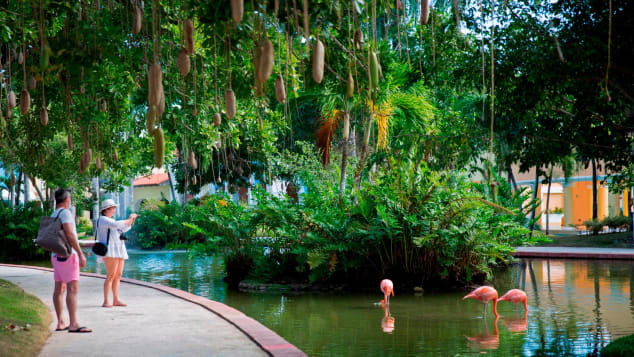
Tourists take pictures of flamingoes in Bayahibe, La Altagracia province.

Tourists take pictures of flamingoes in Bayahibe, La Altagracia province.
Erika Santelices/AFP/Getty Images
What’s on offer: Top-notch beaches and a range of resorts await visitors. Diverse geography, including lush forests and mountains and semi-arid areas, contrasts with Santo Domingo’s historic Cuidad Colonial — a lively and romantic spot to explore.
Who can go? Travelers around the world may enter, but depending on where you’re coming from, entry requirements will differ.
Entry requirements: Travelers from many nations — including the United States, Canada, Mexico and France, among others — do not need a Covid-19 test to enter. But as of June 28, the DR has set up a list of nations from which you do need a negative result from a Covid-19 PCR test taken no more than 72 hours before arrival. Nations on that list include Brazil, Ireland and the United Kingdom, among others. No quarantines are in place.
US CDC travel advisory: Level 3: High. Make sure you are fully vaccinated before traveling to the Dominican Republic.

Jamaica

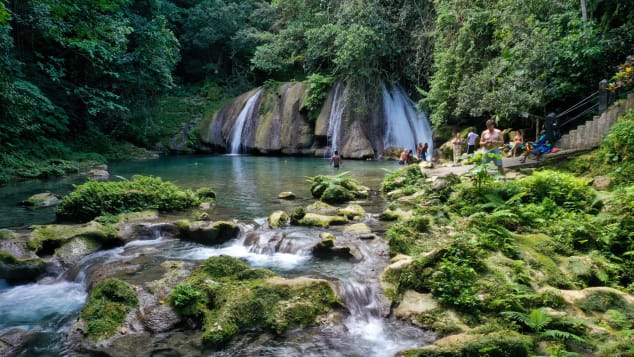
Reach Falls, near the city of Port Antonio, is a popular destination in Jamaica.

Reach Falls, near the city of Port Antonio, is a popular destination in Jamaica.
Valery Sharifulin/TASS/Getty Images
What’s on offer: Jamaica’s reggae and dancehall music and laid-back vibe are perennial draws. Tropical beaches, waterfalls and delicious jerk cuisine also lure visitors.
Who can go? Until September 17, anyone who has been in Argentina, Brazil, Chile, Colombia, India, Paraguay, Peru or Trinidad and Tobago within 14 days of their intended date of entry will not be approved OK’d for travel.
Entry requirements: Travelers 12 and older must have a negative result from a Covid-19 molecular (PCR, NAA, RNA) or antigen test performed taken within three days of the travel date. You must fill out a travel authorization form.
Visitors are allowed to go only to “Resilient Corridors” designed specifically for tourists along with other licensed accommodations that meet Covid-19 safety standards. If you require a Covid test upon arrival, you must quarantine in your hotel or resort until you get a negative result.
US CDC travel advisory: Level 4: High. Avoid travel to Jamaica. (Added on September 7).

Puerto Rico

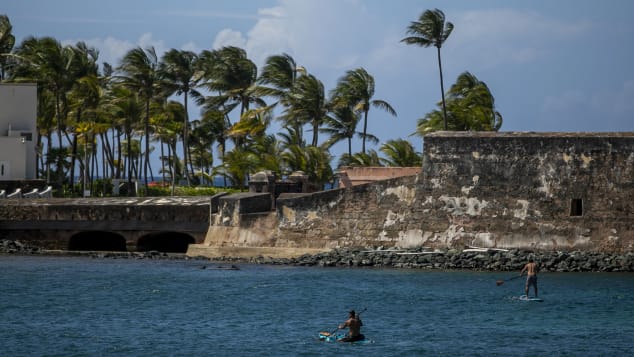
Paddleboarders enjoy themselves near a beach in the Condado neighborhood of San Juan.

Paddleboarders enjoy themselves near a beach in the Condado neighborhood of San Juan.
Xavier Garcia/Bloomberg/Getty Images
What’s on offer: Charming and historic Old San Juan is ripe for exploration. The island’s casinos and El Yunque rainforest are also top attractions that stretch beyond the water activities at the island’s many beaches.
Who can go? Puerto Rico is a US territory. According to US State Department and CDC guidelines on international travel, people who have been in Brazil, China, the European Schengen Area, Iran, India, Ireland, South Africa and the United Kingdom in the past 14 days will be denied entry for leisure travel. Others who meet entry requirements may enter.
Entry requirements: Fully vaccinated travelers on domestic flights must upload their vaccination card to the island’s online portal, which will generate a QR code. Nonvaccinated travelers on domestic flights must have a negative result from a Covid-19 PCR or antigen test taken within 72 hours of arrival.
International visitors, regardless of vaccination status, must have a negative result from a Covid-19 PCR or antigen test taken within 72 hours of arrival.
People who arrive without a test must take a Covid-19 test within 48 hours of arrival and go into quarantine awaiting results. Failure to comply could result in a $300 fine.
US CDC travel advisory: Level 4: Very high. Get fully vaccinated before traveling to Puerto Rico.

Turks and Caicos

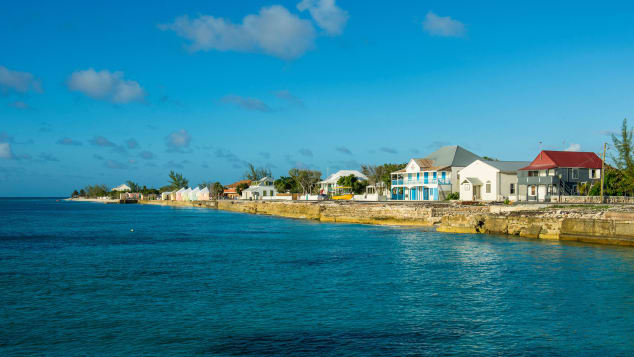
Colonial houses line the waterfront in Cockburn town, Grand Turk.

Colonial houses line the waterfront in Cockburn town, Grand Turk.
Alamy
What’s on offer: This British overseas territory — northeast of Cuba and southeast of the Bahamas — is known for it coral reefs, ripsaw music and a low-key vibe. Whale watching, snorkeling and a range of other outdoor activities pair well with the islands’ natural aquatic beauty.
Who can go? Visitors from around the world are welcomed to vacation here.
Entry requirements: You must be fully vaccinated if you’re 16 or older to visit. All travelers 10 and older need a negative result from a Covid-19 PCR test taken no more than three days before arrival to enter. There’s no quarantine on arrival. You must fill out a travel authorization form, and Covid-19 travel insurance is required as well.
US CDC travel advisory: Level 3: Moderate. Unvaccinated travelers should avoid nonessential travel to the Turks and Caicos Islands.. (Update September 7).

US Virgin Islands

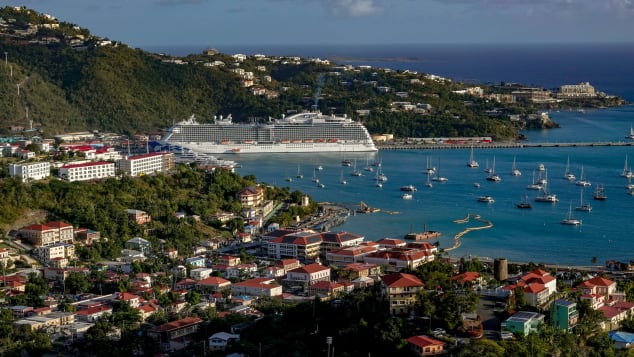
St. Thomas saw a lot of cruise ship activity before the pandemic.

St. Thomas saw a lot of cruise ship activity before the pandemic.
Bonnie Jo Mount/The Washington Post/Getty Images
What’s on offer: From fine dining, scuba diving and golfing on St. Croix to the pristine shores of unspoiled and undeveloped St. John, these islands have a lot to offer. In lively St. Thomas, boating and duty-free shopping are big draws.
Who can go? The USVI is a US territory. According to US State Department and CDC guidelines on international travel, people who have been in Brazil, China, the European Schengen Area, Iran, India, Ireland, South Africa and the United Kingdom in the past 14 days will be denied entry for leisure travel. Others who meet entry requirements may enter.
Entry requirements: Travelers 5 or older who enter by air or sea are required to use the USVI Travel Screening Portal and submit a Covid-19 test result before travel. You must have one of the three following to enter:
— A negative result from a Covid-19 molecular test taken and received within five days of the start of your trip.
— A negative result from a Covid-19 antigen test taken and received within five days of the start of your trip.
Results from Covid-19 antibody tests are no longer being accepted for entry.
No Covid-19 test is required for travel to and from the US Mainland.
US CDC travel advisory: Level 4: Very high. Get fully vaccinated before traveling to the US Virgin Islands.

The post Travel to the Caribbean During Covid-19: What You Need to Know appeared first on The St Kitts Nevis Observer.

Mexico Decriminalises Abortion in Landmark Ruling

BBC- Mexico’s Supreme Court has ruled that criminal penalties for terminating pregnancies are unconstitutional.

The ruling, for the northern state of Coahuila, prevents women from being prosecuted for getting an abortion.

Abortion is currently severely restricted in all but four of the country’s states.

Supreme Court Justice Luis Maria Aguilar described the move as a “historic step for the rights of women”.

On Tuesday, the court ordered the state of Coahuila to remove sanctions for abortion from its criminal code.

The decision could pave the way for the decriminalisation of abortions across the country.

Currently, abortion is only legal in a handful of states, except in cases of rape or where the mother’s life is in danger.

A judicial source said the ruling will affect the whole of Mexico, allowing women in states where abortion is criminalised to undergo the procedure with a judge’s order.

The Information Group on Reproductive Choice (GIRE), which campaigns for abortion rights, described the decision as “historic”.

“We hope that throughout the country women and people with the ability to carry a child have the conditions and freedom to determine their reproductive destiny,” it said.

The ruling could open up avenues for people from Texas seeking legal abortions.

2px presentational grey line

T


The post Mexico Decriminalises Abortion in Landmark Ruling appeared first on The St Kitts Nevis Observer.

Echoes of Trump: Brazil on Edge as Bolsonaro Supporters March on Congress

Police were out in force in Brazil’s capital Brasilia on Tuesday, after supporters of far-right President Jair Bolsonaro answered his calls to rally.

Extra officers were deployed to guard the Supreme Court, following warnings that Mr Bolsonaro’s supporters might try to storm the building.

It comes after the president accused the Supreme Court and Congress of blocking his reforms.

Critics say he wants to put on a show of strength amid plummeting ratings.

One recent opinion poll gave former President Luiz Inácio Lula da Silva a nine-percentage point lead over Mr Bolsonaro in the first round of voting.

Brazil"s President Jair Bolsonaro attends the Independence Day ceremony in Brasilia, Brazil, September 7, 2021
Mr Bolsonaro is planning to address supporters in Brasilia and São Paulo

While elections are not due to be held until October 2022, Mr Bolsonaro’s approval ratings have also dropped to an all-time low.

A poll by the Atlas Institute suggested that 61% of Brazilians described his government’s performance as bad or very bad, up from 23% when he first took office in January 2019.

Mr Bolsonaro has responded by lashing out at the Supreme Court justices. He tried to have one of them impeached after the justice launched two investigations against him.

He has also tried to blame the Supreme Court for his government’s slow response to the Covid pandemic, falsely alleging that the court prevented him from taking quick action to curb the spread of the virus.

Tens of thousands of Mr Bolsonaro’s supporters responded to his call to rally in Brasilia on the country’s independence day on Tuesday.

In the early hours, some broke through a police cordon protecting the Supreme Court but they failed to surround the building as they had apparently planned.

Threats made by some of the president’s supporters to storm the Supreme Court have led to fears that Brazil could see similar scenes to those that played out on 6 January in Washington DC, when supporters of President Donald Trump surged past barricades into the US Capitol.

As recently as Friday, President Bolsonaro called on his backers to turn out on independence day to give the Supreme Court justices an “ultimatum” and to stop them from “meddling”.

“Our country can’t continue to be held hostage by one or two people,” he said on Tuesday in reference to two of the justices.

Mr Bolsonaro is expected to fly from Brasilia to São Paulo later on Tuesday to join a rally of his supporters there.

Smaller events have also been planned in many other cities.

Critics of the president have gathered for counter-rallies and there are fears the two sides could clash.

Some groups opposed to Mr Bolsonaro have urged people to attend protests on Sunday instead to avoid confrontations with the president’s supporters.

The post Echoes of Trump: Brazil on Edge as Bolsonaro Supporters March on Congress appeared first on The St Kitts Nevis Observer.

Chaos: Bitcoin Crashes on First Day as El Salvador’s Legal Tender

By Katie Silver
Business reporter

BBC- Angry protests, technological glitches and a plummet in value marked the first day of El Salvador adopting Bitcoin as legal tender.

The price of Bitcoin on Tuesday crashed to its lowest in nearly a month, falling from $52,000 (£37,730) to under $43,000 at one point.

An opposition politician said the fall caused one of Latin America’s poorest countries to lose $3m.

The rollout of bitcoin in El Salvador was far from what President Nayib Bukele would have envisaged when he began his bold experiment.

Platforms such as Apple and Huawei weren’t offering the government-backed digital wallet, known as Chivo, and servers had to be pulled offline after they couldn’t keep up with user registrations.

But, as the day went on, Chivo began appearing on more platforms and was accepted by the likes of Starbucks and McDonald’s.

The government has even given Salvadorans $30 each of Bitcoin to encourage its adoption. It says bitcoin could save the country $400m a year in transaction fees on funds sent from abroad.

However, using data from the World Bank and the government, the BBC calculates this to be closer to $170m.

“We must break the paradigms of the past,” President Bukele tweeted. “El Salvador has the right to advance towards the first world.”

Ed Hernandez runs a family shop in San Salvador where customers buy essentials like rice, beans and cleaning products. He’s well and truly on board.

“During the pandemic, it will be nice not to use physical cash,” he told the BBC, adding that it protects him from customers paying with counterfeit notes.

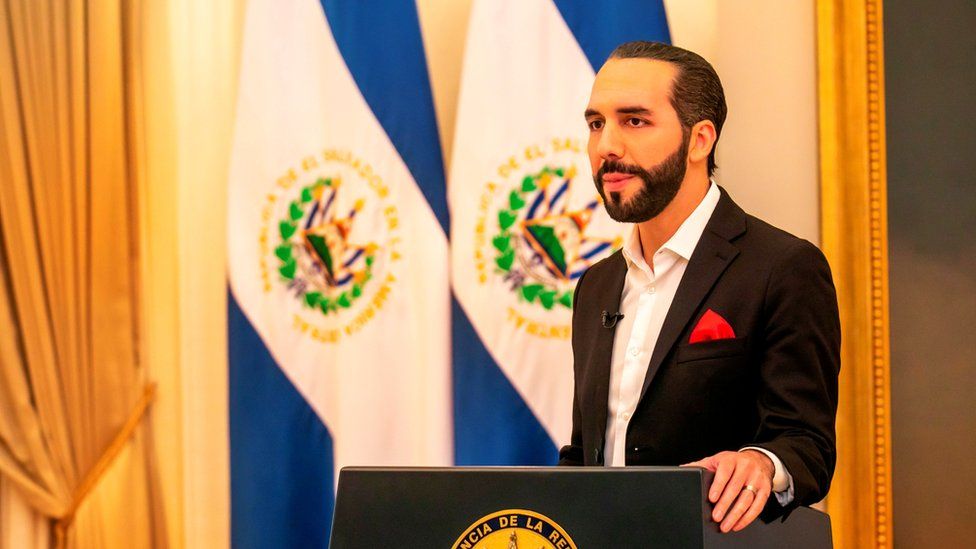
El Salvador"s President Nayib Bukele addresses the nation during a live broadcastEl Salvador’s President Nayib Bukele addressed the country in June to speak about his Bitcoin legal tender plan

What wasn’t good timing for El Salvador though was the tumble Bitcoin took on its first day as legal tender, falling 20% at one point.

“It was a very bad day for President Bukele, his government and his Bitcoin experiment,” opposition politician Johnny Wright Sol told the BBC.

“The majority of the population knows very little about cryptocurrencies. What we do know is it’s a very volatile market. Today that was surely made manifest.”

Mr Wright Sol said Bitcoin was not an apt national currency and was rushed through: “The Bitcoin law was approved in parliament with hardly any debate. It took only about five hours to go through.

“We’re not cryptocurrency or Bitcoin haters, but we don’t believe that it should be compulsory that businesses should be obligated to accept Bitcoin in payment.

“The state is backing these payments and assuming the risk but at the end of the day us taxpayers are all the state.”

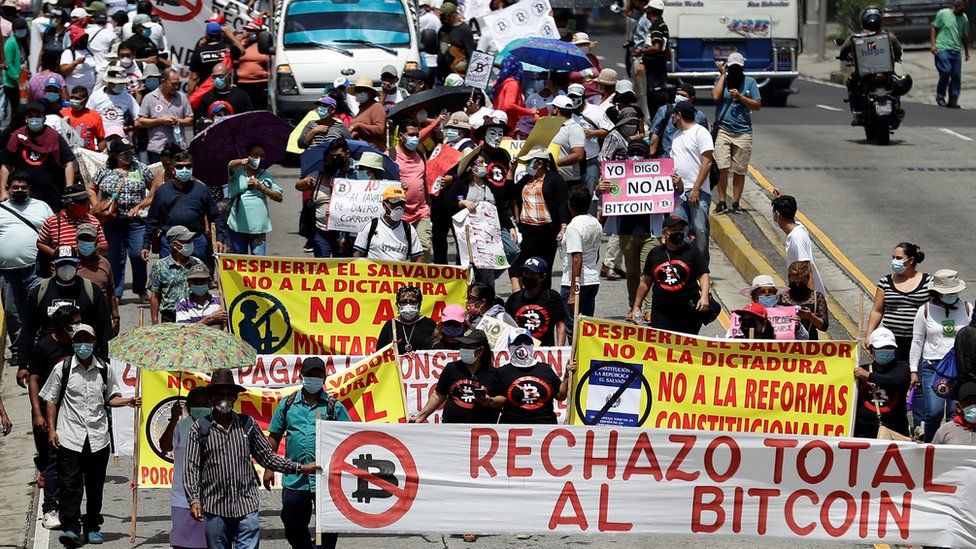
Protestors with signs in San Salvador
Protestors fear Bitcoin’s adoption may cause instability for one of Latin America’s poorest countries

Mr Wright Sol isn’t the only critic. More than 1,000 protesters gathered outside the country’s supreme court, where fireworks were set off and tyres were burnt.

Beyond financial instability, some say the adoption of Bitcoin may fuel illicit transactions.

But Mr Hernandez, the shopkeeper, is not put off by the volatility: “I see it as a risk yes – but like everything in life, there’s a risk. When we own a shop, sometimes we buy a product and we don’t sell it.

“When others see a crisis though, I see an opportunity.”

The post Chaos: Bitcoin Crashes on First Day as El Salvador’s Legal Tender appeared first on The St Kitts Nevis Observer.

UK with 37k New Daily Cases, S. Korea Learns to Live with COVID, World Stats, More

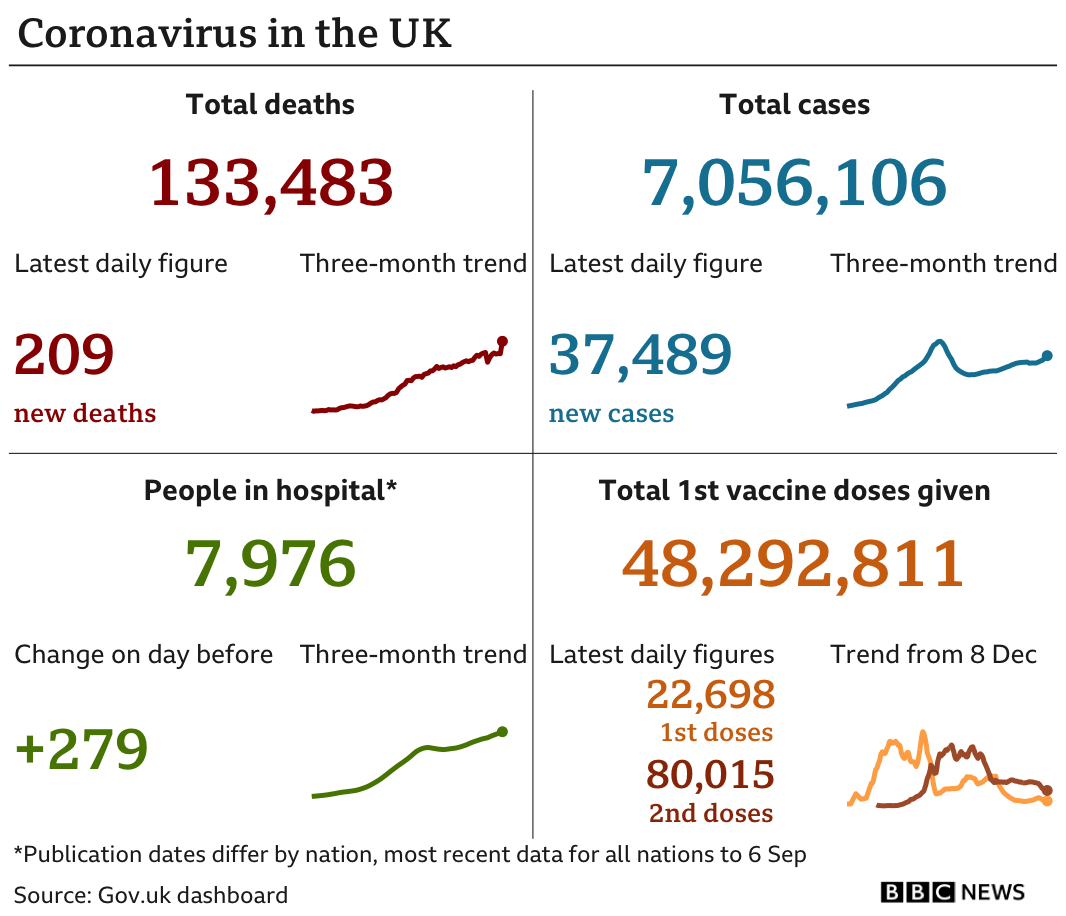
There have been more than seven million confirmed cases of coronavirus in the UK and 133,000 people have died, government figures show.

However, these figures include only people who have died within 28 days of testing positive for coronavirus.

About 89% of people aged 16 and over in the UK have now had their first dose of a coronavirus vaccine and 80% have had their second.

Government statistics show 133,483 people have now died, with 209 deaths reported in the latest 24-hour period. In total, 7,056,106 people have tested positive, up 37,489 in the latest 24-hour period. Latest figures show 7,976 people in hospital. In total, 48,292,811 people have received their first vaccination
Presentational white space
Short presentational grey line
==============================================

S.Korea planning to live ‘more normally’ with COVID-19 after October

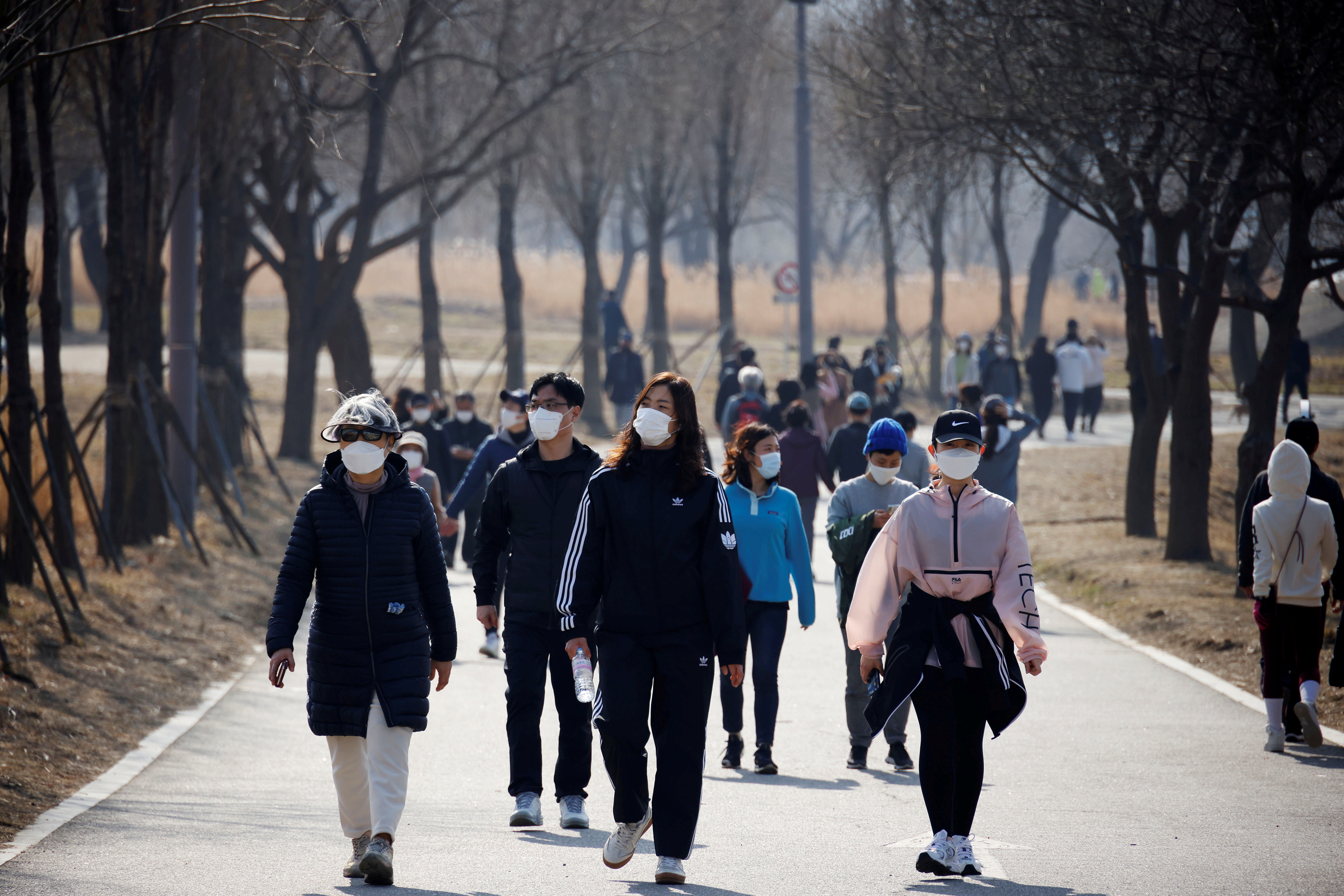
People wearing masks take a walk amid the coronavirus disease (COVID-19) pandemic at a Hanriver Park in Seoul, South Korea, February 21, 2021. REUTERS/Kim Hong-Ji/File Photo

SEOUL, Sept 8 (Reuters) – South Korea is drawing up a plan on how to live more normally with COVID-19, expecting 80% of adults to be fully vaccinated by late October, health authorities said on Wednesday.

The country is in the middle of its worst wave of infections, but it has kept the number of severely ill cases under control through steadily rising vaccination rates.

“We’ll review measures that will allow us to live more normally, but any such switch will be implemented only when we achieve high vaccination rates and overall (COVID-19) situations stabilise,” Son Young-rae, a senior health ministry official, told a briefing.

The strategy will be implemented in phases to gradually ease restrictions, authorities said. Masks will still be required at least in the initial stage.

The government expects to implement the plan sometime after late October, when 80% of its adult population likely will have been vaccinated. As of Tuesday, South Korea had given at least one vaccine dose to 70.9% of its adult population, while 42.6% are fully vaccinated.

It reported 2,050 new COVID-19 cases for Tuesday, with 2,014 of those locally acquired.

South Korea extended national social distancing curbs to Oct. 3 this week as the country boosts its vaccination campaign ahead of a thanksgiving holiday that falls later this month.

Restrictions in place include limited operating hours for cafes and restaurants and on the number of people allowed at social gatherings.

South Korea has registered 265,423 infections since the pandemic started, with 2,334 deaths.

The country has not seen a significant increase in coronavirus deaths, with a mortality rate of 0.88%, largely due to high vaccination rates among the elderly and vulnerable.

Severe or critical cases stood at 387 as of Tuesday.

Reporting by Sangmi Cha; Editing by Miyoung Kim and Tom Hogue
=============================================

Czech Republic’s daily COVID cases highest since May

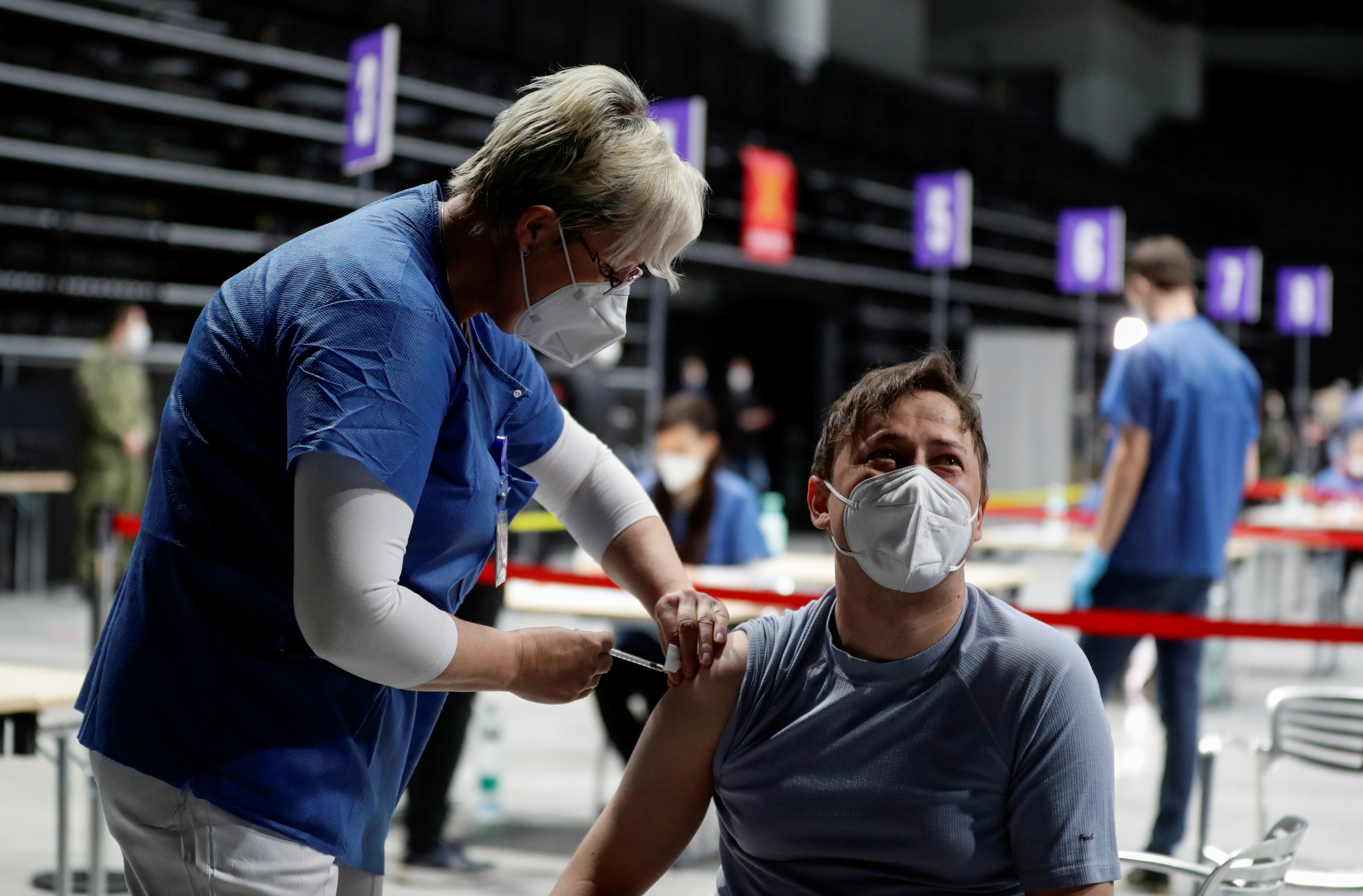
A man receives a dose of the coronavirus disease (COVID-19) vaccine during a trial run of the national vaccination centre located inside the O2 Arena in Prague, Czech Republic, April 9, 2021. REUTERS/David W Cerny

A man receives a dose of the coronavirus disease (COVID-19) vaccine during a trial run of the national vaccination centre located inside the O2 Arena in Prague, Czech Republic, April 9, 2021. REUTERS/David W Cerny

PRAGUE, Sept 8 (Reuters) – The Czech Republic on Wednesday recorded 588 new cases of coronavirus, the highest daily tally since May 25, as government officials predict a continued rise in infections.

The country, which was one of the hardest hit by the pandemic in earlier waves, has seen low infection rates since the summer months. In the past two weeks, it has reported 25 cases per 100,000 people, compared with 137 in Germany, according to the European Centre for Disease Prevention and Control (ECDC).

Prime Minister Andrej Babis said on Tuesday the government was not planning a return to broad lockdown measures – which had been eased going into the summer months – and ministers say local measures could be used in some instances.

The rise in cases reported for Tuesday was still well below peaks in daily infections seen during the waves between October 2020 and March 2021 when they reached into the thousands, hitting a peak of above 17,000 at one point.

The country’s death rate per capita since the pandemic started is the fifth highest in the world, according to Our World in Data, and overall more than 30,000 deaths have been reported in the country of 10.7 million.

============================================

Venezuela receives first batch of vaccines through COVAX mechanism

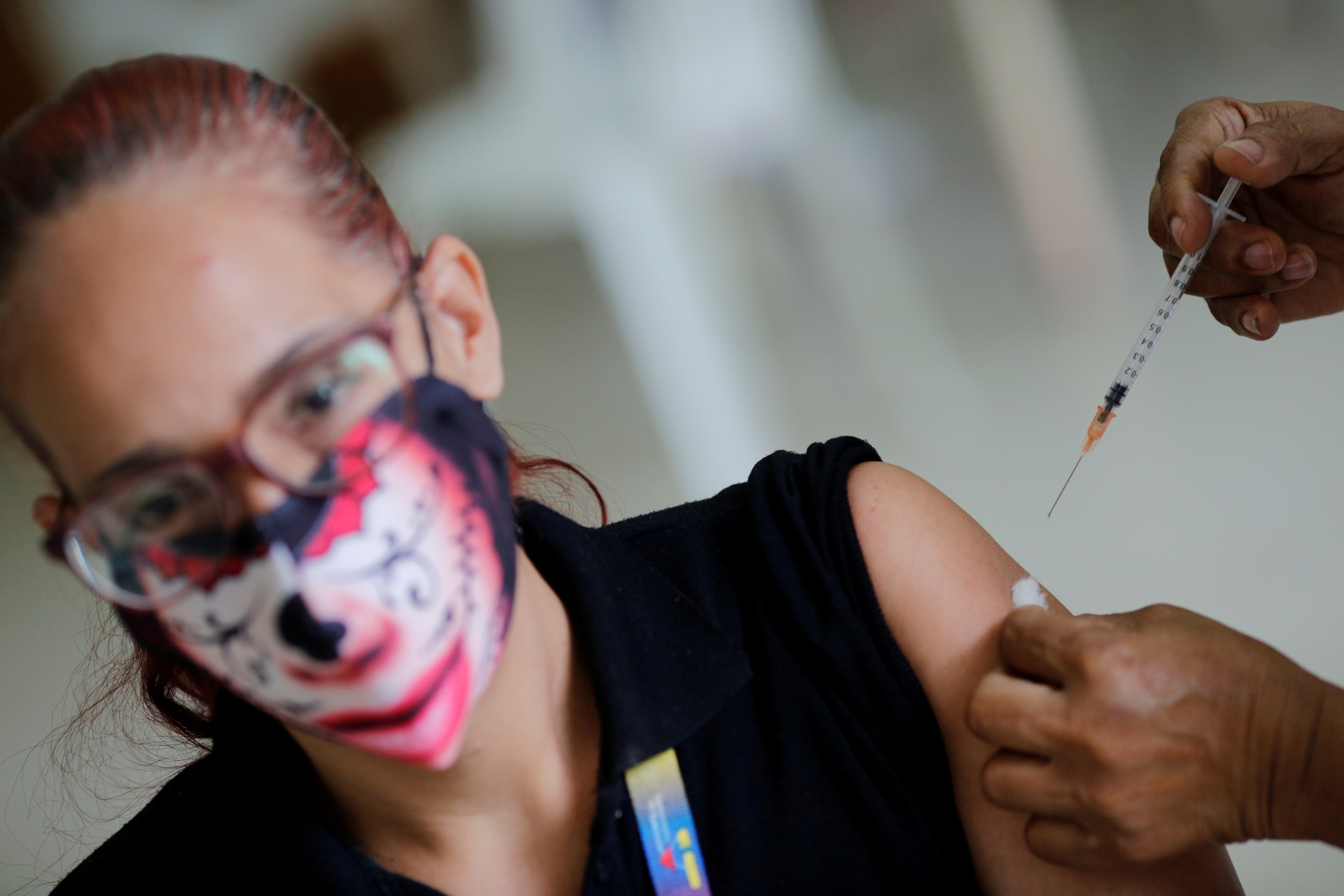
A woman receives a dose of Cuba's Abdala vaccine at a vaccination center in Caracas, Venezuela July 1, 2021. REUTERS/Manaure Quintero

A woman receives a dose of Cuba’s Abdala vaccine at a vaccination center in Caracas, Venezuela July 1, 2021. REUTERS/Manaure Quintero

CARACAS, Sept 7 (Reuters) – Venezuela has received its first batch of coronavirus vaccines through the COVAX mechanism intended for poor countries, the Pan-American Health Organization (PAHO) said on Tuesday, after months of delays the government attributed to U.S. sanctions.

The South American country has received 693,000 doses of the COVID-19 vaccine manufactured by China’s Sinovac Biotech, the first of a total of 11 million it will receive through COVAX, overseen by the GAVI alliance and the World Health Organization.

Representatives of PAHO, the WHO’s regional office for the Americas, and the Venezuelan government were present at Maiquetia international airport outside Caracas to receive the doses on Tuesday morning, PAHO said in a statement.

Venezuela has until now depended on Russia’s Sputnik V vaccine and China’s Sinopharm shot to inoculate its population against COVID-19, though many people who received their first dose of Sputnik-V have reported delays in obtaining the second.

An additional batch of Sputnik V doses also arrived this week, though authorities did not specify how many arrived.

Some 3.3 million Venezuelans, or around 10% of the population, have been vaccinated, according to PAHO estimates. Venezuelan authorities have not provided exact figures on how many residents have been vaccinated.

President Nicolas Maduro said on Sunday that the vaccines were expected this week. The government for months said it had been unable to pay for the vaccines due to U.S. sanctions meant to force Maduro from power, but in April announced it had deposited most of the funds in a Swiss bank account. read more

Reporting by Deisy Buitrago and Mayela Armas Writing by Luc Cohen Editing by Mark Heinrich

============================================

WORLD STATS

Coronavirus Cases:

222,793,289

Deaths:

4,600,334

Recovered:

199,317,213
Highlighted in green
= all cases have recovered from the infection
Highlighted in grey
= all cases have had an outcome (there are no active cases)

[back to top ↑]

Latest News

September 8 (GMT)

Updates

  • 1,268 new cases in

The post UK with 37k New Daily Cases, S. Korea Learns to Live with COVID, World Stats, More appeared first on The St Kitts Nevis Observer.

Mexico Hit by Powerful 7.0-Magnitude Earthquake, Killing at Least One

A man was killed and buildings were damaged in the resort city of Acapulco, and the quake was also felt in Mexico City

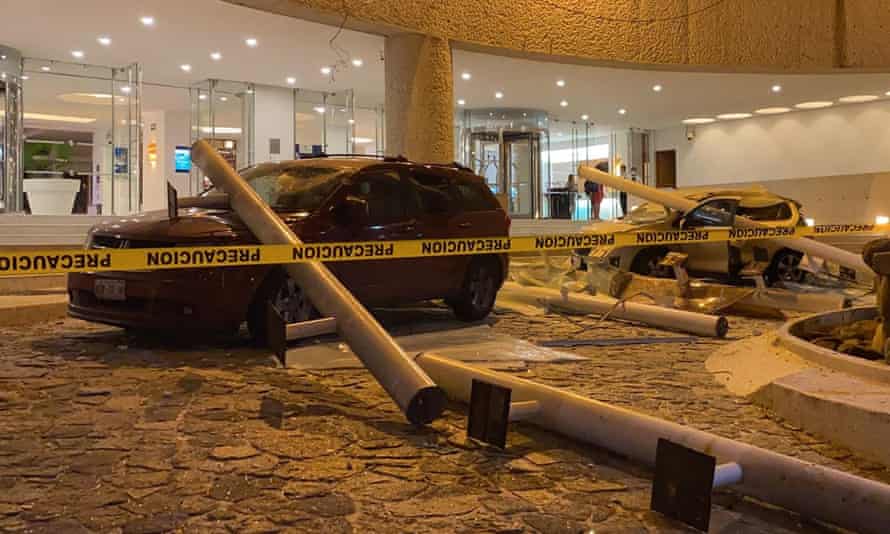
Cars were damaged outside a hotel in Acapulco after a 7.0 magnitude earthquake struck Mexico.
Cars were damaged outside a hotel in Acapulco after a 7.0 magnitude earthquake struck Mexico. Photograph: Francisco Robles/AFP/Getty Images
Guardian Staff and agencies

A powerful earthquake has struck south-west Mexico near the beach resort of Acapulco, killing at least one man who was crushed by a falling post, and causing rock falls and damaging buildings.

The US Geological Survey (USGS) said a 7.0 magnitude quake struck 11 miles (18km) north-east of the resort of Acapulco, Guerrero, in the early hours of Wednesday sending people running into the street for safety.

The quake shook the hillsides around the resort, downing trees and pitching large boulders on to the road.

“We heard loud noise from the building, noise from the windows, things fell inside the house, the power went out,” Sergio Flores, an Acapulco resident told Associated Press by phone.

“We heard leaking water, the water went out of the pool and you heard people screaming, very nervous people.”

The USGS said the quake in the early hours of Wednesday was very shallow at only 7.8 miles (12.5km) below the surface.

The US tsunami warning centre issued an alert following the quake, saying hazardous waves were possible within 185 miles (300km) of the quake site. The agency later updated their advice to say the threat had passed.

President Andrés Manuel López Obrador said the temblor had not caused major damages in Guerrero, the neighbouring region of Oaxaca, Mexico City or other areas.

The country’s civil defence agency said it was conducting reviews for the safety of residents and damage in 10 states.

In Mexico City, 230 miles (375km) away, the quake caused the ground to shake for nearly a minute in some parts of the capital.In the Roma Sur neighbourhood of Mexico City, lights went off and scared residents rushed out, some wearing little more than pyjamas, a Reuters witness said. Residents huddled together in the rain, holding young children or pets, too worried to return to their homes in the dark.

“It was terrible. It really reminds me of the 1985 quake every time something like this happens,” said Yesmin Rizk, a 70-year-old Roma Sur resident.

With Reuters and Associated Press

The post Mexico Hit by Powerful 7.0-Magnitude Earthquake, Killing at Least One appeared first on The St Kitts Nevis Observer.

NTA Now Clients of US-Based PR agency CIIC

NIA CHARLESTOWN NEVIS (September 07, 2021) —  Travel and lifestyle public relations agency, CIIC PR, announced recently in a press statement, the addition of Nevis Tourism Authority (NTA) to its growing list of travel and tourism clients.

According to the statement, CIIC PR was selected to lead a strategic communications campaign that will integrate media and trade relations, partnerships, influencer relations and thought leadership opportunities in the United States and Canada.

“We are looking forward to working closely with the Nevis Tourism Authority to position the island as a premier destination for leisure travellers,” said CIIC Founder and Chief Executive Officer (CEO) Carolyn Izzo-Feldman. “We are thrilled to expand our presence in the Caribbean, a region we hold so near and dear to our hearts.”

The PR agency describes Nevis as an island nestled in the Eastern Caribbean, known for its local history, natural beauty and its rustic charm, one of the most unspoiled and relaxing islands in the Caribbean.

“Loved by many for its vividly green sites with blue skies, clean air, and long empty beaches, Nevis has a pace of life that encourages its visitors to stop and appreciate the natural beauty around them.


The post NTA Now Clients of US-Based PR agency CIIC appeared first on The St Kitts Nevis Observer.

Labor accuses Morrison government of turning its back on Pfizer

The Morrison Government is being accused of turning its back on requests by vaccine manufacturer Pfizer to meet in early 2020.

Freedom of Information documents obtained by Shadow Assistant Minister for Health Ged Kearney appear to show emails from Pfizer representatives requesting a meeting with the government about vaccine supply in June 2020.

It is claimed the government then rejected a Pfizer offer to meet with Health Minister Greg Hunt.

READ MORE: Double-vaxxed Sydney mum with COVID-19 shares message from hospital

https://twitter.com/gedkearney/status/1435460354587328516

In the emails, Pfizer makes it clear that it wanted to secure contracts with nations quickly, and had the potential to supply millions of doses in 2020.

Ms Kearney said she believes this shows Australia had prior opportunity to access more Pfizer doses rather than relying on the locally-made AstraZeneca (now Vaxzevria) vaccine.

"From mid last year, Pfizer has been reaching out to the Government. Knocking on the door. Emailing the department. But no one from Morrison's Government wanted to meet with them," Ms Kearney said.

"Last year Australia was in crisis and vaccines were the only way out. But for some reason, Scott Morrison was too busy to sign a vaccine deal with Pfizer."

READ MORE: Why Singapore's 'living with COVID-19' plan is under threat

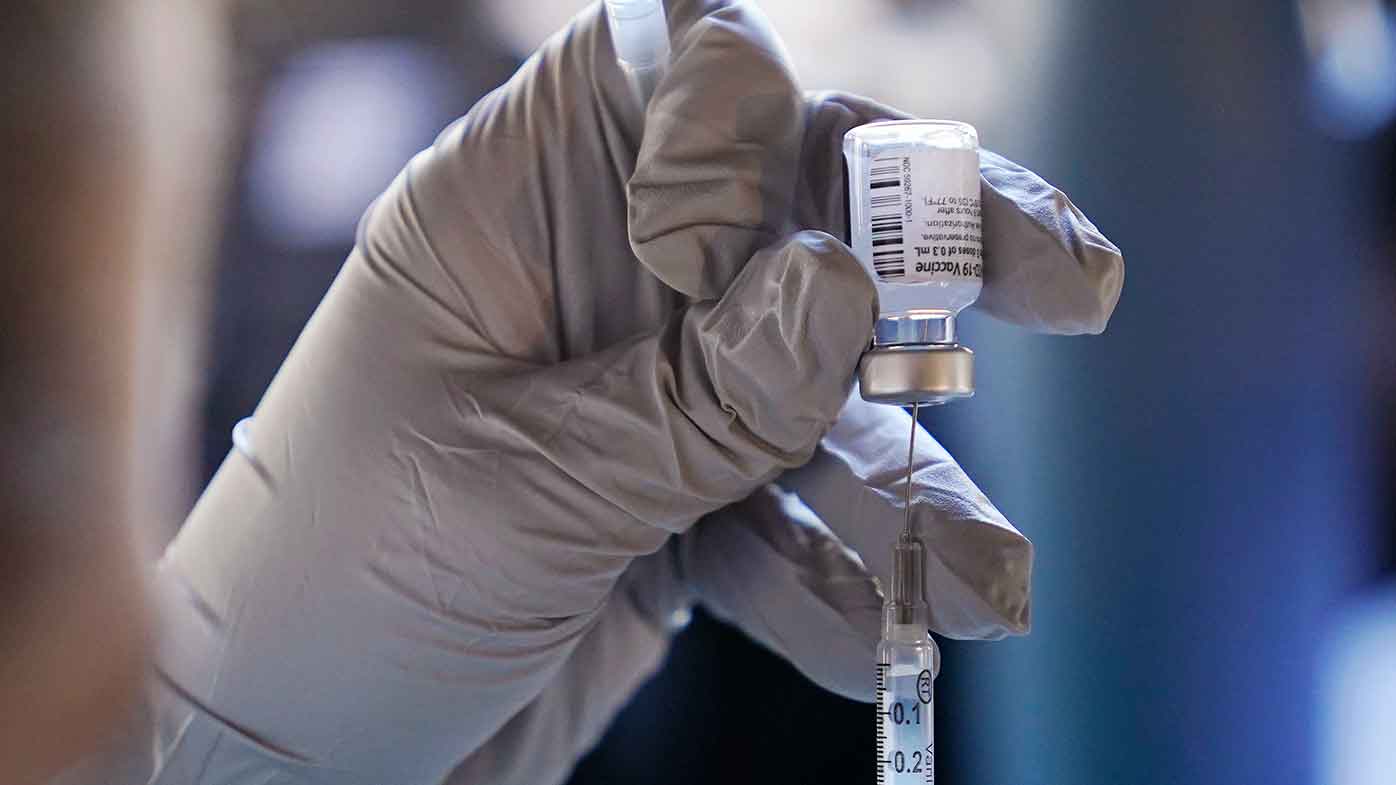
A vial of the Pfizer vaccine is prepared for use.

Mr Hunt refuted the accusations, saying that formal discussions with Pfizer were made as soon as possible.

"Labor is again seeking to undermine the vaccination program, just as Australians are playing their part, rolling up their sleeves and hitting key vaccination targets to bring the lock downs to an end," the health minister said in a statement.

"Both Pfizer and the Health Department have consistently confirmed, including on the public record at Senate Estimates, that the Australian Government entered into formal discussions on the purchase of vaccines, as soon as the company was in a position to do so, and were in discussions prior to this.

"When formal discussions began, no country had a contract with Pfizer."

READ MORE: Huge fines after worshippers refuse to leave Melbourne synagogue

Mr Hunt said referencing in the emails released by Labor as to Pfizer's "potential to supply millions of vaccine doses by the end of 2020" was referring to the company's global stock and not that reserved just for Australia.

"The Australian Government entered into an Advanced Purchase Agreement (APA) with Pfizer for the purchase of their COVID-19 vaccine as soon as possible, whilst ensuring safe and effective vaccines for Australians based on the medical advice from SITAG and the maximum doses available," Mr Hunt said.

"This is another desperate attempt by Labor to try to misrepresent the vaccine procurement process."