NEW YORK (AP) — A stunned U.S. East Coast faced a rising death toll, surging rivers and tornado damage Thursday after the remnants of Hurricane Ida walloped the region with record-breaking rain, drowning more than 40 people in their homes and…Read More
BOISE, Idaho (AP) — The intensive care rooms at St. Luke’s Boise Medical Center are full, each a blinking jungle of tubes, wires and mechanical breathing machines. The patients nestled inside are a lot alike: All unvaccinated, mostly middle-a…Read More
DUBAI, United Arab Emirates (AP) — Afghanistan’s most popular private television network has voluntarily replaced its risque Turkish soap operas and music shows with tamer programs tailored to the country’s new Taliban rulers, who have issued…Read More
WELLINGTON, New Zealand (AP) — New Zealand authorities were so worried about an Islamic extremist they were following him around-the-clock and were able to shoot and kill him within 60 seconds of him unleashing a frenzied knife attack that wo…Read More
WASHINGTON (AP) — President Joe Biden is calling for greater public resolve to confront climate change and help the nation deal with the fierce storms, flooding and wildfires that have beset the country as he makes a sojourn to hurricane-batt…Read More
PEBBLE BEACH, Calif. (AP) — Twenty years later, Jack Grandcolas still remembers waking up at 7:03 that morning. He looked at the clock, then out the window where an image i…Read More
TOKYO (AP) — Amid growing criticism of his handling of the pandemic, Prime Minister Yoshihide Suga said Friday he won’t run for the leadership of the governing party later …Read More
LONDON (AP) — English educator Richard Sheriff watched this week as a group of energetic 11-year-olds entered their new secondary school for the first time — finding their …Read More
LONDON (AP) — ABBA is releasing its first new music in four decades, along with a concert performance that will see the “Dancing Queen” quartet going entirely digital….Read More
According to the Botanic Gardens Conservation International, “World Forestry Report” published Wednesday, one-third of the forest wealth in Latin America and the Caribbean is under threat of extinction.
Of the nearly 60,000 species of trees catalogued globally, around 30% are threatened with extinction, the document noted. The study also showed a similar percentage applied to the rest of the planet.
Latin America and the Caribbean is the region with the greatest forest richness by far: almost 24,000 classified tree species (40% of the world’s total), of which 7,000 are under threat (31%).
Only 31 species are considered definitively “extinct” (0.1%), according to this world classification, a work which took scientists both of state-run and non-governmental organizations five years to complete.
The region of the planet most affected by the risk of extinction is Africa. Of the just over 9,000 classified tree species, almost 40% are under threat. Agriculture, logging and ranching together account for 70% of threats, while climate changes only 4%.
In the last 300 years, forest areas have shrunk by 40% worldwide. Twenty-nine countries lost more than 90% of their trees. That amount would match figures from the Industrial Revolution, which represented an economic and demographic growth unparalleled in history.
Seven commodity crops are responsible for more than half of deforestation worldwide, the Botanic Gardens Conservation International survey showed. But there are also other reasons, such as the one affecting the Honduran rosewood (Dalbergia stevensonii), which is a Central American tree whose wood is incredibly dense, highly valued for making musical instruments.
Due to the demand, the forests of this prized species in Belize have practically disappeared, and the tree is on the Red List of “critically endangered” species.
“Tree species that have evolved over millions of years, adapting to climatic changes, cannot now survive the devastation caused by human threats,” explained Jean-Christophe Vié, CEO of the Franklinia Foundation.
In Amazonia and according to another study also published Wednesday in the journal Nature, between 103,079 and 189,755 km2 of rainforest have suffered fires since 2001. The Amazon rainforest, which extends over the territory of nine countries, has a total area of about 5.5 million km2, a 20% decrease compared to the 1960s. For every 10,000 km2 of forest burned, some 30 species of plants and 2.5 species of animals suffered a significant loss of habitat.
Gleaner- A suspected hitman has been charged with several counts of murder in the Kingston Western Police Division.
Twenty-year-old Ethan Thompson, a labourer of Walker’s Avenue in Gregory Park in Portmore, St Catherine is alleged to be among a group of men who opened gunfire on Friday, January 15, 2021 killing three others.
The deceased have been identified as Jermaine Lawson otherwise called ‘Flash; Mark Nation otherwise called ‘Cool Face’ and Anthony Barnett otherwise called ‘Little T’.
It happened on Lincoln Avenue and Rousseau Crescent, Kingston 5.
On Sunday, the police received information that Thompson had been shot and was admitted to a hospital.
Thompson had, however, given his first name as Andre.
He was placed under police guard.
After being discharged, Thompson was pointed out at an identification parade and later interviewed and charged with three counts of murder and illegal possession of a firearm.
He is to appear before the St Andrew Parish Court on Thursday, September 16.
Thompson has also been charged by Kingston Western detectives with murder and illegal possession of a firearm for the May 26, 2021 shooting death of Patrick Dixon on Lincoln Road, Kingston.
Dixon was standing on the roadway when armed men alighted from a motor car and opened gunfire hitting him.
His court date for this matter is not yet finalised.
Detectives from several police divisions are now coordinating and probing multiple killings as Thompson is suspected to have committed other crimes.
MEXICO CITY/SAN JOSE, Sept 2 (Reuters) – Nicaraguan activist Jesus Adolfo Tefel has already been detained once, in 2019, when he tried to bring water to mothers on a hunger strike against President Daniel Ortega. The government accused him of planning terrorist acts and, he said, locked him up for 46 days.
That time, he stayed in Nicaragua after the government released him without pressing charges. But when the Ortega government began arresting presidential contenders, journalists and activists in June ahead of November elections, Tefel fled across the border to Costa Rica with his family.
“I don’t have the slightest doubt I would have been arrested” again if I stayed, said Tefel, 35, citing his work with opposition leaders aiming to oust the longest-standing president in the Americas, who is seeking a fourth straight term in the elections.
Tefel’s family joined tens of thousands of people who have slipped into exile this year amid the crackdown. The Nicaraguan government did not immediately respond to questions about Tefel, whose earlier arrest was documented by human rights groups and international media including Reuters.
Data from the United States, Costa Rica and Mexico reveal an exodus shaping up to be among the biggest from Nicaragua since a 1980s civil war. It threatens to overwhelm Costa Rica’s asylum system and has swollen already record Central American migration numbers to the United States.
The jump in Nicaraguans going into exile is on track to be higher than in either 2018 or 2019, when repression of opposition protests against Ortega left at least 300 people dead.
The U.S. Customs and Border Protection in July logged more than 13,000 Nicaraguans either illegally crossing or seeking asylum at the nation’s borders, almost double the month before. That pushed Nicaragua to overtake El Salvador, traditionally one of the main drivers of Latino migration to the United States.
Some 33,000 Nicaraguans have been apprehended at U.S. borders so far this year, over twice as many as in all of 2019, the year with the most apprehensions of Nicaraguans in at least a decade.
This could be “the year with the most applications since records began,” said Costa Rican official Allan Rodriguez, who oversees the country’s asylum unit.
Ortega’s office did not respond to a request for comment about the rising migration or accusations of political persecution. Ortega has said his opponents seek to topple him and conspire against national interests.
Costa Rica is struggling to process 11,000 Nicaraguan refugee applications received in July and August, more than in the peak months of the last wave of repression.
Asylum officers have a backlog of 52,000 cases to review.
CRACKDOWNS
Ortega first took power after the 1979 overthrow of U.S.-backed right-wing dictator Anastasio Somoza by Sandinista rebels, and returned to office in 2007.
Working with his wife, Vice President Rosario Murillo, he has tightened his grip in the second-poorest country in the Americas.
He has abolished presidential term limits, expanded his family’s business empire and piled pressure on independent media, while at the same time using budget and tax laws to take control of at least a dozen media and news outlets.
Over the past three months, Ortega has arrested 35 opposition leaders, suspended a rival party and withheld newsprint, among other tactics that U.N. officials, the United States and Europe have called an abuse of power to stifle free speech and free elections.
“What we are seeing in Nicaragua is an escalating climate of repression, fear, and hopelessness,” a U.S. State Department spokesman said.
The Department of Homeland Security (DHS) did not respond to a request for comment.
Under President Joe Biden, the United States has identified bad governance and weak rule of law as a root cause of migration from Central America. It is seeking to cajole the “Northern Triangle” countries of El Salvador, Guatemala and Honduras to tackle these issues to stem flows.
Nicaragua, traditionally a lesser source of immigration to the United States, has been not included in that effort.
However, the State Department said the administration is using “diplomatic and economic tools” to pressure a government it calls undemocratic and authoritarian. Washington has sanctioned several people close to Ortega, including Vice President Murillo.
In Mexico, Nicaraguans are spending weeks or months in southern border towns as they await visas to stay legally or pass through safely to the U.S. border.
Lester Altamirano, 40, lived in the Mexican city of Tapachula for eight months before making it to California with his wife and 8-year-old daughter. He crossed into the United States in late May, a DHS document seen by Reuters showed, and he plans to apply for asylum.
The family first requested asylum in the United States in 2020 but was deported. Back in Nicaragua, Altamirano and his wife were jailed for 11 days for opposing the government, Altamirano said.
Altamirano’s anti-government Facebook posts then drew the attention of officials in his small town in northern Nicaragua.
“It was going to be worse if we stayed. We had to risk it,” he said, echoing others Reuters spoke to for this story, including journalist Carlos Padilla, 26, who said he had been scared to protest on the street at home for fear of arrest.
Tefel, who once ran a tourism company in Nicaragua, said he does not know when he could return home without risking jail.
“I lived it in my own skin,” he said. “I know what it means to be locked up, and unjustly.”
Reporting by Daina Beth Solomon in Mexico City and Alvaro Murillo in San Jose; Additional reporting by Ismael Lopez and Matt Spetalnick; Editing by Frank Jack Daniel and Alistair Bell
CARACAS, Sept 2 (Reuters) – Soon after rebels from neighboring Colombia arrived in this Venezuelan village, they started choosing students from the local high school to harvest coca, the plant used to make cocaine, the school’s principal told Reuters.
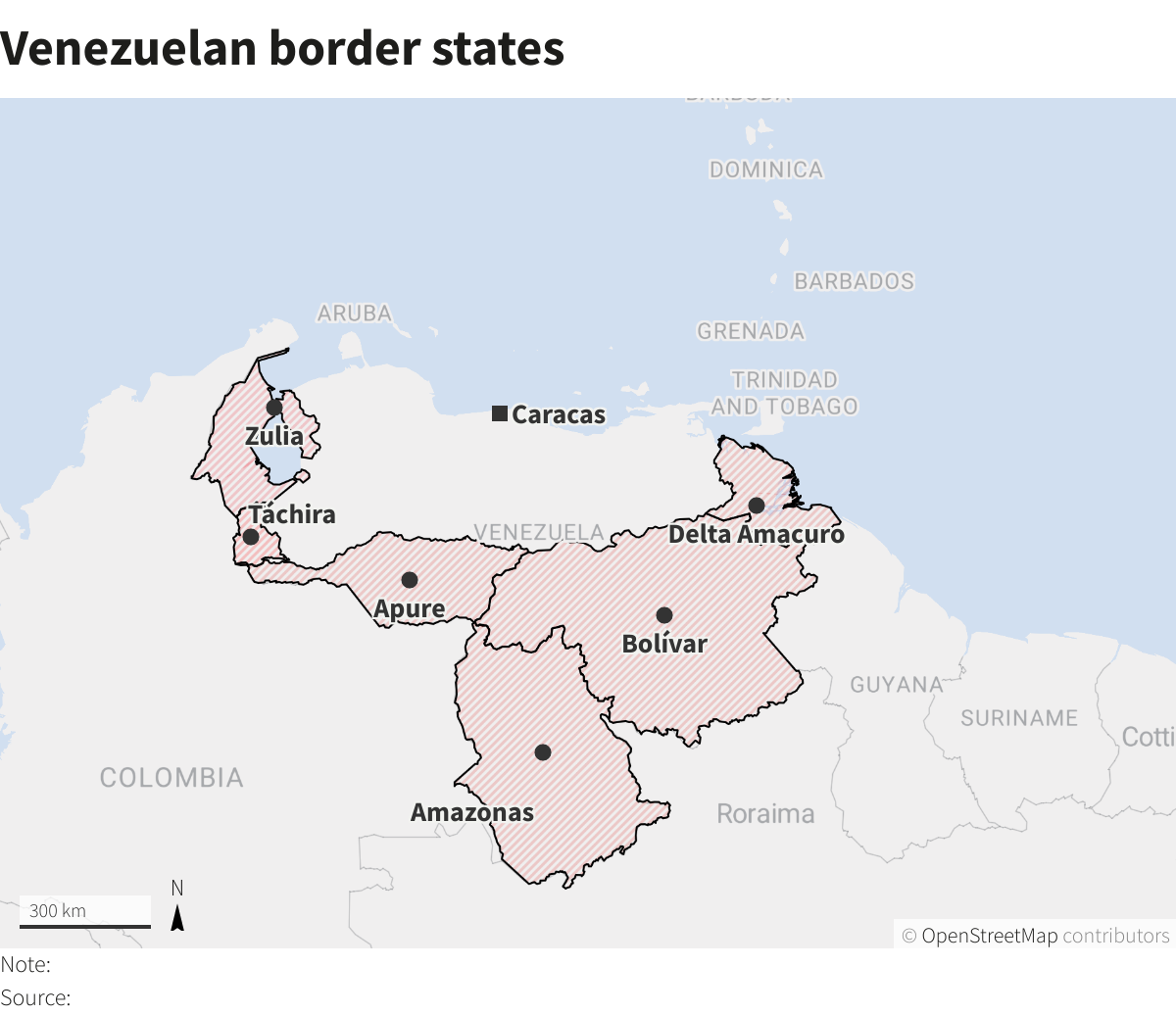
Four years later, these foreigners from the National Liberation Army, or ELN, function as both a local government and a major employer in this town in the northwestern state of Zulia, according to the educator and 14 other residents. All spoke on condition of anonymity and asked that their community not be named because they feared retaliation.
The guerrillas pay villagers, including children, to staff narcotics operations, extortion rackets and wildcat gold mines in both countries, the people said. Colombian security officials say the criminal proceeds are financing the guerrillas’ long-running insurrection against the Colombian government. The group’s recruiting, the residents said, has intensified over the past year as the coronavirus pandemic has deepened misery in Venezuela, where the economy was already reeling from years of hyperinflation and shortages.
When the armed Colombians first arrived, the villagers said, they were flanked by local Socialist Party community leaders and proclaimed they were there to bring security with the blessing of President Nicolas Maduro.
But their brand of law and order, the people said, quickly morphed into tyranny. The Colombians forbade residents from sharing information about the group’s activities, set a strict 6 p.m. curfew, outlawed firearms and controlled who entered the town, the villagers said.
The rebels also brought money. As they tapped pupils to work the coca fields, they offered to “paint the school, fix the lights or whatever we needed,” the principal said in an interview. In 2020, with school enrollment already declining as hungry families fled the country, more than half the remaining 170 students left with the ELN, leaving just 80 kids in class, she said.
The Colombian government has long claimed Venezuela’s leadership grants safe harbor to anti-government Colombian rebels, and that Caracas allows cocaine to move through its territory for a cut of the profits. Maduro has denied the drug-trafficking accusations but expressed sympathy for the rebels’ leftist ideology and openly welcomed some guerilla leaders.
Venezuela’s Information Ministry did not respond to requests for comment about the guerrilla group’s activities in the country.
Pablo Beltran, the ELN’s second in command, denied the group is involved in cocaine production, drug trafficking or other illicit activities, or that it recruits Venezuelans to work in such operations. He told Reuters the group does charge fees to criminal drug groups entering territory it controls in Colombia where coca is cultivated. He acknowledged that poor Venezuelans driven by their nation’s economic crisis do work in those areas, but he said they are not paid by the ELN.
Beltran said the ELN does cross into Venezuelan territory, but the group’s policy was not to have a permanent presence there. He also denied the ELN was present in Venezuela with the blessing of Maduro.
“I hope we have his moral support,” Beltran said. “But the day they perceive there is a force like ours stationed there, they are not only losing sovereignty, but they are violating their constitution.”
This account is based on interviews with more than 60 Venezuelans – including pastors, ranchers and teachers – living in six states near the Colombian border. Reuters also spoke with lawmakers, human-rights activists, indigenous leaders, former Venezuelan military officers, two rebel defectors, and U.S. and Colombian authorities familiar with the rebels’ growing control of the region.
The interviews reveal a portrait of areas being transformed by armed Colombians taking advantage of Venezuela’s decline. Rebels who once hid from Colombia’s military in Venezuela’s jungles have moved into population centers, ruling alongside Maduro’s government in some places, supplanting it in others, residents of these areas said.
Reuters Graphics
They are mainly ELN guerrillas and former fighters from another rebel group, the Revolutionary Armed Forces of Colombia, or FARC, according to residents and internal Venezuelan intelligence documents viewed by Reuters. These combatants reject the landmark 2016 peace deal reached between the FARC and the Colombian government. The FARC dissident groups could not be reached for comment.
More than 1,000 members of the ELN alone are operating in Venezuela, Colombia’s then-Foreign Minister Carlos Holmes Trujillo told the Organization of American States in 2019.
The rebels have filled gaps in Venezuela’s crumbling institutions, handing out food and medicine, even approving infrastructure projects in some areas, villagers told Reuters.
Many said the rebels’ presence had reduced street crime. But all the locals who spoke to Reuters said they feared these armed combatants. A villager in a different Zulia town likened living under ELN rule to “living in a prison with eyes always watching.”
One 16-year-old high-school dropout from outside the once-prosperous oil city of Maracaibo, Zulia’s capital, said he worked 12-hour shifts at an ELN coca farm, picking leaves until his hands bled. Still, the boy said, he gets three meals a day and makes the equivalent of $200 USD a month, a fortune in much of Venezuela.
OLD ALLIANCE
After Maduro’s predecessor Hugo Chavez came to power in 1999, the FARC and ELN were allowed to operate more openly inside Venezuela, according to former Venezuelan officials, residents, analysts, U.S. and Colombian authorities and former guerrillas.
What began as an alliance of like-minded revolutionaries, with common foes in the Colombian and U.S. governments, has morphed into a criminal partnership centered on drug and gold trafficking and other illicit schemes, according to Bram Ebus, who has reported on guerilla activities in Venezuela for the International Crisis Group, a Brussels-based think tank. These enterprises have become financial lifelines for the guerrillas and for Venezuelans stretching from small villages to the corridors of power in Caracas, Ebus, eight former Venezuelan military officers and two former members of FARC dissident groups told Reuters.
In March 2020, the U.S. Department of Justice indicted Maduro for allegedly heading a drug trafficking organization that worked with the FARC to flood the United States with cocaine, offering a $15 million reward for information leading to his capture.
Venezuela’s Foreign Minister at the time, Jorge Arreaza, called the charges unfounded. The Information Ministry did not respond to a request for comment about alleged financial ties between government officials and Colombian guerrilla groups.
U.S. authorities, speaking on condition of anonymity, said they’ve grown increasingly concerned about how entrenched in Venezuela the Colombian rebels have become.
Venezuela has also tracked the expansion of armed groups from Colombia in its territory, according to Manuel Christopher Figuera, an ex-general and former head of Venezuela’s National Intelligence Service, who fled the country in 2019. Figuera showed Reuters maps he said were produced in 2018 by one of the country’s intelligence agencies showing the purported locations of ELN and dissident FARC operatives in Venezuela and their range of alleged activities, including drug and arms trafficking, extortion, kidnapping and murder for hire.
Reuters was not able to verify the authenticity of the maps, which bore the insignia of the Strategic Center for Security and Protection of the Homeland. Venezuela’s Information Ministry did not respond to requests for comment, and calls to the number listed for the intelligence agency were not answered.
If Maduro’s government is allied with Colombian rebels, the relationship is not always friendly. In March, Venezuela’s military launched an offensive against a group of FARC dissidents in the border state of Apure after Maduro said the group was sent by Colombia to destabilize the country.
Colombia’s Defense Minister Diego Molano denied Maduro’s claim, describing the dispute as a conflict over control of drug-trafficking routes.
Locals in Apure, where thousands fled the fighting, told Reuters they’ve watched the guerrillas steadily consolidate power over the past five years, expanding their illicit business activities while largely assuming the role of law enforcement. A local rancher said they have even waded into economic regulation – telling farmers what they can charge for cheese and beef.
“They are the government,” the rancher said of the rebels. Apure’s governor did not respond to requests for comment.
Indigenous Venezuelans say they, too, have had their lives upended by the guerrillas, whom they’ve dubbed “rubber boots” for their tall, black footwear. In mineral-rich Amazonas state, more than a dozen tribal leaders told Reuters that the rebels in recent years have ramped up illegal mining of gold and coltan, a mineral found in cell phones.
In March, leaders from three tribes filed a complaint with the state human rights office alleging “a large number” of indigenous Venezuelans have been “enslaved and extorted by an irregular group of Colombians,” identified as FARC dissidents, who forced them to work in gold mines.
Amazonas’ human rights office acknowledged it had received the complaint, but made no further comment.
‘YOU FEEL SHAME’
Some Venezuelans credit the rebels with keeping their families afloat.
A 42-year-old corn farmer in Apure who asked to not be named for fear of retribution, said he hasn’t seen his older brother since the FARC forcibly recruited him eight years ago. But every month without fail, he said, his brother calls their mother and sends $120, money he and his elderly parents depend on to survive.
In Zulia, a teacher who asked to be identified only by his first name – Armando – said boys are scarce in his high school because so many are working for the ELN on coca farms or at border crossings extorting bribes from migrants and traders.
Armando understands the lure of drug money. He said he, too, began harvesting coca for the ELN in 2017 to supplement his $3-a-month teaching salary. He has no plans to stop.
“You feel shame,” he said, “but you see food for your children in each leaf you pick.”
(Corrects name of Colombian rebel group in paragraph 2 to National Liberation Army, not National Liberation Party)
Reporting by Sarah Kinosian; editing by Marla Dickerson
GUATEMALA CITY, Sept 2 (Reuters) – Guatemalan President Alejandro Giammattei announced new national transport curbs and social restrictions on Thursday in an effort to contain a surge of coronavirus infections and relieve pressure on hospitals.
Giammattei opted against the toughest lockdown measures but said from Saturday, auto transport will be prohibited for most trips from 8:00 p.m. to 4:00 a.m. and social gatherings such as weddings and public sports events will be banned for at least four weeks.
The president, who is a medical doctor, said in a televised speech the measures were “urgent and necessary to contain the spread of the pandemic”.
“It will give our hospital system a chance to breath,” he said, as the capital’s biggest hospital reported it could take no new patients due to the surge of COVID-19 cases.
The new measures require the approval of Congress, which is expected to be granted on Friday.
Guatemala, Central America’s biggest country with about 18 million residents, has posted nearly 480,000 coronavirus infections and more than 12,000 deaths, according to official data.
To date, only 1.3 million Guatemalans have been fully vaccinated.
Reporting by Sofia Menchu; Writing by David Alire Garcia Editing by Robert Birsel
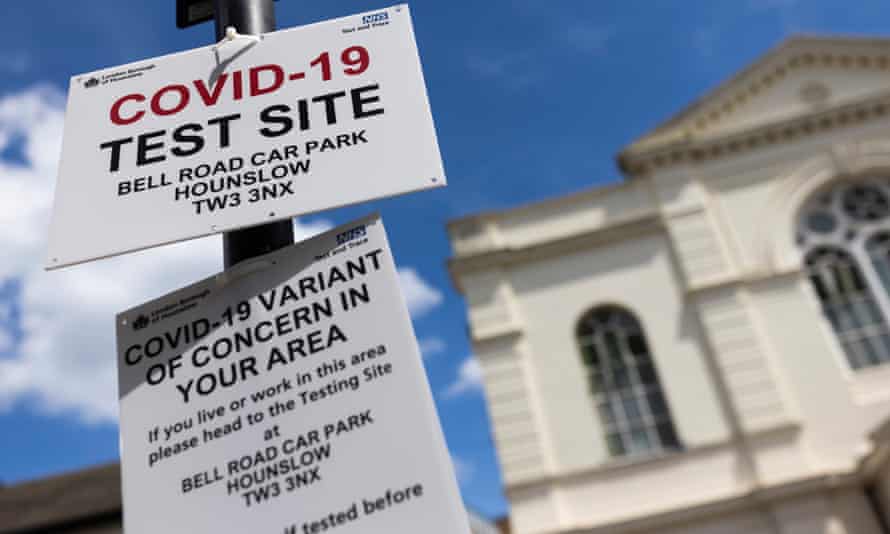
Hounslow in London in one area that has had a recent rise in Covid-19 cases, driven largely by the Delta variant of the coronavirus. Photograph: Dan Kitwood/Getty Images
Vaccine effectiveness is given as a percentage and refers to how well a vaccine works in the real world, as opposed to the term efficacy, which relates to vaccines’ performance in trials. The figures are often given with respect to symptomatic disease, although other outcomes, such as infection, hospitalisation or death, can be used.
If a Covid-19 vaccine is “90% effective” against symptomatic disease that means the risk of becoming ill is 90% lower among vaccinated people than among those who have not been vaccinated. For every 100 unvaccinated people who ended up with symptomatic Covid, for instance, only 10 would have been expected to have fallen ill had they received the jab.
What is vaccine failure?
The term is often used to refer to cases where people develop an infection or disease despite being vaccinated against it. This can relate to a problem with the vaccine itself, but can also refer to some people having a weaker immune response to the vaccine.
Using symptomatic disease as the outcome, a Covid vaccine that is “90% effective” could be said to have a 10% failure rate (ignoring changes in effectiveness over time). However, someone who is not protected against symptoms could still be protected against severe disease or death.
Deborah Dunn-Walters, a professor of immunology at the University of Surrey, says: “If you think of the population having a whole range of different levels of immunity, then where you set the bar in the range will determine the percentage protection figures.”
How effective are the vaccines against the Delta variant, B.1.617.2, compared with the Alpha variant, B.1.1.7?
Some studies, including lab-based work and analysis of real-world data, have suggested current Covid vaccines are somewhat less effective against the Delta variant than the Alpha variant.
According to Technical Briefing 13 from Public Health England, an analysis involving 7,673 symptomatic cases identified as B.1.1.7 and 2,934 cases identified as B.1.617.2 revealed that after a single dose of the Pfizer/BioNTech or Oxford/AstraZeneca Covid vaccines “there was a 17% absolute reduction in vaccine effectiveness against symptomatic disease with B.1.617.2 compared to B.1.1.7, but only a modest reduction in vaccine effectiveness after two doses”.
The take-home message, says Dunn-Walters, is that “vaccines protect, and a second dose is very important against the Delta variant”.
What does 17% reduction mean?
The 17% reduction in vaccine effectiveness relates to symptomatic disease after one dose. But it does not tell us about disease severity. That matters because if the vaccines offer lower protection against severe disease from the Delta variant, the burden on hospitals as cases rise will be greater than otherwise.
Prof Adam Finn of Bristol University, who is a member of the Joint Committee on Vaccination and Immunisation, says: “We don’t have certainty [over] the impact on vaccine effectiveness, especially regarding protection versus severe disease after one dose and after two doses.” It is also unclear how much more infectious the Delta variant is, he says.
In general Covid jabs are most effective against the most severe outcomes, such as death, and less effective against less severe ones, such as asymptomatic infection.
What could this mean for a third wave?
Finn says: “A more infectious virus which is able to escape vaccine induced immunity more often will cause a faster rise in cases as people mix more. But if the vaccines retain their ability to prevent severe disease then hospitalisations will not rise as fast as they have previously.”
Experts have said it is a “realistic possibility” that the Delta variant is as much as 50% more transmissible than the Alpha variant, while modelling suggests a variant that is 40% more transmissible than the Alpha variant could lead to daily hospitalisations exceeding those recorded over the winter. That is assuming the planned relaxation of Covid social restrictions goes ahead in June – and without taking into account any resistance of the variant to the vaccines.
When we will know more?
The picture is likely to take time to become clearer not least because while cases are rising numbers remain low, meaning a longer period is needed to compare outcomes for hospitalisation and other measures among vaccinated, partially vaccinated and unvaccinated people.
“We may not get good answers for a matter of weeks, or even months,” said Dr Peter English, a retired consultant in communicable disease control.
There is “almost certainly no urgency” to press ahead with booster shots for healthy adults and it may be better to see how the pandemic pans out before a decision is made, the scientist leading key research into third shots has said.
Prof Saul Faust, chief investigator of the Cov-Boost study whose data next week is expected to help inform a decision on the rollout of boosters across the UK, told the Guardian that for now it may be preferable to prioritise only the vulnerable, including those with compromised immune systems.
Meanwhile, some scientists said booster shots may be useful for routine use even among highly vaccinated populations to reduce Covid transmission, especially given the prevalence of the Delta variant. On Thursday, scientists including Prof Neil Ferguson suggested that even if evidence did not yet show waning protection in the double-vaccinated against serious illness and death, booster shots could help reduce the spread of cases.
On the recommendation of the Joint Committee on Vaccination and Immunisation (JCVI), it was announced on Wednesday that half a million people aged 12 and over with severely weakened immune systems are to be offered third Covid vaccine shots.
A decision on whether to offer boosters for all healthy adults was expected to be announced next week at the earliest, the Guardian understands, although it could take longer.
The Cov-Boost study – which is designed to assess the use of one of seven different vaccines when given as a third dose, on top of the two doses of either the Pfizer/BioNTech or Oxford/AstraZeneca vaccines – is understood to be a key piece of research to inform the JCVI decision.
Faust said the study would help answer which vaccines were most effective as a third shot, depending on what jabs were given as the initial two shots, rather than which populations should receive a third dose. The committee will have access to early study findings some time next week, he added.
Last week, there were an average of more than 33,750 daily cases across the UK compared to less than 1,400 at the same time last year – before the rise of the highly infectious Delta variant and before all restrictions were eased – and 61,000 at the peak in January. But with nearly 80% of UK adults having received two vaccine doses, hospitalisations and deaths are far lower than at their peak.
High numbers of cases increase the risk to unvaccinated or otherwise vulnerable people, and could lead to the emergence of new variants.
Many rich countries with strong vaccine coverage have announced the routine rollout of third shots amid concerns about waning immunity.
Preliminary data shows that people experience a fall in antibody levels weeks and months after getting their jabs, but so far the fall does not appear to have reduced protection against severe disease and death. In general, there is little scientific consensus on what level of antibodies and other tools in the immune system’s armament confer protective immunity.
However, boosters might work to prevent more infections and transmission, suggested Helen Petousis-Harris, a vaccinologist from the University of Auckland. “Because in order to prevent that infection, we really need the presence of these antibodies, and if they’ve waned, that might make establishing an infection easier.”
UK data suggests somebody who is double-vaccinated is about half as likely to be infected as someone who is unvaccinated, and although the double-vaccinated person is far less likely to develop severe disease, they can still infect others.
“The other thing is, boosters could help improve immunity to variants, and people who might not have responded so well at the beginning to the primary doses might also benefit from a booster,” Petousis-Harris added. “It’s likely that these things will contribute to the overall community immunity.”
Israel, for instance, has already kicked off its booster programme. “I think in Israel, they actually want to suppress transmission … If you have even 10% of your population unvaccinated, then one way of reducing risk to them is by boosting the immunity of everyone else,” said Ferguson, an epidemiologist at Imperial College London.
“I think the UK is adopting a much more incremental approach – so at the moment our joint committee on vaccination is only recommending boosters [third shots] for clinically extremely vulnerable people, which is only about 1% of the population.”
"This means people approved to travel into WA from Victoria will have to have proof of a negative COVID test in the 72 hours prior to departure, proof of at least one vaccination dose, use the new G2G now app, and undergo COVID tests on days 2 and 12," Mr McGowan said.
Mr McGowan said his message to any Western Australians in Victoria who want to come home is "do it now".
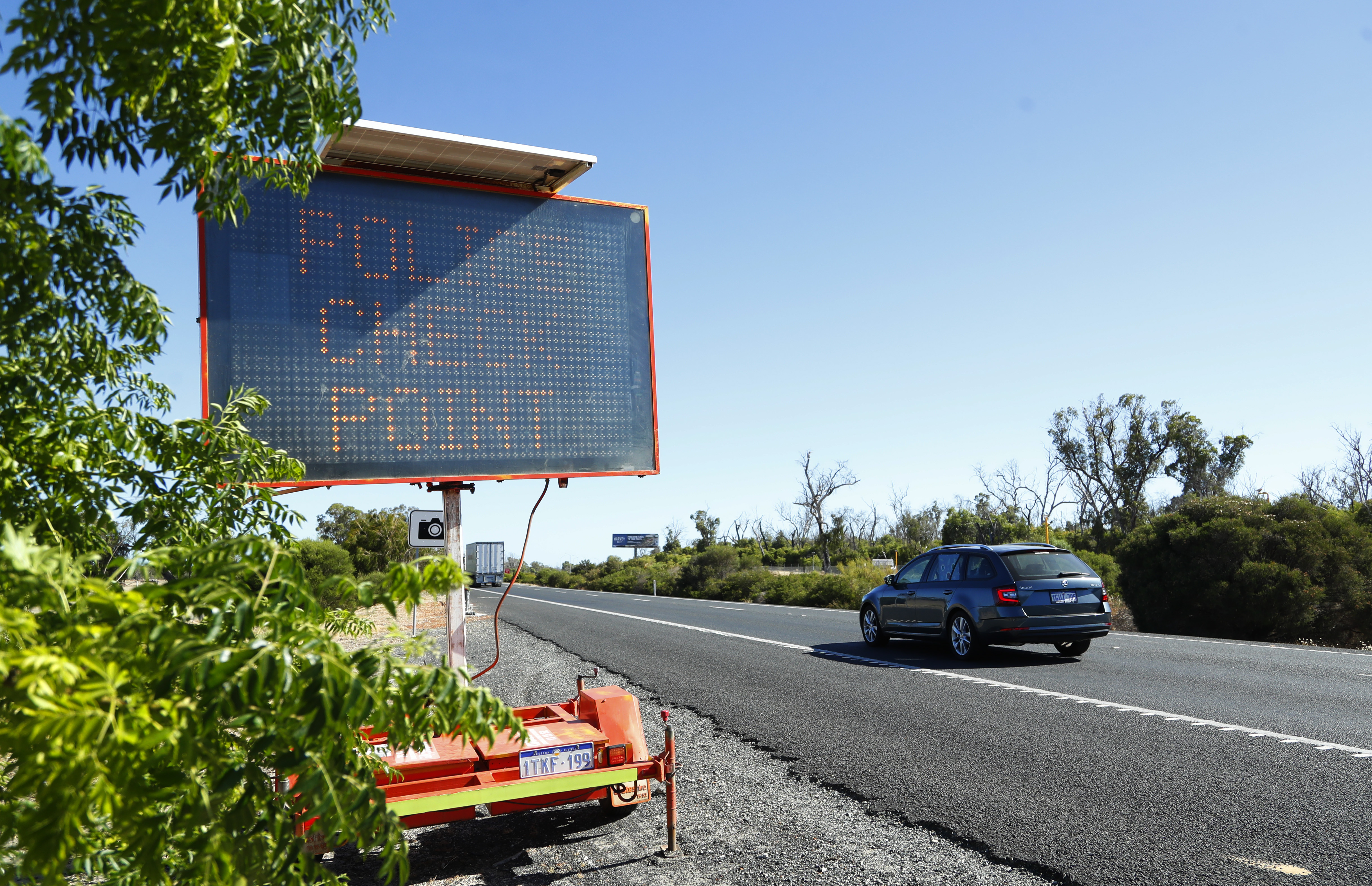
The premier also said tougher testing requirements for truck drivers would come into effect from next week after two COVID-19 positive drivers from NSW made their way into the state.
"From next week, all truckies from high or extreme risk jurisdictions who want to enter WA will have to have returned a negative PCR test undertaken within the prior three days," he said.
"Truck drivers who have not had a test will not be allowed to enter."
Western Australia recorded zero new local coronavirus cases overnight.
Health officials confirmed there are currently 10 active cases in the state, two in hotel quarantine – two diagnosed in WA and two cases diagnosed in NSW – and eight crew members from the MV Ken Hou vessel.
The two NSW truck drivers who were confirmed positive cases on August 27 remain in hotel quarantine and 25 contacts linked to them have returned negative test results and remain in home quarantine.
Whanganui is back to business in level 3. It’s not quite ‘as usual’ but you can get most things. And for many still working from home, the shift from 4 to 3 just means they can get a decent coffee.”It’s been really, really busy…
TERROR ATTACK LATEST* Man was being followed by police, grabbed knife in store before stabbing shoppers * Isis sympathiser had been arrested for allegedly planning ‘lone wolf’ knife attack * Chilling video captures moment of…


 *****@
 *****@
 *****@
 *****@
 *****@
 *****@
 *****@
 *****@
 *****@
 *****@
 *****@
 *****@