Category Archives: headline

Migrants Left High and Dry at Guatemala Border after Deportations from Mexico, U.S.

EL CEIBO, Guatemala, Aug 20 (Reuters) – When 25-year-old Salvadoran migrant Donovan Pedro stepped off a deportation bus at the El Ceibo border crossing that connects Mexico’s southern border with Guatemala, the situation was familiar but the place was not.

Pedro had already made the trek to the U.S. border twice and was stopped by Mexican authorities, who both times sent him to other locations in Mexico.

This time he was detained in the state of Veracruz near the Gulf of Mexico, and sent to a remote border crossing with Guatemala as part of U.S. and Mexican efforts to make it more difficult for migrants to cross the U.S. border repeatedly.

Wearing a jacket and a baseball cap, Pedro carried no suitcase or change of clothes and did not have a working cell phone. But with the pandemic exacerbating unemployment in El Salvador, he was already planning to head back to the United States via the Mexican city of Monterrey near the Texas border.

“I can’t get to my country. I’m going to try to go up and back to Monterrey,” he said.

From there, he planned to get across the U.S. border.

Pedro is one of hundreds of migrants, including children and babies, from Central America that U.S. and Mexican officials have expelled further south by plane and then onward in buses towards El Ceibo, Guatemala, a tiny village of about one hundred wooden and concrete dwellings some 630 kilometers (390 miles) north of the capital, a Reuters witness observed over two days there.

Many are not told where they are going.

U.S. President Joe Biden is under pressure to stem an increase in southern border crossings, with U.S. agents apprehending or expelling more than 1,276,000 migrants since last October.

The Biden administration began flying migrants to Guatemala this month from the United States under a U.S. policy allowing fast-track expulsions for some families arriving from Mexico.

It has also urged Mexico to curb migration, prompting authorities there to quietly fly thousands of undocumented migrants from the north of the country to the south for expulsion. read more

NO ONE TO CALL

For most of the migrants – hailing from Honduras, El Salvador or Nicaragua – they have no connection to Guatemala. When they get off the bus, they have no local currency, no place to stay and no-one to call for help.

Some migrants stranded in El Ceibo told Reuters they are determined to make the journey to the U.S. border again, having learned valuable lessons about navigating the routes.

Others remain in limbo in El Ceibo, unsure of what to do next. Those who can afford it, stay in a local inn for about $20 a night. Others climb a steep hill to a nearby migrant shelter that can house 30 people at a time.

Some sleep in the streets of El Ceibo, a dangerous drug-trafficking area where gunshots can be heard day or night. The rest just start walking.

“This is my first time in Guatemala. I don’t know what to do because I’m alone,” said Aura Diaz, a Honduran woman traveling with her two young daughters, aged 4 and 1.

Fleeing violence in Honduras and hoping to find work in the United States, she had been traveling for more than a month with the two girls when officials stopped them two days before in the Mexican city of Reynosa across from McAllen, Texas, she said.

“We were resting and they grabbed us,” she said.

Guatemala’s government on Tuesday said it was concerned about not receiving any notifications about migrants of different nationalities crossing into its territory by land at its El Ceibo and El Carmen border points.

It said it has facilities for returnees from Mexico at other border points, like Tecun Uman, that have the capacity to provide migrant care in a “dignified and safe” manner.

“Guatemala’s foreign ministry has sent diplomatic communications requesting official information from the governments of Mexico and the United States on these migratory movements,” the government said in a statement.

Guatemala, however, is not providing transport for migrants after they arrive at El Ceibo.

When they get off the bus at the border in Mexico, the migrants cross into the Guatemalan village, where power from a local generator for the houses and three inns goes off at 10 p.m.

Officials there take their temperature, take photos of their IDs and send them on their way. Many migrants could be seen asking where they should go now, or where they should sleep.

“They throw you into a place you don’t know, with no money, nothing, and with small children,” said Eduardo, a Honduran migrant who was staying at a local shelter with his wife and three young children. He, too, plans to return to Mexico in the hope of eventually reaching the United States.

He explained how he and his family fled Honduras after Eduardo’s wife was kidnapped by gang members. Eduardo did not give his last name due to fears for their safety.

“No matter how long we have to stay we’re going to ask for asylum because we do not want to return to our country,” he said.

Reporting by Sofia Menchu in El Ceibo, writing by Cassandra Garrison; Editing by Aurora Ellis

The post Migrants Left High and Dry at Guatemala Border after Deportations from Mexico, U.S. appeared first on The St Kitts Nevis Observer.

‘He Never Stood a Chance’: the Fateful Downfall of Haiti’s President

PORT-AU-PRINCE, Aug 22 (Reuters) – Haitian President Jovenel Moise began this year by warning that his country was a land of coups, conspiracy and murder. In the days before he was shot dead in a murky international plot last month, he was telling friends that enemies were out to get him.

“He told me a lot of people were spending a lot of money to murder him,” said a former Haitian senator and close friend of the late president, relating a conversation with Moise the evening of his death. “I told him to stop thinking like that.”

“He said to me: ‘This is reality.’”

Showing Reuters his final text messages with Moise, the politician, who asked to remain anonymous out of concern for his safety, said the president did not identify the plotters.

More than a dozen officials, politicians, diplomats and relatives of Moise spoke to Reuters about the events surrounding his murder. The assassination decapitated a fragile government in a Caribbean country repeatedly convulsed by crisis – now exacerbated by a major earthquake on Aug. 14 – since the overthrow of the Duvalier family dictatorship in 1986.

The conversations painted the 53-year-old president as a man increasingly isolated and in peril toward the end of his life.

Moise supporters described his downfall as the inevitable consequence of a corrupt ruling elite closing ranks against a provincial outsider who dared to help Haiti’s majority poor.

“He was putting things in order. Here, when you put things in order, you die,” said Guy Francois, an ally who served as Moise’s minister of citizenship.

Critics, by contrast, cast Moise as a political novice who lacked the skills to build consensus, drifted towards autocracy and turned a blind eye to gang violence in areas hostile to his administration.

“He was a poor choice from the get-go,” said Salim Succar, a lawyer and onetime aide to Moise’s predecessor and former backer, ex-President Michel Martelly. “He never stood a chance.”

Many saw in his killing a microcosm of institutional rot in Haiti, where government has been hobbled by factional disputes, entrenched inequality, and a dependence on foreign powers still widely viewed as hostile to the country’s very foundation in 1804, when a slave revolt threw off the French colonial yoke.

MISSING MASTERMIND

In the rubbish-strewn center of Port-au-Prince, the government district is ringed by deserted streets now considered to be gang-controlled territory. Buildings battered by a 2010 earthquake that killed tens of thousands of people in the Western Hemisphere’s poorest country still scar the landscape.

Officials say Moise’s killers took advantage of the porous state of law and order to execute their plot at his personal residence in the Port-au-Prince suburb of Petion-Ville.

Moise’s bullet-ridden body was found in the early hours of July 7 after what the Haitian authorities said was an attack by a commando unit of mostly Colombian mercenaries. His wife, Martine, was injured. Police arrested some of the president’s security chiefs but have not identified the mastermind.

Allies accused “oligarchs” – members of Haiti’s business elite – of hiring foreign assassins to eliminate Moise for threatening their privileges, stoking popular anger over Haiti’s historic treatment by Western powers and the economic predominance of lighter-skinned Haitians.

Some among the elite made no secret of their disdain for Moise, said one diplomat, recalling the “contempt” with which one of its number spoke of Moise at a private meeting.

Several business leaders have publicly condemned Moise’s murder. To date, 18 Colombians, some 20 Haitian police and a handful of other Haitian and Haitian-American suspects have been arrested.

Colombian officials familiar with the investigation say that most of the Colombians detained were probably victims of a plot within a plot to divert attention from the architects.

Only four of the Colombians knew about the conspiracy against Moise beforehand; most went to Haiti in the belief they would be bodyguards, said one Colombian official.

Because the commando unit faced no meaningful resistance until after his killing, investigators believe Moise was betrayed by his own security staff, the official added.

Moise’s friend, the former senator, said the president had known the Colombians were in Haiti and told him during their last phone call he was preparing to arrest the plotters.

“I said, ‘Why don’t you do it right away?,’” the politician said. “He said: ‘I am going to do it.’”

Haiti was meant to elect a successor to Moise and a new parliament in September, but that date quickly began slipping towards November after his assassination.

After the latest earthquake that killed over 2,000 people and destroyed thousands of homes, holding any election this year looked “very difficult”, said Adriano Espaillat, a U.S. congressman originally from the neighboring Dominican Republic.

SHOCK, BUT NOT SURPRISE

Six months before his death, Moise seemed only too aware of the risks. On Jan. 1, he gave a speech to commemorate Haitian independence steeped in gloom.

“For 217 years, the whole history of the country has been based on conspiracies, coups, assassinations,” he said. “We conspire to destroy it, never to build it. More than 30 presidents overthrown or assassinated.”

Moise’s push to improve power supply at the expense of private interests and a constitutional reform that would have strengthened the presidency were cited by both allies and critics as key markers on his road to ruin.

But the problems started early.

Within months of taking office in February 2017, Moise’s administration was rocked by major street protests over tax hikes, then rising fuel prices.

A Senate report later accused Moise of embezzling funds from the Venezuela-backed PetroCaribe oil program, which he denied.

Protests worsened, and in 2019 Haiti fell into months of “Peyi lock”, or country lockdown, fueled by opposition-backed demonstrations. As political unrest, violence and kidnappings spread, calls for his resignation mounted.

Moise, who last year declared himself second only to God in Haiti, began ruling by decree in 2020 in the absence of a sitting parliament, and became increasingly confrontational.

In February, a month after his independence address, Moise said police had foiled a coup and an attempt on his life. A sense of foreboding among foreign officials deepened.

“Everyone was shocked” one diplomat said of his assassination. “But not many people were surprised.”

Reporting by Dave Graham; Editing by Daniel Flynn and Cynthia Osterman

The post ‘He Never Stood a Chance’: the Fateful Downfall of Haiti’s President appeared first on The St Kitts Nevis Observer.
Hurricane Grace Kills 8 as It Rips Through Eastern Mexico

BBC- At least eight people are known to have died after Hurricane Grace tore through eastern Mexico, bringing torrential rain and high winds and causing power cuts and flooding.

The deaths and the worst damage occurred in the state of Veracruz, where the storm uprooted trees when it made landfall early on Saturday.

In the state capital, Xalapa, many streets became rivers of mud.

The hurricane later weakened to a tropical storm as it moved inland.

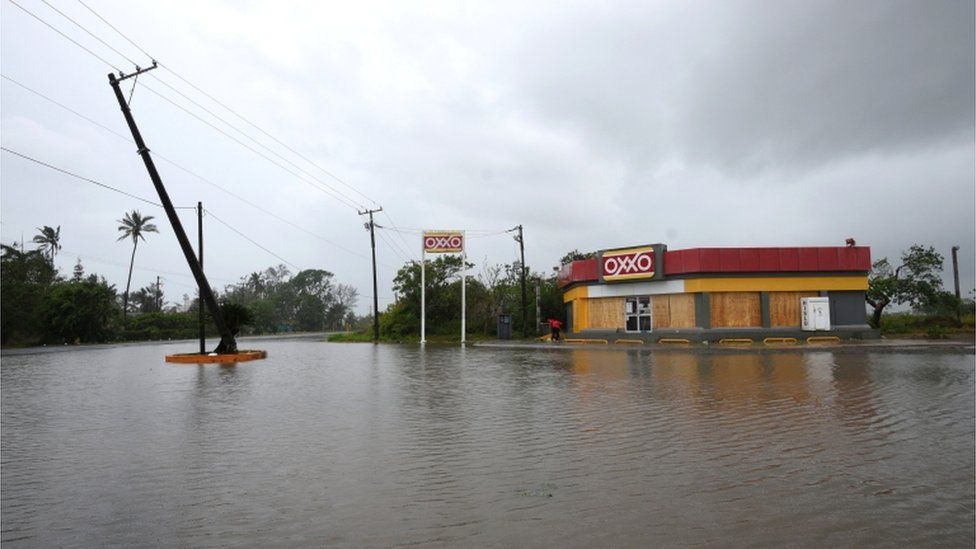
A road next to a convenience store is flooded after Hurricane Grace slammed into the coast with torrential rains, in Costa Esmeralda, near Tecolutla, Mexico, 21 August 2021image sourceReuters

However, high winds and downpours were reported to be causing more flooding as Grace travelled north of Mexico City.

The storm brought wind speeds of up to 200 km/h (125mph) when it reached the coast of mainland Mexico. Of the eight people killed, six were members of the same family, state government officials said.

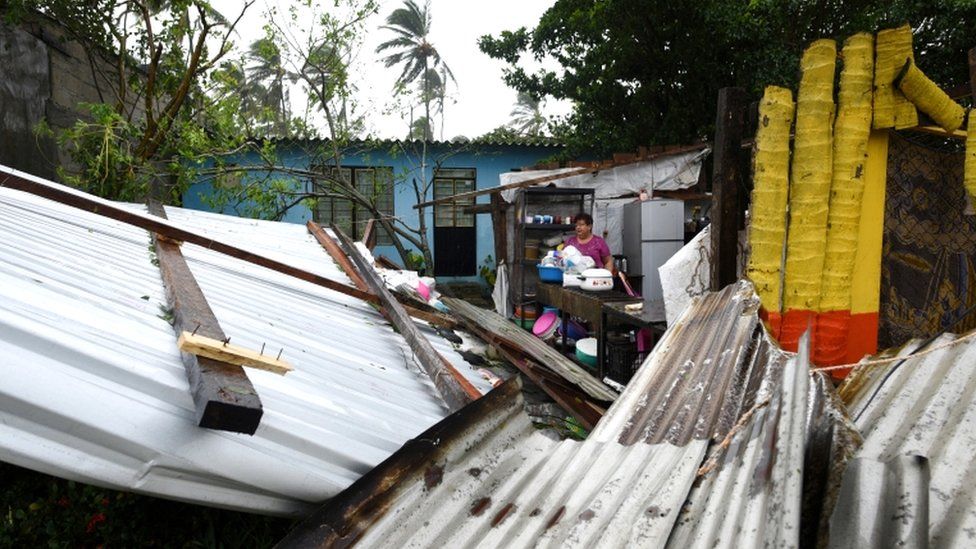
A woman stands amidst the debris of her home which was destroyed when Hurricane Grace slammed into the coast with torrential rains, in Costa Esmeralda, near Tecolutla, Mexico, 21 August 2021image sourceReuters

Residents of the coastal town of Tecolutla, in Veracruz state, said the hurricane had been devastating.

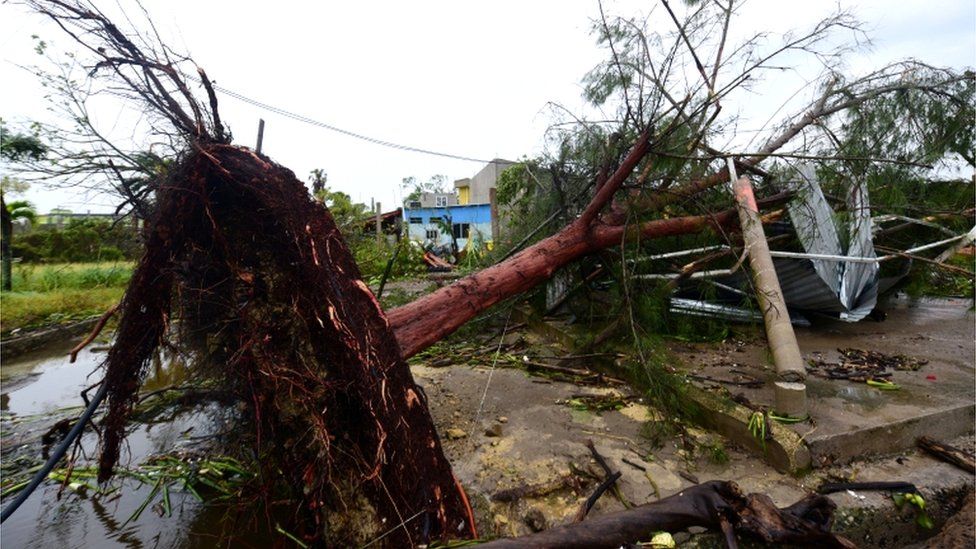
A tree, uprooted when Hurricane Grace slammed into the coast with torrential rains, fell on a house, in Tecolutla, Mexico, 21 August 2021image sourceReuters

“You could just hear the thunder of the falling trees, it sounded very nasty, very horrible,” Laura Jacinto said, adding: ” I was very scared, I was very scared last night.”

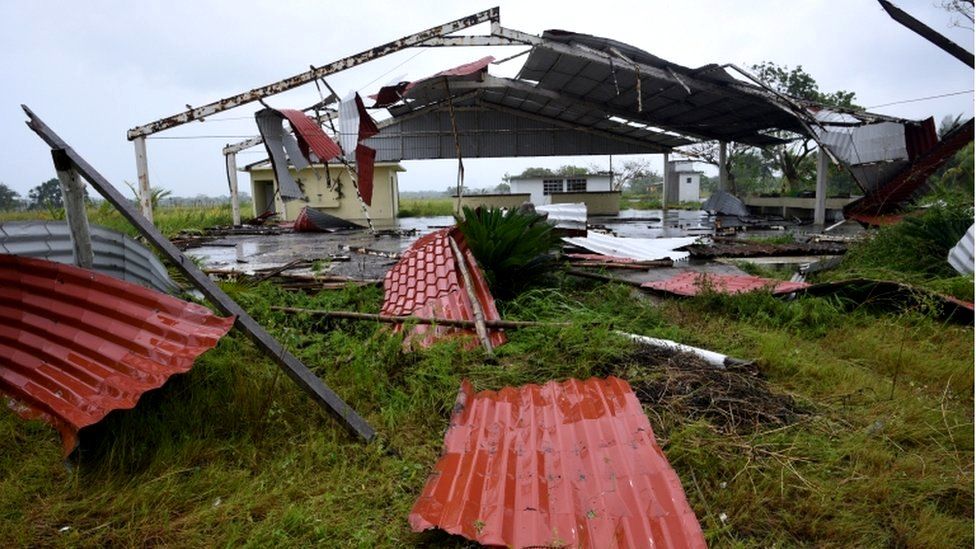
A damaged building, which had been out of use, is seen after Hurricane Grace slammed into the coast with torrential rains, in Costa Esmeralda, near Tecolutla, Mexico, 21 August 2021image sourceReuters

Another resident, Adolfo Lopez, said: “The roof… everything is gone, it took everything with it.”

The post Hurricane Grace Kills 8 as It Rips Through Eastern Mexico appeared first on The St Kitts Nevis Observer.
US: Significant Racial Disparities Found in Excess Deaths Last Year, Data Shows

CNN- Researchers continue to examine the effects of the pandemic in 2020, before the widespread distribution of vaccines that helped keep those infected out of hospitals.
Not only did adults ages 65 and older see higher rates of excess deaths last yet compared with other age groups, according to new research, but significant racial disparities were found as well.
Among adults 65 and older, the highest rates of excess deaths were in Black and Hispanic people, according to a new study published by the CDC on Thursday. Among people younger than 65, Black, American Indian and Alaska Native people had the highest rates compared with other racial and ethnic groups.
The findings “have been driven, in part, by factors such as occupational risk, socioeconomic factors, housing conditions, reduced access to health care, and discrimination,” the researchers from the US National Center for Health Statistics, Yale University and Harvard Medical School wrote in their new study.
The researchers analyzed data from the CDC’s National Vital Statistics System on the weekly number of deaths from all causes and Covid-19 that occurred between December 29, 2019, and January 2, 2021. The researchers examined population estimates from the US Census Bureau for previous years, from 2015 to 2019, to model how many deaths would normally be expected through the year 2020.
“The resulting weekly expected numbers of deaths were subtracted from the observed numbers of deaths to generate estimates of excess deaths,” the researchers wrote.
In the data, they identified racial disparities across all age groups when it came to rates of excess deaths. Overall, they wrote that “these findings could help guide more tailored public health messaging and mitigation efforts to reduce disparities in mortality associated with the Covid-19 pandemic in the United States, by identifying the racial/ethnic groups and age groups with the highest excess mortality rates.”

The post US: Significant Racial Disparities Found in Excess Deaths Last Year, Data Shows appeared first on The St Kitts Nevis Observer.
Florida, US Govt., Schools on Collision Course Over Vaccinations, World Stats, More

Florida gives two school districts 48 hours to comply with mask rule or lose funding

Florida is escalating its war against school districts that require masks in defiance of Gov. Ron DeSantis’s (R) directive against them.

The Florida Board of Education is ordering Alachua and Broward County school districts to comply with an order allowing parents to opt out of local mask mandates, with state officials giving the districts 48 hours to comply before they move to withhold funding.

The state is requesting a list of the annual salaries of all school board members in the counties, and the BOE will then begin withholding 1/12th of that amount each month from the district’s funds, as an initial step.

Both Alachua and Broward have instituted mask requirements for all students and staff, regardless of vaccination status, in defiance of Gov. Ron DeSantis (R), whose “Bill of Rights” order has effectively prevented schools from requiring masks.

The state requires public schools to allow for a parent or legal guardian of the student to opt-out of any mask requirements without any reason. Alachua and Broward require doctors’ notes.

The state: “It is important to remember that this issue is about ensuring local school board members, elected politicians, follow the law,” Commissioner of Education Richard Corcoran said in a statement. “These are the initial consequences to their intentional refusal to follow state law and state rule to purposefully and willingly violate the rights of parents. This is simply unacceptable behavior.”

Federal support for schools: The White House on Friday said Education Secretary Miguel Cardona has spoken with officials in Broward and Alachua counties, telling them to hold the line, and assuring them that any financial penalties imposed by the state can be addressed using federal funds.

==================================================

AstraZeneca antibody cocktail considered effective in preventing symptomatic COVID-19 among the high-risk

AstraZeneca scored a win on Friday as data showed its antibody cocktail is 77 percent effective at preventing symptomatic COVID-19 in high-risk populations.

The research found no one who took AstraZeneca’s combination, called AZD7442, developed severe COVID-19 or died due to the virus. In comparison, three participants who received the placebo endured serious illness, with two fatalities.

AstraZencea called the treatment, involving the antibodies ixagevimab and cilgavimab, the first “long-acting antibody combination to prevent COVID-19” in a release.

Overall, 25 positive coronavirus infections were confirmed in the Provent study involving more than 5,100 patients across sites in the ​​U.S., U.K., Belgium, France and Spain. The participants were unvaccinated at the time and had a negative test.

Significance: Drug manufacturers have been testing different antibody treatments for COVID-19 to provide a way to help those who may not have adequate vaccine protection, including cancer patients, fight the virus.

“With these exciting results, AZD7442 could be an important tool in our arsenal to help people who may need more than a vaccine to return to their normal lives,” Myron Levin, principal investigator in the study, said in a statement.

What’s next: The study is expected to be sent to a peer-reviewed medical journal to be published, as well as to regulators for an emergency use authorization or conditional approval.

===================================================

US extending travel restrictions with Mexico, Canada

The U.S. is extending the nonessential closure of its borders with Canada and Mexico to at least Sept. 21 due to the delta variant of the coronavirus, the Department of Homeland Security announced Friday.

“In coordination with public health and medical experts, DHS continues working closely with its partners across the United States and internationally to determine how to safely and sustainably resume normal travel,” the agency tweeted.

The extraordinary closures have been extended monthly since they were put in place at the onset of the pandemic in March 2020.

Canada began letting fully vaccinated U.S. citizens and permanent residents into the country on Aug. 9, but Canadians still can’t travel into the U.S. unless it is for an essential purpose.

==================================================

World Stats

Coronavirus Cases:

212,606,564

Deaths:

4,444,792

Recovered:

190,231,549
Highlighted in green
= all cases have recovered from the infection
Highlighted in grey
= all cases have had an outcome (there are no active cases)

The post Florida, US Govt., Schools on Collision Course Over Vaccinations, World Stats, More appeared first on The St Kitts Nevis Observer.

The small but significant new addition to Parliament House

Avid #Auspol fans may have noticed a small but significant change to the House of Representatives during Question Time in Canberra today.

With Parliament adhering to strict attendance limits and social distancing protocols during the Australian Capital Territory's COVID-19 lockdown, a new addition to the House was seen in the form of plastic barriers down the middle of the Table of the House.

It is presumably one of the many COVID-19 safety measures put in place to allow Parliament to continue sitting during lockdown.

READ MORE: 'We will live with this virus': PM sets wheels in motion to open up

Parliament House on the whole is currently closed to the public, but as an essential workplace – officially – Prime Minister Scott Morrison was able to avoid suspending sitting during Canberra's lockdown, which ACT Chief Minister Andrew Barr had initially pushed for.

Resembling a sneeze guard, the barriers offer an extra measure of safety for MPs responding to questions, particularly given the heated nature of debate Question Time can often throw up.

READ MORE: Secret conversations between WA Liberal powerbrokers revealed

Just as removalists and people engaging in heavy physical activity can be at a more pronounced risk of COVID-19 due to the more explosive nature of breathing under duress, so a shouted response might be more dangerous than a murmured one.

Bitcoin cracks $70,000 barrier

Bitcoin has cracked the $AUD 70,000 barrier as the virtual currency continues to climb out of a months-long slump.

It's the first time Bitcoin has reached that milestone since May 15.

Bitcoin's peers also advanced: Ethereum was up more than 3 per cent, while Dogecoin rose nearly 2 per cent.

READ MORE: Aussies warned of fake Bitcoin trading websites

Bitcoin had been inching near that mark all weekend before finally crossing it during Sunday evening hours Eastern Time (US), according to data from CoinDesk.

The cryptocurrency is also getting a lift after PayPal announced that it will allow people to buy, hold and sell four types of cryptocurrencies — bitcoin, ethereum, litecoin and bitcoin cash — in the United Kingdom.

This announcement marks the first international expansion of the company's cryptocurrency offering outside of the United States, where it launched the service in October last year.

With this move, the "access, knowledge, and the exploration of cryptocurrency has the potential to become mainstream in the UK," the company said in a statement.

READ MORE: Ethereum could overtake Bitcoin after major upgrade draws new buyers

It's been a turbulent few months for cryptocurrency.

Bitcoin, which hit an all-time high of nearly $90,794 in April, plummeted to as low as $40,228 in June after China escalated its crackdown on digital currencies.

Bitcoin, which had been hovering between $41,905 and $55,873 for many weeks, began to rise out of its slump last month, when major tech giants signaled — or appeared to signal — their support for digital currencies.

In July, Amazon posted a job opening for a digital currency and blockchain product lead, sending cryptocurrencies soaring.

READ MORE: Bitcoin, dogecoin and ethereum suddenly having another great week

The listing generated buzz about the tech company's future involvement with cryptocurrencies and its potential to further legitimize the nascent digital currency sector.

Bitcoin and its ilk also got a boost last month from bullish comments by Tesla and Twitter chief executives Elon Musk and Jack Dorsey, who each shared how they have incorporated or plan to incorporate digital currencies in their businesses.

Mother found 'gagged and bound' after two children abducted

A desperate search is underway for two young children abducted from their Melbourne home during a daylight home invasion.

The armed man entered the Blackburn North home on Springfield Road sometime between 8am and 8.30am today, where he allegedly assaulted the 32-year-old mother and left her gagged and bound.

Police allege he then stole the family's black 2014 Mercedes Benz C200 sedan with registration BEQ 882, fleeing the home with a five-year-old girl and a three-year-old boy.

The children, Adilla Wally, 5, and Bilal Wally, 3, have now been missing for more than eight hours with police racing to track them down.

READ MORE: Victoria records 71 new cases of COVID-19

Neighbours told 9News they had no idea the terrifying ordeal occurred until the mother crawled out onto the driveway bound and gagged while screaming for help.

"We saw a lady on the nature strip. Her mouth was bound, her hands were bound, legs bound and everything, she was just screaming," a witness told 9News.

Officers found the mother in distress after being called to the property about 8.55am for a welfare check.

Detective Inspector Dean Thomas from the Armed Crime Squad said the mother had been hospitalised due to suffering injuries from the alleged attack.

The father of the children was at work at the time of the incident but is assisting police with their investigation.

Detective Inspector Thomas said police remained hopeful they could reunite the "devastated" parents with their two children.

"I am confident we will locate these children and return them to their parents," he said.

The children are both Asian in appearance and were dressed in their pyjamas at the time.

"We are currently speaking with the mother of the two children, and also the father, and they are both cooperating with us and doing everything they can to assist us and to locate their children," he said.

"Obviously, they are very concerned as to what has happened and would like their children recovered as soon as possible.

"They are very distraught. (The mother) is very upset, as is the father."

Detective Inspector Thomas said police believe the abduction was an isolated incident, however, the motive of the crime is still being investigated.

It is believed the mother and the intruder interacted briefly during the incident.

The family is not known to police and moved into their Blackburn North home a year ago.

"Obviously any crime that involves the taking of children is treated very, very seriously," he said.

"We have a number of police working on this at the moment. We have many people, many uniformed members in the area, we have a number of detectives working tirelessly on this to try and ascertain where these children are so that we can liberate them.

"They would be in great fear and would be wanting to see their mum and dad as soon as possible."

CCTV shows the man leaving the property just after 8.45am, with the car last seen driving east along Springfield Road.

The man police are chasing is described as having dark skin and was wearing a black hooded jumper and a surgical face mask at the time.

Armed Crime Squad detectives have released an image of the exact car missing and a second image which is a stock photo of the same vehicle.

"Detectives are also asking anyone who was travelling in the Blackburn North area from 8am this morning and who has dash cam, to please check the footage for any sightings of this vehicle," a Victoria Police statement read.

"Anyone who sights the black Mercedes is urged to call triple-zero immediately."

Anyone with other information is urged to contact Crime Stoppers on 1800 333 000.

In Haiti, Close Relation Between the Living & dead

By MARK STEVENSON and EVENS SANONyesterday

LES CAYES, Haiti (AP) — Haiti’s unusually close relationship between the living and the dead has helped hide, in part, the huge toll of Saturday’s earthquake: People in Haiti want to be close to their deceased relatives, to the point of sometimes burying them in their front yards.

Haiti’s Civil Protection Agency puts the number of dead from the quake at almost 2,200. Questions had arisen about how such a large number of dead could have been handled or buried so quickly, but amateur burials and overflowing private funeral parlors may explain where all the bodies went.

The magnitude 7.2 earthquake injured more than 12,000 people, destroyed or damaged more than 100,000 homes and left about 30,000 families homeless, officials said. Schools, offices and churches — and even funeral homes and cemeteries — were demolished or badly damaged.


The quake also brought the living and the dead even closer in a nation which, like Mexico, celebrates a Day of the Dead holiday: In the countryside outside the city of Les Cayes, some of the frontyard burial crypts were broken open by the force of the quake, exposing coffins inside.

And some of the living came closer to the grave than anyone should: Serge Chery, the head of civil defense for the Southern Province, which covers Les Cayes, said that his officers had found two women buried in the rubble of a two-story apartment building because they had been able to communicate with the outside world via cellphones.

Such stories are common rumors in disaster zones. Chery said his department received innumerable false reports of such calls. “We dialed one number that people said was sending messages from a collapsed house, and a living person answered it in Jeremie,” a nearby city.

But Chery refused to call the real cellphone rescue a miracle.

“The only miracle was that they had their phones charged and in their hands at the time of the quake, and they had sufficient room to dial afterward,” Chery said.

Government hospital morgues, like the one at the Les Cayes’ general hospital, are almost empty. That’s because, as the hospital’s director admits, they haven’t had working refrigeration at the morgue for at least three months due to problems with the electrical equipment.

Instead, local residents know they have to take deceased to one of the dozens of small, modest private funeral homes in the area.

There, at least air-conditioned rooms mean the bodies won’t decompose while relatives struggle to come up with enough money to meet burial costs that can run around $500, a fortune for people in the hemisphere’s poorest country.

Jean Eddy Montezima runs one such parlor, the St. Jaques funeral home in Les Cayes, on a shoestring, and he is overworked and fed up. As he spoke with journalists, another rickety, informal “ambulance” — actually just an SUV with a folding stretcher in the back — pulled up with another body, a woman who died of natural causes at a local hospital.

That’s good, because Montezima says he is no longer accepting the bodies of quake victims. He has 15 corpses crowding his small, air-conditioned rooms. The woman’s body was carried into the parlor and relatives promised to come back later to make arrangements.

Montezima says he has taken in the bodies of at least 50 quake victims since Saturday at his small building, where a noisy generator growls 24 hours a day to keep air conditioners running so the bodies won’t decompose.

“A lot of people may not have the money to bury them,” Montezima said. “If the families don’t come back, I will probably have to do a mass grave with them.” Such a solution is little short of a sacrilege in Haiti, but the beleaguered funeral home director has little choice.

“I was already working eight hours a day, and now I have to work 24,” he said. “I am burning $50 in gas every day. We need an institution or a charity to donate to help with the costs.”

“In some cases, the bodies were in such bad condition, we had to bury them immediately,” he said, adding he can’t hand that task off to the government. “If the body is badly decomposed, they won’t accept them at the morgue.”

Eventually, though, the dead and the living have to part ways.

Chery has the painful task of deciding, along with other authorities, when to send in heavy machinery to clear the rubble, though he acknowledges it will ’inevitably” result in churning up more bodies. Chery said that in the Les Cayes area alone, 300 people are still missing; many are probably still under tons of broken concrete and brick.

“We are planning a meeting to start clearing all of the sites that were destroyed because that will give the owner of that site at least the chance to build something temporary, out of wood, to live on that site,” Chery said, noting that “it will be easier to distribute aid if people are living at their addresses, rather than in a tent.”

He stressed the need to start engineering inspections of buildings to find out which are safe. “If we want the schools and banks and hotels to start working, we have to give people confidence, because they don’t want to go back into those buildings now,” Chery said.

“In Haiti, it is something cultural; families are attached to their dead,” Chery said. “Culturally, even with cholera or COVID-19, people want their relatives to be buried in a nice grave.” But due to the mangled condition of many quake victims, many were buried immediately.

That attitude is on display at the Marc Dor Lebrun funeral home, which he touts as the city’s cleanest and best equipped. Here grieving families can rent a 30-foot-long stretch Humvee limousine to carry the funeral cortege.

Stainless steel refrigerated body cabinets line one room and an air-conditioned preparation room lies nearby. But with the bodies of 17 earthquake victims, and 22 others, already filling his facilities, Lebrun says he cannot take any more.

“It’s because we’re honest. We’re telling people we are not receiving any more bodies,” Lebrun said. “I don’t know about the rest of them,” he said, referring to less well-equipped homes.

“We got three bodies that were so badly destroyed that we put them in zippered body bags and gave them to relatives and they buried them on their own,” Lebrun said.

For the rest — families who can’t meet the costs of burials — Lebrun said he won’t turn them away or set a fixed price. “This is the situation,” he said, referring to Haiti’s grinding poverty. “If a family can’t pay, we’ll help them out.”

The post In Haiti, Close Relation Between the Living & dead appeared first on The St Kitts Nevis Observer.

How your personality affects your waistline

Australians who can match their diet to their personality may be able to keep weight off for good, the nation's top scientific body has found.

The CSIRO today published an update to its 2017 Diet Types study, that identified six of the most common "diet types" and the personality traits that accompany them.

For instance, Australians who are goal-oriented but sensitive to negative feedback are known as "Thinkers" while others who need diet flexibility to fit their social calendar are known as "Socialisers".

READ MORE: Brisbane father loses 50 kilos on 'cookie diet'

Driver blames restrictive diet after running woman over

A full list of the six most common diet types identified in the research can be found below. Australians can also find out their diet type using the CSIRO's five-minute online quiz.

The study researched the unique behavioural and emotional factors of 245,000 people who were dieting, finding that a one-size-fits-all approach was not conducive to long-term weight loss.

"Too often diets are developed with a one-size-fits all approach that ignores the fact that some people behave or think differently to others," Dr Emily Brindal, Senior Research Scientist and lead author of the study, said.

"Working with your Diet Type could help you achieve better weight loss outcomes in the longer term.

"The new Diet Type enhancements use personality and behavioural science to speak uniquely to people identifying with different diet types so they can embark on a weight loss journey that better suits them."

READ MORE: Researchers developing new drug to treat obesity

Most Australians fell into the categories of "Thinkers" or "Battlers".

While "Thinkers" are likely to be highly analytical, "Battlers" are Australians who regularly experience food temptations and are prone to stress and worry when they deviate from their planned diet.

"We are seeing people cope differently with COVID-19 stresses and uncertainty, which has included disruptions to health, fitness, and social routines," Dr Brindal said.

"We hope to help people achieve greater success on their journey to rediscover their health by playing to their individual strengths while also helping them to gain better control over their weaknesses."

READ MORE: Study supports science-backed weight loss method

What to do when you hit a weight loss plateau

Retail assistant, Kayleen Nuus from South Australia, said understanding her diet type played a critical role in her 37 kg weight loss.

"As a Craver I would consume food without a second thought – if it looked or smelled delicious, I had to have it, no matter how unhealthy it was," Ms Nuus said.

"Now I make decisions based on an understanding of how my mind works in certain situations. If I'm craving a particular food, I look for a healthier option. For example, rather than a take-away hamburger, I'll make it at home, so I know exactly what's going in it. I also generally track my food to understand my portions and satisfy my hunger, without the sacrifice.

"Understanding my diet type means I have more control over the psychological elements of my eating habits and can focus my energies on filling my body with nourishing foods, rather than empty kilojoules."

READ MORE: Eating processed foods 'guarantees' weight gain, new study finds

Mediterranean diet

CSIRO's Six Most Common Diet Types

● The Thinker (14.1 per cent) – goal-oriented, motivated and analytical, however sensitive to negative feedback that can lead to stress or anxiety which could ultimately derail their diet.

● The Battler (12.8 per cent) – likely to experience regular food temptation as well as being prone to stress and worry. 'Battlers' require some unique strategies to help them break the cycle and achieve long-term success in their diet journey. Nine in 10 Battlers are female.

● The Craver (7.3 per cent) – likely to experience strong food cravings that may lead to overeating in 'tricky' food-related settings. Cravers had the highest Body Mass Index of all types.

● The Pleaser (7.1 per cent) – likeable and friendly but can also be sensitive to social comparisons which can make them feel like they are not doing well. They are likely to have many people to call upon to support them along the way.

● The Foodie (5.9 per cent) – passionate about all things food including the experience of preparing and eating good quality meals. Foodies love variety and have the best diet quality of all Types. Men often identify as Foodies.

● The Socialiser (4.8 per cent) – a people-person who needs flexibility to make sure strict food restrictions don't stifle social occasions or 'kill the mood' of an event.