Category Archives: headline

Police search for human remains linked to missing teens cold case

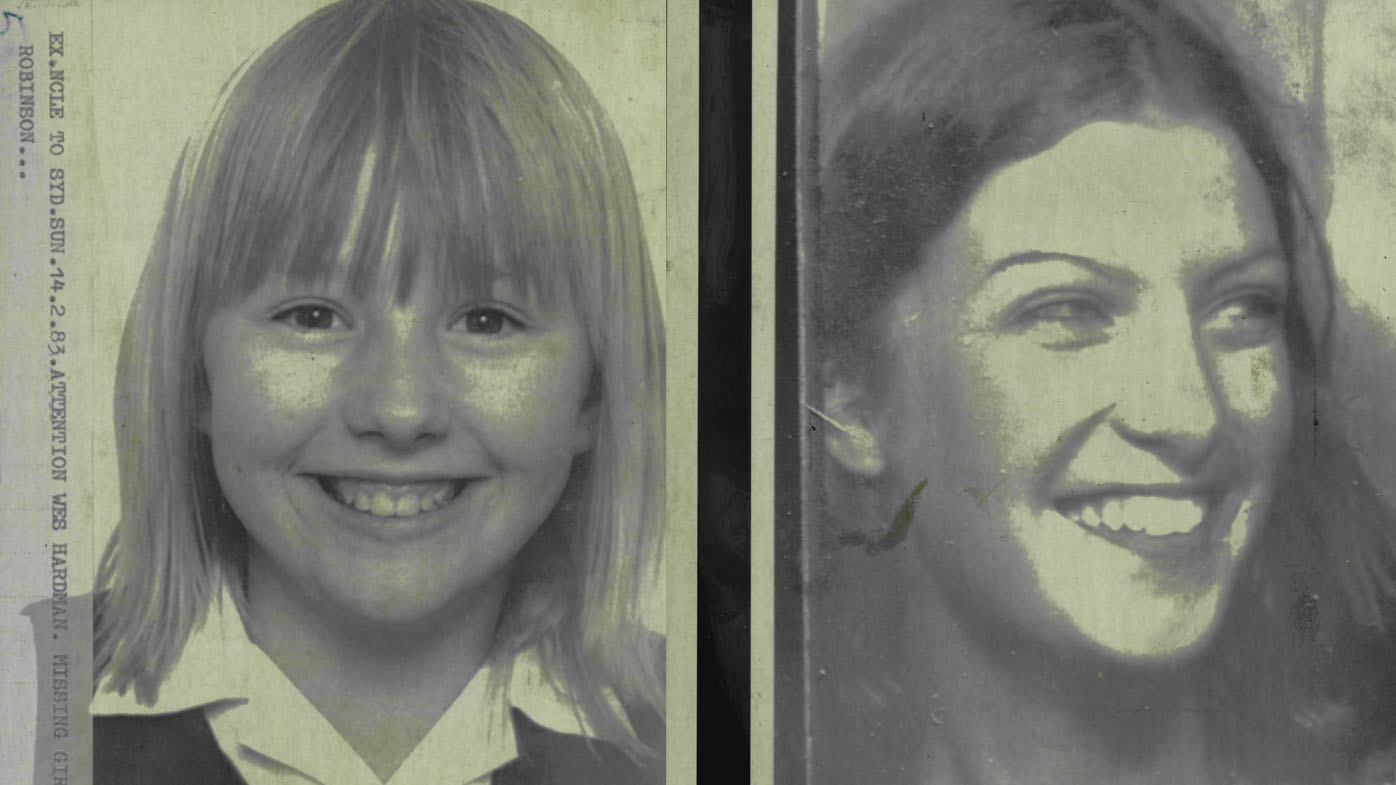
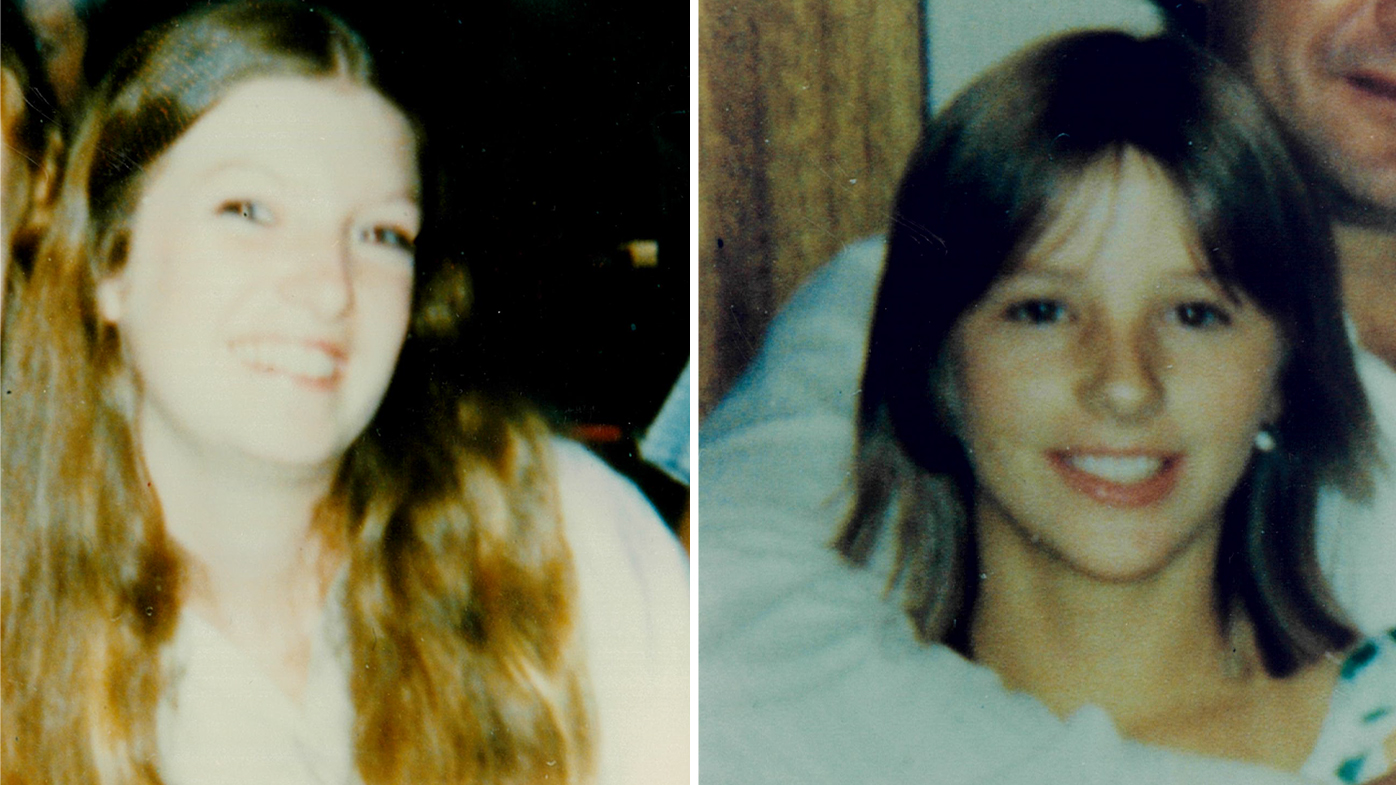
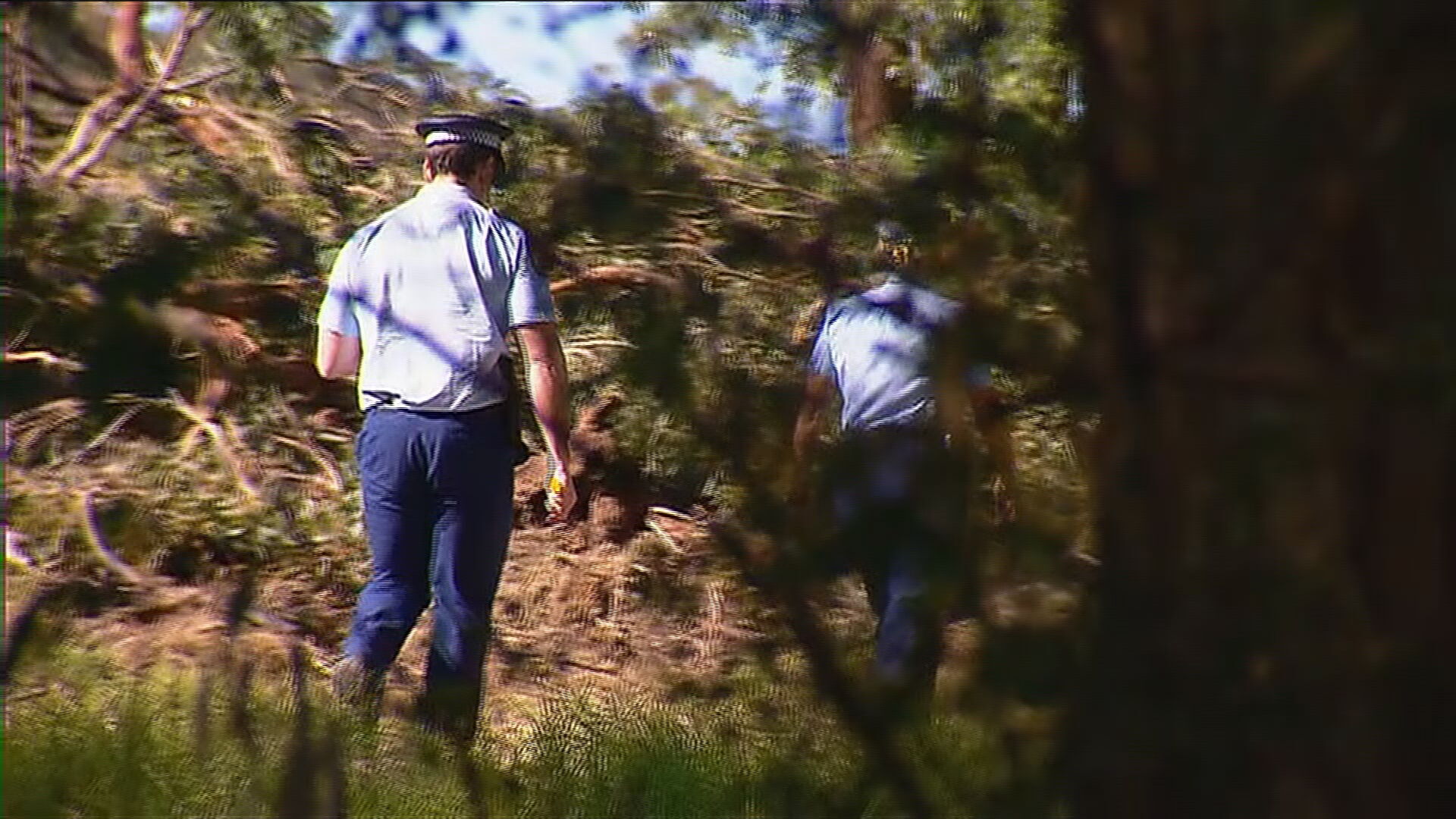
A police operation is underway on the New South Wales Central Coast as investigators search for possible human remains linked to the disappearance of two teenage girls more than 40 years ago.

It comes just two days after NSW Police announced a $1 million reward for information into the unsolved disappearances and suspected murder of Robyn Hickie and Amanda Robinson.

The girls disappeared two weeks apart in 1979 in the Lake Macquarie region of NSW.

READ MORE: Million-dollar reward announced for information into unsolved disappearance of NSW teenagers in 1979

Ms Hickie, then aged 18, left her home about 7.15pm on Saturday April 1, 1979, and was last seen standing at a bus stop on the Pacific Highway, Belmont North.

A fortnight later, Ms Robinson, aged 14, was spotted walking along Lake Road in Swansea, on a Saturday night, after attending a dance at her high school in Gateshead.

Despite extensive investigations at the time, and over the years, neither of the girls have been located.

https://twitter.com/janegoldnbn/status/1427748517166997507?ref_src=twsrc%5Etfw

But in a possible fresh development today, detectives attached to Strike Force Arapaima are searching a former Scout Camp at Nords Wharf, south of Swansea.

Officers dug with heavy machinery today and will also use ground-penetrating radar tomorrow, as part of the new search.

A former scout told NBN News of a possible link between the camp and a person of interest in the police investigation.

"We would from time to time go on camps at Camp Kanangra at Nords Wharf, I know a person of interest who attended there with us … yeah people who may be critical to what is taking place."

Robyn's 91-year-old father Jim spoke on Monday, after police announced two $1-million rewards for information.

"Well if we're going to get answers, it has to be soon doesn't it, I won't last forever."

On the same day, NSW Police Minister David Elliot said investigators would not stop looking for Ms Hickie and Ms Robinson.

"Even though the two girls when missing two weeks apart, police are treating them as a single investigation," Mr Elliott said.

Officers would "leave no stone unturned".

"The dissemblance of two teenager girls is a tragedy."

Police are appealing to the community to come forward with any information that may assist detectives with their inquiries.

Death toll from Haiti's earthquake rises to 1,941

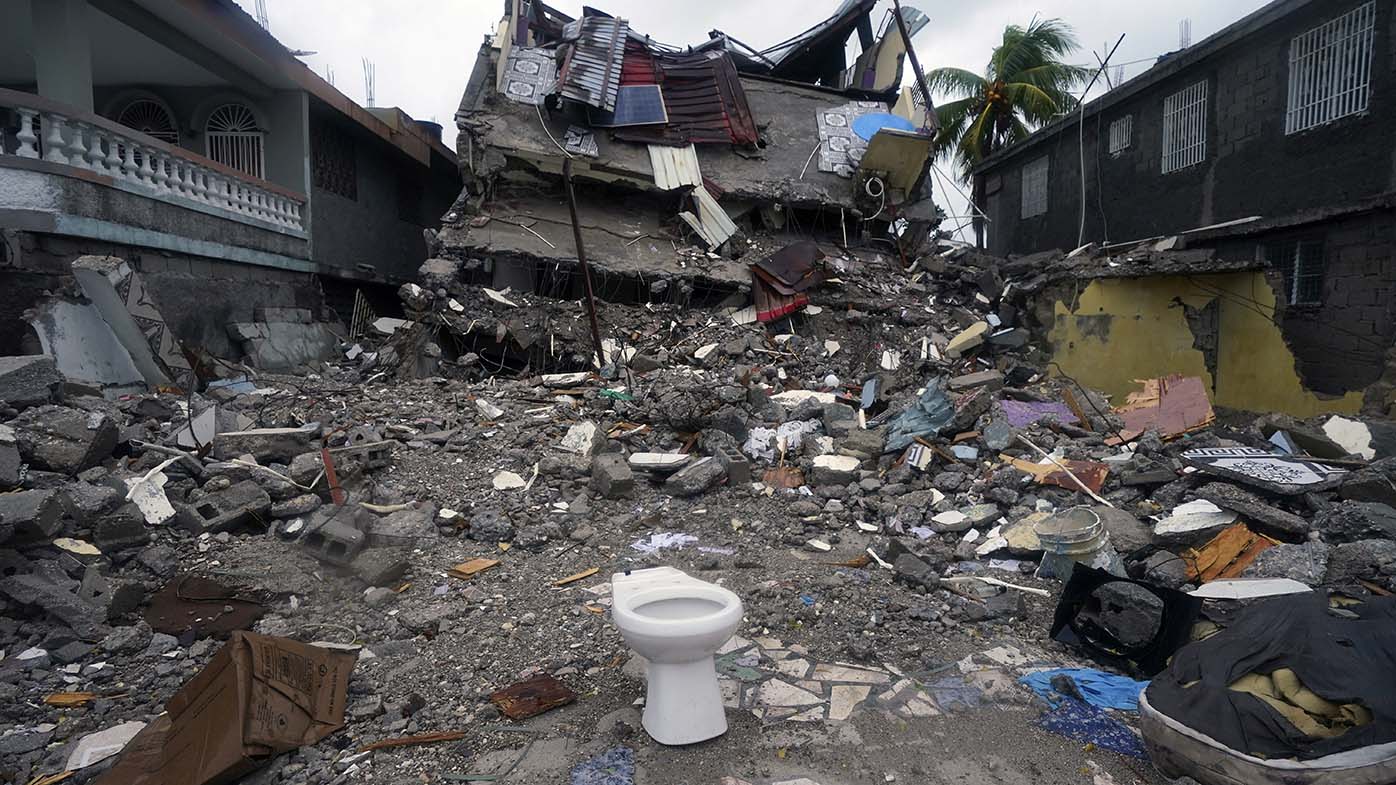
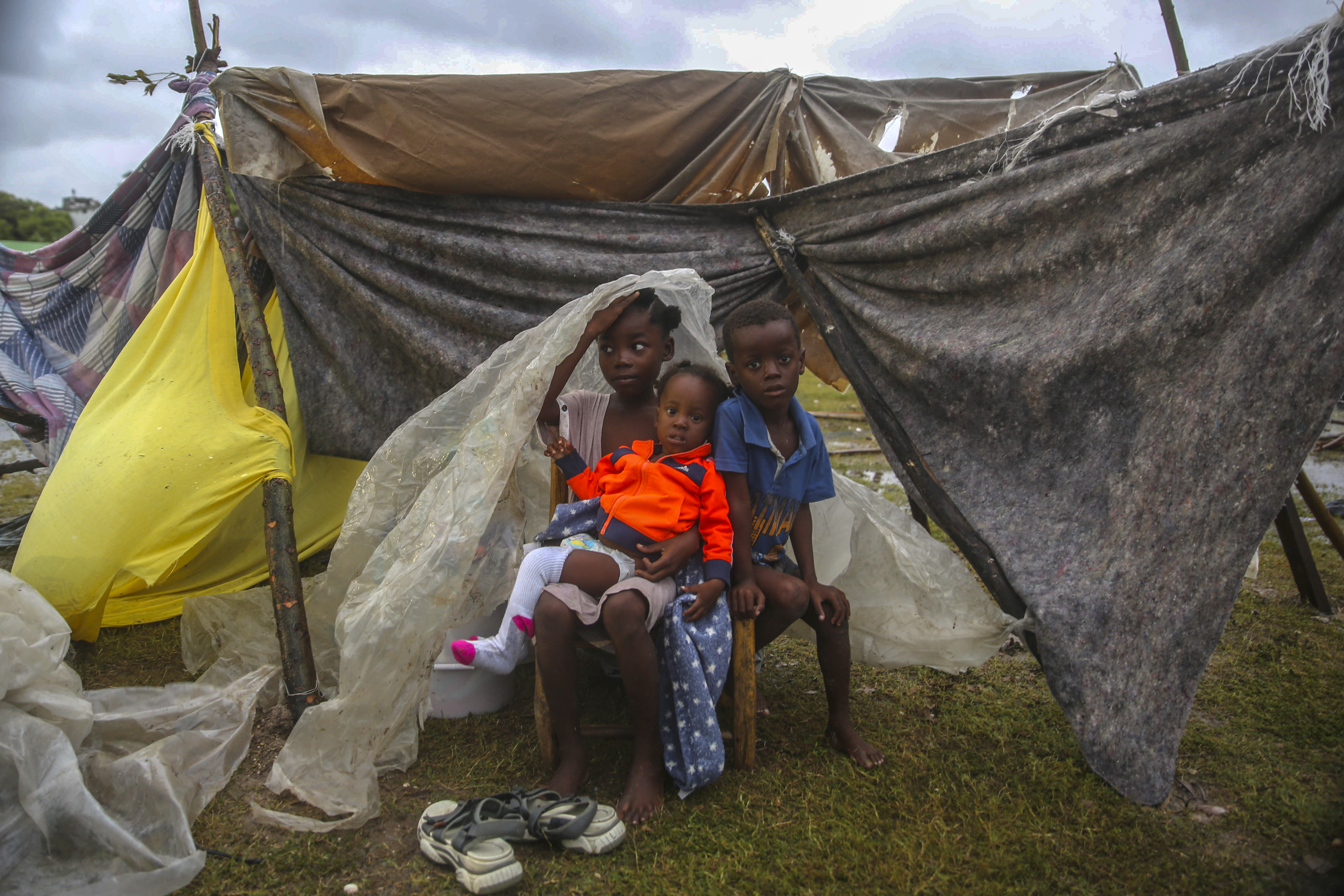
Haitian officials have raised the death toll from a deadly weekend earthquake by more than 500 on Tuesday after Tropical Storm Grace forced a temporary halt to search and rescue efforts, a delay that fed growing anger and frustration among thousands who were left homeless.

Grace battered southwestern Haiti, which was hit hardest by Saturday's quake, and officials warned some areas could get 38 centimetres of rain before the storm moved on. Intermittent rain fell in the earthquake-damaged city of Les Cayes and in the capital of Port-au-Prince.

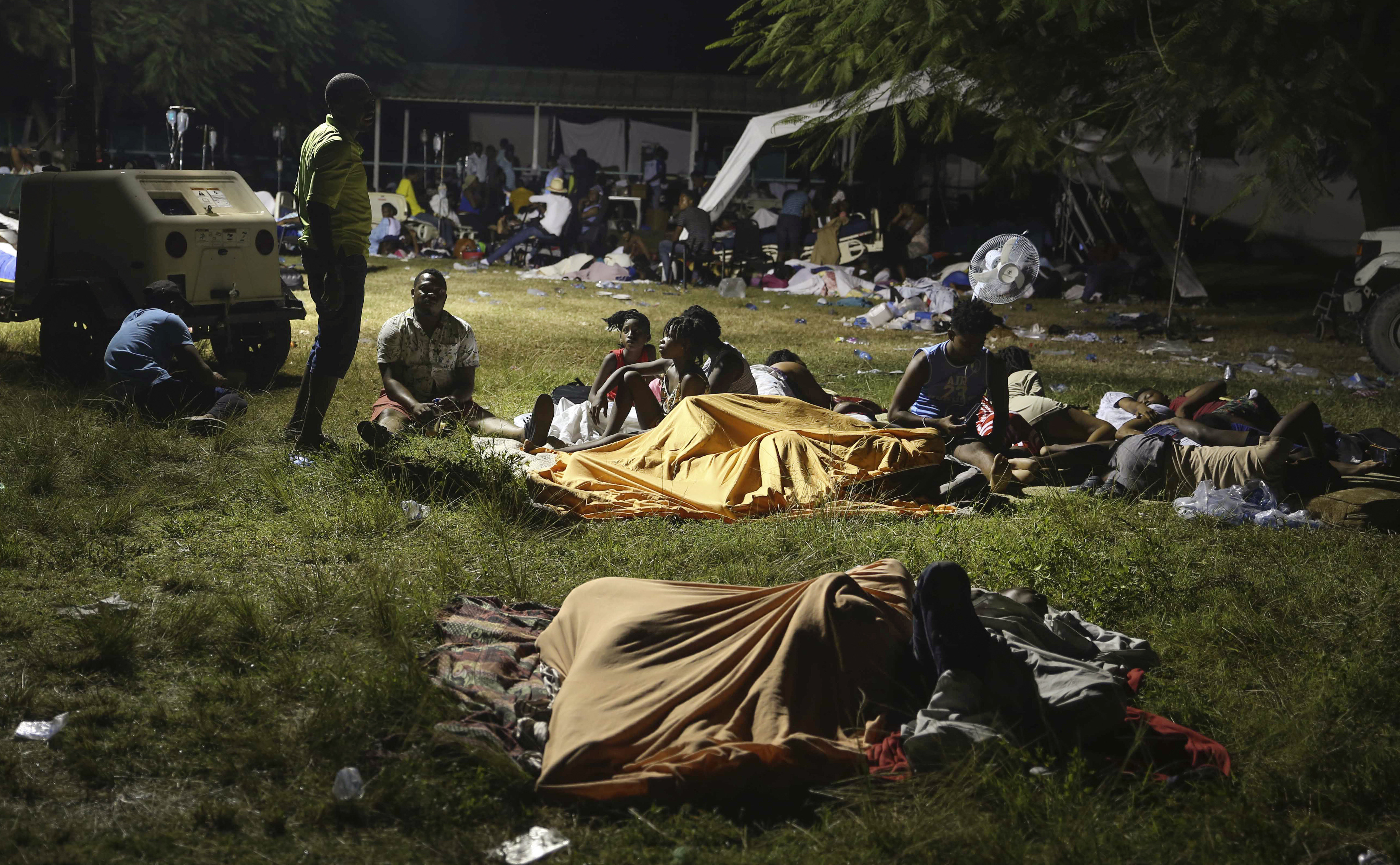
Late on Tuesday afternoon, the Civil Protection Agency raised the death toll to 1,941 and the number of injured to 9,900, many of whom have had to wait for medical help lying outside in wilting heat.

READ MORE: Death toll from powerful earthquake climbs

The devastation is centred in the country's southwestern area, where health care has reached capacity and people have lost homes and loved ones.

Patience was running out in the Western Hemisphere's poorest nation. Haitians already were struggling with the coronavirus, gang violence, worsening poverty and the July 7 assassination of President Jovenel Moïse when the quake hit.

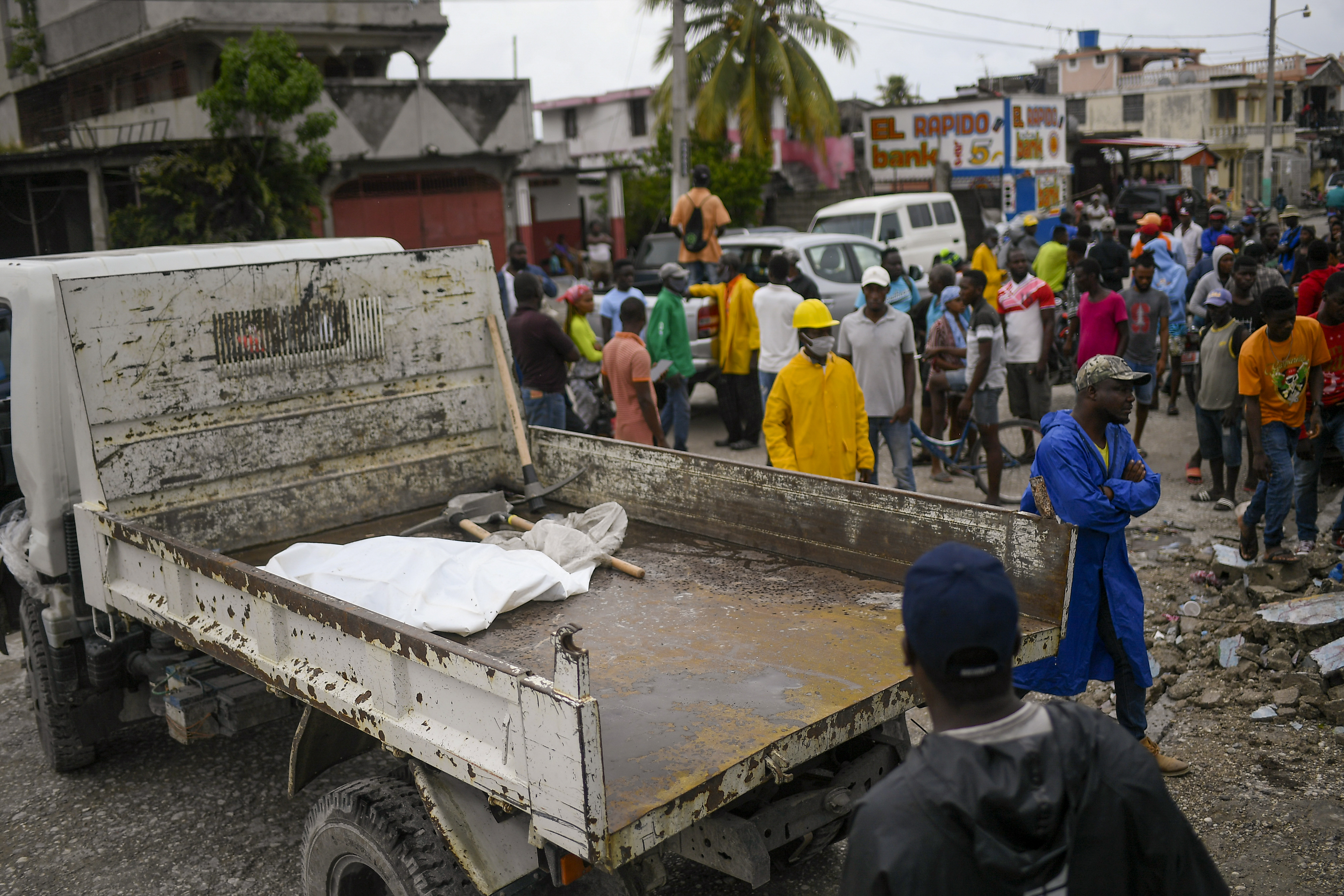
Bodies continued to be pulled from the rubble, and the smell of death hung heavily over a pancaked, three-story apartment building. A simple bed sheet covered the body of a three-year-old girl that firefighters had found an hour earlier.

Neighbour Joseph Boyer, 53, said he knew the girl's family.

"The mother and father are in the hospital, but all three kids died," he said. The bodies of the other two siblings were found earlier.

Illustrating the lack of government presence, volunteer firefighters from the nearby city of Cap-Hatien had left the body out in the rain because police have to be present before a body can be taken away.

READ MORE: Magnitude 7.2 earthquake hits Haiti

Another neighbour, James Luxama, 24, repeated a popular rumour at many disaster scenes, saying that someone was sending text messages for help from inside the rubble. But Mr Luxama had not personally seen or received such a message.

A throng of angry, shouting men gathered in front of the collapsed building, a sign that patience was running out for people who have waited days for help from the government.

"The photographers come through, the press, but we have no tarps for our roofs," said one man, who refused to give his name.

The head of Haiti's office of civil protection, Jerry Chandler, acknowledged the situation. Earthquake assessments had to be paused because of the heavy rain, "and people are getting aggressive," Mr Chandler said on Tuesday.

Some children were orphaned in the quake and some youngsters were starting to go hungry, Carl-Henry Petit-Frère, a field manager for Save the Children, said which added in a statement that it was distributing what it could to people living on the streets without protection from the wind and rain.

READ MORE: Doctor accused of plotting Haiti President assassination

"I see children crying on the street, people asking us for food, but we are low on food ourselves as well," Mr Petit-Frère said, adding that children were warned not to go into houses because they could collapse.

"The organisations that are here are doing what they can, but we need more supplies. Food, clean water and shelter are needed most, and we need them fast."

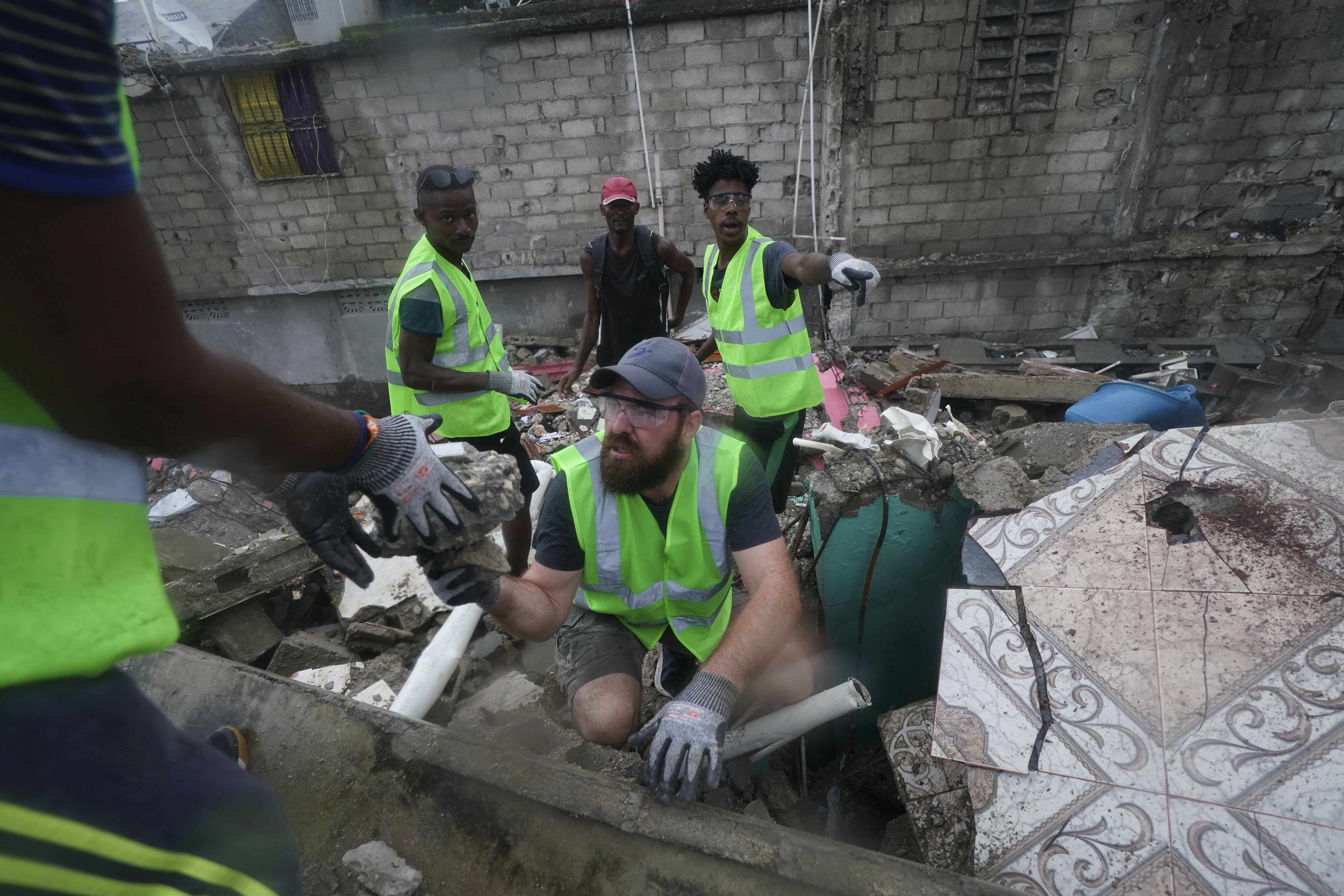
About 20 soldiers finally showed up to help rescuers at the collapsed apartment building.

Prior to that, the only help that arrived was from poorly equipped volunteers.

"All we have are sledgehammers and hands. That's the plan," Canadian volunteer Randy Lodder, director of the Adoration Christian School in Haiti, said.

Sarah Charles, assistant administrator for the US Agency for International Development's Bureau for Humanitarian Assistance, said its disaster response teams were forced to suspend operations as the storm arrived on Monday, but members were back from Tuesday to assess its impact and continue helping.

"We do not anticipate that the death toll related to this earthquake will be anywhere near the 2010 earthquake, where more than 200,000 people were killed," Ms Charles told reporters.

READ MORE: Pollution 'killing more people' than smoking, war, disaster and hunger

The scale of the damage also was not as severe as that earthquake, she said, adding: "That's not what we're seeing on the ground right now."

In a statement, the US military's Southern Command said it was moving eight helicopters from Honduras to Haiti and that seven U.S. Coast Guard cutters were en route to support the USAID team. Two cutters already are there along with two Coast Guard helicopters and US Navy P-8 Poseidon aircraft that are taking aerial images of earthquake devastated areas, the statement said.

The effort was being mounted "to provide the kind of emergency response that is necessary in a human tragedy and catastrophe like this," US national security adviser Jake Sullivan told reporters at the White House.

John Morrison, public information officer for the Fairfax Co. (Virginia) Urban Search and Rescue, said its team was still trying to find survivors. Two US Coast Guard helicopters had ferried searchers to six stricken communities on Monday.

"The team reports that food, health care services, safe drinking water, hygiene and sanitation and shelter are all priority needs," Mr Morrison said. He added that the team had not seen any signs of people trapped alive in buildings.

The rain and wind raised the threat of mudslides and flash flooding as Grace slowly passed over southwestern Haiti's Tiburon Peninsula before heading toward Jamaica and south-eastern Cuba.

Forecasters said it could become a hurricane before hitting Mexico's Yucatan Peninsula.

Death toll of powerful earthquake in Haiti soars to 1297

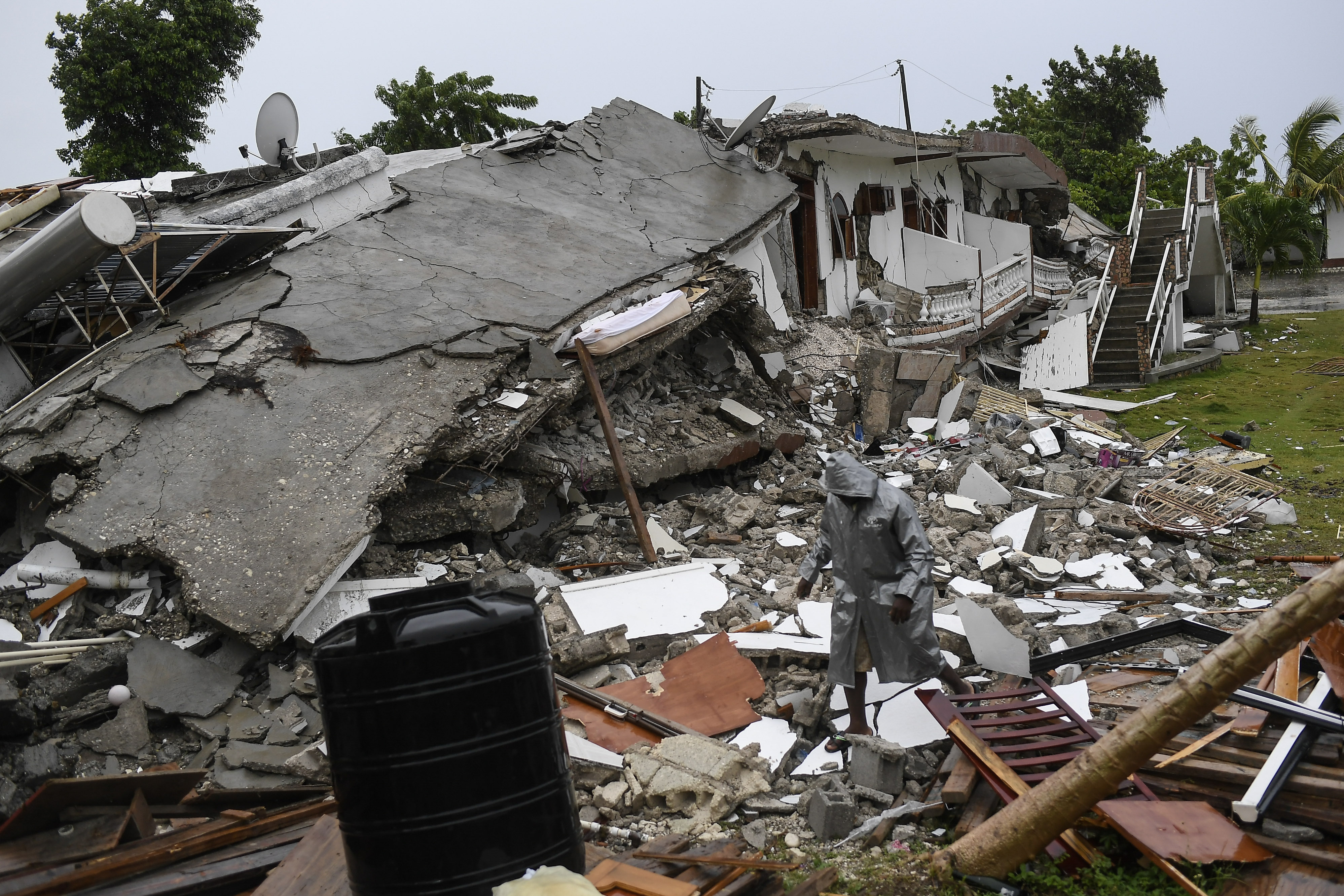
Officials said the magnitude 7.2 earthquake destroyed more than 7,000 homes and damaged nearly 5,000, leaving about 30,000 families homeless. Hospitals, schools, offices and churches also were demolished or badly damaged.

In the village of Bonne Fin, a one-hour drive from from Les Cayes on dirt roads, the mountaintop Hospital Lumiere illustrated the anguish and complexity of Haiti's medical crisis and dire need for outside help.

No one died or was injured at the hospital when the quake hit, but the operating rooms partially collapsed.

Through cracks in a wall, Dr Frantz Codio could see three glistening anaesthesia machines he needed to perform orthopaedic operations on broken bones. But he could not get to them because the building's cement floor was leaning at a crazy angle — in some places just 0.9 meters to 1.2 metres above where it used to be.

Despite warnings not to go inside the structure, Dr Codio did so on Sunday and pulled one of the machines out.

Haiti earthquake

"People said, 'Don't go in there, it's too dangerous,' but I had God with me," Dr Codio said.

Etzer Emile, a Haitian economist and professor at Quisqueya University, a private institution in Port-au-Prince, said the earthquake will almost certainly result in more long-term poverty for Haiti's struggling southwestern region.

Political instability and gang criminality along the southern roads into the region have particularly hobbled economic activity in recent years.

"The earthquake has just given a fatal blow to a regional economy already on its knees for about two and a half years," Mr Emile said.

Eight nationals invested with 2020 Medal of Honour

BASSETERRE, ST. KITTS, August 17, 2021 (MMS-SKN) — At a colourful Investiture Ceremony held at Government House, Springfield in Basseterre, eight nationals were on Tuesday August 17 invested with the 2020 Medal of Honour (MH) by Governor General His Excellency Sir S.W. Tapley Seaton GCMG, CVO, QC, JP, LL.D.

Delivering remarks after seven of the eight honourees received the Medal of Honour, which is one of the two highest civilian honours the Federation of St. Kitts and Nevis bestows on its sons and daughters, Prime Minister Dr the Hon Timothy Harris informed them that their work, dedication and efforts were being publicly acknowledged and appreciated.

“We present these Medals to honour those who go above and beyond their call of duty,” said Dr Harris, who delivered his remarks under the theme ‘You are deserving of our Honour and Gratitude’. “This Medal of Honour is an acknowledgment that the recipient truly has put country before self.”

He added: “Today’s recipients have more than demonstrated this virtue. They are deserving of the Honour and they are deserving of our gratitude.”

The Prime Minister noted that in the times people are living, it is inspiring that there are people like the awardees who are prepared to put their fellow men, and the cause they believe in, first. Their example, he noted, is that service should be embraced and not avoided.

“The adversity we have all experienced this past year, a year like no other, has been more than countered by the great strength we have witnessed from many in our community, and the inspiration others have received from their service and from the example of our honourees,” pointed out the Honourable Prime Minister. “You, gathered here, are the community leaders who are inspiring all of us.”

Quoting from 2 Corinthians 9: 12-13, the Prime Minister told the honourees that the service they rendered is a lesson of what can be achieved when people are driven by their commitment to serve their people.

On behalf of the Federation he thanked the awardees for their passion, for their focus and their commitment, noting that they are truly helping to build a stronger and safer future for all the people of St. Kitts and Nevis, and that St. Kitts and Nevis as a Nation is stronger because of their collective efforts.

The awardees were Mrs Pearline Theresa Mussenden, for her role in Education; Mr Joseph Emmanuel Benders, pioneering in the field of Arts; Dr A. Linton Liburd, for his contribution in the field of Medicine; Mrs Patricia Mary Nurse-Clarke, for her role in Community Services; Mrs Pamela Elaine Brookes, for outstanding service in Nursing; Mr Charles Delvin McMaster, for outstanding Community Service; Mr Brian Dyer, for National Service in Crisis; and Dr Judy Nisbett, for National Service in Crisis.

Nevis-based Dr A. Linton Liburd was not present at the Investiture Ceremony and it was announced that he will be invested with the Medal of Honour by Deputy Governor General for Nevis Her Honour Hyleta Liburd at a later date in Charlestown, Nevis.

“Today we acknowledge, not just their service but the humility that each one brings to their area of service,” said Prime Minister Harris after he called out the names of the awardees and the areas of their service.

He told them: “Your service was not driven by a desire for attention. You did not seek reward or self-promotion. Your work was quiet and understated, driven by the motto that ‘a good deed is its own reward’.”

At the ceremony, which was co-chaired by Inspector Alphonso Hendrickson and Mrs Charisse Gumbs, Mrs Telca Wallace who is the Disaster Coordinator of the St. Kitts-Nevis Red Cross Society received the 161st Commonwealth Point of Light Award for St. Kitts and Nevis which had been conferred to her by Queen Elizabeth II.

Mrs Wallace is currently in Guyana on an International Federation of Red Cross (IFRC) assignment and was represented by her daughter, Ms Shai Wallace, who received the award from Governor General His Excellency Sir S.W. Tapley Seaton.

Present at the Investiture Ceremony were the Deputy Governor General for Nevis Her Honour Hyleta and Mr Elmo Liburd, and Governor General’s Deputy His Excellency Michael and Mrs Morton.

Also present were Speaker of the National Assembly the Hon Michael Perkins, Deputy Speaker Senator the Hon Dr Bernicia Nisbett, Cabinet Ministers – the Hon Eugene Hamilton, the Hon Jonel Powell, the Hon Alexis Jeffers, and the Hon Vincent Byron Jr. and Cabinet Secretary Mrs Josephine Huggins.

Others present included Resident Ambassador of the Republic of China on Taiwan, His Excellency Michael Lin, Commander of the St. Kitts and Nevis Defence Force Lt. Col J. Anthony Comrie, and Commissioner of Police Mr Hilroy Brandy.

The post Eight nationals invested with 2020 Medal of Honour appeared first on The St Kitts Nevis Observer.

Wet spring predicted for parts of Australia

With spring just over a fortnight away, meteorologists are predicting a wet season for eastern parts of Australia.

From September to November, rainfall for spring is likely to be above median for the Northern Territory, South Australia, Queensland, New South Wales, Victoria and eastern Tasmania.

Meanwhile, the Bureau of Meteorology predicts western WA and western Tasmania are likely to have below-median rainfall.

LIVE UPDATES: Additional troops to arrive in western NSW to boost vaccine rollout as cases soar

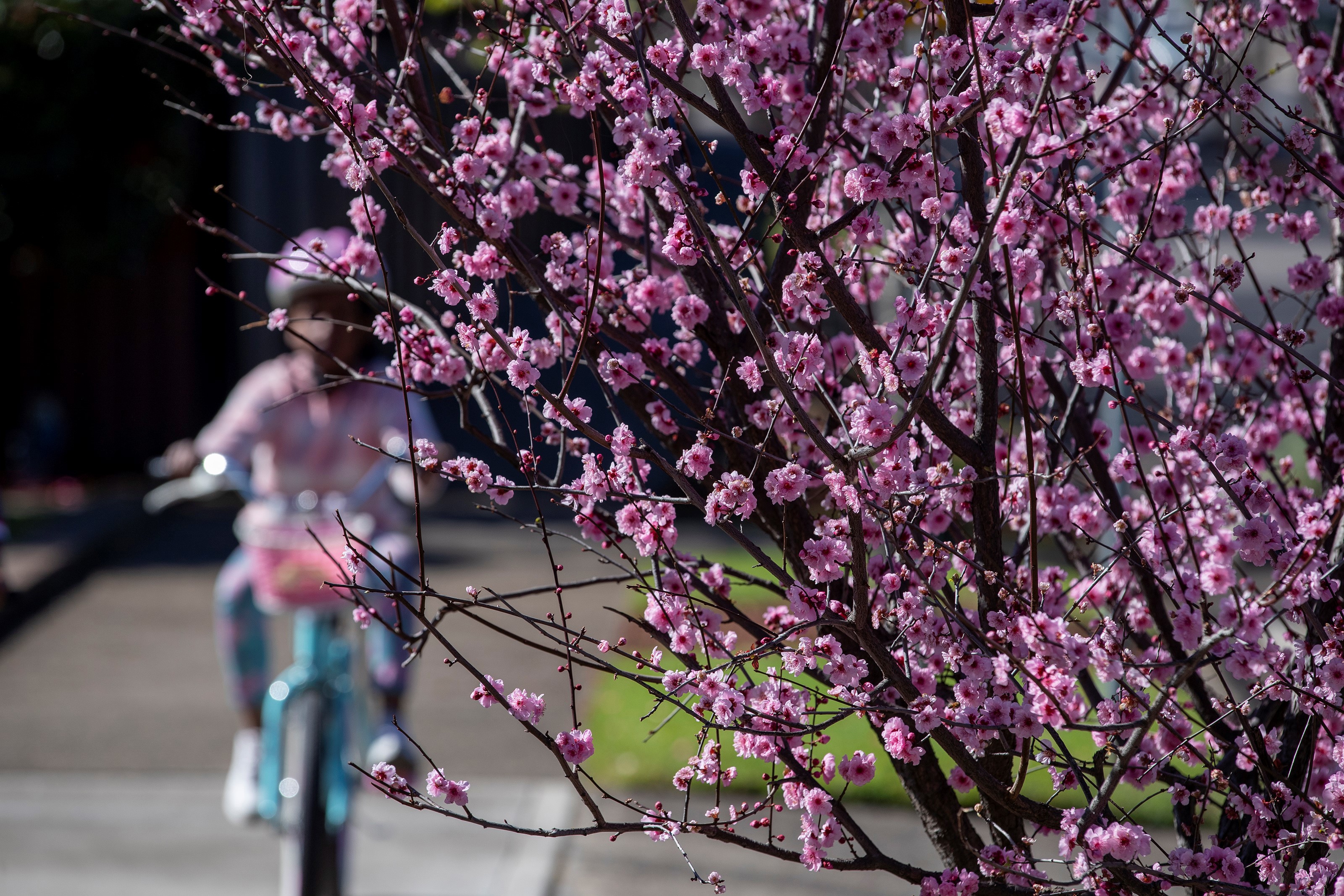
A girl rides past a cherry tree in Sydney, Australia, on Aug. 16, 2021. Australia's state of New South Wales NSW recorded a new record high of 478 new locally acquired COVID-19 cases and eight deaths on Monday. (Photo by Bai Xuefei/Xinhua via Getty Images)

A negative Indian Ocean dipole, the state of sea surface temperatures across the tropical Indian Ocean, will underpin the predicted wet spring.

According to Weatherzone, there are also signs a weak La Niña-like pattern may further enhance rainfall across Australia in spring.

READ MORE: ACT Senator Katy Gallagher in isolation after daughter diagnosed with COVID-19

However, meteorologists predict a full-blown La Niña is unlikely at this stage.

Some parts of Australia will get an early taste of spring, with rainfall predicted in parts of the country today.

New South Wales

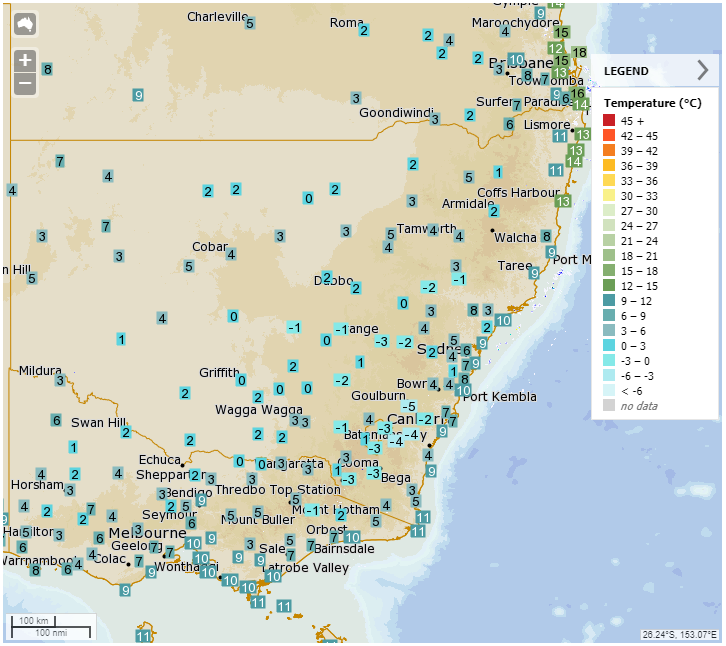
Parts of New South Wales will experience chilly temperatures this morning however, temperatures will become warmer as the day progresses.

Morning frost and fog are expected along the state's ranges and slopes.

There is the chance of a shower on the state's far north coast, while it is predicted to be dry and mostly sunny elsewhere.

Sydney can expect a mostly sunny day with light winds.

Parts of New South Wales will experience chilly temperatures this morning however, temperatures will become warmer as the day progresses.

Victoria

Victorians can expect cloudy conditions throughout most of the state today.

Melbourne will be partly cloudy, with areas of morning fog and a top of 16 degrees.

North-to-north-westerly winds of 15 to 20 kilometres an hour are expected in the city in the middle of the day, before becoming light in the late evening.

It will be mostly cloudy and cold in the southwest of the state, while it will be mostly sunny, cool-to-cold in the southeast.

A mostly cloudy, cool-to-cold is predicted in the northwest and sunny and cold for residents in the northeast.

Queensland

There will be sunny conditions for most of Queensland, thanks to a high-pressure system that is brining stable conditions.

Meanwhile, residents in Far North Queensland can expect a partly cloudy day.

Brisbane will be partly cloudy, with a slight chance of a shower.

South Australia

South Australia will experience showers and cold temperatures in the southeast.

The central part of the state will experience a mostly sunny day, with cool-to-cold temperatures in the central part of the state.

The west and north of the state will experience sunny conditions, with cool-to-mild temperatures.

Adelaide is expected to have be partly cloudy with light winds.

Western Australia

Most of Western Australia will experience cool-to-mild temperatures, while it will be sunny and warm in the north-east of the state.

Perth will be partly cloudy, with the chance of fog early this morning, mainly about the hills.

There will be a medium chance of showers in the city in the morning and early afternoon.

Northern Territory

It will be mostly sunny, very warm in the north-west Top End.

There will be a late shower, mild-to-warm in Arnhem.

Meanwhile, there will be windy, mild conditions over the state's interior and sunny, cool-to-mild temperatures in the south.

It will be a humid, mostly sunny day for Darwin, with a top of 33 degrees.

Tasmania

In Tasmania, Launceston will see early fog and frost this morning.

There will be showers, cold in the southwest and windy conditions on the highlands.

It will be mostly cloudy, cold in the southeast and mostly sunny, cold in the northwest.

The north-east part of the state is expected to experience mostly cloudy, cold conditions.

Taliban knocked on her door three times. The fourth, they killed her

Najia was at home with her three young sons and daughter in a small village in northern Afghanistan when Taliban fighters knocked on their door.

Najia's daughter Manizha, 25, knew they were coming — her mother had told her they'd done the same thing the previous three days, demanding that she cook food for up to 15 fighters.

"My mother told them, 'I am poor, how can I cook for you?'" Manizha said. 

"(The Taliban) started beating her. My mother collapsed and they hit her with their guns — AK47s."

READ MORE: Taliban urge women to join government as thousands seek to flee
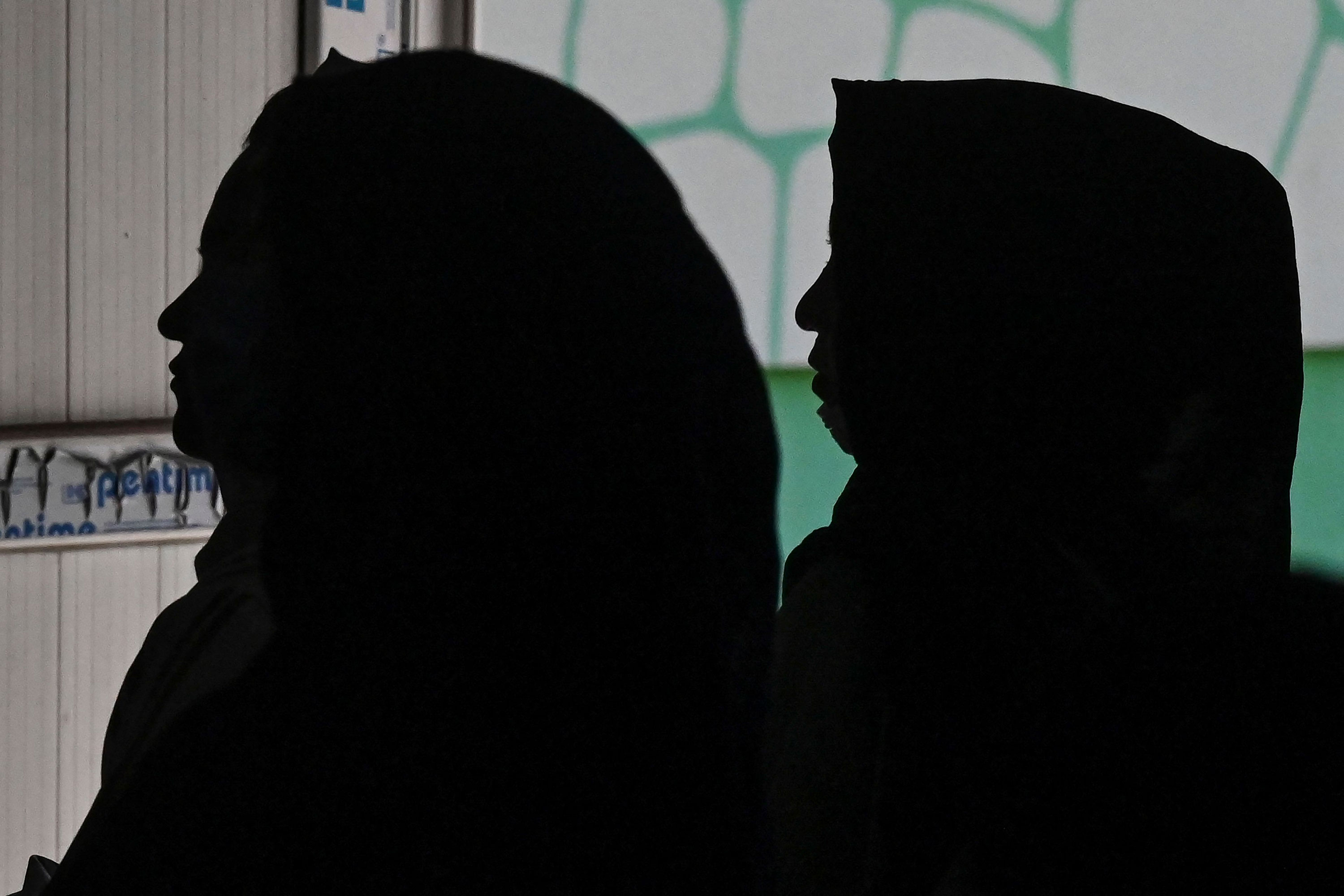
Manizha said she yelled at the fighters to stop. They paused for a moment before throwing a grenade into the next room and fleeing as the flames spread, she said. The mother-of-four died from the beating.

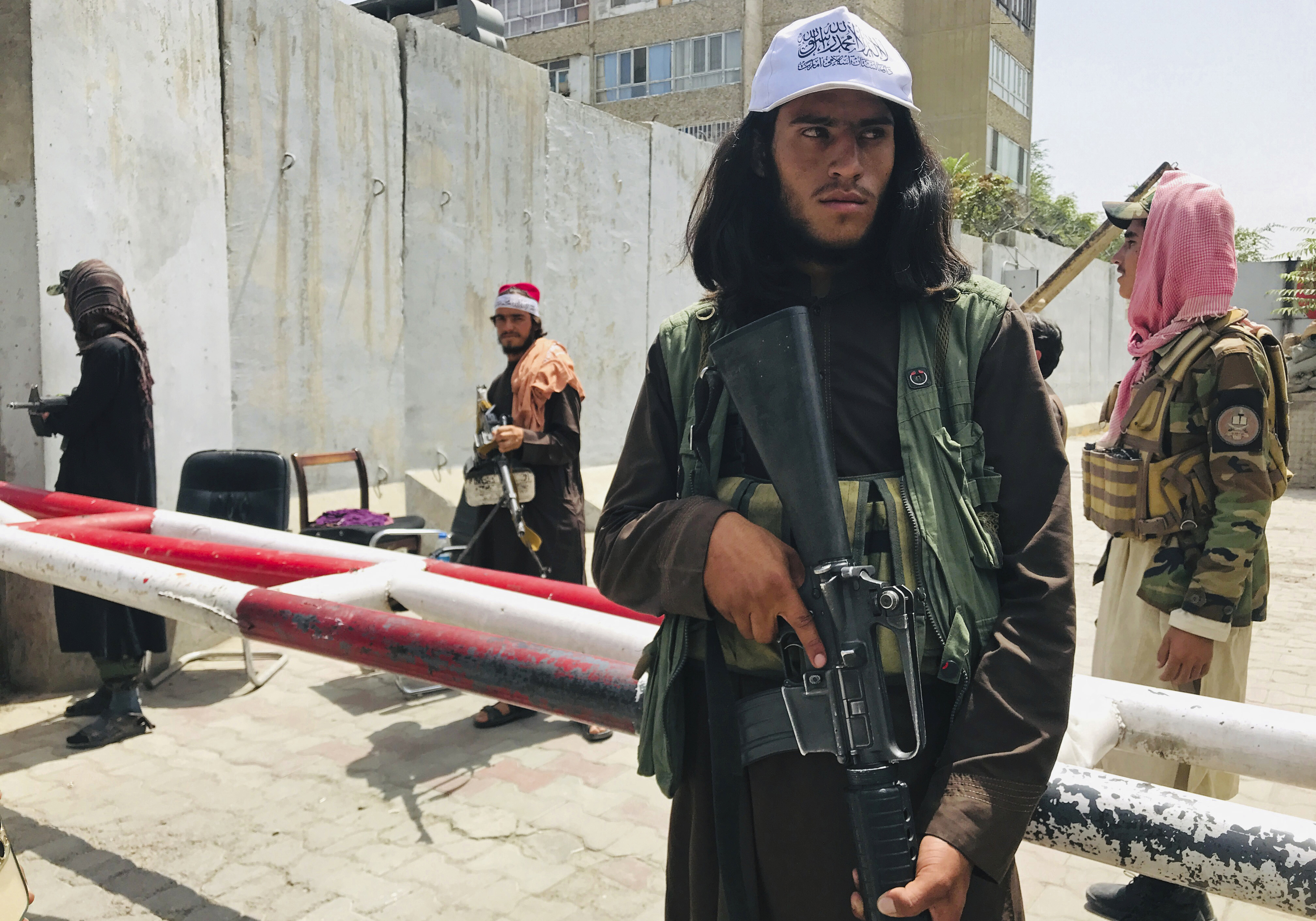
The deadly July 12 attack on Najia's home in Faryab province was a chilling preview of the threat now facing women across Afghanistan after the Taliban's takeover of the capital Kabul. 

CNN is using aliases for Najia and Manizha to protect their identity for safety reasons.

In 10 days, Taliban militants captured dozens of provincial capitals left vulnerable by the withdrawal of US and allied troops.

The speed of the militants' advance caught locals off guard.

Some women said they had no time to buy a burqa to comply with Taliban rules that women should be covered up and accompanied by a male relative when they leave the house.

To Afghanistan's women, the flowing cloth represents the sudden and devastating loss of rights gained over 20 years — the right to work, study, move and even live in peace — that they fear will never be regained.

EXPLAINER: Who are the Taliban and how did they take control of Afghanistan

Deep mistrust

When the Taliban last ruled Afghanistan between 1996 and 2001, they closed girls' schools and banned women from working.

After the US invaded in 2001, restrictions on women eased, and even as the war raged, a local commitment to improving women's rights, supported by international groups and donors, led to the creation of new legal protections.

In 2009, the Elimination of Violence Against Women law criminalised rape, battery and forced marriage and made it illegal to stop women or girls from working or studying.

This time, the Taliban is promising to form an "Afghan inclusive Islamic government," although it's not clear what form that will take and if the new leadership will include women.

Farzana Kochai, who was serving as a member of the Afghan parliament, says she doesn't know what comes next. 

"There has been no clear announcement about the form of the government in the future — do we have a parliament in the future government or not?" she said.

https://twitter.com/Farzanakochai/status/1427565231606226952

She's also concerned about her future freedoms as a woman. 

"This is something that concerns me more," she said. 

"Every woman is thinking about this. We are just trying to have a clue … would women be allowed to work and to occupy a job or not?"

Taliban spokesman Suhail Shaheen said on Monday that under the Taliban girls would be allowed to study. 

"Schools will be open and the girls and the women, they will be going to schools, as teachers, as students," he said.

But stories from locals on the ground paint a different picture — and there's a deep mistrust of militants who caused such misery under their last rule.

In July, the Afghanistan Independent Human Rights Commission said in areas controlled by the Taliban, women had been ordered not to attend health services without a male guardian. TV was banned, and teachers and students were instructed to wear turbans and grow beards.

Religious scholars, government officials, journalists, human rights defenders and women had become victims of targeted killings, the commission said. 

One of them was Mina Khairi, a 23-year-old killed in a car bombing in June. Her father, Mohammad Harif Khairi, who also lost his wife and another daughter in the blast, said the young broadcaster had been receiving death threats for months.

When the Taliban last controlled Afghanistan, women who disobeyed orders were beaten.

The Taliban denied killing Najia, the mother in Faryab province, but their words are contradicted by witnesses and local officials who confirmed the death of a 45-year-old woman whose home was set alight.

A neighbour who yelled at the men to stop said many women in Najia's village are the widows of Afghan soldiers. They earn a living selling milk, but the Taliban "won't allow that," she said. 

"We don't have men in our house, what shall we do? We want schools, clinics and freedom like other women, men — other people," she said.

READ MORE: US military plane rescues 640 Afghans escaping Taliban
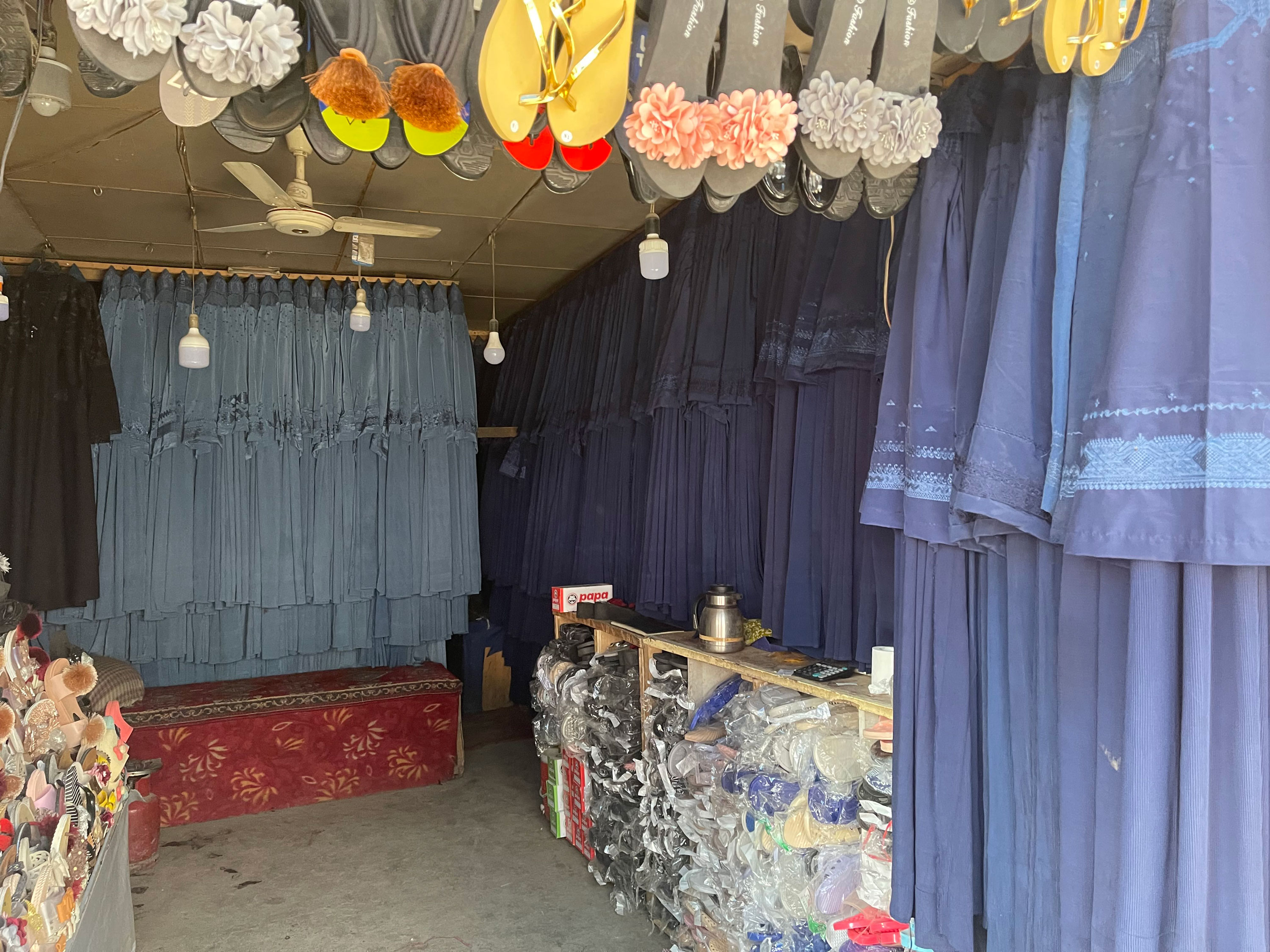
Burqa prices surge

The Taliban's takeover of the country was so quick that some women found themselves without the requisite female uniform for Taliban rule.

One woman, who is not being named for security reasons, said her household had just one to two burqas to share between her, her sister and their mother. 

"If the worse comes to worse and we don't have burqa, we have to get a bedsheet or something to make it a bigger scarf," she said.

Burqa prices surged as much as tenfold in Kabul as women raced to beat the militants ahead of their advance, according to another woman in the city, who is also not being named for security reasons. Some didn't make it to the markets before they closed on Sunday, as store owners rushed to get home.

She said she'd spent hours at a bank on Sunday trying to withdraw as much money as possible to see the family through the coming days of uncertainty.

"It was so unexpected, no one expected this to happen this soon. Even people would be like, 'Oh, Kabul can defend itself for a year or so,' but morale is lost," she said.

"The army is just handing it over to the Taliban."

The woman fears for her life, but also the collapse of a government people fought so hard to build and the end of freedoms for Afghan women.

"As a woman, they just keep us inside," she said. 

"We fought for years to get out, do we need to fight again for the same things? To get the permission to work, to get the permission to go to hospital alone?"
'All for nothing'

Over the last 10 days, a succession of Taliban victories over dozens of provincial capitals took Afghan women closer to a past they desperately wanted to leave behind.

Pashtana Durrani, the founder and executive director of Learn, a non-profit focused on education and women's rights, said she had run out of tears for her country.

"I have cried so much there are no more tears left in my eyes to mourn," she said. 

"We have been in mourning (for) the fall of Afghanistan for now quite some time. 

"So I'm not feeling very well. On the contrary, I'm feeling very hopeless."

Ms Durrani said she'd received text messages from boys as well as girls, who despaired that years of study were "all for nothing."

She said the Taliban kept talking about girls' education, but they hadn't defined what that meant. 

Islamic studies are assumed, but "what about gender education? What about professional education?" she asked. 

"If you think about it, it makes you hopeless because there's no answer for it," she said.

In a tweet, United Nations Secretary-General Antonio Guterres called for an end to all abuses. 

"International humanitarian law and human rights, especially the hard-won gains of women and girls, must be preserved," he said.

https://twitter.com/antonioguterres/status/1427529125074333705

In chaotic scenes at Kabul airport on Monday, desperate Afghans scaled an air bridge in an attempt to board planes out of the country. But for many millions of people, there is no escape.

The woman in Kabul who spent hours at the bank Sunday said even if she could find a flight, without a visa she has nowhere to go. The only other option was to stay inside and hope to avoid attracting attention.

"Going out or doing anything else can risk our life," she said.

As the US and allies evacuated staff members, Patricia Gossman, associate Asia director at Human Rights Watch, urged international donors not to abandon Afghanistan.

"Many, many cannot get out and will be in great need both for urgent humanitarian assistance and for other essential services like education," she said. 

"It's the wrong time now for donors to be saying, 'Oh, we're done now in Afghanistan'."

Women across the country live in fear of the same knock at the door Najia heard last month. Her daughter, Manizha, said she hasn't returned to the house since her mother's death. She doesn't go outside much at all.

"Taliban don't let any women out without a male relative. Men are the only ones allowed out. They can go to work," she said.

"If I need something, how I am I supposed to get it? It's a punishment. It's not Islam. They call themselves Muslim. It's not right for them to punish women."
Caribbean Reefs are Dying from a Mysterious Disease

The devastation caused by the disease is unprecedented. “You can lose colonies that were growing for hundreds of years in just weeks or months,” said one expert.
Vice


TEGUCIGALPA, Honduras—A mysterious, highly contagious and lethal disease is spreading across the coral reefs of the Caribbean Sea, alarming scientists and leaving a trail of skeletons in its path.


Its advance from Florida to the far reaches of the Caribbean could wipe out the majority of the hard coral across the sea, decimating reefs and the marine life they support for generations to come. The environmental damage would also disrupt the lives of millions of people in coastal communities who depend on the reefs for food or jobs.

“It’s basically like a coral Covid,” said Gabriela Ochoa, program manager at the Roatan Marine Park on the Bay Islands of Honduras, describing the disease’s rapid transmission. Affecting more than 20 species of hard coral, the harm that stony coral tissue loss disease (SCTLD) threatens to slow-growing coral reefs and their fragile ecosystems is irreparable.

“The only difference is the mortality rate of COVID doesn’t even compare to what we’re seeing in the reefs,” added Ochoa. In some coral species, the mortality rate reaches as high as 100 percent.

The first sign that a coral is infected is the appearance of a small lesion where the tissue, or the skin, is absent, revealing the bone. Patric Lengacher/Roatan Marine Park

The first sign that a coral is infected is the appearance of a small lesion where the tissue, or the skin, is absent, revealing the bone. Patric Lengacher/Roatan Marine Park

While other more well-known factors such as pollution and climate change have caused the loss of an estimated 60 percent of coral coverage in the Caribbean over the past three decades, the new disease is killing it at a much faster rate.

Once a colony is infected, death can come very quickly. “You can lose colonies that were growing for hundreds of years in just weeks or months,” said Melina Soto, Mexico Coordinator for the Healthy Reefs Initiative.

SCTLD was first discovered in 2014 off the coast of Florida, where it has since infected roughly half of the state’s reefs. The cause is unknown but humans are a likely culprit.

Theories divide along two main tracks. The first is that factors such as climate change and rising sea temperatures along with contaminants like untreated sewage and even sunscreen have reduced the reefs’ resiliency, making coral susceptible to existing bacteria. The second centers around the idea that a new pathogen emerged as a result of human activity.

In the end, the answer could be all of the above. “Like COVID, when you have other health problems, then you’re at higher risk when you get COVID,” said Ochoa.

Over the past seven years, the disease has spread across the Caribbean Sea, often traveling against currents, which suggests that the pathogen may be reaching new areas by clinging to boats. “One of the points that almost always repeats itself is that the first cases are found near ports,” said Soto.

In 2018, SCTLD was discovered in Mexico off the coast of Puerto Morelos, situated between the tourist hotspots of Cancun and Playa del Carmen near the northern tip of the Mesoamerican Reef — the world’s second largest. The disease has since spread hundreds of miles along the reef’s hard coral colonies all the way to its southernmost point around the Bay Islands in Honduras, where it was first detected in September 2020.

Brain corals have been the most affected, according to the Healthy Reefs Initiative, and the disease has put one rare species, pillar coral, at the brink of extinction. The first sign that a coral is infected is the appearance of a small lesion where the tissue, or the skin, is absent, revealing the bone. As the disease progresses, the coral is stripped of all tissue, leaving nothing but a dead skeleton.

Once an infection is present, the disease can spread across a reef system from coral to coral, or by fish or scuba divers hopping from an infected site to a healthy site.

Mitigating the effect is a costly, nearly insurmountable task. An antibacterial cream that is applied to the lesions has shown some success in stopping an infection, but it doesn’t provide any immunity to subsequent infections and the application is extremely labor intensive and expensive.

Instead, organizations are building coral nurseries in water tanks on land to conserve genetic diversity and breed new species with the hope of restoring reefs in the future. But with growth rates of just a couple centimeters per year, full restoration could take hundreds, if not thousands of years.

Soft corals, such as the elegant fan corals that sway with the current, are not affected by SCTLD. But the loss of hard corals is about more than just their genetic diversity

Hard corals are “reef builders” that are essential to a reef’s formation. As the hard corals die off, they erode and compact, reducing the protection against coastal erosion, flooding and hurricane storm surges provided by the reefs. Declining coral cover is also a loss of habitat for marine wildlife, including some 1,500 species of fish.

The damage to the Mesoamerican Reef and others across the region will have an impact that extends beyond the sea. “If we don’t have corals, then we don’t have everything else associated with them,” said Ochoa. Reef-related tourism alone generates about $8 billion for Caribbean economies each year.

Although there have been massive coral die-offs in the past, as well as other diseases that have affected reefs, the devastation caused by SCTLD is unprecedented. “We’ve never seen 23 different species of corals getting sick at the same time,” said Ochoa.

In many places, coral coverage has been reduced to half of what it was before the disease arrived and algae is taking over. What once was a flourish of bright colors is now dull and green.

The spread of such a contagious and lethal disease foreshadows a similar fate for reefs across the Caribbean Sea. “Reefs as we knew them will no longer be” in existence, said Ochoa.

The post Caribbean Reefs are Dying from a Mysterious Disease appeared first on The St Kitts Nevis Observer.

Tropical Storm Henri Forms South of Bermuda.

At 5 pm AST, the centre of Tropical Storm Henri was located over the Atlantic Ocean about 145 miles (230 km) southeast of Bermuda.

The US National Hurricane Centre (NHC) said Henri is moving toward the south-southwest near seven mph (11 km/h). A slow clockwise turn toward the southwest and then toward the west is expected during the next day or two.

On the forecast track, the centre of Henri should pass south of Bermuda tomorrow night.

Photo: NOAA

A Tropical Storm Watch is in effect for Bermuda.

Henri has maximum sustained winds that are near 40 mph (65 km/h) with higher gusts.

Tropical-storm-force winds only extend outward up to 35 miles (55 km) from the centre. The estimated minimum central pressure is 1010 mb (29.83 inches).

Some additional strengthening is forecast during the next couple of days.

The post Tropical Storm Henri Forms South of Bermuda. appeared first on The St Kitts Nevis Observer.

Guyana Welcomes New Cuban Health Brigade

Guyana has welcomed 56 Cuban health professionals, praised Cuba for its support to the country especially during the coronavirus (COVID-19) pandemic.

“Our heartfelt thanks for taking up the challenge, for being here, to come to serve Guyana presently at this time of crisis, a pandemic. We have laboratory technologists, pharmacists, we have an entire medical team, a complete brigade and you will be serving us, the Guyanese people, across the country,” said the Director-General of the Ministry of Health, Dr. Vishwa Mahadeo.

“I take his opportunity on behalf of our President, Dr. Mohamed Irfaan Ali and on behalf of our Minister of Health, Dr. Frank Anthony to welcome all of you and to tell you that we will try our best to make your life comfortable,” he told the Cubans at the ceremony held at the Cheddi Jagan International Airport (CJIA).

The Brigade includes 20 intensivists who will lend support primarily to the Infectious Diseases Hospital, medical specialists in general surgery, anesthesiology, internal medicine, gynecology, obstetrics and pediatrics.  The group also includes nurses, pharmacists and laboratory technicians.

“So, with this Brigade, we will be able to send more specialists in other regions, than the traditional regions to start training in pharmacy assistants, laboratory technicians and so on. So, this batch here, we should be able to make some strides that we had not made before with the composition,” Dr. Mahadeo said.

He said that Cuban Medical Brigades have been coming to Guyana for nearly 44 years and the government continues to be grateful to Havana for its support.

Last Friday, health officials bade farewell to the last Cuban Brigade which served Guyana for approximately four years.

CMC

The post Guyana Welcomes New Cuban Health Brigade appeared first on The St Kitts Nevis Observer.

EU Offers $3.5M to Aid Haiti’s Earthquake Recovery

In light of the devastating effects of the massive earthquake that struck Haiti on August 14, the European Union is allocating €3 million in humanitarian funding to address the most urgent needs of the affected communities.

Janez Lenarčič, Commissioner for Crisis Management said: “Urgent humanitarian needs are following the devastating 7.2 magnitude earthquake that struck Haiti. The EU is quickly mobilising support to this already extremely fragile country, where hurricanes and heavy rainfalls aggravate the dire situation even more. The earthquake strikes at a time when the COVID-19 pandemic and the escalating insecurity already posed a threat to the country. We stand ready to provide further assistance.”

In order to ensure the fastest possible intervention, EU funds will be implemented by humanitarian partners already active in the emergency response and will support and strengthen their capacity to swiftly provide humanitarian aid to the most vulnerable Haitians. The funding will address the most immediate needs such as the provision of medical assistance to local overwhelmed hospitals, water, sanitation and hygiene services, shelter and protection services for the most affected and disadvantaged communities.

Background

On 14 August, a 7.2-magnitude and 10-kilometres deep earthquake hit the southwestern part of Haiti, killing more than 1,300 people and injuring almost 6,000. Strong shakes have destroyed buildings and homes, severely damaged hospitals and schools and disrupted water networks, roads and bridges.

The earthquake strikes an already extremely fragile country, vulnerable to natural hazards and manmade disasters, and chronically unprepared to deal with the arrival of the coronavirus pandemic. Food shortages and malnutrition, disease epidemics and the humanitarian needs generated by the ongoing migration crisis already required sustained humanitarian assistance. Moreover, the COVID-19 crisis is contributing to worsen the ongoing food insecurity crisis in Haiti with 4.4 million people, 40% of the population.

The EU’s emergency Copernicus satellite service has been activated in the aftermath of the earthquake and is currently providing maps of the area. The EU’s 24/7 Emergency Response Coordination Centre is constantly assessing the situation to monitor developments and coordinate eventual further EU assistance.

The post EU Offers $3.5M to Aid Haiti’s Earthquake Recovery appeared first on The St Kitts Nevis Observer.