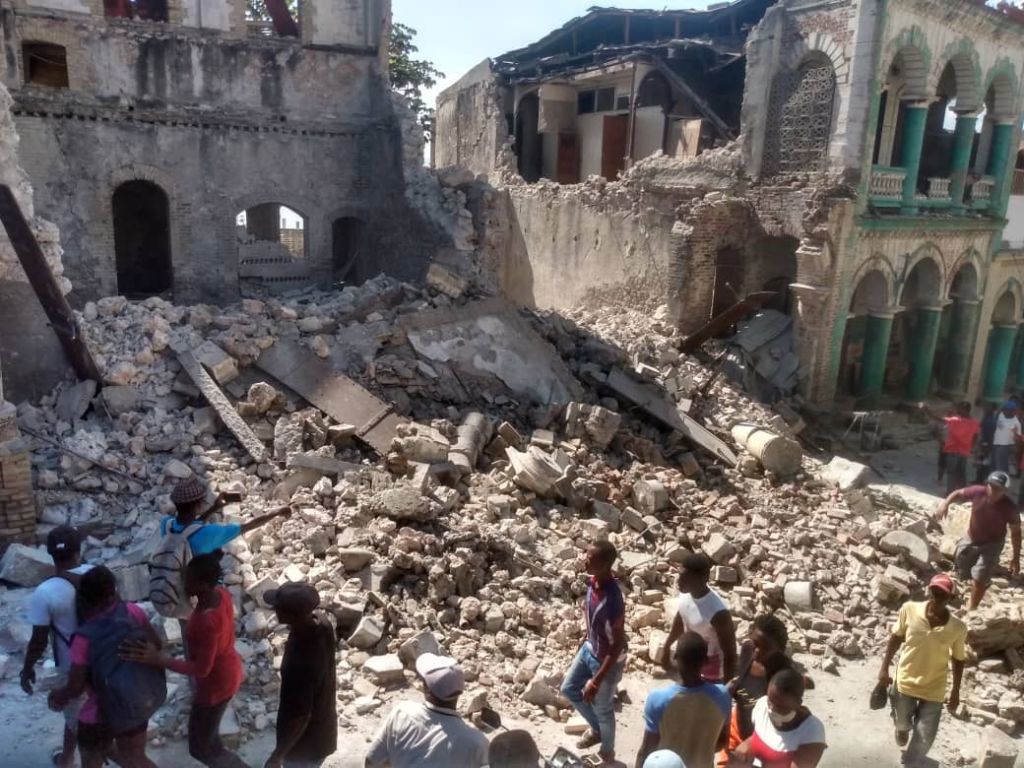
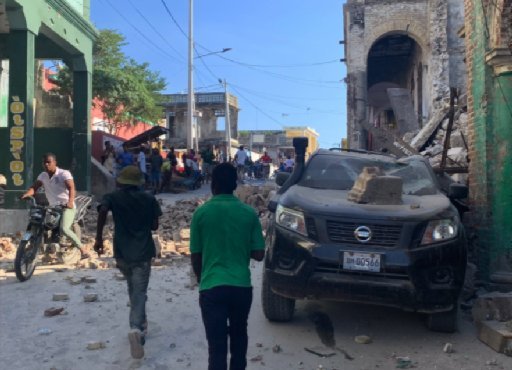
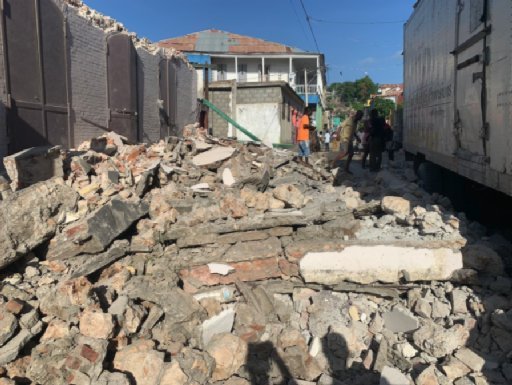
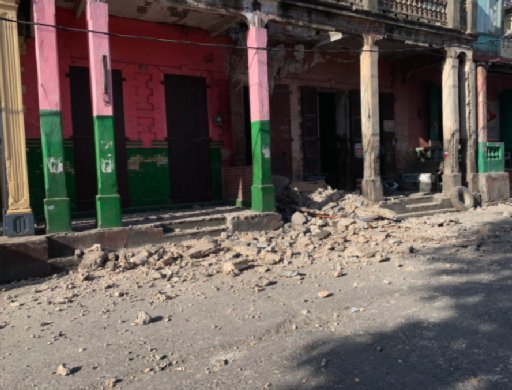
The Haitian government declared a state of emergency after at least 304 people died in a 7.2 magnitude earthquake that hit the country Saturday morning, Prime Minister Ariel Henry announced in a news conference.
More than 1,800 people were injured, the country's civil protection service said.
"When it comes to medical needs, this is our biggest urgency. We have started to send medications and medical personnel to the facilities that are affected," Henry said. "For the people who need urgent special care, we have evacuated a certain number of them, and we will evacuate some more today and tomorrow."
The state of emergency will be in the Western Department, Southern Department, Nippes, and Grand'Anse.
One hospital in the southern city of Jeremie said it is overwhelmed with patients.
"There are a lot of people coming in — a lot of people," an administrator at the Hopital Saint Antoine told CNN. "We don't have enough supplies."
The hospital has set up tents in its courtyard, the administrator said.
The earthquake was about 12 kilometers (7.5 miles) northeast of Saint-Louis-du-Sud and 10 kilometers deep, according to the US Geological Survey (USGS).
"There are reports of significant damage to homes, roads, and infrastructure," American Red Cross spokeswoman Katie Wilkes said.
Martine Moise, the first lady of Haiti, said her heart "hurts" after receiving news about the earthquake, which caused enormous damage south of Grand'Anse.
"The initial information that I have received from Grand'Anse is heart-wrenching," the first lady said. "It hurts my heart for the kids, the mothers, the elderlies, the handicaps, my friends, and all the victims of this earthquake."
"My brothers and sisters, we have to put our shoulders together to come together to demonstrate our solidarity. It is our togetherness that makes up our strength and resilience. Courage, I will always be by your side." Moise added.
Videos offer glimpse of destruction
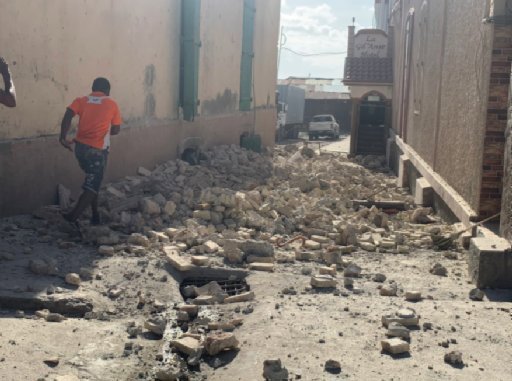
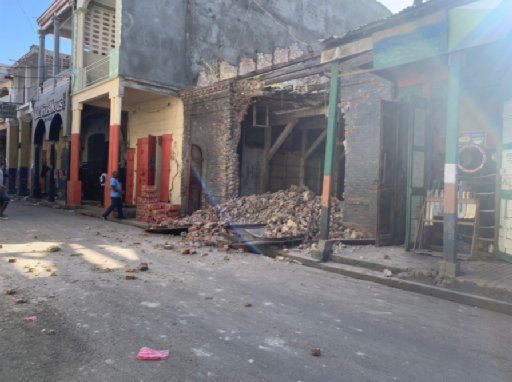
Videos posted on social media offer a glimpse of the widespread destruction. One from Les Cayes shows a street strewn with rubble and what is left of a number of buildings. Dust fills the air.
A man in the video said that he was lucky that the building he was in did not collapse, but many other houses in the area did.
"There are a lot of wounded on the street," he said.
A 7.0-magnitude earthquake that struck Haiti on January 12, 2010, left between 220,000 and 300,000 people dead and injured hundreds of thousands more. That was 13 kilometers deep.
A 5.2-magnitude aftershock hit later in the morning about 20 kilometers west-northwest of Cavaillon, Haiti, according to the USGS. That was followed by several more, including a 5.1-magnitude aftershock around noon.
A tsunami threat that had been issued for the region has passed, according to the US Tsunami Warning System.
Haiti is in the cone of Tropical Storm Grace, and can expect tropical storm-force winds and heavy rain that could lead to flash flooding Monday into Tuesday, CNN Meteorologist Haley Brink said.
Heavy rain could lead to localized flooding and mudslides across the region, according to Brink.
A tropical storm watch is likely to be issued for Haiti later Saturday after one was issued for the Dominican Republic, which shares the island of Hispaniola with Haiti.
"We're concerned that this earthquake is just one more crisis on top of what the country is already facing — including the worsening political stalemate after the president's assassination, COVID and food insecurity," Jean-Wickens Merone, a spokesman with World Vision Haiti, said in a statement.
Haitian President Jovenel Moise was killed July 7.
Merone is in Port-au-Prince, about 100 miles from Saint-Louis-du-Sud, and said the shaking there lasted "more than five to ten seconds," and both sides of his house were shaking.
Prime Minister will assess extent of damage
Henry, the Haitian Prime Minister, declared a state of emergency earlier Saturday and in the evening, arrived at Grand'Anse to assess the extent of the damage.
"I am currently in the Grand'Anse department to see the extent of the damage in order to better coordinate government actions on the ground," Henry said in a Saturday Twitter post.
"Resources have been mobilized since this morning to provide aid and assistance to the victims of this devastating earthquake," he added.
Henry said earlier he has mobilized the government to assess and help.
"Following the earthquake that caused enormous damage in the South, Grand'Anse and Nippes, I have already mobilized the entire government team to adopt all necessary measures- as a matter of urgency," the tweet read.
Henry urged Haitians to band together in solidarity.
"I offer my sympathies to the relatives of the victims of this violent earthquake which caused several losses of human lives and property in several geographical departments of the country," Henry tweeted.
"I appeal to the spirit of solidarity and commitment of all Haitians, in order to form a common front to face this dramatic situation that we are currently experiencing," another tweet read.
Other countries offer support
In a statement on Saturday, US President Joe Biden said he was "saddened by the devastating earthquake that occurred in Saint-Louis du Sud, Haiti, this morning."
"We send our deepest condolences to all those who lost a loved one or saw their homes and businesses destroyed," the statement said. "I have authorized an immediate US response and named USAID Administrator Samantha Power as the senior US official to coordinate this effort."
USAID disaster experts are in Haiti and assessing the damage, the US agency's Bureau for Humanitarian Assistance tweeted.
The Red Cross' emergency response system has been activated and the organization is "identifying urgent needs on the ground," Wilkes said.
Doctors Without Borders/Médecins Sans Frontières (MSF) is preparing to receive patients at Tabarre Hospital in Port-au-Prince, MSF Commucation Advisor Tim Shenk said.
Since June, armed gang violence has cut off some areas affected by the quake, making the aftermath a logistical challenge, Jacqueline Charles, Caribbean Correspondent for the Miami Herald, told CNN.
"This is a country that doesn't have access to helicopters, other than what the United Nations has. So logistically this is a huge challenge," Charles told CNN's Fredricka Whitfield.
Several Latin American countries said they were preparing to support Haiti.
Chilean President Sebastian Piñera said on Twitter Saturday they contacted Haitian authorities and are currently preparing to send humanitarian aid. Mexico President Andres Manuel Lopez Obrador also said on Twitter he has ordered the National Coordination of Civil Protection and other ministries like Foreign Affairs, Navy, and Defense to prepare help "immediately."
The Foreign Ministry of Panama announced they were preparing to send humanitarian aid soon and in the Dominican Republic, President Luis Abinader said he gave instructions to the foreign minister to call the Haitian counterpart to "facilitate any help within our possibilities."
Other countries, including Colombia, Argentina, Peru, Ecuador and Venezuela also expressed their support.
Police are still hunting burglars who raided an Auckland jewellery store and stole a “significant amount” of stock.Offenders forced their way into the North West Shopping Centre about 4.30am yesterday.They then smashed into a…
A person is recovering in hospital and a scene examination is under way at a central Auckland home destroyed by flames. Two others who were taken to hospital last night after the blaze in Grey Lynn have since been discharged. Police…
As her 7-week-old baby lay in a hospital cot sick with Covid-19, tubes coming out of him, the worst came to Rachael Helsby’s mind.”It was just horrendous because I feel like you are told all the time, babies don’t really have symptoms…
Test your brains with the Herald’s morning quiz. Be sure to check back on nzherald.co.nz at 3pm for the afternoon quiz. To challenge yourself with more quizzes, CLICK HERE.
An Eastern Caribbean Supreme Court August 16, 2019 filing by Blue Lagoon Management Ltd., a Belize company, claiming $150,000 worth in shares in the new ownership in the Bank Of Nevis International Ltd. (BONI), came some four and a half months before the new ownership of the international bank became effective.
The Observer attempted to contact BONI’s Managing Director Michael J Prest several times this week, but he didn’t return our calls or respond to our messages.
To get an idea of what to expect in any challenge to Mr. Prest, the Observer made contact with a past colleague and sometimes adversary of his.
“He is the most calculated businessman that I have ever known”, the source told the Observer, speaking on condition of anonymity.
“You can tell that his brain is always working. Every action and everything that he says; every move is well thought out and well calibrated. He does more observing and listening than speaking. The toughest negotiator the industry produced. You go up against him, and when you think that he has backed off, is when he comes on like a tonne of brick. He grinds his opponents into submission. He goes quiet on you, behaving as though he has a hundred years to spare, then out of the blue he attacks,” our source said.
Prest became Managing Director of The Bank of Nevis International Ltd. on January 3 ,2020, following a December 29th 2019 announcement by
The Bank of Nevis Limited that read that the bank had entered into an agreement with Petrodel Investment Advisers (Nevis) Limited (PIAN), a Nevis-registered company, for the purchase of the banking operations of Bank of Nevis International Limited. “PIAN will own one hundred percent (100%) shares of Bank Of Nevis International Limited and will continue to operate the Bank under its existing name”.
The sale was executed on 31st December 2019.
March 5th this year, the Bank of Nevis International, otherwise referred to as BONI, acquired over 1.9 million ordinary shares, representing 24.08 per cent stake in Investrust of the African country, Zambia.
Prest in a speech at an event in April hosted by Edgar Lungu, President of Zambia, said that BONI’s involvement in Investrust would allow investments in natural resources in that country to be scaled up twentyfold.
Last month, the bank’s sister company, Bank Of Nevis International Trust Services (BONITS) announced that it has been approved to promote the island of St. Lucia’s Citizen By Investment Programme.
The launch of Citizenship Investment Programme (CIP) products to St. Lucia by BONITS, followed the announced launch of the entity’s first overseas office in Dubai in April 2021, as the organisation continues to grow its geographic footprint and focus on providing global clients with Migration Investment solutions that meet their changing demands.
The Bank of Nevis International Limited was incorporated under the Nevis Companies Ordinance, Cap 7.06 of the laws of St. Christopher and Nevis, on April 29th, 1998 and commenced operations on July 1st, 1998.
According to a 2010 post by Muhtar Bakare in “Oil and Gas Tanzania”, Michael Prest was “the chief executive officer of Petrodel Resources Limited but was not well-known outside business circles, but he is well-regarded in the exclusive and close-knit world of international independent oil trading”.
Prest is Nigerian, but “not the typical successful Nigerian businessman. He avoids flamboyance and prefers to keep a low profile”, according to the Bakare article.
He is currently 57, and has completed a lot in this life.
Bakare describes Prest as having completed four international marathons, and being “lean, wiry, possessed of a body toned by self-discipline and an aura of incredible calm and self-control”.
“Mr. Prest is from a prominent Warri family. His grandfather was a judge and minister for communication in the first republic, his father was a lawyer, chief of staff and special adviser to President Shehu Shagari. He speaks of his family in reverential tones,” according to Bakare, who interviewed him.
“I wouldn’t be here today without the sacrifices my parents made for me.”
Mr. Prest went to public school in England, considered becoming a priest and gave up a place at the School of Oriental and African Studies, University of London to read law at the then University of Ife.
“That was the first time in my life where I really was put in an arena where people wanted to succeed. I had experienced adversity but I’d never had it right in my face, and I think it was the first time in my life where I got a chance to understand who I was in the context of my own history,” Prest told Bakare.
He sees himself as an introvert, and Bakare said that Mr. Prest admits to a restless spirit. He was called to the bar as a lawyer in 1984 and went into legal practice, but acted on the urge to do something bigger.
“I was impatient because at that time a lot of my friends were getting involved in the global markets. Although, I didn’t understand what it was at the time, I knew there was some momentum building, and that young people were making some fairly big decisions. So, I left Nigeria in 1986, not knowing what I was going to do, but I had this energy,” Prest told Bakare.
“You have to be phlegmatic about failure. When you were young and you had those discos and the boys would stand on this end of the room and the girls would stand over there, I was always that child, as ugly and as short as I am, who would walk across and ask the most beautiful girl in the room to dance,” Bakare quoted him.
His sister Helen Prest, who was at the time Miss Nigeria, was also at the same university at the time as Prest, showed him off as her well-spoken, confident always, well-dressed younger brother. That increased his popularity.
“My brother has always been very determined and focused,” said Helen Prest-Ajayi in an interview with Bakare. “He is very much the same now as he was then. He always knew what he wanted to do and where he was going.”
An old school friend’s reference resulted in Prest being interviewed and hired by the Phillip Brothers (Salomon Brothers) and he was hired as a soft commodities trader covering Africa, Eastern Europe and China.
After four years of successful trading, he moved to the oil section as an apprentice to John Brunner, one of the most influential physical oil traders of his time, who took Mr. Prest under his wing.
Prest opened up to Bakare about his apprentice days.
“I was boy-boy to John Brunner. He asked me to make the tea, I’d make the tea. I met the top echelon of NNPC through him. NNPC was going to buy a refinery; he made me an integral part of the discovery and negotiation process. So I got the best education, from the best, at the time, on how to operate in the oil business.”
Prest made a name for himself in the world of high-rolling oil trading as a calm and shrewd negotiator.
He took his father’s death in 1993 hard, and took over the role as the leader of the family and ensured that his two younger brothers finished university. His father was only 56 when he died.
Prest said in his interview with Bakare, “My father taught me: Never die until they kill you. Always work hard. Look after your siblings because it’s your people, who when you have a problem will save you. And most importantly, he taught me from a very young age; know who you really are; not that image you project to people.”
Prest cemented himself as a star at John Brunner’s. The 1990s were fierce years in the oil trading business and traders knew each other, and the Rich brothers topped that business.
Prest soon came to the attention of oil trading legend Marc Rich, who reached out to him in 1996, according to Bakare’s blog.
“If you were in oil trading, there were two companies or two individuals you always wanted to have worked for because you hoped some of the aura would rub off on you. One was Phillip Brothers, and the other one was Mr. Marc Rich. Despite all the stories you hear about him, if you’re in oil trading, you don’t get any bigger personality than Marc. So, when he was thinking of creating a new business, for him to have me in mind…It was simply a call I had to take…but it was a double-edged sword, because…I know what the world says about him.”
“The only thing I will say is; there’s a human side to this man…a lot of people feel like they haven’t been given an opportunity for whatever reason…and to find an iconic figure, who didn’t care that I was from Nigeria. He didn’t care that you were black, white, Indian or Muslim. He just wanted to know, can you stay the course and can you cut the deal? Can you look him in the eye? Yes or No?” Prest told Bakare.
Bakare quoted the following sources in the comments below;
“The art of the Rich deal according to a 2005 Businessweek article is: Do whatever it takes. The magazine went on: “Rich is notorious for trading with Iran during the hostage crisis, South Africa during apartheid, and Cuba and Libya during U.S. trade embargoes.”
“The Rich Boys, as his protégés have been called by Businessweek, form the most “powerful informal network of independent commodities traders on earth… .” Companies associated with Marc Rich and his protégés include, Glencore, Trafigura and Vitol, which do very brisk business in Nigeria.”
He worked for Marc Rich between 1996 and 2001; at one point running a global business with 400 employees and an annual turnover of $14 billion.
“Mr. Prest’s tenure at Marc Rich heralded the introduction of many young Nigerians and Africans into the company and as counterparties to the company. Many of them are still active today in the oil industry across the continent,” Bakare wrote.
Prest told Bakare, “Marc took a great interest in me and spent hours upon hours in his office in Zug literally teaching me and keeping me on my toes… he then allowed me to run his company trading crude oil and all the derivative products. He respected hard work and most of all valued loyalty”.
Rich ran enterprises that brokered oil, gold, sugar, grain, aluminum and nickel. He even sold copper to the U.S. mint until lawmakers found out about it, according to The Chicago Tribune.
Marc Rich died in June 2013.
Early in 2002, Michael Prest felt that he had learned all he possibly could from Marc Rich, so he lounged out on his own and started Petrodel.
“Don’t forget I’d been an employee since 1986. It’s the experience which I think, money can’t buy. I really do understand the oil business. Wake me up at any time of the day. In this sector, when I talk; I know what I’m talking about. I don’t want to seem arrogant when I say this but, if you had to pick 5-10 personalities in the oil trading business, my name would be there,” Prest told Bakare.
“My father made a point of telling everybody he knew in government; this is my son. Everywhere I went, they would give me an audience. So when I came home, my foot was already in the door. Not just because of me, but people knew my dad and they knew my grandfather, they knew my mother and they knew my sister…Without their sacrifices I would not be where I am today…truth be told, I had to do very little,” Prest related to Bakare.
By 2010, Petrodel had diversified interests in real estate, leisure and hospitality.
Prest opined then that Petrodel would thrive, so long as it continued to add value to its host communities and invest in people:
“We haven’t got to that point yet and we will only get to that point when the wheels of industry are driven by the resolute and the bold, who have now said to themselves, that theirs is a sacrifice where the benefit is a legacy they leave behind for our children.”
Is Bank Of Nevis Int. Chief Prest hard-pressed?
An Eastern Caribbean Supreme Court August 16, 2019 filing by Blue Lagoon Management Ltd., a Belize company, claiming $150,000 worth in shares in the new ownership in the Bank Of Nevis International Ltd. (BONI), came some four and a half months before the new ownership of the international bank became effective.
The Observer attempted to contact BONI’s Managing Director Michael J Prest several times this week, but he didn’t return our calls or respond to our messages.
To get an idea of what to expect in any challenge to Mr. Prest, the Observer made contact with a past colleague and sometimes adversary of his.
“He is the most calculated businessman that I have ever known”, the source told the Observer, speaking on condition of anonymity.
“You can tell that his brain is always working. Every action and everything that he says; every move is well thought out and well calibrated. He does more observing and listening than speaking. The toughest negotiator the industry produced. You go up against him, and when you think that he has backed off, is when he comes on like a tonne of brick. He grinds his opponents into submission. He goes quiet on you, behaving as though he has a hundred years to spare, then out of the blue he attacks,” our source said.
Prest became Managing Director of The Bank of Nevis International Ltd. on January 3 ,2020, following a December 29th 2019 announcement by
The Bank of Nevis Limited that read that the bank had entered into an agreement with Petrodel Investment Advisers (Nevis) Limited (PIAN), a Nevis-registered company, for the purchase of the banking operations of Bank of Nevis International Limited. “PIAN will own one hundred percent (100%) shares of Bank Of Nevis International Limited and will continue to operate the Bank under its existing name”.
The sale was executed on 31st December 2019.
March 5th this year, the Bank of Nevis International, otherwise referred to as BONI, acquired over 1.9 million ordinary shares, representing 24.08 per cent stake in Investrust of the African country, Zambia.
Prest in a speech at an event in April hosted by Edgar Lungu, President of Zambia, said that BONI’s involvement in Investrust would allow investments in natural resources in that country to be scaled up twentyfold.
Last month, the bank’s sister company, Bank Of Nevis International Trust Services (BONITS) announced that it has been approved to promote the island of St. Lucia’s Citizen By Investment Programme.
The launch of Citizenship Investment Programme (CIP) products to St. Lucia by BONITS, followed the announced launch of the entity’s first overseas office in Dubai in April 2021, as the organisation continues to grow its geographic footprint and focus on providing global clients with Migration Investment solutions that meet their changing demands.
The Bank of Nevis International Limited was incorporated under the Nevis Companies Ordinance, Cap 7.06 of the laws of St. Christopher and Nevis, on April 29th, 1998 and commenced operations on July 1st, 1998.
According to a 2010 post by Muhtar Bakare in “Oil and Gas Tanzania”, Michael Prest was “the chief executive officer of Petrodel Resources Limited but was not well-known outside business circles, but he is well-regarded in the exclusive and close-knit world of international independent oil trading”.
Prest is Nigerian, but “not the typical successful Nigerian businessman. He avoids flamboyance and prefers to keep a low profile”, according to the Bakare article.
He is currently 57, and has completed a lot in this life.
Bakare describes Prest as having completed four international marathons, and being “lean, wiry, possessed of a body toned by self-discipline and an aura of incredible calm and self-control”.
“Mr. Prest is from a prominent Warri family. His grandfather was a judge and minister for communication in the first republic, his father was a lawyer, chief of staff and special adviser to President Shehu Shagari. He speaks of his family in reverential tones,” according to Bakare, who interviewed him.
“I wouldn’t be here today without the sacrifices my parents made for me.”
Mr. Prest went to public school in England, considered becoming a priest and gave up a place at the School of Oriental and African Studies, University of London to read law at the then University of Ife.
“That was the first time in my life where I really was put in an arena where people wanted to succeed. I had experienced adversity but I’d never had it right in my face, and I think it was the first time in my life where I got a chance to understand who I was in the context of my own history,” Prest told Bakare.
He sees himself as an introvert, and Bakare said that Mr. Prest admits to a restless spirit. He was called to the bar as a lawyer in 1984 and went into legal practice, but acted on the urge to do something bigger.
“I was impatient because at that time a lot of my friends were getting involved in the global markets. Although, I didn’t understand what it was at the time, I knew there was some momentum building, and that young people were making some fairly big decisions. So, I left Nigeria in 1986, not knowing what I was going to do, but I had this energy,” Prest told Bakare.
“You have to be phlegmatic about failure. When you were young and you had those discos and the boys would stand on this end of the room and the girls would stand over there, I was always that child, as ugly and as short as I am, who would walk across and ask the most beautiful girl in the room to dance,” Bakare quoted him.
His sister Helen Prest, who was at the time Miss Nigeria, was also at the same university at the time as Prest, showed him off as her well-spoken, confident always, well-dressed younger brother. That increased his popularity.
“My brother has always been very determined and focused,” said Helen Prest-Ajayi in an interview with Bakare. “He is very much the same now as he was then. He always knew what he wanted to do and where he was going.”
An old school friend’s reference resulted in Prest being interviewed and hired by the Phillip Brothers (Salomon Brothers) and he was hired as a soft commodities trader covering Africa, Eastern Europe and China.
After four years of successful trading, he moved to the oil section as an apprentice to John Brunner, one of the most influential physical oil traders of his time, who took Mr. Prest under his wing.
Prest opened up to Bakare about his apprentice days.
“I was boy-boy to John Brunner. He asked me to make the tea, I’d make the tea. I met the top echelon of NNPC through him. NNPC was going to buy a refinery; he made me an integral part of the discovery and negotiation process. So I got the best education, from the best, at the time, on how to operate in the oil business.”
Prest made a name for himself in the world of high-rolling oil trading as a calm and shrewd negotiator.
He took his father’s death in 1993 hard, and took over the role as the leader of the family and ensured that his two younger brothers finished university. His father was only 56 when he died.
Prest said in his interview with Bakare, “My father taught me: Never die until they kill you. Always work hard. Look after your siblings because it’s your people, who when you have a problem will save you. And most importantly, he taught me from a very young age; know who you really are; not that image you project to people.”
Prest cemented himself as a star at John Brunner’s. The 1990s were fierce years in the oil trading business and traders knew each other, and the Rich brothers topped that business.
Prest soon came to the attention of oil trading legend Marc Rich, who reached out to him in 1996, according to Bakare’s blog.
“If you were in oil trading, there were two companies or two individuals you always wanted to have worked for because you hoped some of the aura would rub off on you. One was Phillip Brothers, and the other one was Mr. Marc Rich. Despite all the stories you hear about him, if you’re in oil trading, you don’t get any bigger personality than Marc. So, when he was thinking of creating a new business, for him to have me in mind…It was simply a call I had to take…but it was a double-edged sword, because…I know what the world says about him.”
“The only thing I will say is; there’s a human side to this man…a lot of people feel like they haven’t been given an opportunity for whatever reason…and to find an iconic figure, who didn’t care that I was from Nigeria. He didn’t care that you were black, white, Indian or Muslim. He just wanted to know, can you stay the course and can you cut the deal? Can you look him in the eye? Yes or No?” Prest told Bakare.
Bakare quoted the following sources in the comments below;
“The art of the Rich deal according to a 2005 Businessweek article is: Do whatever it takes. The magazine went on: “Rich is notorious for trading with Iran during the hostage crisis, South Africa during apartheid, and Cuba and Libya during U.S. trade embargoes.”
“The Rich Boys, as his protégés have been called by Businessweek, form the most “powerful informal network of independent commodities traders on earth… .” Companies associated with Marc Rich and his protégés include, Glencore, Trafigura and Vitol, which do very brisk business in Nigeria.”
He worked for Marc Rich between 1996 and 2001; at one point running a global business with 400 employees and an annual turnover of $14 billion.
“Mr. Prest’s tenure at Marc Rich heralded the introduction of many young Nigerians and Africans into the company and as counterparties to the company. Many of them are still active today in the oil industry across the continent,” Bakare wrote.
Prest told Bakare, “Marc took a great interest in me and spent hours upon hours in his office in Zug literally teaching me and keeping me on my toes… he then allowed me to run his company trading crude oil and all the derivative products. He respected hard work and most of all valued loyalty”.
Rich ran enterprises that brokered oil, gold, sugar, grain, aluminum and nickel. He even sold copper to the U.S. mint until lawmakers found out about it, according to The Chicago Tribune.
Marc Rich died in June 2013.
Early in 2002, Michael Prest felt that he had learned all he possibly could from Marc Rich, so he lounged out on his own and started Petrodel.
“Don’t forget I’d been an employee since 1986. It’s the experience which I think, money can’t buy. I really do understand the oil business. Wake me up at any time of the day. In this sector, when I talk; I know what I’m talking about. I don’t want to seem arrogant when I say this but, if you had to pick 5-10 personalities in the oil trading business, my name would be there,” Prest told Bakare.
“My father made a point of telling everybody he knew in government; this is my son. Everywhere I went, they would give me an audience. So when I came home, my foot was already in the door. Not just because of me, but people knew my dad and they knew my grandfather, they knew my mother and they knew my sister…Without their sacrifices I would not be where I am today…truth be told, I had to do very little,” Prest related to Bakare.
By 2010, Petrodel had diversified interests in real estate, leisure and hospitality.
Prest opined then that Petrodel would thrive, so long as it continued to add value to its host communities and invest in people:
“We haven’t got to that point yet and we will only get to that point when the wheels of industry are driven by the resolute and the bold, who have now said to themselves, that theirs is a sacrifice where the benefit is a legacy they leave behind for our children.”
The Bank of Nevis International announces the departure of Board member Dr Janice Hodge. Since her appointment to the Board of Bank of Nevis International Limited in April 2020 Dr Janice Hodge has provided counsel and strategic advice to the Board. However since her election as leader of The Nevis Reformation Party (NRP) in September 2020 Dr Hodge has had to re-assess her position as a director of the bank and determine whether she can meet her duties as a director. Dr Hodges departure from the Board is with immediate effect. We wish Dr Hodge all the best for the future.” A statement issued to The Observer by the bank.
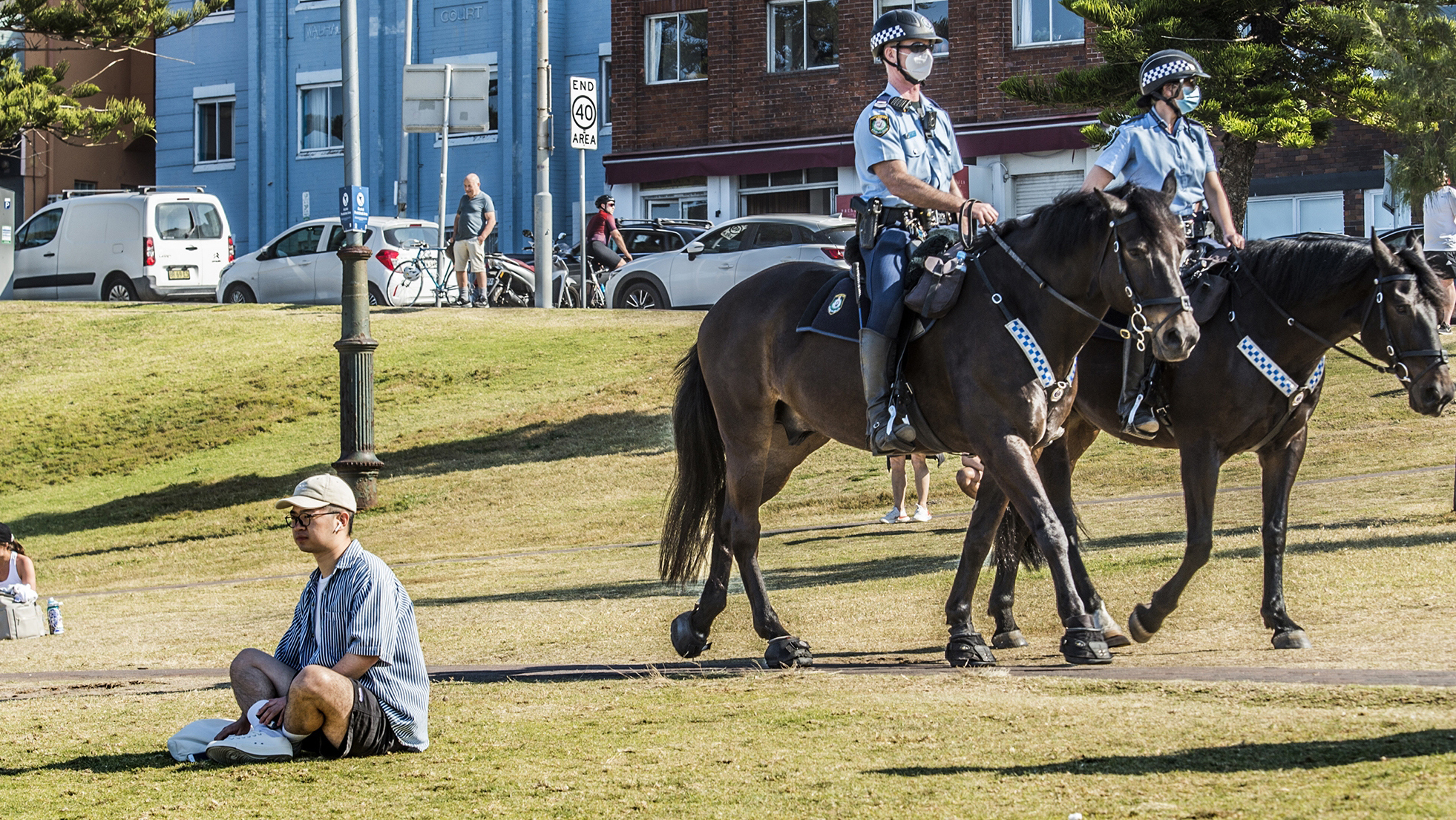
Hundreds of police will flood NSW as a massive new operation is launched to ensure compliance of the state's tough COVID-19 restrictions.
In response to the new state-wide stay-at-home measures, new restrictions in Greater Sydney and an escalation of COVID-19 cases, Operation Stay at Home will kick off first thing on Monday.
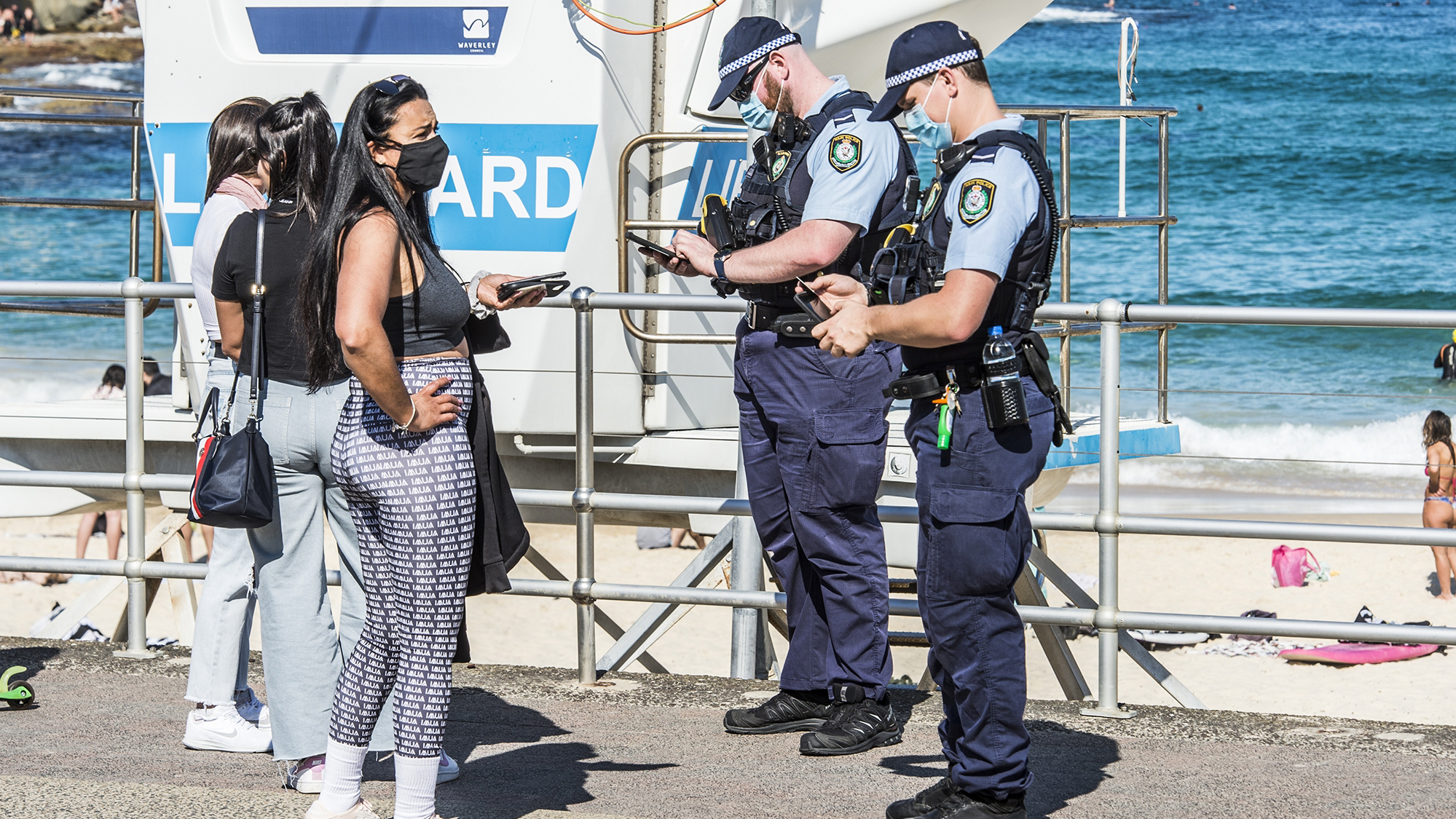
Police will hit major arterial roads, flock to beaches and pull over anyone not in their local government areas without a reasonable excuse or permit.
"The operation will utilise resources from all Police Districts and Police Area Commands under Metropolitan and Regional Field Operations alongside officers attached to Traffic and Highway Patrol Command, Police Transport Command, Dog and Mounted Unit, and a number of other specialist commands as required," NSW Police said in a statement.
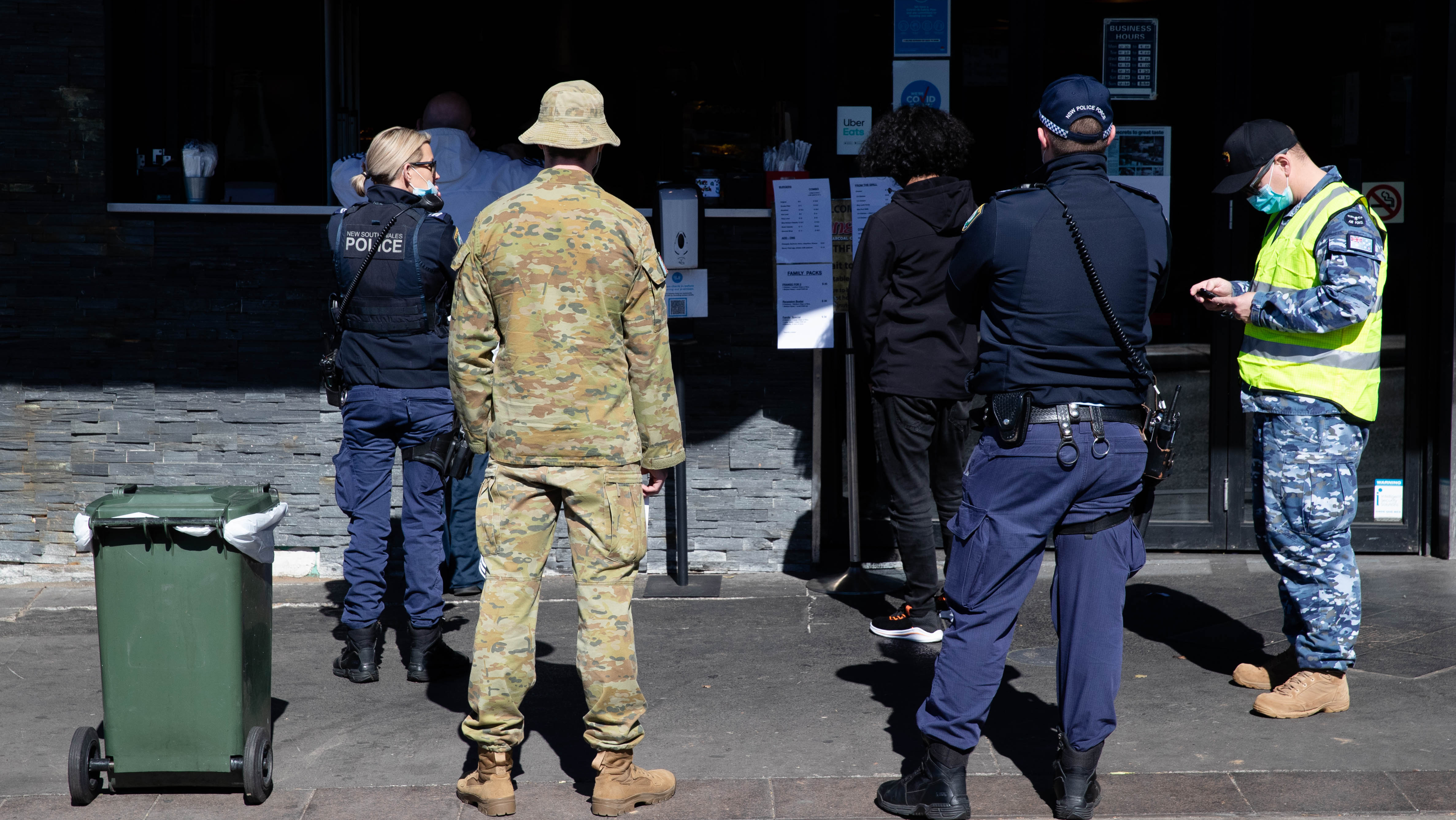
At least 1400 officers will be out on roads, and a further 500 defence troops, in addition to the 300 already deployed, will assist.
"We've had to tighten the current public health orders because of the minority who exploited them. Enough is enough. If you do it, you will get fined," NSW Police Minister David Elliot said.
"The only way out of this COVID-19 crisis is if we support each other and support the NSW Police-led compliance operation, Operation STAY AT HOME."
Increased fines will be imposed on rule-breakers, and Premier Gladys Berejiklian said while the health order would officially be enforced from 12.01am Monday, between now and then, the heavier penalties would apply.
People will receive a $5000 on-the-spot fine for a quarantine breach, up from $1000.
A $5000 penalty will also apply for lying on a permit and for lying to a contact tracer.
There will be $3000 fines issued for breaching the two-person exercise rule, and for breaching the border between Greater Sydney and regional NSW.
Troy Bowker has announced he is exiting his co-ownership of the Hurricanes rugby franchise after a firestorm over his comments on race.The Wellington businessman has been at the centre of controversy over comments he has posted…
Several supermarkets across regional NSW already have long lines of shoppers with loaded trolleys, despite authorities urging people not to panic-buy as the state is plunged into a snap lockdown.
Under new public health orders for every region of NSW, which came into effect from 5pm, supermarkets and grocers are among dozens of essential businesses which will remain open, as always, during the lockdown.
But immediately after the state-wide lockdown was announced, photos and video began emerging on social media from stores across the state with people loading up trolleys in packed supermarkets.
National MP and Member for Oxley, Melinda Pavey, said she understood people in regional areas are disappointed with the disruption to normal life, but the actions by NSW Health are necessary.
"Please can I assure you this decision has not been taken lightly and is intended to prevent transmission of COVID-19 into our region and across NSW," Ms Pavey said on her official Facebook page.
"Please remember, supermarkets will remain open.
"People will be able to get groceries as per usual throughout the week. There is absolutely no need to panic buy, stock-up or rush to the stores."
In footage provided to 9News, the Woolworths store in Ulladulla on the state's South Coast was packed with lines full at every register this afternoon.
At the Woolworths store in Jindabyne, near the Snowy Mountains, lines went out the door, stretching all the way around to the main square outside.
At Bathurst, in the Central Tablelands, shoppers were also seen packed in aisles – seemingly unable to socially distance due to the number of people clearing the shelves.