Category Archives: headline

Nevis Offering UK Uni Scholarships to Local Students

NIA CHARLESTOWN NEVIS (August 06, 2021) — The following is an announcement from the Ministry of Human Resources in the Nevis Island Administration (NIA) regarding the offer of 2022/2023 Chevening Scholarships in the United Kingdom (UK).

The Ministry of Human Resources wishes to inform of the United Kingdom’s Chevening Scholarship Programme. The Chevening Scholarship Programme offers students the opportunity to pursue a fully funded master’s  degree course at a UK university and comes with the following added benefits: 

 – Fully funded tuition fees to your chosen university;

 – Living expenses for the duration of your studies;

 – Return flight to the UK;

 – Access to exclusive events across the UK; and

 – Joining an international Chevening network.

Interested persons can apply during the period August 3rd to November 2nd, 2021Please visit the website www.chevening.org  to apply and to access additional information


The post Nevis Offering UK Uni Scholarships to Local Students appeared first on The St Kitts Nevis Observer.

Argentina: Mass Street Protests Over Jobs, Poverty

BUENOS AIRES, Aug 7 (Reuters) – Tens of thousands of Argentines took to the streets of Buenos Aires on Saturday to protest over poverty and a lack of jobs amid a lengthy economic crisis that has only deepened with the coronavirus pandemic.

Organisations working with the unemployed and leftist groups led the protest that started at a church to the west of the Argentine capital where thousands of pilgrims travel each year to pray at the shrine of San Cayetano, the patron saint of work, whose feast day is Saturday. It ended in the Plaza de Mayo, a massive square in front of the seat of government where protests habitually take place.

“I come on behalf of people who do not have work: my brother, my neighbors and many people who you see really struggling everywhere,” Néstor Pluis, a 41-year-old educational assistant, told Reuters.

Protests also took place in other parts of the country, including in Argentina’s second city of Cordoba and the western city of Mendoza.

Lawmaker Juan Carlos Alderete, leader of the left-wing party Corriente Clasista y Combativa, said the needs of people in some neighbourhoods were “tremendous.”

“The soup kitchens are seeing whole families coming to eat and many of the children have to be attended to by health professionals because they are malnourished,” he said.

A total of 19 million people, 42% of Argentina’s population, was classified as living below the poverty line in the second half of 2020 and unemployment at present stands at 10.2%.

Argentina’s President Alberto Fernandez said on Friday that he saw brighter days ahead, and the first rebound in the economy in three years this year with 7% growth.

“Argentina is growing, recuperating jobs and will recover income,” Fernandez pledged.

Ahead of the legislative elections in November, the government also announced on Friday a relaxation of COVID restrictions in the hope of speeding economic recovery.

Reporting by Nicolas Misculin, writing by Aislinn Laing; editing by Diane Craft

The post Argentina: Mass Street Protests Over Jobs, Poverty appeared first on The St Kitts Nevis Observer.

US: Nicaragua’s Ortega Clinging to Power ‘At All Costs’

U.S. Secretary of State Antony Blinken speaks about refugee programs for Afghans who aided the U.S. during a briefing at the State Department in Washington, DC, U.S. August 2, 2021. Brendan Smialowski/Pool via RUTERS

Aug 7 (Reuters) – U.S. Secretary of State Antony Blinken accused Nicaraguan President Daniel Ortega of taking new “undemocratic, authoritarian actions” after police arrested another rival politician ahead of elections later this year.

Singling out both Ortega and his wife Rosario Murillo, who holds the position of vice president, Blinken said in a statement on Saturday that the pair were seeking to hold on to power “at all costs” with a strategy of disqualifying potential opposition candidates.

“The United States views the regime’s latest undemocratic, authoritarian actions — driven by Ortega’s fear of an electoral loss — as the final blow against Nicaragua’s prospects for a free and fair election,” Blinken said.

The Central American country’s presidential election in November has already “lost all credibility”, the statement said.

Ortega’s office did not immediately respond to a request for comment.

On Wednesday, police put opposition politician Berenice Quezada under house arrest, accusing her of inciting hatred and violence.

A former beauty queen turned Ortega critic, Quezada had been tapped last week by the Citizens Alliance for Liberty Party, or ACXL, to be the running mate of Oscar Sobalvarro. read more

Ortega, a former Marxist guerrilla who has turned against many of his one-time rebel allies, is seeking to retain his grip on power with a fourth consecutive term.

His government has in recent months repeatedly detained political adversaries, including to date seven presidential hopefuls plus a couple dozen other opposition figures. Many have been accused of undermining Nicaragua’s independence and sovereignty, and banned from running for office.

On Friday, the U.S. State Department imposed visa restrictions on 50 relatives of Nicaraguan officials, including family members of lawmakers, prosecutors and judges. read more

Reporting by Ismael Lopez; Writing by David Alire Garcia; Editing by Daniel Wallis

The post US: Nicaragua’s Ortega Clinging to Power ‘At All Costs’ appeared first on The St Kitts Nevis Observer.

Bolsonaro: Sowing Doubt in Brazil’s Electoral System Could Hurt His Own Candidacy.

OSão Paulo, Brazil (CNN) As Brazilian President Jair Bolsonaro falls further and further behind in the polls, his unsupported claim that the 2022 elections could be rigged have only increased in fervor and frequency.

But those freewheeling statements have now sparked investigations that could threaten his very eligibility to run as a presidential candidate at all.

After a series of claims by Bolsonaro that the country’s electronic voting system is insufficient and that it has been “violated” in past years, Brazil’s Superior Electoral Court (TSE), which oversees elections, has opened an administrative inquiry into the president’s statements. It has also requested that Bolsonaro be investigated as part of a larger ongoing probe into the proliferation of “fake news” and disinformation campaigns in Brazil.
Both could come with significant political consequences for Bolsonaro.
If the TSE inquiry finds that the president abused his position to spread misinformation, Bolsonaro could be barred from running for office for eight years, according to Wallace Corbo, professor of constitutional law at Getúlio Vargas Foundation University (FGV).
“As president, Bolsonaro is allowed and expected to take part in public discussions,” Corbo said. “What he cannot do — and has been doing — is systematically attack the electoral system by which he was elected.”
In a press conference last week, Bolsonaro promised to prove that Brazil´s internationally praised voting system is rigged, but provided no evidence and acknowledged, “we don’t have proof.” He only played a series of inconclusive YouTube videos and media reports, examples that Brazil’s Superior Electoral Court (TSE) refuted.
This week, he doubled-down on his attempts to foster doubts about the electoral system, tweeting confidential documents from a 2018 federal investigation that Bolsonaro claims show the country’s voting system was “violated
But according to the TSE, which has repeatedly rebutted Bolsonaro’s claims about election-rigging, the hacking episode did not result in fraud. “It is worth reiterating that electronic voting machines are never networked. As they are not connected to the internet, they are not subject to remote access, which prevents any kind of external interference in the voting and counting process. For this reason, it is possible to say, with a margin of certainty, that the investigated invasion had no impact on the outcome of the elections,” the court said in a statement.
In response to the court’s decision to investigate him, the President has insisted that his concern is purely about the elections’ integrity, and said that he “won’t accept [any] intimidation.”
“Questionable elections will not be permitted next year. Brazil will have an election next year. Clean, democratic elections,” Bolsonaro said.
Nevertheless, his repeated attacks on the current systems have raised concerns that the incumbent is preparing to reject unfavorable results.
During a YouTube livestream on Thursday, Bolsonaro — who has repeatedly insisted on the need to audit ballots with paper records — said he would not ask to audit the 2022 elections if he emerges victorious. “Any side can question the elections. If I win I won’t question them … I won’t waste my time,” he said.
A Datafolha poll from July 7 and 8 currently shows Bolsonaro more than 20 points behind his main opponent, former leftwing president Lula da Silva, in a first round of voting.

Electronic voting

Bolsonaro’s comments have particularly targeted electronic voting, warning that his supporters may not accept the results of the current system. Brazil has had fully computerized elections since 2000 and the TSE has identified no fraud since then.
“If this method continues, they’re going to have problems,” the President said in a July radio interview, according to Reuters. “Because one side, which is our side, may not accept the result.”
Earlier this year, in the wake of the January 6 Capitol riot in Washington, Bolsonaro claimed that Brazil could face even worse repercussions if it doesn’t implement paper ballots. “If Brazil doesn’t have a printed vote in 2022, a way of auditing the vote, we will have a worse problem than the US,” he told supporters in front of the Alvorada Palace in Brasilia then.
(Electronic voting systems can however be audited, as they were when 2014 presidential candidate Aecio Neves demanded a recount after losing to Dilma Rousseff. The audit, which took one year, confirmed Rousseff’s victory.)

'The biggest mistake of my life': Why Bolsonaro fans are turning on him

‘The biggest mistake of my life’: Why Bolsonaro fans are turning on him 03:28
In an interview with CNN Brasil on Wednesday, Brazilian parliamentary leader and Bolsonaro ally Arthur Lira said that he trusts electronic voting machines, but that he would support changing legislation about voting procedure in order to increase public trust, including the potential use of the printed vote system.
But some election officials fear Bolsonaro’s claims may have already damaged public confidence in the upcoming vote. “The threat against elections, polluting the public debate with disinformation, lies, hatred and conspiracy theories is an anti-democratic behavior,” wrote TSE President Luis Barroso this week.
Bolsonaro nevertheless argues that even in his role as president, he has the “right to criticize” electoral processes — wrong or not. “The TSE has taken certain steps to investigate and accuse me of undemocratic acts,” Bolsonaro responded in an interview with the radio program Jovem Pan on Wednesday. “I can be wrong, but I have the right to criticize. We are not wrong. We didn’t make mistakes!”

The post Bolsonaro: Sowing Doubt in Brazil’s Electoral System Could Hurt His Own Candidacy. appeared first on The St Kitts Nevis Observer.

Climate Change: Low-IncomeCountries ‘Can’t Keep Up’ with Impacts

By Navin Singh Khadka
Environment correspondent, BBC World Service

Low-income countries are struggling to protect themselves against climate change, officials and experts have told the BBC.

Organisations representing 90 countries say that their plans to prevent damage have already been outpaced by climate-induced disasters, which are intensifying and happening more regularly.

The UN says the number of developing countries with climate adaptation plans has increased. But it stresses that there’s limited evidence these plans have reduced any risks.

“We need to adapt our plans to the worsening climate crisis. Our existing plans are not enough to protect our people,” says Sonam Wangdi, chair of the UN’s Least Developed Countries (LDC) Group on climate change.

Their call for action comes as the UN’s climate science body prepares to publish its latest assessment on Monday about the state of global warming.

The report, compiled by the Intergovernmental Panel on Climate Change, will provide a scientific assessment of current and future climate change, and be a key reference for policymakers at the UN climate summit in Glasgow this November.

The world has already warmed by about 1.2C since the industrial era began, and temperatures will keep rising unless governments around the world make steep cuts to emissions.

Chaos in the Caribbean

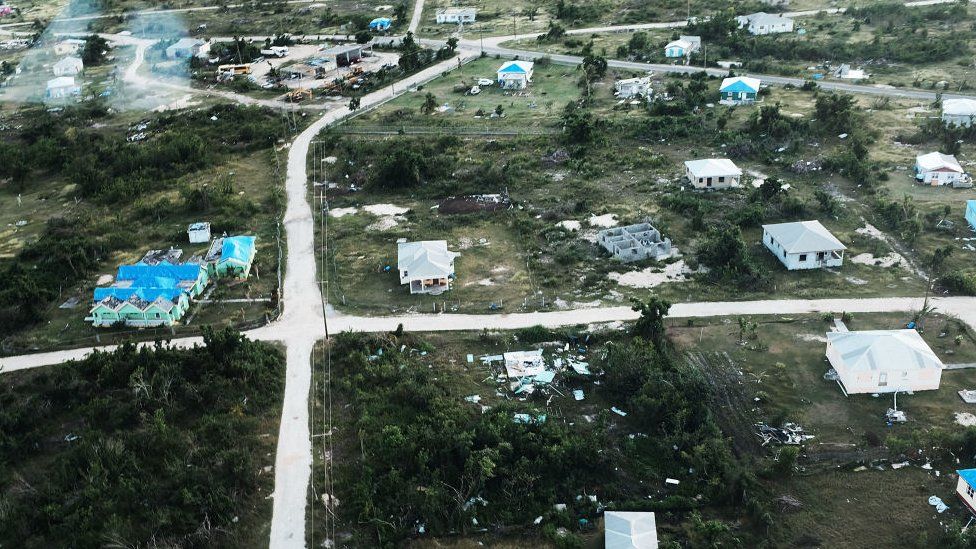
An aerial view of damaged homes on the nearly destroyed island of Barbuda on December 8, 2017 in Cordington, Barbuda.image sourceGetty Images
image captionClimate experts say houses in the Caribbean countries are unable to stand against category five hurricanes

Last year, the Caribbean had a record-breaking 30 tropical storms – including six major hurricanes. The World Meteorological Organisation says the region is still recovering.

On islands like Antigua and Barbuda, experts say that many buildings have been unable to withstand the intense winds these storms have brought.

“We used to see category four hurricanes, so that’s what we have prepared for with our adaptation plans, but now we are being hit by category five hurricanes,” says Diann Black Layner, chief climate negotiator for the Alliance of Small Island States.

“Category five hurricanes bring winds as strong as 180 miles per hour which the roofs cannot withstand because it creates stronger pressure inside our houses,” she said.

Falling seawalls in Pacific islands

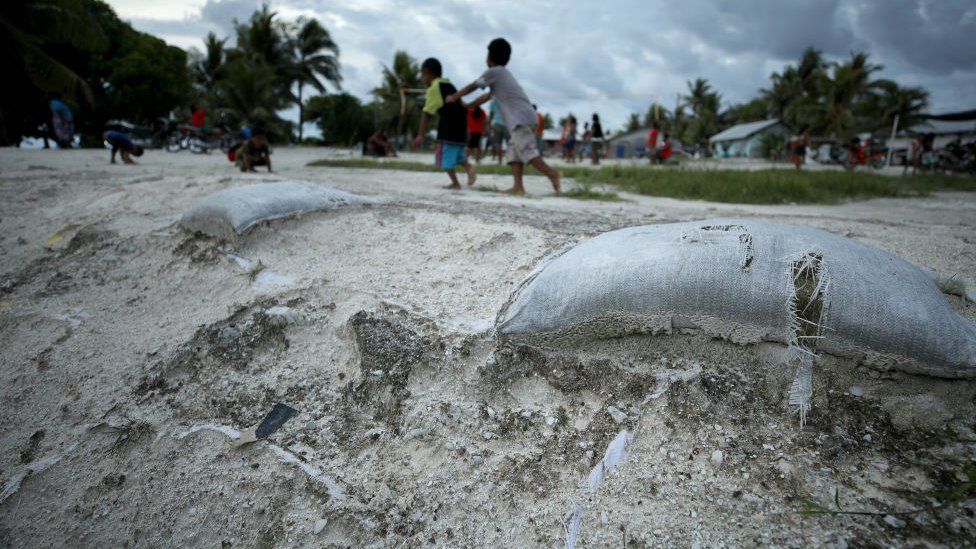
Kids play on an area of reclaimed land stacked with sandbags, a countermeasure to the rising in Funafuti, Tuvalu.image sourceGetty Images
image captionPacific island countries say their defences against rising seas and cyclones are proving to be increasingly weak

Several Pacific Island countries were hit by three cyclones between the middle of 2020 and January 2021.

“After those three cyclones, communities in the northern part of our country have seen the sea walls built as part of their adaptation plans crumbling,” says Vani Catanasiga, head of the Fiji Council of Social Services – a group representing Fijian NGOs in the country’s Disaster Management Council.

“The water and the wind repeatedly battering the settlements even displaced some locals.”

Although it’s rare to see so many storms in such a short space of time, experts say sea storms have been growing in strength.

Studies suggest tropical cyclones have become more intense in the past 40 years, but an increase in the overall number of cyclones has not been established.

Uganda’s mountain menace

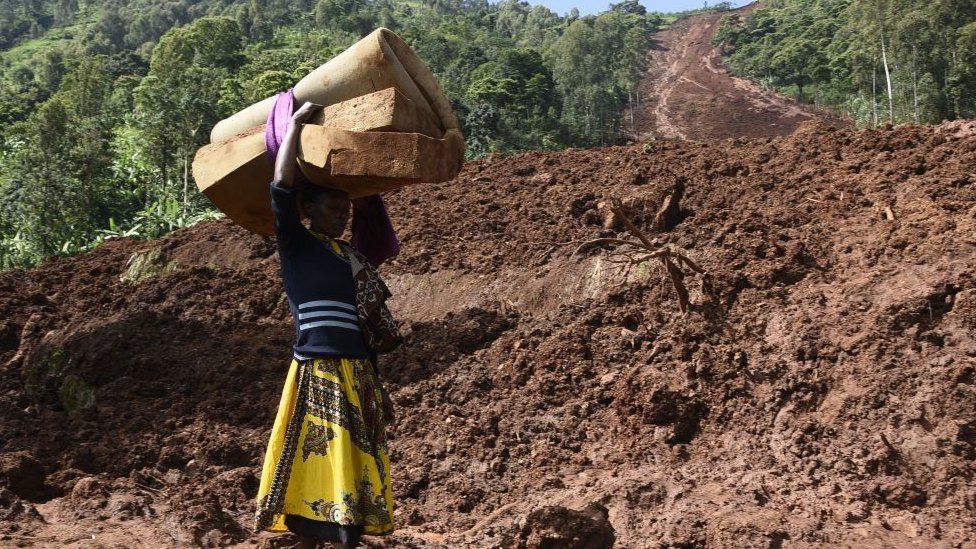
A woman carries a rolled-up mattress at a landslide site in Shisakali village of Bududa district, eastern Uganda,image sourceGetty Images
image captionSome African countries say intensified landslides and floods have rendered their adaptation efforts useless

In Uganda, communities in the Rwenzori region have been trying to protect themselves from landslides and floods by digging trenches and planting trees, helping to prevent soil erosion.

But it has not always been a success.

“The rains have become so intense that we have seen huge, sudden floods sweeping away these defences,” said Jackson Muhindo, a local climate change and resilience coordinator for Oxfam.

“As a result, there have been multiple landslides on mountain slopes which have buried settlements and farms,” he adds. “Adaptation works based on soil conservation are proving to be increasingly useless in the wake of these extreme weather events.”

Adaptation low on the agenda

The UN Framework Convention on Climate Change says more than 80% of developing countries have begun formulating and implementing their national adaptation plans.

But a study by the International Institute for Environment and Development (IIED), published last month, suggests that the 46 of the world’s least-developed countries don’t have the financial means to “climate proof” themselves.

The IIED says these countries need at least $40bn (£28.8bn; €33.8bn) a year for their adaptation plans. But between 2014-18, just $5.9 billion of adaptation finance was received.

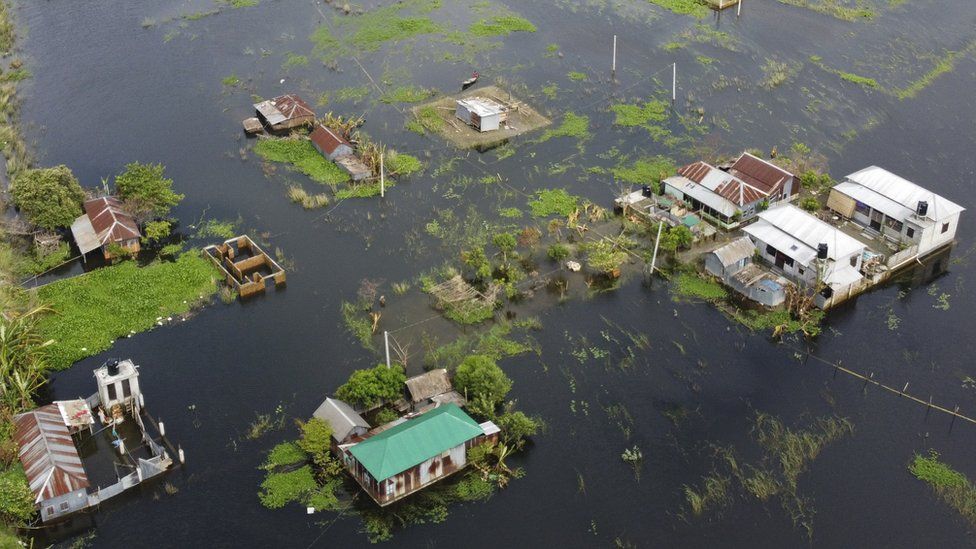
An inundated village in Savra of Bangladesh after monsoon floods.image sourceGetty Images
image captionDeveloping countries say adaptation has not been a priority issue among their wealthier counterparts

Under the UN climate convention, the EU and 23 developed countries have pledged to make $100bn available every year to fund climate-related projects in developing nations – like schemes to cut emissions, and adaptations to mitigate damage caused by weather-induced disasters.

From 2020, this money will be passed on through the Green Climate Fund, Global Environment Facility and other such agencies. But developing countries argue that promise has largely been unkept. A report by the Organisation for Economic Cooperation and Development (OECD) showed developed countries had made nearly $80bn available in 2018 as total climate finance. But it found that only 21% of that money was provided for adapting to climate impacts, while most went towards cutting carbon emissions.

Developing countries have criticised climate finance figures provided by developed world, pointing out they also include money from regular aid payments.

Some experts say adaptation plans have been hampered by politics.

“When you have other issues like [bad] governance, poverty and now Covid, it becomes very difficult for the plans to work. They simply aren’t a government’s priority,” according to Carlos Aguilar, a climate adaptation expert with Oxfam.

The post Climate Change: Low-IncomeCountries ‘Can’t Keep Up’ with Impacts appeared first on The St Kitts Nevis Observer.

Protests: Cuba Allows Small, Medium-Sized Private Businesses

Cuba’s communist government has legalised small and medium-sized private businesses in the wake of mass anti-government protests last month.

Under the new rules, enterprises with up to 100 employees will be allowed.

President President Miguel Díaz-Canel said Cuba was taking firm steps to update its economic model.

Critics say the government’s plans have been accelerated because of July’s protests, when thousands turned out to complain of economic ruin.

Demonstrators condemned the handling of the coronavirus pandemic and demanded political change.

Dozens were arrested nationwide and that least one man died in the unrest.

Friday’s decision is seen as a major shift in government policy on the island, where state-run companies are the norm.

The protests came amid a severe economic crisis.

In July, the authorities said they would allow travellers arriving in the country to bring in food, medicine and other essentials without paying import duties.

Scrapping the import duties had been suggested by some Cubans as a way to ease the shortages of medicines and food.

Tourism, one of the most important sectors, has been devastated by global restrictions on travel during the pandemic.

Sugar, which is mostly exported, is another key earner for Cuba. But this year’s harvest has been much worse than expected.

As a result, the government’s reserves of foreign currency are depleted, meaning it cannot buy imported goods to supplement shortages, as it would normally do.

Cuba has blamed the US and its economic sanctions for the protests and Cuba’s wider problems.

The post Protests: Cuba Allows Small, Medium-Sized Private Businesses appeared first on The St Kitts Nevis Observer.

Climate Change: IPCC Report is ‘Code Red for Humanity’

By Matt McGrath
Environment correspondent

BBC- Humanity’s damaging impact on the climate is a “statement of fact”, say UN scientists in a landmark study.

The report says that ongoing emissions of warming gases could also see a key temperature limit broken in just over a decade.

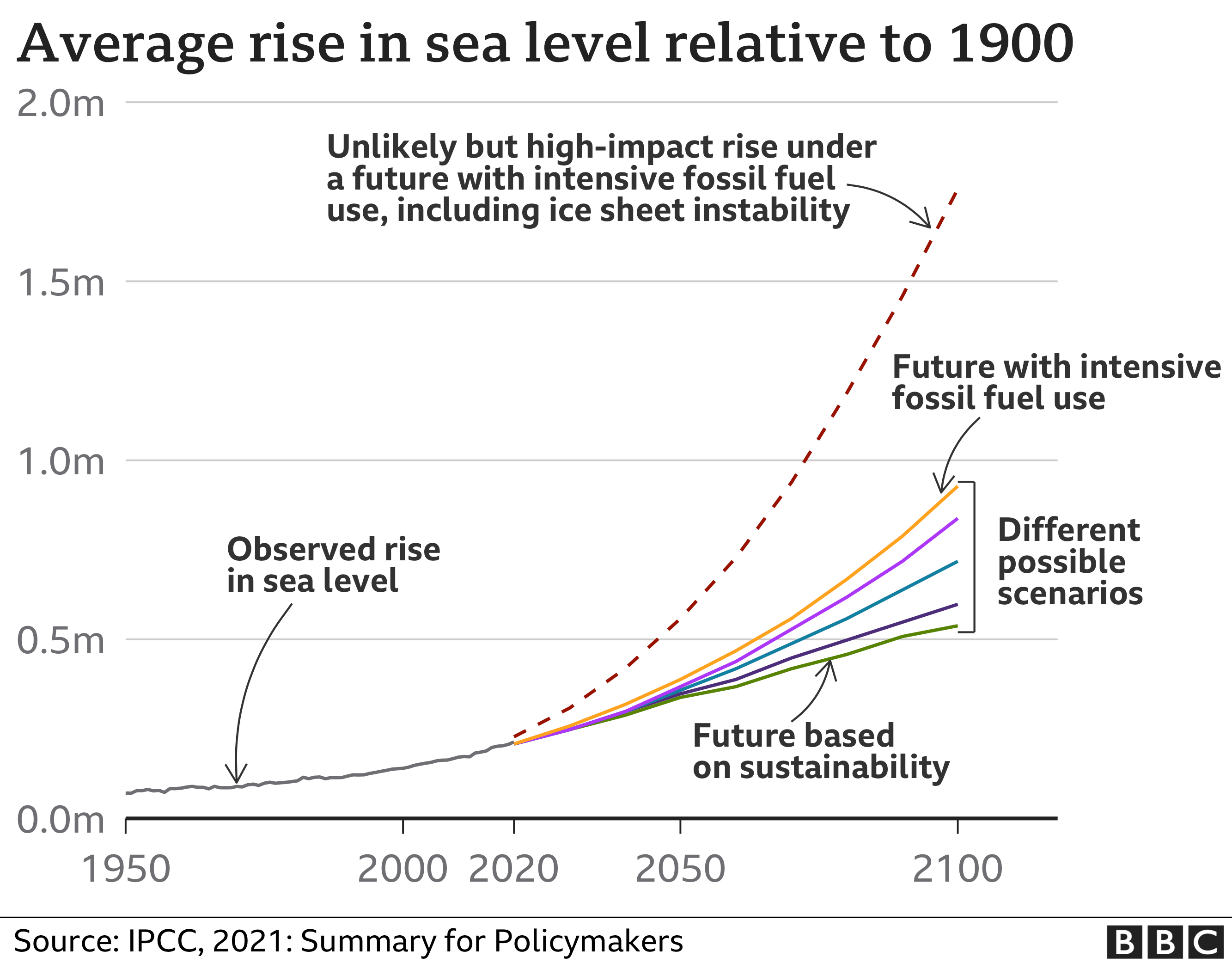
The authors also show that a rise in sea levels approaching 2m by the end of this century “cannot be ruled out”.

But there is new hope that deep cuts in emissions of greenhouse gases could stabilise rising temperatures.

This sober assessment from the Intergovernmental Panel on Climate Change (IPCC) features in a 42-page document known as the Summary for Policymakers.

It leads a series of reports that will be published over coming months and is the first major review of the science of climate change since 2013. Its release comes less than three months before a key climate summit in Glasgow known as COP26.

“Today’s IPCC Working Group 1 Report is a code red for humanity,” said UN Secretary-General, António Guterres.

“If we combine forces now, we can avert climate catastrophe. But, as today’s report makes clear, there is no time for delay and no room for excuses. I count on government leaders and all stakeholders to ensure COP26 is a success.”

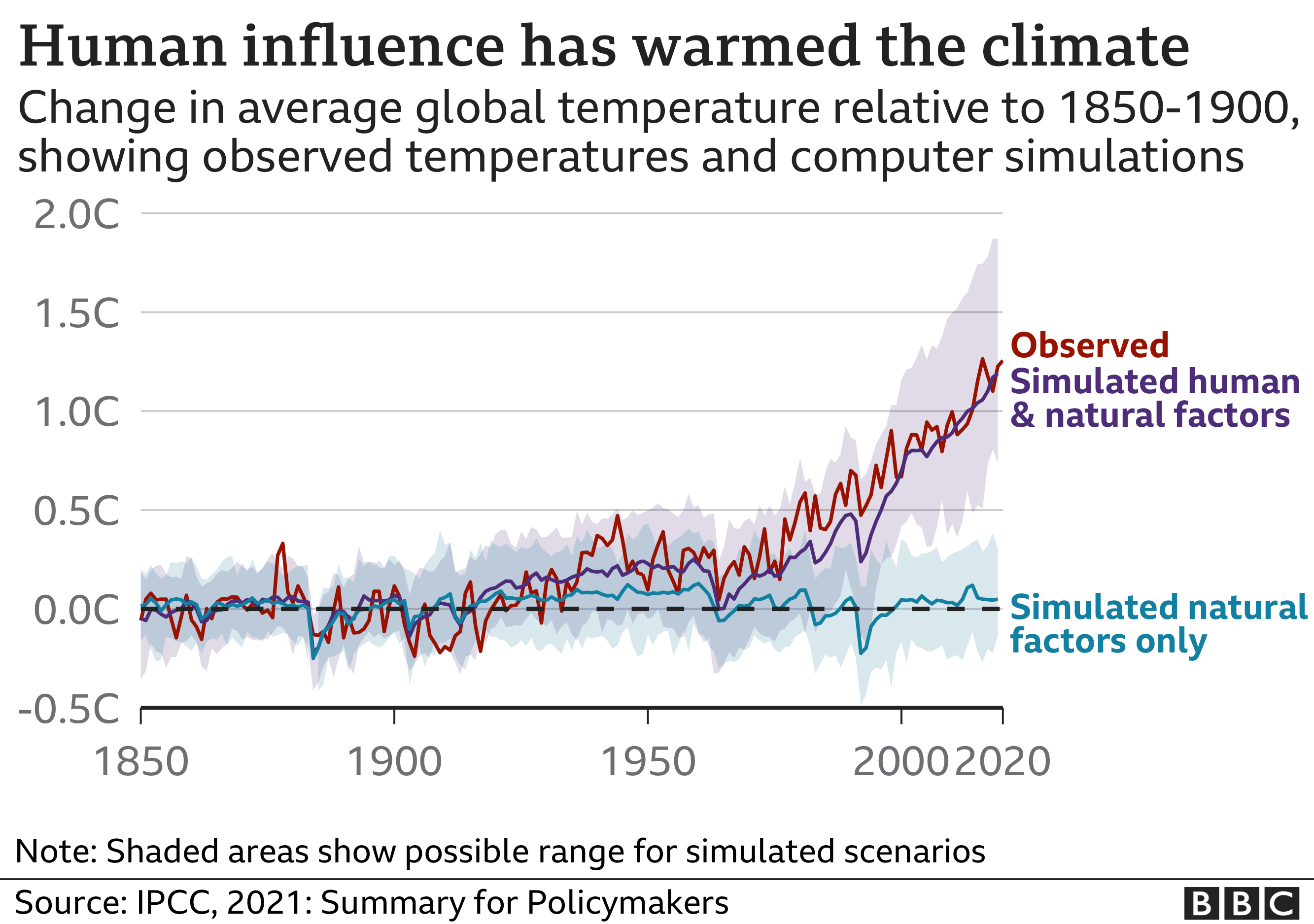
In strong, confident tones, the IPCC’s document says “it is unequivocal that human influence has warmed the atmosphere, oceans and land”.

Infographic

According to Prof Ed Hawkins, from the University of Reading, UK, and one of the report’s authors, the scientists cannot be any clearer on this point.

“It is a statement of fact, we cannot be any more certain; it is unequivocal and indisputable that humans are warming the planet.”

Petteri Taalas, Secretary-General of the World Meteorological Organization, said: “By using sports terms, one could say the atmosphere has been exposed to doping, which means we have begun observing extremes more often than before.”

The authors say that since 1970, global surface temperatures have risen faster than in any other 50-year period over the past 2,000 years.

This warming is “already affecting many weather and climate extremes in every region across the globe”.

Whether it’s heatwaves like the ones recently experienced in Greece and western North America, or floods like those in Germany and China, “their attribution to human influence has strengthened” over the past decade.

2px presentational grey line

IPCC report fast facts

  • Global surface temperature was 1.09C higher in the decade between 2011-2020 than between 1850-1900.
  • The past five years have been the hottest on record since 1850
  • The recent rate of sea level rise has nearly tripled compared with 1901-1971
  • Human influence is “very likely” (90%) the main driver of the global retreat of glaciers since the 1990s and the decrease in Arctic sea-ice
  • It is “virtually certain” that hot extremes including heatwaves have become more frequent and more intense since the 1950s, while cold events have become less frequent and less severe
2px presentational grey line

The new report also makes clear that the warming we’ve experienced to date has made changes to many of our planetary support systems that are irreversible on timescales of centuries to millennia.

The oceans will continue to warm and become more acidic. Mountain and polar glaciers will continue melting for decades or centuries.

“The consequences will continue to get worse for every bit of warming,” said Prof Hawkins.

“And for many of these consequences, there’s no going back.”

firesimage sourceEPA

When it comes to sea level rise, the scientists have modelled a likely range for different levels of emissions.

However, a rise of around 2m by the end of this century cannot be ruled out – and neither can a 5m rise by 2150.

Such outcomes, while unlikely, would threaten many millions more people in coastal areas with flooding by 2100.

One key aspect of the report is the expected rate of temperature rise and what it means for the safety of humanity.

protestorsimage sourceANDY RAIN
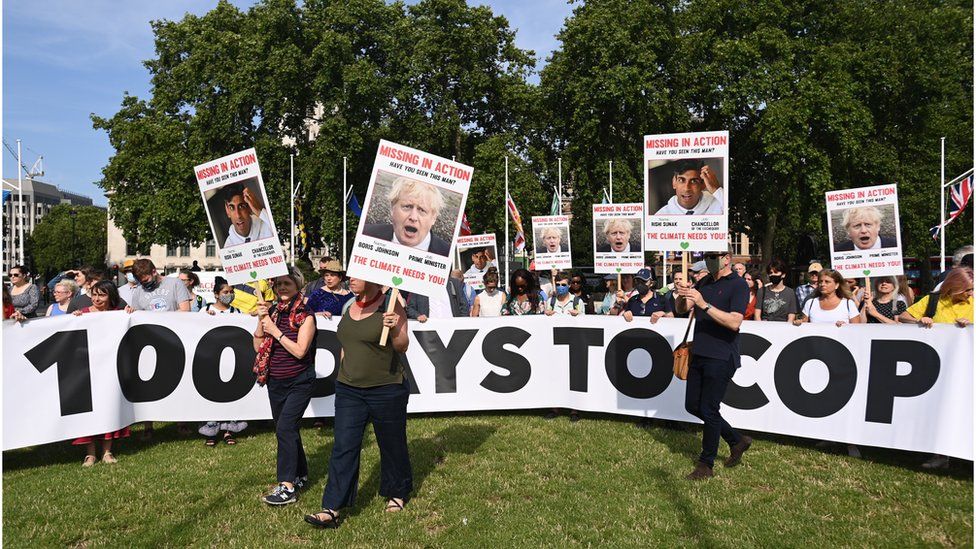
image captionProtestors urge action by politicians as the clock counts down to November’s COP26 climate summit in Glasgow

Almost every nation on Earth signed up to the goals of the Paris climate agreement in 2015.

This pact aims to keep the rise in global temperatures well below 2C this century and to pursue efforts to keep it under 1.5C.

This new report says that under all the emissions scenarios considered by the scientists, both targets will be broken this century unless huge cuts in carbon take place.

chart

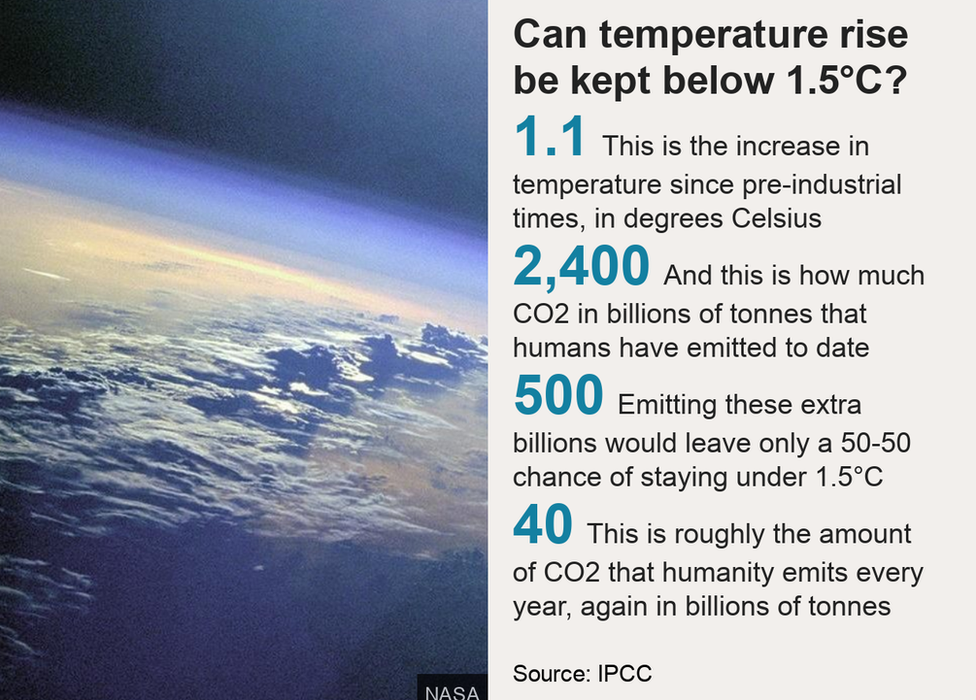
The authors believe that 1.5C will be reached by 2040 in all scenarios. If emissions aren’t slashed in the next few years, this will happen even earlier.

This was predicted in the IPCC’s special report on 1.5C in 2018 and this new study now confirms it.

“We will hit one-and-a-half degrees in individual years much earlier. We already hit it in two months during the El Niño in 2016,” said Prof Malte Meinshausen, an IPCC author from the University of Melbourne in Australia.

2px presentational grey line

What is the IPCC?

The Intergovernmental Panel on Climate Change is a UN body set up in 1988 to assess the science around climate change.

It provides governments with scientific information they can use to develop policies on global heating.

The first of its comprehensive Assessment Reports on climate change was released in 1992. The sixth in this series will be split into four volumes. The new report – from scientists on the IPCC’s Working Group 1 – is the first of these volumes to be released.

2px presentational grey line

“The new report’s best estimate is the middle of 2034, but the uncertainty is huge and ranges between now and never.”

The consequences of going past 1.5C over a period of years would be unwelcome in a world that has already experienced a rapid uptick in extreme events with a temperature rise since pre-industrial times of 1.1C.

“We will see even more intense and more frequent heatwaves,” said Dr Friederike Otto, from the University of Oxford, UK, and one of the IPCC report’s authors.

Alokimage sourceEPA
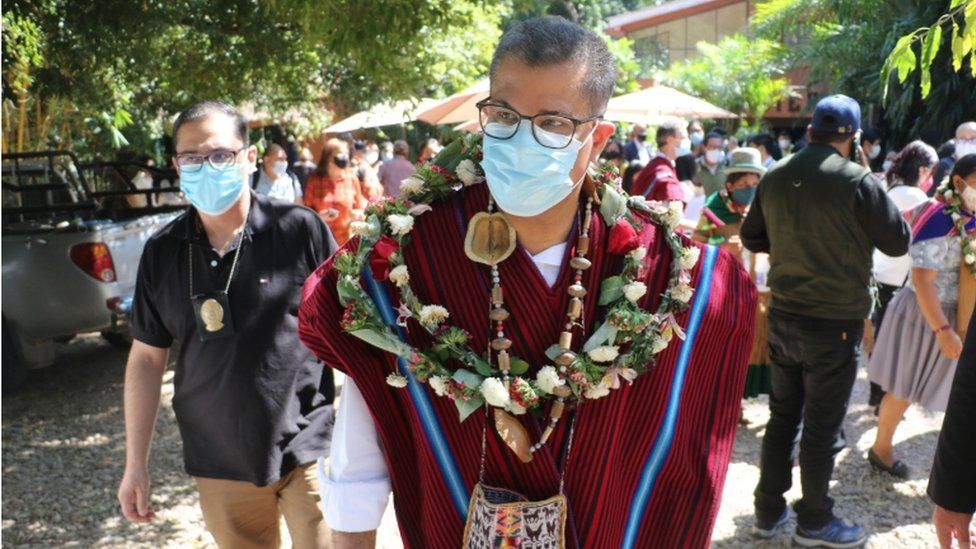
image captionCOP26 president designate Alok Sharma visiting Bolivia recently to drum up support for an ambitious outcome in Glasgow

“And we will also see an increase in heavy rainfall events on a global scale, and also increases in some types of droughts in some regions of the world.”

So what can be done?

While this report is more clear and confident about the downsides to warming, the scientists are more hopeful that if we can cut global emissions in half by 2030 and reach net zero by the middle of this century, we can halt and possibly reverse the rise in temperatures.

Infographic

Reaching net zero involves reducing greenhouse gas emissions as much as possible using clean technology, then burying any remaining releases using carbon capture and storage, or absorbing them by planting trees.

“The thought before was that we could get increasing temperatures even after net zero,” said another co-author, Prof Piers Forster from the University of Leeds, UK.

“But we now expect nature to be kind to us and if we are able to achieve net zero, we hopefully won’t get any further temperature increase; and if we are able to achieve net zero greenhouse gases, we should eventually be able to reverse some of that temperature increase and get some cooling.”

2px presentational grey line

Five future impacts

  • Temperatures will reach 1.5C above 1850-1900 levels by 2040 under all emissions scenarios
  • The Arctic is likely to be practically ice-free in September at least once before 2050 in all scenarios assessed
  • There will be an increasing occurrence of some extreme events “unprecedented in the historical record” even at warming of 1.5C
  • Extreme sea level events that occurred once a century in the recent past are projected to occur at least annually at more than half of tidal gauge locations by 2100
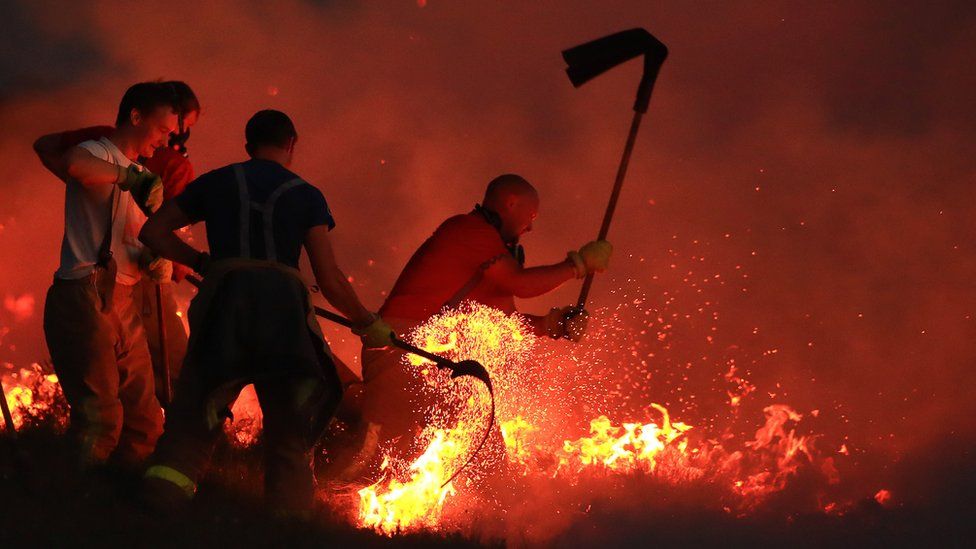
  • There will be likely increases in fire weather in many regions
2px presentational grey line

While the future projections of warming are clearer than ever in this report, and many impacts simply cannot be avoided, the authors caution against fatalism.

“Lowering global warming really minimises the likelihood of hitting these tipping points,” said Dr Otto. “We are not doomed.”

A tipping point refers to when part of the Earth’s climate system undergoes an abrupt change in response to continued warming.

For political leaders, the report is another in a long line of wake-up calls, but since it comes so close to November’s COP26 global climate summit, it carries extra weight.

Follow Matt on Twitter.

Banner saying 'Get in touch'

The post Climate Change: IPCC Report is ‘Code Red for Humanity’ appeared first on The St Kitts Nevis Observer.

US: Foreign Travelers Must Have Been Vaccinated When Restrictions Lift

By Morgan Chalfant

The Biden administration is currently developing a plan that would require most international travelers entering the U.S. from all countries to be fully vaccinated against COVID-19, a White House official said Wednesday.

The U.S. is keeping international travel restrictions in place for the time being due to the spread of the delta variant and rising domestic cases of the coronavirus. The new plan would be operationalized when the U.S. begins to lift restrictions on international travel.

The White House official said that interagency working groups are currently working to develop a plan for “a consistent and safe international travel policy” that would involve a phased approach that would require foreign nationals traveling to the U.S. to be fully vaccinated “with limited exceptions.”

“Currently, the interagency working groups are developing a policy and planning process to be prepared for when the time is right to transition to this new system,” the official said.

Reuters first reported that Biden administration officials are developing the plan for international travelers.

It’s unclear precisely when the U.S. will lift restrictions on travel from Mexico, Canada, Europe and other countries. The White House said in late July that it would keep restrictions in place, citing the delta variant.

After steeply declining from the start of the year, coronavirus cases have been on the rise again as vaccination rates have slowed. The Biden administration is working to convince millions of eligible Americans who have not yet gotten vaccinated to do so as quickly as possible. Currently, about 70 percent of U.S. adults have received at least one dose of the coronavirus vaccine.

States like Florida, Texas and Arkansas are seeing large numbers of coronavirus infections.

While the U.S. has kept restrictions in place, other countries have moved to open their borders to vaccinated travelers. The European Union is allowed entry of vaccinated U.S. travelers, and so has the United Kingdom and Canada.


The post US: Foreign Travelers Must Have Been Vaccinated When Restrictions Lift appeared first on The St Kitts Nevis Observer.

Brazil: 43,033 COVID Cases, 990 Deaths in 24 hours, US COVID Surge Highest in 6 Months

A health worker administers a dose of Johnson & Johnson vaccine against the coronavirus disease (COVID-19) to a resident, during mass vaccination at the Ilha Grande island, one of the most famous tourist spots in Rio de Janeiro state, Brazil, July 10, 2021. REUTERS/Lucas Landau

SAO PAUsLO, Aug 7 (Reuters) – Brazil had 43,033 new cases of the novel coronavirus reported in the past 24 hours, and 990 deaths from COVID-19, the Health Ministry said on Saturday.

The South American country has now registered 20,151,779, cases since the pandemic began, while the official death toll has risen to 562,752, according to ministry data, in the world’s third worst outbreak outside the United States and India and its second-deadliest after the United States.

Reporting by Ana Mano; Editing by Aurora Ellis

===============================================

US COVID Surge Highest in 6 Months

CNN- The US is averaging more than 100,000 new daily Covid-19 cases each day, the highest in nearly six months, according to data from Johns Hopkins University.

The last time the seven-day average surpassed 100,000 cases was on February 11, according to the data. The country hit a 2021 low average of 11,299 daily cases on June 22.

And the surge, largely among unvaccinated people, has been fueled by the spread of the Delta variant of the coronavirus.

As half of the US population remains unvaccinated, hospitalizations and deaths have climbed, the US Covid-19 surge is. But experts say we can turn things around

More than 63,250 Covid-19 patients were in US hospitals on Friday — a number that has generally climbed since a 2021 low of 16,152 on June 29, according to the US Department of Health and Human Services.

The alarming uptick in cases and hospitalizations comes as millions of students are returning to schools in-person.

And conversations about mask mandates in schools are once again shaping the debate on mitigation efforts between state and local school officials.

In Florida, which has the highest Covid-19 hospitalization rate in the country, school officials told CNN on Saturday that they want to keep their students and staff masked. But they are concerned about the anti-mask mandate stance taken by GOP Gov. Ron DeSantis, who threatened to pull funding from schools that implement such requirement.

n masking children in schools as pediatric hospitals fill up with Covid-19 patients

“We’ve already seen children are sick right here in Broward County. We have a high school student that is fighting for her life with Covid. We’ve had two students throughout the state of Florida this past couple of weeks that have passed away from Covid,” Anna Fusco, president of Broward Teachers Union, told CNN’s Pamela Brown on Saturday.

“So students are dying. And to have this mandate with funds held over our head if we go forward with it just shows really, really poor leadership in our governor.”

DeSantis issued an executive order last week, telling the state’s health and education departments to create rules preventing local school mask mandates. Two different lawsuits have since been filed against the Republican governor over the executive order.

Unvaccinated dad records days of regret in hospital — and makes heartbreaking request for daughter’s wedding in case he dies

Andrew Spar, president of Florida Education Association, said some districts are mandating masks, but allowing parents to opt out their children to get around DeSantis’ order.

Hillsborough County Public Schools in Tampa will require face coverings when schools starts, but parents will have the opt-out option, Superintendent Addison Davis said Saturday in a statement.

“While the outcome may be the same whether we make face coverings optional or required with an opt-out, we believe this decision continues to illustrate that Hillsborough County Public Schools takes public safety seriously,” said Davis, adding that masks are optional for employees.

Orange County Public Schools in Orlando is also adopting the same opt-out rule for students, but employees, visitors, volunteers and parents will be required to wear masks, the district said.

Florida has fully vaccinated 49.5% of its total population, but the rate of virus transmission is still high, according to the US Centers for Disease Control and Prevention.

Overall, the CDC recommends that everyone — students, teachers, staff and visitors — wear masks in schools.

===============================================

CDC: Unvaccinated more than twice as likely to get COVID-19 reinfection

By Justine Coleman

Unvaccinated people are more than twice as likely than the fully vaccinated to get reinfected with COVID-19, according to a Centers for Disease Control and Prevention (CDC) study released Friday.

The research determined that unvaccinated Kentucky residents who had a confirmed coronavirus infection last year had a “significantly higher likelihood of reinfection” than those considered fully vaccinated. The study concluded that the unvaccinated were 2.34 times more likely to contract COVID-19 again.

The CDC’s Morbidity and Mortality Weekly Report (MMWR) counters the argument that people previously infected with the coronavirus don’t need the vaccine because natural immunity offers enough protection.

The agency has already recommended that people previously infected with COVID-19 get vaccinated for more protection.

The study involved 246 Kentucky residents who were reinfected in May and June this year after having a confirmed 2020 case. They were compared to 492 controls who had a 2020 infection but were not reinfected.

Reinfection had previously been studied in laboratory settings, but the CDC noted there has been limited real-world data on the subject.

“These findings suggest that among persons with previous SARS-CoV-2 infection, full vaccination provides additional protection against reinfection,” the report reads. “To reduce their risk of infection, all eligible persons should be offered vaccination, even if they have been previously infected with SARS-CoV-2.”

The CDC said that natural immunity after recovering from COVID-19 without a vaccination “is suspected to persist for ≥90 days in most persons,” acknowledging it is “not well understood.” The report also said that variants could affect a person’s immunity to a natural infection.

The highly contagious delta variant was not as prevalent in May and June but has since become the dominant strain in the U.S. At the time, the alpha strain was the most common.

The agency noted that the reinfection numbers “might be overestimated” since vaccinated people are “possibly less likely to get tested.”

Some members of Congress, including Sen. Rand Paul (R-Ky.), have said they do not plan to get the vaccine, citing claims that because they previously had COVID-19, they have immunity.

“Until they show me evidence that people who have already had the infection are dying in large numbers or being hospitalized or getting very sick, I just made my own personal decision that I’m not getting vaccinated because I’ve already had the disease and I have natural immunity,” Paul said in May.

=======================================================

WORLD STATS

Coronavirus Cases:

203,508,853

Deaths:

4,308,544

Recovered:

182,815,018
Highlighted in green
= all cases have recovered from the infection
Highlighted in grey
= all cases have had an outcome (there are no active cases)

[back to top ↑]

Latest News

August 9 (GMT)

Updates

  • 14,472 new cases and 7 new deaths in Japan [source]
  • 22,160 new cases and 769 new deaths in Russia [source]
  • 603 new cases and 18 new deaths in Fiji [source]
  • 483 new cases and 8 new deaths

The post Brazil: 43,033 COVID Cases, 990 Deaths in 24 hours, US COVID Surge Highest in 6 Months appeared first on The St Kitts Nevis Observer.

Climate change report a 'code red for humanity', UN warns

Earth's climate is getting so hot that temperatures in about a decade will probably blow past a level of warming that world leaders have sought to prevent, according to a report released Monday that the United Nations calls a "code red for humanity."

"It's just guaranteed that it's going to get worse," said report co-author Linda Mearns, a senior climate scientist at the US National Centre for Atmospheric Research.

"I don't see any area that is safe … Nowhere to run, nowhere to hide."

READ MORE: Moderna COVID-19 vaccine provisionally approved by the TGA for use in Australia
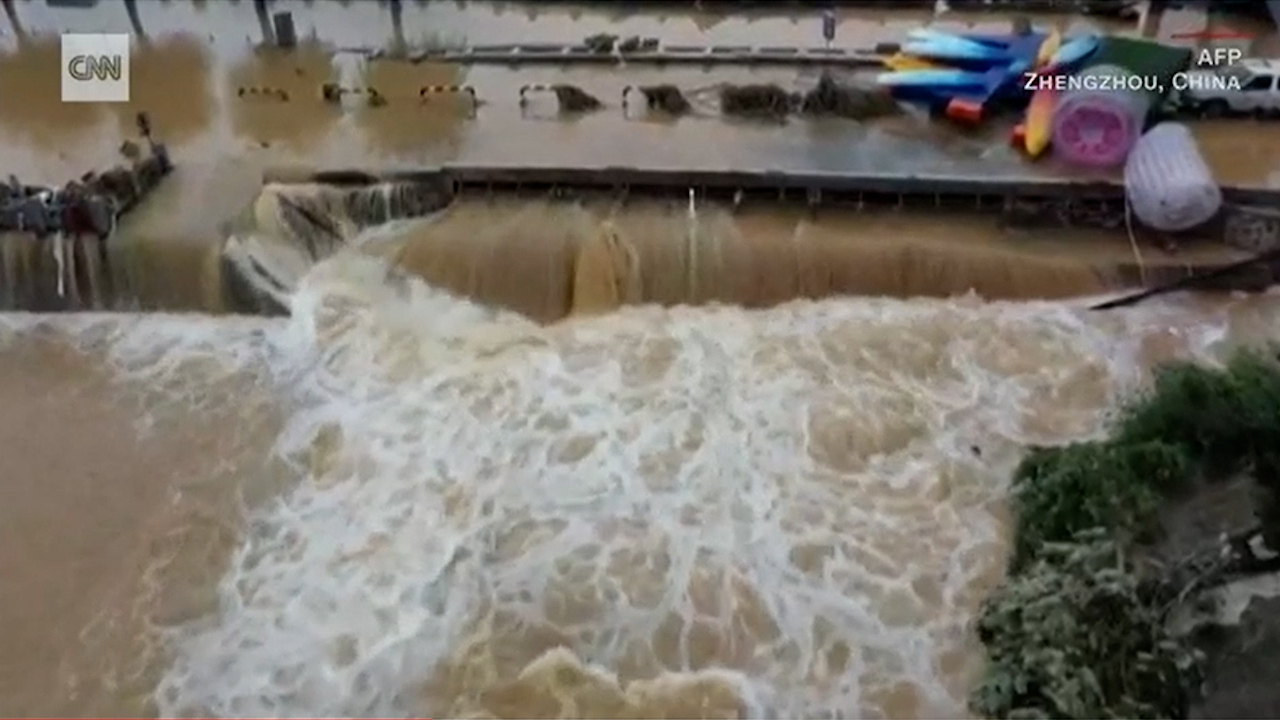
Heavy rainfall hit the province of Henan on July 20, causing flooding in numerous towns and cities. Zhengzhou, the provincial capital of 12 million people, was one of the hardest- hit areas, with entire neighborhoods submerged and passengers trapped in flooded subway cars.

But scientists also eased back a bit on the likelihood of the absolute worst climate catastrophes.

The authoritative Intergovernmental Panel on Climate Change (IPCC) report, which calls climate change clearly human-caused and "unequivocal," makes more precise and warmer forecasts for the 21st century than it did last time it was issued in 2013.

Each of five scenarios for the future, based on how much carbon emissions are cut, passes the more stringent of two thresholds set in the 2015 Paris climate agreement.

World leaders agreed then to try to limit warming to 1.5C since the late 19th century because problems mount quickly after that. The limit is only a few tenths of a degree hotter than now because the world has already warmed nearly 1.1C in the past century and a half.

Under each scenario, the report said, the world will cross the 1.5C warming mark in the 2030s, earlier than some past predictions. Warming has ramped up in recent years, data shows.
In three scenarios, the world will also likely exceed 2C over pre-industrial times — the other, less stringent Paris goal — with far worse heat waves, droughts and flood-inducing downpours "unless deep reductions in carbon dioxide and other greenhouse gas emissions occur in the coming decades," the report said.

"This report tells us that recent changes in the climate are widespread, rapid and intensifying, unprecedented in thousands of years," said IPCC Vice Chair Ko Barrett, senior climate adviser for the US National Oceanic and Atmospheric Administration. "The changes we experience will increase with further warming."

The 3000-plus-page report from 234 scientists said warming is already accelerating sea level rise, shrinking ice and worsening extremes such as heat waves, droughts, floods and storms. Tropical cyclones are getting stronger and wetter, while Arctic sea ice is dwindling in the summer and permafrost is thawing. All of these trends will get worse, the report said.

For example, the kind of heat wave that used to happen only once every 50 years now happens once a decade, and if the world warms another degree, it will happen twice every seven years, the report said.

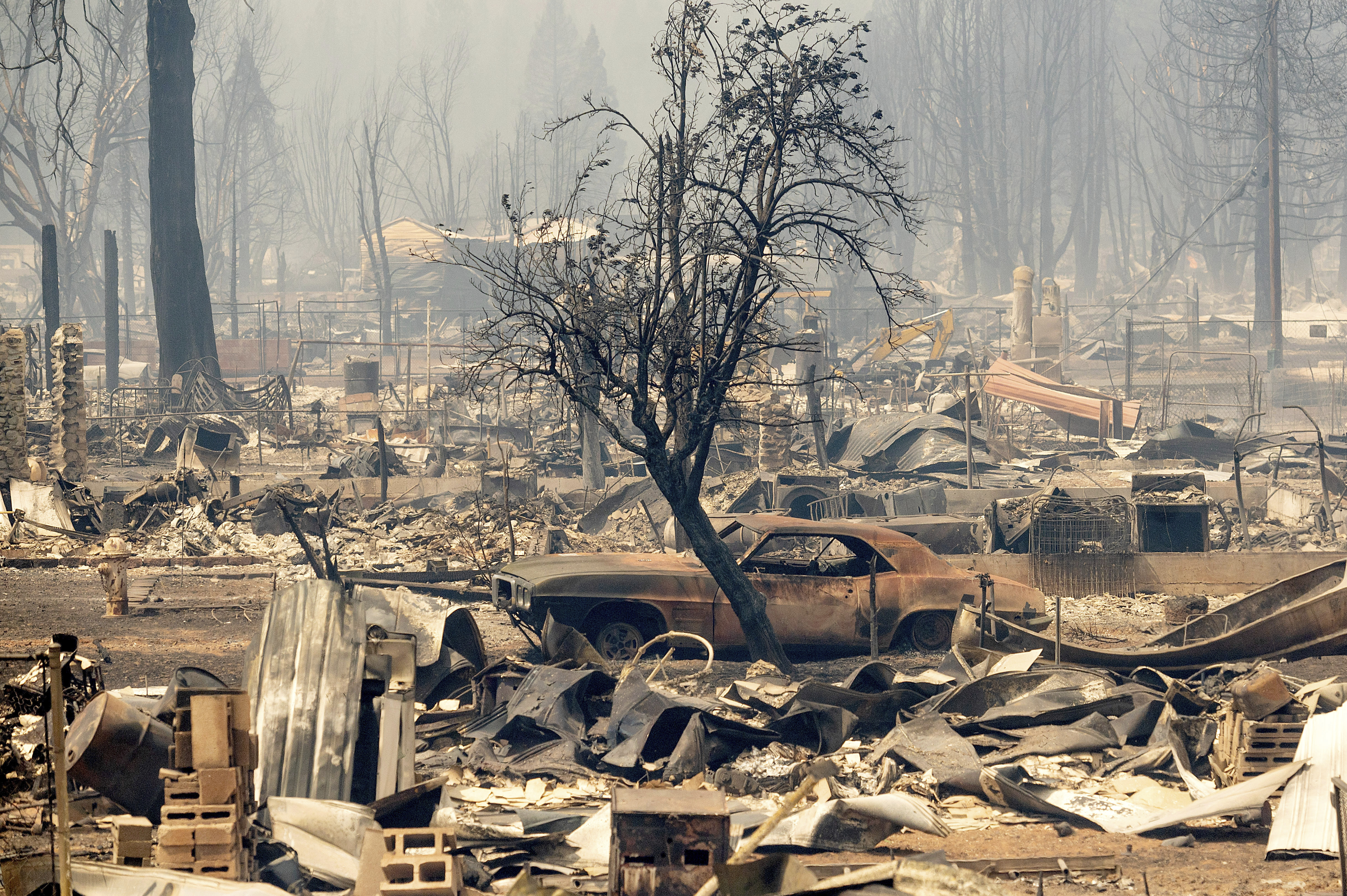
As the planet warms, places will get hit more not just by extreme weather but by multiple climate disasters that occur simultaneously, the report said. That's like what's now happening in the Western US, where heat waves, drought and wildfires compound the damage, Ms Mearns said.

Some harm from climate change — dwindling ice sheets, rising sea levels and changes in the oceans as they lose oxygen and become more acidic — are "irreversible for centuries to millennia," the report said.

The world is "locked in" to 15 to 30 centimetres of sea level rise by mid-century, said report co-author Bob Kopp of Rutgers University.

Nearly all of the warming that has happened on Earth can be blamed on emissions of heat-trapping gases such as carbon dioxide and methane. At most, natural forces like the sun or simple randomness can explain one- or two-tenths of a degree of warming, the report said.

The report described five different future scenarios based on how much the world reduces carbon emissions. They are: a future with incredibly large and quick pollution cuts; another with intense pollution cuts but not quite as massive; a scenario with moderate emissions; a fourth scenario where current plans to make small pollution reductions continue; and a fifth possible future involving continued increases in carbon pollution.

In five previous reports, the world was on that final hottest path, often nicknamed "business as usual." But this time, the world is somewhere between the moderate emissions path and the small pollution reductions scenario because of progress to curb climate change, said report co-author Claudia Tebaldi, a scientist at the US Pacific Northwest National Lab.

In a way, the world can stay at the 1.5-degree threshold with extreme and quick emission cuts, but even then, warming would hit 1.5 degrees in a decade, rise a tad and then come back down, said co-author Maisia Rojas Corrada, director of the Centre for Climate and Resilience Research in Chile.

While calling the report "a code red for humanity," United Nations Secretary-General Antonio Guterres kept a sliver of hope that world leaders could still somehow prevent 1.5 degrees of warming, which he said is "perilously close."

"Anything we can do to limit, to slow down, is going to pay off," Ms Tebaldi said. "And if we cannot get to 1.5, it's probably going to be painful, but it's better not to give up."

In the report's worst-case scenario, the world could be around 3.3C hotter than now by the end of the century. But that scenario looks increasingly unlikely, said report co-author and climate scientist Zeke Hausfather, climate change director of the Breakthrough Institute. Both extremes are looking less likely, he said.

"We are a lot less likely to get lucky and end up with less warming than we thought. We won't be able to meet Paris Agreement goals without rapid near-term reductions in our emissions," Mr Hausfather said. "At the same time, the odds of ending up in a much worse place than we expected if we do reduce our emissions are notably lower."

The report said ultra-catastrophic disasters, commonly called "tipping points," like ice sheet collapses and the abrupt slowdown of ocean currents are "low likelihood" but cannot be ruled out. The much talked-about shutdown of Atlantic ocean currents, which would trigger massive weather shifts, is something that's unlikely to happen in this century, Mr Kopp said.

The report "provides a strong sense of urgency to do even more," said Jane Lubchenco, the White House deputy science adviser.

In a new move, scientists emphasised how cutting airborne levels of methane, a powerful but short-lived gas that has soared to record levels, could help curb short-term warming.

More than 100 countries have made informal pledges to achieve "net zero" human-caused carbon dioxide emissions sometime around mid-century, which will be a key part of climate negotiations this fall in Scotland. The report said those commitments are essential.

"It is still possible to forestall many of the most dire impacts," Ms Barrett said.