Category Archives: headline

Colombia Protests Into Fourth Week, Demonstrators Vow No Letup

Nelson Bocanegra


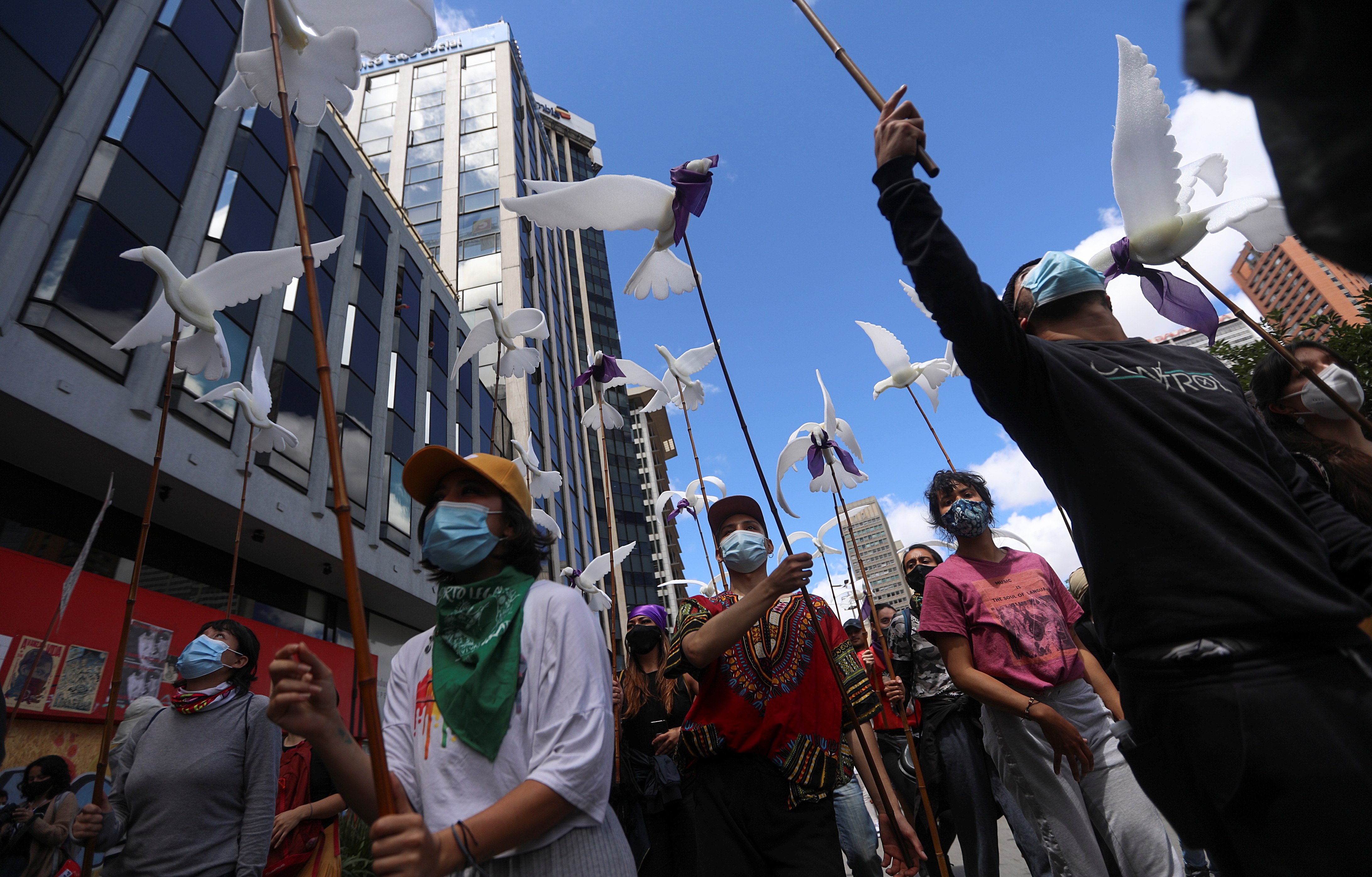
Colombia’s wave of anti-government protests entered their fourth week on Wednesday, as unions, student groups and others turned out at marches to demand social change amid intermittent talks between the government and strike organizers.

The protests have been marked by violence by both police and civilians. The attorney general’s office has confirmed 15 deaths connected to protests, while one human rights group tallies more than 40.

President Ivan Duque earlier this week ordered the clearance of road blockades around the country, which have caused shortages of food and gasoline. read more

The demonstrations, originally called in late April against a now-canceled tax plan, have expanded to include demands like a basic income, an end to police violence and opportunities for young people.

A health reform also opposed by many protesters, which they had criticized as too vague to make real change to Colombia’s fragile healthcare system, was shelved by a joint congressional committee on Wednesday.

Some 8,000 people attended protests in capital Bogota, the mayor’s office estimated. It added in a statement that all demonstrations were peaceful, but urged people to begin journeys home by 4 p.m.

A few hundred gathered in Bogota’s Bolivar Plaza.

“We’re accompanying our young people, our children, our grandchildren, who still lack opportunities despite our fighting for so long,” said lawyer Roberto Hermida, 68.

Hermida said he wanted there to be more educational opportunities and better healthcare.

Ati Quigua, 40, an Arhuaco indigenous leader, said she was protesting murders of human rights activists with 50 members of her community, saying they were on an “indefinite strike.”

The national strike committee, made up of major unions, student groups and others, has held several discussions with government representatives about protesters’ demands, but the two sides are not yet holding formal talks.

They are set to meet again with the government on Thursday morning, and organizers have vowed protests will continue.

The economic fall-out of the coronavirus pandemic has rolled back recent anti-poverty gains in Colombia, sending unemployment soaring, shuttering businesses and forcing the government to increase its debt load.

Demonstrations and blockades cost the county some $132 million per day, the finance ministry has said, and analysts predict the protests may slow Colombia’s recovery from a record economic contraction of 6.8% last year.

The post Colombia Protests Into Fourth Week, Demonstrators Vow No Letup appeared first on The St Kitts Nevis Observer.

Guatemala Detains Anti-Graft Investigators as U.S. Pushes for Rule of Law

Guatemala has dropped a graft charge against a jailed former president and arrested former investigators who built cases against him, hours before a White House meeting to discuss concerns about the rule of law in the Central American nation.

The arrests and move favoring former president Otto Perez Molina were the latest setbacks to U.S. President Joe Biden’s campaign to hold the powerful accountable in Central America.

Guatemala’s first chamber of the Court for High Risk Crimes said that it dropped one of five charges linked to corruption and money laundering against Perez Molina, 70, whose government was brought down by corruption scandals.

Perez Molina, a former army general, will remain in a prison on a military base, where he has been held since he resigned and lost his immunity in 2015.

Also on Wednesday morning, police arrested Juan Francisco Solorzano Foppa, a former prosecutor who was part of a team that revealed the first case of corruption against Perez Molina.

Solorzano went on to serve as the head of the Tax Administration Superintendency (SAT) between 2016 and 2018, where he built a reputation for chasing the wealth of powerful families that hold huge sway in Guatemala.

“This does not give me any shame,” Solorzano said, showing the handcuffs on his wrists to reporters in court. “This shows we are touching the powerful people of this country.”

Solorzano had been forming a new political party and was detained on accusations of falsifying official documents related to the party. Under a warrant in the same case, police also arrested Anibal Arguello, a lawyer who had worked for Guatemala’s U.N.-backed anti-corruption commission CICIG.

Arguello is a witness in the main case against Perez Molina. Known as La Linea, the case relates to corruption in Guatemala’s customs agency.

Solorzano is best known for uncovering and reporting a corruption network within SAT that had been defrauding the state by helping business leaders avoid paying taxes.

The Biden administration has made targeting corruption central to its $4 billion strategy to address “root causes” driving migration from the so-called Northern Triangle countries of Guatemala, Honduras and El Salvador.

On Wednesday, only hours after Solorzano’s detention, U.S. Vice President Kamala Harris met in Washington with four former Guatemalan judicial officials, some of whom she said fled the country because of their work against corruption.

The officials included former attorneys general Claudia Paz y Paz and Thelma Aldana, and former judges Claudia Escobar and Gloria Porras.

“Injustice is a root cause of migration and in particular it is causing the people of the region to leave their homes involuntarily, meaning they don’t want to leave but they are fleeing,” Harris said during the meeting.

The vice president is scheduled to visit Guatemala in June.

A day earlier, a U.S. State Department report on Central American officials “credibly alleged” to be corrupt includes six sitting Honduran lawmakers and two Guatemalan legislators, according to a list released by the office of U.S. Representative Norma Torres on Tuesday.

The post Guatemala Detains Anti-Graft Investigators as U.S. Pushes for Rule of Law appeared first on The St Kitts Nevis Observer.

Woman accused of exploiting cancer victims

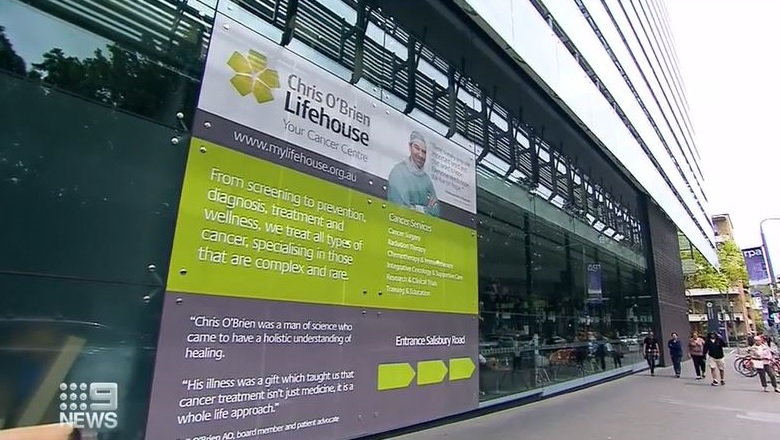
A Sydney woman has been accused of exploiting the information of cancer victims, submitting fraudulent expense forms and pocketing the money.

Police arrested 58-year-old Sara Stig yesterday at her home at Freemans Reach, near Windsor, a home she shared with former partner Chris Thomas.

"Multiple patients – we will be alleging it's in excess of $200,000 that she managed to obtain," NSW Police detective superintendent Linda Howlett said.

READ MORE: Third Australian dies of COVID in India

Police arrested 58-year-old Sara Stig yesterday at her home at Freemans Reach, near Windsor

Mr Thomas claims he was blindsided by the allegations.

"Just in shock… [I] just don't know what to say," he said.

Police will allege Ms Stig, who held an administration position at the clinic, submitted fraudulent expense forms for a patient who had passed away.

More than $200,000 was allegedly deposited into her bank account.

READ MORE: Sydney dad was on annual surf trip when he was killed in shark attack

Chris O'Brien Lifehouse

"All these years she's told me she's a nurse – told my family, my daughter that she's a nurse… then I find out last night she's in admin," Mr Thomas said.

The not-for-profit confirmed today that a former employee is being investigated by police.

"It is important we keep our focus on caring for each other, our patients, and the community," they said in a statement.

The 58-year-old will face court in June.

Partisan Politics in Honduras Fuels Exodus to US

Reuters- Bags of rice and beans arrived in a tough neighborhood in San Pedro Sula, Honduras’ second-largest city, with government aid for poor residents struggling during a coronavirus lockdown in April 2020.

Cesar López and his hungry family got nothing. The food, he said, went only to supporters of the ruling National Party, which he opposes. He said it’s much the same for government jobs and other benefits.

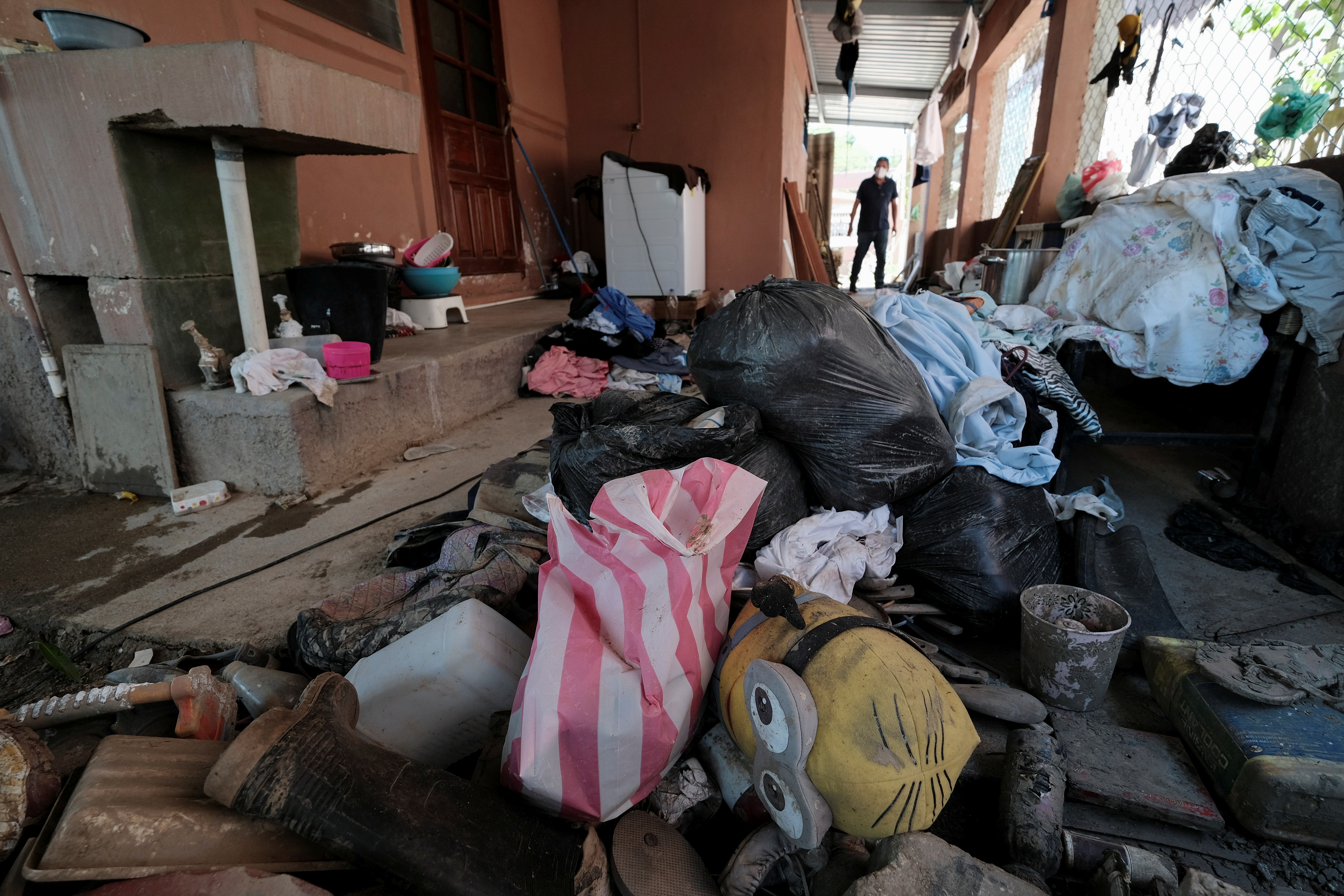
López set out for the United States earlier this year – motivated in part by what he claims was unfair distribution of assistance during a hunger crisis caused by the pandemic and two hurricanes last year.

“The government only gives to its supporters,” López told Reuters in March, taking a break in a Guatemalan village on his way to Texas.

The ruling party denies playing favorites and said such allegations are typical of opponents aiming to make President Juan Orlando Hernández look bad. What is undisputed is that the conservative National Party, since seizing power in the wake of a 2009 military coup, has built a formidable political machine that wields great influence over the lives of Honduras’ 10 million people.

The patronage system, known as “clientelism,” helps fuel migration to the United States by breeding cynicism among those deprived of public benefits, said migrants and policy specialists.

“Sometimes the balance between staying and leaving is hope things could get better, and clientelism destroys that hope,” said Andrew Seele, president of the Washington-based Migration Policy Institute, which supports liberal immigration policies.

The National Party routinely uses its control of government institutions and funds to reward supporters, punish opponents and influence elections, according to Reuters interviews with two dozen current and former government officials, opposition politicians, former National Party insiders, diplomats, anti-corruption investigators and academics.

Another three dozen Hondurans – some en route to the United States – told Reuters that the system influenced them or their relatives to migrate.

Corruption is ingrained in Central America. For years, politicians have been embroiled in graft scandals and drug-trafficking prosecutions. The Biden administration has made targeting corruption central to its $4-billion strategy to address “root causes” driving migration from the so-called Northern Triangle countries of Honduras, Guatemala and El Salvador.

Economist Julio César Raudales served as minister for planning and external cooperation in the National Party-led government from 2010 to 2014. He said anti-poverty spending was directed mostly to areas where the party had the best chance of winning elections, though top party officials didn’t openly discuss the practice at cabinet meetings.

“All the public investments passed through my office, so it wasn’t difficult to see,” said Raudales, now a vice-rector of international relations at The National Autonomous University of Honduras.

While the practice isn’t new, it has become “shameless” under National Party rule, he said.

The party dismissed allegations that it doles out aid based on political support.

“This is totally false,” said Fernando Anduray, a spokesman and executive secretary of the party’s political commission.

Honduran law requires the federal government to involve municipalities in implementing social programs. The National Party captured 58% of the nation’s mayor’s offices in the most recent elections in 2017. Anduray said any instances of local officials favoring National Party supporters were isolated cases.

FLOURISHING PATRONAGE

Clientelism has a long history in Latin America. Authoritarian parties including Venezuela’s ruling Socialist Party and Mexico’s PRI, which held power for seven decades until 2000, have used it to wield influence, political scientists say. So has the National Party’s longtime rival in Honduras, the Liberal Party.

“We’re all complicit,” said Juan Carlos Elvir, a Liberal Party vice-presidential candidate for November’s election. The country’s welfare programs, he said, force citizens to rely on political parties for aid, an impediment to fighting poverty.

Supporting the ruling party doesn’t guarantee cash or food, nor does opposing it necessarily mean a permanent loss of public benefits, political analysts and residents said.

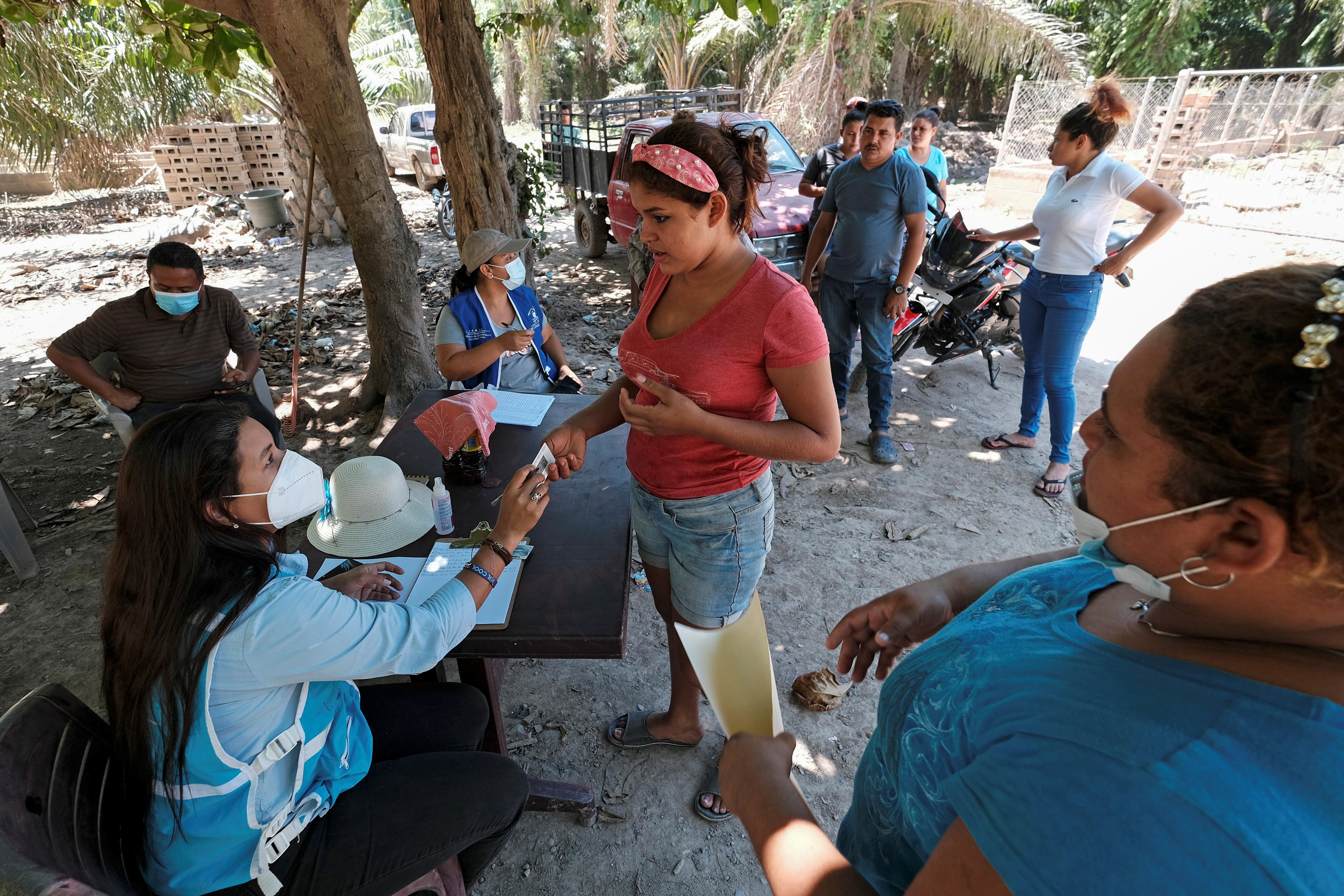
An activist from the ruling Partido Nacional (National Party) holds the identification of a woman to register on a list to receive help from the government foe the people affected by the floods caused by hurricanes Eta and Iota, in El Progreso, Honduras March 27, 2021. REUTERS/Yoseph Amaya

Still, Honduran migrants said the practice has become particularly disheartening in the upheaval of the past year – and a factor in their decision to leave.

Maria Garcia, who set out for the United States in February with her two young children, said she got none of the food assistance that trickled into her town in southwestern Honduras.

“Only those with (the president) receive help,” said Garcia, a supporter of the Liberal Party. She spoke to Reuters at the Guatemala-Mexico border.

The presidency, in a statement, said Hernández’s goal is to dispense social aid independent of political affiliations.

Anti-corruption investigators and academics who have studied Honduras say access to all manner of state benefits – from food handouts to multimillion-dollar public contracts – requires fealty to the National Party.

The party’s dozen years in power have allowed it to expand and consolidate such practices, studies show.

A 2019 report by the Latin American Public Opinion Project at Vanderbilt University found Honduras had the second-highest level of clientelism in Latin America, after the Dominican Republic. The study found that more than 18% of 1,561 Honduran voters surveyed in 2014 said they were offered a gift, favor or benefit in exchange for their vote in the 2013 presidential election. The survey, however, did not state which political parties made the alleged offers.

Local National Party activists are in charge of dispensing government welfare programs, which are then used to cement support from poor citizens ahead of elections, according to a March 2021 report by the Honduran Documentation Center, a Tegucigalpa-based private think-tank, with support from the National Democratic Institute, a U.S. pro-democracy group.

VOTING WITH THEIR FEET

Mauricio Arias said he has witnessed this arrangement as mayor of the western Honduras town of Copán Ruinas. A member of the opposition Liberal Party, Arias said his administration is excluded from decision-making about a federal assistance program called “Vida Mejor” or “Better Life.” He said local National Party operatives decide who gets help, directing most of the aid to the party’s base of voters.

Following Hernández’s victory in 2013, the government rolled out distribution of food parcels known as “bolsa solidaria” or “solidarity bag.” The government aid was largely channeled to citizens identified in an internal party “census” as likely National Party voters, said Raúl Pineda Alvarado, a former National Party lawmaker.

“If you are not in the census, you don’t have access to the solidarity bag,” added Alvarado, who now works as a political analyst.

Anduray, the National Party spokesman, said the party had an extensive database of its members and supporters. He denied the party discriminates against opposition voters in handing out cash assistance.

Among those helping the ruling party forge connections with voters are foot soldiers like Sogeri López, a long-time supporter in Chamelecón, a suburb of San Pedro Sula.

Ahead of the March primaries this year, she said, the National Party offered her a stipend to door-knock in her neighborhood, which was clobbered by November’s hurricanes.

López said her job was to obtain contact information from likely party supporters to help mobilize turnout. In addition, she said, she was instructed to tell voters they’d receive food, new mattresses and building materials to repair their homes.

The National Party “promised aid in exchange for people’s votes,” she said. López said she was also told her canvassing would lead to a job for her 21-year-old son Daniel.

The National Party’s Anduray said it would have been an “isolated case” if any such promises were made. “It is not a strategy of the party,” he said.

López has since grown disillusioned.

She said some of the handouts she’d promised voters never arrived. Neither did her stipend or the job for Daniel, who headed north last month in hopes of reaching the United States.

The post Partisan Politics in Honduras Fuels Exodus to US appeared first on The St Kitts Nevis Observer.

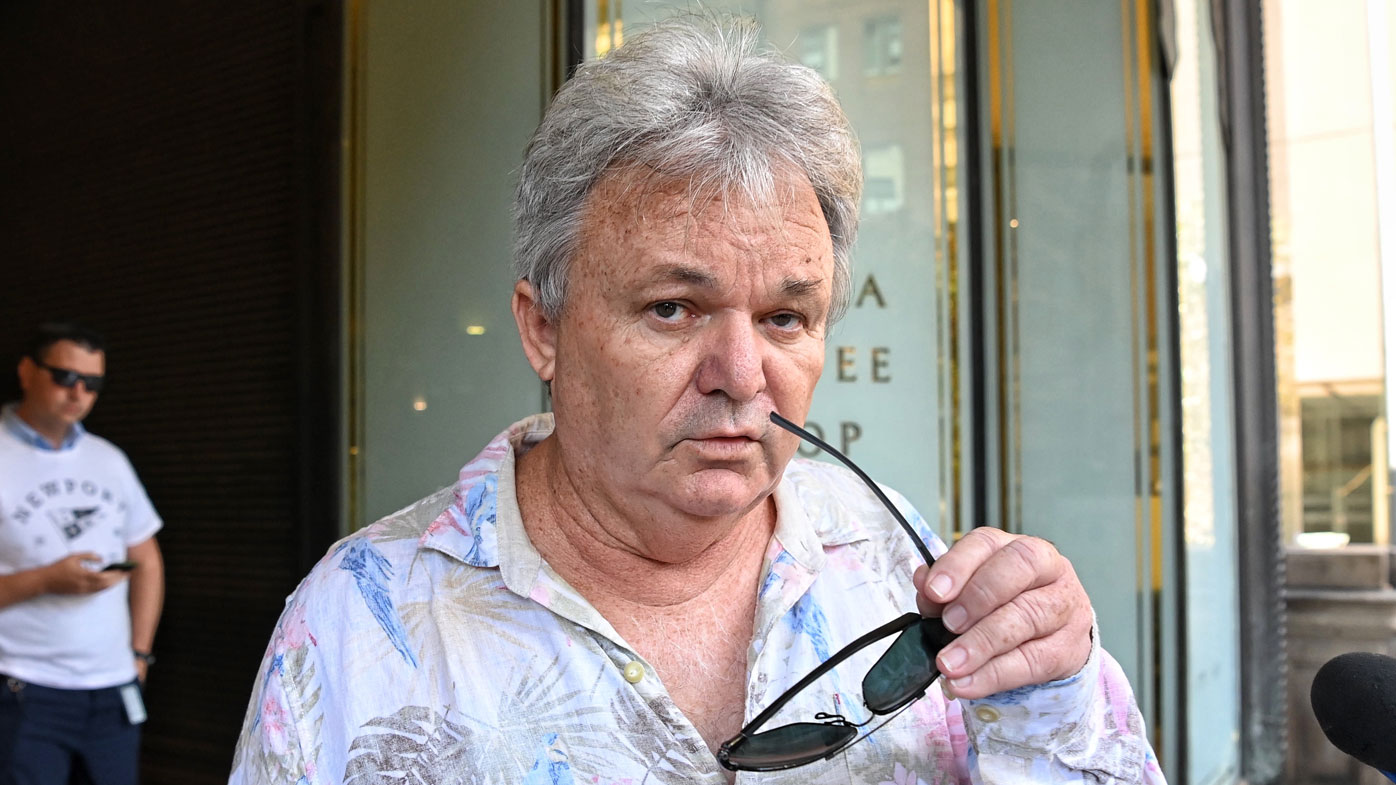
Businessman Peter Foster wanted by police

Notorious businessman Peter Foster is again a wanted man after he failed to show up for a court appearance.

He was last seen this morning at his lawyer's office and was due to appear at Downing Centre today for a mention.

However, the 58-year-old's lawyer admitted to the court he simply could not find him.

Notorious conman Peter Foster has disappeared from his lawyer's office in Sydney.

Despite not appearing, all 16 fraud charges were withdrawn.

But he's wanted in Queensland and a warrant has been issued for his arrest.

"Queensland Police have issued a warrant for the arrest of a 58-year-old man in New South Wales in relation to a number of alleged fraud offences," a statement from Queensland Police said.

This afternoon NSW Police arrived at Mr Foster's lawyer's office inspecting CCTV from the building.

NSW Police have confirmed to 9News they will assist their Queensland counterparts in locating him.

India Variant Spreads in UK, J&J to Restart Vaccine Production, More

Ministers consider diluting plan to relax Covid rules as India variant surges

Health secretary indicates plans for ‘freedom day’ in England on 21 June could be knocked off track

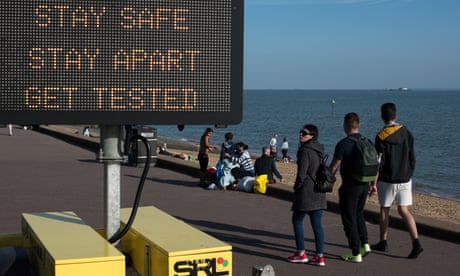
Members of a testing team wait for people to arrive for swab tests in Bedford.
Members of a testing team wait for people to arrive for swab tests in Bedford. Photograph: Leon Neal/Getty


Ministers are considering diluting plans for “freedom day” in England on 21 June and delay the end of all social distancing rules, as new figures showed another sharp increase in the Covid variant first detected in India.

The health secretary, Matt Hancock, said no announcement would be made until 14 June on whether all restrictions will be lifted a week later, as planned.

“We’ve always known that one of the things that has the potential to knock us off track would be a new variant,” he said. “That’s why we made the presence of a new variant that could do that one of our four tests when we set out the roadmap, which is the test we must pass for going down each step.”

Meanwhile, he said, the government was “throwing everything” at speeding up testing and vaccinations in Bolton, Blackburn and six newly affected areas.

The number of confirmed cases of the variant B.1.617.2 uncovered in the UK had now risen to 2,967, the health secretary said. That was up by 28% in just two days, from 2,323 on Monday.

The true number may be higher, as genomic sequencing to confirm the presence of the variant takes several days. Public Health England said the most recent sample included in the 2,967 total was taken a week ago, on 12 May.

No 10 has still not lost hope of allowing all restrictions to lift on 21 June. Sources said there was now more optimism in government than there was a few days ago about the prospect of forging ahead with the roadmap as planned. Next week is expected to be the crucial deciding week to show how the variant may have spread and to assess its transmissibility.

Officials had explored whether using Covid certification in venues such as pubs and restaurants could help remove the need for social distancing, but ministers have now rejected that prospect. However, it may be used for venues which have not yet been allowed to open – such as nightclubs and arenas.

The delay in lifting rules on social distancing, mask-wearing and work from home guidance may mean in practice that little would change on 21 June, apart from the opening of some high-risk venues on the condition of prior vaccination or testing on entry.

Diluting the government’s plans is likely to infuriate Conservative MPs who are adamant the prime minister must stick to his roadmap, which he called a “one way road to freedom”, when he announced it in February.

Businesses such as pubs and restaurants are also keen to see distancing rules lifted urgently, to allow them to serve more customers.

The deputy chief medical officer, Prof Jonathan Van-Tam, said that “the data will begin to firm up sometime next week”, giving a better picture of the threat posed by the virus.

“That will then feed into models that will help them to understand how this looks in terms of the future prospects in terms of resurgent disease, and from there ministers will be able to make further decisions,” he said.

Van-Tam said it was a race against the virus to vaccinate as many people as possible. “The challenge that’s ahead of us in the next two to three to four weeks is to make sure that we outrun the virus through really vigorous push on vaccine delivery and that is why when you are called, you must come forward and help us finish the job.”

Hancock said six new areas had been identified by the government as potential hotspots for the variant, based on analysis of data including travel routes and tests on sewage.

He said testing and vaccinations would now be accelerated in Bedford, Burnley, Hounslow, Kirklees, Leicester and North Tyneside.

Van-Tam urged the public to be cautious in these areas, and not “rip the pants out of it”, by overdoing new freedoms such as meeting up in pubs and restaurants. “I would advise the residents in those areas to think very carefully about the freedoms they have, weigh the risks, and be very cautious,” he said, suggesting they meet outside, and in smaller groups, if possible.

England lockdown end date ‘very much in the balance’, expert warns


Read more

Hancock and Van-Tam also played down the likelihood of foreign holidays this summer, with the health secretary stressing that the public should only be travelling to the 170 or so amber list countries for exceptional reasons. The travel lists are due to be reviewed every three weeks.

“We have been absolutely crystal clear that you should not go to an amber or red list country on holiday,” the health secretary said, when asked why some ministers had hinted that people could travel simply to see friends.

Hancock also repeated his promise to holiday in the UK this summer.

The increasing prevalence of the variant has raised renewed questions about whether the government should have acted earlier in placing India on the red list of countries from which travel is largely banned – a decision that was not made until 23 Apri

The prime minister’s spokesperson confirmed on Wednesday that direct flights from India continued to arrive in the UK. He said that was so that UK citizens could return safely, and stressed that they would be subject to the strict hotel quarantine regime on arrival.

Hancock said the government’s approach had been, “surging vaccines and testing”, in the affected areas, hailing the fact that across Blackburn with Darwen and Bolton, the NHS had delivered 26,094 jabs over the past week, as well as 75,000 tests.

Prof Neil Ferguson, a member of the government’s Scientific Pandemic Influenza Modelling Group (SPI-M), said on Wednesday that the final stage of lockdown easing appeared “very much in the balance”.

He said there was a “glimmer of hope” that the B.1.617.2 variant might be less transmissible than first feared but that it would take time to be sure. Asked whether it was realistic for England to emerge fully from lockdown on 21 June, Ferguson said: “I think that’s being actively considered. I think it’s very much in the balance. The data collected in the next two to three weeks will determine that.”

He said early data suggested vaccines protected against serious illness but may be less effective at stopping transmission of the variant first detected in India.

=================================================

Emergent CEO: J&J vaccine production could resume in days

Emergent BioSolutions could resume manufacturing doses of Johnson & Johnson’s coronavirus vaccine “within a matter of days,” the company’s CEO Robert Kramer told a House panel Wednesday.

The company is facing scrutiny from Congress after it was awarded a $628 million contract last year to establish the primary U.S. facility for manufacturing vaccines developed by Johnson & Johnson and AstraZeneca.

Democratic lawmakers on the House Coronavirus Crisis Subcommittee pressed Kramer on Emergent’s ability to fix a host of manufacturing issues identified by a Food and Drug Administration (FDA) inspection of its Baltimore facility in April.

At least one of those issues led to the contamination of 15 million J&J doses with ingredients from AstraZeneca’s vaccine, which the company was also manufacturing at the time.

As a result, the FDA paused production and essentially quarantined the remaining doses on hand to conduct thorough quality checks. The Biden administration also ordered AstraZeneca to find a new manufacturing partner.

How many doses are we talking about? There are more than 100 million doses of Johnson & Johnson’s vaccine on hold, Kramer said, disclosing for the first time just how much of the vaccine has been affected.

“We have made significant progress against all of those commitments, we are very close to completing them, and I would expect we would be in a position to resume production within a matter of days,” Kramer said.

Significance: If that were the case, the resumption of manufacturing would be a major boon to the U.S. vaccination effort. The nation is relying only on two-dose vaccines from Moderna and Pfizer-BioNTech, as supplies of the single-dose J&J vaccine have essentially dried up.

Related: Emergent has been paid more than $270 million without actually making a usable vaccine yet.

Democrats on the Oversight and Reform Select Subcommittee on the Coronavirus Crisis found that under a May 2020 contract issued by the Trump administration, taxpayers have already paid Emergent more than $271 million.

Emergent has charged the federal government $27 million per month in reservation fees to maintain its “readiness” to manufacture vaccines, but has not been able to distribute any doses.

The documents raise new questions about Emergent’s oversight from the Trump administration, and the outsize role it played in Johnson & Johnson’s manufacturing plan.

Fauci: Americans ‘misinterpreting’ mask rules

Anthony Fauci, the nation’s leading infectious diseases expert, said in a new interview that some Americans do not have a full understanding of the latest guidelines put forth by the federal government relative to mask wearing and coronavirus vaccines.

“I think people are misinterpreting, thinking that this is a removal of a mask mandate for everyone. It’s not,” Fauci told Axios at an event on Wednesday. “It’s an assurance to those who are vaccinated that they can feel safe, be they outdoors or indoors.


The post India Variant Spreads in UK, J&J to Restart Vaccine Production, More appeared first on The St Kitts Nevis Observer.

Giant magpie steals the show on 9News skycam

A magpie made a guest appearance in the 9News Queensland studio today, surprising presenter Melissa Downes as she prepared for the evening news bulletin.

The oblivious bird stuck its beak in front of the Brisbane skycam for its 15 seconds of fame, at one point appearing to peck at a passing insect.

The news was not on-air at the time.

https://twitter.com/9NewsQueensland/status/1395256309746835464

Downes was unflappable as she moved around the set, humoured by the giant uninvited guest.

It's not the first time a curious bird has unknowingly been caught on camera. In 2018, a cockatoo stole the show on a Cairns traffic camera.

Aussies warned of new 'smishing' scam

Australians are being inundated by a new form of scam whereby victims are sent text messages asking for them to share personal details which are then on-sold.

Known as "smishing" – or sms phishing – the scam involves cyber criminals impersonating legitimate organisations such as banks or delivery companies and request mobile phone users to click a link.

Figures from the ACCC's Scamwatch show that in just one month smishing scams have increased by more than 20 per cent, leading experts to worry that incidences of identity theft are about to spike.

READ MORE: Aussies warned of spike in online rental property scams

"The latest figures from the ACCC are consistent with a wider global trend that text messages are becoming one of the most preferred ways for cybercriminals to target victims," Crispin Kerr, ANZ area vice-president of cybersecurity agency Proofpoint, said.

"These types of attacks are commonly referred to as 'smishing'.

"In smishing texts, scammers will often use fake branding of an organisation such as a company logo, combined with a sense of urgency and usually some form of request for the target to click on a malicious link contained within the text."

READ MORE: Hackers behind Queensland hospital cyberattack identified

A scam impersonating Australia Post is circulating, asking people to pay for shipping.

Mr Kerr said the difficulty of containing SMS scams is that Australians are more likely to trust a link in a text message than they would in an email.

"With virtually all Australian adults owning a mobile phone, this makes this channel of communication ideal for cybercriminals to steal personal information and commit further crimes like identity fraud," Mr Kerr said.

"Many businesses are also using mobile messaging more to communicate with their consumers who are more trusting of text messages than email for example, and therefore more likely to click on malicious links within texts."

Figures from the ACCC show that Australians lost more than half a million dollars to unexpected prize and lottery scams, the highest amount recorded in more than 12 months.

In sheer dollar terms, investment scams are the most damaging with Australians fleeced an eye-watering $8 million in one month alone.

READ MORE: Australians targeted by fake myGov email scam

Mr Kerr said any Australians worried about becoming the victim of a scam should be suspicious of communications that sound too good to be true.

"Australians should continue to exercise caution," Mr Kerr recommends.

"The best thing to do if you think you may have been contacted by a scammer is to refrain from clicking on any links and report the scam to the ACCC's Scamwatch service immediately. Only communicate with an organisation through official channels that are typically listed on their company website and never give out your personal information to an unsolicited source.

"By knowing these simple safe practices and what to look out for, you can help to prevent financial losses for yourself, your business and loved ones."