Category Archives: headline

Old Road, St. Paul’s Enjoy Wins

With some high profile matches in this past weekend’s SKNFA premier league ending in draws, three teams enjoyed victories. Two of those teams won on Friday night when MFCR United Old Road Jets defeated Hotsprings Bath United 2-0 and S.L. Horsfords St. Paul’s United dismissed Flow 4G Cayon Rockets 3-0. Tiquanny Williams scored both goals for Old Road, who are now back to winning ways after suffering a losing streak and a draw in their last few matches. Williams scored in the 85th and 90th minute. It was a credit to Bath who held their opponents scoreless for 85 minutes, had it not been for two blunders that cost them the match. 

All the SKNFA Premier League matches were streamed live on the SKNFA Facebook page. In the post-match analysis, Loshaun Dixon and Essington Watts spoke about Old Road returning to winning ways and Bath United playing good football despite the loss. “It’s a heartbreaking moment for the Nevisian team,” Watts said. “They held out for 85 minutes and just some blunders and a goal scorer like Tiquanny Williams with great finishing instinct was able to capitalize on the mistakes,” he added. 

In Friday night’s second match, defending champions S.L. Horsfords St. Paul’s United proved why they are favorites to repeat this season after they dispatched title contenders Flow 4G Cayon Rockets. This is the second time in a week that St. Paul’s defeated the team that was ranked second in the table, after defeating Spurs that was ranked second last week. Jovaughn Leader got the goalscoring off in the 38th minute followed by Vinceroy Nelson 10 minutes later with a stunning free-kick yards out. Nelson, a former Cayon player celebrated his goal in front the Cayon bench as if to send a message to his old side. Anthony Caines, who came off the bench in the dying moments of the game scored in the 5th minute of stoppage time. 

Assistant coach of Cayon Jazza Buchanan said they played well in the first half to limit St. Paul’s chances and capitalize on their weakness. However, they gave St. Paul’s chances to score from set pieces which plays into their hands. “We can’t afford to give them anything in those areas because they are very good at set pieces,” Buchanan said. 

For St. Paul’s, their manager Derionne Edmeade said Cayon bossed them around in the first half and they had to make changes in the second half, despite leading 1-0. “We went into the second half and make the adjustments. We realized that we had to match Cayon’s energy based on how they were playing in the first half, he said. “We really had to look at what they were really doing and figure out what we were not doing properly and after making the adjustments I think we came out second half with St. Paul’s playing St. Paul’s football,” he explained.

The post Old Road, St. Paul’s Enjoy Wins appeared first on The St Kitts Nevis Observer.

Malian Woman Gives Birth to 9 Healthy Babies

A Malian woman has given birth to nine babies in an extremely rare case that has fascinated the West African nation’s leaders.

Halima Cisse gave birth on Tuesday to four boys and five girls after the Malian government flew her to Morocco for specialist health care.

In a statement, Mali’s health minister Fanta Siby said that the 25-year-old and all the children “are all doing well”.

The minister added that she was being kept informed by a Malian doctor who accompanied Ms Cisse to Morocco and that they due to return home in several weeks’ time.

Doctors originally detected only seven babies inside Ms Cisse’s womb during the ultrasound. But when the Moroccan doctors performed a caesarean section they were shocked to find two more babies.

One of the babies at hospital in Morocco
Originally only seven babies were detected during the ultrasound, but Moroccan doctors found two more when performing a caesarean section

Strangely, Morocco’s health ministry said they had no knowledge of such a multiple birth taking place in one of the country’s hospitals.

Mali’s ministry of health said in a statement that Ms Cisse had stayed at a hospital in the capital Bamako for two weeks before being sent to Morocco for treatment by the president of the transitional government.

Cases of women successfully carrying septuplets to term are rare. Nonuplets are even rarer. Medical complications in such multiple births often mean that some of the babies do not make it.

The first recorded case of nonuplets was in Australia in the 1970s. None of the babies survived. Then in  1999, a woman in Malaysia gave birth to nine children. Sadly, none of them survived more than six hours.

The post Malian Woman Gives Birth to 9 Healthy Babies appeared first on The St Kitts Nevis Observer.
Donald Trump Facebook ban decision upheld by Oversight Board

Facebook's quasi-independent Oversight Board has upheld Donald Trump's suspension, while issuing a rebuke of the social media giant's decision-making process.

The board found the former president's posts during the Capitol riot "severely" violated Facebook's rules and "encouraged and legitimised violence".

But it also criticised the company for violating its own rules by issuing an "indefinite" suspension, stressing it could not "make up the rules as it goes".

READ MORE: Donald Trump launches his own blog in the wake of Twitter ban

https://twitter.com/OversightBoard/status/1389928311174750211

The board issued a six-month deadline to review the decision and make a new ruling.

It listed two options: a time-limited ban or account deletion.

"Facebook cannot make up the rules as it goes, and anyone concerned about its power should be concerned about allowing this," the board said, in a series of Twitter posts.

"Having clear rules that apply to all users and Facebook is essential for ensuring the company treats users fairly. This is what the board stands for."

The company-appointed panel called for a review into Facebook's general "contribution to the narrative of electoral fraud and political tensions that led to the events of January 6" and urged a rethink of the way world leaders and important figures were dealt with.

"The 'newsworthiness' of a public figure's remarks should never take priority over urgent action to prevent harm," the panel wrote.

"Facebook must be far more transparent about how its newsworthiness policy works."

The Californian company was urged to ensure it issued a time-limited suspension or deleted the account of a head of state or high government official if they repeatedly posted messages risking harm under international human rights norms.

That suspension could be extended if the risk remained.

"Restrictions on speech are often imposed by powerful state actors against dissidents and political oppositions," the board wrote.

"Facebook must resist pressure from governments to silence political opposition, and stand up for free expression."

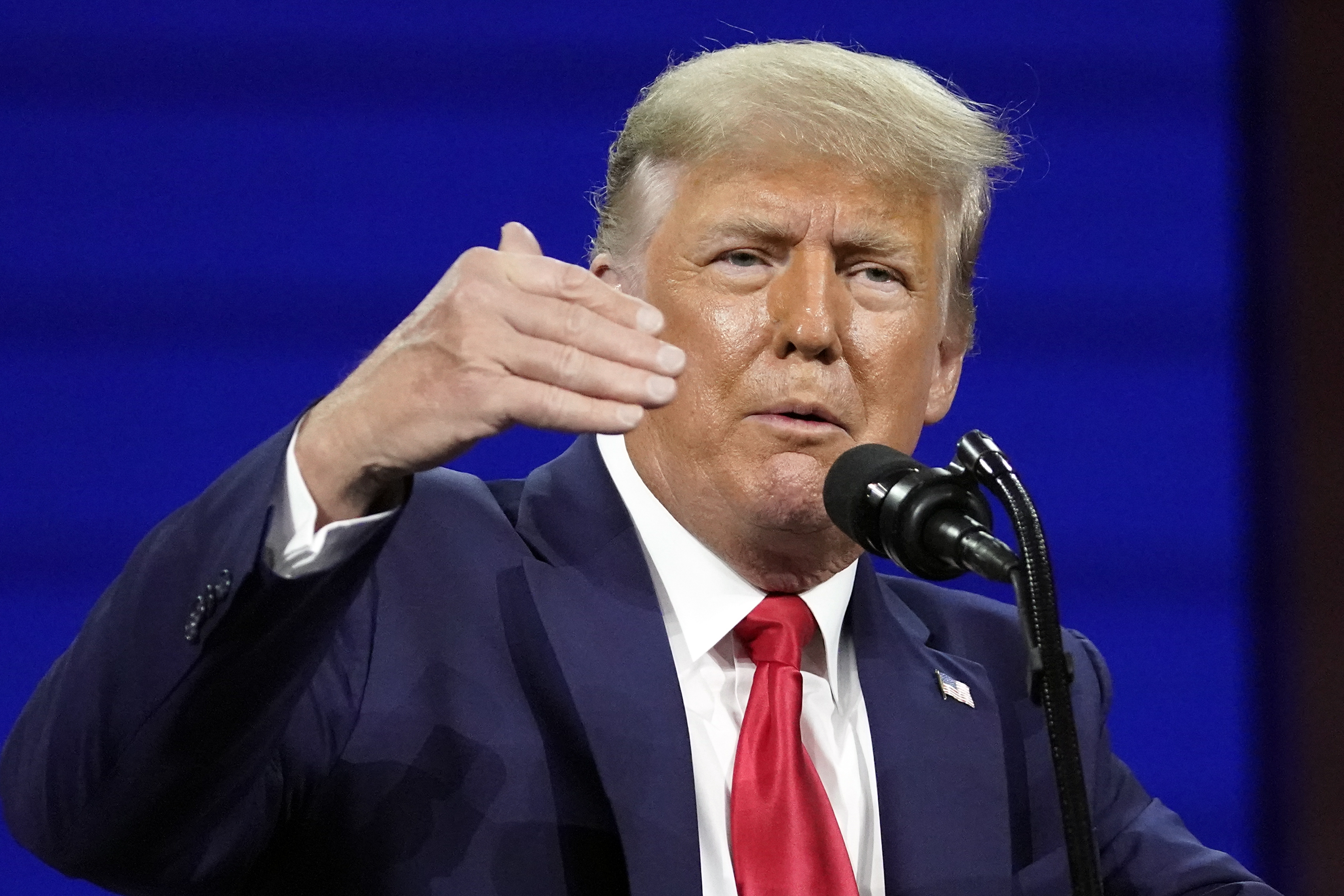
Former president Donald Trump speaks at the Conservative Political Action Conference

Trump 'severely violated' content standards

The board agreed with Facebook that two of Mr Trump's January 6 posts "severely violated" the content standards of both Facebook and Instagram.

"We love you. You're very special," he said in the first post, and "great patriots" and "remember this day forever" in the second.

Those violated Facebook's rules against praising or supporting people engaged in violence, the board said.

Helle Thorning-Schmidt, a former Danish prime minister who sits on the board, said in a conference call with reporters that Facebook shirked its responsibility to enforce its own rules.

"Facebook should either permanently disable Trump's account or propose a suspension for a specific period of time," she said.

The board said if Facebook decided to restore Trump's accounts, the company must be able to promptly address further violations.

A Trump spokesman did not immediately respond to a request for comment.

What is the Facebook Oversight Board?

The board, which has 20 members and will eventually grow to 40, did not reveal how it voted.

It said a minority of members emphasised that Facebook should require users who seek reinstatement after being suspended to "recognise their wrongdoing and commit to observing the rules in the future."

The social media giant had asked the board to make a final ruling on whether it was justified in indefinitely suspending Mr Trump from its platforms after he incited supporters to storm the US Capitol in January.

Facebook set up the oversight panel to act as the ultimate referee on content decisions, amid furious criticism about its inability to respond to a tide of misinformation, hate speech and other harmful content.

The board is empowered to make binding rulings on issues such as whether posts or ads violate the company's rules.

The social media giant regularly takes down thousands of posts and accounts.

Since it was launched in October, the board has received some 300,000 appeals from users over content decisions but it's prioritising cases that have the potential to affect many users around the world.

It has overturned decisions in five of the seven cases it has ruled on so far.

Mr Trump has also been permanently banned from Twitter.

– with Associated Press

SKN Pledges $1M for St. Vincent Volcanic Eruption Relief

THE ISLAND of St. Kitts and Nevis has pledged financial and humanitarian support of up to $1 million for St. Vincent and the Grenadines following a volcanic eruption.

Prime Minister the Hon. Dr. Timothy Harris made the announcement in the aftermath of a series of eruptions of the ‘La Soufriere’ volcano in the north-eastern part of St. Vincent.Support is expected to include providing accommodation for evacuees and resettling citizens and residents from the danger zone around the volcano.

Prime Minister Dr. the Honourable Timothy Harris.

They plan to also provide human resources through the Regional Security System (RSS) recruited from the Defence and Police Forces to support humanitarian activities, provide technical support and keep peace efforts on the ground.

The Caribbean Disaster Emergency Management Agency (CDEMA) have also released of a sum of $20,000 for its Special Emergency Assistance Fund.

Other Caribbean islands including Antigua, Grenada, and St Lucia have also pledged their support by opening up their doors to those evacuating.

More than 100 people have been taken to St Lucia so far already and the Royal Caribbean and other cruise ship companies have also been helping evict residents.

In a statement, the St Kitts and Nevis government said: “The Government and people of the Federation of St. Kitts and Nevis stand in solidarity with the Government and people of St. Vincent and the Grenadines during this very difficult time brought about by the volcanic eruption in that Country. St. Kitts and Nevis has always stood in strong support of our OECS Member States in their time of difficulty and need.

“Our prayers are with the Government and people of St. Vincent and the Grenadines at this most challenging time.”

The post SKN Pledges $1M for St. Vincent Volcanic Eruption Relief appeared first on The St Kitts Nevis Observer.

Supermarket, homewares store added to Sydney COVID-19 exposure list

The list of Sydney venues visited by an infectious COVID-19 patient has grown further to include a golf club, a gym, a chemist and a supermarket.

NSW Health on Wednesday night expanded the health alert to almost 20 venues and revealed fragments of the coronavirus had been detected in the Marrickville sewage network, servicing about 42,000 people.

Authorities urged residents of Dulwich Hill, Marrickville, Summer Hill, Lewisham, Ashfield, Haberfield, Petersham, Lilyfield and Leichhardt to be "especially vigilant" in monitoring for symptoms and getting tested.

READ MORE: NSW records one new community case of COVID-19

The man, aged in his 50s, had been "very active in the community" before he tested positive to the virus, NSW Premier Gladys Berejiklin said.

He visited a cafe in Paddington, an optometrist in the city, a cinema and four barbeque stores over the weekend.

On Monday, he went to a gym and a cafe in Moore Park's Entertainment Quarter before spending the evening at The Royal Sydney Golf Club.

Then on Tuesday, he spent time in Brookvale, Collaroy, Balgowlah and Double Bay, visiting a chemist, supermarket, rug cleaning business and two homewares shops.

Anyone who attended one of the following venues at the times specified is asked to immediately get tested and isolate until NSW Health provides further information.

Friday, April 30:

– District Brasserie, Chifley Square, 11am – 11:45am

– HineSight Optometrist, Sofitel Sydney, Wentworth, 12pm – 1pm

– Barbetta, Paddington, 1:30pm – 2:30pm

– Screening of The Courier at Event Cinemas, Westfield Bondi Junction, 6pm – 8pm

– Figo Restaurant, Rushcutters Bay, 8.45pm – 11pm

Saturday, May 1:

– Joe's Barbeques & Heating, Silverwater, 1pm – 1.45pm

– Tucker Barbecues, Silverwater, 1pm – 1.45pm

– Barbeques Galore, Annandale, 2pm – 3pm

– Barbeques Galore, Casula, 4pm – 5pm

– BP Mascot, Botany Road, 4.30pm – 5pm

Sunday, May 2

– The Meat Store, Bondi Junction, 3pm – 4pm

A man with coronavirus went to see a movie at Event Cinemas in Bondi Junction.

Monday, May 3

– The Stadium Club, Moore Park, 11.30am-12.30pm

– Azure Café, Moore Park, 12.30pm-1pm

– The Royal Sydney Golf Club, Rose Bay, 5.30pm-9pm

Tuesday, May 4

– Rug Cleaning Repairs Hand Rug Wash Sydney, Brookvale, 12.30pm-1pm

– Alfresco Emporium, Collaroy, 1pm-1.30pm

– SMITH MADE, Balgowlah, 2.30pm-2.45pm

– Chemist Warehouse, Double Bay, 3.45pm-4pm

– Woolworths, Double Bay, 4.05pm-4.15pm

The man, who authorities said hadn't returned from overseas, worked in border roles or interacted with the hospital system, used QR codes to check in and out of venues, making contact tracing easier.

"This person did everything right, but it goes to show we can't take anything for granted," NSW Premier Gladys Berejiklian said.

The man was initially tested on Tuesday but thought to have been infectious since Friday, April 30.

Health Minister Brad Hazzard said it was "a very clear reminder" of the risk of coronavirus remains.

He urged residents to get tested regardless of whether they had been vaccinated or not.

"People in the eastern suburbs particularly should be listening to these messages and getting tested," Mr Hazzard said.

PM Harris Gets Second Dose of COVID-19 Vaccine

Ten weeks after taking his first dose of the Oxford/AstraZeneca COVID-19 vaccine, Prime Minister Dr. the Honourable Timothy Harris today (May 04) visited the Sylvia Garnette Primary Health Care Facility in his hometown of Tabernacle where he was administered his second vaccine shot and will be deemed fully vaccinated in two weeks time.

Prime Minister Harris was one of about 70 persons to take the vaccine when the Government rolled out its mass vaccination programme on February 22.

After taking his second jab, the honourable prime minister used the opportunity to encourage citizens and residents of St. Kitts and Nevis, who have not yet done so, to take the free COVID-19 vaccine at the earliest possible time to help the country attain its goal of reaching herd immunity. 

As part of the life saving strategy, the critical component in that battle was the vaccines and that the health advice was that every country should try to achieve at least 70 percent of the population being vaccinated. It is a tall order but a necessary order which we must achieve if we are to put our countries and our societies back to work,” Prime Minister Harris said.

Joining the prime minister today at the Sylvia Garnette Primary Health Care Facility in taking their second vaccine jab were Attorney General, the Honourable Vincent Byron; Commissioner of Police, Mr. Hilroy Brandy and Commander of the St. Kitts and Nevis Defence Force, Lieutenant Colonel J. Anthony Comrie.

A number of persons also seized the opportunity to take their first shot of the Oxford/AstraZeneca COVID-19 vaccine.

At other centers in St. Kitts, other members of the Cabinet including Minister of Health, the Honourable Akilah Byron-Nisbett took their second vaccine shot as well. A significant number of medical practitioners also were administered their second dose along with senior government officials.

To those who are still hesitant in taking the vaccine, Prime Minister Harris reminded them that COVID-19 is still very much a deadly disease that continues to wreak havoc around the world.

He said, “COVID-19 is a dangerous virus. It has killed and will continue to kill. It has turned almost every country it has visited upside down. Today as we speak, Trinidad and Tobago is under lockdown. Today as we speak, in parts of Jamaica the situation is still dangerously bad. Today as we speak, within the Caribbean region hundreds of persons have lost their lives.”

At the end of day on Saturday, May 01, a total of 12,857 persons had taken their first shot of the vaccine, representing 38.9 percent of the Government’s target population.

On April 27, 2021, Prime Minister Harris announced several changes to the country’s COVID-19 protocols that will benefit persons who are fully vaccinated, that is, persons who have taken two doses of a 2-dose regimen vaccine.

Among the changes is the reduction in the quarantine period for fully vaccinated inbound air travelers to St. Kitts and Nevis from 14 days to 9 days effective May 01. Moreover, effective May 20, fully vaccinated spectators can access venues of amateur and recreational sporting events such as football and basketball matches and athletic meets.


The post PM Harris Gets Second Dose of COVID-19 Vaccine appeared first on The St Kitts Nevis Observer.

Where India Went Wrong, World Stats

BBC- On Monday, a senior official from India’s federal government told journalists that there was no shortage of oxygen in Delhi or anywhere else in the country.

As he spoke, several small hospitals – only a few miles from where he stood in the capital – were sending out desperate messages about them running out of oxygen, putting patients’ lives at risk.

The chief doctor of one of the hospitals – a specialist paediatric facility – told the BBC that “our hearts were in our mouths” because of the risk of children dying. They got supplies just in time, after a local politician intervened.

And yet, the federal government has repeatedly insisted that there was no shortage. “We are only facing problems in its transportation,” Piyush Goyal, a senior official from India’s home ministry, said.

He also advised hospitals to “ensure judicious use of oxygen as per the guidelines”. Several doctors who have spoken to the BBC say they are giving oxygen only to patients who need it, but there is not enough.

But experts say that the shortage of oxygen is just one of the problems which shows both federal and state governments were not prepared, having failed to do enough to stop or minimise the damage of the second wave.

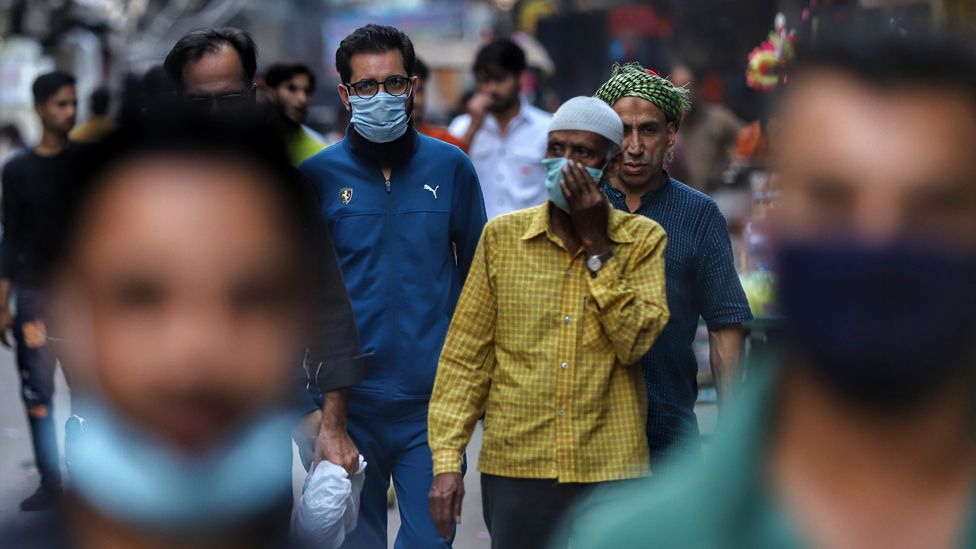
Commuters wearing masks in Delhi, India, on 14 March 2021image copyrightGetty Images
image captionA street in Delhi in early March, when, despite warnings, India’s health minister said the country was in the “endgame” of Covid-19

Warnings have in fact been repeatedly issued, including:

Despite this, on 8 March, the country’s health minister announced that India was in the “endgame of the pandemic“.

So, where did it go so wrong?

The basics

In January and February, the national number of daily cases fell to under 20,000 from peaks of around 90,000 in September last year. Prime Minister Narendra Modi declared Covid beaten, and all places of public gathering opened.

And soon, people were not adhering to Covid safety protocols, thanks in part to confused messaging from the top.

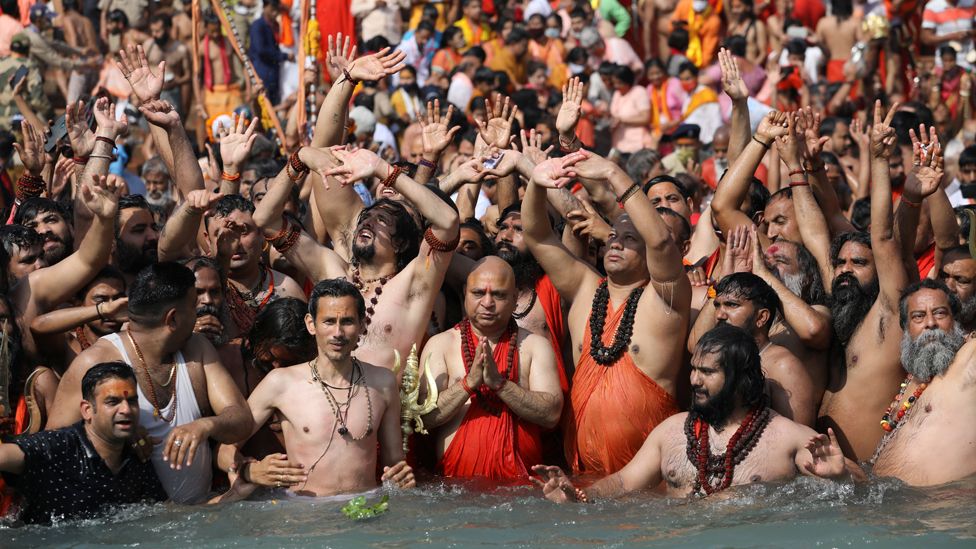
While Mr Modi asked people to wear masks and follow social distancing in his public messages, he addressed large unmasked crowds during his election campaigns in five states. A number of his ministers were also seen addressing large public gatherings without wearing masks. The Kumbh Mela, a Hindu festival – which attracts millions – was also allowed to go ahead.

People in the Ganges river in Haridwar, India, 14 April 2021image copyrightReuters
image captionThe Kumbh Mela religious festival in mid-April, which, like political rallies at the time, were attended unmasked

“There was complete disconnect between what they practised and what they preached,” says public policy and health systems expert Dr Chandrakant Lahariya.

Prominent virologist Dr Shahid Jameel says “the government just did not see the second wave coming and started celebrating too early”.

But there is more to the story: the devastation has also exposed the underfunding and neglect of the public healthcare system in India.

The heart-breaking scenes that have been witnessed outside hospitals – people dying without getting treatment – shows the grim reality of India’s healthcare infrastructure.

As one expert puts it, India’s “public health infrastructure was always broken, the rich and the middle class are just finding out”. Those who could afford it have always relied on private hospitals for treatment, while the poor struggle to get even a doctor’s appointment.

Recent schemes, like health insurance and subsidised medicines for the poor, are not helping because very little has been done in decades to increase the number of medical staff or hospitals.

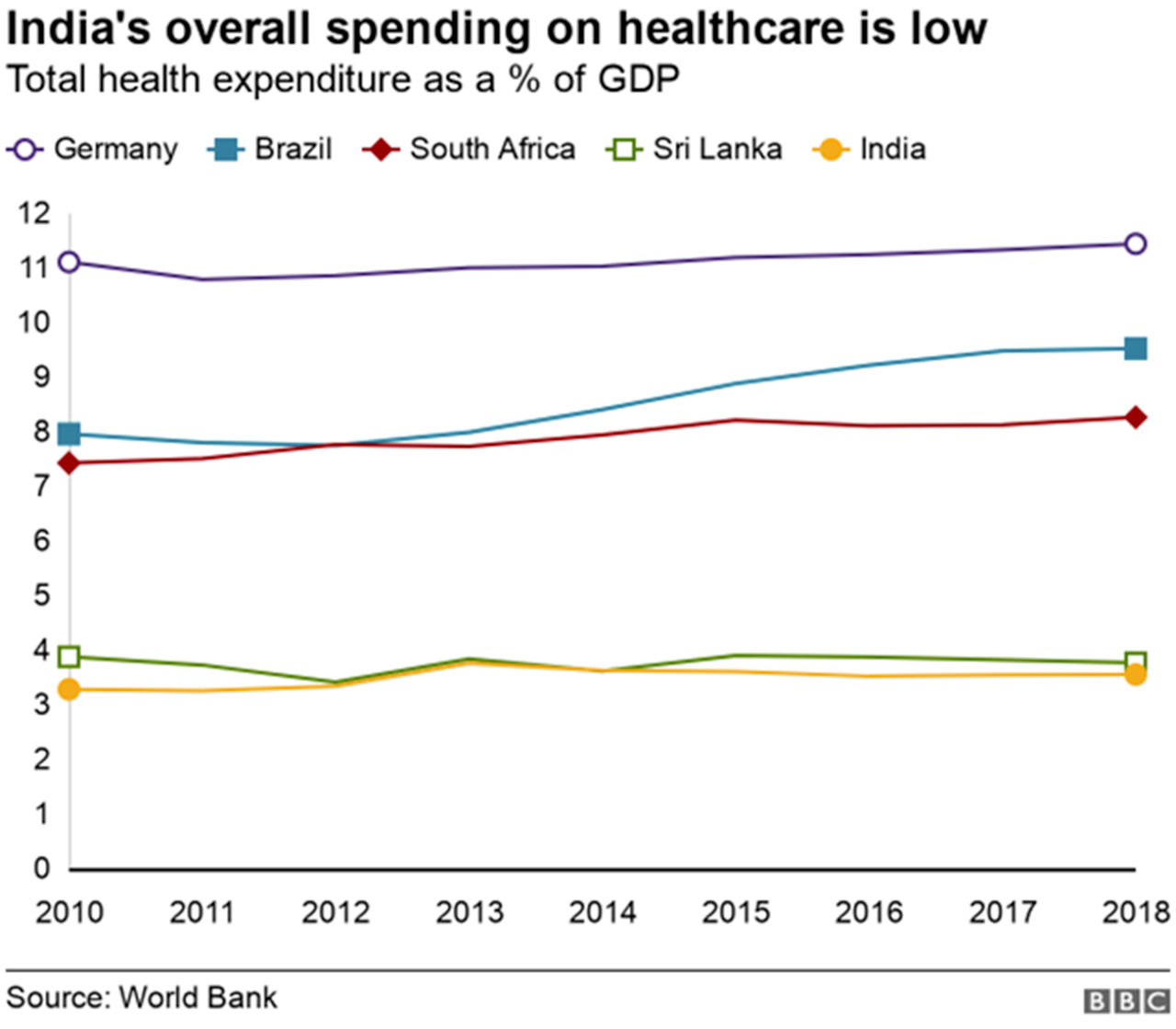
A graph comparing countries healthcare spending
Presentational white space

India’s healthcare spending, including both private and public, has been around 3.6% of GDP for the past six years, the lowest percentage in the five Brics countries: Brazil spent the most at 9.2%, followed by South Africa at 8.1%, Russia at 5.3% and China at 5% in 2018.

Developed nations spend a far higher proportion of their GDP on health. In 2018, for instance, spending in the US was 16.9% and Germany 11.2%. Even smaller nations like Sri Lanka (3.76%) and Thailand (3.79%) spend more than India.

And India has fewer than 10 doctors per 10,000 people, and in some states the figure is less than five.

Preparation

Several “empowered committees” were last year looking at the preparations needed to tackle the next coronavirus wave, so experts are baffled by the shortages of oxygen, beds and drugs.

“When the first wave was tapering, that’s when they should have prepared for a second wave and assumed the worst. They should have taken an inventory of oxygen and [the drug] remdesivir and then ramped up manufacturing capacity,” Mahesh Zagade, former health secretary of Maharashtra state, told the BBC.

Officials say India produces enough oxygen to meet the spike in demand but transportation was the problem. Experts say this should have been fixed much earlier.

The government is now running special trains carrying oxygen from one state to another and stopping use of oxygen in industries – but only after many patients died because of a lack of oxygen.

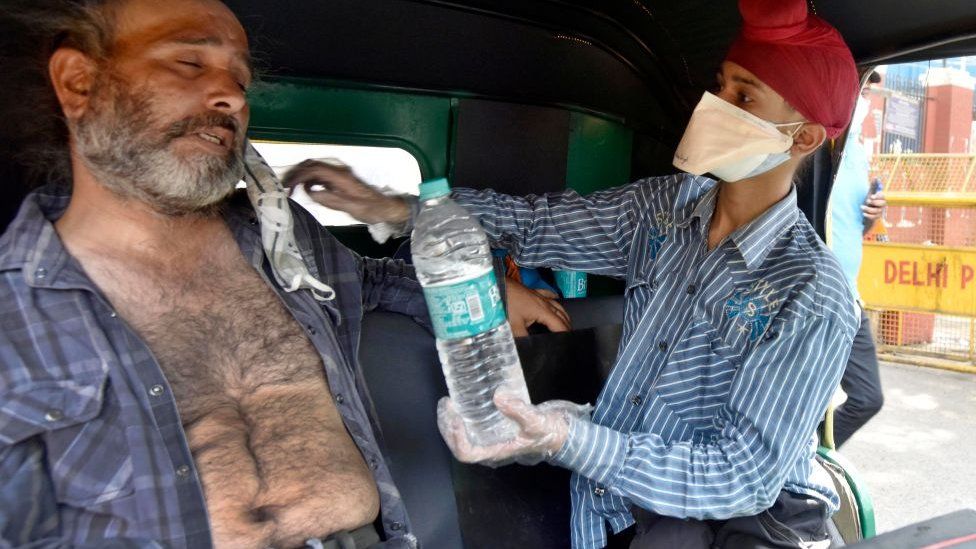
A Covid-19 patient waits for a bed outside Lok Nayak Jai Prakash (LNJP) hospital, on May 3, 2021 in New Delhi, India.image copyrightGetty Images
image captionVery ill patients have been stuck outside hospitals as they wait for beds to become available

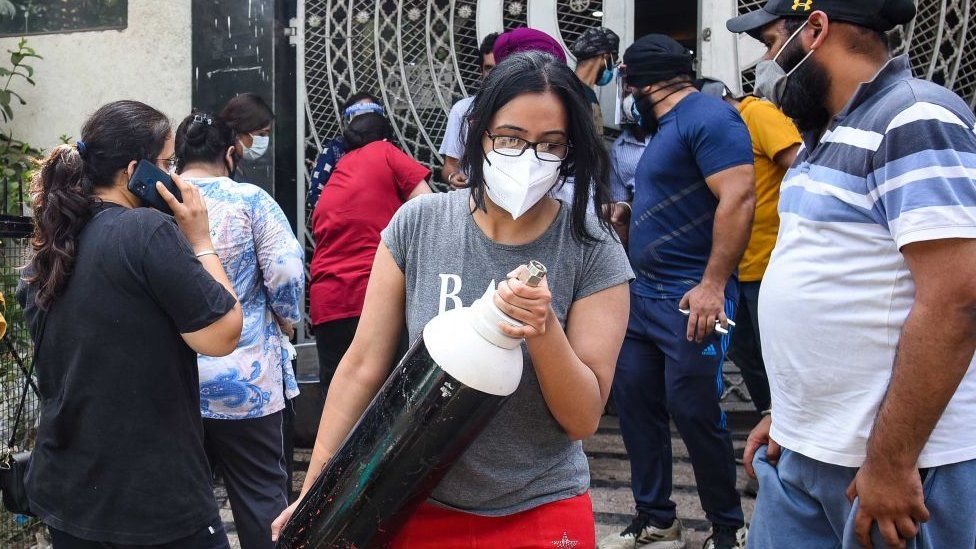
“The outcome has been that desperate family members are spending thousands of rupees to secure an oxygen cylinder on the black market and then stand for hours in a queue to get it filled,” points out Dr Lahariya.

An executive from a pharmaceutical company which manufactures remdesivir said “demand had dried up” in January and February. “If the government had placed an order, we would have stockpiled and there wouldn’t have been any shortage. We have ramped up production but demand has grown significantly,” he said.

In contrast, the southern state of Kerala planned for the surge in advance. Dr A Fathahudeen, who is part of the state’s Covid taskforce, says there was no shortage of oxygen in the state as necessary steps were taken in October last year.

A woman seen with an oxygen cylinder, outside a refilling station at Lajpat Nagar, on May 3, 2021 in New Delhi, Indiaimage copyrightGetty Images
image captionRelatives of patients have been refilling oxygen cylinders themselves

“We also procured sufficient stock of remdesivir and tocilizumab and other drugs well in advance. We also have a surge plan in place to tackle any exponential rise in the numbers in the coming weeks,” he says.

Mr Zagade says other states should have also taken similar steps “to avoid the suffering”.

“Learning means someone else has done it and you can do it now, but that means it will take time,” the former health secretary for Maharashtra said.

But time is running out as the second wave is now spreading to villages where healthcare systems are not equipped to deal with the surge.

Prevention

Genome sequencing of the virus is an important step in identifying new variants that could be more infectious and deadly. The Indian SARS-CoV-2 Genomic Consortia (INSACOG) was set up last year and it brought together 10 labs in the country.

But the group reportedly struggled to get funding initially. Virologist Dr Jameel says India started seriously looking at mutations fairly late, with sequencing efforts only “properly started” in mid-February 2021.

India is sequencing just over 1% of all samples at the moment. “In comparison, the UK was sequencing at 5-6% at the peak of the pandemic. But you can’t build such capacity overnight,” he said.

However, India’s main hope was always vaccination.

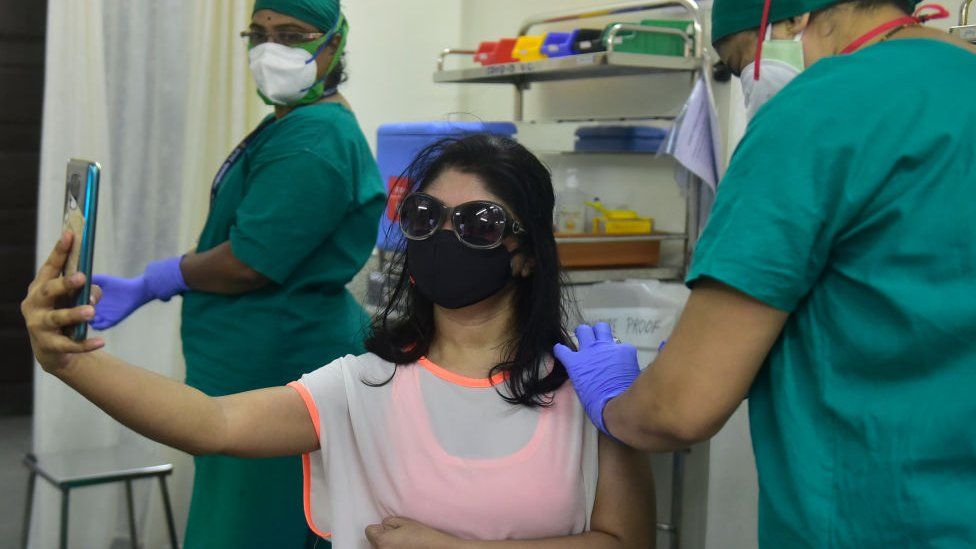
A woman taking a selfie while getting vaccinatedimage copyrightGetty Images
image captionThis woman wanted to record the moment of vaccination

“Any public health specialist will tell you there is no practical way to strengthen an already broken public healthcare system in a matter of months,” one woman, whose family runs a large private hospital in Delhi, told the BBC.

“The best and most effective alternative to battle Covid was to vaccinate the population as quickly as possible so the majority wouldn’t need hospital care and hence not overburden the healthcare system.”

India initially wanted 300 million people vaccinated by July, “but it seems the government did not do enough planning to secure vaccine supply to run the programme”, Dr Lahariya says.

“On top of it, it has opened the vaccination for all adults without securing vaccine supplies.”

So far, only about 26 million people have been fully vaccinated out of a population of 1.4 billion, and about 124 million have received a single dose. India has millions more doses on order, but still far short of what it actually needs.

The federal government needs 615 million doses to vaccinate everyone above the age of 45 – about 440 million people. There are 622 million people between the age of 18 and 44, and 1.2 billion doses are required to vaccinate them.

The government has also cancelled exports, reneging on international commitments.

The government has enlisted other firms like Biological E and the state-run Haffkine Institute to produce vaccines. It has also given credit support of $609m to the Serum Institute of India, which produces the Oxford-AstraZeneca jab which is being made in India as Covishield, to ramp up production.

But that funding should have come earlier, Dr Lahariya says, saving precious lives. “It will take months before we have enough vaccines to speed up the programme. In the meantime, millions will continue to be at risk of getting Covid,” he adds.

Experts say it is ironic that India is known as the world’s pharmacy and it is now facing shortages of vaccines and drugs.

All of this, Dr Lahariya says, should serve as wake-up call for for both federal and state governments, which should invest drastically more in the healthcare sector because “this definitely is not the last pandemic we will have to fight against”.

“The future pandemic may come earlier than any model can predict,” he says.

===============================================

WORLD STATS

Coronavirus Cases:

155,060,050

Deaths:

3,243,494

Recovered:

132,555,507
Highlighted in green
= all cases have recovered from the infection
Highlighted in grey
= all cases have had an outcome (there are no active cases)

[back to top ↑]

Latest News

May 5 (GMT)

Updates

  • 15,872 new cases and 349 new deaths in Iran [source]
  • 770 new cases and 9 new deaths in Oman [source]
  • 3,896 new cases and 349 new deaths in Poland [source]
  • 7,975 new cases and 360 new deaths in Russia [source]
  • 6,914 new cases and 19 new deaths in India [source]
  • 3,064 new cases and 395 new deaths in Mexico [source]

January 2020 – February 2020

The post Where India Went Wrong, World Stats appeared first on The St Kitts Nevis Observer.

World View: Biden- 70% Vaccinated by July, India Just Gets Worse, Cicadas Ready to Emerge, More

March 19, 2021

Alternate text


Here are today’s selection of top stories from The Associated Press at this hour.

The Associated Press

The Rundown

I'm an image

WASHINGTON (AP) — President Joe Biden set a new vaccination goal to deliver at least one shot to 70% of adult Americans by July Fourth as he tackles the vexing problem of winning over the “doubters” and those unmotivated to get inoculated……Read More

I'm an image

Since the day after the deadly Jan. 6 riots on the U.S. Capitol, former President Donald Trump’s social media accounts have been silent — muzzled for inciting violence using the platforms as online megaphones… …Read More

I'm an image

NEW DELHI (AP) — India’s hospitals were packed with coronavirus patients, relatives of the sick scrambled to find supplies of oxygen, and crematoriums were running near full capacity to handle the dead… …Read More

I'm an image

MISSION, Kan. (AP) — After more than a year of fretting over her 13-year son with a rare liver disease, Heather Ousley broke into tears when she learned that he and millions of other youngsters could soon be eligible for the COVID-19 vaccine…Read More

I'm an image

JAKARTA, Indonesia (AP) — Myanmar’s security forces moved in and the street lamps went black. In house after house, people shut off their lights… …Read More

OTHER TOP STORIES

NEW YORK (AP) — The U.S. birth rate fell 4% last year, the largest single-year decrease in nearly 50 years, according to a government report being released Wednesday… …Read More

WASHINGTON (AP) — House Republican leader Kevin McCarthy wants his party to stand firmly with Donald Trump, despite the former president’s false claims about the election…Read More

BABB, Mont. (AP) — On a cloudy spring day, hundreds lined up in their cars on the Canadian side of the border crossing that separates Alberta and Montana… …Read More

COLUMBIA, Md. (AP) — Sifting through a shovel load of dirt in a suburban backyard, Michael Raupp and Paula Shrewsbury find their quarry: a cicada nymph… …Read More

The post World View: Biden- 70% Vaccinated by July, India Just Gets Worse, Cicadas Ready to Emerge, More appeared first on The St Kitts Nevis Observer.
Brazil: Govt. Pandemic Probe Hears of President’s Faith in Malaria Drug

Brazil’s former health minister told a parliamentary inquiry on Tuesday that President Jair Bolsonaro’s right-wing government knew full well that the treatment they were advocating for COVID-19 patients had no scientific basis.

Luiz Henrique Mandetta, who was fired last April by Bolsonaro for not agreeing to push the malaria drug chloroquine as a COVID-19 treatment, testified before a parliamentary inquiry into the handling of the pandemic that has killed more than 408,000 Brazilians.

The Senate investigation is expected to hurt the president politically 17 months ahead of elections by showing the country that his opposition to lockdowns and social distancing measures, his failure to secure vaccines and the touting of unproven treatments deepened the crisis Brazil is now in.

“I warned Bolsonaro systematically of the consequences of not adopting the recommendations of science to fight COVID-19,” Mandetta told the commission.

The minister said he was called to a cabinet meeting with the president, where there was a plan to change the official indications for use of the old anti-malaria drug to say it could be prescribed for COVID-19.

Antonio Barra Torres, president of Brazil’s health regulator Anvisa who was also at the meeting, said that could not be done.

“The government was aware that it was prescribing chloroquine without any scientific evidence,” Mandetta said.

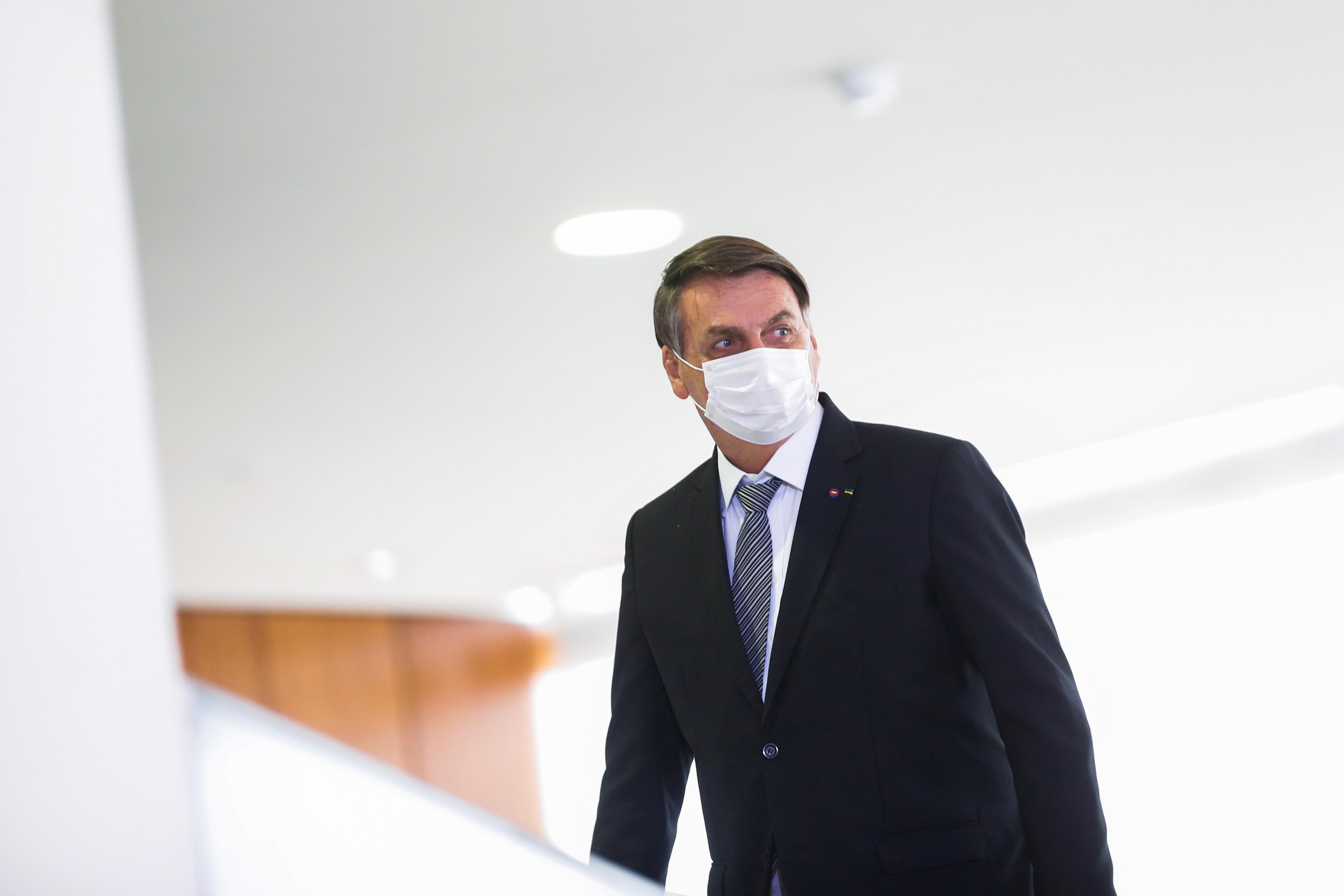
Brazil's President Jair Bolsonaro attends a promotion ceremony for generals of the armed forces, at the Planalto Palace in Brasilia, Brazil April 8, 2021. REUTERS/Adriano Machado
Brazil’s President Jair Bolsonaro attends a promotion ceremony for generals of the armed forces, at the Planalto Palace in Brasilia, Brazil April 8, 2021. REUTERS/Adriano Machado

Brazil has the highest death toll in the world from COVID-19 after the United States, and third in total coronavirus infections after the United States and India

The South American country is so short of vaccine supplies that several big cities have not been able to administer second doses. Some intensive care wards have run out of oxygen and drugs needed to sedate intubated COVID-19 patients.

The United States is working to give Brazil access to $20 million worth of medication used for patients in need of mechanical breathing assistance. The medications will come from the U.S. government’s strategic stockpile and will be delivered in partnership with the Pan American Health Organization, the White House said on Tuesday.

The Senate investigation has called up other former health ministers, including General Eduardo Pazuello, who was picked by Bolsonaro after two ministers were removed for not backing his chloroquine treatment plan.

Bolsonaro’s championing of chloroquine mirrored former U.S. President Donald Trump’s lobbying for use of the related drug hydroxychloroquine as a COVID-19 treatment despite a lack of scientific evidence of any benefit for those patients.

Bolsonaro admired Trump and shares many of his ideological views, including playing down the severity of the pandemic.

Pazuello was due to testify on Wednesday, but said he could no appear because he had been in contact with two army colonels who tested positive for COVID-19. His testimony has been rescheduled for May 19.

The post Brazil: Govt. Pandemic Probe Hears of President’s Faith in Malaria Drug appeared first on The St Kitts Nevis Observer.