By RNZ National is accusing Labour of trying to sneak through a divisive plan to set up separate systems for Māori at all levels – including in Parliament.Party leader Judith Collins made the remarks in a speech to party…
Category Archives: headline
Tavita Karika's death: Bachelorettes pay tribute, fundraiser to bring body home
Heartbroken former Bachelorettes have paid tribute to beloved contestant Tavita Antoni Karika who died suddenly this week. Their comments come after his family launched a Givealittle page in a bid to raise funds to bring Karika’s…
Pictures of the week: Pyres burn into night with India's virus victims
India's COVID-19 crisis continues to spiral further out of control, with thousands dying every day amid a crumbling healthcare system.
Deepfake nudes change the face of cyber threats
The rise of deepfake nude technology poses radical new threats to anyone who posts images and videos of themselves on the world's most popular social media sites.
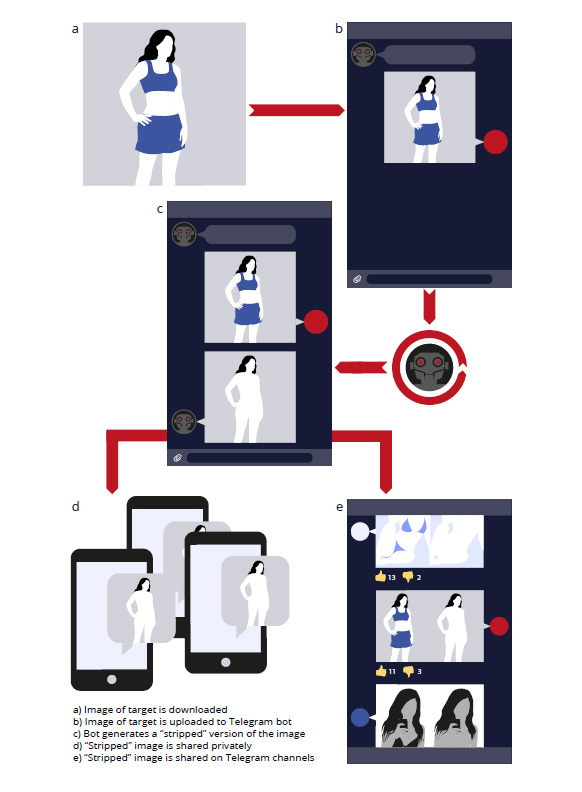
Research by Sensity, a company specialising in detecting online visual threats and cyber scams, recently uncovered a pornographic deepfake ecosystem where more than 100,000 innocent women had been stripped naked by deepfake technology.
Users inside that nefarious community only needed a single photograph of their victim.
READ MORE: Why this deepfake video of Mark Zuckerberg is bad news for Facebook
After their clothes were digitally removed and their naked bodies regenerated, images of the women were then shared amongst a massive user base on the encrypted messaging app Telegram.
Amsterdam-based Sensity chief executive Giorgio Patrini said this kind of deepfake nude threat against everyday people will only "intensify" in the future and likely play out in a number of disturbing ways, with financial and privacy implications.
"It's so easy," Mr Patrini said of the ecosystem his firm discovered, "and it only required one image, so any one of us may be attacked."
While the trove of pictures detected by Sensity were only of women, Mr Patrini said men, minors and children are also vulnerable for targeting by scammers, child abuse material creators and jilted lovers seeking to carry out acts of revenge porn.
"We had never seen this kind of technology before, this kind of accessibility and usability anywhere on the Internet," Mr Patrini said.
Deepfakes have always been the domain of skilled practitioners, who use and manipulate countless hours of video and hundreds of photos to generate increasingly difficult to spot fakes.
In recent times, deepfakes of Tom Cruise, Arnold Schwarzenegger, Jim Carrey and other celebrities have both dazzled and confused with their incredible likeness of the actual person.
Experts, too, have expressed concern that deepfakes of politicians will in the future be a nefarious tool used to destabilise elections and spread fake news and propaganda.
READ MORE: Crackdown on Fakeapp pornographic deepfake videos
But Mr Patrini was "shocked" by new technology and pioneering bots which were now moving deepfake capability into the hands of total amateurs.
"No technical skills, inexpensive, very easy to use," Mr Patrini said.
Users of the deepfake bot he discovered submitted just one image of a woman and "let the bot do its job".
Mr Patrini acknowledged the quality of the end photos was generally poor and not always convincing. But he said realistic results were possible when the woman photographed was wearing a swimsuit, and cautioned that focusing on the quality or otherwise of the fake was missing the point.
"The quality of the deepfakes is just going to get better and better," he said.
"This application learns to regenerate the parts of the body that were covered by clothes, but only if the woman was in a particular position or was semi-naked. So this was a limitation.
"But do you care if a picture is maybe pixelated but it is still generating your breasts and is spread online?
"It is still a very tough psychological attack on you and it is publicly shaming you, regardless of the quality."
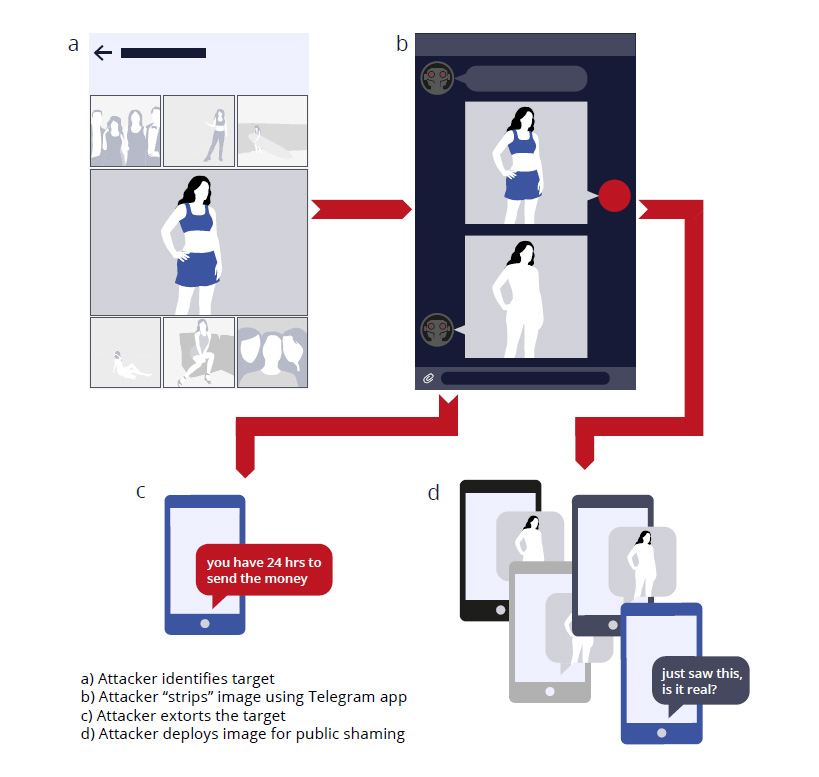
Mr Patrini said as deepfake tools became more accessible and improved, scammers would inevitably seize on the opportunity to extort bitcoin or money from a victim, by creating a deepfake nude of a victim and threatening to share it online.
His blunt message to anyone on social media is that scammers or anyone looking to inflict reputational damage can "abuse our online content and turn it against us".
A cache of personal photos and videos on Facebook, Instagram and TikTok make for easy pickings if privacy settings are left wide open, he said.
Romance scams could go next-level
Sean Duca, the Asia-Pacific regional chief security officer with cyber security firm Palo Alto Networks, has no doubt the emergence of deepfake technology has the potential to wreak havoc for individuals and nation states.
"We believe what we see with our own eyes," Mr Duca said.
The Sydney-based security expert said deepfakes will significantly amplify the risk of romance scams.
Last month alone, Australians were stripped of $1.9 million by romance scammers.
Typically, romance scams involve grooming of a victim, often someone older and single, over email or digital platforms to squeeze money from them once a connection is established.
"Now add video quality where someone looks like a legitimate person," Mr Duca said, "a good-looking guy or girl."
Deepfake apps which are capable of transposing someone else's face on top of yours during online video calls would erase any doubts in a victim's mind, he said.
"You could go through conversations and work up levels of trust with people … all of a sudden a hook comes into it, a financial request."
Workplaces and in particular employees responsible for company finances will also be a target, Mr Duca said.
The shift to virtual conferences and remote working opens up opportunities for hackers who work tirelessly to gain backdoor entries into a corporation's IT network.
Taking a video call from your boss may not be what it seems, Mr Duca said.
"All of a sudden you've got the boss sitting there telling you to do something," he said, like transferring funds to pay a client or company who doesn't exist.
"Deepfake software is going to get better and better and we are going to see advancements in AI.
"The big thing is how we develop ways to detect this."
Biometric fraud, banking and government
Wherever the money is, criminal networks are striving to be one step ahead of law enforcement.
Mr Patrini said biometric fraud, once thought impenetrable, is now at risk.
In the future, Mr Patrini said, government departments will increasingly seek to interact with us remotely and through video calls.
"So (for the government) it's about identification, identifying people and authenticating them remotely online.
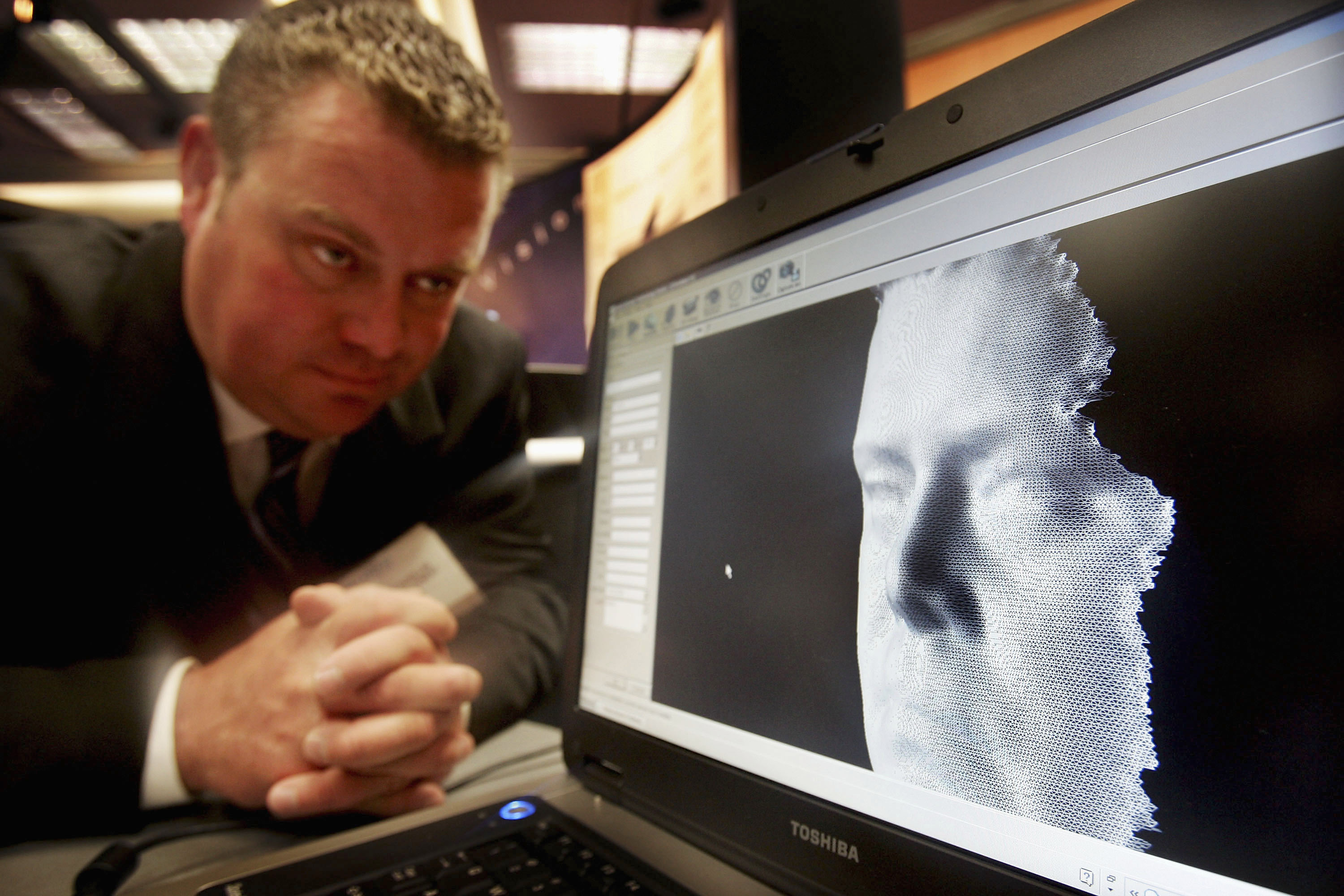
"Something we are working on at the moment is understanding the vulnerability of governments and banking to the threat of the face."
He said "having faces swapped in real time" over a webcam is a "potential catastrophic threat" for the financial system.
Mr Patrini said he hadn't detected that kind of deepfake, AI capability – yet.
"It requires some sophistication. But again, there is so much at stake, because you could move so much money, there is so much financial incentive that we believe it's just a matter of time that somebody is going to do it," he said.
"We are just at the beginning."
Nine.com.au contacted Telegram for comment.
Contact: ms******@******om.au
FOLLOW: Mark Saunokonoko on Twitter
Covid 19 coronavirus: NZ teacher stranded in Mongolia faces uncertainty about coming home
By RNZ New Zealander Mark Chapman, who is in limbo as he awaits a flight out of Ulaanbaatar in Mongolia, is trying to stay upbeat despite being uncertain when he will see his family again.Chapman is a teacher at the International…
Boy racer crash destroys fence: Trail of debris left behind as driver flees scene in Trentham, Upper Hutt
A fence is now destined for the wood box after an alleged boy racer incident ended with a vehicle leaving a path of destruction – and bits of itself – in suburban Upper Hutt early this morning.Wallaceville woman Johanne Greally’s…
Death toll rises following stampede at big Israeli religious festival
Hundreds of buses stretched over miles of winding road were ferrying thousands of worshipers off Mount Meron in northern Israel on Friday after 45 people were killed and some 150 others injured in a crush at a mass Jewish gathering overnight.
Australian Prime Minister Scott Morrison sent his condolences on behalf of the nation to those impacted by the disaster.
"I send Australia's heartfelt condolences to our friends in Israel following the tragic loss of life at Mount Meron in northern Israel, with many more injured," the PM tweeted. "You are in our thoughts as you grieve at this terrible time."
https://twitter.com/ScottMorrisonMP/status/1388064505783996424https://twitter.com/RoyalFamily/status/1388165455324581889?ref_src=twsrc%5Etfw
Queen Elizabeth also sent a message of condolence to the President of Israel.
Israeli Prime Minister Benjamin Netanyahu called the incident a "huge disaster," while paramedics described chaotic scenes of teams administering CPR en masse to people, including children, lying breathless on the ground.
Kalanit Taub, a first responder, described a "horrific scene" with "nonstop people to care for."
"I saw 20 plus CPRs ongoing at the same time," Taub told CNN. "Anywhere you looked, you saw another person doing CPR."
In the hours afterward, she said she saw people crying or staring into space, struggling to process what they had seen.
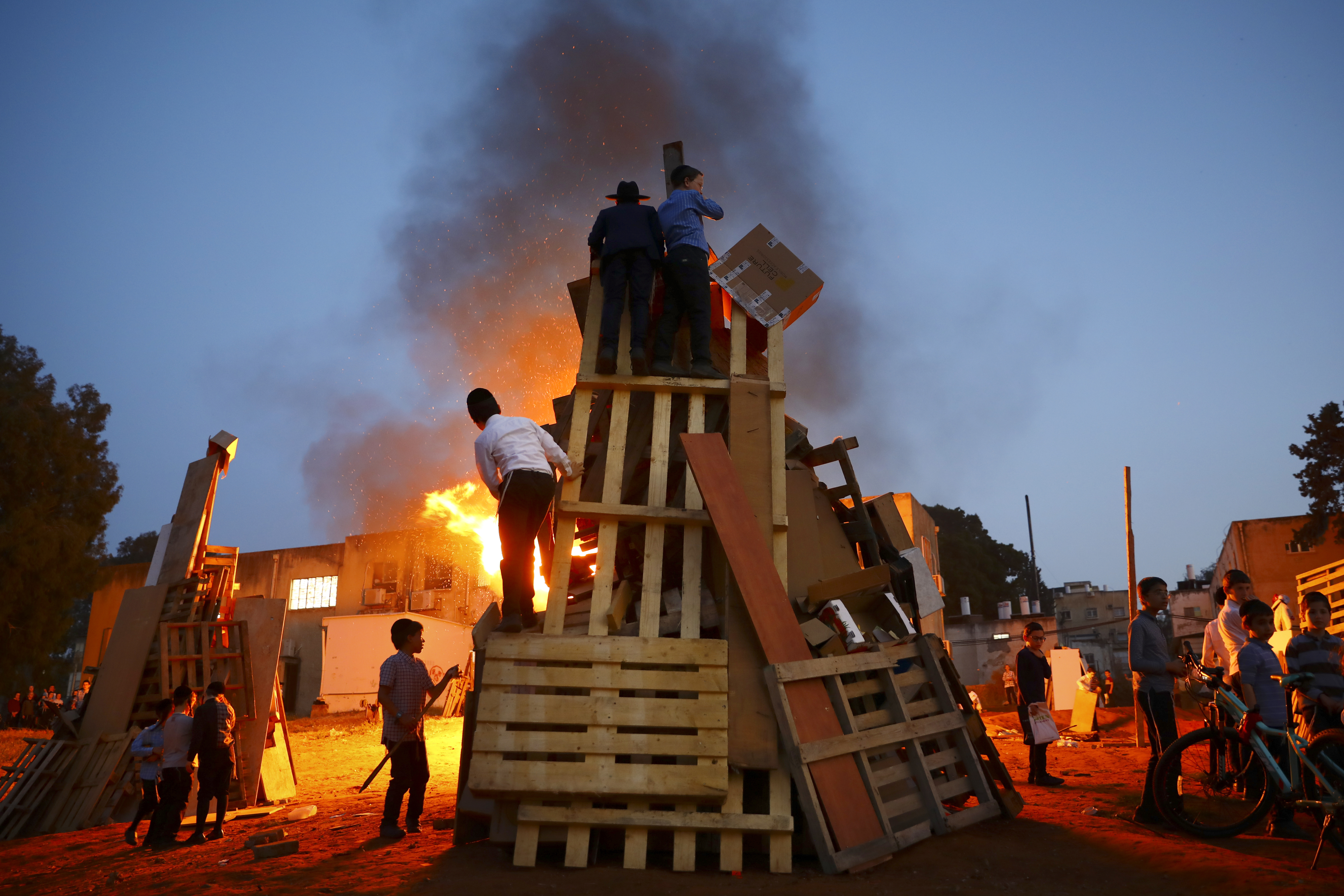
Israeli investigators are examining exactly how the crush happened at the mountain, where worshipers marked the Lag B'Omer holiday, an annual event where participants sing, dance and light fires in homage to second-century sage Rabbi Shimon Bar Yochai at his burial site.
Israel's health ministry had urged people not to attend the festival, warning of the risk of another coronavirus outbreak. However, case numbers have been low, and Israel has already fully vaccinated more than 58 per cent of its population, so the event was allowed to proceed.
Dov Maisel, vice president of operations of the volunteer-based emergency organisation United Hatzalah, told CNN that around 100,000 people were in attendance, though such numbers aren't unusual for the annual festival. Maisel said up to 400,000 people had attended in past years.
Hundreds of people were pouring into the site at the same time from different directions, leading to a "massive amount of congestion," he said. People tightly packed in a small area had fallen down a staircase and crushed each other, he added.
"Overall they usually control the crowd, but at a certain point at the peak the crowd became too tight," Maisel said. "It was simply tragic and horrific."
Social media video from the site show men and boys crammed into a narrow passageway, which may be the stairway that Maisel refers to, when it suddenly becomes clear that many are struggling to continue walking, being thrown back and forth in waves of the commotion.
Most people hospitalised have been released, Health Minister Yuli Edelstein said Friday.
Wice Israel, a participant, described to Reuters how there was "no place to move, and people started to fall to the ground, a lot fell to the ground."
Shlomo Katz, another worshiper, told the news agency: "We were going to go inside for the dancing and stuff and all of a sudden we saw paramedics from MADA … running by, like mid-CPR on kids, and then one after the other started coming out of ambulance, and then we understood something's going on here," he said.
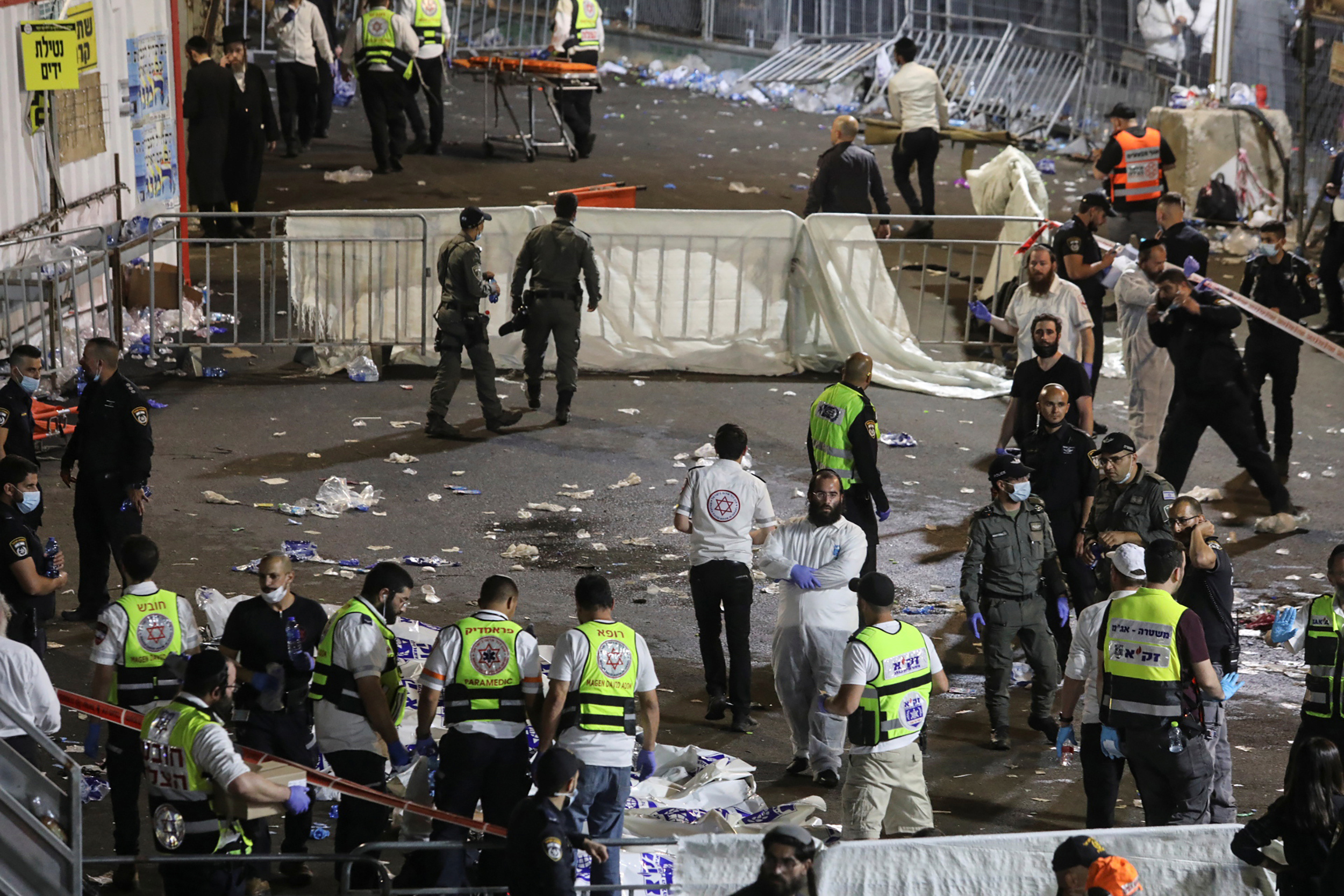
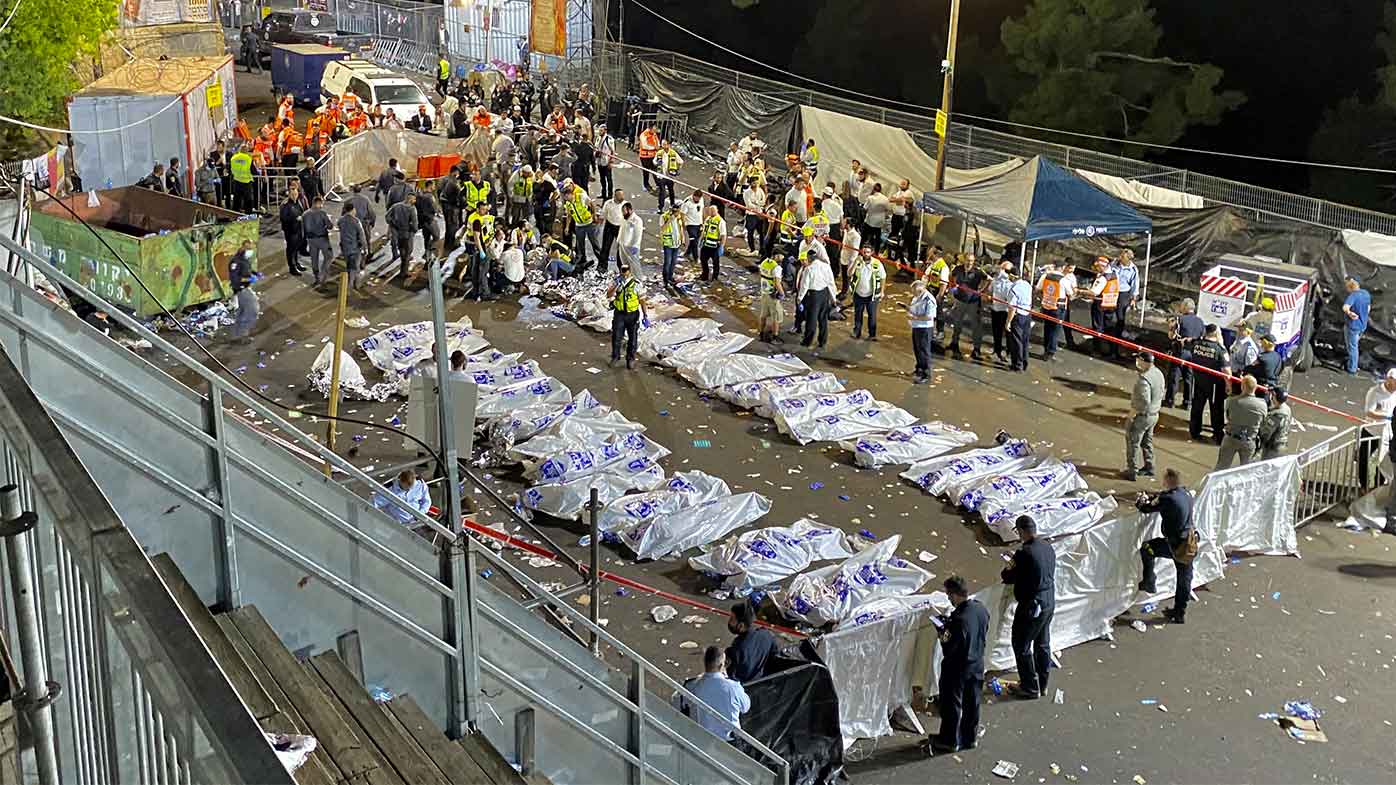
Footage from the scene showed dozens of body bags lined up on the ground, and personal items like abandoned shoes and crushed eyeglasses lying scattered on the ground at the scene.
Dozens of ambulances parked in rows, their lights flashing, were on standby to receive the many injured. Authorities said 250 ambulances had been made available to respond. Six helicopters transferred some of the wounded to hospital. Paramedics were seen running all over the area, with stretchers carrying people in need of treatment.
The local police chief told Israeli TV he accepted full responsibility for the incident.
"I take overall responsibility, for good and for bad. I am ready for every eventuality," said Shimon Lavie, Israel Police's northern commander. He said Israel's northern police command had prioritised security and public safety, but he could not explain what caused the stampede.
Lavie commended police officers who tried to help victims before patients were ferried to hospitals in ambulances and by helicopter. "Police were saving people's lives while they were also dealing with this complicated incident," he said.
Lazar Hyman, vice president of United Hatzalah, said it was one of the worst tragedies that he had ever experienced. "I have not seen anything like this since I entered into the field of emergency medicine back in 2000," said Hyman.
Prime Minister Benjamin Netanyahu said the nation was praying for the injured in the "huge disaster."
"I want to strengthen the hand of those carrying out rescue efforts and who are operating on site," Netanyahu tweeted.
Each year, hundreds of thousands of Jews — many of them ultra-Orthodox — flock to Bar Yochai's tomb site on Mount Meron, which lies in the Upper Galilee region of northern Israel, about 40 kilometres northeast of the city of Haifa. Bar Yochai's book 'The Zohar' is the foundation of Jewish mysticism.
Covid-19 coronavirus: Immediate isolation advised for Kiwis caught up in Brisbane Airport green zone breach
Some passengers on board three flights to New Zealand caught up in the Brisbane International Airport Covid-19 green zone breach have been told to immediately isolate. The Ministry of Health was last night advised by the Queensland…
Hastings architect designs an infill home for the future, in his own backyard
An architect is so passionate about creating new infill housing in Hastings, he decided to build a model for the city’s future in his own backyard.Infill and higher density housing feature heavily in the new Hastings Place Based…
India sets another new record for daily virus cases
India has set another global record with 386,452 daily coronavirus cases.
The Health Ministry on Friday also reported 3,498 deaths in the last 24 hours, bringing the total to 208,330. Experts believe both figures are an undercount, but it's unclear by how much.
India's pandemic response has been marred by insufficient data. An online appeal — signed by over 350 scientists Friday afternoon — asks the government to release data about the sequencing of virus variants, testing, recovered patients and how people were responding to vaccines.
RELATED: Stranded Australians could be jailed for trying to come home
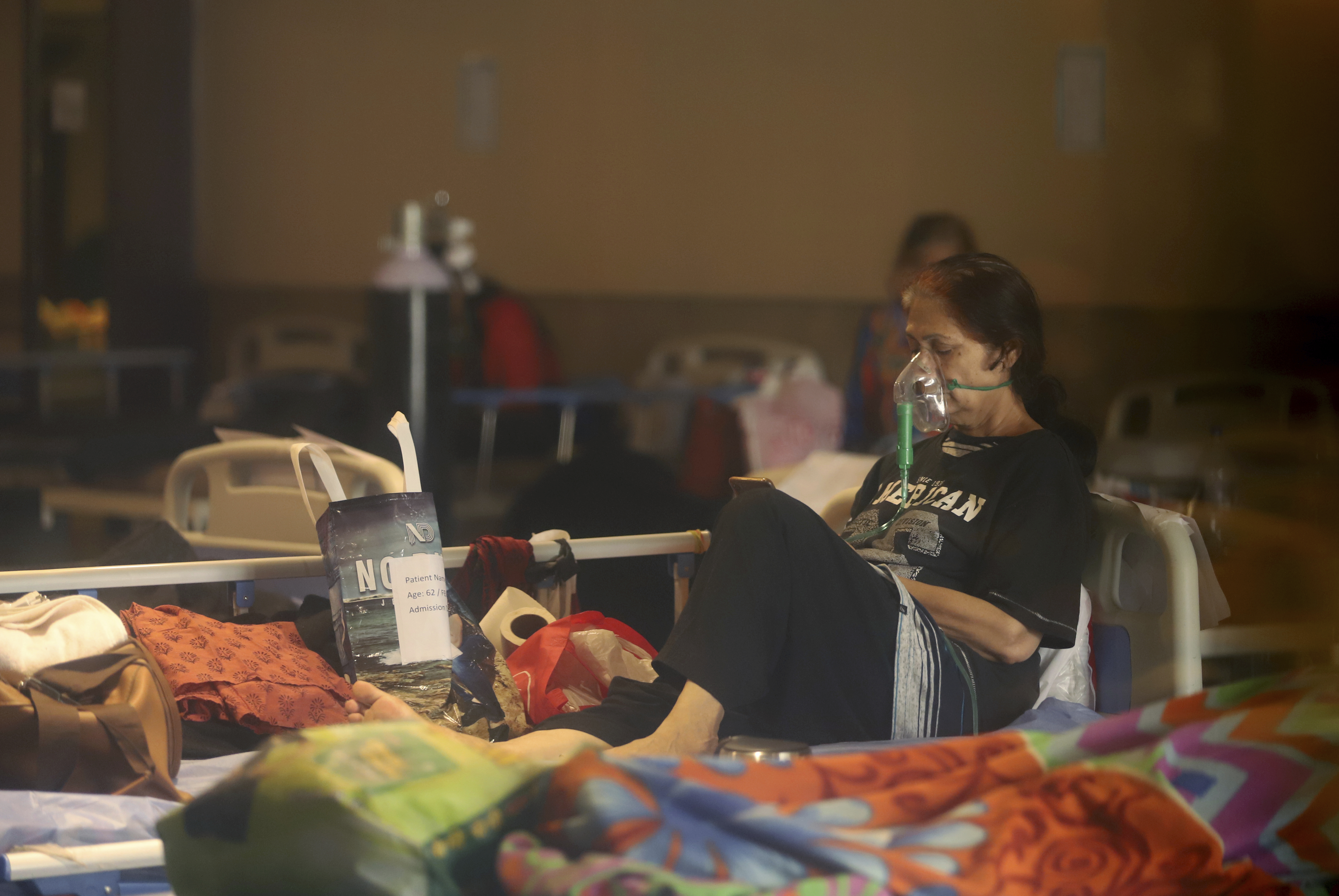
The appeal says the "granular" data on testing was inaccessible to non-government experts and some government experts too.
READ MORE: Fiji announces curfew as part of ongoing lockdown after factory worker diagnosed
India has set a daily global record for more than a week with an average of nearly 350,000 infections. Daily deaths have nearly tripled in the past three weeks, reflecting the intensity of the latest surge.
Meanwhile, families continued to flood social media and messaging apps with pleas for help: oxygen, beds, medicines, intensive care units and wood for funeral pyres.
India has reported more than 18.7 million cases since the start of the pandemic, second only to the United States. Globally, total deaths rank fourth.
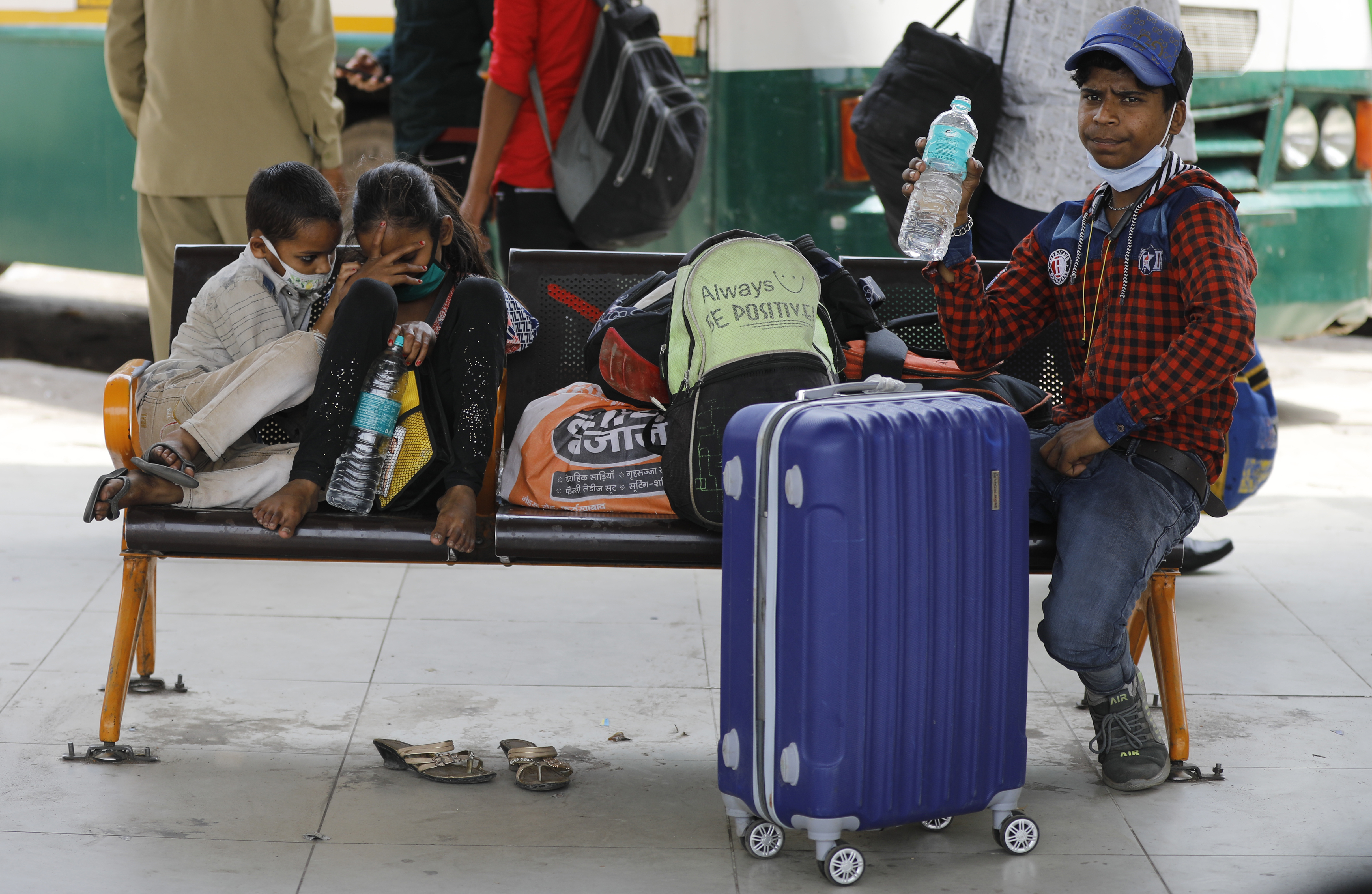
Japan said Friday it will send 300 ventilators and 300 oxygen concentrators in response to the Indian government request. "Japan stands with India, our friend and partner," the Foreign Ministry said.
France, Germany, Ireland and Australia have also promised help, and Russia sent two aircraft carrying oxygen generating equipment. The Indian air force also airlifted oxygen containers from Singapore, Dubai and Bangkok.
Chinese state media said the first batch of 25,000 oxygen concentrators pledged by Beijing to India also arrived Friday. There was no immediate comment by India but it could be a step in thawing tensions between the two countries.
The reports said China has already sent 5,000 ventilators and 21,000 oxygen generators to India.