Category Archives: headline

Coronavirus: Brazil Running Out of Crucial Drugs, Pandemic Updates, World Stats

RIO DE JANEIRO (AP) — Reports are emerging of Brazilian health workers forced to intubate patients without the aid of sedatives, after weeks of warnings that hospitals and state governments risked running out of critical medicines.

A 43-year-old patient suspected of having COVID-19 is transferred from an ambulance into the HRAN public hospital in Brasilia, Brazil, Wednesday, April 14, 2021. (AP Photo/Eraldo Peres)

One doctor at the Albert Schweitzer municipal hospital in Rio de Janeiro told the Associated Press that for days health workers diluted sedatives to make their stock last longer. Once it ran out, nurses and doctors had to begin using neuromuscular blockers and tying patients to their beds, the doctor said.

“You relax the muscles and do the procedure easily, but we don’t have sedation,” said the doctor, who agreed to discuss the sensitive situation only if not quoted by name. “Some try to talk, resist. They’re conscious.”

Lack of required medicines is the latest pandemic problem to befall Brazil, which is experiencing a brutal COVID-19 outbreak that has flooded the nation’s intensive care units. The daily death count is averaging about 3,000, accounting for a quarter of deaths globally and making Brazil the epicenter of the pandemic.

“Intubation kits” include anesthetics, sedatives and other medications used to put severely ill patients on ventilators. The press office of Rio city’s health secretariat said in an email that occasional shortages at the Albert Schweitzer facility are due to difficulties obtaining supplies on the global market and that “substitutions are made so that there is no damage to the assistance provided.” It didn’t comment on the need to tie patients to beds.

The newspaper O Globo on Thursday reported similar ordeals in several other hospitals in the Rio metropolitan region, with people desperately calling other facilities seeking sedatives for their loved ones.

It’s unclear whether the problem seen in Rio remains an isolated case, but others are sounding the alarm about impending shortages.

Sao Paulo state’s health secretary, Jean Carlo Gorinchteyn, said at a news conference Wednesday that the situation was dire in the hospitals of Brazil’s most-populous state. On Thursday, more than 640 hospitals were on the verge of collapse, with shortages possible within days, officials said.

“We need the federal government’s support,” Gorinchteyn said. “This is not a necessity for Sao Paulo; it is a necessity for the whole country.”

His state’s health officials sent nine requests for intubation medication to the Health Ministry over the past 40 days, according to a statement Wednesday. Its last delivery was enough to cover just 6% of monthly needs in the state’s public health network, officials told

Federal Health Minister Marcelo Queiroga, who took over the post last month, said Wednesday that a shipment of sedatives was expected to arrive in Brazil “in the next ten days.” It is the result of a contract signed with the Pan American Health Organization.

He said two separate efforts to acquire medications on the international market are underway “to end this day-to-day struggle.”

For many weeks, the ministry has also been facing logistical constraints on getting oxygen delivered to hospitals across the country. Queiroga said it remains “a daily concern.″

A more contagious coronavirus variant, known as P.1, has been spreading across Brazil this year. It may also be more aggressive than the original strain, and health workers have reported patients requiring far more oxygen than last year.

The private sector has stepped up to help address some of the supply shortfall. A group of seven large companies donated 3.4 million doses of intubation drugs — enough for the management of 500 beds for six weeks — to the Health Ministry.

A first batch of 2.3 million was scheduled to arrive from China late Thursday at Sao Paulo’s international airport and would be distributed to states with critical shortages, the ministry said in an emailed response to AP questions about supply bottlenecks.

Last month, the Health Ministry requisitioned intubation medications from laboratories, reportedly as a means to distribute to the neediest hospitals. That has caused others facilities’ stocks to dwindle, said Edson Rogatti, director of an association of more than 2,000 hospitals nationwide.

“If we run out, the health sector will be in chaos,” Rogatti said on Globo News TV.

Shortages aren’t limited to the public sector. Brazil’s private hospital association published a survey Thursday in which nine of 71 institutions reported having supplies for five days or less. About half said they had enough for a week.

Private facilities are looking to import medications from India, but still need regulatory approval, the association told AP.

The city of Itaiopolis in southern Santa Catarina state this week reported shortages of both sedatives and oxygen. Neighboring Rio Grande do Sul state also reported supplies running out.

“The situation is desperate,” Rio Grande do Sul’s health secretary, Arita Bergmann, said in a statement Thursday. “We urgently need the Health Ministry to replenish hospitals’ stocks, or else intubated patients can wake up without medication, and that would be terrible.”

================================================

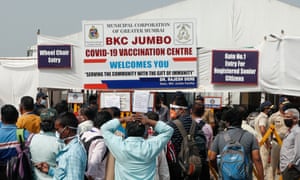
People queue outside a vaccine centre in Mumbai. Photograph: Francis Mascarenhas/Reuters

The coronavirus lockdowns and restrictions that Michigan’s governor, Gretchen Whitmer, enacted in March last year were among the nation’s toughest, and the governor’s leadership is thought to have saved lives. It also drew high marks from many in the state.

The same approach proved effective last fall when the second wave hit. Now, as Michigan faces another surge of cases and hospitalizations, its worst yet, Whitmer has changed tack.

Despite past success and growing calls for another lockdown from public health experts, and doctors managing hospitals with Covid patients, the governor is resisting further restrictions, and is instead largely relying on a vaccination rollout and a voluntary suspension of in-person dining services.

Several factors are driving the new approach, experts say. Among them is a growing sense of pandemic fatigue, and sustained pressure from conservatives. Eroding support from independents and Whitmer’s looming 2022 re-election race have also played a role. Many of those bearing the economic brunt of her lockdowns are donors and influential business leaders, said Bill Ballenger, a Michigan political analyst, and the governor appears to have been “scared straight”.

“I really do think the constant pressure over the last year is catching up, not just from the right and conservatives, but there are a growing number of people in the population, including independents and business persons who are Democrats, who are really angry at Whitmer,” Ballenger said.

The pressure to remain open continues even as cases and hospitalizations rise, putting Whitmer in an exceedingly difficult position. The surge hit soon after she lifted restrictions in early March, and Michigan’s two-week per-capita caseload now leads the nation. The state reached a bleak mark on Tuesday when over 4,000 people were reported hospitalized – the highest daily total of the pandemic. A high number of cases from Covid variants is also fueling the surge.

Among supporters strongly urging the governor to once again put restrictions in place are Dr Abdul El-Sayed, the former director of the Detroit health department. He noted that an increase in deaths has followed spikes in caseloads and hospitalizations, and said a new lockdown “would have a profound impact over the next couple weeks”.

He said: “Governor Whitmer showed a tremendous level of leadership last spring and fall, and that came with a lot of political blowback from conservatives, but she did the right thing – evidence shows that she saved lives, and we need that leadership now.”

Read more of Tom Perkins’ report from Detroit: ‘Alarm is growing’: Michigan governor faces shutdown dilemma as Covid cases rise

The post Coronavirus: Brazil Running Out of Crucial Drugs, Pandemic Updates, World Stats appeared first on The St Kitts Nevis Observer.
Mexican Grass: Growers Not Happy About Planned Canabis Legalization

BADIRAGUATO, Mexico (AP) — For the first time that María can remember, half of her marijuana harvest is still in storage on her ranch in Mexico’s Sinaloa state months after it should have been sold.

Sitting in her wooden house tucked into the same mountains that produced some of the world’s most notorious drug traffickers, including Joaquín “El Chapo” Guzmán, the 44-year-old mother of four thinks she knows why: expectations Mexico will soon legalize marijuana.

“It has never happened to us where we harvest and have it (stored) in sacks,” said María, who asked that her full name not be used and her exact location not be revealed because in the mountains surrounding Badiraguato, where organized crime controls everything, misspeaking can be dangerous.

Mexican legislation awaiting final Senate approval, which now may not come before September, would legalize pot production and sale for recreational use while creating a private market regulated by the government. Medicinal use is already legal.

The effort has generated uncertainty among families who have cultivated the crop for generations and throughout the trade. Growers expect the price of marijuana to drop further and think their trade will become economically unfeasible. They say in the past five years, the price they get has been halved. Everyone is waiting to see how the drug capos will respond to a new legal business. Meanwhile, half of María’s crop sits unsold.

Marijuana has become less lucrative each day compared to the cartels’ revenue from synthetic drugs like fentanyl. Demand and the price for pot fell when several states in the U.S. legalized it, though Mexico is still the top foreign supplier to U.S. consumers, according to a recent report by the U.S. Drug Enforcement Administration.

Here in Sinaloa’s mountains, some farmers have stopped growing marijuana. Others are focusing on higher-quality strains that fetch a higher price or they continue to grow it, but along with opium poppies, hoping at least one of them will keep them afloat.

María has been working between the tall leafy plants since she was 16 and says she even fell in love among them. At her house, surrounded by fruit trees and chickens, the family doesn’t lack food, but the income from marijuana pays for everything else over the course of the year, from clothing to cellphones to her children’s schooling. Her eldest just got his degree in computer science.

For her family and many others, the concern is not whether marijuana is legal, just that it keeps providing income.

“Since we heard they were going to legalize (marijuana) we began to make the poppy plots larger,” María said. But that didn’t work.

In February, their main poppy crop was destroyed. They had planned to live off the revenue from it for a year. Hearing the military helicopters approach, María took her picture of Saint Jude, the patron saint of lost causes, off the wall and ran to the field to place it among the red flowers. The saint couldn’t save them from the effects of the herbicide.

Two months later, María’s husband worked among marijuana plants more than 3 feet high planted among the dead poppies. It’s all they’re able to water with drip irrigation fed by extra water from the house.

“This little plot is from another seed and it is going to sell, they say, because it’s better quality,” María said.

The marijuana they managed to sell from the previous harvest yielded $500, or about $25 per kilogram. In contrast, the poppies that were destroyed would have produced about $5,000 worth of opium gum.

The drug trade has brought a lot of money to inhabitants of these mountains over the years, but also a lot of problems.

María remembers the years of bonanza when the family was able to buy some cows, which were later sold to pay for her children’s education. Her husband recalls periods of violence when rival groups killed and terrorized locals in an attempt to control the area.

The couple wants a different future for their kids. But asked if she can imagine a time when the mountains are no longer tied to drug trafficking, María’s 18-year-old daughter says, “never.”

The ties are strong and numerous.

Years ago, María’s husband smuggled marijuana across the U.S. border in a backpack. Her daughter’s boyfriend moved marijuana from Phoenix into the U.S. interior.

As María prepared chicken soup, “narcocorridos,” the ballads chronicling the exploits of drug traffickers, sang of the “heirs of Mr. Guzmán,” who is serving a life sentence in the U.S.

Guzmán’s sons control this area, according to experts.

Five days after an AP team visited the area, Mexican marines carried out an operation near the birthplace of Rafael Caro Quintero, another notorious trafficker released in 2013 from a Mexican prison where he was serving time for the murder of a DEA agent. But otherwise there was little government presence and the area appeared calm, though watched closely by lookouts.

One of the arguments Mexican politicians cite in their efforts to legalize recreational use of marijuana is reducing violence. Some experts are not so sure this will happen, but say shrinking the black market and the income of organized crime would be positive.

The objective “is not to end the illegal market, because that’s not going to happen in the first years,” but rather reduce it as much as possible, said Zara Snapp, an international drug policy consultant and co-founder of Instituto RIA, a public policy think tank in Mexico.

Nongovernmental organizations like Snapp’s believe there needs to be a stronger social justice component to Mexican legislation.

“If the communities decide not to (move to the legal market) it is because there aren’t sufficient economic reasons,” she said.

While María prays to St. Jude and hopes her small remaining plot of marijuana carries her family through, in another part of the mountains a skinny 39-year-old man has been growing a strain of marijuana that sells at 10 times the price of the traditional Mexican marijuana because it has a much higher psychoactive content.

If the man, who also requested anonymity, is able to get two harvests — and the army doesn’t find it like it did two years ago — he will have 110 pounds of high-quality marijuana that should yield $15,000. It’s not easy money.

“From the time you plant until you sell it, you’re fighting,” he said.

Water is scarce. He pays two workers to be on the ranch, look after the plants and later carefully cut the the strong smelling reddish buds that he and others will then weigh and package.

The man has been working in marijuana since he was 9 years old. His partner also comes from the business, but a different branch. “My dad was a money launderer,” he said casually.

Decades ago, marijuana was such big business that it was carried out of the mountains on airplanes that landed on dirt roads. Now the man and his partner drive it to the state capital of Culiacan and sell it there.

“You have to go to who’s in charge and give him half or sell it all to him” to avoid problems, he said.

For the man — as with María — the important question isn’t legalization but the numbers, income numbers.

“If they pay me the same — or almost — being legal, well great. You’ll work more at ease,” he said.

The post Mexican Grass: Growers Not Happy About Planned Canabis Legalization appeared first on The St Kitts Nevis Observer.

Media tycoon Jimmy Lai jailed in Hong Kong over China protest

Nine of Hong Kong’s leading pro-democracy advocates were sentenced to jail terms Friday for organising a march during the 2019 anti-government protests that triggered an overwhelming crackdown from Beijing.

Those sentenced include the city’s so-called “father of democracy” Martin Lee as well as pro-democracy media tycoon Jimmy Lai.

They were found guilty earlier this month of organising and participating in a massive protest in August 2019, where an estimated 1.7 million people marched in opposition to a bill that would have allowed suspects to be extradited to mainland China for trial.

The protest was not authorised by the police.

Their convictions and sentencing were the latest blow to the city’s flagging democracy movement, amid an ongoing crackdown by Beijing and Hong Kong authorities on dissent in the semi-autonomous Chinese city.

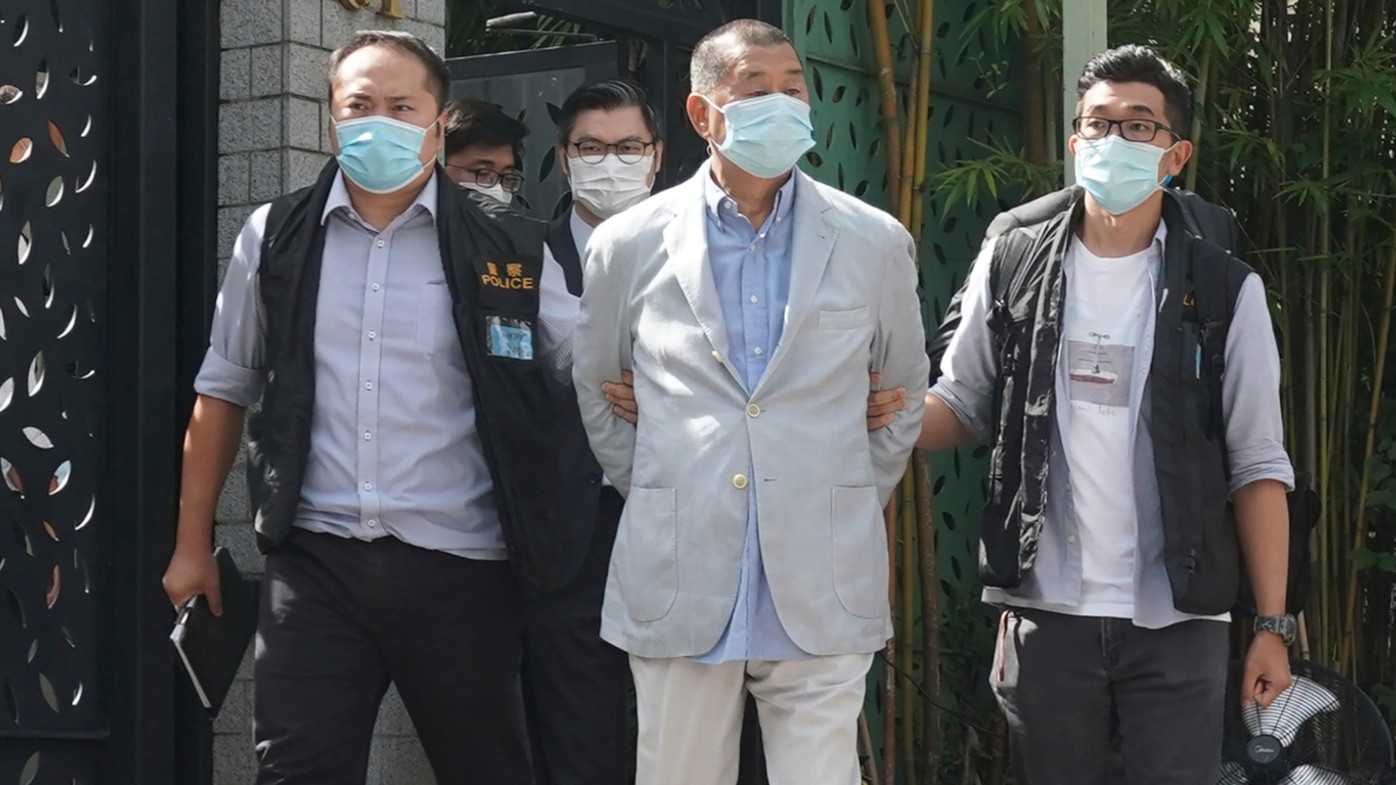
Hong Kong media tycoon Jimmy Lai has been arrested.Australia suspends extradition treaty with Hong Kong

Lee, an 82-year-old lawyer and former lawmaker known for his advocacy of human rights and democracy in the city, had his sentence of 11 months in prison suspended after his age was taken into consideration.

Lai, the founder of Hong Kong’s Apple Daily tabloid, was sentenced to 12 months in prison. Prior to sentencing, he was remanded in jail on other charges, including collusion with foreign forces to intervene in the city’s affairs — a new crime under a national security law imposed on the city in 2020 by the central government in Beijing.

Lee Cheuk-yan, a pro-democracy activist and former lawmaker known for helping to organise annual candlelight vigils in Hong Kong on the anniversary of the bloody crackdown on pro-democracy protests in Beijing’s Tiananmen Square in 1989, was sentenced to 12 months in prison.

Lawyers Albert Ho and Margaret Ng both had their 12-month jail sentences suspended. Former lawmaker Leung Kwok-hung was sentenced to 18 months, while another former legislator, Cyd Ho, was given a jail sentence of eight months.

Two other former lawmakers, Au Nok-hin and Leung Yiu-chung, who previously pleaded guilty were also given jail sentences. Au was sentenced to 10 months in prison, while Leung’s eight-month jail term was suspended.

China's new political view of Hong Kong

Beijing had pledged to allow the city to retain civil liberties not permitted in mainland China for 50 years after the former British colony reverted to Chinese rule in 1997, but recently has ushered in a series of measures, including a national security legislation and electoral reforms, that many fear are a step closer to making Hong Kong no different from cities on the mainland.

China accuses Australia of interference

Under the new rules, Hong Kong residents can be held legally liable for any speech opposing China's government and the ruling Communist Part or perceived colluding with hostile foreign political groups or individuals.

Electoral changes mean just 20 out of 90 Legislative Council members will be directly elected and Beijing will retain even tighter control over the body that picks Hong Kong's future chief executives.

St Vincent Fears COVID-19 Outbreak with Volcano Evacuations

yesterday

KINGSTOWN, St. Vincent (AP) — Officials in St. Vincent said they were extremely worried about a COVID-19 outbreak given the lack of water and more positive cases being reported as thousands of evacuees fleeing the erupting volcano crowd into shelters and private homes.

About a dozen cases have been reported in recent days, with at least five evacuees staying in two homes and one shelter testing positive, exposing at least 20 people to the virus, said Dr. Simone Keizer-Beache, chief medical officer on the Caribbean island.

Keizer-Beache said officials are preparing to do massive testing as part of contact tracing, a complicated undertaking given that between 16,000 to 20,000 people were evacuated before La Soufriere’s explosive eruptions started on Friday. She also urged people to keep wearing masks and asked them to cooperate, noting that some who arrive at shelters do not want to be tested, which is voluntary.

“Let us work together to prevent a second catastrophe,” she said in a press conference broadcast by local station NBC Radio.

Complicating efforts to fight COVID-19 is the lack of water in some communities given the heavy ashfall, with people walking or driving to spigots with buckets and jugs in hand as long lines formed.

Among those in line was Suzanne Thomas, a 46-year-old saleswoman from South Union, a community in eastern St. Vincent that has been hit with water shortages since Saturday. She had welcomed nine evacuees into her home who are huddled together, sleeping only on rugs and blankets.

“It’s real rough. We have to use one jug of water to shower, brush your teeth and flush the toilet,” she said, laughing as she added: “Water conservation.”

Others, like 17-year-old Kevin Sam, said they’ve had no water at all since Saturday: “I’m glad that these stand pipes are available, ’cause I don’t know what we would’ve done. It’s not easy to bathe with half a bucket.”

Meanwhile, supplies were non-existent or running low at some government shelters.

Lisa May, 36, said she and her three children were sleeping on the floor at a shelter in the capital of Kingstown and hoped they would soon have at least one mattress to share: “Any little help we get, we (would be) grateful.”

More than 4,000 people are staying in 89 government shelters. Meanwhile, the government so far has registered more than 6,000 evacuees in private homes, a number that keeps growing, said Prime Minister Ralph Gonsalves.

He said he worries about an uptick in COVID-19 cases in certain areas given dwindling water supplies or complete lack of water.

“If we’re not careful, we’re going to have a spike, which could create a real danger in addition to what we’re having with the volcano,” he said. “Washing your hands when you don’t have a lot of water is problematic.”

Garth Saunders, director of St. Vincent’s utilities company, said crews are still cleaning intakes of the island’s water and sewer system and expected water to reach more communities later Thursday, adding that ashfall has been very heavy. Neighboring islands and organizations also have shipped water to St. Vincent, where officials have distributed water bottles and dispatched water trucks.

Long lines formed at those trucks and at money transfer companies, with some standing for hours to retrieve cash from loved ones.

“I’ve been here since 4:30 this morning,” said Joseph King, a 67-year-old plumber, adding that he was tired and hungry.

La Soufriere is expected to keep erupting for days or even weeks, with a scientific team expected on Thursday to estimate the amount of gases expelled by the volcano and gather samples of pyroclastic flow material. Those analysis will tell scientists how the volcano is behaving and help them guess what it’s likely to do in the future, said Richard Robertson, who is leading the team for the University of the West Indies’ Seismic Research Center.

The volcano had a minor eruption in December, and prior to that erupted in 1979. A previous eruption in 1902 killed some 1,600 people.

_

Coto reported from San Juan, Puerto Rico.

The post St Vincent Fears COVID-19 Outbreak with Volcano Evacuations appeared first on The St Kitts Nevis Observer.

Biden With Stiff New Sanctions Against Russia for Cyber Attacks

The White House has announced sanctions against Russia and the expulsion of Russian diplomats in response to Moscow’s interference in US elections and the cyber breach to vital federal government agencies last year.

The measures announced Thursday include sanctions on six Russian companies that support the country’s cyber activities and on 32 entities and individuals for disinformation campaigns and carrying on government interference in the 2020 US presidential election. The executive order also expels 10 Russian diplomats, some of whom are suspected intelligence officers.

The announcement includes the first retaliatory measures against Moscow for the cyberhack known as the “SolarWinds” breach, in which Russian hackers are believed to have used malicious code that enabled them to access the networks of at least nine US agencies and US companies. The US additionally named the Russian Foreign Intelligence Service and several connected entities as being responsible for SolarWinds. US officials believe this was an intelligence-gathering operation.

The post Biden With Stiff New Sanctions Against Russia for Cyber Attacks appeared first on The St Kitts Nevis Observer.

US: Biden’s Main Foreign Policy Goals: China, Middle East, Russia

The Hill- President Biden’s early months in office have been dominated by his domestic agenda as the nation tries to recover from the coronavirus pandemic.

Biden has expended most of his time, energy and political capital on passing the $1.9 trillion COVID-19 relief bill and on beginning the process of selling an even larger infrastructure package.

But the world beyond America’s borders is already knocking on his door — not least in the shape of the influx of migrants that have brought the U.S. immigration system to the point of crisis.

Here are five other major foreign policy challenges that Biden faces.

  • Countering the rise of China

China is a singular threat to the U.S. position of global dominance.

Its economy could supplant America’s as the world’s largest by the end of this decade.

Beijing has also been expanding its influence massively in trade and investment in other nations. And it has been flexing its military muscle.

An initial conversation between Biden and Chinese President Xi Jinping in February lasted two hours. The tension between the two sides was plain, with Biden pressing Xi on human rights and the Chinese leader bridling at what he sees as Washington’s meddling in its internal affairs.

The president has cast the battle for supremacy with China as one of pivotal importance. Last month, Biden said it was up to the U.S. to prove that “democracy works.”

Derek Grossman, a senior defense analyst at the Rand Corporation, pointed to a whole number of points of strain — including the fate of Taiwan, tension in the South China Sea, and the perennial struggles over intellectual property and cyber espionage — to conclude that “unfortunately U.S. China-relations are at perhaps their lowest point since the establishment of diplomatic relations in 1979.”

What can Biden do about it?

China’s economy is not going to suddenly shrink. But Grossman is among those emphasizing Beijing’s vulnerabilities, including a relative lack of allies around the world — and the amount of resources it spends surveilling and controlling its own people.

Biden is expected to play a long game, too, firming up alliances in the hope of containing Chinese spheres of influence.

The Trump administration followed a similar path, but that also came with incendiary rhetoric from the former president about “the China virus” and starting trade wars.

  • Exploring a return to the Iran nuclear deal

Former President Trump pulled the United States out of the Iran nuclear deal in 2018. Tehran breached the terms of the accord the following year, having complied up until that point.

The original deal, signed in 2015, had been painstakingly stitched together by Iran, the United States, five other major nations and the European Union.

Now distrust is rife. But the Biden administration is hoping that things can get back on track. On Thursday, the State Department said the U.S. was “prepared to take the necessary steps” to restore the deal, including “lifting sanctions that are inconsistent” with the accord.

The problem is that there is plenty of ill feeling lingering from the Trump-era breach.

Trita Parsi, an Iran expert and executive vice president of the Quincy Institute for Responsible Statecraft, noted that careful choreography was required since both the U.S. and Iran are demanding verification that the other side will follow through on its promises.

While the reasons for Washington’s skepticism of Tehran are well known, “you have on the Iranian side a tremendous loss of confidence in the U.S. as a whole — not only because of what Trump did but because they are not confident the U.S. has the capacity to fulfill its obligations,” Parsi said.

The arduous path to a resumption of the deal will also be played out against a tense backdrop. In late February, Biden ordered airstrikes against Iran-backed militias in Syria.

  • Seeking progress between Israel and the Palestinians

The Biden administration announced last week that it would restore aid to the Palestinians, which had been frozen during his predecessor’s time in office.

That decision alone will likely result in the flow of about $235 million to the Palestinians.

The decision was criticized in Israel — and by some in Washington.

Much of the aid will be administered through the United Nations Relief and Works Agency (UNRWA). Israel contends that UNRWA harbors an anti-Israel agenda, citing examples including the textbooks it supplies to schools.

Meanwhile, some Republicans in Congress contended that Biden should have used the offer of restoring aid as a bargaining chip with the Palestinian Authority.

The Trump administration had pushed a vigorously pro-Israel position, including a purported peace plan helmed by the president’s son-in-law and senior White House adviser Jared Kushner that went nowhere.

The Biden administration may temper that position, but there is no sea change at hand — notably, the new administration has said it will not reverse Trump’s decision to move the U.S. Embassy from Tel Aviv to Jerusalem.

More broadly, a stable solution to the long struggle between Israel and the Palestinians has proved elusive. It’s been almost three decades since former President Clinton watched then-Israeli Prime Minister Yitzhak Rabin and then-Palestine Liberation Organization leader Yasser Arafat shake hands and sign the Oslo peace accords on the White House lawn.

The optimism of those days is long gone, and there is no compelling reason to think it is about to return.

Complicating the issue further, the Israeli government is in flux, with Prime Minister Benjamin Netanyahu trying to patch together a coalition to keep him in power.

  • The Russia question

Foreign policy experts are divided on how serious a threat Russia really poses to the United States.

On one hand, its election meddling has been a huge story since Trump won in 2016. And Moscow is capable of causing Washington real embarrassment — it is almost universally blamed for the SolarWinds hack that targeted thousands of American security networks, including major government departments.

Doubters cast Russia as a nation straining to preserve an illusion of greater strength than it actually possesses. The economy of the former superpower does not rank among the 10 largest in the world, lying below those of Italy and Canada, among others.

Biden has promised to be tougher on Russia than was Trump. And he caused a mini-furor last month by agreeing with a description of Russian President Vladimir Putin as “a killer.”

The Biden administration announced new sanctions against Russian officials last month, contending that the Kremlin’s intelligence services were responsible for poisoning opposition leader Alexei Navalny. There is also some talk of a cyber counterstrike in response to the SolarWinds hack.

  • Clarity on Cuba

Biden faces competing pressures on Cuba.

Hawks — mostly but not universally Republican — want the new president to continue Trump’s hard line on Cuba. This included designating the government in Havana as a state sponsor of terrorism.

Sens. Ted Cruz (R-Texas), Marco Rubio (R-Fla.) and Rick Scott (R-Fla.) are among those advocating for this position, and Democratic Sen. Bob Menendez (N.J.) is another long-standing hard-liner on Cuba.

But 80 House Democrats have also pushed Biden to return to the more open posture toward Cuba pursued by former President Obama. Restrictions on travel and remittances were lifted by Obama, who in 2015 also reopened the U.S. Embassy in Havana, which had been closed for 54 years.

Politically speaking, the direction of U.S. policy toward the island, with a population of 11 million, would not be so important were it not for the pivotal importance of Cuban American voters in the key swing state of Florida.

Biden performed poorly in Florida last November, though there is some evidence that this was rooted more in a successful GOP effort to tar Democrats as “socialists” rather than in the nuts and bolts of Cuba policy.

Professor William LeoGrande, a Cuba expert at American University in Washington, D.C., praised Obama’s approach as “extraordinarily successful” at encouraging cooperation on areas of mutual interest.

“Now, if your criteria is ‘Did Cuba become a multiparty democracy?’ the answer is obviously no. But neither did it become one during the 60 years of hostility before.”

White House press secretary Jen Psaki recently said that a shift in Cuba policy is “not currently among President Biden’s top priorities.”

During the 2020 campaign, Biden said he would “in large part … go back” to Obama’s approach between the U.S. and Cuba.

In office, he appears to be setting a more cautious course.


The Memo is a reported column by Niall Stanage.

The post US: Biden’s Main Foreign Policy Goals: China, Middle East, Russia appeared first on The St Kitts Nevis Observer.

US to Coordinate with NATO on Troop Withdrawal from Afghanistan

US Secretary of State Antony Blinken and Defense Secretary Lloyd Austin are meeting with NATO officials in Brussels to discuss a withdrawal of the military alliance from Afghanistan, after two decades of war.

President Biden is expected to announce later on Wednesday the symbolic date of Sept. 11 as a new deadline to pull US troops out of Afghanistan.

Blinken said despite the withdrawal, neither the US nor NATO are abandoning Afghanistan, where approximately 7,000 NATO forces and an additional 2,500 US troops remain. “Together, we went into Afghanistan to deal with those who attacked the date approached, it became clear that the withdrawal was improbable.

us …, ” Blinken said. “And together, we have achieved the goals that we set out to achieve. And now it is time to bring our forces home.”

The Trump administration had previously set a deadline for withdrawal for US troops from Afghanistan for May 1.

With the forthcoming withdrawal, many are anxious about what this could mean for Afghanistan’s future in terms of security. Who is going to govern Afghanistan if there is no peace agreement? Will the country descend into civil war? These are just some of the questions on the minds of many Afghans these days.

The post US to Coordinate with NATO on Troop Withdrawal from Afghanistan appeared first on The St Kitts Nevis Observer.