SAO PAULO (AP) — A Brazilian Supreme Court justice ordered the Senate on Thursday to investigate the government’s handling of the coronavirus crisis and the full court ruled that churches can be barred from reopening during the pandemic, threatening to further strain tensions between President Jair Bolsonaro and the judiciary.
The order by Justice Luis Roberto Barroso for a Senate probe came only minutes after the whole court upheld the power of local authorities to prevent churches and other houses of worship from opening.
Bolsonaro has downplayed the threat of the coronavirus while arguing that the economic and emotional impacts of shutdowns would harm more Brazilians than the pandemic. He has at times bristled at the checks and balances from other branches of government, and has repeatedly criticized the Supreme Court for upholding the power of governors and mayors to establish restrictions on economic and personal activity during the pandemic. Last year, he attended protests against the court.
The conservative president, a proud Christian who has the support of some of the country’s main evangelical leaders, has opposed locally imposed lockdowns and other restrictions that health experts have said were sorely needed to halt the virus’ spread. In recent weeks, Brazil has become the epicenter of the pandemic crisis, accounting for more than one-quarter of the world’s deaths from COVID-19.
“The inquiry will call scientists from all over Brazil to testify and show how irresponsible the president’s statements were. It will get tougher for him. Public opinion will be heard at the Senate,” said Carlos Melo, a political science professor at Insper University in Sao Paulo. “It was unavoidable. The time came for the political system to react.”
With the country’s death toll rising — among the 345,000 dead are three senators — more than the required 27 senators had already signed a request for a congressional investigation into the administration’s handling of the pandemic, but moving forward required approval by the chamber’s president, Sen. Rodrigo Pacheco. Pacheco, who won his leadership post in January with Bolsonaro’s support, had refrained from triggering the probe.
“It wasn’t the moment. That’s what I think,” Pacheco told reporters in Brasilia after the judge’s order. “This inquiry at this moment will be out of bounds. It might crown the national failure in this pandemic.”
Pacheco said a probe will inevitably drag forward the 2022 presidential race in which Bolsonaro is expected to seek reelection, giving opposition senators a platform for attacking the leader and potentially accusing him of committing crimes.
The Senate is to look at how the government dealt with the COVID-19 crisis, and could level new criticism at Bolsonaro. If senators decided there was anything criminal in the response, the Senate would have to ask the federal attorney general to open its own investigation.
The ruling on houses of worship doesn’t prevent local authorities from allowing churches to reopen, and some have already done so.
But the court acted after Justice Kassio Marques, the court’s only member appointed by Bolsonaro, allowed churches across Brazil to reopen Saturday provided they followed health protocols. Many churches opened on Easter Sunday, some without observing social distancing.
Marques was overruled by his colleagues in a 9-2 vote that culminated Thursday.
Justice Gilmar Mendes said during his vote that Brazil has become “an international pariah in matters of health care.”
“Brazil, which was once a role model in public health, in immunization campaigns, is today in this highly embarrassing situation,” he said.
SAN JUAN, Puerto Rico (AP) — Puerto Rico’s health secretary announced Thursday that all public and private schools in the U.S. territory would close for two weeks amid a surge in COVID-19 cases.
The closures would go into effect April 12, roughly a month after some 100 of the island’s 858 public schools were authorized to reopen for the first time in a year amid the pandemic. Only kindergarteners, special education students and children in first, second, third and 12th grades were allowed to return to school. They attend in-person classes only twice a week and are dismissed before noon, with school cafeterias remaining close.
The announcement was praised by some health experts, teachers and parents who worried about an increase in infections and had warned that reopening schools was a rushed decision.
Health Secretary Carlos Mellado said that while no COVID-19 breakouts were identified at any of the schools, the move is necessary given the recent spike in cases.
The island of 3.2 million people has reported more than 200,000 confirmed and suspected cases and more than 2,000 deaths.
More than 1 million vaccines have been administered since inoculations began in December, and starting on April 12, all those 16 years and older can be vaccinated. Currently, only those 35 to 49 years old with chronic health conditions are authorized to receive a vaccine, along with all those 50 and older.
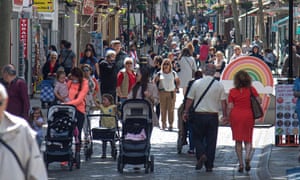
GUARDIAN (UK) Gibraltar has become one of the first places in the world to vaccinate the bulk of its adult population against Covid-19, allowing virus restrictions to be lifted and life to almost return to normal.
AFP report that since the end of March, masks are only required in enclosed public spaces, shops and on public transport. And a curfew between midnight and five am was also lifted, boosting business at bars and restaurants which only reopened on 1 March after months of restrictions.
Popular spots are once again buzzing with people enjoying a meal or a drink. Gino Jimenez, chairman of the Gibraltar Catering Association who also runs a popular eatery, said it was “especially gratifying” to see vulnerable seniors finally “out of their homes and safe”.
People walk without wearing face masks in Gibraltar. Photograph: Cristina Quicler/AFP/Getty Images
Gibraltar Chief Minister Fabian Picardo announced Thursday that rules restricting gatherings to no more than 16 people will be eliminated as of 16 April 16. And as of Monday there will no longer be any limit on the numbers who can sit together at a bar or restaurant.
In Gibraltar, with a population of 34,000, the pandemic claimed 94 lives, most this January and February, and infected nearly 4,300 residents. But thanks to the vaccine drive, there have been no virus-related hospitalisations for more than two weeks
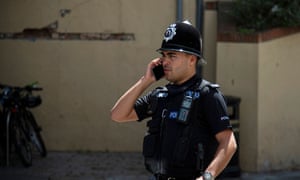
A British police officer talks on the phone without a protective face mask in Gibraltar. Photograph: Cristina Quicler/AFP/Getty Images
Since “Operation Freedom” began in January, Gibraltar has fully inoculated 85 percent of the population. “It is a huge relief,” Health Minister Samantha Sacramento told AFP at her office atop the only hospital. She credits the enclave’s small size and a steady supply of vaccines – Pfizer and AstraZeneca – for the swift rollout.
“During the first weeks, we were vaccinating seven days a week. It was literally a conveyer belt,” said Sacramento, the only woman in Gibraltar’s cabinet. Frontline hospital staff and elderly care home residents and workers were the first in line.
Those who receive both doses of the jab are issued with a vaccination card that can be used to attend mass events or to travel. Last week Gibraltar’s Victoria Stadium welcomed 600 fully-vaccinated people for the territory’s World Cup football qualifier against the Netherlands.
The crowd during the World Cup qualifying match between Gibraltar and the Netherlands. Photograph: Hollandse Hoogte/REX/Shutterstock
And on 27 March, 500 spectators watched a top heavyweight boxing match at Gibraltar’s Europa Sports Complex. In both cases, fans also had to test negative on the day of the event.
Rafael Cordon, a 63-year-old chef who commutes daily to work in the British territory from the Spanish town of San Roque said he was grateful to Gibraltar for being able to get fully vaccinated so quickly. He said there was now a big contrast between both places.
Being in Spain, where mask-wearing in public is compulsory and night curfews are in place, is “like being inside a fishbowl where your movements are limited,” he said. “Then you cross over to this side and it is like going from one world to another. This is an oasis right now.”
As the US aims to ramp up inoculations to win the race against Covid-19 variants, more than 1 in 4 adults are now fully vaccinated. Officials and experts hope to get Americans vaccinated quickly as lockdown fatigue takes its toll and many people are letting down their guard just as more transmissible, and perhaps more deadly, variants of the virus become dominant. In that effort, all 50 states have committed to opening vaccinations to all Americans 16 and up by 19 April.
The US is still averaging above 60,000 new cases a day – a level Dr Anthony Fauci, the director of the National Institute for Allergy and Infectious Disease, said puts the US at risk for another surge. Experts are especially concerned about the spread of the B.1.1.7 variant, first identified in the UK and now the dominant strain in the US.
“I wish we had another three or four months before this B.1.1.7 variant surge started to occur,” Dr. Michael Osterholm, director for the Center for Infectious Disease Research and Policy at the University of Minnesota, said this week.
As states including California and Vermont plan to fully reopen this summer, experts are warning that to truly declare victory against the variants, Americans need to get vaccinated and continue measures like social distancing and mask wearing.
Maria Kiselyova for Reuters reports that Russia’s Sputnik V coronavirus shot is less effective against the South African variant – but the manufacturer is claiming that it still does better than other vaccines
The lead scientist behind it, Alexander Gintsburg, has been cited by the Interfax news agency as saying: “With regards to the ‘South African’ strain, the effictiveness of the antibodies produced by Sputnik V, like all other vaccines, against it declines.”
The Sputnik V shot has become embroiled in a controversy in Slovakia, where the health agency has claimed that the vaccines delivered to it are not the same as the Sputnik V vaccines that were tested in clinical trials.
===============================================
Australia Frustration
There is a lot of frustration in Australia about the distribution of vaccines not matching the efficiency with which the country initially tried to squash Covid. Christopher Knaus reports for us:
Australia could have been manufacturing vaccines like Pfizer already had it acted early on calls to develop onshore mRNA capability, experts say.
The AstraZeneca announcement on Thursday has left the vaccine rollout in a state of disarray, and heavily reliant on securing more imports of the Pfizer/BioNTech vaccine, which has already achieved provisional approval by the Therapeutic Goods Administration.
Unlike the AstraZeneca vaccine, which can be produced at CSL’s Melbourne facilities, there is no current capability to produce mRNA vaccines in Australia.
For months, the Australian Academy of Science and mRNA experts have urged the Australian government to help develop a domestic mRNA manufacturing capability. That capability has not been developed.
In February, the academy used a pre-budget submission to warn Australia and the region would be vulnerable to supply limitations without the ability to produce mRNA vaccines.
Associate professor Archa Fox, a leading mRNA expert with the University of Western Australia, said it was frustrating that the country was yet to develop mRNA manufacturing capability.
But she said it was not too late.
Fox said it was difficult to be too critical of government, given the uncertainty around the various vaccine candidates – particularly the relatively new RNA vaccine technologies – in the early stages of the pandemic.
“It is a little frustrating because even if lots of people jumped in now, it still would take at least probably a year, even with plenty of investment,” she told the Guardian. “But that’s not too late for boosters against variants and all that sort of stuff.”
Even with manufacturing capability, the government still would have needed to achieve a licensing agreement with pharmaceutical companies to produce local versions of their mRNA vaccines.
The Serum Institute of India (SII) is legally compelled to ship coronavirus vaccine to global vaccine sharing facility COVAX, its co-lead Gavi has told Reuters, a provision that could complicate the SII’s efforts to boost domestic supplies. Gavi is a public–private global health partnership which says it has the goal of increasing access to immunisation in poor countries.
India, where infections have surged to 13.06 million, suspended all major exports of vaccines last month to fill demand at home, forcing the world’s biggest vaccine maker to divert nearly all its production to the domestic market, and meaning reduced supplies for nations expecting vaccine shipments.
“The agreement is legally binding and served as a basis for the first-round allocation document, which has been communicated to all participating economies,” a Gavi spokeswoman said in an email to Reuters.
The pact specified Gavi would receive from SII 1.1 billion doses of either the AstraZeneca vaccine or that of Novavax , with 200 million committed, and the rest on option. SII partner AstraZeneca has already issued it a legal notice over delays to other shipments, even as many Indian states have complained of a shortage facing priority recipients.
From an initial August target of vaccine coverage for 300 million of its highest-risk people, or just over a fifth of its population of 1.35 billion, India has upped the figure by about 100 million, adding pressure on SII to crank up supplies.
India could resume vaccine exports by June, the firm’s chief executive, Adar Poonawalla, told the media this week. However he also said that the Indian government needed to provide the SII with financial assistance, as the revenue lost from being unable to export was hampering efforts to ramp up production.
On Thursday, the foreign ministry said domestic demand would determine the extent of India’s exports. It has already shipped 64.5 million doses and given out 92 million at home.
Hong Kong has confirmed this morning that it has requested AstraZeneca suspend delivery of its Covid-19 vaccine amid fears of side effects and concerns over its efficacy against new variants of the coronavirus.
Hong Kong’s health chief Sophia Chan said the city has asked AstraZeneca not to deliver as planned later this year. “We think it is not necessary for AstraZeneca to deliver the vaccines to the city within this year,” she said, adding Hong Kong wanted “to avoid any waste as vaccines are in short supply globally”.
Hong Kong’s Secretary for Food and Health Sophia Chan. Photograph: Isaac Lawrence/AFP/Getty Images
Hong Kong has already secured a decent supply of vaccines for its 7.5 million residents, with deals for 7.5 million shots each with BioNTech/Pfizer and China’s Sinovac, both of which have begun deliveries.
Chan said Hong Kong was also keen to look at other vaccines that may have stronger results against newer strains of the coronavirus.
Earlier this week David Hui, a leading public health expert and government adviser, called for Hong Kong to replace AstraZeneca with a new single dose vaccine made by Johnson and Johnson.
People queue up outside a vaccination center for BioNTech in Hong Kong earlier this week. Photograph: Vincent Yu/AP
While it has a steady supply of vaccines, take up has been slow amid swirling distrust of the government. So far just 529,000 people have had their first dose. There has also been public concern that China’s Sinovac vaccine received fast-track approval despite not publishing its clinical trial data in a peer reviewed journal.
Worries over the AstraZeneca shot have spread worldwide after Europe’s medicines regulator said this week it could cause very rare blood clots in some recipients, prompting some countries to stop giving it to people under a certain age.
An extremely quick snap from Reuters here, that Finland plans to gradually ease the country’s Covid-19 restrictions towards the summer.
Prime minister Sanna Marin added a note of caution at a news conference this morning though, saying that the spread of the virus is still severe and that the restrictions should not be lifted prematurely.
==============================================
UK transport secretary: public could now ‘start to think’ about foreign holidays
The UK’s transport secretary Grant Shapps has said that the public could now “start to think” about foreign holidays this summer.
Asked if people could start to book foreign holidays now, he told Sky News: “I’m not telling people that they shouldn’t book summer holidays now, it’s the first time that I’ve been able to say that for many months.
“But I think everybody doing it understands there are risks with coronavirus and of course actually, I think people would want to be clear about which countries are going to be in the different traffic light system.
“So there is only two or three weeks to wait before we publish that list itself. But yes, tentative progress, for the first time, people can start to think about visiting loved ones abroad, or perhaps a summer holiday.
“But we’re doing it very, very cautiously, because we don’t want to see any return of coronavirus in this country”, PA report him saying.
There’s a grim despatch from Agence France-Presse about the situation in the Philippines this morning. In a bid to slow the spread of the virus and decongest hospitals, authorities in the Philippines last month ordered more than 24 million people in the capital and four neighbouring provinces to stay home unless they are essential workers.
A week after lockdown was imposed, 70-80 percent of hospital beds for Covid-19 patients were full, while ICU beds were “almost 100 percent” occupied in most of the capital, Health Undersecretary Maria Vergeire said.
“It’s a dire situation – it is the worst nightmare of a hospital manager happening in reality,” said Jaime Almora, president of the Philippine Hospital Association.
Leland Ustare, an anaesthesiologist at St Luke’s Medical Center, said some patients were spending days in the emergency room waiting for an intensive care bed. “This time is even worse than last year,” Ustare said, referring to the first few months of the pandemic. The numbers are really worse.”
AFP report that the government is distributing modular tents to struggling hospitals and re-deploying health workers from regions where virus transmission rates are low. Isolation facilities were being expanded to include schools and hotel rooms for mild cases in an effort to ease the burden and stop the virus spreading in crowded households.
Almora said the problem in hospitals was a lack of health workers, not beds. “The hospitals have the capacity, they have the beds, but they cannot expand their capability because of the manpower problem,” he said.
Some nurses have resigned out of fear of catching the virus or gone abroad to work in hospitals where the risks were the same but the pay higher, he said. Government insurance restrictions on copayments was also deterring smaller facilities from accepting Covid-19 patients, Almora added.
The country’s caseload of more than 828,000 – the second highest in Southeast Asia – is expected to top a million before the end of April. President Rodrigo Duterte, whose government has been under fire over its handling of the pandemic and vaccine rollout, warned last week of “bleak months” ahead.
======================================
Australians left in lurch as AstraZeneca Covid vaccine advice changes
States and territories have been left scrambling to respond to government advice recommending against vaccinating anyone under 50 with the AstraZeneca Covid-19 vaccine, leaving tens of thousands of people in the lurch.
On Friday, New South Wales halted its AstraZeneca rollout entirely for several hours while patient consent forms with the latest information about the rare risk of severe clotting associated with the vaccine were added. The state’s rollout for people aged 50 and over has since resumed.
“As with all other vaccines, informed consent is required before administering Covid-19 vaccines, ensuring recipients make decisions based on an understanding of the risks and benefits,” a NSW health spokesman said. “AstraZeneca vaccinations for those aged 50 years and over will recommence later today.”
Meanwhile Western Australia has barred anyone under the age of 50 from getting the AstraZeneca vaccine. The chief health officer, Andrew Robertson, said effective from Friday: “People under 50 who are booked in to receive their AstraZeneca vaccine will have their appointments cancelled.”
People in the 1a and 1b vaccination program cohorts – including health workers – who are under 50 and have already received their first AstraZeneca vaccine, should “not be alarmed” and proceed to get their second jab, he said. “You should not cancel your second vaccination booking,” he said.
The Tasmanian government put an immediate hold on any first dose AstraZeneca vaccinations for people aged under 50, with the premier, Peter Gutwein, saying the state government was working through what the latest advice would mean for the ongoing rollout.
The advice to the federal government from the Australian Technical Advisory Group for Immunisation (Atagi) does not say all people under 50 should not receive the vaccine, but rather says the alternative Pfizer vaccine is “preferred”. The difficulty is Australia has low supply of the Pfizer vaccine, and GPs can not readily offer it to everyone as an alternative.
By Louise Ternouth of RNZ A new Covid-19 vaccination clinic in Ōtara, South Auckland, could be vaccinating five times the number of people that are booked in. South Seas vaccination clinic, in the old Manukau Institute…
Two helicopters have been deployed to locate a missing person after a boat overturned at Tikitiki, north of Gisborne.Police were notified at 5pm this evening that a boat had overturned south of the Tikitiki river mouth.Two people…
By Tess Brunton of RNZ Tougher penalties and fines are on the cards as part of a proposed crackdown on irresponsible freedom camping.Tourism Minister Stuart Nash has released a plan to hike the costs for those who break the…
A manhunt is underway after a 16-year-old boy was stabbed and left to die in Brisbane's CBD.
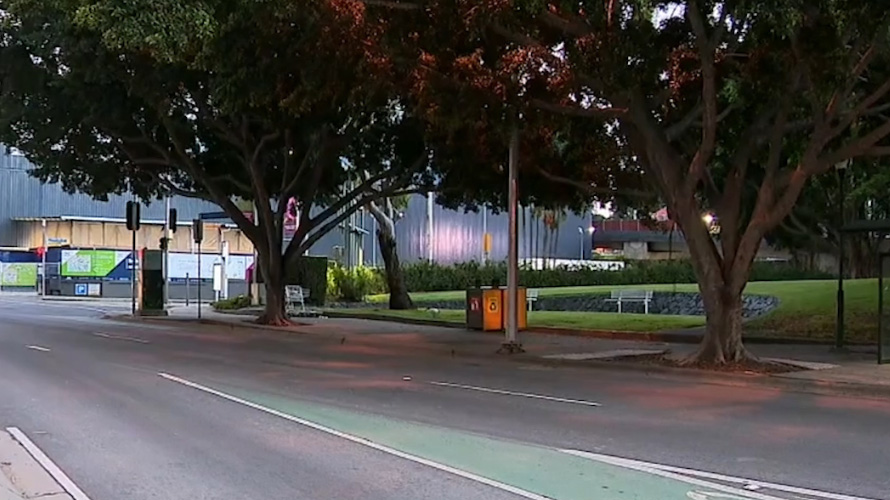
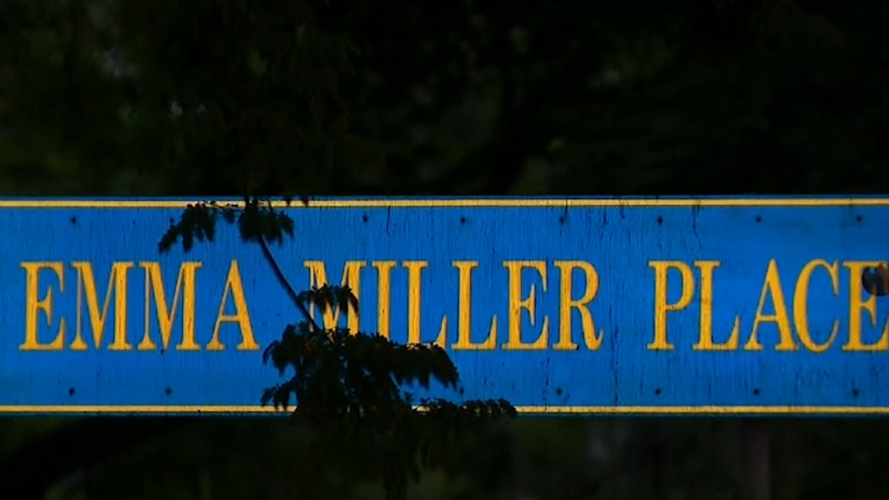
Yannis Leulusso is understood to have been ambushed by a man who stabbed him once in the stomach with a large machete about 8pm in Emma Miller Place near Roma Street.
The attacker then fled the scene.
The teen ran to the city's King George Square to get help, and paramedics were called.
He was taken to the Royal Brisbane and Women's Hospital but died three hours later.
The search for the teen's killer is ongoing. 9News understands he fled through Roma Street Parklands and has not been found.
The Woodcrest State High student has been described as the "life of the party" by friends, some of whom were there in Brisbane's CBD last night when he was killed.
"I just hope his family's okay. We love him, we miss him," one friend said.
Detectives are focusing on whether Yannis was a member of a low-level street gang and was attacked by a rival group.
Western Australians along a 1400 kilometre stretch of coastline are being warned to get out or batten down, as two cyclones are set to hit coastal communities this weekend.
In a very rare occurrence, two separate cyclones – Cyclone Seroja and Cyclone Odette – have become intertwined and are now spinning around each other about 500km off the coast of WA.
A former tropical low, Cyclone Odette strengthened into a cyclone this morning, becoming the seventh such weather event to be named in the Australian region so far this season.
Cyclone Seroja is currently a Category One storm but is expected to strengthen into a Category Three by the time it makes landfall on Sunday.
Residents from Perth all the way up to Onslow in the Pilbara are being warned of destructive winds of up to 150 kilometres, intense rainfall and the risk of flash flooding.
First to be impacted will be the area around Exmouth, when Cyclone Odette hits on Saturday night, bringing a brief but intense period of heavy rain and strong to gale-force winds with the possibility of flash flooding.
Some regions could see a month's worth of rain in a single day.
Then, late on Sunday or early Monday, the stronger of the two systems, Cyclone Seroja, will make landfall, bringing with it dangerous winds of up to 150 kilometres, heavy rain and flash floods.
The Bureau of Meteorology is warning that dangerous surf and a large storm surge will make conditions on the oceans treacherous.
The storm cell is expected to first make landfall between Carnarvon and Jurien Bay.
It is unusual for a tropical storm to make its way so far south.
The Bureau of Meteorology has warned that this is "an area not accustomed to tropical cyclones, making impacts more significant".
"Tropical Cyclone Seroja has already brought widespread devastation and deaths to parts of Timor Leste state and Indonesia," Bureau of Meteorology meteorologist Jonathan How said.
"Over the coming days, both Seroju and 23U (now Cyclone Odette) will strengthen and dumbbell around each other. This is known as the Fujiwhara effect and isn't often seen."
The rarity of the event – last seen in Western Australia in the 1950s – is making the storms' paths difficult for meteorologists to predict, but it's expected that Cyclone Seroju will build in strength as it profits off the smaller low.
Severe weather may also extend into the Western Australian wheat beat, as Cyclone Seroja continues its path inland.
A 76-year-old man has been arrested for importing drugs after 1.5kg of liquid cocaine was discovered in a package at an Auckland mail centre.Customs discovered the liquid drug in late March after intercepting the package when it…