Gleaner- To guide Caricom countries on the shaping of policy surrounding ‘front of package’ labelling, or FOPL, standards for manufactured goods, the trade bloc will be conducting an eight-month study on what is currently a hot-button issue.
The impact study to be done by Caricom Private Sector Organisation will assess various FOPL models, said CPSO economic and trade consultant Dr Patrick Antoine while addressing a webinar CPSO on the issue on Thursday. The webinar was organised by CPSO and the Jamaica Manufacturers and Exporters Association.
The study, titled ‘The Caricom Impact Assessment Determination of an Appropriate FOPL Scheme and the Identification of a Harmonised Approach for Implementation’, will take place between May and December of this year.
“The related preliminary processes for this work has already commenced and we anticipate the unswerving support of the entire community in this ‘whole of society’ approach in facilitating the space required to undertake this work,” Antoine said.
The JMEA has said it is broadly on board with the FOPL initiative, which is meant to assist consumers make healthier food choices so as to reduce the incidences of non-communicable diseases, but they have concerns on its potential commercial impact, having noted in past statements that the warning labels could create the impression that a product was unhealthy.
“The JMEA believes that it is critical that introduction of such measures should be rooted in a model which provides best fit for the realities faced by Jamaica and other Caricom countries,” said Deputy President of the JMEA Jerome Miles during the webinar.
Both the JMEA and the CPSO are at loggerheads with the Pan American Health Organization, the regional body charged with overseeing health policy at a multilateral level. Miles noted that JMEA has registered concerns about the implementation of new FOPL standards using ‘PAHO Thresholds’.
The regional private sector has already adopted the FOPL models and labelling of major trading partners, Antoine noted. The steps now being taken by Caricom, he said, are meant to harmonise policies across the 15-member trading bloc, using the FOPL model that best suits the circumstances of Caricom businesses.
“We should use the best experiences in Jamaica and other Caricom countries, where we have done it well, in ensuring that we do not make these unforced errors in instituting models without the benefit of the scientific help or without looking to find the best FOPL model that is good for Caricom,” Antoine said.
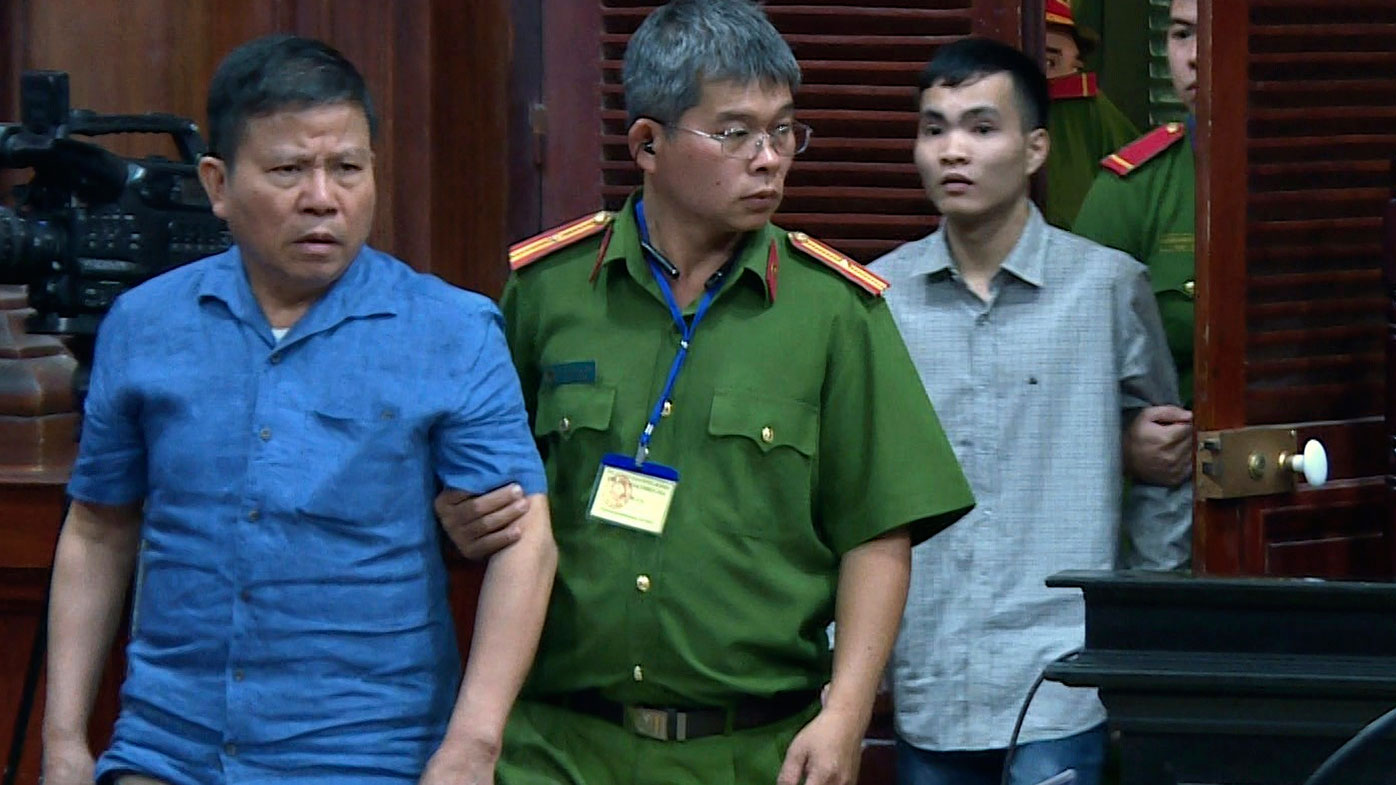
The family of a 71-year-old Western Sydney man jailed overseas on trumped up charges are begging the Australian Government to help bring him home.
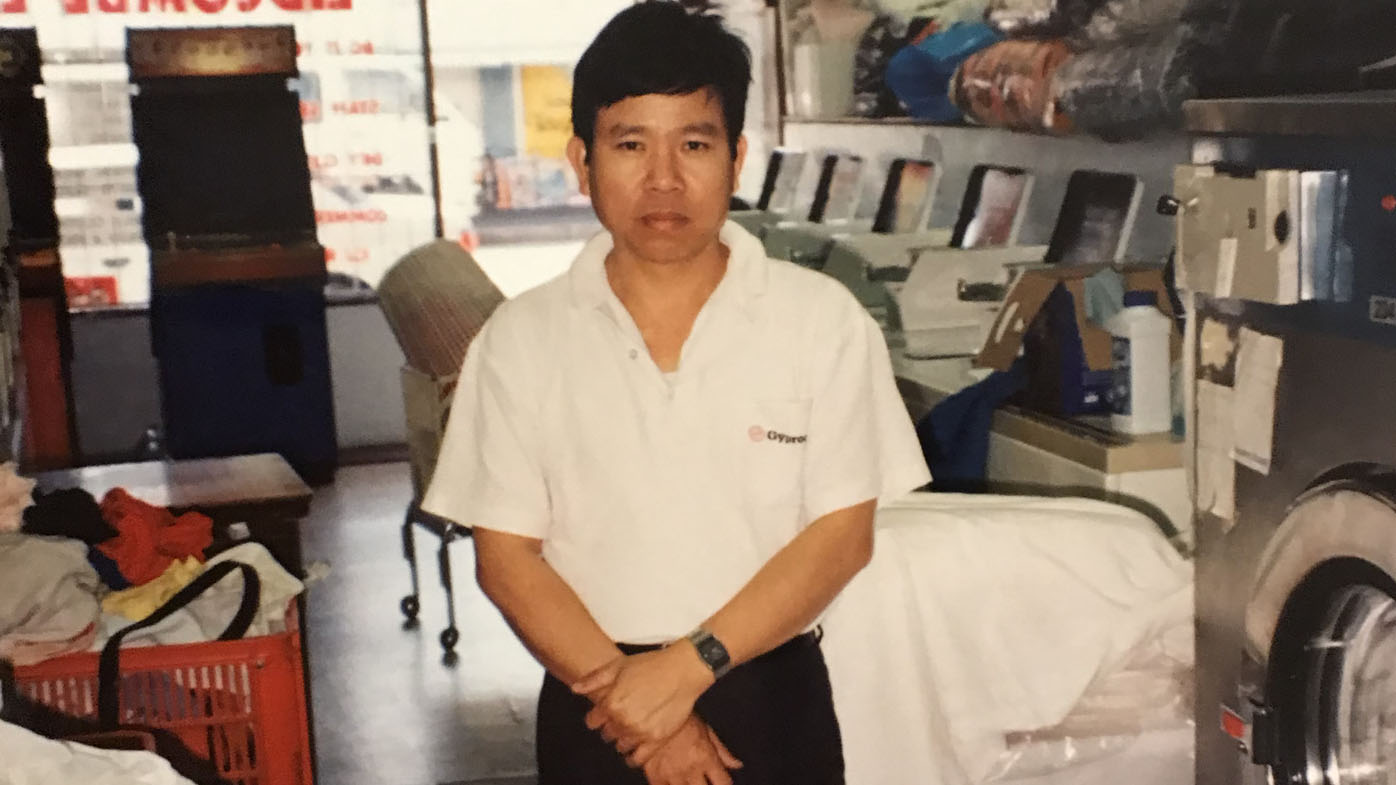
Fears are growing over the deteriorating health of Chau Van Kham, a retired baker from Berala with several medical conditions, as he languishes in difficult conditions in Thu Duc prison in Vietnam.
"He's always been the rock of our household and it kind of fell apart, when they took him away," added their son Dennis Thong Kham Chau.
Mr Van Kham has lived in Sydney for 40 years, raising a family and running a successful bakery and laundromat.
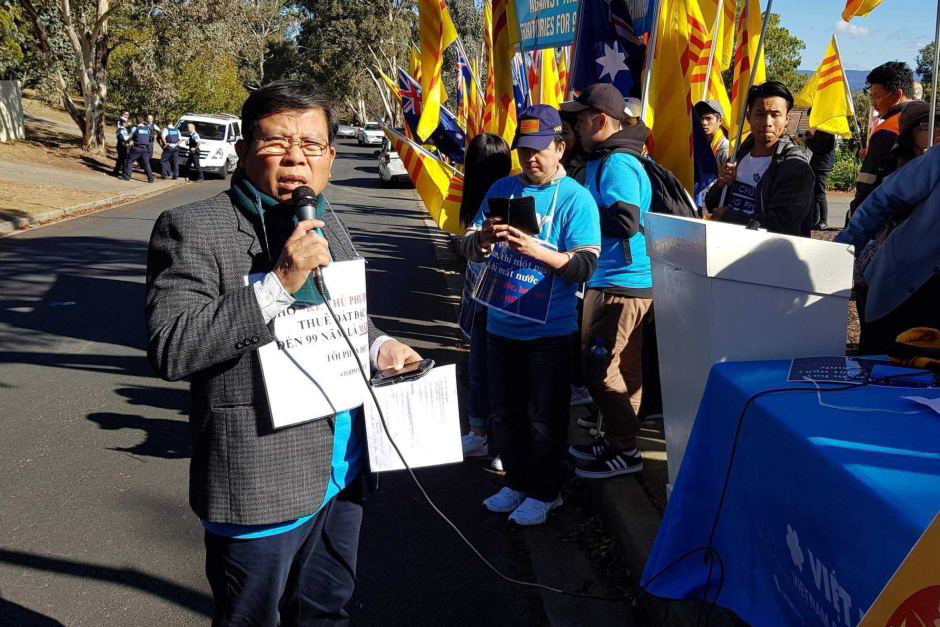
Devoted to his adopted homeland, he advocates for democracy – a belief that has landed him in jail.
The family fears he will die soon unless the government intervenes in his imprisonment, which has been condemned by Amnesty International and Human Rights Watch.
Mr Van Kham's barrister Michael Polak, an international lawyer based in London, is making a submission on the case to the United Nations.
"He should be enjoying his retirement in Sydney," Mr Polak said.
"We call on the Australian Government to raise this at the highest level."
Mr Van Kham was visiting Vietnam when he was arrested on "terrorism" charges for being a member of the pro-democracy organisation Viet Tan.
He had met with another member of the group when he was detained in January 2019 in Hoi Chu Minh City.
His case went to trial 10 months later – but he wasn't told the allegations he was facing beforehand, was forbidden from meeting a lawyer privately and the Australian Consulate was not allowed into the courtroom.
With no independent witnesses nor evidence of violence, Mr Van Kham was convicted of "Terrorism to Oppose the People's Government" and sentenced to 12 years imprisonment.
Viet Tan is described by the UN as "a peaceful organisation advocating for democratic reform".
Mr Van Kham was also fined for using a fake ID to cross into Vietnam from Cambodia – an offence he and his legal team does not dispute.
He suffers from glaucoma, high blood pressure, prostate problems, cholesterol and kidney stones and needs medication.
Mr Polak argues Mr Van Kham's detention is arbitrary as he was convicted for his beliefs rather than anything he had actually done.
"There's no evidence he's committed any offences, just that he's a member of this group, described by the United Nations, as a peaceful democratic movement and that's why he's convicted," he said.
The family's Sydney solicitor Dan Nguyen said Mr Van Kham has always been a hard-working family man who paid his taxes and values the Australian way of life.
"He's 71 soon to be 72," she said. "If nothing's done, he will die in jail."
The legal team is timing the UN submission to coincide with Liberation Day on 30 April, a date when pardons are traditionally granted in Vietnam.
Thu Doc prison, located about three hours out of Ho Chi Minh City, is known for hard labor and cramped conditions.
Mr Van Kham's former cellmate Michael Phuong Minh Nguyen, a US citizen who was released four months ago after the US Government intervened in his case, told 9News he was worried about his friend coping in jail.
"Any prison is horrible, but in Vietnam it's worse," he said.
Mr Van Kham arrived in Sydney in 1982, after fleeing Vietnam by boat.
In a written statement to 9News, the Department of Foreign Affairs and Trade said it was providing consular assistance to Mr Van Kham and that the Government of Vietnam was aware of its interest in his case and welfare.
Police have released the name of the man who died following a crash between a car and a motorcycle on State Highway 38, near Rerewhakaaitu, on Saturday.The motorcyclist was Tony Lars Hansen, 52, of Rotorua – one of seven people…
BUENOS AIRES, Argentina (AP) — Argentine President Alberto Fernández says he had an initial positive test for COVID-19, despite having been vaccinated in January.
Fernández sent a tweet early Saturday saying he took a quick antigen test for the virus after feeling a headache and experiencing a fever of 37.3 Celsius (99.1 Fahrenheit). He said he otherwise has light symptoms, is isolating and is “physically well.”
He said he is awaiting a confirmation of the result using a more rigorous PCR test.
The president, who turned 62 on Friday, received a dose of the Sputnik V vaccine on Jan. 21 and a second dose a few days later.
ADVERTISEMENT
None of the vaccines used against the new coronavirus completely eliminate infections, though they have been shown to sharply reduce the rate of infection and its severity.
The Russian Gamaleya Institute that produced the vaccine tweeted that it wished the president a quick recovery, and said the vaccine has a 91.6% rate of effectiveness against infection and 100% against critical cases.
“If the infection is confirmed and occurred, the vaccination assures a rapid recovery without severe symptoms,” it said.
More than 650,000 people in Argentina have received both scheduled shots of the vaccine and only about 1,000 of those have been found to be infected more than 14 days after the final dose, according to national health statistics.
“It is totally plausible, probable, logical and expectable that people are infected with the virus” even after two shots, said virologist Humberto Debat of the National Institute of Agroindustrial Technology in Cordoba, Argentina. He noted that the main purpose of the vaccine is to prevent serious illness and deaths.
Argentina recently tightened border restrictions due to an upsurge in cases. The nation of some 45 million people has recorded nearly 2.4 million infections, with 56,000 deaths. It has administed more than 4 million doses of vaccine against the disease.
Officials said several people were also in isolation after recent close contact with the president, including his spokesman, the secretary-general of the presidency and the head of his party in the lower house of congress, Máximo Kirchner, the son of Vice President — and former President — Cristina Fernández.
People who are fully vaccinated against COVID-19 can travel domestically in the US, according to new guidelines released by the US Centers for Disease Control (CDC).
The new public health recommendations note that fully vaccinated people are less likely to contract and spread the virus, and can therefore travel domestically without the need to get tested before or after a trip, or self-quarantine afterwards. Vaccinated travelers also don’t need to be tested for COVID-19 before leaving the US—unless it is required by their destination.
While domestic travel is back on the table, the CDC advises anyone interested in international travel to pay attention to the public health situation in their destination of choice before traveling “due to the spread of new variants and because the burden of COVID-19 varies globally”. Some countries are starting to open their borders to vaccinated travelers, however the rules around travel are still rapidly changing in many destinations.
While this opens more doors for vaccinated travelers who are eager to hit the road, things won’t be completely back to normal.
Even those who have received the vaccination are still required to wear a mask on all forms of public transportation and in airports and stations. Fully vaccinated air passengers heading to the US—including US citizens—must still have a negative test result or a documentation showing they have recovered from COVID-19 before boarding a flight to the US. Travelers are encouraged to still get a test three to five days after traveling, regardless of their vaccination status.
Everyone in England to be offered twice-weekly Covid tests, PM to say
Boris Johnson to promise universal rollout of lateral flow testing scheme in bid to ease England out of lockdown
The testing scheme will involve kits for use at home or at test centres, workplaces and schools. Photograph: Finnbarr Webster/Getty Images
Boris Johnson is to unveil a plan for routine, universal Covid-19 tests as a means to ease England out of lockdown, as the government faced a renewed backlash over the idea of app-based “passports” to permit people entry into crowded places and events.
Six months after Johnson unveiled plans for “Operation Moonshot”, a £100bn mass testing scheme that never delivered on its stated aim of preventing another lockdown, all people in England will be offered two Covid tests a week from Friday.
The prime minister is to announce the rollout of the lateral flow tests at a press conference on Monday afternoon, at which he will also outline a programme of trial events for mass gatherings, as well as proposals for potentially restarting foreign travel.
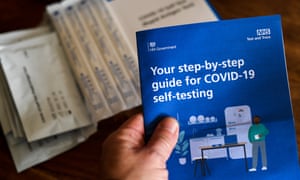
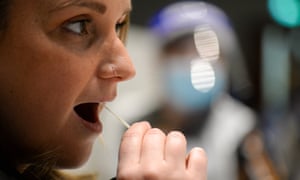
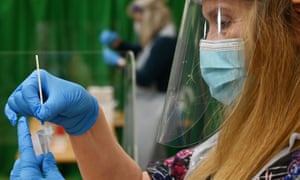
The testing scheme, involving kits for use at home or at test centres, workplaces and schools, is billed as a means to limit any continued community transmission of the virus, in parallel with the vaccination programme, and as a way to track outbreaks of potentially vaccine-resistant Covid variants.
The test-and-trace phone app will also be updated so that when pubs and other hospitality venues reopen everyone in a group will have to register, not just the lead person, with those who test positive asked to share other places they have visited.
Some scientists have expressed scepticism at the plan, noting both the possibility of false negatives with lateral flow tests, and the need for better support for people to self-isolate if they do test positive.
Civil liberties groups and many MPs will also be wary if the new testing system potentially feeds into a regime of Covid certificates, which would use recent tests, vaccination or the presence of antibodies to the virus to determine entry to pubs or mass events. Sometimes also called “Covid passports”, these would be purely for domestic use, and would be distinct from a vaccination record to allow foreign travel.
Over the weekend, the government unveiled plans for nine pilot events, ranging from football matches and a snooker tournament to comedy and business gatherings, to try out the practicalities of Covid certificates, whether using paper or via an app.
Such documents would allow people entry to events if they had been vaccinated, or could show they had recently tested negative for Covid or had antibodies to the virus.
The scheme will run in parallel with the vaccination programme, and as a way to track outbreaks of potentially vaccine-resistant Covid variants. Photograph: Finnbarr Webster/Getty Images
Liverpool city council, where four of the events are planned, said these would instead be general tests of how such venues could reopen, including social distancing, ventilation and test-on-entry systems, but were not designed to feed into a certificate trial.
Paul Blair, a co-owner of the Hot Water Comedy Club in the city, which is organising an event on 16 April, said the venue had received abuse on social media and emails accusing it of being part of a “medical apartheid”.
Johnson has suggested businesses would welcome the option to use Covid passport schemes, but he faces a battle to win parliamentary support for the idea. Last week more than 70 MPs, including 40 Conservatives, announced they would oppose the idea.One option for the government would be to use such certificates for mass events such as sports and for places such as theatres, but not for access to pubs and bars.
The government has only recently gone public about the plans for such certificates, having previously discounted the idea. However, documents seen by the Guardian show research commissioned for the NHS’s test-and-trace system reported as early as December on ways for Covid passports to operate.
The documents include mock-ups of possible app-based passports, and research about possible public attitudes towards using these as a condition of entry to not just events such as football matches or to pubs, but also for family gatherings such as weddings.
In a quote released to promote the new testing system, Johnson hailed the progress with vaccination, and said tests were now “even more important to make sure those efforts are not wasted”.
He said: “That’s why we’re now rolling out free rapid tests to everyone across England – helping us to stop outbreaks in their tracks, so we can get back to seeing the people we love and doing the things we enjoy.”
Test protocols in the other UK nations are organised by the devolved governments.
A member of staff processes a Covid-19 lateral flow test in the sports hall of Wilberforce college in Hull. Photograph: Paul Ellis/AFP/Getty Images
Free testing is already available to frontline NHS workers, care home staff and residents, and schoolchildren and their families. As part of the rollout to the whole population people will be able to order tests to be delivered to their home and visit participating pharmacies to collect boxes of seven.
Stephen Reicher, professor of psychology at the University of St Andrews and a member of the Spi-B subcommittee of Sage that advises on behavioural science, said testing by itself was “no solution”, noting a rate of false negatives for self-administered lateral flow tests of up to 50%, as well as a lack of contact tracing or support for those self-isolating.
He said: “All in all, the government keeps on seeking quick fixes based on one intervention. What they consistently fail to do is to build a system in which all the parts work together to contain the virus.”
John Drury, professor of social psychology at the University of Sussexand also a member of Spi-B – but speaking in a personal capacity – said: “Is twice-weekly testing going to be accompanied by the required support for self-isolation, which currently is insufficient? If not, increased testing helps with the data but not with the practicalities of dealing with the virus.”
Labour said it backed the mass testing plan, but expressed similar worries. Jonathan Ashworth, the shadow health secretary, said: “To break transmission chains and suppress infections, testing must go hand in hand with community public health-led contact tracing to find cases and must be backed up by decent financial support so sick people can isolate.”
A magnitude 6.1 earthquake has struck off the East Coast.The quake had a depth of 22km and GeoNet has described the shaking intensity as moderate.It hit at 7.37pm on Easter Monday, about 120km east of Te Araroa. A second Easter…
SAN JUAN, Puerto Rico (AP) — The Eastern Caribbean has created its own form of digital currency meant to help speed transactions and serve people without bank accounts.
The Eastern Caribbean Central Bank said its “DCash” is the first such blockchain-based currency introduced by any of the world’s currency unions, though some individual nations have similar existing systems.
It became available Wednesday in four island nations under a yearlong pilot program: St. Lucia, Grenada, Antigua and Barbuda, and St. Kitts and Nevis.
“(It) is a milestone in the history of monetary instruments,” said Bitt CEO Brian Popelka during a press conference broadcast online.
DCash was created by Barbados-based fintech company Bitt in partnership with the central bank. Unlike cryptocurrencies, it is issued by an official central bank and has a fixed value, tied to the existing Eastern Caribbean dollar used across much of the region.
The system allows users even without bank accounts — but with a smartphone — to use a downloaded app and make payments via a QR code. Those without bank accounts would go to a previously approved agent or nonbanking financial institution who would verify a person’s information and then approve a “DCash” wallet. That person would then go to a supermarket or other store and give the cashier physical cash which would then be deposited as digital currency in their wallet, Bitt spokesman Chris Burnett told The Associated Press.
In addition, there are limits on the amount of money people can send via DCash, there are no plans for now of integrating credit cards and interest does not apply to the digital currency.
While many in the Eastern Caribbean cheered the historic move, some experts worry that digital currency issued by smaller countries could end up being used as a conduit for illicit activities, including terrorism financing and money laundering, said Eswar Prasad, a trade policy professor at Cornell University.
“That skepticism is waning as more central banks get into the act, and as central banks around the world face the inevitability of the declining use of physical cash,” he said.
He noted that the Bahamas last year became the first country to roll out its digital currency nationwide, and that the Marshall Islands is considering its own cryptocurrency. For smaller countries, “there is more at stake” in part because many people remain unbanked, he said.
“That’s why I think small countries are being more aggressive about this, simply because they need to,” Prasad said.
Officials said that by September at the latest, the digital currency will be available in Anguilla, Dominica, Montserrat and St. Vincent and the Grenadines, which form part of the eight island economies under the Eastern Caribbean Central Bank.
The project aims to see a 50% reduction in the use of physical cash by 2025, said Sharmyn Powell, chairperson of the bank’s fintech working group.
“It’s safer, faster and cheaper,” Powell said.
Central Bank Governor Timothy N.J. Antoine said he envisions farmers, fishermen, small business owners, single mothers and people without bank accounts, among others, using the digital currency.
“Payments are still too slow and too expensive,” Antoine said of the current system. “We heard you, and we have delivered.”
Antoine said it is harder to steal digital cash and said it’s a safe way to make payments while avoiding contact during the pandemic.
One Eastern Caribbean dollar is currently equivalent to 37 U.S. cents. All Eastern Caribbean notes feature Queen Elizabeth II of England as head of the Commonwealth.
The project comes more than two months after the European Central Bank, the Bank of Japan, the Bank of Canada, the Bank of England, the Swedish Riksbank and the Swiss National Bank created a group to study whether they should issue digital currencies.
The Swedish central bank already has commissioned a pilot program. Meanwhile, China rolled out a digital currency in four cities in April 2020 as part of a pilot program that has since expanded to more than two dozen cities.
However, Lee Rainers, a fintech law and policy professor at Duke University, said it remains to be seen whether central bank digital currency is the future.
“I approach it with a sense of skepticism because this technology has been around for over 10 years now but has not taken off as a broad medium of exchange,” he said.
By RNZ Two repeat pāua poachers have been banned from fishing, both for three years.A Lower Hutt man and a Napier man were sentenced last week, in unrelated cases, for repeatedly taking excess and undersize pāua.Ionatana…
From Europe to the USA, Vaccine passports may be required for travel and public services as a way to prevent spreading coronavirus. But, this has instantly become a toxic issue for many US politicians.
Republicans are up in arms over the possibility that businesses and local governments may require vaccine passports for people to get access to certain activities, buildings or events.
Florida Gov. Ron DeSantis (R) has urged his state’s GOP-controlled legislature to pass a law forbidding passes showing proof of coronavirus vaccination while vowing to take executive action. Congressional Republicans have similarly slammed the passports, framing them as invasive.
The Biden administration has said it will provide guidance on the matter, but signaled the decisions will largely be left up to local governments and business owners.
“We’re going to provide guidance, just as we have through the [Centers for Disease Control and Prevention],” White House press secretary Jen Psaki said Monday. “There’s currently an interagency process that is looking at many of the questions around vaccine verification.”
Supporters of the idea say it will help boost businesses — especially in hard-hit industries like travel and entertainment — as COVID-19 restrictions are scaled back and more Americans receive vaccines.
“The cruise lines, for instance, want to get people back on cruises. Airlines want to get people back traveling. And quite frankly, I want to get back traveling again as well, because I haven’t been on an airplane since March and I used to travel all the time,” said Tim Paydos, global vice president of IBM’s government industry business.
“I only want to get on that airplane if I feel reasonably safe that everyone in there is healthy, and that the airline is taking care of me. And so that’s what this is really all about,” he added.
Paydos said IBM is in talks with “just about every state” and federal agencies about such passes.
Requiring vaccine passports could allow industries that have been closed off for much of the past year to reopen while minimizing the risks of spreading the virus. And proponents say virtual passes would speed up the verification process.
In New York, which last week became the first state to formally launch a virtual pass, the voluntary information is being touted as helping the state boost businesses that faced some of the toughest restrictions during the pandemic.
For example, New York recently expanded the number of permissible wedding guest attendees from 50 to 150 — as long as all attendees have proof of a negative test result or vaccination. Similar requirements have been made as the state allows sports fans back into stadiums and arenas.
New York’s Excelsior Pass, created in partnership with IBM, allows people to show if they have been vaccinated before attending events where proof is required.
Connecticut Gov. Ned Lamont (D) on Monday signaled his state may launch a similar pass in the coming months.
“I think it’s a little premature, only in that not everyone has the vaccine available to them yet. But I like to think within a month or two when broadly available, I think you will see some type of vaccine passport or validation … probably led by the private sector,” Lamont said at a press briefing.
Some Republican governors, though, are fiercely pushing back on such efforts.
DeSantis vowed on Monday to take executive action this week to ban the passes.
“It’s completely unacceptable for either the government or the private sector to impose upon you the requirement that you show proof of vaccine to just simply participate in normal society,” he said at a press conference.
South Dakota Gov. Kristi Noem (R) slammed the Biden administration for “one of the most un American ideas in our nation’s history,” even though the administration has yet to provide any guidance on the matter.
“The @joebiden #CovidPassport proposal is one of the most un American ideas in our nation’s history. We as Americans should oppose this oppression,” Noem tweeted Monday night.
Congressional Republicans have also joined the chorus of criticism.
A New York state official pushed back on the GOP criticism that such passports are invasive, telling The Hill that the Excelsior Pass provides less information than residents would otherwise need to show.
The pass lets users verify that they have met either the vaccine or testing standard and then flash a QR code to enter, as opposed to providing specific documents showing a negative test or a vaccine card.
Moreover, the state guidance does not require the Excelsior Pass to show proof. Residents choose to instead show print documents to enter events where proof is required, the official said.
A requirement to show proof of vaccination is not unprecedented, particularly when it comes to international travel. Yellow cards, for example, are required to show proof of yellow fever vaccination before traveling to certain countries.
The International Air Transport Association is testing a COVID-19 passport, called the Travel Pass, that will allow passengers to provide information about testing and vaccination, in addition to checking the COVID-19 requirements for their destination.
Although the group does not support mandatory vaccine requirements for air travel, products such as the virtual Travel Pass could ease the process to help international travel come back if countries decide to put such requirements in place, said spokesperson Perry Flint.
Even with international travel at a fraction of pre-pandemic levels, existing requirements to show a negative coronavirus test are already causing hours-long waits, and the lack of digital passes to provide testing or vaccination proof would cause “enormous jams” in airports, Flint said.
“Forget about 6 feet, there’s going to be lines out the door,” he added.
Former Rep. Justin Amash, a Michigan Libertarian who left the Republican Party after voicing support for former President Trump’s impeachment, dismissed arguments that passes showing proof of COVID-19 vaccinations are similar to requirements already in place for certain forms of travel.
“Let’s get the terms clear: A ‘vaccine passport’ is not ‘what we already do.’ It’s not proof of vaccination for internat’l travel or schooling. It’s proof of vaccination for everyday living—groceries, restaurants, movies. It’s disingenuous to conflate the former with the latter,” Amash tweeted Monday.
“No vaccine passport. It doesn’t get much more dystopian than being required to show your ‘health papers’ wherever you go,” he said in a separate tweet.
Although the Biden administration has not detailed its plans for any passport guidelines, Psaki on Monday said the White House will not create a federal mandate requiring all residents to obtain a single vaccination credential, nor create a centralized, universal federal vaccination database.
She declined to share a timeline on when the guidelines will be released.
As for the creation of such passports, the Biden administration said it is largely leaving that responsibility up to the private sector.
“This is going to hit all — all parts of society. And so, naturally, the government is involved,” said Andy Slavitt, a White House senior adviser on COVID-19. “But unlike other parts of the world, the government here is not viewing its role as the place to create a passport, nor a place to hold the data of citizens.”
“We view this as something that the private sector is doing and will do,” he added.
=================================================
AND IN THE UK
Covid certificates on the cards for use in England since December
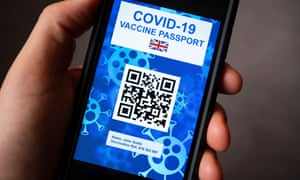
A conceptual design for an electronic Covid-19 certificate using a QR code on a smart phone.
A government-commissioned report in December examined how Covid certificates could be used to decide whether people should be allowed into sports events, pubs and other crowded spaces, months before ministers publicly confirmed the plan.
A document prepared for NHS test and trace and seen by the Guardian shows that the research also looked into whether certificates could be made a condition of entry for family events such as weddings or even small casual gatherings.
The report, dated 17 December, was prepared by staff working for Zühlke Engineering, a Swiss-based consultancy that has worked closely on the UK’s Covid contact-tracing app, and has a number of staff embedded within the test-and-trace team.
It details research into possible public attitudes to a Covid certificate, sometimes called a domestic Covid passport. This would use vaccination status, a recent negative Covid test or proof of coronavirus antibodies to allow people into potentially packed places when the country opens up.
The document includes mock-up pictures of how an app-based Covid certificate might work, using scannable QR codes. One shows this on the main NHS app, with a countdown showing when the pass expires.
Another shows the certificate attached to the NHS test and trace app. This option is seen as unlikely, because the test and trace app is anonymous while the certificate involves personal information.
Covid certificates are enormously controversial. At least 40 Conservative backbenchers are among 70-plus MPs who announced last week that they would oppose them.
Boris Johnson is expected to announce the initial findings of a review into the subject on Monday, but not to say categorically whether or not they will be introduced.
The December document uses focus group research to highlight public attitudes towards the idea. It found that people considered them potentially useful for events such as football matches and even weddings, but not for smaller family gatherings.
The Hill- US President Biden has outlined what he called a “bold” $2 trillion plan to make aggressive investments in repairing U.S. infrastructure and addressing climate change with the goal of spurring job creation.
The investments would be made over eight years, and Biden’s plan relies on a hike to the corporate tax rate to 28 percent that the White House says will pay for the new investments over 15 years.
Here are five takeaways from the announcement.
The proposal is not bold enough for progressives
Biden’s proposal is being met with resistance from some members of the Democratic Party’s progressive wing who argue that it is not large enough, particularly to address climate change.
Rep. Alexandria Ocasio Cortez (D-N.Y.) tweeted Tuesday that the package “needs to be way bigger,” as she noted that the $2.25 trillion plan would be spent over a much longer timetable than Biden’s rescue package.
Meanwhile, a coalition of progressive organizations making up the Green New Deal Network are pressing Biden for bolder action to address climate change, such as the $10 trillion climate agenda backed by Sen. Ed Markey (D-Mass.) and other members of the progressive caucus. The groups have organized grassroots events across the country to highlight the message that Biden must go bolder.
Adam Green, co-founder of the Progressive Change Campaign Committee, described Biden’s plan as a good first step but said that more is needed to address climate change.
“As an infrastructure plan, it’s a home run. As a climate policy, it’s a really significant step, and hopefully there are more steps to come,” Green said.
A lack of Republican support means that Biden will need to keep Democrats in the House and Senate unified behind his plan in order to get it passed using budget reconciliation. That means keeping progressives happy while also addressing concerns from more moderate Democrats, including Sen. Joe Manchin (W.Va.).
Biden found it relatively easy to keep Democrats in line to pass his $1.9 trillion coronavirus relief package earlier this year, especially after the Senate parliamentarian ruled that a hike in the federal minimum wage to $15 could not be part of the package.
This could be a little tougher.
GOP unlikely to offer support
Getting GOP support for a bill paid for through tax increases was always going to be difficult for the White House, and Republicans were quick to signal their opposition to raising the corporate tax rate.
“Our nation could use a serious, targeted infrastructure plan. There would be bipartisan support for a smart proposal. Unfortunately, the latest liberal wish-list the White House has decided to label ‘infrastructure’ is a major missed opportunity by this Administration,” Senate Minority Leader Mitch McConnell (R-Ky.) said in a statement.
The Biden proposal calls for paying for the legislation over a 15-year period by raising the corporate tax rate from 21 percent to 28 percent. The proposal leaves out other ideas that had been batted around, such as a wealth tax or an increase in the capital gains tax for certain Americans.
The White House has been adamant that Biden’s proposal is a starting point and the administration will seek out members of Congress in both parties to decide how to best move forward, but it’s unclear how the president will be able to satisfy Republicans who are both opposed to tax increases and against adding to the deficit.
But Biden was unable to attract a single GOP vote for his $1.9 trillion COVID-19 relief package.
Biden campaigned on uniting the country and his ability to reach across the aisle to find bipartisan solutions in a deeply polarized Washington, but he’s already finding it hard to make headway on a traditionally bipartisan issue such as infrastructure.
The plan goes well beyond roads and bridges
Biden is proposing a $620 billion investment to repair America’s aging transportation infrastructure that the White House says will fix 20,000 miles of roads and 10,000 bridges — but the scope is much larger.
The plan puts $174 million toward boosting the electric vehicle market, setting up incentives for state and local governments to build a national network of 500,000 electric vehicle chargers over the next decade.
Biden is also proposing more than $100 billion in funding to ensure safe drinking water by eliminating all lead pipes and service lines. The plan aims to invest $100 billion in expanding broadband access to all Americans, particularly those in rural areas and other underserved communities.
One prong of the package is designed to enhance the “care economy,” with Biden calling for $400 billion to expand access to home and community-based services for elderly people and those with disabilities.
Biden’s plan is also formulated to address racial inequities, including by proposing a $10 billion investment in research and development at historically Black colleges and universities and other minority-serving institutions in the United States and $15 billion for establishing centers of excellence at these institutions to provide graduate fellowships and similar opportunities.
Biden also satisfied gun safety advocates by including in his plan a proposed $5 billion for community violence prevention programs.
Biden bets on big government
Some Democrats and historians have begun likening Biden’s legislative initiatives to those of former President Franklin Roosevelt, whose New Deal aimed to pull the country out of the Great Depression by implementing new government programs to address economic insecurity and drive private sector growth.
With a $1.9 trillion COVID-19 spending package under his belt, Biden is again aiming to reimagine how the government and economy interact with his $2.1 trillion infrastructure bill.
The proposal will touch on many different aspects of American life. In addition to making investments in traditional infrastructure projects such as roads, bridges and broadband, the bill would also direct government money toward electric vehicles, green energy projects, the health care sector, child benefits, elderly care and developing future technologies.
Biden reportedly referenced Roosevelt in a meeting with historians last week. The current president has a lot riding on the success of his programs in transforming the government and society in response to the COVID-19 crisis.
Biden makes the case for the moment
Biden made the case for passing his sweeping infrastructure plan during an address in western Pennsylvania, arguing that passing it was a test of whether democracies can work for their people.
He spoke with urgency and suggested that America’s future depends on his plan to reshape the economy.
“We have to move now. Because I am convinced that if we act now, in 50 years people are going to look back and say, this was the moment that America won the future,” Biden said in an afternoon address at Carpenters Pittsburgh Training Center.
Biden made a point to focus on his blue-collar roots and talked about his support for union workers and the middle class, pointing to the need to build an economy that “rewards work, not just rewards wealth.”
The rhetoric echoed Biden’s consistent message on the campaign trail to be a president for working Americans.
“Wall Street didn’t build this country. You, the great middle class, built this country, and unions built the middle class. And it’s time we rebuild the middle class. We’re going to bring everybody along,” Biden said.



 Fully vaccinated people can travel within the US, according to the CDC © Getty Images/iStockphoto