Category Archives: headline

Police take down suspect with bean bag ammunition to end Perth siege

A suspected gunman has been taken into custody after an hours-long siege in a Perth pharmacy.

A police spokesman told 9News.com.au officers used beanbag ammunition to subdue a man, who was understood to have walked into a Pharmacy 777 in Applecross claiming to have a gun about 4.30pm.

It was reported the man had said the words "today is the day".

https://twitter.com/9NewsPerth/status/1377562198285881344?ref_src=twsrc%5Etfw

The police spokesman said there were no staff or shoppers present when the man was subdued about 8.40pm and taken to hospital for "precautionary measures".

He was not able to confirm whether or not the man was armed.

Earlier, parts of the Canning Highway were shut as tactical response group officers with weapons drawn surrounded the building near the corner of Risely Street.

A bystander told WA Today he had pulled up to the shopping precinct to buy dinner when police arrived.

"Police started zooming everywhere and running into the pharmacy," he said.

"Then more and more turned up, police with high powered rifles, more police in black, TRG I assume, and we were moved out of Grill'd up the street."

The roadblocks would gradually be dismantled, police said.

Grenada: Cops Concerned Over Increase in Illegal Immigrants

Police officials in Grenada are concerned about what appears to be an increasing number of immigrants from Venezuela and CARICOM nations illegally entering the country, particularly as the country tries to prevent community spread of the virus.

Commissioner of Police Edvin Martin disclosed on Tuesday that for the first quarter of 2021, 15 illegal immigrants were held. There were only 20 illegal entries recorded for all of 2020.

“We do not know how many have escaped the law enforcement gaze. We do not know how many might be circulating within our society, and hence the call for us to continue exercising vigilance,” he told journalists during the weekly post-Cabinet briefing.

“It could be a travesty if any such person circulating in our community is positive with a [COVID-19] strain that can potentially affect our population.

Acting Chief Medical Officer Dr Shawn Charles said health officials were extremely worried about that development.

“The Ministry of Health is very concerned because we do have examples from other territories where illegal entry into the country has played a huge part in the establishment of community spread there, and these countries have not been able to get past these events and the populations are right now experiencing some difficulties as a result of that,” he said.

“We have been able to exert a high level of control, but we always want people to remember that not everyone who enters Grenada enters through our net.

“So, it is never accurate to say, ‘well we have no COVID-19, why can’t we do this?’. It is more accurate to say no known cases because we may have some that may escape our control measures,” Dr Charles added.

Since the start of the pandemic, Grenada has confirmed 155 cases of COVID-19. There has been one death.

CMC


The post Grenada: Cops Concerned Over Increase in Illegal Immigrants appeared first on The St Kitts Nevis Observer.

D-Cash: SKN Among First to Get Digital EC Dollar

The Eastern Caribbean Central Bank (ECCB) has officially launched the digital version of the EC dollar – or ‘DCash’.

The currency was rolled out as a pilot in four countries yesterday: Antigua and Barbuda, Grenada, St Kitts and Nevis, and St Lucia.

DCash is being touted as an innovative, real-time payment option within the Eastern Caribbean Currency Union (ECCB) that offers a safer, faster and cheaper method of making payments, and sending and receiving funds to and from other DCash users and merchants.

Consumers can access DCash via the official app, the DCash wallet, and conduct financial transactions using their smart devices.

Speaking during the virtual launch yesterday, ECCB Governor Timothy Antoine explained that in the context of the coronavirus pandemic where physical and social distancing is a requirement, DCash offers a contactless method of payment that will serve member states well in the new normal.

He said the ECCB is firmly committed to the safety, soundness and integrity of the region’s financial system and, in this regard, the bank has been careful to embed anti-money laundering and counter financing protocols in the DCash design and industry standards and best practices as it relates to cyber security.

“Due care and attention have also been given to data privacy; payments and transfers are near instantaneous and there is no charge for transacting DCash – the central bank has made that upfront investment.

“For both financial institutions and businesses, reduced use of physical cash translates into a reduction in the storage, security and transportation costs associated with the movement, handling and securing of physical cash,” Antoine said.

He also explained that by using the reporting function in the DCash app, users will be able to track their transactions and monitor their spending.

The pilot phase will run for 12 months and will include an e-commerce portal. The pilot will also eventually be rolled out in other ECCU member states.

“Leveraging our experience with the first four pilot countries we expect the onboarding process will be faster,” he added.

“It is our strong desire to see all member countries in this pilot as soon as practicable but no later than September 2021.”

DCash can be obtained from participating commercial banks, credit unions or other authorised institutions. The two participating merchants in Antigua are the Caribbean Union Bank (CUB) and the Eastern Caribbean Amalgamated Bank (ECAB).

DCash quick facts

O Use it for paying for goods and services

O  Send it to family and friends who also have the DCash app

O  Merchants can offer this contactless payment option to their customers

O  DCash is a digital analogue of the national currency, not a type of crypto-currency

O  DCash payments are made in real-time; all you need is internet access

The post D-Cash: SKN Among First to Get Digital EC Dollar appeared first on The St Kitts Nevis Observer.

US On Track to Confront 2m Migrants on Mexican Border

(CNN) The US is on track to encounter more than 2 million migrants at the US-Mexico border by the end of the fiscal year, according to internal government estimates reviewed by CNN, marking a record high.

The projections could be subject to change in the event of policy modifications or other changes in Latin America. US Border Patrol encounters are also expected to be largely made up of single adults, who are being turned away at the US southern border as soon as they’re encountered under a public health order, and as a result, might also account for repeat crossers.

But combined, the data — based on preliminary reporting as of this month — illustrates the continuing challenge for the Biden administration, which has already faced a series of hurdles on the US-Mexico border, particularly with unaccompanied children and migrant families. 

Data reviewed by CNN shows that up to 1.1 million single adults are expected through September, along with up to around 828,000 families and more than 200,000 unaccompanied children. Border Patrol encounters are expected to continue to rise month-by-month, according to the projections, which can vary.

The last time Border Patrol apprehensions surpassed 1 million was in fiscal year 2006, according to publicly available data from Customs and Border Protection. Border Patrol arrests also climbed during the 2019 border crisis, but fell short of 900,000.

Deputy Chief of the Border Patrol Raul Ortiz told reporters Tuesday that the agency expects to encounter more than a million migrants this fiscal year.

Homeland Security Secretary Alejandro Mayorkas also warned of the uptick in mid-March, saying: “We are on pace to encounter more individuals on the southwest border than we have in the last 20 years. We are expelling most single adults and families. We are not expelling unaccompanied children.”

CNN reached out to the Department of Homeland Security. Customs and Border Protection pointed to Ortiz’s comments.

It’s difficult to compare today’s situation with those of recent years because of the drastically different circumstances, in part relating to the coronavirus pandemic. There are several factors at play — including deteriorating conditions in Latin America, pent-up demand to enter the US and a perceived relaxation of enforcement under President Joe Biden — that are driving migrants to the border at what appears to be an accelerated pace.

The administration is also relying on a public health law known as Title 42 that was invoked under former President Donald Trump and allows border authorities to turn back migrants encountered at the US-Mexico border, either to Mexico or their country of origin. Unaccompanied children are not subject to the policy.

These projections could also include a high number of people crossing the border twice or multiple times. In February, around 25% of people encountered at the border had crossed more than once, up from 7% for all fiscal year 2019, the most recent annual data available.

“We are seeing higher than usual recidivism rates, as a result of COVID protocols. So the number of encounters, while they impact our operations at Border Patrol, they also can seem to overstate the migrant flows that we are seeing,” a CBP official said earlier this month.

In his first news conference, Biden noted that fluctuations in migration flows are common.

“It happens every single, solitary year: There is a significant increase in the number of people coming to the border in the winter months of January, February, March. That happens every year,” he said.

Biden also said his administration is in discussions with Mexico to have the country receive migrant families expelled by the US under the pandemic-related policy, indicating the pressure the US is placing on Mexico to help stem the flow of migration to the US.

“Mexico is refusing to take them back. They’re saying they won’t take them back — not all of them,” Biden said, when asked why some families weren’t being returned. “We’re in negotiations with the President of Mexico. I think we’re going to see that change. They should all be going back. All be going back. The only people we’re not going to let sitting there on the other side of the Rio Grande by themselves with no help are children.”

Families from Mexico and the Northern Triangle countries are sent back to Mexico unless the country does not have the capacity to receive them, the Department of Homeland Security said in a statement this month. If Mexico won’t take the families, they are processed into the US.

Measures taken in conjunction with Mexico and other Latin American countries could help the administration as it faces an ongoing influx of migrants. But it’s still likely to be a pressing challenge for officials, as evidenced by the growing number of children.

Over recent days, the Health and Human Services Department, which is charged with the care of migrant children, announced a string of new facilities, leaning on convention centers, military sites and influx shelters to accommodate children.

But even as those beds come online, more children are being encountered daily along the border, leading to overcrowding in border facilities.

“What bogs us down is the fact that we’re having to take care of 1,200 kids. We’re already done. We already completed the Border Patrol process, so if HHS would be able to take these kids off of our hands then it would be better for everybody,” acting Executive Officer for Rio Grande Valley Operational Programs Division Oscar Escamilla told reporters during a tour of a temporary border facility Tuesday.

“We’re not in the business of dentition. We’re forced into the business because we can’t turn them over to anybody,” he added.

CNN’s Geneva Sands contributed to this report.

The post US On Track to Confront 2m Migrants on Mexican Border appeared first on The St Kitts Nevis Observer.

Drug Smuggler- Brother of Honduras Pres. Gets Life Sentence in US

A court in the United States has sentenced the brother of Honduran President Juan Orlando Hernández to life in prison for drug trafficking.

Former Honduras congressman Juan Antonio “Tony” Hernández was found guilty in October 2019 of smuggling tonnes of cocaine into the US.

Prosecutors said he had bribed law enforcement officials and was also complicit in at least two murders.

President Juan Orlando Hernández called his brother’s sentence “outrageous”.

Lawyers for Tony Hernández said they would appeal against the sentence.

Who is Tony Hernández?

The 42-year-old served as a member of Congress for the National Party from 2014 to 2018.

He was arrested in November 2018 in Miami on charges that he had used his connections with the government to smuggle cocaine through Honduras to the US.

Prosecutors said his career in drug trafficking began as early as 2004, when he started providing Honduran traffickers with information about the movements of the police and the military.

By 2008, Hernández was running his own cocaine lab in Colombia which produced tonnes of the drug, some of which was stamped with his initials.

According to court documents, Hernández was “involved in all stages of the trafficking”, bribing law enforcement officials to protect drug shipments, arranging heavily armed security for cocaine shipments and brokering large bribes from major drug traffickers to powerful political figures”.

Assistant US Attorney Matthew Laroche said Tony Hernández had turned to drug trafficking because he was “greedy”.

He “can’t point to poverty, lack of opportunities or a need to support his family,” Mr Laroche said.

Judge Kevin Castel said Tony Hernández’s life sentence plus 30 years was “richly deserved”.

How damaging is this for President Hernández?

It is very damaging indeed. While anti-government protests and opposition politicians have accused President Hernández of running a “narco-state” for years, the life sentence for his brother has drawn international attention to Honduras.

In the year since Tony Hernández was arrested, prosecutors have made damaging allegations against the president.

They said that Tony Hernández had “conspired with his brother, the president of Honduras” to engage in “state-sponsored drug trafficking”.

Court documents also alleged that Juan Orlando Hernández’s 2013 presidential campaign was financed by drug money.

In one of the most shocking allegations, prosecutors said that jailed Mexican drug lord Joaquín “El Chapo” Guzmán had given Tony Hernández $1m (£725,000) as a bribe destined for Juan Orlando Hernández.

President Hernández has rejected all allegations, saying they are part of a political vendetta against him by drug traffickers.

He has repeatedly said that drug seizures have gone up since he took office and that his family is being targeted by disgruntled drug gangs.

“I find it unbelievable that the false testimonies of self-confessed murderers are listened to and valued in this way,” he said reacting to his brother’s sentence.

“What happened (today) is hard on the family, hard on me personally. I don’t wish it on anyone. I find it outrageous,” he said.

The post Drug Smuggler- Brother of Honduras Pres. Gets Life Sentence in US appeared first on The St Kitts Nevis Observer.

AstraZeneca: Is there a blood clot risk?, Brazil’s Deadliest Month, France Lockdown

James Gallagher
Health and science correspondent

AstraZeneca vaccineimage copyrightGetty Images

Unusual blood clots in the brain have been detected in a handful of people after they were injected with the Oxford-AstraZeneca vaccine.

These “cerebral venous sinus thromboses” or CVSTs have led some countries – including Germany, France and Canada – to restrict who can be given the jab. The World Health Organization and the European Medicines Agency say the benefits of the vaccine outweigh any risks.

Scientists and medicines safety regulators around the world are trying to figure out if the vaccine is genuinely causing these strokes, how big any risk might be and what that might mean for vaccination programmes.

Is the vaccine causing clots?

At the moment, we do not know.

The European Medicines Agency (EMA), which has been reviewing the safety data, says it is “not proven, but is possible”.

The organisation has to figure out whether the reported clots are a side-effect or a coincidence that would have happened naturally. This is incredibly hard when dealing with rare events. If, on the other hand, one in every 10,000 people was having serious blood clots then the answer would be obvious.

I have spoken to respected scientists some of whom are sceptical, others increasingly convinced.

Some point to the highly unusual nature of the clots as a sign something could be going on. They are often appearing at the same time as low levels of blood platelets, which are one of the main components of a clot, and antibodies linked to other clotting disorders appearing in the blood.

Others say there is not enough proof and the reported cases could plausibly be down to Covid, which itself is linked to abnormal clotting.

How big might the risk be?

It remains entirely possible the risk is zero as vaccines are not proven to cause the brain clots.

Germany’s Paul Ehrlich Institute has reported 31 cerebral venous sinus thromboses and nine deaths out of 2.7 million people vaccinated there.

However, the most recent UK data reported far fewer clots, just five, despite vaccinating far more people – 11 million.

The European Medicines Agency, which has assessed data from around the world, estimates there is around a one in 100,000 risk of a CVST in people under the age of 60 who have been given the AstraZeneca vaccine.

The organisation’s head of safety monitoring, Dr Peter Arlett, said that was “more than we would expect to see”.

However, it is uncertain what the background rate of these blood clots in the brain truly is. Estimates vary from around two cases per million people every year to nearly 16 in every million in normal times and coronavirus itself may be causing them too.

Why is there a difference between the UK and Germany?

You might expect to see the same numbers of CVSTs in different countries if they were genuinely being caused by the vaccine. Yet the UK and Germany have massively different figures.

One argument is the type of people being vaccinated is different.

The UK has, largely, been working from the oldest age groups down, while Germany was one of the countries that initially refused to use the vaccine in the over 65s because of a lack of trial data. Instead nearly 90% of Germans given AstraZeneca are thought to be under 60.

Side-effects in general tend to be more severe in younger people as they have a stronger immune response, which has been one speculated reason why the UK has had fewer cases.

However, CVSTs are inherently more common in younger women and taking the pill increases the risk. So the natural risk levels – whether people are vaccinated or not – could have a role too.

Teasing all this apart is challenging, but the EMA said it had found no specific risk factors such as age, gender or medical history.

Is the AstraZeneca vaccine safe?

Nothing in medicine in completely safe and even therapies that are highly toxic are used in the right circumstance.

Chemotherapy drugs have brutal side effects, but are hugely valuable; and even over-the-counter painkillers like paracetamol and ibuprofen have severe side-effects, they are just incredibly rare.

The real decision is always whether the benefits outweigh the risks.

This is particularly challenging in a pandemic. Normally medicine would rely on the “precautionary principle” to prove adequate safety before giving a new medicine to large numbers of people. But in a pandemic, any delays in vaccinating people will also cost lives.

Based on the Germany data alone, if you vaccinate a million people then you would expect 12 to have a blood clot and four of them to die.

But if a million 60-year-olds catch coronavirus then around 20,000 would die of Covid-19. If a million 40-year-olds catch coronavirus then around 1,000 die. It would be a few hundred people in their 30s.

The benefits of vaccination clearly increase with age and countries like Germany and Canada have allowed the AstraZeneca vaccine to be used in older age-groups. These decisions will also be driven by which alternative vaccines they have available and who still needs to be immunised.

The world is scrutinising the data intensely, but clarity will still take time.

===================================================

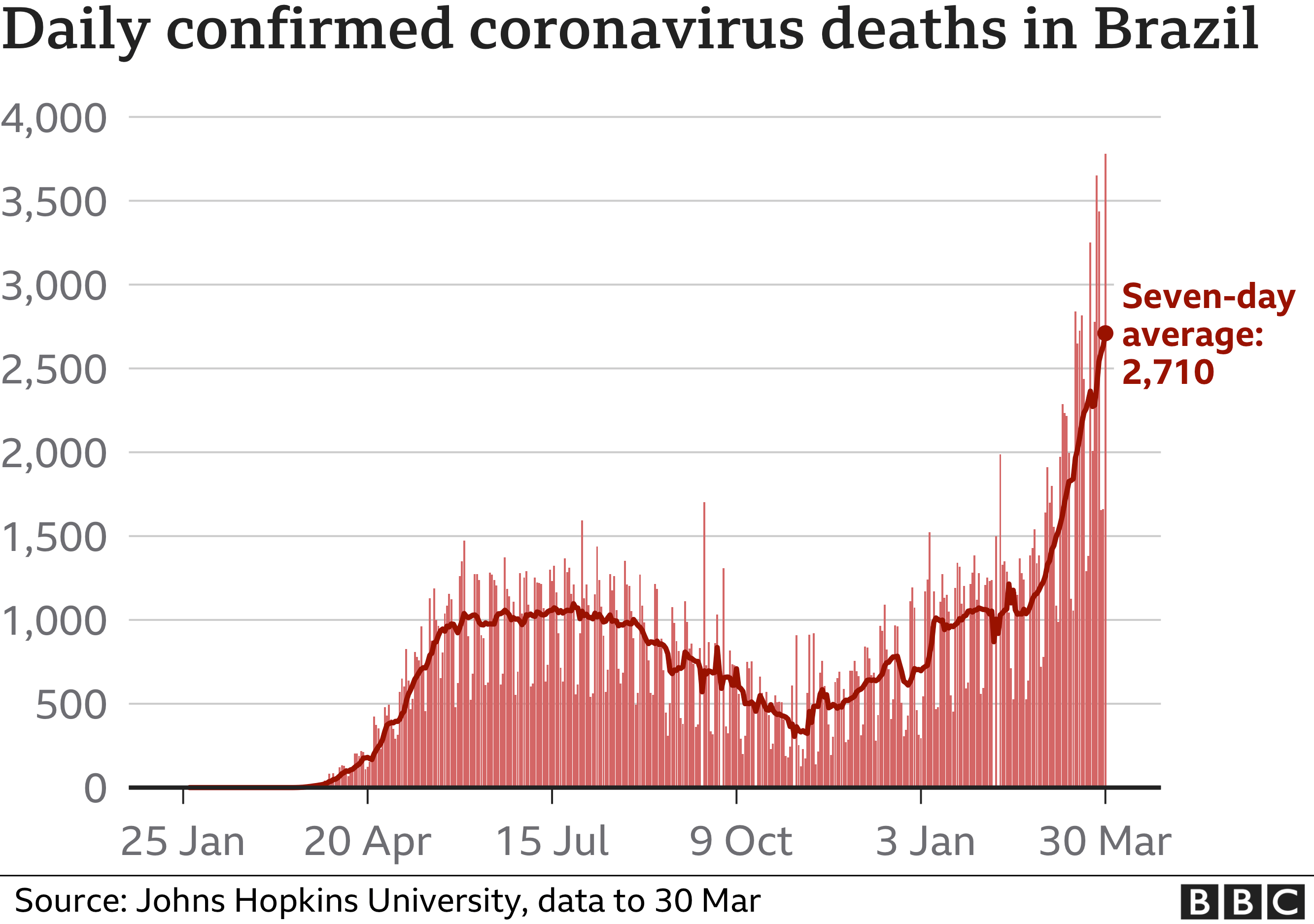
Brazil: More than 66K People Died of Virus During March

Some 66,570 people in Brazil died of Covid-19 in March, more than double the previous monthly record, figures show. To date, 326,000 people have died there from COVID.

The country’s health service has been pushed to the brink as cases of the virus continue to climb.

President Jair Bolsonaro has faced intense criticism for his handling of the crisis and was hit by high-profile resignations this week.

But on Wednesday he again railed against lockdown measures imposed by local governors and mayors.

“We had, and we have, two enemies – the virus and unemployment! It is a reality! We are not going to solve this problem by staying at home,” he said.

Wednesday also saw a further 3,800 new deaths and over 90,000 new coronavirus cases. Brazil’s daily deaths currently account for about a quarter of all coronavirus fatalities in the world.

New chiefs of the army, navy and air force were announced on Wednesday to replace those who resigned on Tuesday in an apparent protest at the sudden sacking of Defence Minister Fernando Azevedo e Silva.

Mr Bolsonaro and his minister had clashed over the issue of the armed forces’ loyalty, which the defence minister said should be directed to upholding the constitution rather than supporting the president personally.

The role of the armed forces in Brazilian politics has been a sensitive issue since the country’s return to democracy in 1985 after 21 years of military rule.

The new defence minister, Walter Braga Netto, announced that Paulo Sergio Nogueira de Oliveira would head up the army, Almir Garnier the navy and Carlos Almeida Baptista Júnior the air force.

His announcement came on the anniversary of the 1964 coup that brought the military to power.

He said the military would “not be found wanting when the country needs it”. The day before he had raised concern by saying the coup had “pacified the country” and should be celebrated.

President Bolsonaro, a former army captain, himself prompted outrage in 2019 when he organised a commemoration of the coup.

As well as losing his defence minister, Mr Bolsonaro also had to replace his foreign minister and five other cabinet ministers. Marcelo Queiroga, a cardiologist, became the fourth health minister since the pandemic began.

line
Daily confirmed deaths in Brazil graphic
======================================================

Lockdown in France extended to entire country

The government will considerably accelerate the vaccination process in the upcoming weeks

France extends the lockdown restrictions to include the entire country starting 3 April. This is what President Emmanuel Macron announced in an official address on Wednesday evening. The restrictions that have been valid for 19 departments will now be implemented to the whole metropolitan territory for a period of four weeks.

Pledge: every person over 18 could get a vaccine by the end of summer

One year after the start of the coronavirus pandemic in France, the President returned with another official address to the French people. This time, however, on top of another portion of restrictions, there was a positive announcement: by the end of summer, the entire French population over 18 years old could be vaccinated.

As of 16 April, this will be open to everyone above 60. From 5 May, everyone above 50 will be able to get a vaccine, while from mid-June this possibility will be given to everyone above the age of 18.

The entire address can be seen on the website of the Élysée or below (in French):

Official address of President Emmanuel Macron on 31 March 2021, announcing the extension of lockdown. Source: Élysée

Restrictions in force in France

As of Saturday, 3 April, the following restrictive measures will apply to Metropolitan France:

  • Curfew starting at 7 p.m
  • Systematic teleworking
  • Closure of certain businesses, deemed non-essential (establishments selling food and drugs, as well as bookstores and record dealers are considered essential)
  • Ban on inter-regional trips after April 5, except for compelling reasons
  • Travel ban during the day beyond 10 kilometres from one’s home unless there is a compelling reason

In addition, to help the health system face the increased strain, the country will deploy additional personnel to hospitals: medical students, retired medical personnel, members of the army health service, volunteers from the health reserve. The number of hospital beds will also be considerably increased.

Finally, as of this month, there will be a gradual opening of schools. The return will take place for everyone on 26 April, physically for nurseries and primary schools, remotely for colleges and high schools – which will reopen on 3 May.

==================================================

The post AstraZeneca: Is there a blood clot risk?, Brazil’s Deadliest Month, France Lockdown appeared first on The St Kitts Nevis Observer.

Puerto Rico Vaccinates Thousands in 15-Hour Mass Event

SAN JUAN, Puerto Rico (AP) — Thousands of people were vaccinated against COVID-19 on Wednesday as part of a mass inoculation event in Puerto Rico’s capital that was scheduled to last 15 hours.

It was the first event of its kind since the U.S. territory began vaccinating people in mid-December.

Officials hoped to vaccinate 10,000 people with the single-dose Johnson & Johnson shot during the event that would run from 7 a.m. to 10 p.m. By late Wednesday afternoon, more than 5,000 vaccines were given, according to Health Secretary Carlos Mellado.

For now, Puerto Rico is vaccinating only those 35- to 49-years-old with chronic health conditions and all those 50 years and older, along with all workers in the food and telecommunications industries, among others.

Wednesday’s event was meant only for people who qualified and made an appointment, but Mellado said someone sent a fake message via social media claiming that all those 21 years and older could show up without an appointment. Hundreds did so, and some of them were vaccinated amid grumbling from those who had an appointment and were waiting in line.

More than 1 million vaccines have been administered in the U.S. territory of 3.2 million people. The government has reported more than 195,500 confirmed and suspected cases and more than 2,000 deaths.

The post Puerto Rico Vaccinates Thousands in 15-Hour Mass Event appeared first on The St Kitts Nevis Observer.

Calls to Address Vaccine Shortage in Less Wealthy Nations

Activists have called for changes to intellectual property laws in an effort to speed the global vaccination project

Guardian UK

A chorus of activists are calling for changes to intellectual property laws in hopes of beginning to boost Covid-19 vaccine manufacturing globally, and addressing the gaping disparity between rich and poor nations’ access to coronavirus vaccines.

The US and a handful of other wealthy vaccine-producing nations are on track to deliver vaccines to all adults who want them in the coming months, while dozens of the world’s poorest countries have not inoculated a single person.

Activists have dubbed the disparity a “vaccine apartheid” and called for the world’s largest pharmaceutical companies to share technical know-how in an effort to speed the global vaccination project.

“The goal of health agencies right now is to manage the pandemic, and that might mean not everyone getting access – and not just this year – in the long-term,” said Peter Maybarduk, director of Public Citizen’s access to medicine program.

Covid: new vaccines needed globally within a year, say scientists

if we want to change that, if we’re not going to wait until 2024, then it requires more ambitious and a different scale of mobilization of resources,” said Maybarduk. Right now, “it’s not even clear the goal is to vaccinate the world”.

The pressure to get more vaccines to poor nations has also weighed on the Joe Biden administration, which is now considering whether to repurpose or internationally distribute 70m vaccine doses. After outcry, the US has shared 4m AstraZeneca vaccine doses with Canada and Mexico.

“There’s no question poorer countries are having a hard time affording doses,” said Dr Howard Markel, a pandemic historian at the University of Michigan School of Public Health. “Even if they were at wholesale or cost there are a lot of different markups.”

As it stands, 30 countries have not received a single vaccine dose. Roughly 90m vaccine doses expected to be distributed through Covax, the global alliance to distribute vaccines to poor countries, have been delayed through March and April by a Covid-19 outbreak in India. In Europe, rising Covid-19 cases and a slow vaccination campaign have also prompted vaccine export controls.

Beyond existing vaccine supply, many activists see a bigger fight in patent laws, and are drawing on experience advocating for greater access to antiretroviral drugs for HIV.

“More is possible than we believe,” said Maybarduk. “It was assumed Aids drugs could not be produced for less than $10,000 per person per year, right up until the moment they could, and they were produced for $1 per person per day.”

Similarly, Maybarduk said the technology for Covid-19 vaccines, along with other supplies, should be shared among the countries of the world. Activists have used Moderna as a key example of the leverage the US government might have, if it chose to use it.

Though popular shorthand often refers to it as just the Moderna vaccine, it was developed in partnership with the US National Institute of Allergy and Infectious Disease (NIAID). American taxpayers provided $6bn in late-stage development funds, in return for potential vaccine doses. It was also tested on Americans, who volunteered for research across 99 research sites.

“It is literally the people’s vaccine,” said Maybarduk.

Part of the proposal from activists focuses on a petition to temporarily suspend intellectual property laws governing World Trade Organization member states. Suspending those patent laws could urge companies to share technology, they argue, and better protect the whole world from emerging variants that can blunt vaccine efficacy.

“This is a classic case where you have an industry that has a very direct stake in protecting itself, and there’s very little understanding among the public how much is at issue,” said Dean Baker, an economist and co-founder of the Center for Economic and Policy Research. Activists argue pharmaceutical companies should share production know-how, and be appropriately compensated.

One part of this fight centers on a provision of international trade law called the Trips agreement, or more formally, the agreement on trade-related aspects of intellectual property rights. Put in force in 1995, Trips requires all member states to recognize 20-year monopoly patents for pharmaceuticals, including vaccines.

“What Trips was about was imposing US-European style copyright on the whole world,” said Baker. “Most developing countries had very little idea what they were dealing with.”

In October 2020, South Africa and India introduced a petition to suspend the Trips agreement through the pandemic. India is home to one of the largest generic drug manufacturing industries in the world. South Africa has the largest HIV epidemic in the world, and is part of a group of sub Saharan African countries which were priced out of antiretroviral therapies in the 1990s.

“Even if we say, ‘OK, this is highly specialized knowledge’ … the idea it wouldn’t benefit everyone to share that knowledge is kind of crazy,” Baker said. “The industry’s argument – we’re just stuck – that makes zero sense.”

However, some vaccine researchers counter that the lack of vaccine access is far more complicated than lifting patent restrictions, because there is so little manufacturing outside of the US and Europe.

“In my experience from working on vaccines for the last few decades, the patents are not the biggest problem [and] the intellectual property is not the biggest problem,” said Dr Peter Hotez, a vaccine researcher and dean of the National School of Tropical Medicine at Baylor College of Medicine in Texas.

Hotez is currently working to develop a low-cost, easily manufactured vaccine that can be distributed in low- and middle-income countries. “The problem with vaccines is having the infrastructure and the human capital to know how to make vaccines,” Hotez said.

Reliance on these major pharmaceutical companies, Hotez said, has resulted in a dearth of vaccine candidates designed for regional Covid-19 variants and suited for local administration. “We’ve still not fixed a broken financial model for how to get vaccines for the poor,” Hotez said.

On this, both camps agree.

“There should be major facilities in Africa and Asia and Latin America, as well as North America, that help respond to future pandemics,” said Maybarduk. “What is not agreed on is what the political economy of that looks like: who controls those facilities, will the technology be openly available, will they be publicly accountable.”

The fight also comes at a time when annual or booster Covid-19 shots appear increasingly likely – in part driven by the possibility variants could emerge in populations without vaccine access – and as pharmaceutical companies eye future profits.

“The big players are Astrazeneca, Moderna, BioNtech – these are not really vaccine companies,” said Hotez. They are involved because technological advances will, “provide a glidepath so they can accelerate their technology to down the line make actual money making products”, such as vaccines to treat cancer and neurodegenerative disorders.

The Trips agreement is expected to be discussed again in April, though it is unclear whether the coalition of more than 80 poorer nations will succeed. Opposition to the Trips petition has come from wealthy countries, including the US, which for the last four decades has traditionally argued for enhanced patent protections. It is unclear how the recently confirmed US trade representative, Katherine Tai, might handle the talks.

“Here you’ve got the equivalent of a blockbuster vaccine, because everybody needs it,” said Markel. “If you need it every year, boy, what a boon.”

The post Calls to Address Vaccine Shortage in Less Wealthy Nations appeared first on The St Kitts Nevis Observer.

US Puzzle-More Vaccinations, Yet More Cases of Corona

Another 948 Americans died of COVID-19  Tuesday,  23 percent lower than two weeks ago, according to The New York Times COVID-19 map and case count.   Yet Deaths are rising in 8 states, Kentucky, New York, Missouri, Tennessee, Nebraska, Michigan, Montana and Hawaii, as well as Washington, DC.

On Tuesfday 62,045 more Americans were confirmed as infected, 20 percent more than two weeks ago.

The Times reports that over the past week, there has been an average of 66,064 new cases per day, 20 percent higher than two weeks ago.

In the past week, cases were higher in 34 states, the Virgin Islands, D.C., and Puerto Rico.

New infections have plateaued in 16 states, Guam, and the Northern Mariana Islands.

Cases are not declining anywhere in the United States.

HOSPITALIZATIONS: There are 40,317 people hospitalized with the virus, a drop of 3 percent over the past two weeks.

VACCINATIONS: The CDC reported yesterday that about 29 percent of US adults have received at least one dose of a vaccine, and 16 percent are fully vaccinated. About 2.77 million doses are being administered per day. Experts say anywhere from 70 to 90 percent of the population has to acquire antibodies to the virus, either by infection or vaccine, in order to achieve herd immunity.


What are we doing, people???

We’re vaccinating people at a remarkable rate, and yet cases are rising again — up a disgraceful 20 percent over the past two weeks — and infectious disease experts are very worried that the trend will continue and develop into yet another surge.

Why? Because as great as our vaccination rate is, it can’t outpace the political calculations of governors ending mask mandates and distancing guidelines, and the selfishness of people who simply don’t care how many people are infected and how many health care workers are forced to put their health and lives on the line treating the sick.

Sorry, let me correct that: Those people will suddenly care when they or someone they know gets really, really sick, and then they’ll show up on TV crying and whining and begging others not to be as stupid as they were. Spare me.

There are so many truths being revealed about so many Americans during this crisis: What an aggressively selfish people so many of us are, how proud too many of us are of our deliberate science ignorance, how callous so many of us are to the suffering of people we don’t know.

And the proclivity of so many gullible simpletons to fall for wild conspiracy theories is on a whole other level, including that the vaccine shots implant a microchip controlled by Bill and Melinda Gates so they can control us.

As one Twitter wag put it: “Second chip successfully implanted. All I need now is a space laser and I’ll be ready for Passover!”

Others are tweeting that their chip is sour cream and onion, or that it’s picking up all sorts of TV stations they don’t have to pay for, or that they hope it will enable them to time travel. 😉


The post US Puzzle-More Vaccinations, Yet More Cases of Corona appeared first on The St Kitts Nevis Observer.