Category Archives: headline

ILO: Growth of Digital Labor Needs Regulation

GENEVA (ILO News) – Digital labour platforms have increased five-fold worldwide in the last decade according to the ILO’s latest World Employment and Social Outlook 2021 report.

This growth has underlined the need for international policy dialogue and regulatory cooperation in order to provide decent work opportunities and foster the growth of sustainable businesses more consistently.

According to the report World Employment and Social Outlook 2021: The role of digital labour platforms in transforming the world of work , digital labour platforms are providing new work opportunities, including for women, persons with disabilities, young people and those marginalized in traditional labour markets. Platforms also allow businesses to access a large flexible workforce with varied skills, while expanding their customer base.

The report focuses on two main types of digital labour platform: online web-based platforms, where tasks are performed online and remotely by workers, and location-based platforms, where tasks are performed at a specified physical location by individuals, such as taxi drivers and delivery workers. Its findings are based on surveys and interviews with some 12,000 workers and representatives of 85 businesses around the world in multiple sectors.

New challenges for workers and businesses

The challenges for platform workers relate to working conditions, the regularity of work and income, and the lack of access to social protection, freedom of association and collective bargaining rights. Working hours can often be long and unpredictable. Half of online platform workers earn less than US$2 per hour. In addition, some platforms have significant gender pay gaps. The COVID-19 pandemic  has further exposed many of these issues, says the report.

Many businesses face challenges relating to unfair competition, non- transparency with regard to data and pricing, and high commission fees. Small and Medium Enterprises (SME’s) also have difficulties accessing finance and digital infrastructure

All workers, regardless of employment status, need to be able to exercise their fundamental rights at work”

Guy Ryder, ILO Director-General

The new opportunities created by digital labour platforms are further blurring the previously clear distinction between employees and the self-employed. Working conditions are largely regulated by the platforms’ terms of service agreements, which are often unilaterally determined. Algorithms are increasingly replacing humans in allocating and evaluating work, and administering and monitoring workers.

With platforms operating across multiple jurisdictions, coherent and coordinated policies are needed to ensure they provide decent work opportunities and foster the growth of sustainable businesses, the report says.

“Digital labour platforms are opening up opportunities that did not exist before, particularly for women, young people, persons with disabilities and marginalized groups in all parts of the world. That must be welcomed. The new challenges they present can be met through global social dialogue so that workers, employers and governments can fully and equally benefit from these advances. All workers, regardless of employment status, need to be able to exercise their fundamental rights at work,” said ILO Director-General Guy Ryder.

Digital divide

The costs and benefits of digital platforms are not shared equally across the world. Ninety-six per cent of investments in such platforms are concentrated in Asia, North America and Europe. Seventy per cent of revenues are concentrated in just two countries, the United States and China.

Work on online web-based platforms is outsourced by businesses in the global North, and performed by workers in the global South, who earn less than their counterparts in developed countries. This uneven growth of the digital economy perpetuates a digital divide and risks exacerbating inequalities.

A way forward

Many governments, enterprises and workers’ representatives, including unions, have begun to address some of these issues but their responses are varied. This leads to uncertainty for all parties.

Since digital labour platforms operate across multiple jurisdictions, international policy dialogue and coordination is needed to ensure regulatory certainty and the application of international labour standards, says the report.

It calls for global social dialogue and regulatory cooperation between digital labour platforms, workers and governments, which could lead over time to a more effective and consistent approach towards a number of objectives to ensure that:

  • Workers’ employment status is correctly classified and is in accordance with national classification systems.
  • There is transparency and accountability of algorithms for workers and businesses.
  • Self-employed platform workers can enjoy the right to bargain collectively.
  • All workers, including platform workers, have access to adequate social security benefits, through the extension and adaptation of policy and legal frameworks where necessary.
  • Platform workers can access the courts of the jurisdiction in which they are located if they so choose.

The post ILO: Growth of Digital Labor Needs Regulation appeared first on The St Kitts Nevis Observer.
Turks & Caicos Opposition in Landslide Poll Victory

The main opposition Progressive National Party (PNP) secured a landslide victory when the citizens of Turks and Caicos went to the polls in a general election on Friday.

Led by businessman Charles Washington Misick, the PNP obtained a landslide 14 to 1 victory over the incumbent People’s Democratic Movement (PDM).

According to the territory’s supervisor of Elections, Dudley Lewis, the opposition party won nine of the 10 electoral district seats and all five of the At Large seats.

Misick, 70, is a former chief minister and the brother of former premier Michael Misick.

The PDM, in a major defeat, saw their leader, Sharlene Cartwright-Robinson, who was elected the country’s first female premier in 2016, losing her seat.

The only successful PDM candidate was former health minister Edwin Astwood who won the Grand Turk South.

Meanwhile, the Caribbean Community (CARICOM) in a statement on Saturday said that the CARICOM Elections Observation Mission (CEOM) that monitored the polls, said that the process was free and fair “and the people of the Turks and Caicos Islands must be commended for this.”

“The peacefulness of the elections that transpired on 19 February 2021 reflected the tranquility of the society of the Turks and Caicos Islands,” said the three-member CEOM team that was deployed to observe the electoral process across the territory.

CMC

The post Turks & Caicos Opposition in Landslide Poll Victory appeared first on The St Kitts Nevis Observer.

‘Crisis? What Crisis?, Democracy OK in Haiti’-Pres. Moise Tells UN

Haiti’s President Jovenel Moise told the UN Security Council that “democracy was doing well in Haiti” despite its ongoing political crisis, an assertion challenged by the United States, which called on him to quickly put an end to his era of “rule by decree.”

Moise has been ruling by decree for a year because there currently is no parliament, and only a third of its senators are in office. Legislative elections due in 2018 were delayed.

He also maintains that his term lasts until February 2022 — but the opposition argues it should have ended two weeks ago, in a standoff over disputed elections.

During a rare address by a head of state — countries are usually represented by the foreign minister — Moise said that in four years, his country “had had to face down bids to interrupt the constitutional order through violence.

“At the base of all this, there is a rejection of the democratic regime and of elections as the only means of access to the management of the affairs of the state,” he said, lauding his own administration’s “tireless efforts… to appease the sociopolitical climate.”

“We are facing a powerful lobby which has great resources,” he said during a speech that lasted 27 minutes, instead of the 15 normally granted, and that was marred by the sound and image cutting out because of a poor internet connection.

He said this lobby was associated with “sore losers” and has violently blocked the senate’s regular functioning, preventing the government from being formalised and voting on a budget and an electoral law.

The president promised “limited use” of presidential decrees until the next general election scheduled for September, but Washington asked him to stop using them at all, while France said that several of the more recent ones were “a source of concern.”

Jeffrey DeLaurentis, the acting US ambassador to the UN, reiterated “the need to bring the current period of rule by decree to a swift conclusion.”

He said such measures should only be taken when absolutely necessary and in issues such as security and election preparations.

“We urge the government of Haiti to hold overdue legislative elections as soon as possible in order to restore the parliament’s constitutional role,” he said.

“Recent actions unilaterally removing and appointing three supreme court judges, creating a national intelligence agency, and actions constraining the role of Haiti’s independent audit agency risk damaging Haiti’s core democratic institutions,” he added.

The dispute in Haiti stems from Moise’s original election. He was voted into office in a poll subsequently canceled after allegations of fraud, and then elected again a year later, in 2016.

The issue has led to weeks of violent protests on the streets of the poor Caribbean country.

(AFP)

====================================================

But, the UN Human Rights Office Concerned Over Attacks on Courts

The United Nations Human Rights Office (OHCHR) says it is “very concerned” over recent attacks against judicial independence in Haiti, as the country is gripped by political and institutional instability.

According to OCHCHR spokesperson Liz Throssell, a judge of the Haitian Cour de Cassation (Supreme Court) was arrested on February 7 “in circumstances that may amount to unlawful or arbitrary arrest and detention.”

Throssell said 22 other individuals were also arrested, 17 of whom still remain in pre-trial detention.

While the judge was subsequently released, the person along with two others were “forced to retire and later replaced, apparently through an irregular procedure”, she said

“These developments cause concerns about judicial independence and have further eroded the separation of powers in Haiti,” said Throssell at a regular media briefing at the UN Office at Geneva.

Throssell stressed that respecting the rule of law and the system of checks and balances at all times is paramount.

“It is even more crucial now given the growing political tensions and the increasing expression of dissent in demonstrations”, she said.

OHCHR called on the Haitian authorities to ensure respect for the established legal and institutional framework, and to comply with their obligations under the country’s Constitution and international human rights treaties, she added.

“We urge the Government and opposition to engage in a meaningful and inclusive dialogue to avoid further escalation of tensions, and to resolve the current political and institutional deadlock in a manner that is both lasting and sustainable”, Throssell said.

She said OHCHR “stands ready to continue supporting Haitian authorities in their fulfilment of international human rights obligations” and expresses its continuing willingness to strengthen its human rights engagement with all sectors in the society.

Earlier this month, the Organization of American States (OAS) said its General Secretariat was “closely monitoring the current situation in Haiti,” and that it was “concerned with the respect for human rights and the independence of powers.”

“The OAS General Secretariat has an essential interest in the protection of democratic institutions and the political rights of its citizens,” said the OAS in a statement. “It is fundamental that state institutions work together to resolve the problems afflicting Haiti.

“We call for democratic structural changes in Haiti through the discussion of a new Constitution and an effective participation in general elections this year,” it added.

The OAS said that its General Secretariat “renews its support for the electoral process as the only option consistent with the Democratic Charter to replace the current constitutional President with another President on February 7, 2022.”

Opposition parties in Haiti had declared 72-year-old judge Joseph Mecene Jean-Louis the country’s interim leader, a day after an alleged coup plot was foiled, as they insisted that President Jovenel Moise must step down.

In a video message, Jean-Louis, the longest-serving judge in the Supreme Court, said he “accepted the choice of the opposition and civil society, to serve (his) country as interim president for the transition”.

Moise, who has ruled by decree since mid-January, has stated he would hand over power to the winner of the elections but would not step down until his term expires in 2022.

But the opposition has rejected his interpretation of the constitution and has insisted his term had come to an end.

“We are waiting for Jovenel Moise to leave the National Palace, so that we can get on with installing Mr. Mecene Jean-Louis,” opposition figure Andre Michel told international news agency AFP.

Former senator Youri Latortue said that the transition period was expected to last around 24 months.

“There’s a two-year roadmap laid out, with the establishing of a national conference, the setting out of a new constitution and the holding of elections,” he said.

Haiti Prime Minister Joseph Jouthe said Supreme Court judge Hiviquel Dabrezil and inspector general for the national police force, Marie Louise Gauthier, were among 23 people who were detained for their role in an alleged plot to oust President Moise.

Meanwhile, the US lawmakers said Haiti remains gripped in “a cascade of economic, public health and political crises.”

The new Joe Biden administration in the United States has called on the Haitian administration to hold talks to resolve the crisis, saying that a newly-elected president should succeed President Moise when his term ends on February 2, 2022.

CMC

The post ‘Crisis? What Crisis?, Democracy OK in Haiti’-Pres. Moise Tells UN appeared first on The St Kitts Nevis Observer.

Haiti: Then & Now…Can the People & Democracy Survive?

Two aircraft carriers in the Caribbean Sea, a media circus, and a dramatic speech by then US president Bill Clinton – that was how, back in 1994, operation ‘Uphold Democracy’ in Haiti began. It returned the democratically-elected President Jean-Bertrand Aristide to office after he had been deposed by a military junta three years earlier.

As with Afghanistan and Iraq, Haiti was one of the many examples of US interventionism justified by the mission to establish or protect democracy. ‘Now, three decades, ten international missions, and 30 billion US dollars later, Haiti holds the world record in failure,’ wrote the former Organisation of American States (OAS) envoy, Ricardo Seitenfus, in an article for the Haitian newspaper Le Nouvelliste.

It’s hard to dispute it: Haiti is still suffering from a lack of democracy, stability, and development. In early 2021, four years after the last UN peacekeepers left, the country’s capital Port-au-Prince is once again the centre of unrest, as barricades burn again – this time, because of yet another of the endemic state crises.

The causes are, from a European perspective, hard to understand. It’s not a right-vs-left issue, for instance: Aristide was a left-leaning priest and poverty activist on election, but ended up as a corrupt dictator propped up by bloodthirsty militiamen.

It’s also not just a question of colonial guilt, either: although there is plenty of historical justification for seeking the culprits in the French as one-time colonisers (and racist opponents of Haiti as the first independent black republic) or in modern US imperialism and the forces of capitalism, they are not, by themselves, enough to explain the situation now.

Seen from outside, Haiti can look like a mesh of wires which, every time someone tries to untangle it, only gets even more tangled up. The primary reason is that, behind the façade of its manifold institutional conflicts, there lies a complex set of deeper seated power struggles within a half-criminal state run by predatory clans.

In view of the country’s dysfunctional political structures, the international community has, in some areas, replaced the state – and this entangles it in the complex power nodes, robbing it of its credibility as a neutral arbiter and complicating matters even further.

Pressure from the streets

Without entering too much into these complexities, we can say that the current crisis has come about as follows. In 2017, President Jovenel Moïse was sworn in after a 2016 election which was contested and repeated following intervention from the international community, leading to a year-long delay in him taking office.

He has since gone on to reconstitute the army, increase fuel prices, and doc the power of the country’s Court of Auditors after it revealed that he had embezzled funds from international aid following the devastating 2010 earthquake.

Never popular, the preferred successor of his singing predecessor Michel Martelly had secured support from the country’s invisible elite and the US embassy, winning the election with the votes of 18 per cent of the general population with an overall turnout of 25 per cent). Known as the ‘Banana King’, businessman Moïse has therefore been the target of street protests since the day he was sworn in, with only the pandemic to take the pressure off for a short period.

Haiti’s political system is no stranger to crises and has managed to reach a precarious equilibrium that could, at any point, come crashing down.

Now, the pressure on him is mounting again as a loose opposition coalition of unions, politicians, judges, intellectuals, and youth activists has responded to a ruling by the Superior Court of Justice that Moïse’s term of office had come to an end on 7 February: the judges count the five years of his term from 2016, when an interim president was in office pending the repetition of the election.

The opposition agreed on the eldest of the Superior Court’s judges, Joseph Mécène Jean-Louis, as provisional president, who has since disappeared entirely from the public eye, presumably out of fear that he will be arrested. There is now no clear path forward, with disagreement over whether to bring forward the next presidential election or to set up a constitutional council.

From his residence in Kenscoff, high up in the cool mountains above Port-au-Prince, Moïse has roundly rejected both options, speaking in a video address of an ‘attempted coup’ by a group of ‘oligarchs’ and having those he considers the conspirators arrested. He underlined his intention to stay in office until February 2022, promising that elections will be held in September.

The international community is in favour; the opposition does not believe a word – after all, Moïse never held the parliamentary elections scheduled for 2019, and has been ruling without the assembly by decree for a year now. Another reason the opposition is sceptical is the president’s stated aim of reforming the constitution prior to the election in order to strengthen the role of the president and reintroduce conscription; the latter is a particularly delicate topic in a country which remembers all too well the horrors of military dictatorship.

US interests in Haiti

Why is the international community supporting Moïse, here? There are two main reasons. Firstly, he does not challenge US foreign policy interests. This is important because Haiti has become an unofficial US protectorate, a de facto status made clear by an anecdote from the immediate aftermath of the 2010 earthquake.

With the airport severely damaged, especially its control tower, a team was dispatched to repair it by the UN mission (MINUSTAH). Orders came from the US to open it for the US Air Force, which promptly took control of it, but to keep it closed to flights from socialist Venezuela. The latter were ready to land before the Americans, yet found themselves forced to unload their aid supplies in the neighbouring Dominican Republic. Later, under pressure from President Donald Trump, Moïse turned against Haiti’s formerly close ally (and major creditor) Venezuela and supported plans to turn the country into a sweatshop for US fashion labels.

Secondly, the international community is banking on Moise for fear of anarchy. With the opposition disunited, there is no clear leader in view who represents a prospect of stability and governability. Haiti’s political system is no stranger to crises and has managed to reach a precarious equilibrium that could, at any point, come crashing down.

Haiti’s dysfunctional political culture

What has become clear is that constitutional blueprints from elsewhere in the world don’t work in Haiti. The semi-presidential system copied from France, for instance, was supposed to keep authoritarian presidents in check, submitting them to parliamentary consent by an assembly that nominates a prime minister. The result has, however, proved to be a lasting paralysis in the country’s institutions due to a lack of political parties, depriving the president of a majority and keeping the terms of Haitian prime ministers short.

As such, it’s not just Moïse that Haitians are angry with. Their anger is mixed with bitter disappointment at the position of the international community.

This points us towards the real core of Haiti’s woes: the country has a political culture that does not see state institutions and other power centres as checks and balances moderating between competing interests, but simply as prizes to be taken.

There is no emphasis on consensus, no willingness to negotiate: everyone is in the game to annihilate his opponents or at least block their path to power in order to claim it for himself and then share out the booty with his supporters. ‘If you don’t join in, they think you’re a spoilsport,’ was the way a former interior minister, Paul-Gustave Magloire, once put it to me.

This form of rampant power-politics also doesn’t shy away from violence. There are historical grounds for this mentality. Haiti is a young nation born of a slave-state into which the French colonial rulers deliberately brought people taken from differing regions and without common languages or culture in order to make communication difficult and, so the logic, to prevent slave rebellions.

The young are questioning the status quo

Thus far, these dysfunctional power systems have hindered the emergence of a broad societal consensus, with fundamental questions such as how the country should seek to structure its economy or what the role of the state and that of the market should be remaining undiscussed.

The only people who have a clear plan for the future are those in the business elite – and their plan does not foresee any changes to the privileges they enjoy nor to the lack of educational provision, healthcare, and infrastructure from which the population at large is suffering.

And when it comes to instrumentalising the international community, this elite has a well-developed skillset, with the liberalisation in trade between Haiti and the US in the 1980s and 1990s as a notable example: conducted in line with the neoliberal economic thinking prevalent at the time, the effect of the opening of the markets was to ruin Haitian farmers and leave the population dependent on food imports from the US.

As such, it’s not just Moïse that Haitians are angry with. Their anger is mixed with bitter disappointment at the position of the international community: ‘They preach democracy and development while financing and propping up a corrupt elite whose actions contravene these goals,’ says Jean-Ronald Joseph, for instance, Professor of Political Science at the Quisqueya University in Port-au-Prince.

The demonstrators currently out on the streets calling for a constitutional assembly are by and large young people who want a new societal consensus. Moreover, they are getting support from their contacts abroad: although the brain-drain has been a constant problem in Haiti (three quarters of Haitians with degrees emigrate), in today’s globalised world, leavers no longer lose touch with their roots. Many return on frequent visits, invest in the country, and are politically active. It is the country’s young who are questioning the status quo of the failed state that is Haiti. The international community should start listening to them and rethink its strategy.

The post Haiti: Then & Now…Can the People & Democracy Survive? appeared first on The St Kitts Nevis Observer.

St. Kitts and Nevis Protocols Ignite Tourism Relaunch

The post St. Kitts and Nevis Protocols Ignite Tourism Relaunch appeared first on The St Kitts Nevis Observer.

UK: Coke Worth $259m Found in Banana Boxes from Colombia

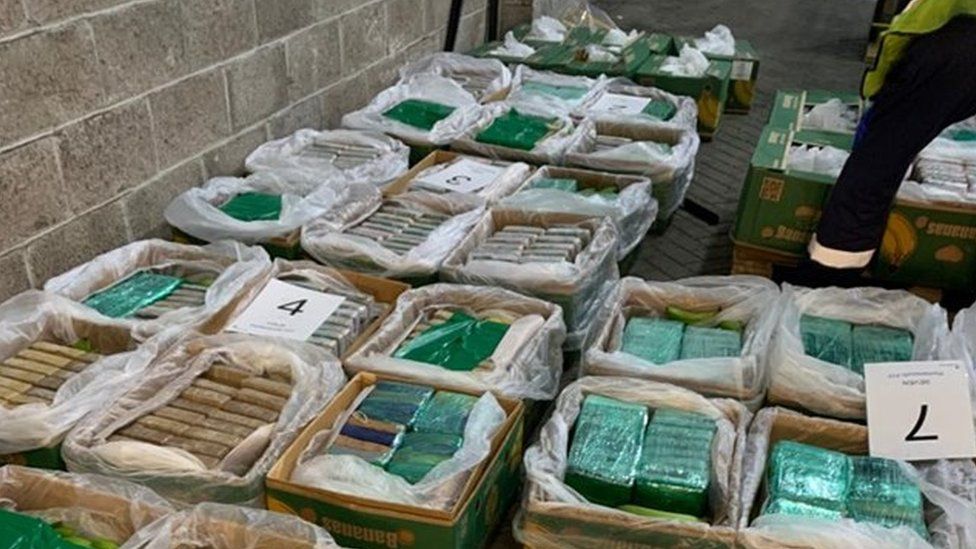
Cocaine weighing 2,300kg and with an estimated value of US$259 million has been found inside a consignment of bananas that arrived in the UK from Colombia.

The haul of cocaine was intercepted in Portsmouth and the drugs were removed, the National Crime Agency (NCA) said.

The pallets were then loaded with dummy packages and delivered to Tottenham Industrial Estate in north London.

Ten people were arrested over the haul, which represents one of the UK’s biggest ever drugs seizures.

The NCA said three people had been charged.

The raid was a joint operation between the NCA and the Met Police and was the culmination of a week-long investigation, following intelligence received by detectives.

Drug seizureimage copyrightNCA
image captionThe consignment is equivalent to more than half the quantity of cocaine seized in an average year

Officers tracked the shipment of drugs on 41 pallets as it arrived in Portsmouth, where UK Border Force officers removed the cocaine.

The pallets were then delivered to Tottenham. Police moved in once enough evidence had been gathered from a surveillance operation at the site.

Body-worn footage showed armed officers breaking into storage units where the drugs had been due to be delivered.

‘Five million drug deals’

The Met’s Det Supt Simon Moring believes officers have cost organised criminals more than £100m in profits.

He said: “By the time that’s divided down into deals we could be talking about five million drug deals.

“That’s five million deals taken off the streets of the UK – that will have a profound effect on the price in the UK and the criminals involved.”

John Coles, head of specialist operations at the NCA, said: “Illegal drugs are a corrosive threat and those who deal in cocaine are often violent and exploitative.

“Cocaine supply is directly linked to the use of firearms, knife crime and the exploitation of young and vulnerable people.”

The consignment is equivalent to more than half the quantity of cocaine seized in an average year.

About 4,200kg of the drug was intercepted in the year to March 2020.

The post UK: Coke Worth $259m Found in Banana Boxes from Colombia appeared first on The St Kitts Nevis Observer.

El Chapo’s Wife Arrested in US for Drug Trafficking

BBC- The wife of jailed Mexican drug lord Joaquín “El Chapo” Guzmán has been arrested in the US on suspicion of drug trafficking, US authorities say.

Emma Coronel Aispuro, 31, was detained at Dulles International Airport outside Washington DC.

She is charged with participating in a conspiracy to distribute cocaine, methamphetamine, heroin and marijuana.

Guzmán is currently serving a life sentence in New York for drug trafficking and money laundering.

The 63-year-old is a former head of the Sinaloa cartel, which officials say was the biggest supplier of drugs to the US.

His trial in 2019 heard shocking revelations about his life, from drugging and raping girls as young as 13 to carrying out the cold-blooded murders of former cartel members and rivals.

Ms Coronel Aispuro is due to appear in a federal court in DC via video conference, the US justice department said.

As well as facing drug trafficking charges, she is also accused of conspiring with others to help her husband escape from prison in Mexico in 2015.

He was sprung from Mexico’s maximum-security Altiplano prison after his sons bought a property near the prison and a GPS watch smuggled into the prison gave diggers his exact location. He escaped by riding a specially adapted small motorcycle through the tunnel.

Court documents said Ms Coronel Aispuro was allegedly involved in planning another prison escape for her husband before he was extradited to the US in January 2017.

She has not commented on the charges.

media captionEl Chapo trial: Five facts about Mexican drug lord Joaquín Guzmán

Ms Coronel Aispuro is a dual US-Mexico citizen and the mother of twins with Guzman. She attended nearly every day of her husband’s three-month trial in New York, during which she heard not only grim accounts of murder and rape, but also claims he spied on her and other mistresses.

She stayed loyal, saying at the end of the trial: “I don’t know my husband as the person they are trying to show him as, but rather I admire him as the human being that I met, and the one that I married.”

Guzmán came from a poor family in Sinaloa state, north-west Mexico. His organised crime business grew so big that he entered Forbes’ 2009 list of the world’s richest men at number 701, with an estimated worth of $1bn (£709m).

The post El Chapo’s Wife Arrested in US for Drug Trafficking appeared first on The St Kitts Nevis Observer.

Guatemalans Outraged by Fake COVID-19 Tests

GUATEMALA CITY (AP) — Lawmakers and rights official in Guatemala called Monday for an investigation into 30,000 fake COVID-19 tests that were bought by public health officials.

The 30,000 tests and testing materials cost the Central American country’s Health Ministry almost $1 million, but were found to be unreliable.

Jordán Rodas, the head of the country’s human rights agency, said Monday “it is inconceivable that in the midst of a humanitarian crisis there is corruption in even the purchase of COVID-19 tests.”

A private Guatemala company says it bought the tests from a U.S. firm, which denies having sold them.

Edwin Asturias, the former had of pandemic efforts in Guatemala, asked in his Twitter account how many people might have relied on a false negative from the tests and unwittingly infected others.

Health Minister Amelia Flores has asked prosecutors to investigate representatives of the Guatemalan company and a former health official for possible fraud, perjury and other misdeeds.

Guatemala has had 171,289 coronavirus cases and 6,306 deat


The post Guatemalans Outraged by Fake COVID-19 Tests appeared first on The St Kitts Nevis Observer.