Ukrainian President Volodymyr Zelensky has emerged as a hero to his nation’s citizens and far beyond as the former actor and comedian first elected in 2019 remains in his country at great personal risk during its bombardment by Russia.
Zelensky, who agreed on Sunday to talks at the Belarus border with Russia to end the military conflict, has been his country’s man in the capital city of Kyiv, where he has issued a series of videos urging Ukrainians to resist the invasion.
“I am here. We will not lay down any weapons. We will defend our state, because our weapons are our truth,” he said in one clip filmed outside his office in Kyiv.
“This is what I wanted to tell you. Glory to Ukraine!” he said.
Zelensky was previously perhaps best known in the United States for the role he played in the controversy surrounding former President Trump’s first impeachment. Zelensky was pressured by Trump and his allies to investigate then-candidate Joe Biden and his family for corruption.
In today’s existential crisis facing his country, Zelensky has won praise across the political spectrum in the United States for sticking at home and producing a series of videos urging Ukrainians to resist the Russian invasion.
Sen. Ben Sasse (R-Neb.) tweeted that Zelensky was “a bigger man than Putin” and that “even the dictator’s cronies know.”
Zelensky is a bigger man than Putin.
The whole world knows.
Russian army knows.
Even the dictator’s cronies know.
Zelensky has done so at great personal risk, as U.S. officials have made it clear they believe Russian President Vladimir Putin wishes to knock out Ukraine’s leaders with lethal military strikes. Zelensky’s family has also remained in Ukraine.
Sources who have spoken to people on the ground in Ukraine said there is a sense of surprise among many Ukrainians in terms of how Zelensky has met the moment. The political novice won election in grand style in 2019, but polls suggested he was getting mixed reviews from the public before the invasion.
By sticking in Ukraine, he has become a leader for all Ukrainians to rally around as civilians take up arms to slow the Russian advance. And the risk to his own life is something that has resonated. Zelensky has said that Russia has “marked” him as its top target, believing that by killing the leader, support for the resistance would disappear. He pointedly noted that his family was Russian target “No. 2.”
Zelensky’s decision to stay in Ukraine also stands in contrast to the U.S.-backed leader of Afghanistan, who fled Kabul in August as the Taliban took over the city and U.S. troops left.
When the Biden administration offered to get Zelensky securely out of the country, he refused, asking for ammunition instead.
Zelensky has also emerged as a leader to those opposed to the Russian invasion around the world, including in Russia itself. Online tributes compare Zelensky favorably to Biden and Trump as well as Putin.
Sen. Rob Portman (R-Ohio), during an appearance on NBC’s “Meet the Press” on Sunday, noted that there has been extraordinary unity behind Ukraine, characterized by 40 rallies being held around the United States in solidarity with the country, including one he planned to attend in Ohio.
“The world is standing up, frankly, in ways I haven’t seen since 9/11,” he said.
Samuel Charap of the RAND Corporation in an interview with CNN compared Zelensky to Winston Churchill, who rallied international opposition to the Nazis as his country was bombarded.
“He, to a certain extent, is alone, and it’s clear the Russians have put a target on his back” he said. “You need a real Churchill-type leader to excel in a moment like this. I think he is scrambling and trying to find the right message.”
NIA CHARLESTOWN NEVIS — The Ministry of Education on Nevis was presented with a cheque of $43,200 from the Dr. Lornette Mills Charitable Foundation, a donation which sponsors 48 students in the School Meals Programme.
Ms. Zahnela Claxton, Principal Education Officer in the Department of Education, responding to the donation from the foundation through its representative Mr. Carlisle Powell, expressed gratitude for the gift, at the handing over ceremony at the Jessups Community Centre on February 24, 2022.
“On behalf of the Ministry and Department of Education I want to extend our profound thanks to the Dr. Lornette Mills Charitable Foundation and of course the representative here today Mr. Carlisle Powell.
“I want to reiterate that this foundation and this programme has been sponsoring 48 students this school year from nine schools and the sponsorship amount is in the total of$43,200., and I think that this is no small feat. That is an excellent contribution, and we want to extend our heartfelt thanks to the foundation and specifically to Dr. Lornette Mills,” she said.
The foundation has been making donations to the department for students’ meals for many years. Ms. Claxton described the donation as an important one, citing that it is always good when persons who are able to contribute to the nation building process do so, even when they have migrated.
While presenting the cheque, Mr. Powell spoke of the foundation’s gift to Dr. Mills’ homeland.
“For almost 10 years the Dr. Lornette Mills Charitable Foundation has donated a significant amount of money to sponsor the Schools Meals Programme, and she does this because of her love for Nevis, her love for young people, and her desire for young people to be given every opportunity to excel,” he said.
Mr. Powell explained that the gift covers 48 students in nine schools – seven primary and two secondary schools.
He also explained why Dr. Mills continues to give back to her country.
“While the foundation continues to partner with the Nevis Association of South Florida, 100 percent of the funds provided are from the resources of Dr. Lornette Mills. What is truly remarkable is that the Dr. Lornette Mills Charitable Foundation does not seek donations.
“The first paragraph of the mission statement for the foundation clearly says why Lornette continues to do this, and the first sentence says: ‘To provide assistance to Nevisians at home and in the diaspora and to facilitate the pursuit of education and development of our children especially those in need.’ For the record, the foundation also sponsors the island wide school quiz competition,” he said.
The foundation’s representative also gave some insight into Dr. Mills background noting that she is from Hanley’s Road in Gingerland.
According to Mr. Powell, in her formative years she attended the Gingerland Primary School now the Joycelyn Liburd Primary School and on her graduation attended the Gingerland Secondary School.=
She left Nevis at age 15 to join her mother and the rest of her siblings in the United States of America but Nevis continues to be a part of her. She has a home on the island and returns on vacation as often as she can.
He said Dr. Mills always knew she wanted to become a doctor, and so in 1989 she graduated from the New York University with a bachelor of science degree. Four years later she graduated from the School of Medicine and Biomedical Sciences at Buffalo with her medical degree.
In 1996 she completed her residency in internal medicine at the George Washington University Hospital, and in 1999 she completed the Gastroenterologist Fellowship from the State University of New York Downstate.
Regarding her employment, Mr. Powell said over the years she has not had many bosses. Dr. Mills was a gastroenterologist at Calvert Internal Medicine. She became the first female gastroenterologist in Southern Maryland.
From 2002 to present she is the owner and president of Gastrointestinal Associates of Maryland (GIA), and from 2001 to present she is the owner, president, chief medical director of Walldorf Endoscopy Center (WEC).
Mr. Powell said the foundation is delighted to assist the youth of Nevis. He used the opportunity to thank Mr. Rico Clarke who manages the fund.
BOGOTA, Feb 27 (Reuters) – An explosion at a coal mine in Colombia’s Boyaca province killed 11 people and left four missing, the national mining agency (ANM) said on Sunday.
The accident occurred on Saturday night and was caused by a build up of methane gas at the mine, which is located in the Tasco municipality, the ANM said.
Colombia’s mining industry includes huge open-pit and underground projects operated by multinational companies, as well as hundreds of small, informal deposits.
Accidents in the mining sector occur regularly as some enterprises are illegal, or do not properly enforce safety measures.
The mine in Tasco had approval to operate, the ANM said. Rescue crews and fire fighters fear that the four people still missing were also killed in the explosion.
Colombia saw 128 mining accidents in 2021, which killed 148 dead. So far this year 19 mining accidents have taken place, with 36 deaths, according to the ANM.
Reporting by Luis Jaime Acosta; Writing by Oliver Griffin; Editing by Michael Perry
KYIV, Ukraine (AP) — Outgunned but determined Ukrainian troops slowed Russia’s advance and held onto the capital and other key cities — at least for now. In the face of stiff…Read More
Jamaican-born American Dr Susan M Collins, who, in July this year will become the first black woman to head a federal reserve bank in the US, was inspired to become an economist by observing social and financial hardships in the land of her birth.
Collins’ appointment as president and chief executive officer of the Federal Reserve Bank of Boston, Massachusetts – one of 12 branches in the US — was announced earlier this month, drawing high praise for her qualification and leadership abilities.
“This is a brilliant appointment,” Lisa Lynch, a Brandeis University professor and former chair of the Boston Fed, was quoted as saying by ABC News. “She is a tested leader with the expertise and demeanour to be a strong voice at the Federal Reserve in Washington and the New England business community.”
Dr Christina Paxson, president of Brown University and chair of the Boston Fed board who led the search committee, said: “After an intensive search, we are thrilled to appoint this exceptionally well-qualified person to be the bank’s president and a key leader in the Federal Reserve System.”
Collins, 63, graduated summa cum laude from Harvard University in 1980 and earned her PhD in economics at the Massachusetts Institute of Technology (MIT) in 1984. She then returned to Harvard to teach.
She will also be a voting member of the central bank’s powerful Federal Open Market Committee, whose mandate is to promote full employment and stable consumer prices.
Collins grew up in Manhattan, New York, after her social anthropologist father who worked at the United Nations and university librarian mother (now deceased) migrated from Kingston. She is married with two children.
A&B Observer- The Caribbean will undoubtedly be affected by an increase in prices for food and petroleum products if the escalating conflict between Russia and Ukraine continues.
Almost immediately following the news of the Russian military invasion of Ukraine on Thursday, the world began experiencing higher gas prices.
The price of oil has surged past $100 for the first time since 2014 when Russian President Vladimir Putin launched a military attack on his European neighbour, Ukraine, which led to widespread condemnation of the blatant disregard for international law.
Due to these developments, A&B Prime Minister Gaston Browne has notified residents about the potential increase of local gas prices in the event that the war in Eastern Europe shows no signs of de-escalation.
“Now, I believe that within the last few days petroleum prices are about $100 per barrel and potentially it could get up to maybe $120 within the next week or two, especially if this conflict continues. So, here is the implication of potentially where we have been subsidising the pricing and would have kept the pricing of petroleum products stable for the last few years, we could have a situation where we are forced to increase the price at the pump,” Browne explained on local radio over the weekend.
Further explaining the economic fallout which could arise out of the emerging conflict, the Prime Minister noted that the government may no longer be able to shield consumers from high prices at gas station pumps across the country.
“If petroleum prices continue to increase, then there may be a time when we cannot continue to hold the price of $12.50 or whatever it is for gas and then in that case, they may have to be a pass through at some point. Again, the whole idea is to reduce the price at the pump but if it gets to the stage in which the government consumption tax is totally wiped out and then it’s going into negative ground then we may have to pass on the increase in price to consumers,” he said.
Additionally, the price of utilities, such as electricity could also rise as a result of the price of oil skyrocketing because of the closed borders and sanctions because of the war.
“Petrol and food, those contribute to co-inflation and the thing about it is that these increases in those prices affect the poor disproportionately and that is why Antigua and Barbuda has had this price equalisation mechanism in place to control the price at the pump.”
With regards to international relations, Browne believes that larger countries tend to throw democracy out of the window due to sheer power and size of both land mass and economy.
“We have to be careful not to get involved in their rhetoric but at the same time stand on those principles that will defend our interests. These powerful countries, whenever it is convenient for them, they speak about defending democracy but whenever they believe their so-called national interest is at stake, then might becomes right and that is precisely what is happening right now in Russia,” he said.
BOGOTA/BUENOS AIRES/SANTIAGO, Feb 24 (Reuters) – Colombia, Argentina and Chile have called for swift withdrawal of Russian troops from Ukraine, as other Latin American countries rejected the use of force but stopped short of calling for a Russian exit.
Russia invaded Ukraine by land, sea and air in the early morning, in the biggest attack by one state against another in Europe since World War Two. Russian President Vladimir Putin said the attack is an effort to ‘denazify’ Ukraine. read more
“We categorically reject war and we join all the voices of the international community who today clamor for the speedy withdrawal of Russian troops from Ukrainian territory,” Colombia’s centre-right President Ivan Duque said in a video statement.
“This premeditated and unjustified aggression is a threat to world peace,” he said. Vice-President and Foreign Minister Marta Lucia Ramirez branded the invasion “absurd colonialist nostalgia” on Twitter.
Argentina’s foreign ministry in a statement called on Russia to cease military actions in Ukraine, while Chile said it would support sanctions approved by the United Nations Security Council.
“Our country calls for Russia to withdraw its troops and especially for it to respect the territorial integrity and sovereignty of Ukraine,” Chile’s Foreign Minister Carolina Valdivia said.
Ecuador’s Foreign Minister Juan Carlos Holguin also condemned Russia, saying it had violated international law, and called for an end to fighting.
Brazilian President Jair Bolsonaro, who recently met with Putin in Moscow, did not mention the Ukraine crisis in a Thursday address to supporters. Bolsonaro came under strong U.S. criticism for saying during his visit that he was “in solidarity with Russia,” without elaborating. read more

Demonstrators stick a portrait of Vladimir Putin during an anti-war protest in front of the Russian embassy, after Russia launched a massive military operation against Ukraine, in Santiago Chile, February 24, 2022. REUTERS/Ivan Alvarado
But his Vice President Hamilton Mourao said economic sanctions may not be enough and the West may need to use force against Russia.
Mourao’s comments went well beyond a statement by the foreign ministry calling for a halt to Russian hostilities and saying it would act as a member of the Security Council to find a peaceful solution.
Argentina’s President Alberto Fernandez has also recently visited Moscow, prompting some analysts to suggest Russia has courted Latin America amid the Ukraine tensions.
Some Latin American countries were less pointed in their criticism.
Mexican President Andres Manuel Lopez Obrador called for dialogue, while Foreign Minister Marcelo Ebrard later took a tougher stance, condemning the invasion and demanding Russia end its military operations in Ukraine.
Peru’s foreign ministry expressed concern and appealed for an end to hostilities, and Paraguay’s foreign minister urged dialogue and a ceasefire.
Russia’s strongest allies in the region – Cuba and Venezuela – had yet to directly address the invasion early on Thursday morning.
Venezuela’s foreign minister Felix Plasencia on Wednesday backed Putin’s fight against what he said was North Atlantic Treaty Organization’s (NATO) desire for war.
Cuba on Wednesday criticized the United States for imposing “the progressive expansion of NATO towards the borders of the Russian Federation” and called for a diplomatic solution. read more
Reporting by Julia Symmes Cobb in Bogota, Adam Jourdan in Buenos Aires and Fabian Cambero in Santiago, additional reporting by Lisandra Paraguassu in Brasilia and Gabriel Stargardter in Rio de Janeiro, Dave Sherwood in Havana, Ana Isabel Martinez and Daina Beth Solomon in Mexico City, Vivian Sequera in Caracas, Marco Aquino in Lima, Alexandra Valencia in Quito and Daniela Desantis in Asuncion; Editing by Diane Craft and Kenneth Maxwell
BRASILIA, Feb 25 (Reuters) – Brazil voted on Friday for a draft U.N. Security Council resolution that would have deplored the Russian invasion of Ukraine, despite some reluctance by Brazilian President Jair Bolsonaro to condemn Russia.
The South American country was among the 11 council members that voted in favor of the resolution, while China, India and the United Arab Emirates abstained from the vote on the U.S.-drafted text. read more =
The draft was vetoed by Russia and is now expected to be taken up by the 193-member U.N. General Assembly.
Reuters reported earlier on Friday that Brazil would vote in favor of the resolution despite doubts of its far-right president.
Bolsonaro, who recently met with President Vladimir Putin in Moscow, on Thursday scolded his Vice President Hamilton Mourao for condemning the Russian invasion, saying it was not Mourao’s job to speak about the crisis in eastern Europe.
Brazil’s foreign ministry on Thursday expressed concern about Russia’s military operations and urged a diplomatic solution, but stopped short of condemning the invasion.
Just days before the invasion, standing alongside Putin at the Kremlin, Bolsonaro said he was “in solidarity with Russia,” without elaborating. He later told reporters Putin had peaceful intentions.
The U.S. State Department deplored Bolsonaro’s comments and said they undermined diplomatic efforts to avert a disaster as well as Brazil’s own calls for a peaceful resolution.
Ukraine’s diplomatic representative in Brasilia, Anatoliy Tkach, called again on Friday for a strong Brazilian condemnation of Russia’s “aggression” against his country.
Reporting by Lisandra Paraguassu; Writing by Gabriel Araujo, Anthony Boadle and Peter Frontini; Editing by Rosalba O’Brien
Multiple media organizations are reporting that Ukraine and Russia will hold peace talks on the border of Ukraine and Belarus.
Ukrainian President Volodymyr Zelensky confirmed to Sky News that the two sides would hold the talks on the border of Ukraine and Belarus, where some of the Russian troops invading his country had been held.
Zelensky had refused to agree to an earlier request for talks in Belarus, arguing it was not neutral territory.
Sunday was the fourth day of the Russian invasion of Ukraine, which has been slowed by fierce resistance from Ukrainian troops and private citizens.
Several cities, including the capital of Kyiv, have been bombarded by Russia, and there has been fighting in the streets.
Sky News, referring to a statement from Zelensky’s office, said the two delegations will meet “without preconditions” near the Pripyat River.Earlier in the day, Zelensky had spoken with Belarusian President Alexander Lukashenko, an ally of Russian President Vladimir Putin.
“Alexander Lukashenko has taken responsibility for ensuring that all planes, helicopters and missiles stationed on Belarusian territory remain on the ground during the Ukrainian delegation’s travel, talks and return,” the statement said, according to Sky News.
=====================================
US ambassador not surprised by Putin’s threat of nuclear deterrence
By Joseph Choi
Linda Thomas-Greenfield, the U.S. ambassador to the United Nations, said on Sunday that she is not surprised by Russian President Vladimir Putin‘s apparent threats of nuclear deterrence in response to the international condemnation for invading Ukraine.
Thomas-Greenfield was asked during an appearance on CBS’s “Face the Nation” about Putin’s order earlier Sunday to put Russia’s nuclear deterrent forces on high alert.
“It means that President Putin is continuing to escalate this war in a manner that is totally unacceptable, and we have to continue to condemn his actions in the strongest possible way,” said Thomas-Greenfield.
“Our voices have been unified with the Europeans and with the world that he needs to cease his aggressive actions toward Ukraine,” Thomas-Greenfield added. “And we will continue here at the United Nations and around the world to use every possible lever we have at our disposal to expose his actions.”
Host Margaret Brennan also asked the ambassador whether she believes the rhetoric from Putin is “loose talk” or if there is a readiness that was cause for concern.
“I’m just hearing this from you, Margaret, but I’m not surprised at this information because Putin has tried every means possible to actually put fear in the world in terms of his action, and it just means that we have to ramp up our efforts here at the United Nations and elsewhere to hold him accountable,” said Thomas-Greenfield.
In his announcement, Putin cited supposed threats from NATO for his decision to put Russia’s nuclear deterrents on high alert.
“Senior officials of the leading NATO countries also allow aggressive statements against our country, therefore I order the minister of Defense and the chief of the general staff [of the Russian armed forces] to transfer the deterrence forces of the Russian army to a special mode of combat duty,” Putin said, according to The Guardian.
“Western countries aren’t only taking unfriendly actions against our country in the economic sphere, but top officials from leading NATO members made aggressive statements regarding our country,” he added
A study newly published in The Lancet medical journal shows that from March 1, 2020, to April 30, 2021, about 5.2 million children globally lost a parent or guardian to COVID-19.
The study does not include deaths related to the omicron variant of COVID-19, which would likely increase the number of children who have lost a parent to the virus.
Of the parents who died of COVID-19, about 77 percent of them were fathers, or male guardians, compared to about 23 percent of mothers, or female caregivers, lost, the study reports.
The estimates were reached by gathering data available on COVID-19 mortality from 21 countries — including the United States, Brazil, England, Russia, Mexico, France, Italy, Kenya, and more — which represent 76 percent of coronavirus deaths, in order for the researchers to “model global minimum estimates of children affected by COVID-19-associated orphanhood and caregiver death.”
Grandparents were included as caregivers in the study as the researchers acknowledged the pivotal role that grandparents play in children’s lives, especially in lower-income settings. Children who live in households that home extended family members, including grandparents, is about 40 percent worldwide and almost 50 percent in the Asia-Pacific, the study notes.
This week the UK government announced additional vaccine booster jabs for the over-75s and suggested a further shot is likely to be needed in the autumn. But imagine if the next Covid vaccine jab you have were the last you would ever need.
That’s a dream being actively pursued now by researchers, who feel it could be possible to make a “universal” vaccine against the Sars-CoV-2 virus that would work well not only against all existing variants but any that the virus could plausibly mutate into in the future.
Some are thinking even bigger. In January, Joe Biden’s chief medical adviser, Anthony Fauci, and two other experts called for more research into “universal coronavirus vaccines” that would work not only against Sars-CoV-2 but against the many other coronaviruses in animal populations that have the potential to spill over into humans and cause future pandemics. “We need a research approach that can characterise the global ‘coronaviral universe’ in multiple species,” Fauci and colleagues wrote in the New England Journal of Medicine, “and apply this information in developing broadly protective ‘universal’ vaccines against all [coronaviruses].”
Is that just a fantasy? Not necessarily. After all, many considered it fanciful, when the pandemic began, that we’d have a vaccine against Covid-19 in less than a year. But experience has proved that “we as a research community can pull together and do remarkable things,” says Larry Corey, a virologist and vaccine expert at the University of Washington in Seattle.
The current vaccines were developed against the original “ancestral” variant of Sars-CoV-2. They still work remarkably well against the new variants in preventing severe disease – Corey says that even against Delta there seems to be about a 90-fold difference in the death rate between vaccinated and unvaccinated individuals. But the Omicron variant has caused alarm by its ability to transmit faster than the others and to infect vaccinated people. Although very few such individuals develop serious symptoms from Omicron, it can actively suppress the immune defences that vaccination (as well as natural infection) activate.
A woman receives a Covid jab in Bangkok, Thailand, last month. The country is battling a spike in Omicron cases. Photograph: Anusak Laowilas/NurPhoto/REX/Shutterstock
Variants acquire changes to the chemical structure of the viral proteins, through random mutations when the virus replicates, that give them some competitive advantage – improved transmissibility, say. Many of these changes happen on the so-called spike protein, which sticks out of the virus shell and latches on to proteins in the membranes of human cells, creating a point of attachment and attack. Omicron has an alarming number of such mutations, showing how much capacity Sars-CoV-2 has to spring surprises.
One answer is to adapt the vaccines to the variants. The mRNA vaccines made by Pfizer/BioNTech and Moderna contain RNA molecules that act as templates for our cells to make harmless fragments of the spike protein. This is the vaccine’s antigen, provoking the immune system to find antibody molecules that will recognise the viral protein and mobilise immune cells against it. Then if the actual virus gets into our bodies, our immune system is primed to identify and destroy it. Other vaccines, such as AstraZeneca’s, use other methods to elicit the same immune priming. If the spike protein of a variant has a slightly different structure, in principle we can change the RNA molecule to one that encodes part of this new protein.
If, as widely expected, Sars-CoV-2 eventually becomes endemic in the population, constantly circulating at a low level like flu and cold viruses but with the potential to produce an epidemic outbreak, the vaccines could be tailored to whatever variants are currently in circulation. This is more or less what happens with flu: each season’s flu vaccine is based on a best guess of what that season’s strains are likely to be.
That’s all very well – except that Omicron has shown how rapidly a significantly new variant of the coronavirus can appear and spread globally. Pfizer and Moderna are now working on a vaccine tailored to Omicron. But even if this can be made and tested within a few months, that may be too late. So a universal vaccine that can protect against all variants could be preferable. “We need a vaccine that has potential to protect broadly and proactively against multiple coronavirus species and strains,” says Kayvon Modjarrad, who leads a team seeking to develop one at the Walter Reed Army Institute of Research in Silver Spring, Maryland.
At the moment we have no pan-variant vaccine for any endemic virus. Researchers have long dreamed of a universal vaccine that would make flu epidemics less lethal, and there are now promising signs that it could be possible. The design principle for a universal Covid vaccine would follow similar lines.
One option might be to prime the immune system to recognise not just one bit of a viral protein, but lots of bits – not all of which are likely to change (or change significantly) at once in any new variant. We’d give the immune system many different ways to spot, and then suppress, the invader, in the hope that one will work. This might involve, for example, making an mRNA vaccine that contains many different RNA molecules, each encoding as a different protein fragment. Or a single particle in the vaccine could hold several different fragments.
Alternatively, you can look for parts of the virus that seem to be “conserved” across variants: proteins (or bits of them) that don’t mutate much at all, presumably because such changes would be too detrimental to the virus. But how can you know what those will be, even for variants that haven’t emerged yet? One way is to see if highly conserved protein regions exist already among a whole family of related coronaviruses. “If you can find things that are in common between Sars-CoV-2, Sars [the related respiratory virus that caused alarm in 2003], and a bunch of other animal coronaviruses, then the likelihood is that the next variant of Sars-CoV-2 will have them too,” says Skip Virgin, chief scientific officer of San Francisco-based Vir Biotechnologies, which is working with GlaxoSmithKline on vaccine development – a collaboration that has already produced the monoclonal antibody sotrovimab for alleviating Covid symptoms.
At the moment, researchers are mostly striving for the relatively modest target of hitting just a subset of the coronavirus universe: typically, to stimulate an immune response against a part of the spike protein, called the receptor binding domain (RBD), shared by Sars, Sars-CoV-2 and closely related bat coronaviruses. The RBD is the part of the spike protein that latches on to the host cells. Although some of the variants have small mutations in their RBD, its chemical structure doesn’t change much: create a strong immune response to the RBD and it should work against any virus in this family.
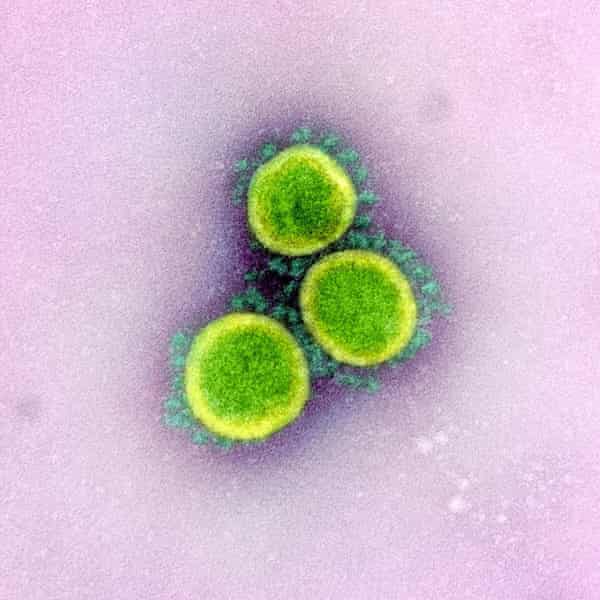
Sars-CoV-2 particles captured by a transmission electron micrograph. Photograph: AlamyModjarrad’s team began Phase I clinical trials (looking just at the safety) of their pan-variant vaccine in April 2021. It uses a tiny nanoparticle called ferritin – a natural protein that stores iron atoms in the body – studded with many copies of the Sars-CoV-2 RBD.
It has been long known that many copies of an antigen in a single vaccine particle elicit a stronger immune response than a single copy does. The institute is cagey about releasing details of its progress until its clinical trial data has been published. In December, however, the team published results showing that their ferritin vaccine confers good protection in macaques not only against the ancestral form of Sars-CoV-2 but also against the Alpha, Beta, Gamma and Delta variants, and the original Sars virus.
Barton Haynes of the Duke University School of Medicine in North Carolina is taking a similar approach with RBD-studded ferritin-based nanoparticles. Last May he and his coworkers reported a candidate vaccine that protected macaques against Sars-CoV-2, Sars, and some Sars-like bat coronaviruses. Very recently they showed that it generates a good immune response against the Delta and Omicron variants too.
Haynes says they hope to start human clinical trials at the end of 2022. If they work out, he thinks that it might take a year or two before the vaccine is ready to use, depending on whether it’s deemed different enough from those we have already to warrant another large-scale Phase III clinical trial before being approved.
These efforts might yield a vaccine resistant to all SARS-CoV-2 variants – but in principle such approaches might have an even wider scope, offering the universal coronavirus vaccines that Fauci and colleagues have called for. Haynes says that would probably entail finding the crucial RBDs for other families and adding those on to the particles too. That’s the beauty of the nanoparticle approach: it can readily incorporate a variety of protein fragments into a so-called multivalent vaccine.
Finding the right protein fragments could mean combing through the thousands of coronaviruses known to infect wild animals such as bats, civet cats and raccoon dogs, as well as the four coronaviruses already endemic in human populations and which cause mild cold-like respiratory symptoms. It would be a huge task. But now we know the awful dangers such coronaviruses (which include those that caused outbreaks of Sars in 2003 and Mers in 2012) pose, the investment would be cheap compared with the economic and social harm it might prevent. Haynes hopes it might ultimately be possible for a single jab to protect against all coronaviruses for five to 10 years.
Of course, no one can be sure what the fiendishly ingenious Covid-19 virus has in store for the future. “The first axiom of infectious disease is, never underestimate your pathogen,” says Corey. “The rapidity with which we’ve got four major variants in two and a half years is unprecedented and surprising. One wouldn’t bet against this virus.”
But even viruses have limits. For example, despite Omicron’s extensive set of mutations, Vir’s sotrovimab still works against it. “Viruses can change some things but have a really hard time changing others,” says Virgin. “There are some things a virus just can’t get away with changing.” If you can find them, you’re in business. “I am optimistic that we can generate a vaccine that will give truly broad protection,” he says.
Even the current vaccines still do well at preventing deaths, and we’re building up an arsenal of antivirals and other treatments too. What might be more important now, Corey says, is a vaccine that does better against all variants at blocking transmission. Even when death rates are reduced, “we are seeing the fabric of our lives, our travel, the things that make modern culture, be interfered with enormously,” he says. So we need second-generation vaccines that can prevent widespread infection – a goal that Corey says is widely regarded as tougher, and which would be hard to assess until they are rolled out.
It’s tempting to think that we need to solve this pandemic before preparing for the next one, says Virgin, but “there’s absolutely no reason that your pandemic response can’t prepare you for the next”. And after all, he adds, it’s easier to persuade governments to spend on solving an existing problem than on one that hasn’t happened yet.
“We really want to get to the point where we’re preventing the next pandemic, not responding to it,” says Neil King of the University of Washington in Seattle, who is also developing a universal nanoparticle-based coronavirus vaccine. “The only way to do that is through broadly protective vaccines.” How marvellous it would be if, in developing a variant-proof Covid vaccine, we end up with one that can avoid the next pandemic too.

 *****@


 *****@
 *****@


 *****@
 *****@
 *****@