The post Newspaper Cover Newspaper Cover for 31st December, 2021 appeared first on The St Kitts Nevis Observer.
Tag Archives: caribbean
PR: San Juan’s 500th Anniversary Celebrations Kick Off With New Year’s Eve TV Special
Forbes- This year’s New Year’s Eve celebrations will be a little more sober than anticipated on what marks a momentous year for the party-loving people of Puerto Rico.
To coincide with the 500th anniversary of its capital city in 2022, Puerto Rico is making its official debut on “Dick Clark’s New Year’s Rockin’ Eve” by hosting the iconic TV show’s first Spanish-language countdown to midnight. Though the global audience will still be able to watch the televised version, the virulent Omicron strain of COVID-19 has muted the excitement by keeping the public from participating in person.
“In an effort to ensure the safety of both residents and visitors, the governor of Puerto Rico, Pedro Pierluisi, has announced scaling back the planned New Year’s Eve celebration at DISTRITO T-Mobile,” emails Discover Puerto Rico’s chief marketing officer, Leah Chandler, of the festive countdown and live music performances scheduled for the brand-new Distrito drinking, dining and entertainment complex in San Juan.
Before the unfortunate announcement, the stars had lined up perfectly for Puerto Rico to spectacularly showcase its fun-loving culture to thousands of attendees and approximately 20 million viewers. Not only is it San Juan’s quincentennial, the telecast – now hosted by Ryan Seacrest – turns 50 this year. Beyond that, the commonwealth welcomed an unprecedented number of tourists in 2021 and just opened Distrito, whose many superlative descriptors have PR’s stakeholders calling it a game-changer for events and marketing.
“Discover Puerto Rico, alongside our public relations agency Ketchum, identified this as a dream moment for Puerto Rico and thus approached Dick Clark productions to pitch the idea (three) years ago,” says Chandler. “DISTRITO T-Mobile is our newest state-of-the-art entertainment and nightlife complex. It opened in August, and it’s truly the perfect location and backdrop for such a historic celebration.”
Televised performances by headliners like Puerto Rican rapper Daddy Yankee and actor and singer Roselyn Sanchez will go on on ABC, as will the Spanish countdown, starting just before 11pm EST (midnight in San Juan). And though the crowds will be kept from Distrito, a record-breaking number of them will presumably be partying elsewhere.

2021, San Juan, Puerto Rico — The Distrito entertainment complex will host internationally televised … [+]
With Puerto Rico emerging out of a bleak decade marred by a deep recession and two devastating hurricanes, the pandemic has boosted some key economic indicators in the tourism sector. Hotel bookings for this week beat those of 2019 by 41%, with combined hotel and rental demand for 2021 beating the record set that year by 16%. Lodging revenue surpassed $1 billion for the first time this year, and the busiest US airline route during COVID-19 has been Orlando to San Juan.
At a time when international travel has largely shut down, this tropical American territory has beckoned mainland travelers with its many charms, not least of which may be the emotional security it offers as one of the most COVID-cautious places in the country.
The governor has long required visitors arriving by air to show a negative test result or risk quarantine, and bars and restaurants currently require patrons to show a vaccination card or a negative test result no greater than 48 hours old. Large events require a negative COVID test taken within 48 hours in addition to proof of vaccination.
With 89% of the eligible population receiving at least one dose of the vaccine, and an 80% full vaccination rate, Puerto Rico boasts one of the highest vaccination rates in the US.
Chandler says, “While the New Year’s celebrations will be virtual, the Island is beyond prepared and rather excited to continue welcoming travelers. Dick Clark’s New Year’s Rockin’ Eve with Ryan Seacrest 2022 validates our Island’s stature as a must-visit destination more than capable of hosting events of this magnitude, all while continuing to keep the public’s health and safety in mind every step of the way. This event rockets Puerto Rico into a new realm of entertainment events, unlike ever before.”
The post PR: San Juan’s 500th Anniversary Celebrations Kick Off With New Year’s Eve TV Special appeared first on The St Kitts Nevis Observer.
REUTERS WORLD NEWS: Muted New Year Celebrations, Omicron Optimism, Russia Tests New Cruise Missile, More
Friday, December 31, 2021 by Linda Noakes |
Here’s what you need to know.South Africa says its COVID fourth wave has peaked, Russia test-fires new hypersonic missiles, and stocks see in the New Year near record highs after a banner 2021 |
 |
|
Today’s biggest stories
|

A barber colors the digits of the number 2022 after cutting a man’s hair to welcome the upcoming new year, in Ahmedabad, India, December 31, 2021. REUTERS/Amit Dave
|
|

|
|
|
The post REUTERS WORLD NEWS: Muted New Year Celebrations, Omicron Optimism, Russia Tests New Cruise Missile, More appeared first on The St Kitts Nevis Observer.
New York Governor Frees Convicted Jamaican Drug Dealer Serving Life Sentence
New York Governor Kathy Hochul has granted clemency to a convicted Jamaican-born drug dealer among 10 immigrants who have “showed remorse and exemplified rehabilitation”.
In commuting the sentence of Roger Cole, 55, Hochul noted that he was originally sentenced to 125 years to life in prison, “having been put on trial during the Rockefeller Drug Law era during which extremely lengthy prison sentences were handed down for drug-related convictions”.
In 1989 and 1992, Cole was convicted of five counts of Criminal Sale of a Controlled Substance in the First Degree, and one count each of Criminal Sale of a Firearm in the Second Degree and Criminal Possession of a Weapon in the Third Degree.
His sentence was subsequently reduced on appeal to 85 to 100 years, of which Cole has now served more than 30 years.
“If he were sentenced today, he likely would not have faced such a lengthy sentence,” Governor Hochul said.
While incarcerated, she said, Cole earned his General Educational Diploma (GED) and an associate degree, and completed numerous vocational training and certification programs, including legal research and law library management. He also earned a certificate for completing a three-year business course while incarcerated.
“Upon his release, Mr. Cole will be reunited with his mother and other family members in his home country of Jamaica, who will provide housing and help him find employment,” Hochul said.
She said the immigrants selected for clemency have “shown a commitment to bettering their communities and themselves, and were carefully selected after a thorough review process”.
The Governor also announced several steps to reform the executive clemency program, including announcing that she has directed the Counsel to the Governor to select an advisory panel to assist in advising the governor on clemency applications.
Hochul said the panel will consist of impartial experts from the fields of law enforcement, public defense, the judiciary and clergy, as well as formerly incarcerated people.
“As governor, I have a unique and solemn responsibility to carefully use the power of clemency to address individuals in the criminal justice system who have made mistakes and have taken extraordinary steps to rehabilitate themselves,” she said.
Other immigrants pardoned, whose nationalities were not disclosed, were: Ana Sanchez Ventura, 64; Juan Vinas, 56; Faustino Reyes, 60; Sandra Williams, 65; Francisco Vargas, 53; Orlando Fernandez Taveras, 46; Hanley Gomez, 41; Juan Suazo, 54; and Edilberta Reyes Canales, 56.
“I am granting clemency to these deserving individuals who have exemplified rehabilitation, and I am committed to increased transparency and accountability in this process going forward. No one should be defined by their worst mistake, and these individuals have worked tirelessly to atone for theirs,” Hochul said.
/CMC
The post New York Governor Frees Convicted Jamaican Drug Dealer Serving Life Sentence appeared first on The St Kitts Nevis Observer.
Tourism Blow: US CDC Warns Against Cruises, Regardless of Vaccination Status
The US Centers for Disease Control and Prevention warned people on Thursday not to go on cruises, regardless of their vaccination status, because of onboard outbreaks fuelled by the omicron variant.
The CDC said it has more than 90 cruise ships under investigation or observation as a result of COVID-19 cases. The agency did not disclose the number of infections.
“The virus that causes COVID-19 spreads easily between people in close quarters on board ships, and the chance of getting COVID-19 on cruise ships is very high,” even if people are fully vaccinated and have received a booster, the CDC said.
The CDC also recommended that cruise passengers get tested and quarantine for five days after docking, regardless of their vaccination status and even if they have no symptoms.
The omicron variant has sent case levels soaring across the US, including Florida, the hub of the nation’s cruise industry. The state set another record this week for new daily cases, with more than 58,000 recorded Wednesday.
US cruise lines have not announced any plans to halt trips, though vessels have been denied entry at some foreign ports.
The post Tourism Blow: US CDC Warns Against Cruises, Regardless of Vaccination Status appeared first on The St Kitts Nevis Observer.
Brazil’s Bolsonaro Refuses Flood Aid from Argentina, Drawing Bahia Rebuke
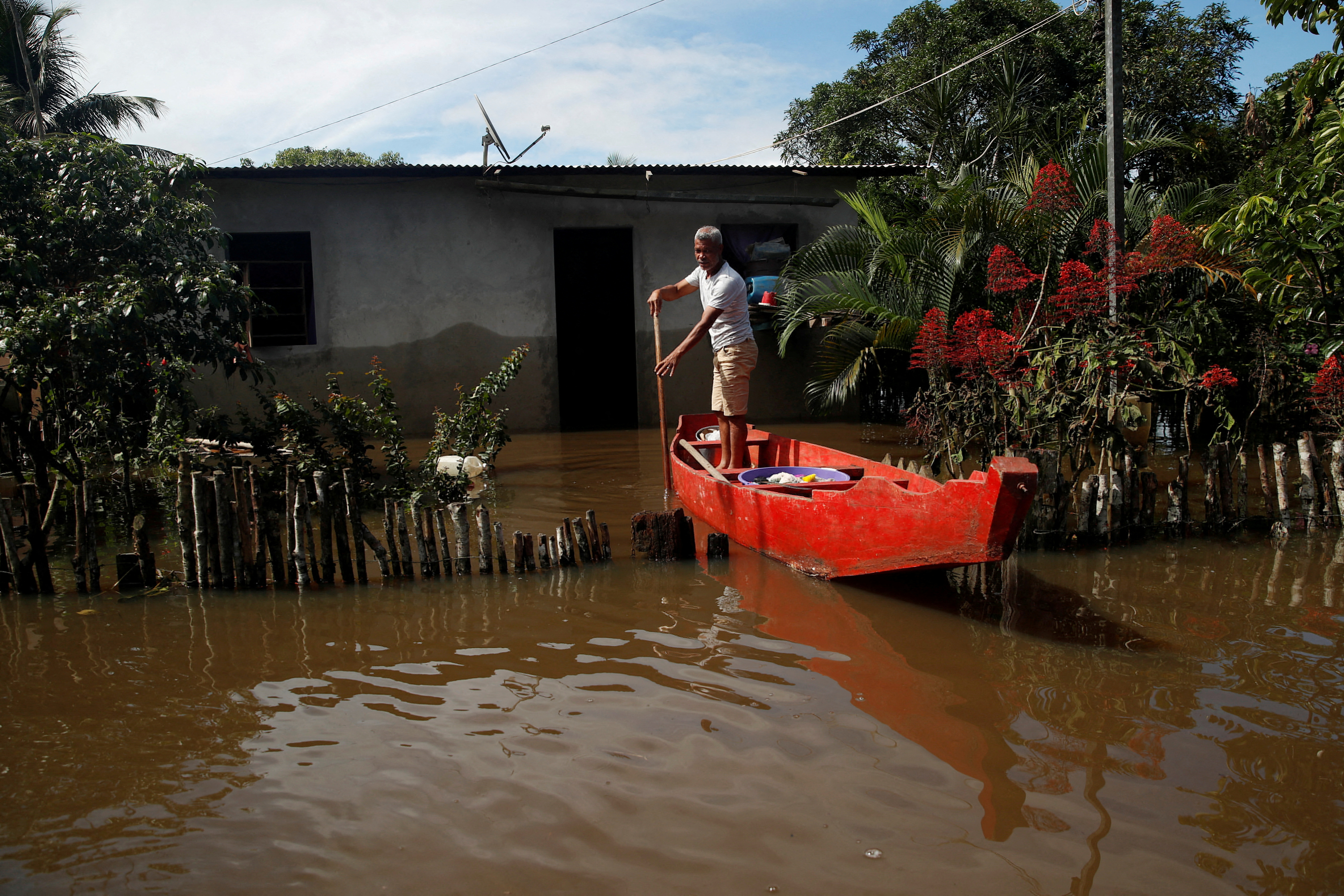
Sergio da Silva dos Santos hands clothes to other residents in front of a flooded house accessed by canoe at Sambaituba in Ilheus, Bahia state, Brazil December 29, 2021. REUTERS/Amanda Perobelli/File Photo
RIO DE JANEIRO, Dec 30 (Reuters) – Brazilian President Jair Bolsonaro rejected an offer of aid from Argentina, saying on Thursday that his country did not need the assistance dealing with deadly floods that have affected broad swaths of the country’s northeast and killed dozens.
His comments drew a quick rebuke from the governor of hard-hit Bahia state, who said local authorities would welcome help from any nation and that foreign countries should feel free to contact the state directly.
So far, at least 24 people have died and tens of thousands have been left homeless as record rains pound parts of the northeast, in some cases causing dams to fail and rivers to rise meters above their normal levels. Bahia Governor Rui Costa has called it the “worst disaster” in the state’s history and said large parts of Bahia looked as if they had been “bombarded.”
Bolsonaro, meanwhile, has faced criticism for continuing with his beach holiday in the southern state of Santa Catarina, thousands of miles from the affected zone.
In a Twitter post on Thursday, the president said the Argentine government had offered to send 10 people to help set up temporary shelter, provide psychological assistance and to otherwise aid with the logistics of the rescue effort.
However, the aid offer was “very expensive for Brazil,” he wrote, adding that Brazilian authorities were already providing the services offered. He added that Brazil had already accepted donations from Japan’s foreign aid agency and might accept Argentina’s assistance should it become needed.
“The Brazilian government is open to aid and international donations,” he wrote.
Far-right Bolsonaro’s Brazil has had chilly relations with Argentina since the election of center-left President Alberto Fernandez in 2019. Bolsonaro had previously called Fernandez a “red bandit.”
Costa, governor of left-leaning Bahia and a political critic of Bolsonaro, shot back in his own Twitter post, saying that the nation would accept help from any foreign power directly.
“I’m speaking to all the countries of the world: Bahia will directly accept, without needing to pass through Brazil’s diplomats, any type of help in this moment,” he wrote.
Argentina’s foreign ministry declined to comment on the statements from Bolsonaro and Costa.
Reporting by Gram Slattery in Rio de Janeiro; Additional reporting by Nicolas Misculin in Buenos Aires; Editing by Aurora Ellis
The post Brazil’s Bolsonaro Refuses Flood Aid from Argentina, Drawing Bahia Rebuke appeared first on The St Kitts Nevis Observer.
Panama Records Massive Jump of Unlawful Migration in 2021
PANAMA CITY, Dec 30 (Reuters) – A record wave of unauthorized migrants entered Panama this year from Colombia, according to government data provided to Reuters on Thursday, as a surge of mostly Haitians entered the Central American country in route to the United States.
Through mid-December, 126,675 unlawful migrants had entered Panama after crossing the Darien Gap, a remote stretch of jungle on the border between Panama and Colombia, according to the latest security ministry data.
The 2021 figure marks a massive jump compared to the previous year, when less than 9,000 migrants crossed into Panama from Colombia without legal authorization.
In fact, the 2021 wave of migrants is greater that the combined figure of the previous 11 years, when a total of around 118,000 unlawful migrants crossed into Panama from Colombia, according to official data.
Record numbers of migrants have been apprehended at the U.S.-Mexico border this year, largely comprised of Central Americans as well as Haitians who fled extreme poverty, gangland violence and natural disasters in their home countries.
Panamanian Security Minister Juan Pino said earlier this week that he expects to trend to continue, due in large part to pandemic-related economic hardships.
Reporting by Milagro Vallecillos; Editing by David Alire Garcia and Sandra Maler
The post Panama Records Massive Jump of Unlawful Migration in 2021 appeared first on The St Kitts Nevis Observer.
Mexico Disbands Makeshift Camp with Thousands of Migrants
Central American migrants form a line while they wait for a QR code to register their migrant situation in Tapachula, Chiapas, Mexico. Dec 29, 2021. REUTERS/Jose Torres/File Photo
TAPACHULA, Mexico Dec 30 (Reuters) – Mexican officials dismantled a makeshift migrant camp in the country’s south near the Guatemalan border on Thursday, government officials and Reuters witnesses said.
Many of the migrants, some families with children, had been waiting in Tapachula camp for months, which some described asa “prison” due to the squalid or cramped conditions. Mexican authorities have used the camp to contain migrants and restrict their movement.
Before officials disbanded the camp in Tapachula, about 3,000 migrants were granted permission by Mexico’s National Migration Institute (INM) to process their travel documents, which would allow them to leave the camp.
Migrants, mostly from Central America and the Caribbean, left the camp after INM officals gave them a QR code, registering them to complete their “regularization” process.
They will now have a month to complete their visa process, which could include applying for asylum, in one of 14 states, according to a government official and migrants who showed Reuters their documents. Migrants will need to find their own housing.
“I am going to Sinaloa to get the humanitarian visa with my own resources,” said a woman from Cuba who declined to give her name. She said she stayed at the camp for more than two weeks waiting on her QR code so she could continue on her way to the United States.
Mexico accelerated the transfer of tens of thousands of migrants to various regions this month, promising to regularize their stay amid a record number of people arriving in the country in 2021 with the aim of crossing the border into the United States.
There were, however, dozens of migrants who said they had not received a QR code on Thursday, but were still forced to leave the camp. It is unclear if housing assistance will be provided.
Lester Centeno, 25, a migrant from Nicaragua, said he arrived in Tapachula seeking asylum but didn’t get a QR code or a transfer to another region.
“They told me they were going to deport me if I didn’t leave here (from the camp),” Centeno said, referring to immigration agents.
(This story was refiled to add editing credit)
Reporting by Jose Torres, additional reporting by Lizbeth Diaz, writing by Cassandra Garrison; Editing by Aurora Ellis
The post Mexico Disbands Makeshift Camp with Thousands of Migrants appeared first on The St Kitts Nevis Observer.
Barbados 1st Omicron Case, Hong Kong Spread, S.A. May Have Peaked, Fauci Defends New Rules, World Stats
Barbados First Omicron Case
Chief Medical Officer Dr Kenneth George Thursday evening disclosed that Barbados has recorded its first case of the Omicron variant of COVID-19.ci o(CARPHA) Laboratory, he said.
“To date, that is the only confirmed case we have. However, I must couch that by saying that we have been doing testing, preliminary sequencing at the [local] Best-Dos Santos Laboratory and there is also preliminary evidence is Omicron is established in Barbados,” Dr George said, although declining to disclose where the person who tested positive for the variant was from.
“We do not need to panic. We have come to this road before,” he added.
The Chief Medical Officer suggested it was no surprise that Barbados had now joined the list of countries recording the presence of Omicron.
“We have been consistently saying to the public within the last two to three weeks that the likelihood of Omicron being within our borders was high. We had a reason for saying this because the experience in several other countries across the globe indicated that the virus spreads extremely rapidly within communities and therefore Barbados was not going to be spared,” he pointed out.
Dr George added that the Ministry of Health has sent “carefully selected” samples to CARPHA lab and the results are expected in seven to ten days.
“Once we have this information we will share it with the public,” he said.
Meantime, the CMO expressed concern that cases of COVID-19 in Barbados are trending upwards.
He, therefore, urged residents to continue to protect themselves by wearing masks at all times in public spaces and when in close quarters with others; observe physical distancing; sanitize frequently, and get vaccinated and/or booster shots.
====================================================
Hong Kong says Omicron has spread despite COVID restrictions
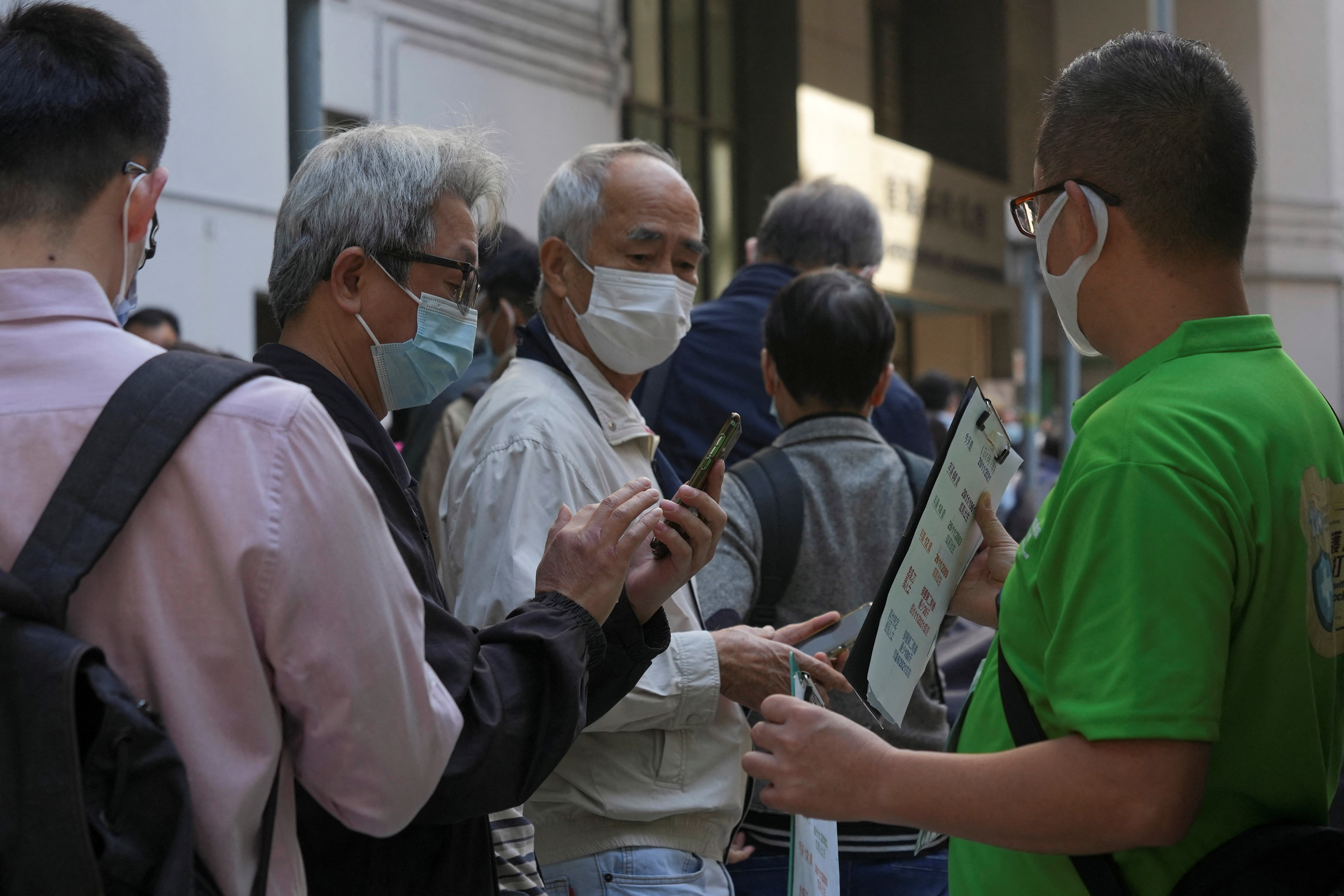
A staff member holds a QR code for the “LeaveHomeSafe” COVID-19 contact-tracing app to people lining up outside a community vaccination centre providing Sinovac Biotech’s CoronaVac COVID-19 vaccine in Hong Kong, China December 2, 2021. REUTERS/Lam Yik
HONG KONG, Dec 31 (Reuters) – Hong Kong’s health officials said on Friday the Omicron variant of the coronavirus has made its way past some of the world’s toughest COVID 19 restrictions, with the city reporting its first cases outside its strict quarantine system.
The findings raise risks that the global financial hub might keep its borders shut well into 2022. It has largely isolated itself from the world hoping in turn to open the border with mainland China for a limited number of business travellers.
Hong Kong’s last COVID-19 case tracked outside its quarantine facilities and hotels was discovered in October. Previous infections with the Omicron variant were discovered during quarantines of people returning to Hong Kong.
Health Secretary Sophia Chan told reporters one of four air crew members who tested positive after their return to Hong Kong had breached home quarantine rules by going to a restaurant, where he passed the virus to his father and a client sitting at another table.
“Omicron is raging around the world … and it has now found its way into the community,” Chan said.
She added that China border reopening preparations continued, but “the priority was handling the pandemic.”
Health official Chuang Shuk-kwan told reporters a different airline worker, who tested positive but was previously thought to have stayed at home, had visited a bar in a crowded nightlife district shortly after their latest flight back.
The government this week tightened quarantine rules for air crew, who had been allowed to quarantine at home, unlike most people returning to the city who have to quarantine in hotels for up to 21 days at their own cost. read more
Pilots had expressed worries about their mental health amid prolonged periods of isolation even before the tightening. read more
Cathay Pacific Airways said on Thursday the latest tightening had forced it to cancel a significant number of passenger and cargo flights to and from Hong Kong.
Hong Kong which has been coronavirus-free for extended periods since the pandemic began.
But less than 70% of its eligible population, far lower than in other developed cities, have taken two shots of either China’s Sinovac (SVA.O) or Germany’s BioNTech vaccines (22UAy.DE).
Only about 5% of people have received a third booster shot.
Even three doses of Sinovac’s vaccine do not produce adequate levels of antibodies to fight the Omicron variant, researchers from Hong Kong found. read more
Reporting by Marius Zaharia; Editing by Kim Coghill
========================================
South Africa says Omicron wave may have peaked
South Africa has lifted overnight curfew rules, with officials saying the country may have passed the peak of its fourth wave of Covid infections sparked by the Omicron variant. A statement released after a special cabinet meeting said cases and hospital admission rates had dropped in almost all provinces across the country. Omicron – first reported by the country last month – is spreading fast elsewhere, leading to widespread curbs.
===============================================
Fauci defends new CDC isolation guidelines |
| Anthony Fauci on Thursday defended the Centers for Disease Control and Prevention’s (CDC) decision to cut its recommended isolation time to five days for people infected with COVID-19 who are asymptomatic.
Fauci said there was a need to cut the isolation period for asymptomatic people to keep society running as the nation is hit with the highly contagious omicron variant. “The reason is that now that we have such an overwhelming volume of cases coming in, many of which are without symptoms, there’s the danger that this is going to have a really negative impact on our ability to really get society to function properly,” Fauci, President Biden’s chief medical adviser, said in an interview on NewsNation’s “Morning in America.” ================================================= WORLD STATSCoronavirus Cases:286,909,243
Deaths:5,446,797
Recovered:253,256,354
Highlighted in green
= all cases have recovered from the infection
Highlighted in grey
= all cases have had an outcome (there are no active cases)
Latest NewsDecember 31 (GMT)Updates
|
The post Barbados 1st Omicron Case, Hong Kong Spread, S.A. May Have Peaked, Fauci Defends New Rules, World Stats appeared first on The St Kitts Nevis Observer.
Dr. Laws: Omicron variant in St. Kitts and Nevis
The Omicron variant of COVID-19 has been discovered in St Kitts and Nevis and is being spread among the population, Chief Medical Officer (CMO) Dr Hazel Laws confirmed today.
Dr Laws revealed that on December 22, the federation sent off a small package to CARPHA, and they had just received results of genomic sequencing.
“Two of the three samples returned positive for the Omicron variant of concern. When we looked at the data for these two cases, we have objective evidence that the Omicron variant is in circulation in the federation…”
“We have two variants in circulation, the Omicron and Lambda.”
The Lambda variant has been in circulation for the past seven months.
Dr Laws noted that the federation is currently in the fourth wave of COVID-19. This wave started last Friday.
“If you have been monitoring the information provided by the Ministry of Health, you would recognise there is an uptick – a surge – in the number of newly diagnosed cases each day.”
The post Dr. Laws: Omicron variant in St. Kitts and Nevis appeared first on The St Kitts Nevis Observer.