Prime Minister Dr Keith Mitchell says he does not believe legislating a mandatory vaccination policy for Grenada will help curb the spread of the deadly coronavirus (COVID-19) and urged stakeholders, including the media, the private sector and trade unions to do more to get people to voluntarily accept vaccinations.
Grenada has since March last year, recorded 200 deaths and 5, 873 positive cases linked to the virus and Mitchell said people with influence, such as sporting icons and artists should lend their voice to the campaign.
“I believe that will be the best approach. People have been telling me to go to parliament and to force people (to get vaccinated). To tell you the truth if I thought that could work I would do it because I have no problem with it,” Mitchell said during a live new two-hour “conversation” with selected local journalists on Sunday.
He said in terms of whether or not that approach would be legal that would not have been a problem for his administration” because that has proven. The regional legal authorities have given us the green light in this matter.
“But I am not convinced it will work. If anything, you might get more resistance. What do you do? Put a bunch of 5,000 people who refuse to take the vaccine, put them in jail. What’s the point? If you are going to do something, you want to do something to achieve a result,” he said, adding that the measure should not be to ‘show that I have power and I could demand or command you to do this. People will just laugh at you”.
Mitchell said more people here should get involved in getting persons vaccinated adding that anyone entering this country would believe that “this is a government thing for government interest.
“I don’t believe as a country we have taken our responsibilities as serious as it is. I honestly believe the media could do a lot if anything, some parts of the media could be said to be guilty of doing the opposite.
“When I listen to certain things on certain stations it baffles me as if we don’t realise it is not about (the ruling) NNP (New National Party), it is not about the Prime Minister, it is not even about the Opposition Leader. It is about life and death and all of us should be on that wavelength.”
Mitchell said that the country has a ‘serious problem” saying “I have not heard enough (of the) business community speaking. Where are they? Is it the government that’s going to benefit directly when the businesses expand and the country is free up and more activities (take place)? The business sector has a lot to gain”.
He said while the government would receive taxes based on the improvement in the economy, he is also concerned about the silence of the local medical association.
“I hope people don’t get vex with me when I say this, to me I can only speak the truth. Where are they, where are the voices?…and then you have elements within them who are telling people they are not taking it and that’s a fact.
‘We have a problem there,” Mitchell said, adding also “I have not heard the trade union movement as a body come out and tell their workers you must get vaccinated”.
Loop- The Seismic Research Centre (SRC) at the St. Augustine campus of the University of the West Indies (UWI) says it is monitoring the water levels at the Boiling Lake and they “have changed significantly in recent days”.
It noted however that the situation is not related to increased volcanic activity in the area.
In a statement, the Trinidad-based SRC said that it is a phenomenon that has occurred several times since 1876 and that a local tour guide visiting the Boiling Lake last week Thursday first reported unusual activity and water levels at the lake.
SRC scientists, who are currently conducting fieldwork in Dominica, will visit the lake on Monday to make further observations and measurements, if possible. They will be accompanied by staff of the Forestry, Wildlife & Parks Division,” the SRC added.
The Boiling Lake is a volcano-hydrothermal feature located in an area next to the Valley of Desolation in southern Dominica. The lake levels have dropped dramatically and been restored at least eight times in the past. The last draining episode occurred on November 8, 2016, with the lake returning to its normal state by January 10, 2017.
“The historical record, as well as the present-day volcano-monitoring network, suggests that the past episodes reflected local changes in the volcano-hydrothermal system. The observed changes in water levels and activity at the Boiling Lake are not necessarily related to increased volcanic activity in the area.
“However, during these episodes, harmful gases, such as carbon dioxide, can be released and small steam explosions may also occur. People should, therefore, avoid visiting the immediate area until the activity has subsided.”
The Valley of Desolation and the Boiling Lake itself are considered sites of interest for locals and visitors to Dominica. They have been part of the Morne Trois Pitons National Park, a UNESCO World Heritage Site since 1987.
The SRC monitors the Boiling Lake as part of its volcano monitoring programme in Dominica and updates the Office of Disaster Management (ODM) when significant changes are observed, the SRC added.
TAPACHULA, Nov 22 (Reuters) – Several thousand Haitian migrants on Monday clustered outside a stadium in southern Mexico that has been re-purposed into a migration office, urging authorities to let them pass freely through Mexico.
Two caravans of migrants largely from Haiti and Central America have departed from the southern city of Tapachula in recent weeks, many taking off on foot for the long journey in hopes of reaching the U.S.-Mexico border.
Thousands of people have also remained in Tapachula, close to the Guatemala border, where they are applying for refugee status and hope to receive visas to let them transit the country.
About 130,000 people will have requested asylum or protected status by year’s end, Mexico’s Interior Ministry projected on Monday. More than 50,000 of the 116,500 applications received so far this year were from Haitians, it added.
Migrants typically request asylum as a first step to receive a visa letting them travel freely within Mexico.
“We need documents to be able to move around here in Mexico,” said Haitian migrant Robinson, 31, who declined to give his last name, adding that fellow migrants who try to cross the country without a proper visa get sent back to Tapachula.
“It can’t be this way,” he said, speaking outside the stadium, where Mexico’s National Migration Institute (INM) has set up makeshift offices to handle a surge in demand.
INM did not immediately respond to a request for comment.
The rise in the number of Haitians trying to make their way through Mexico has been spurred by economic malaise, an earthquake and political turmoil following the assassination of Haitian President Jovenel Moise in July.
The group outside the stadium in Tapachula on Monday also included Cuban and Venezuelan migrants.
About 100 kms (62 miles) away in the city of Mapastepec, a northbound migrant caravan with about 2,500 people, mostly from Haiti, took a break after walking since before dawn.
Loubens Narcisse said he hoped to land a visa more easily in another state of Mexico, even if he had to walk hundreds of kilometers.
“It’s not easy, but it can be done,” he said.
Reporting by Jose Torres in Tapachula and Jose Luis Gonzalez in Mapastepec; Additional reporting by Lizbeth Diaz and Daina Beth Solomon in Mexico City; Editing by Stephen Coates
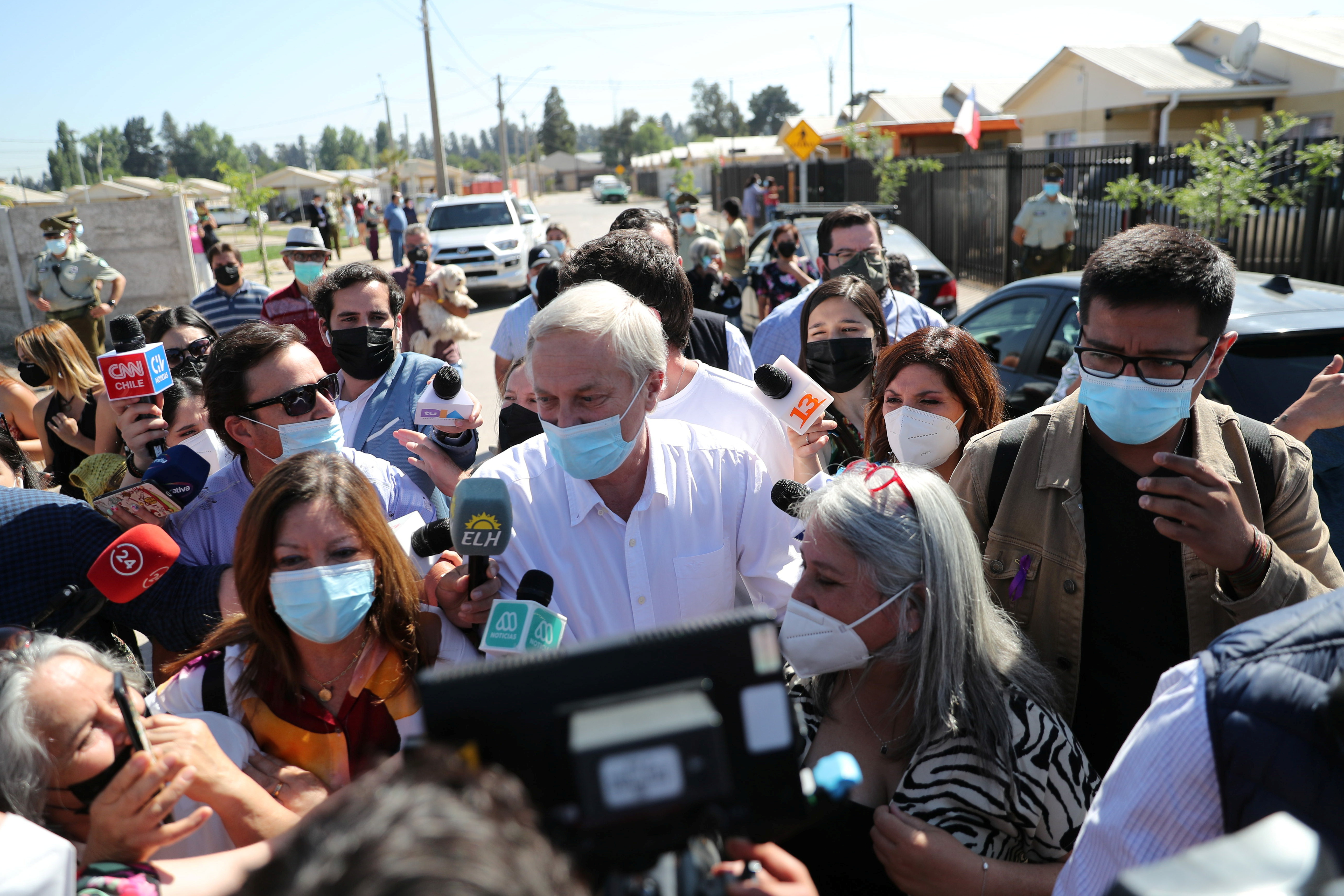
SANTIAGO, Nov 22 (Reuters) – After years of divisive street protests and the election of a mainly left-wing body to rewrite the constitution, Chileans surprised analysts, markets and even themselves on Sunday night by favoring a right-wing presidential candidate and delivering significant gains to conservatives in Congress.
With 99.99% of votes counted as of Monday, ultra-conservative former congressman Jose Antonio Kast had won 27.91%, and leftist lawmaker Gabriel Boric had come in second, with 25.83%. As both fell well short of the 50% threshold needed to win outright, they will now advance to a Dec. 19 runoff.
Kast, who has pledged to crack down on crime and illegal immigration, appears to have the momentum, though Boric can still eke out a victory if he wins over enough centrists, analysts said.
Still, the results of congressional elections may make the radical changes to Chile’s free-market model that Boric has promised out of reach. Leftist and center-left coalitions lost significant ground in both the upper and lower houses, and no coalition is expected to emerge with a functioning majority.
“It’s going to be very difficult for any of the two major coalitions in the Senate to pass legislation,” said Kenneth Bunker, head of political consultancy Tresquintos.
“For the conservative sectors, this is not a problem as they are in favor of the status quo, but for the opposition it is very bad news.”
Just six months ago, Chileans had favored left-wing independents when selecting representatives to the body charged with rewriting the nation’s dictatorship-era constitution. Boric, a 35-year-old who rose to fame leading student protests, has thrown his support behind the constitutional rewrite.
But crime fears, ongoing confrontations between police and separatist indigenous groups in the nation’s south and fatigue with continued protests and disorder in what is traditionally one of Latin America’s most stable countries likely played a role in the swing to the right, analysts said.
“What’s happening in the south, combined with crime and the general idea of change without really knowing what changes will be made caused a significant portion of the population to turn against Boric,” said Miguel Angel Lopez, a professor at the University of Chile.
While some recent opinion polls had shown Kast gaining ground, many Chileans and political observers did not expect him to do as well as he did, given the country’s leftward turn in recent years.
“It seems sad to me, sad after everything that has happened to the country,” Salvador Carrasco, a musician in central Santiago, said on Monday morning.
Chile’s benchmark IPSA equities index (.SPIPSA) was up over 10%, while the country’s peso currency gained ground against the dollar overnight.
The rally in the peso was due to relief that Congress was split, which will act as a moderating force if Boric wins, said Mary-Therese Barton, Head of Emerging Debt at Pictet Asset Management.
“Markets’ first reaction has certainly been positive. It’s less to do with the presidential side and more to do with Congress,” she said.
In the presidential runoff, eyes will now be on how successful both candidates will be at winning voters outside their traditional bases of support. Five failed candidates between them garnered some 46% of votes that are now up for grabs.
Perhaps the biggest mystery will be how those who voted for libertarian economist Franco Parisi will cast their votes. Parisi, who lives in Alabama and never set foot in Chile during the campaign, surprised many by finishing third with 12.8% of the vote.
“The Parisi voter is neither on the Left nor the Right,” said Guillermo Holzmann, a professor at the University of Valparaiso.
“This is a vote that will need a lot of analysis.”
Reporting by Gram Slattery, Natalia A. Ramos Miranda and Fabian Cambero, Additional reporting by Reuters TV, Editing by William Maclean and Rosalba O’Brien
Venezuela opposition says it must rebuild after heavy election loss
CARACAS, Nov 22 (Reuters) – Venezuela’s opposition needs to rebuild and reflect on its strategy after suffering a heavy defeat in regional elections at the weekend, its leader Juan Guaido said on Monday, calling for unity among the fragmented movement’s leadership.
Venezuela’s ruling party won at least 18 governorships out of 23 states, according to updated election results published by the National Electoral Council (CNE) on Monday.
The electoral authority had earlier declared the ruling party victorious in 20 governorship elections. But close elections in Barinas and Apure states, which traditionally back the Socialist party, led the CNE to later say those results remained to be confirmed.
Opposition politicians have so far won just three states.
The main opposition parties had boycotted presidential elections in 2018 and congressional polls in 2020, arguing a fair ballot was impossible because of interference from President Nicolas Maduro’s government and violent gangs loyal to him.
But they returned to the ballot box this year amid frustration over the failure of U.S. sanctions to dislodge Maduro despite prolonged social and economic hardship.
Sunday’s vote was seen as a test of strength ahead of presidential elections scheduled for 2024. The opposition was also emboldened by the presence of election observers from the European Union.
A preliminary report from the mission is due on Tuesday, but there were no major reports of disruptions.
However, U.S. Secretary of State Antony Blinken accused Maduro’s government of holding flawed elections that “skewed the process” to pre-determine the result in his party’s favor, citing harassment and bans of opposition candidates, voter roll manipulation, and censorship.
Guaido, the former speaker of Congress who is recognized by Washington and its allies as Venezuela’s rightful leader, said on Monday that the opposition needed to “rebuild itself” after the disappointing result.
“Today a new phase is opening,” he said, without providing specifics. “Today is a time for reflection amongst our leadership… It is not the time for fights nor egotism among political leaders.”
Analysts said ahead of the vote that the opposition’s late decision to participate and in-fighting over whether it should run candidates would damage its showing.
The opposition urgently needed to rethink its strategy in order to reconnect with voters and burnish its credibility, said Enderson Sequera, head of Venezuela’s Politiks consultancy.
“The conclusion of (Sunday’s vote) in Venezuela is very clear: Chavismo is more stable in power and the democratic opposition finds itself further from achieving political change,” Sequera said, referring to the nickname for the ruling party, once headed by the late President Hugo Chavez.
NEED TO REBUILD TRUST
Despite opposition efforts to galvanize voters at the last minute, turnout was relatively low at 41.8%, according to the CNE. That is equivalent to some 8.1 million people and is in line with previous local and regional elections. Low turnout in Venezuela favors the ruling Socialist party’s political machine, analysts say.
“The government has shown again that despite not having widespread popular support, it remains in power due to the lack of an opposition with a coordinated strategy,” said Maryhen Jimenez, a researcher at the University of Oxford’s Latin American Centre.
After seeing living standards decline amid hyperinflation and a seven-year recession, many ordinary Venezuelans are disillusioned with politics. Millions of people have emigrated.
The ruling party saw supporter numbers drop to 3.7 million, according to CNE figures, from some 5.9 million votes in 2017 regional elections.
The oil-rich state of Zulia was won by opposition politician Manuel Rosales with 56.1% of the vote, who said it was clear that Venezuela’s opposition movement faced challenges.
“You can’t hide this crisis with complacent speeches,” Rosales, a lawyer and former presidential candidate, said on Monday in Maracaibo, Zulia’s capital.
The CNE has yet to announce victors in mayorship races – with the exception of capital Caracas, where the ruling party candidate won.
Maduro said on Sunday a return to negotiations in Mexico with the Venezuelan opposition would not take place until “the kidnap” of prominent government envoy Alex Saab – recently extradited to the United States on money laundering charges – is answered for.
The talks, begun in August, are meant to seek a way out of Venezuela’s economic and social crisis.
Guaido said he was cautiously optimistic the government would return to the table and he was discussing with international allies ways of increasing pressure on Maduro’s government.
Reporting by Vivian Sequera, Mayela Armas and Deisy Buitrago. Additional reporting by Mariela Nava in Maracaibo Writing by Julia Symmes Cobb and Oliver Griffin Editing by Daniel Flynn and Rosalba O’Brien
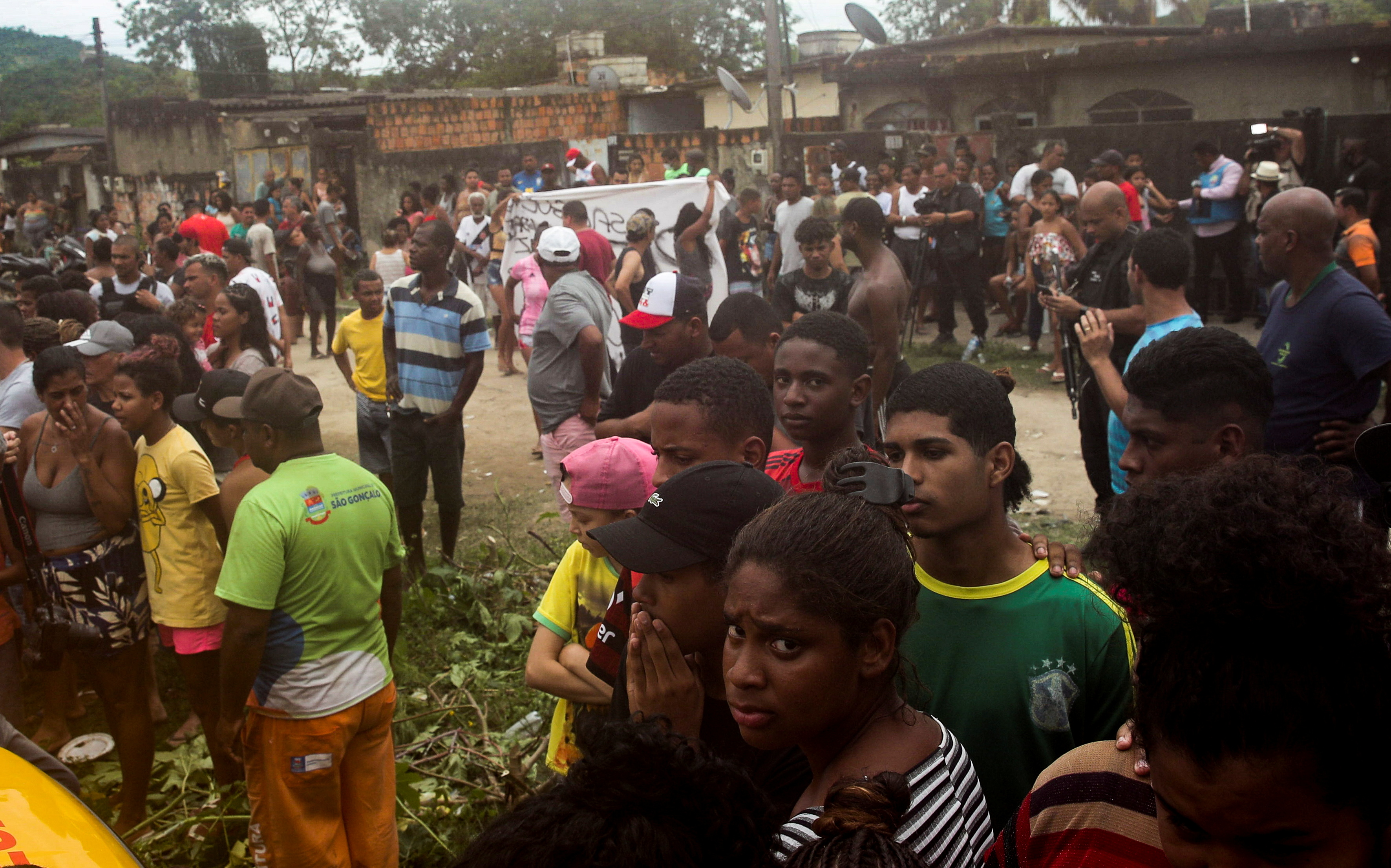
RIO DE JANEIRO, Nov 22 (Reuters) – Residents on the outskirts of Rio de Janeiro on Monday found the corpses of at least eight people in a mangrove after a sustained gunbattle with local police.
The bodies were found near a complex of slums called Salgueiro, in the city of Sao Goncalo, a poor and violent region that is part of metropolitan Rio.
Locals told media outlets that they believed other bodies would be found.
“The bodies were all thrown into a mangrove swamp, with signs of torture. They were tossed one on top of the other. This was clearly a massacre,” one resident told the G1 news website.
Other residents, who also declined to be named, gave similar accounts to other outlets.
The bodies were found after a weekend-long operation in the area, which began after a local police officer died while on patrol on Saturday. Sao Gonacalo is overseen by the 7th battalion, which has long been one of Rio state’s most deadly.
Rio’s military police did not respond to locals’ accusations of officers having been involved in torture or multiple killings but said in a statement: “So far, eight bodies have been found.”
Police said they had entered the region to “stabilize” it after violence from alleged drug gangs.
They said officers would remain in the area to allow civil police officers to investigate.
In 2019, Reuters reported on the shooting to death of a local resident by officers from the 7th amid a sharp rise in police killings. So far this year, officers from the 7th battalion killed 1,096 people, the highest of any battalion in the state, and up 17% from the first nine months of last year.
Reporting by Rodrigo Viga Gaier Writing and additional reporting by Gabriel Stargardter; Editing by Alison Williams and David Gregorio
An asylum seeker crosses the border from New York into Canada followed by a Royal Canadian Mounted Police (RCMP) officer at Roxham Road in Hemmingford, Quebec, Canada March 18, 2020.
(CNN) Canada is ending its pandemic-era policy of turning back asylum-seekers trying to cross into the country between ports of entry, according to a revised policy document released on Sunday.
Canada turned at least 544 would-be refugees back to the Unites States between March 2020 and mid-October. The government did not immediately respond to questions regarding why it was ending the policy now and what if any quarantine rules would apply to asylum-seekers who are not vaccinated.
Canada had said the measure was necessary given health concerns during the coronavirus pandemic. But refugee advocates argued attempts to claim asylum should not be considered “discretionary travel” and pointed to class exemptions Canada made during the pandemic for professional athletes, among others.
“It’s a relief to see the measures for refugees align more with our international obligations, and I think it’s been clear all along that public health and refugee protection could coexist,” said Maureen Silcoff, a refugee lawyer and past president of the Canadian Association of Refugee Lawyers, which took the government to court over the policy.
Silcoff said it did not make sense to allow tourists entry, as Canada has begun to do, while barring people seeking protection.
An unknown number of asylum-seekers turned back were taken into indefinite U.S. immigration detention and at least two were deported, refugee lawyers working on their cases say.
Exemptions have been available since the policy began, and in August Canada began allowing more turned-back asylum-seekers to return and file refugee claims as part of what it called a “managed approach to reopening the border.”
But advocates said this option was only open to those aware of it or who had legal counsel familiar with Canada’s shifting system. The government defended the policy in court last month.
Canada has a Safe Third Country Agreement with the U.S. under which asylum-seekers trying to cross at official ports of entry are turned back. The agreement, challenged twice, was upheld most recently this past spring and may go to Canada’s Supreme Court.
COVID-19 cases are climbing nationally as the U.S. barrels into its second holiday season during the pandemic, with most families planning this year to gather for Thanksgiving.
The U.S. is in better shape than at this point last year, when authorities confirmed well over 160,000 COVID-19 cases every day.
The daily average of new cases stands below 100,000 and almost 200 million Americans are fully vaccinated. They can “feel good about enjoying a typical” holiday season, top infectious diseases expert Anthony Fauci said this week.
But with millions still unvaccinated and cases rising, experts are urging Americans, particularly the unvaccinated, partially vaccinated and vulnerable, to exercise caution when gathering with others.
“There is concern that the rate of infection spreading is already so high as we head into the holiday season,” said Amber D’Souza, an epidemiologist at the Johns Hopkins Bloomberg School of Public Health.
“We’re definitely headed into our next surge,” she added.
Nationally, the seven-day average for new COVID-19 cases is nearing 95,000, a 33 percent increase from two weeks prior, according to data from The New York Times. In the past two weeks, cases have increased in 39 states and D.C., and they have doubled in Massachusetts and Rhode Island.
Certain areas like the Midwest, New England and the Southwest in particular are dealing with surges.
The daily average of about 48,000 hospital admissions is flat from two weeks ago, while the 1,100 fatalities per day has dipped by 1 percent.
The case upticks come as many across the country plan for intergenerational gatherings next week, prompting public health experts to call on Americans to consider safety measures for their events.
The risk of different Thanksgiving gatherings vary, as indoor events are more dicey than outdoor and including unvaccinated guests poses more danger than limiting to fully vaccinated attendees. In the end, experts said it ultimately depends on how much risk individuals want to take.
Researchers, including Joshua Weitz, a professor of biological sciences at the Georgia Institute of Technology, have developed a tool to help figure out the localized risk that at least one infected person will be at an event.
For events with 50 people, the calculator shows eight states have counties with an at least 95 percent risk level.
“Even if we are fatigued, the reality is that cases are rising, and there remains far too many individuals who are unvaccinated, and that is contributing to increased spread as well as severe outcomes,” said Joshua Weitz, a professor of biological sciences at the Georgia Institute of Technology.
“I think we should all be concerned that the things that we hold dear, that we enjoy doing may inadvertently lead to increases in cases and severe outcomes,” he added.
About 57 million people aged 12 and older remain unvaccinated and at higher risk of contracting and spreading COVID-19, in addition to ending up hospitalized or killed by the virus.
Still, experts don’t expect any potential surge to reach the levels of last year with the majority of the country having immunity against the virus.
Almost 196 million Americans are fully vaccinated, and 32 million have received a booster dose, according to Centers for Disease Control and Prevention (CDC) data. Among adults aged 65 and older who are more at risk for severe illness, 86.2 percent are fully vaccinated and 38 percent have gotten their booster.
Even with most Americans protected with the vaccine, however, the shots are not 100 percent effective, meaning breakthrough cases can still emerge. Experts also said waning immunity from the vaccine over time and high community transmission could lead to more breakthrough cases.
Although it’s too late to initiate any vaccinations to be fully protected by Thanksgiving next week, experts said hosts and visitors can still take precautions to mitigate spread during the holiday, including having attendees take rapid tests, hosting events outdoors and increasing ventilation.
Justin Lessler, an infectious disease epidemiologist at the University of North Carolina’s Gillings School of Global Public Health, said even people going to fully vaccinated events can take steps to protect attendees.
“I think that extra layer of doing a rapid test or something or other activities to try to help you make doubly sure that your dinner doesn’t become a superspreading event is – still worth doing,” he said.
Older, immunocompromised and other vulnerable people should “really consider a safety plan,” he said, while adding “but I don’t think that safety plan has to be: call off the gathering altogether.”
The U.S. has already made booster shots available to these at-risk populations in recent months, and the Food and Drug Administration expanded booster authorization for all adults on Friday.
The CDC’s holiday guidance updated last month suggests for all eligible people to get vaccinated in order to protect those who can’t, such as children, and those at risk.
For children aged 5 to 11, the Pfizer vaccine recently became available earlier this month so a vast majority will not be fully vaccinated by next week. Children younger than 5 are still not eligible for a shot.
To protect these children, Lori Handy, the medical director of infection prevention and control at Children’s Hospital of Philadelphia, recommended implementing additional “layers of protection” and ensuring that those with exposures or symptoms do not attend.
For children at risk due to medical conditions, she said it’s “time to kind of be mama bear and protect your kids for a bit more this pandemic.”
“I would recommend people be as cautious as possible,” she said. “Find ways to get joy and happiness in the holiday season, but don’t overdo it with very large gatherings where you could regret that event.”
Top infectious diseases expert Anthony Fauci warned on Monday about “prematurely” dropping mask mandates as Washington, D.C., lifts its requirement for indoor masking despite opposition from the city’s council members.
President Biden’s chief medical adviser told NPR’s “Morning Edition” that the city’s move “adds an extra degree of risk” as the country sees rising cases and hospitalization while it heads into the holiday season.
“When you have a dynamic like that … you really gotta be careful,” he said. “Masks are not going to be forever for sure. The more people that get vaccinated, the more people that get boosted, the lower the level of infection in the community will be, and then you start thinking about pulling back on masks.”
“But you don’t want to do it prematurely,” he added. “As much as you’d like to do it, you’ve got to be careful.”
Fauci pointed to the national increase in cases, citing that they are up 29 percent from two weeks earlier. Hospitalizations have ticked up 6 percent, while deaths still are decreasing, although he cautioned fatalities are “usually a lagging indicator.”
What’s next: When asked about when mask mandates can end, Fauci said it’s “tough to predict” but he hopes it’s “as we get through the winter and into the spring.”
“But you can’t guarantee it,” he added. “This virus has fooled us before. It’s a very wily virus — this delta variant.
RIGHTS GROUPS PRESS BIDEN ON INTELLECTUAL PROPERTY WAIVER FOR COVID-19 VACCINE
More than a dozen medical and human rights groups have teamed up to call on President Biden to take action supporting an intellectual property waiver for COVID-19 vaccines, seeking to keep pressure on the administration in an effort to improve global access to the shots.
The 15 organizations, including Doctors Without Borders, Human Rights Watch and Public Citizen, sent a letter to the White House on Friday requesting Biden’s “personal engagement” on the matter. The groups are pushing for a temporary waiver at the World Trade Organization (WTO) to boost production and supplies for COVID-19 vaccines, treatments and tests.
The groups said they’re “very disappointed” with the Biden administration for its lack of action, beyond the president’s May endorsement, “as millions die or become seriously ill waiting for effective vaccines and treatments.”
The administration has previously declared its support for an intellectual property waiver for the COVID-19 vaccines in May. The White House also called on all WTO members to back an intellectual property waiver for the vaccines last month.
But the organizations said in the letter that there’s been “no progress on enacting it.”
The groups called for movement on this waiver at the upcoming WTO Ministerial Conference slated for the end of this month.
=============================================
French prime minister tests positive for Covid-19 as Coronavirus cases climb
The office of France’s prime minister confirmed early this morning that he has tested positive for Covid-19, hours after returning from a visit to neighbouring Belgium and just as France is seeing a nationwide resurgence of infections.
Jean Castex will adapt his schedule for the coming 10 days to continue his activities in isolation, his office said.
Officials at the prime minister’s headquarters did not comment on whether Mr Castex has any virus symptoms.
One of Castex’s daughters tested positive on Monday after her father returned from a meeting with Belgian Prime Minister Alexander de Croo in Brussels, and Castex himself then took two tests that were both positive, his office said.
De Croo’s office said he will be tested on Tuesday and will self-isolate while awaiting the result, according to Belgian state broadcaster RTBF.
While 75 per cent of France’s population is vaccinated, the number of virus infections has risen quickly in recent weeks.
Hospital admissions and deaths linked to the virus are also rising in France, though are so far well below the crisis levels of earlier surges.
French President Emmanuel Macron contracted Covid-19 last December, and other government ministers have also had the virus.
BASSETERRE, ST. KITTS — Area Parliamentary Representative for St. Christopher Seven (Bellevue to Ottley’s), Prime Minister the Hon. Dr. Timothy Harris, was first elected to parliament on November 29, 1993.
As he prepares to celebrate the 28th anniversary as a parliamentarian, he is reflecting and sharing with his constituents the transformation that has taken place under his watch in the constituency and the country on a whole, and is thanking them for their loyalty and trust in him.
PM-Harris at worship-service-at-Miracle-Temple
“Thank you very much for your support through all the years,” said Dr Harris. “Through good times and bad times, the people of Constituency Number Seven have never let me down, and I will do and endeavour to do my very best always to assist you – to deliver for you, and by the Grace of God I shall continue to deliver, so thank you again for your support.”
Prime Minister Harris, who is also the National Political Leader of the Peoples Labour Party (PLP), one of the three political parties in the ruling Team Unity Administration, made the remarks on Sunday November 21 when he and members and supporters of the PLP worshipped at the Miracle Temple in Lodge Project.
“Thank you for your loyalty, and thank you for your trust in me,” continued the Honourable Prime Minister at the worship service which was conducted by Pastor John Bradley, who also delivered the sermon. “And over the last many years we have seen the constituency transform because I made it my business to deliver for you.”
Starting with the Lodge-Ottley’s area, Prime Minister Harris informed that there are several housing programmes, and that he would have delivered housing for somebody that they know, and the new Violet Petty Primary School. He pointed out that those are things they are to give God thanks because that is part of the promised stronger and safer future.
“We have seen for example in Upper Lodge Project two housing projects on either side as we continue to go further up in the hills, as we use available lands to deliver housing for all the people of the constituency,” stated Dr Harris.
“We have seen, going down to the Grange Health Facility, the extension of our housing programme, and on the left-hand side you have seen one of the most modern community centres in the country (the new Lodge-Ottley’s Community Centre) being delivered for you the people of this constituency. So everywhere, there is evidence that I have been working for you the people.”
In Molineux he mentioned of further housing programmes, the building of a new Mary Charles Hospital and the bringing back of the ambulance service and the dental unit. He recalled that he at one time he met the former Premier of Nevis, Ambassador His Excellency Vance Amory, going to the facility for a dental appointment.
As for the neighbouring Mansion Village, the Prime Minister also talked of the new primary school built under his watch, and two housing projects. He advised that fifteen homes will be delivered between now and Christmas for the people of the Constituency.
“Tabernacle continues to expand,” said Dr Harris of his hometown. “We have brought there improvement in our security with a brand new Forensic Department. We built the best health centre in the country and in the Caribbean, right there in Tabernacle, and we named it after an outstanding nurse, Nurse Sylvia Garnette, who served as matron.”
Black Rocks, which is on one end of the vast constituency (Bellevue), has been developed from a small petite community, and has expanded with a housing programme. Government has created a brand-new tourism attraction at Black Rocks, where a lot of activities take place, to include a modern stage and it has bathroom facilities.
“When we look around, we see transformation of the constituency and indeed of the country,” pointed out the Prime Minister. “I am happy that under my watch that so much things have happened, particularly in public infrastructure. Ambassador Ian Liburd did a wonderful job, and was the most productive minister of Public Infrastructure.”
According to the Prime Minister, some of Ian Liburd’s work as the minister of Public Infrastructure include roads that have been resurfaced around the island of St. Kitts, the Basseterre Ferry Terminal, the East Basseterre and the West Basseterre Bus Terminals, and the brand-new Department of Public Works on the factory compound among many others.
“But not only in St. Kitts had we been working hard,” observed Dr Harris. “We have delivered services on the island of Nevis and we have worked well with that government so that today nearly $400 million have been provided to the people of Nevis, first a range of public sector initiatives and government initiatives. So, we have been good as we promised the people of Nevis, and we have done that without creating any challenges for the people of St. Kitts and Nevis, because by the grace of God we have been able to manage the finances of the country very well.”
He concluded: “We continue to deliver for you the people because Government is about people – government is about doing good for the largest possible number of persons. Everyone will not be satisfied, and everyone perhaps may not be rich, though we must bring the majority of the people along in the country.”
CMC- A Special Reserve Police officer and a member of the Trinidad and Tobago Coast Guard were among several people killed during a bloody weekend in Trinidad and Tobago where the murder toll has inched closer to 400 this year.
Last year the murder toll was 340 and as of October 28, there had been 340 killings.
Police confirmed that Coast Guardsman Jabari Francois and Special Reserve Police (SRP) officer, Jomo Golston, shot and killed each other in Diego Martin, west of here, during a fracas on Sunday apparently over a woman.
Police reported that Golston had dropped off a female friend when he was approached by Francois who knocked on the window of the policeman’s car. The two argued over each other’s perceived disrespect before the gunfire erupted. Both men died at the scene of the incident.
In another incident, police believe that a long-standing feud that may have originated in Venezuela resulted in the death of one man on Sunday.
The authorities said that Charlys Agosto Polo Mata, 22, who was originally from Tucupita, Venezuela, died after he was stabbed several times. His cousin, Omar Ramos, 25, was also stabbed but survived.
Mata, a labourer, was the father of a two-year-old girl.
Relatives told Newsday newspaper that Mata, Ramos and two other Venezuelan men had earlier left a bar in Caroni in Central when a car pulled alongside the four men, and a man got out with a knife. Three other accomplices, all believed to be Venezuelans, remained in the car. The knifeman stabbed both Mata and Ramos repeatedly, killing Mata on the spot.
“The killer went back in the car and the driver drove off. The men who were with Charlys ran off,” the unnamed relative told the newspaper.
Police are also probing the death of a 43-year-old man, who died at a hospital after being shot once in the head on Sunday.
Police said Ronnie Samuel of Caledonia, along the east-west corridor, was in his yard when he was shot.
In another incident on Sunday, officers from the Port-of-Spain Task Force responded to reports of an explosion on the outskirts of the capital where they discovered a vehicle ablaze,
After the fire was extinguished, law enforcement officials said a burnt corpse was found in the vehicle and another body with multiple gunshot wounds was found a short distance away.
The victims were later identified as Jordan and Jada Pierre.
The police were also kept busy investigating a shooting incident in Armia, east of here, where two men dressed in camouflage clothing and armed with firearms broke into Jose Mariano Acosta Bella’s home.
After robbing Bella and his relatives of their cash and cell phones, the men had an argument with Bella, whom they shot Bella several times in his chest before escaping. Bella was taken to the Arima District Hospital and died while undergoing emergency surgery.
Police are also investigating the death of 33-year-old Kendell John, who was at his home with his wife and two children in Cunupia in Central Trinidad when the occupants of a vehicle alighted the vehicle and pretended to be interested in purchasing a refrigerator from John, who was then shot several times.
The people of Belize and the wider Caribbean are celebrating today, after Destiny Wagner was crowned Miss Earth 2021!
The Belizean beauty made history when she emerged best out of 88 delegates from around the world at the competition which was held virtually for the first time.
Wagner will now be written into her country’s history books as the first to secure a placement at the Miss Earth pageant and the first Belizean delegate to place at a Big 4 pageant- Miss Universe, Miss International, Miss World and Miss Earth- since 1979.
The other finalists at the pageant which was hosted on Saturday night were Miss Earth-Air, Marisa Butler from the USA; Miss Earth-Water, Romina Denecken from Chile and Miss Earth-Fire, Jareerat Petsom from Thailand.
After being crowned, Wagner said: “My country has never placed at Miss Earth before nor have we ever had an international crown so right now, this is what we needed and I am happed to represent such a gorgeous country. I am overwhelmed right now with emotions. The words and the gratitude, it’s very hard to express, but I am thankful. I am thankful for the Miss Earth Organisation and thankful for my team as well.”