Tag Archives: caribbean

Cricket: Spinners Ambush West Indies, Sri Lanka Level Series

ST JOHN’S, Antigua (CMC) — A cavalier West Indies paid a heavy price for their indiscreet stroke-play as Sri Lanka’s spinners weaved a web around them to earn their side a series-leveling 43-run victory in the second Twenty20 International.

Left-arm spinner Lakshan Sandakan (3-10) and leg-spinner Hasaranga de Silva (3-17) snatched three wickets apiece on March 5th, laying waste to the Caribbean side’s pursuit of 161 at Coolidge Cricket Ground.

Fast bowler Dushmantha Chameera chipped in with two for 26 as West Indies collapsed from 45 for one at the start of the seventh over to a hugely disappointing 117 all out in the penultimate over.

Number 10 Obed McCoy top-scored with a merry 23 from just seven balls with the game already gone while Lendl Simmons was the only specialist batsman to pass 20 with 21 off 19 deliveries.

Opener Danushka Gunathilaka had earlier top-scored with a bold 56 off 42 deliveries, posting an entertaining 95 for the first wicket with Pathum Nissanka who struck 37 from 23 balls in only his second international, to fire the visitors up to 160 for six from their 20 overs.

Veteran medium-pacer Dwayne Bravo was the standout bowler with two for 25 from his four overs and it was he who broke the opening stand which led to the decline in Sri Lanka’s innings.

While the defeat came on the heels of a similarly suspect batting display in Wednesday’s opener which West Indies won by four wickets, Captain Kieron Pollard was quick to downplay the issue as a major worry.

“We can say all sorts. At the end of the day, we didn’t get the total,” Pollard said afterwards.

“I just thought that a couple dismissals were a bit soft and [we were] just not playing our match-ups. It’s a matter of just figuring it out mentally and coming and trying to put it right.”

Needing to score at a shade over eight runs an over, West Indies started slowly with eight runs from the first two overs before Evin Lewis (6) missed a swipe at the sixth ball he faced and had his stumps shattered by leg-spinner Akila Dananjaya in the third over.

Simmons, who struck two fours and a six, put on 36 for the second wicket with veteran Chris Gayle who hit a run-a-ball 16 with two fours and a six.

In the first of two expensive overs from seamer Thisara Perera, Simmons and Gayle combined to smash 20 runs, giving their side the advantage at the end of the first power play.

However, Hasaranga changed the complexion of the run chase when he removed Gayle and Simmons in the next over and his first of the innings, as West Indies slumped to 48 for three in the seventh.

Gayle holed out to deep midwicket off the first ball while Simmons played down the wrong line to a googly and was plumb lbw.

All-rounder Jason Holder (9) followed in the ninth, picking out long off with off-spinner Gunathilaka one ball after he had cleared the ropes in the same area.

And when Chameera got Dwayne Bravo (2) to parry a short ball to captain Angelo Mathews at midwicket and then bowled Nicholas Pooran (8) when the left-hander missed an ungainly swipe in the same over, the home side had lost three wickets for six runs in 15 balls to be tottering on 66 for sixth in the 11th over.

Pollard (13) and Fabian (12) added 23 for the seventh in a last-ditch effort before Hasaranga trapped Allen lbw in the 16th and Sandakan got Pollard to hole out to deep extra cover in the next over.

Gunathilaka had given the innings a rousing start after Sri Lanka opted to bat, punching four fours and two sixes while Nissanka counted four fours and one six before becoming the first casualty of the innings, run out by Bravo’s direct hit at the non-striker’s end going for a quick single in the 11th over.

With one run added in the same over, Gunathilaka also perished softly, guiding an innocuous delivery from Bravo into Kevin Sinclair’s lap at cover.

Thereafter, Sri Lanka lost wickets steadily as the innings fell away and it was left to Ashen Bandara with 21 off 19 deliveries to add runs at the end.

The post Cricket: Spinners Ambush West Indies, Sri Lanka Level Series appeared first on The St Kitts Nevis Observer.

Jamaica: Hospitals Overflowing with Record COVID Cases

Jamaica Observer- The new field hospital which opened in Falmouth Trelawny just yesterday is already expected to be at full capacity by today as Jamaica continues to report record number of COVID-19 cases.

The island is slated to receive a shipment of 50,000 doses of the AstraZeneca vaccine this afternoon as a gift from the people and Government of India to begin an ambitious vaccination programme, but even then the authorities are warning that the public health system is being heavily challenged.

Head of the Western Regional Health Authority Errol Greene yesterday told the Jamaica Observer that COVID-19-positive patients had already been assigned to every bed in the field hospital.

“We just opened a 36-bed field hospital in Falmouth and we are going to start putting in people tonight (Sunday) or no later than tomorrow morning (today), and already we are [at] full capacity,” said Green as he pointed to the impact that the spike in cases is having on personnel in the public health system

“Would you believe if I tell you that on Friday seven doctors assigned to the Accident and Emergency Department at the Cornwall Regional Hospital came down with COVID-19 symptoms and had to be sent home?

“And then the doctor who has been our medical coordinator is also down, and he is the gentleman who would go and take charge,” added Green.

He noted, too, that the medical personnel and facilities have been dealing with COVID-19 cases for almost a year now and are fatigued and stressed.

“Jamaicans really need to start taking COVID-19 very serious. There is an advertisement that says ‘the mask or the ventilator’, but we don’t have ventilators for everybody. We are doing our best under the circumstances, but this is a struggle,” lamented Green, who dismissed reports that Cornwall Regional Hospital was on the verge of running out of oxygen yesterday evening.

“We are very low, but we get deliveries every day, and as I speak to you two IGL trucks are on their way to the hospital — one with bulk and the other with cylinders. The issue is IGL used to deliver oxygen to us once or twice a week; now they have to be delivering every day. We are low, but not dangerously low,” said Green.

The hospital administrator was speaking with the Observer minutes after the Ministry of Health announced a 24-hour record of 723 positive cases from 2,640 tests, at a positivity rate of almost 36 per cent.

The ministry also reported that seven people had died from complications related to the virus in the previous 24 hours, with Jamaica having 11,039 active cases of which 31 individual were moderately ill and a further 31 critically ill.

Yesterday’s number pushed Minister of Health Dr Christopher Tufton to take to social media to warn Jamaicans that more people are going to die if more effort is not made to follow the protocols in place to reduce the spread of the virus.

“Jamaican people will die. It’s as simple as that,” said Tufton in his dire warning.

“It must sink in that 723 persons in one day, and more importantly over three out of every 10 persons tested are positive, means that corona is right across the length of our population.

“It must sink in that if you continue to have the parties, the drink-ups; if you continue to ignore the protocols around gatherings and you congregate and you don’t wear the mask, then the chances of you getting the coronavirus are real and the probability is increasing. And when you get to the hospital, the chances of you getting a bed is going to become less and less.”

The health minister declared that that he was not trying to rid the Government of its responsibilities to deal with the virus, but argued that Jamaicans need to do more.

“The truth is we do not have enough policemen or soldiers to police every shop in Jamaica, to police every beach in Jamaica, to look over every single individual in this country, and it is downright unfair for persons to blame our public health officials, our public health teams, our doctors, and our nurses when they cannot get through at a hospital because they are there because they went to the party that they should not have gone to, or to the beach or the funeral that they should not have congregated at and have picked up the virus, and then they expect the Government or the public health system to solve the problem. And if we don’t do it, we get cuss,” said Tufton.

The health minister argued that, while this latest spike would call for a total lockdown in other countries, the Government continues to maintain the decision that people need to work.

“We will continue to do what we must as a public health system, as a Government. We will work hard to provide the beds, to ensure that the doctors are alert, to ensure that you get triaged or looked after when you turn up, but the reality is there is so much and no more of us. There are so many beds and no more beyond a certain point, and, truthfully, it doesn’t have to be this way, we don’t have to have the overcrowding if we respect the protocols and take personal responsibility,” Tufton said.


The post Jamaica: Hospitals Overflowing with Record COVID Cases appeared first on The St Kitts Nevis Observer.

Oprah Interview: ‘I Didn’t Want to Live Anymore,’ Meghan Markle

(CNN) Meghan, Duchess of Sussex, said in a bombshell interview with Oprah Winfrey that her life as a British royal was so isolating and lonely at one point she “didn’t want to be alive anymore” — a stunning admission likely to rock the foundations of the centuries-old institution.

In her first public (comments since she and her husband Prince Harry announced their plans to step back from senior roles in the British royal family, Meghan described herself as the victim of an image-obsessed Buckingham Palace, which weighed in on everything from how dark her son Archie’s skin color would be to how often she went to lunch with friends.

The TV special was highly anticipated because Harry and Meghan are now allowed to speak more freely about the royal family due to their effective split from the palace.

And the couple did not hold back.

Meghan began the interview speaking with Winfrey one-on-one outdoors in sun-drenched Southern California, where she and Harry now live. Meghan made several revelations about the royal couple’s private lives, including that the two were married three days before their official wedding and the second child they are expecting is a girl.

But the most powerful portions of the two-hour interview came when Meghan discussed the difficulties of her life as a working royal. Meghan, an American former actress, said she was forced to suppress her outspoken nature and give up her personal freedom. She said she did not have access to her passport, driver’s license or keys after she joined the royal family, and they were only returned when the couple moved away.

Meghan said the situation was exacerbated by often racist and “outdated, colonial undertones” that repeatedly appeared in coverage of the couple in Britain’s notoriously vitriolic press.

Fighting back tears at one point, Meghan said the thoughts of suicide were incredibly difficult to bear, and she was reticent to share them with her husband — who lost his mother, Princess Diana, when he was a boy.

“I was really ashamed to say it at the time, and ashamed to have to admit it to Harry especially, because I know how much loss he has suffered. But I knew that if I didn’t say it, that I would do it — and I just didn’t want to be alive anymore,” she said.

Harry said he was “terrified” by his wife’s admission.

“I had no idea what to do, I went to a very dark place as well, but I wanted to be there for her,” he added.

The prince, who is sixth in line to the throne, said there is a culture of suffering in silence in the royal family. However, Meghan’s race — she is half Black — and the abuse she endured made the situation even more difficult for the couple than it had been for other royals.

Harry said that pushed him to discuss the issue with the royal family. He told Winfrey he believed there were many opportunities for the palace to “show some public support” in the face of continued racial abuse in the press, “yet no one from my family ever said anything. That hurts.”

Harry said the issue was bigger than just the couple, because of what Meghan represented as an influential Black woman in a public position.

“It was affecting so many other people as well,” he said. “That was the trigger for me to really engage those conversation with the palace, senior palace staff and my family to say, guys, this is not going to end well.”

The interview is likely to have lasting consequences for the royal family. It aired at an already fraught time for the royals, with Prince Philip, the Queen’s 99-year-old husband, spending a third week in hospital following a heart procedure Thursday.

Members of the royal family conduct tell-all TV interviews roughly once a generation. A 1970 interview with the abdicated King Edward VIII and Wallis Simpson posed problems for the palace. Twenty-five years later, Princess Diana’s “Panorama” confessional was watched by tens of millions in Britain. Meghan wore Diana’s diamond bracelet during the Winfrey special.

Harry and Meghan’s interview may have reached an even larger audience. It aired on prime-time television in the United States and was relentlessly promoted by CBS in the days ahead, with the network saying it would peel back the curtain on why Meghan and Harry split from the Windsors last year.

The Sussexes painted a picture of an institution so stuck in its ways that it forced a young, biracial couple to simply live with racist abuse at a time when much of the world is coming to terms with the lasting legacy of institutional racism.

“It has been unbelievably tough for the two of us,” Harry said as he sat beside his wife. “But at least we had each other.”

‘I didn’t see a way out’

Harry and Meghan stepped back from their royal duties in early 2020, but the formal agreement they struck with the palace was only reached in February.

The deal allows them to both keep the royal titles bestowed by the Queen, but they will give up their royal patronages, which are to be redistributed among working members of the royal family.

Harry said the decision to step back boiled down to “a lack of understanding” between the two sides. He said he would not have stepped back from his family if it was not for Meghan, who helped him realize the couple was trapped.

“I myself was trapped as well. I didn’t see a way out. I was trapped but I didn’t know I was trapped,” he said.

Meghan said she felt she was victim of a “character assassination” in the British media and the machinations of the palace, which valued how it is perceived more than her, her husband and her child’s well-being.

She also said that when she was pregnant with her son, Archie, she was told he wouldn’t be made a prince and thus wouldn’t receive security.

“I regret believing them when they said I would be protected,” she said.

Meghan specifically complained of how lonely and isolated life became after her marriage. She said she wasn’t even allowed to go out for lunch with friends at times because she was too heavily covered in the media.

“Everyone was concerned with optics,” she said.

When the burden became too much to bear, on her own, Meghan said she sought help from human resources at Buckingham Palace. Meghan said she was told she was not a paid employee and would need to seek help elsewhere — which she was told she couldn’t.

Meghan said it was particularly difficult putting on a happy face while suffering in silence. She recounted one particular evening at Royal Albert Hall with her husband, while the two were sitting together in the royal box.

“Every time that those lights went down,” she said,” I was just weeping, and he was gripping my hand.”

When the lights went back on, Meghan said “you just have to be on again.”

The interview has sparked something of a public relations battle between the Sussexes and allies of Buckingham Palace.

On Tuesday, following the release of promotional clips in advance of the interview, The Times of London published an article that alleged Meghan bullied several staff members. The story cited unnamed royal aides saying a complaint in 2018 claimed the duchess drove out two personal assistants from her Kensington Palace household and undermined the confidence of a third staff member. CNN has been unable to corroborate the claims.

The sources said they approached The Times because they felt the version of Meghan that had publicly emerged was only partially true, and they were concerned about how matters of bullying had been dealt with. The report said the sources believed the public “should have insight into their side of the story” ahead of the couple’s interview with Winfrey.

Buckingham Palace said it was “very concerned” about the allegations outlined in the report and would investigate. A spokesperson for the Sussexes dismissed the Times report as “a calculated smear campaign” ahead of the interview.

Meghan told Winfrey that despite the ordeal, it was important to differentiate the royal family from “the people running the institution.”

The Duchess of Sussex said she had been welcomed into the family itself and Queen Elizabeth II, Harry’s grandmother, had always been wonderful, warm and welcoming.

Meghan discussed rumors of a dispute with Kate, Duchess of Cambridge, the wife of Prince William. Meghan said reports she made Kate cry over the dresses of flower girls at her wedding were untrue, and it was in fact the Duchess of Sussex who cried.

“There was no confrontation,” Meghan said.

She declined to discuss the incident further because Kate had apologized to her. “I don’t think it’s fair to her to get into the details of that,” Meghan added.

Harry said the decision to step back has had financial consequences — they were cut off by the palace in early 2020 — and affected his relationship with his family. He said his father, Prince Charles, who is next in line to the throne, briefly stopped taking his calls.

“I feel very let down because he’s been through something similar. He knows what pain feels like. And Archie is his grandson,” Harry said.

Harry also described his relationship with his older brother, William, as “space,” but added “time heals all things, hopefully.”

Meghan struck a positive tone at the end of the interview. She said life after the royal family is “just the beginning” for their family.

When asked by Winfrey if her story with the prince has a happy ending, Meghan answered unequivocally.

“(It’s) greater than any fairytale you’ve ever read,” she said.

CNN will soon launch Royal News, a weekly newsletter bringing you the inside track on the royal family, what they are up to in public and what’s happening behind palace walls. Sign up here.

CNN’s Rob Picheta, Jessie Yeung, Max Foster and Laura Smith-Spark contributed to this report

The post Oprah Interview: ‘I Didn’t Want to Live Anymore,’ Meghan Markle appeared first on The St Kitts Nevis Observer.

Mobile Orchestra Brings Cheer to Gloomy Venezuela

BARQUISIMETO, Venezuela (AP) — Orchestra music envelops the streets of a Venezuelan city every time a truck carrying musicians has made its way through traffic for the past year, capturing the attention of drivers and passers-by who take photos and stare at the vehicle. The live performance is an effort to give people some small respite from the coronavirus pandemic and other hardships.

One hot afternoon this week, the musicians climbed on the truck’s platform, and wearing facemasks, began to play as they traveled around Barquisimeto, a city west of the capital, Caracas. Their instruments included a cello, violins and even a Steinway & Sons grand piano.

“Music beyond entertaining us, it can transform us, it can heal, it can alleviate emotions,” said José Agustín Sánchez, a Venezuelan pianist, composer and conductor who came up with the initiative.

Before the show began, Sanchez reminded the musicians that their upcoming performance was a “musical disinfection” that might provoke in them and their audience a range of emotions. He told them to be ready to get yelled at but also to see someone clap and cry.

The tour began outside a school of medicine next to a hospital. Sanchez conducted the mobile orchestra from his piano as the musicians sweated under the midday sun. The orchestra performed for hours many of his melodies, which he wrote while serving as resident composer of the Caracas Municipal Symphony Orchestra.

Venezuela has seen more than 140,900 confirmed infections and 1,364 deaths from COVID-19. Experts believe the small number of cases compared to other countries in the region, such as Brazil, Colombia and Peru, is largely due to the isolation that Venezuela has been experiencing for years because of a political, economic and social crisis.

Barquisimeto is also known as the “musical city” of Venezuela for being the hometown of several of the country’s manufacturers of musical instruments, musicians and composers, including Gustavo Dudamel, the music and artistic director of the Los Angeles Philharmonic in the United States and considered one of the great conductors of today.

Sanchez, 31, returned to Venezuela in 2017, after almost 11 years abroad. His travels took him to Tibet and Nepal, where after several months of “exploring peace from sound,” he decided to return to his afflicted country to deliver a message of unity.

He has been touring Venezuela during the pandemic, playing from the back of pickup trucks but also in medical facilities where patients with COVID-19 are being treated. His Instagram account includes videos of Sanchez wearing personal protective equipment from head to toe and playing the piano next to patients and health care workers.

“It’s a worthy show, it’s beautiful,” said Zulay Chirinos Mariño, a 60-year-old resident of Barquisimeto. “I have goosebumps.”

Associated Press photographer Ariana Cubillos and writers Jorge Rueda in Caracas, Venezuela, and Regina Garcia Cano, in Mexico City, contributed to this report.

The post Mobile Orchestra Brings Cheer to Gloomy Venezuela appeared first on The St Kitts Nevis Observer.

Afghan President Ready to Talk Elections with Taliban

By Hamid Shalizi and Charlotte Greenfield

KABUL (Reuters) – Afghan President Ashraf Ghani said on Saturday, in a bid to push forward peace talks with the Taliban, that his government was ready to discuss holding fresh elections, insisting that any new government should emerge through the democratic process.

“Transfer of power through elections is a non-negotiable principle for us,” Ghani told lawmakers at the opening of parliament session in Kabul.

“We stand ready to discuss holding free, fair and inclusive elections under the auspices of international community. We can also talk about the date of the elections and reach a conclusion.

President Ghani met U.S. special envoy to Afghanistan Zalmay Khalilzad in Kabul during the past week to discuss ways to inject momentum in the stalled peace negotiations with Taliban representatives being held in Qatar. After his talks in Kabul, Khalilzad went to Qatar.

U.S. President Joe Biden’s administration has begun a review of its strategy for Aghanistan, including an agreement reached with the Taliban in early 2020 that paved the way for talks between the insurgents and the Afghan government.

Afghan officials and western diplomats said that during his visit to Kabul Khalilzad had floated the idea of establishing an interim government after bringing Afghan leaders and Taliban leaders together for a multilateral conference outside the country.

But Ghani said the only way to form a government should be through an election.

“I advise those who go to this or that gate to gain power is that political power in Afghanistan has a gate, and the key is the vote of the Afghan people,” he said.

“Any institution can write a fantasy on a piece of paper and suggest a solution for Afghanistan. These papers have been written in the past and will be written in the future. Our guarantee is our constitution.”

Elected two years ago, Ghani is not yet midway through his five-year term.

Violence and targeted killings have surged since the Afghan government began U.S.-backed negotiations with the Taliban last September, and western security officials say the insurgents, already holding large swathes of rural areas, have begun to gain ground around towns and cities.

(Additional reporting by Jonathan Landay in Washington, Jibran Ahmad in Peshawar and Alexander Cornwell in Doha, Writing by Rupam Jain; Editing by Simon Cameron-Moore.

The post Afghan President Ready to Talk Elections with Taliban appeared first on The St Kitts Nevis Observer.

Unaccompanied Kids Crossing Border a Big Headache for Biden

President Biden is facing a growing dilemma at the southern border that shows few signs of abating: the number of unaccompanied minors crossing into the United States steadily increasing in recent weeks.

Thousands of migrants have crossed the border in Biden’s first six weeks in office, many of them unaccompanied minors. The influx has tested the administration’s resources and ability to quickly implement its own strategy as Republicans sound alarms over what they have deemed a crisis of Biden’s making.

The Biden administration is rapidly adapting its approach to meet the need for space and staffing in a reflection of the seriousness of the situation.

“President Biden has asked senior members of his team to travel to the border region in order to provide a full briefing to him on the government response to the influx of unaccompanied minors and an assessment of additional steps that can be taken to ensure the safety and care of these children,” White House spokesperson Vedant Patel said in a statement.

Officials are reportedly working to get the Federal Emergency Management Agency involved, and The Washington Post reported that the administration is looking to convert family detention centers into processing facilities to more rapidly screen migrant children and their parents.

Those moves come a few weeks after the administration reopened a facility for migrant children in Texas despite Biden’s fervent criticism of the use of similar facilities during the Trump administration.

Experts said the influx of migrants seen in Biden’s first weeks in office is not significantly higher compared to past surges, but cautioned that the Trump administration’s efforts to make it more difficult to enter the country could complicate efforts to handle the challenge.

“There are plenty of instances in which there have been more people, but the past administration went out of its way to dismantle the institutions that make for a functioning immigration system,” said Eric Hershberg, director of the Center for Latin American and Latino Studies at American University.

“So what this administration is having to do is to rapidly ramp up the capacity to process the people who arrive at the border, to figure out how to house them while their requests for immigration relief are adjudicated … and figuring out how to get them, once they’re cleared epidemiologically, to family members who can care for them while they work through the immigration system,” he added.

Biden administration officials have discouraged migrants from the Northern Triangle region in Central America from making the trek to the U.S. border, warning the journey is dangerous, the United States lacks the capacity to process large numbers of people and that the majority of migrants are being turned away at the border.

Still, border agents are apprehending thousands of migrants a day, and even some Democrats have warned that the situation could develop into a full-blown crisis in the coming weeks.

Texas State Sen. Juan “Chuy” Hinojosa, a Democrat who lives in the border town of McAllen, told The Hill the influx of migrants is fast becoming a crisis and that officials there do not have the resources they need to process the migrants or to test them all for COVID-19.

He said the Biden administration’s move to allow people to remain in the country while they await their immigration proceedings — a so-called “catch and release” practice that was banned under Trump — is encouraging migrants to make the dangerous trip, despite pleas from the White House that people stay home.

“It’s gotten worse,” Hinojosa said. “I don’t think, quite frankly, the Biden administration was aware of what’s happening on the ground here, which you can understand because they’re just coming in and trying to get people up to speed with what’s happening, but I don’t think they were aware there were that many coming across. The border patrol is overwhelmed, they’re throwing their hands up because they don’t know what to do.”

The Border Patrol reported averaging about 3,000 arrests per day in January. Officials have not disclosed the total number of apprehensions in recent weeks, but Reuters reported that Border Patrol agents arrested roughly 4,500 migrants on Wednesday alone, a number that rivals peak apprehension numbers in 2019 when former President Trump threatened to close down the border.

Biden made unraveling Trump’s immigration policies a priority upon taking office. The new administration halted construction of the border wall and halted the Migrant Protection Protocols that required migrants to remain in Mexico while awaiting processing while vowing to reunite families separated during the last four years.

“We certainly have a different approach,” White House press secretary Jen Psaki said Friday when asked if Biden’s shift in approach was encouraging migrants to make their way to the U.S. border. “We understand the outcome and the impact of that, but we are using every tool at our disposal, and we will use every official we can to convey clearly this is not the time to come.”

Republicans are looking to raise pressure on Biden to move authoritatively to address the issue.

House GOP leader Kevin McCarthy (Calif.) on Friday requested a meeting with Biden, saying he feels “compelled to express great concern with the manner in which your administration is approaching this crisis.”

House Republicans have asked the top Democrat on the House Judiciary Committee to hold a hearing on the border surge.

In a statement released Friday, Trump unloaded on Biden, accusing him of creating the crisis.

“Our border is now totally out of control thanks to the disastrous leadership of Joe Biden. Our great Border Patrol and ICE agents have been disrespected, demeaned, and mocked by the Biden Administration. A mass incursion into the country by people who should not be here is happening on an hourly basis, getting worse by the minute,” Trump said.

At the same time, liberals have expressed anger over the reopening of housing facilities for unaccompanied minors that were used under Trump.

The Pentagon confirmed Friday that the Biden administration may use a military base in Virginia to house unaccompanied minors as facilities along the border reach maximum capacity.

John Amaya, the former deputy chief of staff for Immigration and Customs Enforcement (ICE) under former President Obama, told The Hill that Biden has done admirable work so far in unwinding Trump’s policies.

But he said before any comprehensive immigration bill is passed, Biden will need to have convinced lawmakers and the public that the border is secure, immigrants are being vetted, and that the entry process is seen as fair by Americans and migrants alike.

He said that will require Senate-confirmed agency heads and ground-level leaders that the Biden White House has been slow to put in place at ICE, Customs and Border Protection, and Health and Human Services.

“They’re doing a great job reviewing everything done by the last team and trying to do away with the Frankenstein monster Trump created and to try and institute a fair and just system that adheres to international laws and our own laws — that’s a huge and wonderful step,” Amaya said.

“Where they need a little more assistance, and it’s an internal decision, they need to put Senate confirmed heads of agencies in place,” he said. “The workforce, officers, agents, they need that Senate confirmed leadership and it’s sorely missing. It makes a profound difference when you have those leaders in place.”


=====================================

Some Migrants at Mexican  Border Test Positive for Coronavirus


By Damià Bonmatí, Noticias Telemundo Investiga and Martha Alicia López

BROWNSVILLE, Texas — Miriam Izaguirre, a 35-year-old asylum-seeker from Honduras, crossed the Rio Grande at dawn Monday with her young son and turned herself in to the authorities.

A few hours later she was released, and the first thing she did was take a rapid test for Covid-19 at the Brownsville bus station. They told her her test came out positive.

“Right now we were tested for Covid and they separated about eight of us because we were positive,” she told Noticias Telemundo Investiga. “We are waiting right now.” She was waiting to catch a bus to Houston.

Other migrant families who also said they had tested positive were waiting to go to other destinations: North Carolina, Maryland and New Jersey.

The city of Brownsville administers these rapid tests at the bus station, after migrant families are released by the Border Patrol. A spokesperson for Brownsville confirmed that, since they began doing these tests Jan. 25, 108 migrants have tested positive for Covid-19, which is 6.3 percent of those who took the test.

Asylum-seekers released by Border Patrol undergo a Covid-19 diagnostic test in Brownsville, Texas on March 1, 2021.Damia

In response to Noticias Telemundo Investiga, a spokesperson for the city said in an email that Brownsville does not have the authority to retain these migrants who plan to travel to dozens of cities throughout the country. The city assured that municipal workers recommend to those who test positive to keep quarantine as indicated by the Centers for Disease Control and Prevention. The city employees suggest to families they go to nongovernment organizations (NGOs) and nonprofits in the the border area who can take them in and isolate them in order to keep quarantine.

“The City of Brownsville continues to follow all guidelines provided by the CDC and DSHS for Covid-19. The migrants who test positive at the B-Metro facility are advised of quarantine procedures and are asked to socially distance,” Felipe Romero, Brownsville’s communications and marketing director, said in an emailed statement. DSHS refers to the state’s Department of State Health Services.

“There are several NGOs providing resources to a positive case,” the email states. “For example, organizations help with quarantine either in a shelter or at hotel. Since the City started testing the migrants on January 25, there has been 6.3% of positive cases. The Cameron County positivity rate is 13.8%.”

Several of the asylum-seekers who tested positive told Noticias Telemundo Investiga they were planning to leave Brownsville for their destinations; one of them bought a bus ticket for the journey.

Eva Orellana, 29, who is from Honduras and who tested positive, said she was going to take the bus to North Carolina with her 3-year-old daughter. “On the way, we were wearing a mask all the time, gel, washing our hands,” she said. “Really, I don’t feel anything.”

Those who tested positive and spoke to Telemundo did not have any document indicating their Covid-19 test results; they said they were simply told by the station workers after taking the test.

They said the station workers told them to wait in a different waiting area than the rest of the migrant families, but they still had freedom to move, a few meters from the rest.

Noticias Telemundo Investiga asked Customs and Border Patrol about the release of migrant families and Covid-19 testing. A spokesperson said in an email that CBP personnel conduct initial inspections for symptoms or risk factors associated with Covid-19 and consult as appropriate with onsite medical personnel, the CDC or local health systems.

Suspected Covid-19 cases “are referred to local health systems for appropriate testing, diagnosis, and treatment,” according to CBP.


Asylum-seekers are separated from other passengers after testing positive for Covid-19 at a bus station in Brownsville, Texas, on March 1, 2021.Damia Bonmati / Telemundo Investiga News

At the station, Martín Fernández, an Omnibus Express worker, said that the bus company where he works respects the protocols of federal authorities: passengers must wear masks on board the vehicle and use hand sanitizer gel. But they cannot, he clarified, ask passengers for Covid-19 tests before getting on buses.

For years, bus stations have been at the the epicenter of the arrival of migrants to the border. Different administrations have released tens of thousands of immigrant families in these buildings and, from there, they buy tickets to reach the residences of their relatives in the United States.

They are long routes, sometimes lasting days, crossing the country from station to station. Migrants are usually released with a permit called “paroleor under supervision with an ankle monitor. Once they are at their new destinations, they continue their asylum processes to try to stay in the United States.

The last few weeks has seen an increase in the number of families who have been allowed to enter the U.S. and continue their quest for asylum, as Noticias Telemundo Investiga has verified.

The post Unaccompanied Kids Crossing Border a Big Headache for Biden appeared first on The St Kitts Nevis Observer.

The Billions Being Made from Corona Vaccines

From Pfizer to Moderna: who’s making billions from Covid-19 vaccines?

Among the biggest winners will be Moderna and Pfizer – two very different US pharma firms which are both charging more than $30 per person for the protection of their two-dose vaccines. While Moderna was founded just 11 years ago, has never made a profit and employed just 830 staff pre-pandemic, Pfizer traces its roots back to 1849, made a net profit of $9.6bn last year and employs nearly 80,000 staff.

But other drugmakers, such as the British-Swedish AstraZeneca and the US pharma Johnson & Johnson, have pledged to provide their vaccines on a not-for-profit basis until the pandemic comes to an end.

Whether the market remains a money-spinner in the future depends on whether the vaccines become the type that need just a one-off shot – as for measles – or if regular vaccinations will be required, such as for flu. But in the immediate future, there are big financial returns up for grabs.

Here, we look at who is in line for the biggest gains – and which shareholders have already made fortunes.

Pfizer/BioNTech mRNA vaccine

Pfizer’s Comirnaty vaccine, developed with Germany’s BioNTech, is based on re-engineered messenger RNA – the molecule that sends genetic instructions from DNA to a cell’s protein-making machinery. It was the first to be approved and has to be stored at ultra-low temperatures (-70C). Governments have ordered about 780m shots, including the US (200m doses for $3.9bn) and the EU commission (300m), while 40m doses will go to lower-income nations via the Covax facility. It costs $39 (£28) for two doses in the US and about $30 in the EU.

Expected sales in 2021: $15bn-$30bn

Pfizer, which splits costs and profit margins equally with BioNTech, expects $15bn in 2021 sales based on current deals. The final number could be twice as high, as Pfizer says it can potentially deliver 2bn doses this year. Barclays analyst Carter Gould is predicting sales of $21.5bn in 2021, $8.6bn next year and $1.95bn in 2023, on the assumption that the jab is given as a one-off shot.

Share price change over the past 12 months

Pfizer: +1.8%

BioNTech: +156%

The two founders of BioNTech, the husband and wife team Ugur Sahin and Özlem Türeci – both doctors – became multibillionaires last year, when the potential of the vaccine and the deal with Pfizer prompted the shares to surge.

Moderna mRNA vaccine

The vaccine produced by the US biotech firm, based in Massachusetts, must be stored at freezer temperature (-20C). The UK has ordered 17m doses, the EU bought 310m with an option for a further 150m in 2022, while the US government ordered 300m shots. Japan purchased 50m shots. Moderna charges $30 for the required two shots in the US and $36 in the EU.

Expected sales in 2021: $18bn-$20bn

Moderna has said it expects 2021 sales of $18.4bn. Barclays analyst Gena Wang forecasts sales of $19.6bn, $12.2bn in 2022, and $11.4bn in 2023, assuming recurring vaccinations.

Share price change over past 12 months

+372%

A group of investors that backed the company when it was founded in 2010 will have made substantial returns. The chief executive, Stéphane Bancel, a 48-year-old French executive, owns 9% of the shares, now worth nearly $5bn.

Johnson & Johnson Adenovirus vaccine

J&J’s jab, the world’s first single-shot Covid-19 vaccine, was developed by its Janssen division in Belgium. It uses adenovirus-26, a rare variant of cold virus. It was approved in the US in late February and can be stored at standard fridge temperatures for at least three months. Big orders include the US, UK (30m doses plus option for 22m), the EU (up to 400m doses), and Covax nations (500m doses through 2022).

Expected sales in 2021: up to $10bn

The company aims to deliver at least 1bn doses this year, which would generate $10bn. The US government has ordered 100m doses, with the option to buy 200m more, and is paying $10 a shot.

Share price change over past 12 months

+7.7%

AstraZeneca Adenovirus vector vaccine

The vaccine developed with Oxford University uses a modified chimpanzee cold virus and can be kept at fridge temperature. Viral vector vaccines use a harmless virus to deliver a piece of genetic code to cells. Big orders have come from the UK (100m), the EU (up to 400m), the US (300m) and Japan (£120m).

Expected sales in 2021: $2bn-$3bn

Analysts at SVB Leerink are forecasting sales of $1.9bn this year and $3bn in 2022. The 2021 figure could be far higher if AstraZeneca achieves its ambitious target of 3bn doses. The company has pledged to supply the vaccine on a not-for-profit basis during this pandemic, and charges $4.30 to $10 for two doses.

Share price change in last 12 months

-8.6%

Sinovac Inactivated virus vaccine

The CoronaVac jab has been administered for emergency use in several Chinese cities since last summer, and was approved by China’s regulator in early February. Sinovac, which is based in Beijing, has struck deals with Brazil, Chile, Singapore, Malaysia and the Philippines. In January, Turkey and Indonesia kicked off their vaccination campaigns with the jab. Sinovac also plans to supply 10m vaccine doses to Covax nations.

Expected sales in 2021: billions of dollars, but unclear

Sinovac says it can produce more than 1bn doses this year. The vaccine has been priced at $60 for two shots in some Chinese cities. Sinovac’s Indonesian partner Bio Farma, which has ordered at least 40m doses, said it would cost $27.20 for two doses locally.

Share price change in last 12 months

-21.6%

Gamaleya Institute/Russian Direct Investment Fund Adenovirus vaccine

Although it has not been approved by the EU regulator yet, Hungary and Slovakia have bought the Russian vaccine Sputnik V. In total, more than 50 countries, including Iran, Algeria and Mexico, have ordered it. AstraZeneca is testing a two-shot combination of its vaccine with Sputnik.

Expected sales in 2021: unclear but possibly billions

The developers are struggling to mass-produce Sputnik in Russia, but RDIF, a sovereign wealth fund, told the Financial Times last month that it had signed contracts with 15 manufacturers in 10 countries to produce 1.4bn jabs. The developers have said they would charge $20 or less for the required two doses internationally but are providing it free in Russia.

Novavax Recombinant protein vaccine

The Novavax vaccine uses a small fragment of a lab-made version of the Sars-CoV-2 spike protein. The US firm hopes for regulatory approval in the UK, US and other countries in the first half. The company has been researching vaccines for more than 30 years and has never before had a jab approved. It has agreed to supply 300m doses so far, including the UK (60m doses), EU, Canada and Australia. It hopes to produce 150m doses a month and is expected to be cheaper than rivals. According to the Financial Times, the company has agreed to charge $3 a shot in Africa. The vaccine will also be made in Stockton-on-Tees, in north-east England, and can be be kept at fridge temperature.

Expected sales in 2021: ‘several billion dollars

Based on these deals, Novavax said this week it sees “the potential for several billion dollars in revenue in the next 12 months”. This is set to rise, as Novavax expects to be able to make 2bn doses a year by mid-2021, thanks to a partnership with the Serum Institute of India.

Share price change in the past 12 months

+1,128%

The biggest financial gains will go to fund managers such as Vanguard and BlackRock, who are the biggest shareholders.

CureVac mRNA vaccine

CureVac expects to publish late-stage results for its CVnCov vaccine in April and hopes to gain EU approval by June. The EU has pre-ordered 225m doses with the option to buy a further 180m. Unlike other mRNA vaccines, CureVac’s shot can be stored at fridge temperature. Together with GSK, which owns nearly 10% of the German firm, it is seeking to develop next-generation shots for multiple emerging Covid-19 variants in one vaccine.

Expected sales in 2021: unclearpricing not yet revealed, but priced at a profit

The Nasdaq-listed biotech aims to produce up to 300m doses this year and 600m to 1bn doses in 2022. CureVac says its jab requires less active ingredient than rivals but insists it cannot price it at cost because investors are expecting a return.

Share price change

+45.5%

The biggest shareholder is German billionaire Dietmar Hopp, the co-founder of the software firm SAP. He owns more than 80% of CureVac, now worth more than $12bn.

Topics

The post The Billions Being Made from Corona Vaccines appeared first on The St Kitts Nevis Observer.

China’s Navy the World’s Largest…For What Purpose?

Hong Kong (CNN)In 2018, Chinese President Xi Jinping donned military fatigues and boarded a People’s Liberation Army Navy destroyer in the South China Sea.

Spread out before him that April day was the largest flotilla Communist-ruled China had ever put to sea at one time, 48 ships, dozens of fighter jets, more than 10,000 military personnel.
For Xi, the country’s most powerful leader since Mao Zedong, the day was a way point to a grand ambition — a force that would show China’s greatness and power across the world’s seven oceans.
“The task of building a powerful navy has never been as urgent as it is today,” Xi said that day.
China was already in the midst of a shipbuilding spree like few the world has ever seen. In 2015, Xi undertook a sweeping project to turn the PLA into a world-class fighting force, the peer of the United States military. He had ordered investments in shipyards and technology that continue at pace today.
By at least one measurement, Xi’s plan has worked. At some point between 2015 and today, China has assembled the world’s largest naval force. And now it’s working to make it formidable far from its shores.
In 2015, the People’s Liberation Army Navy (PLAN) had 255 battle force ships in its fleet, according to the US Office of Naval Intelligence (ONI).
As of the end of 2020, it had 360, over 60 more than the US Navy, according to an ONI forecast.
Four years from now, the PLAN will have 400 battle force ships, the ONI predicts.
Go back to 2000, and the numbers are even more stark.
“China’s navy battle force has more than tripled in size in only two decades,” read a December report by the leaders of the US Navy, Marines and Coast Guard.
“Already commanding the world’s largest naval force, the People’s Republic of China is building modern surface combatants, submarines, aircraft carriers, fighter jets, amphibious assault ships, ballistic nuclear missile submarines, large coast guard cutters, and polar icebreakers at alarming speed.”
Some of those will be the equal or better of anything the US or other naval powers can put in the water.
“The PLAN is not receiving junk from China’s shipbuilding industry but rather increasingly sophisticated, capable vessels,” Andrew Erickson, a professor at the US Naval War College’s China Maritime Studies Institute, wrote in a February paper.

A Type 052D Chinese guided missile destroyer participates in a naval parade to commemorate the 70th anniversary of the founding of China's PLA Navy in 2019.

Those include ships like the Type 055 destroyer — which some analysts say betters the US Ticonderoga-class cruisers for firepower — and amphibious assault ships that could put thousands of Chinese troops near foreign shores.

Where the US stands

While China is expected to field 400 ships by 2025, the goal of the current US Navy shipbuilding plan, a goal with no fixed date, is for a fleet of 355 — a substantial numerical disadvantage.
That’s not to say the US Navy has seen its days as the world’s premier fighting force come to an end.
When counting troops, the US Navy is bigger, with more than 330,000 active duty personnel to China’s 250,000.
Analysts point out several other factors in Washington’s favor.
The US Navy still fields more tonnage — bigger and heavier armed ships like guided-missile destroyers and cruisers — than China. Those ships give the US a significant edge in cruise missile launch capability.
The US has more than 9,000 vertical launch missile cells on its surface ships to China’s 1,000 or so, according to Nick Childs, a defense analyst at the International Institute for Strategic Studies.
Meanwhile, the US attack submarine fleet of 50 boats is entirely nuclear powered, giving it significant range and endurance advantages over a Chinese fleet that has just seven nuclear-powered subs in its fleet of 62.
Close to home, however, the numbers move in Beijing’s favor.
“The big advantage the Chinese navy holds over the US Navy is in patrol and coastal combatants, or corvettes and below,” Childs said. Those smaller ships are augmented by China’s coast guard and maritime militia with enough ships combined to almost double the PLAN’s total strength.
Those are troubling signs for Washington as it grapples with budget and pandemic problems that are much larger than China’s. Analysts worry the trend lines, including China’s announcement Friday that it will increase its annual defense budget by 6.8%, are going in Beijing’s direction.

Chinese President Xi Jinping, meets with representatives of the aircraft carrier unit and the manufacturer at a naval port in Sanya, south China's Hainan province on Dec. 17, 2019.

Nobody can match China’s shipbuilding

You can’t have the world’s largest navy if you can’t build a lot of ships. China gives itself that ability by being the world’s largest commercial shipbuilder.
In 2018, China held 40% of the world’s shipbuilding market by gross tons, according to United Nations figures cited by the China Power Project at the Center for Strategic and International Studies, well ahead of second place South Korea at 25%.
Put in a historical perspective, China’s shipbuilding numbers are staggering — dwarfing even the US efforts of World War II. China built more ships in one year of peace time (2019) than the US did in four of war (1941-1945).
“During the emergency shipbuilding program of World War II, which supported massive, mechanized armies in two theaters of war thousands of miles from home, US shipbuilding production peaked at 18.5 million tons annually, and the United States finished the war with a merchant fleet that weighed in at 39 million tons,” said Thomas Shugart a senior fellow at the Center for a New American Security and former US Navy captain, in testimony before Congress last month.
“In 2019, during peacetime, China built more than 23 million tons of shipping, and China’s merchant fleet … totals more than 300 million tons,” Shugart said.
The Chinese state-owned companies churning out commercial shipping are also the engines of its naval buildup.
“In conflict, excess PRC industrial capacity, including additional commercial shipyards, could quickly be turned toward military production and repair, further increasing China’s ability to generate new military forces,” Erickson, of the US Naval War College, wrote last year.
The infrastructure in place, the workforces involved and the technology employed in those commercial shipyards is applicable in turning out warships in quantity.
That’s something China does very well. “Between 2014 and 2018, China launched more submarines, warships, amphibious vessels, and auxiliaries than the number of ships currently serving in the individual navies of Germany, India, Spain, and the United Kingdom,” according to the China Power Project.
“At the rate China is building naval vessels, and with the capabilities those newer warships have, I would say that they’ve already progressed from what was a coastal defense navy, to what is now probably their region’s most powerful navy — with some global reach — and are on their way to building a world-class power projection navy if they continue growing as they have,” Shugart told CNN.

A Type 052D destroyer of China's People's Liberation Army Navy provides an escort ahead of the Liaoning aircraft carrier into the Lamma Channel as it arrives in Hong Kong territorial waters on July 7, 2017.

The power of missiles

Beijing has been methodical in its naval buildup, with much of its numbers to date concentrated on craft such as corvettes, frigates and diesel-electric-powered submarines that would be useful in waters around China, said Sidharth Kaushal, research fellow at the Royal United Services Institute in London.
“The bulk of China’s shipbuilding, such as its force of (approximately) 75 Type 056 corvettes, are smaller vessels of the corvette/frigate size,” Kaushal said. Contrast that to the US Navy, whose closest ship to the frigate class, the littoral combat ship, now numbers only around 15 combat-dedicated vessels.
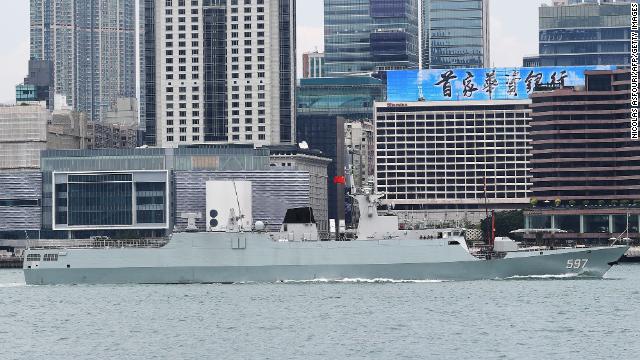
  • Corvette

    A Type 056 corvette, above, of the Chinese navy transits Hong Kong’s Victoria Harbor in 2019.

    Corvettes form the biggest chunk of the People’s Liberation Army Navy fleet, with 72 in service as of February 2021, according to a report in state-run Global Times.

    Source: Global Times

The corvette force is ideal for tighter, shallower ocean environments, like China’s key areas of concern, the South China Sea; around Taiwan; and the Senkaku/Diaoyu islands in the East China Sea, controlled by Tokyo but claimed by Beijing.
The ships the PLAN puts to sea near Chinese shores are protected by a large ground-based missile force.
The missiles “problematize US power projection and prevent overwhelming naval and air power from striking the Chinese mainland,” said Kaushal. “However, this also has the effect of facilitating power projection against local nations, as these nations are far more vulnerable when the maritime links that enable the US to support them are severed.”
For instance, if the US Navy was unable to operate in the South China Sea because of the Chinese missile threat, it would have a hard time protecting the Philippines, with which Washington has a mutual defense treaty.
US military leaders are also cognizant that in 2021 the PLA Navy is much more than ships.
“Take a look at what China’s really investing in,” US Chief of Naval Operations Adm. Mike Gilday said this week in an interview with Breaking Defense. “Yes, they are putting more ships in the water, but they’re investing heavily in anti-ship missiles as well as satellite systems to be able to target ships.”
All that gives China a strong hand to play in any possible conflict close to home. And China is adamant its military is defensive.
“The development of China’s national defense aims to meet its rightful security needs and contribute to the growth of the world’s peaceful forces,” said the country’s 2019 defense white paper, titled “China’s National Defense in the New Era.”
“China will never threaten any other country or seek any sphere of influence.”
So why is the PLA Navy building aircraft carriers, amphibious assault ships and large, powerful destroyers and cruisers suitable for operation far from China?

This aerial photo taken on January 2, 2017, shows a Chinese navy formation, including the aircraft carrier Liaoning (C), during military drills in the South China Sea.

Near seas defense vs far seas protection

Protecting the Chinese mainland and its territorial claims around the region are what Beijing calls “near seas defense.”
China’s massive naval buildup coincides with it reinforcing its claims to almost all of the 3.3 million square-kilometer (1.3 million square-mile) South China Sea by building up tiny reefs and sandbars into man-made artificial islands heavily fortified with missiles, runways and weapons systems.
“Islands and reefs in South China Sea have unique advantages in safeguarding national sovereignty and maintaining a military presence in the open sea,” read a December 2020 article in Naval and Merchant Ships, a Beijing-based magazine published by the China State Shipbuilding Corporation, which supplies the PLA Navy.
But they can’t stand alone, the magazine noted. In the events of hostilities, outposts in the southern reaches of the waterway could require reinforcements from near China’s southern coast, more than a day’s sailing away, it said.
Piling resources in the near seas to achieve that level of control could be problematic for China, some argue. It may leave China vulnerable to a distant naval blockade that could deprive it of vital materials from abroad, severing what are termed sea lines of communication, or SLOC for short.
“China does not control the straits and transit lanes on which its economy depends and ‘once a crisis or war at sea occurs, (China’s) sea transport could be cut off,’” Jennifer Rice and Eric Robb, senior intelligence analysts at the US Office of Naval Intelligence, wrote in a paper for the US Naval War College’s China Maritime Studies Institute last month. “The regional focus of near seas defense is also insufficient to address the increasingly global scope of China’s economic interests.”
To bring Chinese military power to bear on its global interests, they said, China has begun implementing “far seas protection.”
“Far seas protection reflects Beijing’s direction for the PLAN to ‘go global,’ … part of a larger Chinese government policy to encourage the expansion of China’s economy and cultural outreach,” Rice and Robb wrote.
Part of the play is perception. For decades now, nothing has quite projected military power as the image of a US Navy aircraft carrier in waters far from home. It’s something China craves, analysts say.
“Some Chinese military analysts suggest it is imperative for the PLA to safeguard China’s overseas interests and note that sending out the PLAN is essential to establishing China’s image as a great power,” Rice and Robb wrote.
Dozens of corvettes can’t do that. So China has ramped up its production of ships that form an aircraft carrier task force, like guided-missile cruisers and nuclear-powered submarines, which have much longer endurance than the diesel-electrics that comprise most of the PLAN fleet.
The PLA Navy has two aircraft carriers in service, but their endurance without refueling is limited to less than week, according to the China Power project. That makes them more suitable for use in places like the South China Sea rather than in far oceans.
But more carriers are in planning and production. The newest planned Chinese carrier is expected to be equipped with a nuclear power reactor and electromagnetic catapults that will enable it to launch aircraft with more firepower and greater range than the existing carriers.
Rice and Robb point out that two Chinese defense white papers, from 2015 and 2019, say long-range naval forces are necessary to help with international peacekeeping, disaster relief and naval diplomacy — in other words, flying China’s flag overseas.
But they issue a warning. “The peacetime nature of these activities can obscure far seas protection’s wartime applications. The concept encourages offensive operations during wartime, despite the defensive strategy its name implies,” they wrote.
Citing Chinese publications, they add, “One source urges naval forces to ‘control key strategic channels’ far from China. Another source advocates employing strategic ‘fist’ forces formed around aircraft carriers. … Another wartime mission is to strike important nodes and high-value targets in the enemy’s strategic depth to ‘ease pressure on the near-seas battlefield.’”

China's first aircraft carrier, Liaoning, arrives in Hong Kong waters on July 7, 2017.

What’s possible now — and later

Although the Chinese navy would be a formidable opponent for any foe, its practical abilities don’t yet match its aspirations.
Firstly, the PLAN would require aircraft carrier battle groups with far stronger air wings than the Chinese fleet’s current capabilities.
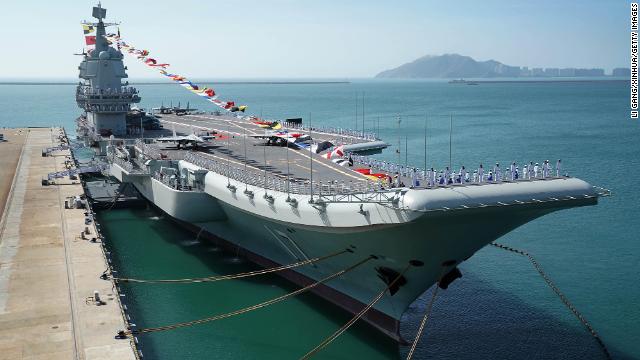
  • Aircraft carrier

    The Shandong, above, is the newest of China’s two active aircraft carriers.

    Commissioned in 2019, it is an updated version of its predecessor, the Liaoning, which is a platform originally built for the Soviet navy.

    The Shandong carries an air wing of approximately four dozen aircraft split between fighters and helicopters. The Shandong is conventionally powered, meaning it can only operate about six days at sea before refueling.


    Source: China Power-CSIS

The PLAN’s two active carriers are conventionally powered and based on old Soviet designs. That limits the range of the ships themselves, the range and number of aircraft they carry, and the payloads of munitions on those aircraft.
In short, they are not even near peers to the US Navy’s fleet of 11 aircraft carriers. And just one of those US carriers makes an intimidating statement while steaming off a foreign shore.
“A US Navy aircraft carrier, its air wing, is more powerful than most countries’ entire air forces,” said Eric Wertheim, editor of the US Naval Institute’s “Combat Fleets of the World.”
The PLA Navy is not there yet. Note how limited China’s long-range naval power projection has been to date.
China’s aircraft carriers haven’t ventured farther than the western Pacific, let alone to projected power globally. While PLAN ships have deployed to the Indian Ocean, the Mediterranean Sea, and into the North Atlantic to northern Russian ports, they’ve done so in small numbers and infrequently.
Just last week, state-run tabloid Global Times reported on a Chinese naval expedition group of at least five ships led by a guided-missile destroyer crossing the equator and sailing into the open sea. It did not give an exact location of the equator crossing but noted the group had likely been at sea for three weeks.
“Such missions enable the PLA to get familiar with the high seas as China eyes to build a blue-water navy,” the report said.
Global Times said a year ago a similar expedition group ventured out into the Pacific, an event noted by Roderick Lee, director of research at the US Air Force’s Air University China Aerospace Studies Institute.
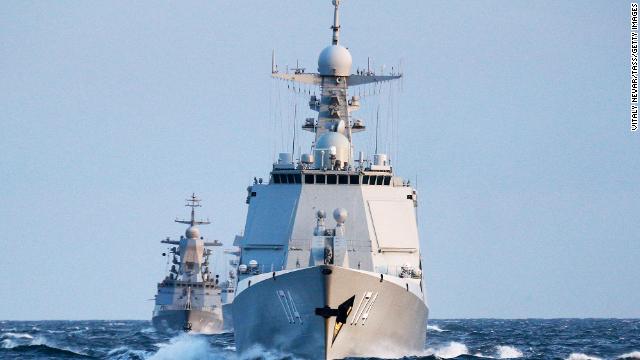
  • Destroyer

    A Chinese navy Type 052D destroyer, front, takes part in an exercise with the Russian navy in the Baltic Sea in 2017.

    The ship, of which China had built 25 as of August 2020, is a prime example of how China is making modern warships with the ability to project naval power around the world, analysts say.

    Sources: Global Times, US Naval Institute

“The key takeaway from this training event is that the PLAN is developing the proficiencies to sustain limited offensive strikes against US forces — perhaps as far out as Hawaii,” Lee wrote for the Jamestown Foundation’s China Brief.
“The PLA Navy is making significant progress in joint operations, damage control, logistics, and intelligence — to the extent that they may soon be able to operate on the doorstep of US Navy port facilities in wartime.”
But other analysts say the realization of the PLAN’s blue-water efforts could be years, if not decades, away.
“By 2049 China aims to have a global military that’s able to fight and win wars and project power globally,” Meia Nouwens, senior fellow for Chinese defense policy at the International Institute for Strategic Studies, said last week as the think tank released its annual world “Military Balance” report.
Along that timeline, analysts say they are looking for certain benchmarks to measure progress. They include establishing more overseas bases to support the PLAN — it has only one, in Djibouti on the Horn of Africa — and building heavy air transport to supply those bases.
“An interesting one will be when a Chinese carrier group makes a long-range deployment of significance, potentially into the Indian Ocean,” Childs, the International Institute of Strategic Studies defense analyst, said.
Other notable deployments could include going into the Arctic and possibly the Atlantic, Childs added.

Soldiers stand on deck of the ambitious transport dock Yimen Shan of the PLA Navy as it participates in a parade in the sea near Qingdao, China, in 2019.

The Taiwan question

But in the near term, the center of attention is Taiwan, the democratic self-governing island that the powers in Beijing say is a historical and inalienable part of their sovereign territory.
Beijing’s 2019 defense white paper said the island’s authorities were “intensifying hostility and confrontation, and borrowing the strength of foreign influence.”
“The ‘Taiwan independence’ separatist forces and their actions remain the gravest immediate threat to peace and stability in the Taiwan Strait and the biggest barrier hindering the peaceful reunification of the country,” the paper said.
And in a press conference in January, a Chinese Defense Ministry spokesman made clear where the military stands. “Taiwan is an inalienable part of China,” Senior Col. Wu Qian said.
“The PLA will take all necessary measures to resolutely defeat any attempt by the ‘Taiwan independence’ separatists, and firmly defend national sovereignty and territorial integrity.”
In a speech in 2019, Xi said “not a single inch of our land” could be ceded from China.
“We should safeguard the sovereignty and territorial integrity of the country and achieve full unification of the motherland,” he said.
In many ways concerning Taiwan, Xi has set up the PLA Navy fleet to do that.
As noted, the concentration of smaller surface ships like corvettes and coastal patrol craft are suited for combat near shores. And there’s only about 130 kilometers (80 miles) of relatively shallow water between Taiwan and the Chinese mainland, ideal for the corvettes.
Those six dozen or so corvettes, for example, can carry two anti-ship missiles each with ranges of up to 200 kilometers (125 miles). Imagine the tracking and missile defense headache that creates for the US Navy surface fleet in the Pacific, which can only muster about three dozen destroyers.
PLA capital shipbuilding can also been seen in the lens of Taiwan.
Late last year, the Type 075 landing helicopter dock (LHD), a 35,000- to 40,000-ton multipurpose ship about half the size of China’s two in-service aircraft carriers, embarked on sea trials.
As one of the biggest amphibious assault ships in the world, the Type 075 has a full flight deck to handle helicopters, and a flooded well deck that can launch and recover hovercraft and amphibious vehicles, according to an analysis from the Center for Strategic and International Studies (CSIS). It also has the capacity to carry 900 ground troops, who the helicopters and hovercraft can put ashore.
The ship, the first of three in the water or in production, “considerably elevates China’s ability to transport, land, and support ground forces operating outside the Chinese mainland,” analysts Matthew Funaiole and Joseph Bermudez Jr. wrote for the CSIS.
“The new class of ship … represents a significant step forward for enhancing China’s amphibious capabilities.”
But if China were to invade Taiwan, it would need far more than 900 ground troops to control and occupy the island.
And that brings us back to those numbers, including the coast guard, the maritime militia, even those merchant ships China produces like no one else can.
“We would be wise to assume that China will bring all of its tools of maritime power to bear in ensuring success in a cross-Strait invasion,” Shugart, the CNAS analyst, told Congress, who drew an analogy to the escape of British forces from France in World War II to visualize his point.
“In something like the form of a reverse-Dunkirk, we should expect that instead of only dealing with dozens of gray-painted PLA Navy amphibious vessels and their escorts, we would likely see a Taiwan Strait flooded with many hundreds of fishing boats, merchant ships, and Coast Guard and Maritime Safety Administration vessels.”

The post China’s Navy the World’s Largest…For What Purpose? appeared first on The St Kitts Nevis Observer.

Corona Effect: 4th Wave Feared in Race to Vaccinate, World Stats

A year after the frightening beginning of the coronavirus pandemic, the world stands on the brink of a fourth wave of infection as nations race to vaccinate their populations and stave off a new surge in hospitalizations and deaths.

Total reported cases rose across the globe in the last week of February after six weeks of decline, driven in part by new, more virulent variants that transmit between people at startlingly higher rates than the initial strains out of Wuhan, China, and northern Italy.

“This is disappointing, but not surprising,” World Health Organization Director-General Tedros Adhanom Ghebreyesus told reporters last week. “This is a global crisis that requires a consistent and coordinated global response.”

The United States recorded about 66,000 new cases a day over the last week, according to the Centers for Disease Control and Prevention (CDC), down 73 percent from the apex reached in early January and similar to levels of transmission from October. But the precipitous decline of late January and early February has plateaued in recent days, raising fears that a new wave is just around the corner.

“We could not have made a more wonderful environment for this virus to take off than we have right now,” said Michael Osterholm, director of the Center for Infectious Disease Research and Prevention at the University of Minnesota. “We are not driving this tiger, we’re riding it. And the first time we may be able to drive it is with widespread use of the vaccine, and we’re not there yet.”

A total of 107 million doses of the three vaccines approved by the Food and Drug Administration have been shipped to states across the nation, according to CDC data. About 53 million people have received at least one dose, 16 percent of the population, while 27 million have received two doses. The first doses of the one-shot vaccine developed by Johnson & Johnson were administered last week.

Globally, 115 million coronavirus cases have been confirmed, a quarter — 28.7 million — in the United States. The 518,000 Americans who have died represents about 20 percent of the global death toll. The latest data from the CDC shows 41,000 are still hospitalized.

CDC forecasts show the number of weekly deaths dropping through the rest of March and into April, though the number of deaths will continue at a horrible cost of thousands of lives.

Some models show an increase in cases just around the corner. One model maintained by the PolicyLab at the Children’s Hospital of Philadelphia shows reproduction rates — the measure of how many people are infected by someone who has the virus — rising in three quarters of the counties surveyed. States in the Northeast, Mid-Atlantic and Midwest showed higher transmission rates last week.

Several states have loosened restrictions on businesses and gatherings imposed over the summer, even though infections continue at higher levels today than when those mandates were initially put in place.

“You’re seeing a lot of states loosening mask restrictions at a point where they’re having more cases per day than they had over the summer when they put the mask restrictions in place,” said Rich Besser, a former CDC director who now runs the Robert Wood Johnson Foundation. “That just doesn’t make sense.”

The governors of Texas and Mississippi have removed mask mandates, and most states have lifted capacity rules for indoor establishments like bars and restaurants. Public health experts cautioned against racing to reopen at a faster pace than the science suggests is safe.

“If we’re a little bit too capricious in this in between phase, we can really lengthen this [pandemic] out,” said David Rubin, who runs PolicyLab. “A lot of people very close to the finish line before they’re offered vaccinations can be infected.”

Rubin said the coming spring months are likely to aid the battle against the coronavirus as more people spend more time outdoors. Early warm weather in Southern states may be partly responsible for lower transmission in February, he said.

But the barriers to a return to normal remain in the form of vaccine hesitancy, as millions voice skepticism over shots that have shown no serious medical consequences.

“If we continue to see this large group of people who are not getting vaccinated, that’s going to have a big impact on sustainability of transmission in the US, even with the vaccine here. We’ve done little to dent that,” Osterholm said.

Variants that now account for an increasing share of cases in the United States are a growing cause of concern. Scientists are especially concerned about the B.1.1.7 variant, responsible for a winter outbreak in the United Kingdom, and the B.1.357 variant, first identified in South Africa and now prevalent in several of its neighbors.

As more Americans receive their vaccines, communities are looking ahead to a promising spring and summer. But while the light is on at the end of the tunnel, experts warned there is still plenty of tunnel to traverse.

“This in-between time, our collective response with communities and how we go about the next couple months is such a critical moment,” Rubin said. “Everything we do now has an impact on what might happen three months from now.”

The US is approaching Joe Biden’s target of 100m vaccinations in his first 100 days in office, with 90,351,750 doses of Covid-19 vaccines as of Sunday morning, the Centers for Disease Control and Prevention said. The vaccine doses are for both Moderna and Pfizer/BioNTech vaccines.

==================================================

Summary


The post Corona Effect: 4th Wave Feared in Race to Vaccinate, World Stats appeared first on The St Kitts Nevis Observer.

Home-going service held for late STEP Field Officer Ms. Avanel ‘Ellen’ Akers

Interment, clockwise from top: Pastor Keith Phipps officiating; Prime Minister Harris lays the first wreath; Keith Hendricks lays wreath on behalf of Skills Training Programme; Family members at the grave.

BASSETERRE, ST. Kitts — On March 4, family and friends of Ms. Avanel ‘Ellen’ Akers, who until her death last month was a Skills Training Empowerment Programme (STEP) Field Officer, gathered for a home-going service at the House of Deliverance New Testament Church of God on Main Street in Tabernacle Village.

Prime Minister and Minister with responsibility for STEP and Area Parliamentary Representative for St Christopher Seven, Dr. the Hon Timothy Harris, joined family and friends at the service.

“I wish on behalf of my family, indeed on behalf of the Parliament to extend deepest condolences to Darlin Akers and the extended family, Akers and Williams,” said the Hon. Dr. Harris.

The Honourable Prime Minister and Deputy Speaker of the National Assembly Senator the Hon. Dr. Bernicia Nisbett, left Parliament, which was in session, to attend the home-going service. Also present at the service was the St. Kitts and Nevis Resident Ambassador in Cuba, Her Excellency Verna Mills, who is originally from Tabernacle Village.

“Ellen was well known in the community, well respected as a strong young lady with an independent mind, she could fight her own battles,” said Dr. Harris. “With her last job on STEP, the reports were good. She was one of the few people who could take a hard job and do what was required, and I recommend her work.

“On behalf of the entire Tabernacle community and beyond, I extend again heartiest condolences to the family as you mourn this terrible loss,” said Dr. Harris.

The home-going service was officiated by Pastor Keith Phipps, a brother of the late Ms. Avanel ‘Ellen’ Akers, who is also a STEP Field Officer, and Senior Pastor Octavia Charles-Warner. The entire STEP head office staff and field officers led by Director Emile Greene attended the service.

“Ms. Akers was one of our very outstanding field officers,” said Greene. “Given the work and changes that we are making at STEP, I can tell you we are going to miss her. But the song we are singing today is symbolic of what we can say of Ms. Akers.”

STEP staff paid tribute to their fallen colleague by rendering the song ‘What a friend we have in Jesus.’

“What a friend we have in Ellen, because many of her attributes, her kindness, her frankness, her honesty, her dedication to her work and her attributes you can find in our Lord and Saviour Jesus Christ,” said Greene. “I want us to appreciate the very good work that she has done while she was with us.”

Several glowing and moving tributes were paid, among them by her mother Ms. Iris Williams who is better known as Darlin Akers, and by Senior STEP Field Officer Jason McKoy. The eulogy was read by her niece, Deputy Speaker of the National Assembly, Senator the Hon. Dr Bernicia Nisbett.

Interment was at the Tabernacle cemetery, where her brother Pastor Keith Phipps led the proceedings. Area Parliamentary Representative, Prime Minister Dr the Hon Timothy Harris laid the first wreath followed by family members, community members and her friends. STEP’s Field Officer for Saddlers to Dieppe Bay Keith Hendricks laid a wreath on behalf of the staff of STEP.

Director of the Skills Training Empowerment Programme (STEP) Emile Greene and STEP Head Office staff members pay tribute to their fallen colleague STEP Field Officer Ms. Avanel ‘Ellen’ Akers.

The post Home-going service held for late STEP Field Officer Ms. Avanel ‘Ellen’ Akers appeared first on The St Kitts Nevis Observer.