Tag Archives: caribbean

Women can combat COVID-19s negative effects with collaboration, support

BASSETERRE, St. Kitts — The effects of COVID-19 are felt globally by all sectors of society. The pandemic has deepened many pre-existing inequalities within societies such as those that are gender-based. Within the Federation of St Kitts and Nevis, women are currently facing the negative effects affiliated with the COVID-19 pandemic.

“In most societies across the globe, systems are unequal in relation to the access they give to women and men – that really is the underpinning of the inequality that has manifested as a result of COVID-19,” explained Professor Jeune Guishard-Pine, OBE, Business and Professional Women’s group representative.

The effects of the pandemic range from job loss to the increased cases of domestic violence against women. Professor Guishard-Pine noted that the issues affecting women within the Federation are felt across the Caribbean region.

“Much of what is happening in St. Kitts and Nevis happen across the region because of our dependence on tourism,” she said. Women’s roles are integral to the tourism industry across the Caribbean region.

“Combatting the effects of COVID-19 will require a collaborative and multi-layered approach to spreading awareness and creating a substantial support system for women.

“Pooling creativity will find a whole raft of solutions that we wouldn’t find if we just remained isolated and alone,” noted Professor Guishard-Pine. “We need to continue to raise awareness and create a dialogue across womankind in the Federation,” said Professor Guishard-Pine. “We must be aware of sisterhood, how we can support one another, and how we can understand each other’s pain. We can think together about creativity that exists beyond our job roles, beyond our existence as mothers and daughters.”

Mrs. Celia Christopher, Director of the Department of Gender Affairs, expressed the need for the ministries to work together to assist women impacted by the COVID-19 pandemic.

“One of the ways to address the impact of COVID-19 on women is to have the key ministries working together to assist women,” said Mrs. Christopher. “We can work with the Ministry of Health, Ministry of Consumer Affairs, and the Ministry of Labour so we can see how we can help them.”

She noted that although a stimulus package was given, women should continue to be supported until they are once again gainfully employed.

The post Women can combat COVID-19s negative effects with collaboration, support appeared first on The St Kitts Nevis Observer.

Indigenous Amazonians Suing Supermarket Chain Over Deforestation

French supermarket chain Casino is being sued by indigenous groups from the Amazon, for allegedly selling beef linked to deforestation.

The 11 indigenous groups, backed by NGOs in the US and France, are seeking €3.1m ($3.7m; £2.7m) in damages.

In a statement, the groups linked Casino meat to an area of deforestation “five times the size of Paris”.

Casino told AFP and Reuters news agencies that it took a “rigorous” approach to its supply chains.

The company is being taken to court under a French law enacted in 2017. Under the law, businesses must avoid human rights and environmental violations in their supply chains.

The indigenous groups from Brazil and Colombia have accused Casino of “damages done to their customary lands and the impact on their livelihoods”.

In the statement they said deforestation in South America, particularly in Brazil, was mainly driven by cattle ranching.

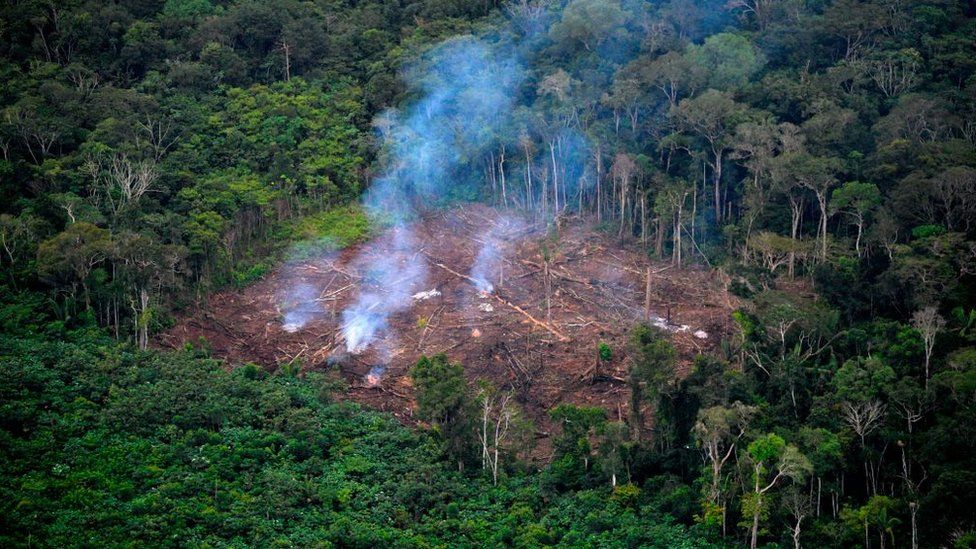
Deforestation in the Colombian Amazonimage copyrightGetty Images
image captionDeforestation is a major problem in the Amazon region

“According to evidence compiled and analysed by the Center for Climate Crime Analysis for this case, Groupe Casino regularly bought beef from three slaughterhouses owned by JBS,” a meatpacking company accused of deforestation, they said in a joint statement.

“The three slaughterhouses sourced cattle from 592 suppliers responsible for at least 50,000 hectares of deforestation between 2008 and 2020… The deforested area is five times the size of Paris.”

Casino also controls Brazil’s largest food retailer, Grupo Pão de Açucar (GPA), and Colombian retailer Almacenes Éxito.

The indigenous groups also accuse Casino of violating indigenous rights, and cite one case in particular in which indigenous lands were invaded and used by cattle farms that supplied beef to GPA.

“The demand for beef by Casino and Pão de Açucar brings deforestation and land-grabbing and violence, and the murder of indigenous leaders when they choose to resist,” Luiz Eloy Terena, a leader of Brazil’s Terena people, said in the statement.

“With this lawsuit, we seek to hold the company accountable for the consequences of these impacts and to bring some relief to the reality confronted by our indigenous peoples on their lands.”

Casino told Reuters news agency that its Brazilian-sourced beef was not sold in its French shops.

GPA also told the agency that in 2016 it set out criteria that its suppliers must comply with – including “zero Amazon deforestation, no slave-like condition, no child labour and no invasions of indigenous land or conservation areas”.

The post Indigenous Amazonians Suing Supermarket Chain Over Deforestation appeared first on The St Kitts Nevis Observer.

Associated Press Worldview: Capitol Riot, Nursing Home Deaths, Earthquake, More

March 05, 2021

Alternate text

AP Morning Wir

Ted Anthony

Director of Digital Innovation

The Rundown

I'm an image

Two firefighters loaned to Washington for the day were the only medics on the Capitol steps Jan. 6, trying to triage injured officers as they watched the angry mob swell and attack police working……Read More

I'm an image

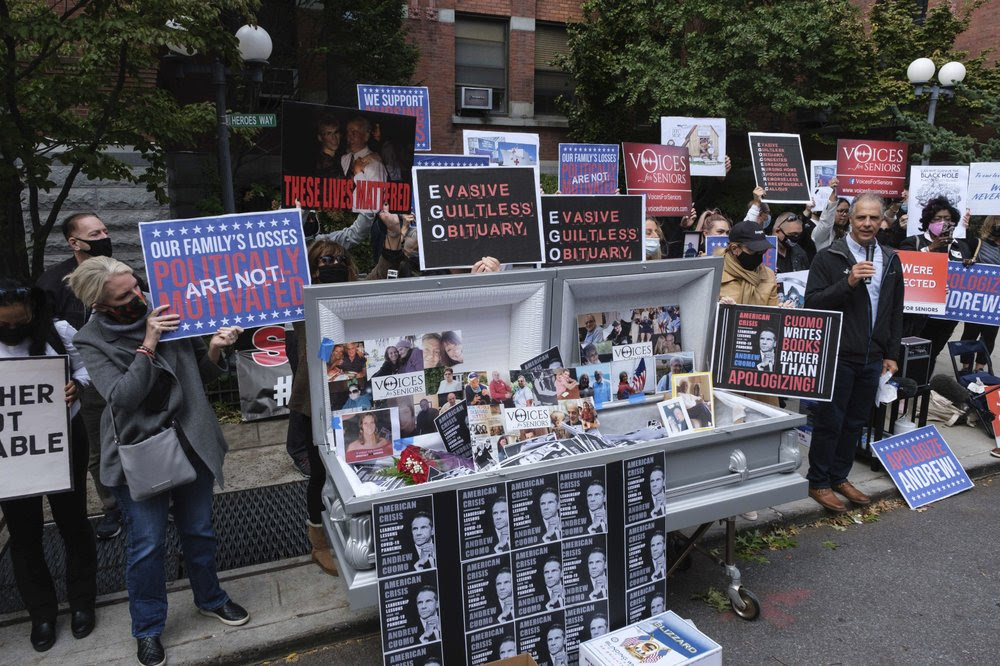
NEW YORK (AP) — Top aides to Gov. Andrew Cuomo altered a state Health Department report to obscure the true number of people killed by COVID-19 in the state’s nursing homes, The Wall Street… …Read More

I'm an image

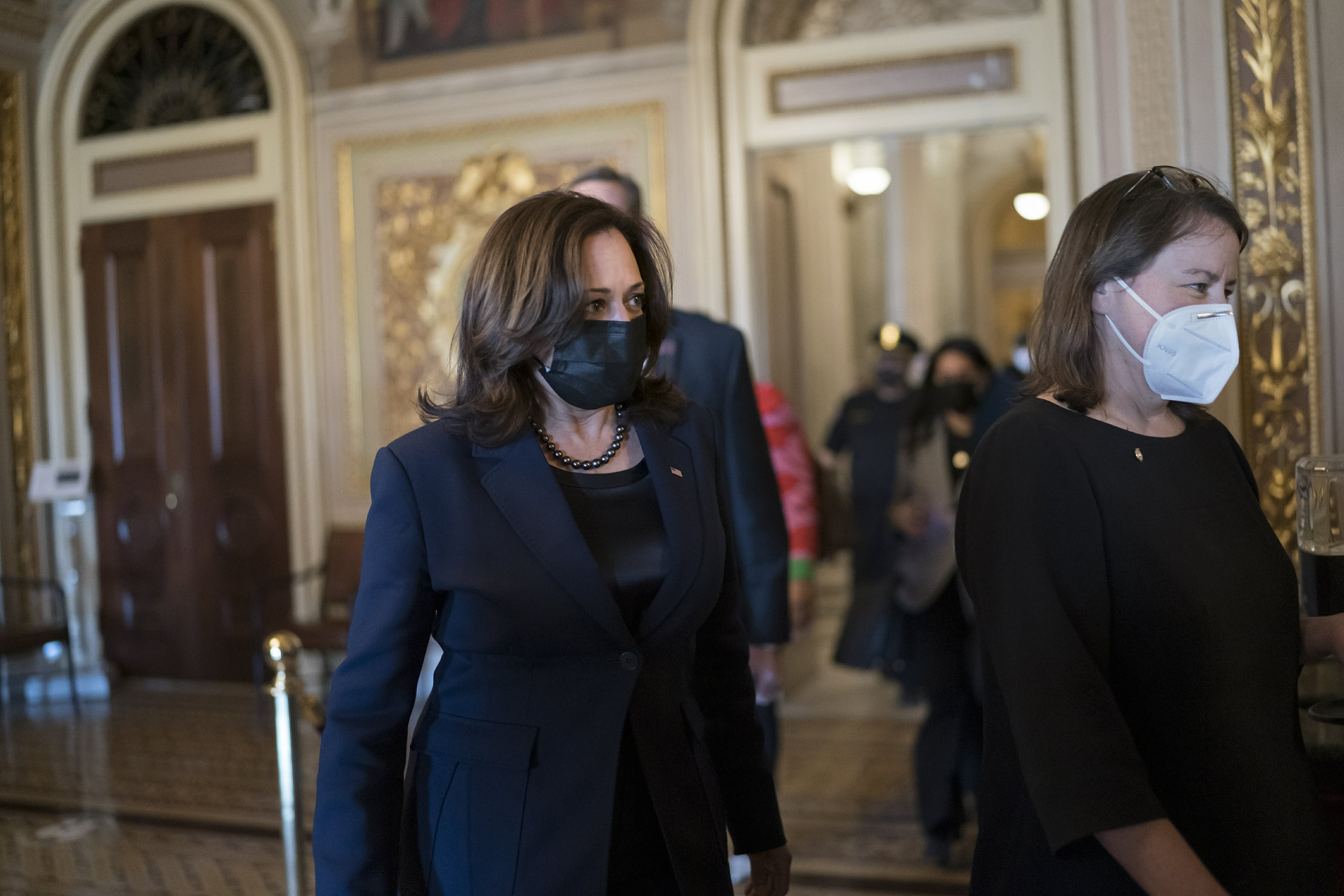
WASHINGTON (AP) — The Senate is beginning debate on a $1.9 trillion COVID-19 relief bill, after Democrats made eleventh-hour changes aimed at ensuring they could pull President Joe Biden’s top… …Read More

I'm an image

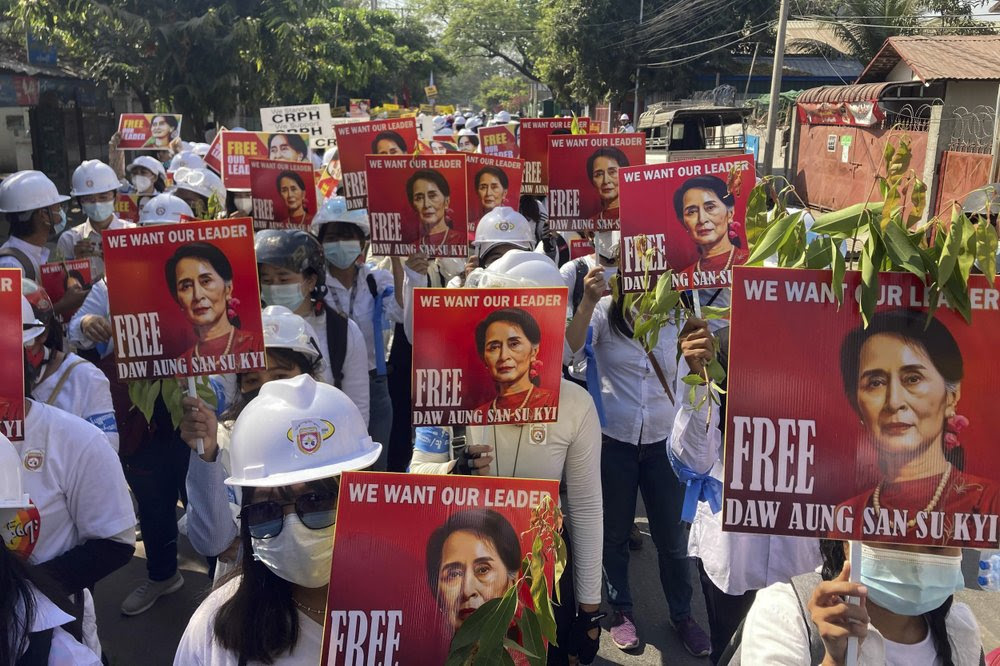
BANGKOK (AP) — YouTube has removed five channels run by Myanmar’s military for violating its community guidelines and terms of service. The company said Friday that it terminated channels… …Read More

I'm an image

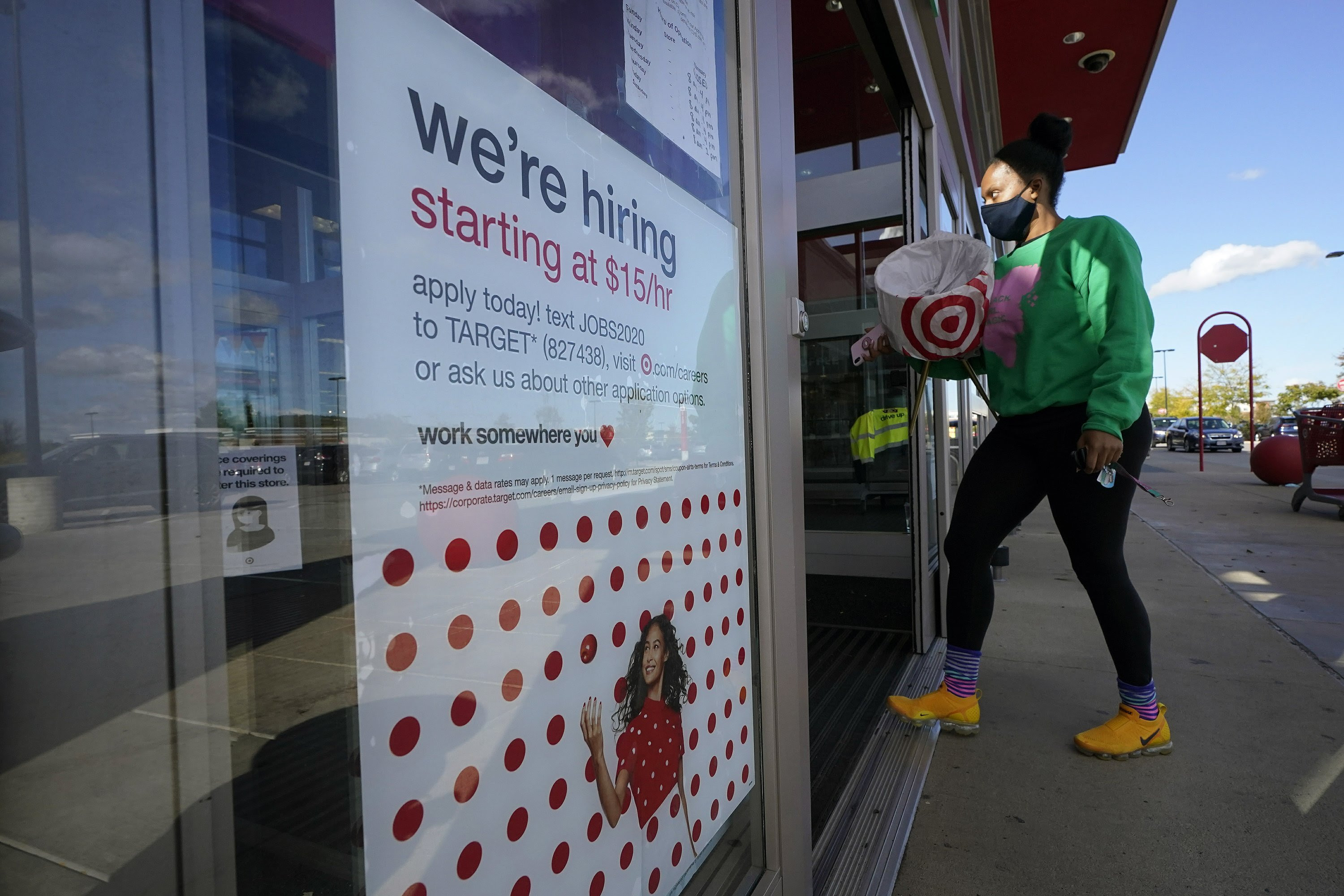
WASHINGTON (AP) — America’s employers likely stepped up their hiring in February as confirmed viral cases declined, consumers spent big chunks of their government aid checks and the economy… …Read More

OTHER TOP STORIES

BAGHDAD (AP) — Pope Francis heads to Iraq on Friday to urge the country’s dwindling number of Christians to stay put and help rebuild the country after years of war and pers…Read More

WELLINGTON, New Zealand (AP) — Officials in New Zealand issued a tsunami warning for coastal areas after a shallow, powerful earthquake struck off the northeastern coast on …Read More

Iceland Shakes

More than 18,000 small-scale earthquakes have shaken southwestern Iceland over the past week, raising fears of impending seismic activity from the region’s numerous volcanos. While the area hasn’t seen volcanic activity in more than 800 years, a 300-year-long period of eruptions lasted from the 10th to the 13th century. During that stretch, eruptions were continuous but relatively small, though at least one major eruption may have occurred.

The country’s volcanic activity arises from its position straddling the Mid-Atlantic Ridge, an undersea mountain chain separating the North American and Eurasian tectonic plates (see video explainer). The two plates are pulling apart from each other at roughly 1 inch per year—a fairly rapid clip by geologic standards.

The ridge has created in Iceland one of the few places you can literally bridge two tectonic plates.

LONDON (AP) — Banksy appears to have thrown his support behind a campaign to turn a former prison in the English town of Reading into an arts venue, a town spokesman said on…Read More

Imagine being trapped in the confines of your own neighborhood, losing a sense of the outside world — and of yourself — with each passing day. Things are seeming kind of fla…Read More

The post Associated Press Worldview: Capitol Riot, Nursing Home Deaths, Earthquake, More appeared first on The St Kitts Nevis Observer.

T&T: Touchstone Exploration Ups Oil & Natural Gas Reserves

Touchstone Exploration Inc (LON:TXP, TSE:TXP) announced a jump crude oil and natural gas reserves at its Trinidad exploration properties.

Total proved, probable and possible (3P) net reserves, the widest measure, surged 236% to 100,150 thousand barrels of oil equivalent (Mboe) as of the end of 2020. The figure included total proved net reserves (1P) – those with the highest likelihood of being recovered – which grew 189% to 34,238 Mboe from the previous year.

“Our year-end 2020 reserves evaluation provides further independent confirmation of the significant opportunities that the company has in place from our Trinidad assets,” said Paul Baay, president and chief executive of Touchstone. “Our 1P reserves are now significantly higher than our 3P reserves at the same time last year, providing greater operational and financial certainty for investors, and exclude any potential reserves from the recently drilled Chinook-1 well or Cascadura Deep-1 wells.

“We have a lot to be excited about as we focus on converting our world class reserves to production during 2021 as well as expanding opportunities through additional drilling at Ortoire.”

The Chinook-1 and Cascadura Deep-1 wells were drilled in the fourth quarter of 2020.

Touchstone has tested two low resistivity zones in the Chinook-1 well. The first zone was considered uneconomic due to the high volume of water, but the company said indications of light oil prove the concept of hydrocarbons. Touchstone has permanently abandoned this lowermost zone and completed a second zone in the Herrera formation which encountered 35 degrees API sweet oil and is being configured for an extended oil production test.

“This is an encouraging start to the production testing programme as it confirms the presence of hydrocarbons in the sub-thrust sheet and will allow for further up-dip drilling targets based on available 3D seismic data,” said chief operating officer James Shipka.

“The sub-thrust sheet was not one of the original Chinook-1 well targets, so the confirmation of hydrocarbons in the deep section is very positive,” he added. “Although the lower zone was considered uneconomic given the high water cuts, the reservoir displayed potential as fluid flowed to surface at over 2,200 bbls/d. Future targets structurally up-dip from Chinook-1 hold tremendous potential.”

Touchstone expects to conducting the first natural gas test at the Cascadura Deep-1 well while the Chinook-1 well is on the extended oil production test.


The post T&T: Touchstone Exploration Ups Oil & Natural Gas Reserves appeared first on The St Kitts Nevis Observer.

West Indies Win First Match in Sri Lanka Series Thanks to Pollard

Captain Kieron Pollard smashed six sixes in an over for only the third time in Twenty20 Internationals to counter leg-spinner Akila Dananjaya’s sensational hat-trick, as West Indies held their nerve in a chaotic run chase to beat Sri Lanka by four wickets on March 3rd.
Chasing a modest 132 for victory in the opening match at Coolidge Cricket Ground, West Indies raced to 52 off the first 19 deliveries courtesy of some awesome power-hitting from openers Evin Lewis (28) and Lendl Simmons (26).

However, the drama unfolded when Dananjaya (3-62) removed Lewis, Chris Gayle (0) and Nicholas Pooran (0) in quick succession in the fourth over to claim his hat-trick.

Pollard responded almost immediately, arriving at the crease to punish Dananjaya with six massive sixes in the sixth over, en route to an 11-ball 38 which helped West Indies regain their balance.

Even more drama erupted in the next over when Pollard was one of two wickets to fall off consecutive deliveries to leave leg-spinner Hasaranga de Silva (3-12) on a hat-trick, and West Indies stuttering again on 101 for six.

That was not the end of the tumult either as Jason Holder (29 not out) was then dropped in the deep on nine off Dananjaya and Dwayne Bravo (four not out) missed by the bowler a couple deliveries later, before West Indies gathered themselves to win comfortably in the end.

“It was a bizarre game,” a relieved Pollard said afterwards.

Debutant 22-year-old Pathum Nissanka had earlier top-scored with 39 while opener Niroshan Dickwella got 33 but Sri Lanka found themselves restricted to 131 for nine off their 20 overs.

They were well placed at one stage at 71 for one in the 10th over but then lost eight wickets for 60 runs at the back end, to fall away badly.

Sent in, they lost Danushka Gunathilaka for four in the third over to a diving catch at short mid-wicket by Pollard to give debutant off-spinner Kevin Sinclair his first international wicket but Nissanka and Dickwell put on 50 for the second wicket to repair the damage.

Nissanka faced 34 balls and struck four fours and a six while the left-handed Dickwella punched three fours and a six off 29 deliveries.

Fast bowler Holder broke the stand when Dickwella tried to sweep a low full toss and had his stumps rattled off the final ball of the 10th over and Nissanka followed in the 13th, missing a charge at left-arm spinner Fabian Allen and leaving Pooran to complete a straightforward stumping.

A rain break did little to improve Sri Lanka’s fortunes as left-arm seamer Obed McCoy (2-25) snatched two wickets following the resumption to help accelerate the innings decline.

In reply, Lewis lashed three sixes in the opening over from captain Angelo Mathews’ gentle medium pace and added later two fours in a whirlwind 10-ball knock while Simmons hit three fours and two sixes off 15 balls, in a rapid start for West Indies.

And the home side appeared set for an easy victory before Lewis holed out to long off and veteran left-hander Gayle then got one that spun past an uncertain defensive prod to hit the front and back pad, for what should have been a straightforward LBW decision but was only gained through DRS.

When Pooran nicked the next ball behind, an elated Dananjaya had claimed the 14th hat-trick in T20 Internationals.

Simmons missed a sweep at Hasaranga and was lbw at the end of the fifth at 62 for four but Pollard eased tensions with his stunning achievement in the next over.

The first six was giant hit over long on, the second flew straight back overhead into the sight-screen while the third comfortably cleared long off. Pollard then found wide long on for the fourth six, tugged a straight six off the back foot for his fifth before casually flicking the sixth over the ropes at mid-wicket to join South African Herschelle Gibbs and Indian Yuvraj Singh in the record books.


He was looking to push on when he failed to navigate a Hasaranga googly and was lbw and Allen followed next ball, also lbw playing down the wrong line to another googly.

Bravo averted the hat-trick but was let off in the next over when Dananjaya failed to haul in a return catch, just moments after debutant Ashen Bandara grassed the easiest of chances at deep mid-wicket to keep Holder at the crease. Holder calmly set about seeing West Indies over the line, however, ending the contest with the second of his two sixes.

CMC

The post West Indies Win First Match in Sri Lanka Series Thanks to Pollard appeared first on The St Kitts Nevis Observer.

Dominica Gets China COVID Vaccine Shipment

A handover ceremony for the Sinopharm COVID-19 vaccines donated by China to Dominica was held in Dominica’s capital Roseau on Thursday, after the vaccines arrived in the Caribbean country late Wednesday, according to reports reaching here.

Since Dominica and China established diplomatic relations 17 years ago, the two countries have always been true friends, Dominican Prime Minister Roosevelt Skerrit said during the ceremony, adding that today, the precious gifts from Chinese friends once again confirm that China is a reliable and sincere partner of Dominica.

He praised China’s contributions to making Chinese COVID-19 vaccines a global public good accessible and affordable to developing countries.

China’s vaccine technology is mature and stable, and its safety and effectiveness have been widely confirmed, he added.

Charge d’Affaires of the Chinese Embassy in Dominica Luo Songtao said that facing the challenges posed by the COVID-19 pandemic, the Chinese government has always upheld the vision of a community with a shared future for mankind, and has been dedicated to making vaccines accessible and affordable to developing countries.

China and Dominica have always been supporting each other to overcome difficulties together in the fight against the pandemic, Luo said, adding that China will continue to provide assistance within its capacity for Dominica.

The post Dominica Gets China COVID Vaccine Shipment appeared first on The St Kitts Nevis Observer.

Cuba on Verge of Own COVID Vaccine as Cases Soar

(CNN) Cuba may be on the verge of a coronavirus vaccine breakthrough and not a moment too soon, as deaths and cases spike on the communist-run island.

Starting in March, two of the island’s four homegrown vaccine candidates will begin their third and final trials, the Cuban government has announced.

While other developing countries compete with richer nations for a limited supply of doses, Cuba has gambled everything on producing their own vaccines, as much an exercise in national pride as a response to a public health crisis.

Two of the vaccines are named Soberana — Spanish for sovereignty. The remaining two are called Abdala, the name of a poem written by Cuban revolutionary icon Jose Marti, and Mambisa, referring to Cuban guerillas who fought a bloody war for freedom against the Spanish.

Cuban scientists will start the final trials for their Soberana-02 and Abdala vaccines this month, as the island experiences a surge in new cases. For much of 2020, Cuba was able to keep the spread of the pandemic under control but a bungled reopening to international travelers in December led to a surge in cases.

February has been the deadliest month to date for the Caribbean nation with 108 deaths and 7642 new cases, according to the Cuban government’s statistics.

Cuban scientists say they expect their vaccines to be a game changer — not just against the rising Covid numbers but also for the disastrous impacts of the pandemic on their economy.

“The main object of this clinical trial is to show the clinical efficacy of our vaccine candidate,” said Dagmar Garcia Rivera, a researcher with the government-run Finlay Institute for Vaccines. “After that we could be in conditions to start massive vaccination in Cuba and some other countries in the world.”

With the third trial of Soberana-02, Cuban doctors say, starting in March they will vaccinate 44,000 trial participants in Cuba. Researchers told CNN they have already made more than 300,000 doses of that vaccine and will ramp up production with the expectation that trials will show Soberana-02 to be safe and effective.

Abroad, Iran has already begun widespread trials of Soberana-02 and Mexico is in talks with Cuba to begin trials soon. Suriname and Ghana are reportedly interested in buying Cuban vaccines when the drugs are ready.

Rafael Hernandez, 73, took part in the vaccine’s second trial and said the side effects were mild.

“Before applying the first dose, the doctor told me they had not registered, among the hundreds of patients vaccinated, a single adverse reaction, beyond light pain, raised temperature, stiffness in the vaccinated arm, fever or mild discomfort,” Hernandez told CNN.

Cuba’s most-tested vaccine candidate, Soberana 02 is a conjugate vaccine which carries part of the spike protein from the virus, binding it to human cells.

Researchers will not know how effective the vaccine is until they complete the Phase 3 trials and they are currently studying whether vaccinating with Soberana 02 will require giving patients three doses of the vaccine.

“We need many vaccines to vaccinate 11 million Cubans. If we are estimating that Cubans will need one or two or three doses, we are estimating that Cuba will need 30 million doses,” said Dr. Tania Crombet Ramos, the director for the government-run Center for Molecular Immunology in Havana.

Crombet said she was confident that Cuba would end up with more than one approved vaccine which would give the island greater flexibility to fight the pandemic.

“I think at the end we might be able to implement what we call ‘prime and boost,’” she said, “which is using some vaccines for the first dose and boostering and reimmunizing.”

In addition to finishing its vaccine trials, Cuba still needs to show that it can handle the massive ramp up in production that will be required to make tens of millions of doses.

This would be no small feat for any country but a particularly daunting one for an island where the economy has been battered by the pandemic and increase in US sanctions under the Trump administration. Many Cubans currently have difficulty finding basic painkillers and antibiotics much less a cutting-edge vaccine.

Nevertheless, Cuban health officials have said they expect to vaccinate the island’s entire population by the end of the year and could even sell or donate additional doses abroad or even market ‘vaccination vacations’ to help Cuba’s hard hit tourism industry to rebound.

“We have productive capacity for millions of doses of the vaccine,” Garcia said. “Probably more of the vaccine than Cuba needs. At some moment we have will some vaccine or some level of doses available for other countries in the world.”

Dr. Jose Moya, a Peruvian health expert based in Havana for the World Health Organization and Pan American Health Organization, said he was encouraged that Cuban vaccine researchers were complying with international protocols and providing updates on their progress.

“We are following these results carefully first because the Cuban population will directly benefit from their vaccine candidates and this at some point could control the transmission in the country,” Moya said. “The fact that Cuba has four vaccine candidates is very good news not just

The post Cuba on Verge of Own COVID Vaccine as Cases Soar appeared first on The St Kitts Nevis Observer.
US: Legislation for Caribbean ‘Dreamers’ to Earn Green Card,Citizenship

Caribbean American Democratic Congresswoman Yvette D. Clarke (contributed photo)


WASHINGTON, CMC – Caribbean American Democratic Congresswoman Yvette D Clarke has introduced legislation in the United States House of Representatives that would allow Caribbean and other “Dreamers” to earn lawful permanent residence, or green card, and US citizenship.

The Development, Relief, and Education for Alien Minors Act, known as the DREAM Act, is a United States legislative proposal to grant temporary conditional residency, with the right to work, to unauthorised Caribbean and other immigrants who entered the US as minors—and, if they later satisfy further qualifications, they would attain permanent residency.

In April 2001, United States Senators Dick Durbin (D-Illinois) and Orrin Hatch (R-Utah) first introduced the bill in the Senate as S. 1291, but it did not pass.

The proposal has since been reintroduced several times, but has not been approved by majorities in either House of the United States Congress.

Caribbean American Democratic Congresswoman Yvette D. Clarke

On Wednesday, Clarke, the daughter of Jamaican immigrants, who represents the 9th Congressional District in Brooklyn, New York,  introduced H.R. 6, the Dream and Promise Act of 2021.

The bill, co-authored by New York Democratic Congresswoman Nydia Velázquez and her California counterpart Lucille Roybal-Allard, will enable US-raised immigrant youth, known as “Dreamers”, to earn lawful permanent residence and American citizenship.

In addition to “Dreamers”, the Dream and Promise Act includes protections and a path to citizenship for Temporary Protected Status (TPS) recipients, such as hundreds of undocumented Haitians living in the US, and Deferred Enforced Departure (DED) beneficiaries.

H.R 6, The Dream and Promise Act, provides a pathway to citizenship for “Dreamers”, those individuals who entered the US under the age of 18.

The legislation also provides “Dreamers” with access to equitable higher education.

For TPS and DED holders, H.R. 6, will secure permanent residency and allow them to apply for citizenship after five years.

The legislation goes even further to prevent immediate deportations, establish the right to judicial review, and impose penalties on those who use application data for immigration enforcement purposes.

“I am proud to co-lead H.R.6, the Dream and Promise Act, which provides 2.5 million ‘Dreamers’ Temporary Protected Status and Deferred Enforcement Departure recipients with a pathway to citizenship – 2.5 million people who already call America home and are contributing to our society,” Clarke said.

“As chair of the Congressional Black Caucus Immigration Task Force, it is my passion and my duty to stand up for immigrants,” she added. “H.R. 6 is the right thing to do for ‘Dreamers’ and TPS and DED holders. Immigrants greatly contribute to our economy, our community and our culture.

“Reversing the policies of the last four years is not enough,” continued Clarke, referring to the last four years of the previous President Donald J. Trump administration. “We must reimagine the immigration system in a manner that is humane, just and fair. The time has come for the values of our nation to be reflected in our immigration policies.”

In 2012, former US President Barack Obama enacted a temporary program, called the Deferred Action for Childhood Arrivals (DACA), which provided temporary protection from deportation and work permits for eligible “Dreamers”.

But, in 2017, the Trump administration rescinded the program, taking DACA protections away from its 800,000 recipients.

“This unlawful act by the Trump administration was part of a larger effort to advance their anti-immigrant agenda,” Clarke said. “The Dream and Promise Act seeks to remedy these actions and do right by the immigrants in our country.”

In 2019, H.R. 6, the Dream and Promise Act was passed in the House, but it was not signed into law.

Clarke, therefore, co-leads the legislation’s 2021 re-introduction, with co-sponsorship by 134 members of Congress.

The reintroduction of H.R. 6 comes as momentum continues to build for long-overdue US immigration reform.

Earlier this year, Clarke co-led the House’s version of President Joe Biden’s US Citizenship Act of 2021, along with six of her colleagues known as the “Closers”.

“This comprehensive legislation would restore humanity and American values to our immigration system,” said Clarke, stating that, among many provisions, it would allow “qualified, hardworking immigrants who contribute to our country and enrich their communities with a pathway to citizenship.

The post US: Legislation for Caribbean ‘Dreamers’ to Earn Green Card,Citizenship appeared first on The St Kitts Nevis Observer.

US Capitol: Cops Want Guard to Stay, Pelosi Wants Better Security

US House Speaker Nancy Pelosi (D-Calif.) called for more funding for Capitol security, citing the ongoing threat of violence from “all the president’s men” — a reference to the mob of former President Trump‘s supporters who ransacked the Capitol on Jan. 6.

“Between COVID — where we need to have vaccinations more broadly in the Capitol so that many more people can come here and do their jobs — [and] the threat of all the president’s men out there, we have to ensure with our security that we are safe enough to do our job, but not impeding [that work],” Pelosi told reporters at a press briefing.

Also, Capitol Police on Thursday requested the National Guard extend its deployment of National Guardsmen at the Capitol amid heightened security concerns almost two months after the Jan. 6 attack.

“Today, US Capitol Police Acting Chief Yogananda Pittman formally asked the Department of Defense to extend the support provided by the National Guard to remain at the Capitol beyond March 12th,” the police said in a statement.

Earlier in the day, a Defense Department official said the Pentagon was reviewing a draft request from Capitol Police to extend the deployment, which started after the Jan. 6 insurrection.

Details of the potential extension “are still being worked out,” the Pentagon official said.

Capitol Police provided few other details.

The security issue has been front and center since the mob overwhelmed law enforcement officers and forced the evacuation of lawmakers who were certifying President Biden‘s victory in the Electoral College.

On Wednesday, the House moved up a vote because Capitol Police and the FBI had warned that some of the militia groups participating in the Jan. 6 rampage had designs on a second attack on March 4 — a symbolic date which marked the inauguration of presidents until the early 1930s.

Those conservative conspiracy theorists, law enforcers warned, believed Trump would somehow return to the White House on that day.

The threat of another violent attack on the Capitol had unnerved many lawmakers who were targeted on Jan. 6.

Pelosi on Thursday, however, downplayed the significance of the new security threat in the decision to keep the House out of session on Thursday. She noted that Republicans launch their annual issues retreat Thursday afternoon, and the House had a short floor schedule already in place to accommodate that event.

“I don’t think anybody should take any encouragement that, because some trouble-makers might show up, that we changed our whole schedule,” Pelosi said. “No, we just moved it a few hours, and it largely will accommodate the Republicans going to their own [conference].

Yet a number of Democrats — lawmakers and leadership aides alike — had said Wednesday that the schedule change was a direct result of the violent threats. And Pelosi on Thursday acknowledged that security concerns were a factor, noting that the logistics of keeping 435 House lawmakers safe is a taller order than ensuring the safety of 100 senators, who remain in session Thursday.

“Frankly, there are a lot of us,” she said. “The Senate is in, and they should be. We’re at least four times more people, and therefore all that that implies in terms of numbers of people in the Capitol — if in fact there’s any troublemakers around.”

The comments come as the Capitol Police have asked the Pentagon to extend the deployment of thousands of National Guard troops, who have been stationed around the Capitol complex since Jan. 6.

Pelosi declined to comment on the prospect of keeping those troops around for another two months, deflecting questions of Capitol security to the officials in ch

The post US Capitol: Cops Want Guard to Stay, Pelosi Wants Better Security appeared first on The St Kitts Nevis Observer.

Sputnik V Spreading Over Latin America, Brazil Pres: “Stop Whining,” World Stats

(CNN)- Russia’s Sputnik V has seen rising popularity across Latin America as more countries announce shipments and deals to purchase the Covid-19 vaccine.

Nine Latin American countries so far have approved usage of the Sputnik V vaccine — Argentina, Bolivia, Guatemala, Guyana, Honduras, Mexico, Nicaragua, Paraguay and Venezuela. Distribution of the vaccine has also begun in Argentina, Bolivia, Mexico, Nicaragua, Paraguay and Venezuela.
The vaccine has been approved in 39 countries around the world, according to the Russian Direct Investment Fund (RDIF), which handles the marketing of the vaccine.

Millions of doses of Sputnik V are already being produced each month at the Generium Pharmaceutical plant.

Millions of doses of Sputnik V are already being produced each month at the Generium Pharmaceutical plant.

The Sputnik V vaccine has a cheaper list price and can be stored at higher temperatures than the Pfizer vaccine, which has made it appealing to Latin American countries with less-developed economies and infrastructures. It requires two doses taken 21 days apart to be effective.

Argentina became the first Latin American country to distribute the Sputnik V vaccine in late December, with the purchase of up to 25 million doses. The country has already distributed over 600,000 doses.

Since then, Venezuela and Mexico both received shipments of 100,000 and 200,000, respectively, in early February. Nicaragua began distributing the vaccine on March 2 after receiving a donation of an undisclosed amount of doses.

As Russia struggles to keep up with demand, some countries have received only very small shipments. Bolivia received 20,000 Sputnik V doses in January, though it expects enough to eventually vaccinate 2.6 million people. Paraguay announced the purchase of one million doses, but has so far only received 4,000.

A nurse Injects the Sputnik V vaccine to the first doctor as part of the vaccination plan against COVID-19 at Hospital del Norte in El Alto, Bolivia. (Photo by Gaston Brito/Getty Images)

Russia has acknowledged the production squeeze and has considered launching regional production hubs in several countries, including Brazil, according to Kremlin spokesman Dmitry Peskov.

Some interest has been expressed in producing the Sputnik V vaccine locally in Latin America. The RDIF recently announced an agreement with Argentina’s Richmond Laboratories to begin producing the vaccine in the country, though it has not yet provided a timeframe for delivery.

Experts have repeatedly voiced concern over transparency around Sputnik’s testing and its accelerated authorization in Russia. However, the vaccine was found 91.6% effective against symptomatic Covid-19 and 100% effective against severe and moderate disease, in an interim analysis of the vaccine’s Phase 3 trial results published in The Lancet.

Reporting contributed by Mitchell McCluskey in Atlanta, Stefano Pozzebon in Bogota, Tatiana Arias in Atlanta and Tim Lister in Spain.

==================================================

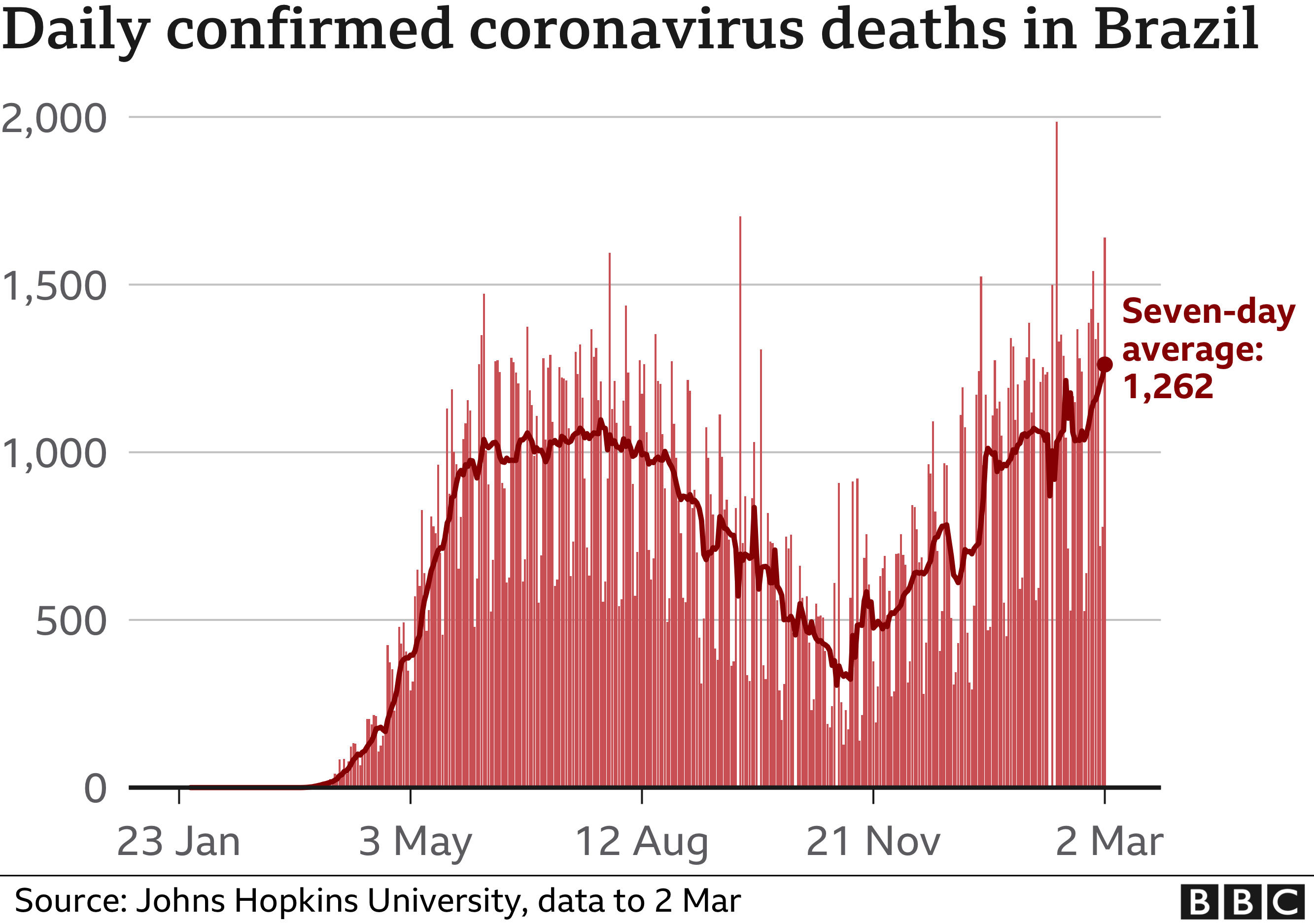
President Jair Bolsonaro has told Brazilians to “stop whining” about Covid-19, as he criticised measures to curb the virus despite a surge in cases and deaths.

His comments came a day after Brazil saw a record rise in deaths over a 24-hour period.

Brazil is facing its worst phase of the pandemic yet, leaving its health system in crisis.

In response some cities and states have imposed their own restrictions.

Brazil’s health ministry says more than 260,000 people have died with Covid-19, the second-highest pandemic death toll in the world after the US.

On Thursday, another 1,699 deaths were added to that tally, a slight decrease on Wednesday’s record 1,910. Meanwhile, a further 75,102 cases of coronavirus were reported, the second-highest daily rise on record.

The explosion of cases has been attributed to the spread of a highly contagious variant of the virus thought to have originated in the Amazon city of Manaus.

Yet on Thursday Mr Bolsonaro continued to downplay the threat posed by the virus.

“Stop whining. How long are you going to keep crying about it?” Mr Bolsonaro said at an event. “How much longer will you stay at home and close everything? No one can stand it anymore. We regret the deaths, again, but we need a solution.”

What reaction has there been to President Bolsonaro’s comments?

The comments were met with a furious response from São Paulo’s governor, João Doria, who has been particularly scathing of Mr Bolsonaro’s handling of the pandemic.

Speaking to the BBC, Mr Doria called President Bolsonaro “a crazy guy” for attacking “governors and mayors who want to buy vaccines and help the country to end this pandemic”.

“How can we face the problem, seeing people die every day? The health system in Brazil is on the verge of collapse,” Mr Doria said

President Bolsonaro has consistently opposed quarantine measures introduced by governors, arguing that the collateral damage to the economy will be worse than the effects of the virus itself.

“Unfortunately, Brazil has to fight, at this moment, two viruses: the coronavirus and Bolsonaro virus. This is a sadness for the Brazilians,” Mr Doria said.

Chart showing daily confirmed deaths
line

What measures are cities and states introducing?

Concerned about the strain on hospitals, mayors and state governors have taken matters into their own hands in recent days.

Rio de Janeiro is the latest city to announce a partial lockdown, placing restrictions on bars, restaurants and beaches.

The measures, which will take effect on Friday for one week, will require bars and restaurants to shut early and suspend commercial activity on the city’s famed beaches.

The measures come after São Paulo state – Brazil’s largest, with 46 million people – declared a “code red” situation, ordering non-essential businesses closed for two weeks starting Saturday.

Frustrated state governors announced on Tuesday that they would join forces to buy vaccines directly from manufacturers rather than wait for the federal government to deliver them.

Brazil, the worst-affected country by Covid in Latin America, has lagged behind in its roll-out of Covid vaccines.

What do we know about the new variant?

Researchers from the University of São Paulo working with their colleagues at Imperial College London and Oxford University think that the second wave may be linked to the emergence of a new variant of coronavirus which has been traced to the city of Manaus.

The new variant, named P.1, was first detected in people who had travelled from Manaus to Japan in January. The researchers studying it think it first emerged in Manaus in early November and has been spreading there quickly since.

Their data – which is still preliminary – suggests that the P.1 variant could be up to twice as transmittable as the original version of the virus.

It also suggests that the new variant could evade immunity built up by having had the original version of Covid. They put the chance of reinfection at between 25% and 60%.

Manaus, in the Amazon region, was one of the hardest hit cities in the first wave of the pandemic.

It was expected that the people infected in the first wave would have acquired some degree of protection or immunity. And yet, the city has seen a second wave of infections.

Researchers think this may be because a new variant has emerged which may be evading immunity provided by past infections.

===================================================

Covid: Italy ‘blocks’ AstraZeneca vaccine shipment to Australia

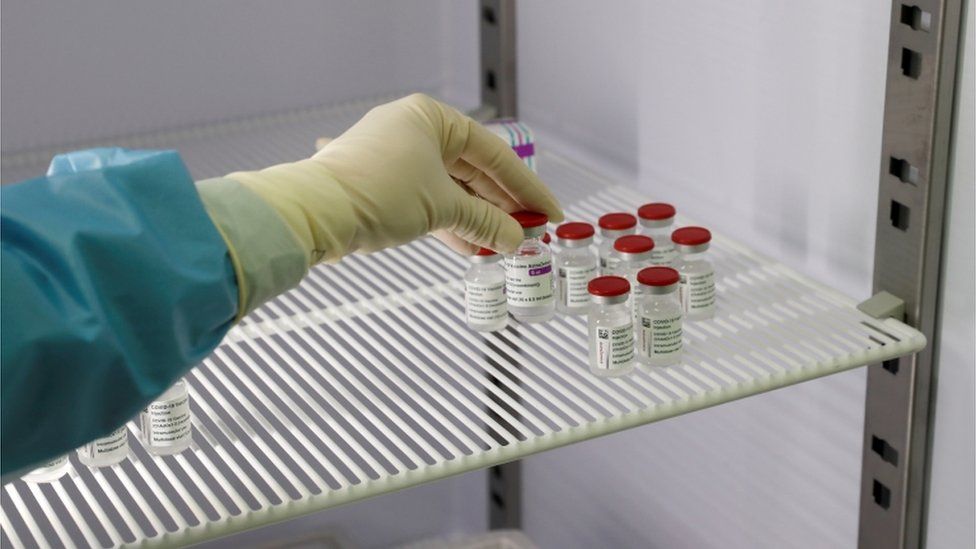
A medical worker in Italy holds a vial of the Oxford-AstraZeneca vaccineimage copyrightReuters

The Italian government has blocked the export of an Oxford-AstraZeneca vaccine shipment to Australia.

The decision affects 250,000 doses of the vaccine produced at an AstraZeneca facility in Italy.

Italy is the first EU country to use the bloc’s new regulations allowing exports to be stopped if the company providing the vaccines has failed to meet its obligations to the EU.

Australia said losing “one shipment” would not badly affect its rollout.

But it has asked the European Commission, which reportedly backs Italy’s move, to review the decision.

AstraZeneca is on track to provide only 40% of the agreed supply to member states in the first three months of the year. It has cited production problems for the shortfall.

In January, then Italian Prime Minister Giuseppe Conte described delays in vaccine supplies by both AstraZeneca and Pfizer as “unacceptable” and accused the companies of violating their contracts.

The EU has been widely criticised for the slow pace of its vaccination programme.

Under the EU vaccine scheme, which was established in June last year, the bloc has negotiated the purchase of vaccines on behalf of member states.

There has been no official comment on the Italian move by the EU or AstraZeneca.

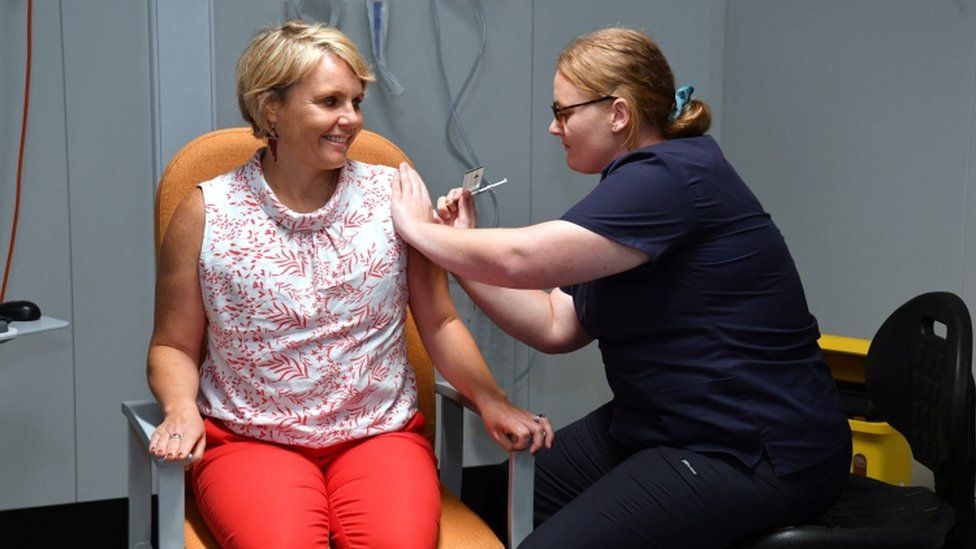
Australian Labor MP Peta Murphy gets vaccinated - 23 Februaryimage copyrightEPA
image captionVaccinations began in Australia last week using the Pfizer jab

Australia began its vaccination programme last week using the Pfizer/BioNTech vaccine. It was due to start inoculations with the AstraZeneca jab on Friday.

What does Italy say?

The Italian government approached the European Commission last week to say that it was its intention to block the shipment.

In a statement on Thursday, the foreign ministry explained the move, saying it had received the request for authorisation on 24 February.

It said that previous requests had been given the green light as they included limited numbers of samples for scientific research, but the latest one – being much larger, for more than 250,000 doses – was rejected.

It explained the move by saying that Australia was not on a list of “vulnerable” countries, that there was a permanent shortage of vaccines in the EU and Italy, and that the number of doses was high compared with the amount given to Italy and to the EU as a whole.

What does Australia say?

“Australia has raised the issue with the European Commission through multiple channels, and in particular we have asked the European Commission to review this decision,” Health Minister Greg Hunt said.

Australia said it had already received a shipment of 300,000 doses and planned to begin local production next month.

“Domestic production starts with 1 million [doses] per week of deliveries from late March and is on track,” Mr Hunt said.

“This [Italy] shipment was not factored into our distribution plan for coming weeks.”

==============================================

Summary (Guardian (UK)

Paris will not be put under weekend lockdowns, the French prime minister, Jean Castex, announced at his weekly Covid-19 round-up on Thursday evening, reports the Guardian’s Paris correspondent, Kim Willsher.

The news came as a relief to Parisians, who feared they were heading for yet another restriction after the city and surrounding areas became one of more than 20 French departments on high alert following a rise in coronavirus contaminations and deaths. City mayor Anne Hidalgo had vigorously argued against a weekend lockdown, saying it was “inhumane” not to allow residents, many of them living in small flats, to spend time outside.

Nice, in the south of France, and Dunkirk, in the north, remain under weekend lockdown, which has been extended to the department around the Channel port.

The whole of France remains under a daily 6pm to 6am curfew.

Castex also announced a speeding up of France’s much-criticised vaccine rollout with pharmacies being allowed to vaccinate from 15 March. Vaccines will even be administered at weekends, he said, in the hope of getting 30 million French people inoculated by the summer.

However, there is concern that only 40% of France’s health workers have been vaccinated, despite having been eligible for the jab for weeks. French media reported that president Emmanuel Macron had suggested it be made obligatory for health workers, but Castex and the French health minister, Olivier Véran, stopped short of this and urged those in the health sector to get vaccinated to protect “themselves, their families and the people they care for”.

Castex warned another lockdown was “not inevitable” but also not ruled out if the situation worsens.

During a council of ministers meeting on Thursday – the equivalent to a Cabinet meeting in the UK – Macron was reported to have had a dig at the sluggish pace of vaccinations in France that has seen millions of doses still unused, telling ministers: “You’re great, but as long as there are vaccines sitting in fridges, I’m not locking people down again.”

Some people with asthma have been ‘refused’ the Covid-19 vaccine

The main UK story from overnight this morning is that Cyprus will allow British tourists who have been fully vaccinated against Covid-19 into the country without restrictions from 1 May.

Visitors would need to be inoculated with vaccines approved by the European Medicines Agency (EMA) and the second dose of a vaccine should be administered at the latest seven days before travel. Authorities would still reserve the right to carry out random tests on arrivals.

The post Sputnik V Spreading Over Latin America, Brazil Pres: “Stop Whining,” World Stats appeared first on The St Kitts Nevis Observer.