Tag Archives: caribbean

COVID: US Disease Center Urges Schools to Reopen, Jan. Deadliest Month

In the US, where cases have fallen by about 30% over the past two weeks (see previous write-up), the Centers for Disease Control and Prevention called for schools to begin returning students to the classroom.

The decision cited accumulating evidence in districts where schools have opened that in-person learning has not contributed meaningfully to community spread of the virus, assuming mitigation measures were in place. See an overview of the data here.

However, January has already become the worst month for US Covid-19 deaths since the start of the pandemic.

As of Tuesday, there have been more than 79,000 coronavirus fatalities, topping the previous record set in December by more than a thousand, according to data from Johns Hopkins University.
The grim milestone underpins the growing demand from state officials for more vaccines so that Americans can be inoculated more quickly.

The total number of COVID-19 cases reported worldwide has surpassed 100 million, with more than 2.1 million deaths (see dashboard). Five countries—the US (25 million), India (11 million), Brazil (8.8 million), Russia (3.7 million), and the UK (3.7 million)—make up more than half of all reported cases.

Separately, Johnson & Johnson said it was on track to produce 100 million doses of its COVID-19 vaccine by June, and would present efficacy data early next week. Pending approval, it would become the third available vaccine in the US. Unlike the existing two vaccines, it requires only one shot and can be stored at standard refrigerator temperatures for up to three months (how it works).

As of this morning, the US had distributed more than 44 million vaccine doses, with about 23.5 million administered. Roughly 4,100 COVID-19 deaths were reported yesterday, bringing the total in the US to just over 425,200. See rolling averages for cases and deaths.

The post COVID: US Disease Center Urges Schools to Reopen, Jan. Deadliest Month appeared first on The St Kitts Nevis Observer.

Caribbean Story and Author in Book of Year Win

BBC- The Mermaid of Black Conch, a dark love story about a fisherman and a mermaid torn from the sea, has won the Costa Book of the Year award.

Trinidadian-born British writer Monique Roffey beat four other contenders with her sixth novel to scoop the £30,000 prize.

Judges said the book was “utterly original… and feels like a classic in the making”.

A “delighted” Roffey said her win was a vote for Caribbean literature.

“A huge thank you to the judges for exposing my book to a wide readership. I’ll be pinching myself for weeks to come,” she added.

Based on a Taino legend of a beautiful woman transformed into a mermaid, the story is set in the Caribbean village of St Constance.

David, a fisherman, unexpectedly attracts the attention of Aycayia, a mermaid who is drawn to his singing. When she is captured from the sea during an annual fishing competition, he does all he can to save her, with dramatic consequences.

Professor Suzannah Lipscomb, chair of judges, said: “The Mermaid of Black Conch is an extraordinary, beautifully written, captivating, visceral book – full of mythic energy and unforgettable characters, including some tremendously transgressive women.”

line

Analysis from Rebecca Jones, BBC Arts correspondent

The Costa Book Awards have a reputation for picking popular reads: books you would recommend to a friend. And I would definitely recommend The Mermaid of Black Conch.

At first, the novel might sound a bit odd. Set on a Caribbean island in the 1970s, it is a bittersweet love story between a beautiful young woman cursed to live as a mermaid and a fisherman.

Based on a legend passed down by the indigenous people of the Caribbean, the Taino, there are touches of magic and snippets of poetry. The book was also shortlisted for the Goldsmiths Prize last year, which rewards fiction that breaks the mould or extends the possibilities of the novel.

But while it is unusual it is also a joy to read, brimming with memorable characters and vivid descriptions.

We see the mermaid’s “hair flying like a nest of cables” while we are told “sea moss trailed from her shoulders like slithers of beard” and “barnacles speckled the swell of her hips.”

For me, this was a hugely entertaining and thought-provoking novel and a worthy winner.

line

Caribbean representation

Roffey, a senior lecturer in creative writing at Manchester Metropolitan University, secured her publishing deal through Peepal Tree Press, an independent publisher supporting Caribbean writers.

She then crowd-funded her publicity campaign with the support of fellow authors.

Monique Roffey's book coverimage copyrightCosta Awards
image captionThe Mermaid of Black Conch is set in the Caribbean

Roffey’s entry was also named Costa’s Novel of the Year earlier this month, alongside winners from four other categories:

  • First Novel Award – Love After Love by Ingrid Persaud
  • Children’s Book Award – Voyage of the Sparrowhawk by Natasha Farrant
  • Poetry Award – The Historians by Eavan Boland
  • Biography Award – The Louder I Will Sing by Lee Lawrence

The Mermaid of Black Conch is the thirteenth novel to take the overall prize. Days Without End by Sebastian Barry was the last novel to be named Costa Book of the Year in 2016.

Tuesday’s virtual ceremony also saw London-based writer Tessa Sheridan receive the 2020 Costa Short Story Award.

Sheridan won the public vote and £3,500 for her story, The Person Who Serves, Serves Again.

The Costa Book Awards, formerly the Whitbread Book Awards, were established in 1971 to encourage, promote and celebrate the best contemporary British writing.

It is open to UK and Irish authors.

Seamus Heaney, Ted Hughes and Sebastian Barry are among the authors to have won the book of the year award more than once.

line

The post Caribbean Story and Author in Book of Year Win appeared first on The St Kitts Nevis Observer.

Coronavirus: Barbados Returns to Lockdown

The Caribbean island nation of Barbados will return to a two-week lockdown next Wednesday, which includes wearing a face mask in all public places, as part of an initiative to curtail a rise in COVID-19 cases.

Prime Minister Mia Mottley announced Tuesday night that from February 3 to February 17, a 7:00 pm to 6:00 am curfew will be in effect.

She also announced that the country had confirmed three cases of the easily spread British strain of the virus.

Motley said the rise in COVID-19 cases coupled with the deaths of three elderly people within a week prompted her to bring back the restrictions.

Essential businesses such as supermarkets, pharmacies and gas stations will continue to operate during the lockdown.

Supermarkets will only open from 8:00 am to 3:00 pm Monday through Friday during the lockdown.

All other businesses, including bars, restaurants and gyms will close during the lockdown. Banks are excepted, shutting down for just six days, February 3 to 9.

Barbados has recorded more than 1,400 COVID-19 infections and 10 deaths, according to Johns Hopkins University COVID Resource Center.

The post Coronavirus: Barbados Returns to Lockdown appeared first on The St Kitts Nevis Observer.

Trump Likely to Skate Free at 2nd Senate Trial

Senate Republicans seem ready to hand former President Trump his second acquittal in an impeachment trial in a little more than a year after just five GOP senators on Tuesday rejected a motion that the trial was unconstitutional.

Most GOP senators haven’t formally announced how they will vote on convicting Trump, and, in a shift from 2020, most are not rushing to defend him after a mob, egged on by the then-president, sacked the Capitol.

But Tuesday’s vote, which sidelined the effort from Sen. Rand Paul (R-Ky.), sends a clear signal to everyone in Washington that the trial is highly unlikely to end with a Trump conviction vote.

At least 17 GOP votes to convict would be needed to reach the two-thirds majority.

“I can’t see how you get 17. I think that that was a test vote,” said Sen. John Boozman (R-Ark.) after 44 GOP senators sided with Paul.

While it is possible senators could change their minds, few think that is likely.

Sen. Mike Rounds (R-S.D.) said the Tuesday vote was a “pretty good indication” that most Republicans don’t believe the trial is constitutional.

“It would really surprise me if any of those individuals decided that it was appropriate to move forward with an impeachment,” Rounds said.

Sen. James Inhofe (R-Okla.) said the vote was a “good indication” of where the final vote on convicting Trump would end up, while Paul declared the chances that Trump would become the first president to be found guilty “dead on arrival.”

The vote comes as Republicans have been increasingly signaling they view the impeachment trial as unconstitutional. Trump will be the first president to have a trial after leaving office, but the Senate previously held a trial for a Cabinet official who was no longer in office.

“We’re now being asked to convict a president who’s been impeached and he’s no longer in office. To me, this lacks legitimacy as I read the Constitution,” said Sen. John Barrasso (Wyo.), the No. 3 GOP senator.

Sen. Joni Ernst (R-Iowa) said in a statement that while Trump’s rhetoric on Jan. 6 showed “poor leadership,” she was also concerned that “the president is no longer in office” and Congress could be “opening itself to a dangerous standard.”

Asked about the upcoming trial, Ernst told reporters that Tuesday’s vote shows “they’ve got a long ways to go to prove it.”

Barrasso and Ernst joined with every other member of GOP leadership to vote against tabling Paul’s efforts to deem the impeachment trial unconstitutional.

Senate Minority Leader Mitch McConnell (R-Ky.), who said last week that Trump “provoked” the mob, supported Paul’s efforts.

Some Republicans cautioned against mapping the vote total on Paul’s effort as a direct correlation of what the breakdown will be on the final vote on convicting Trump.

Sen. John Thune (R-S.D.) called Tuesday’s vote “indicative of where a lot of people’s heads are” but stressed that he didn’t think it binded anyone into voting to acquit Trump at the end of the trial.

“I think most of us thought that the threshold issue of whether or not you can remove, as the Constitution suggests, somebody who’s no longer in office … from a constitutional standpoint, it’s on really shaky ground,” Thune said.

Sen. Rob Portman (R-Ohio), who voted against tabling Paul, said he wasn’t voting to say a trial would not be constitutional but was voting to say the issue should be discussed. Tuesday’s vote effectively pigeonholed Paul.

“I mean, I’ve the same position Mitch McConnell has. He didn’t do that to be tabled either, even though he wants to have, you know, a fulsome discussion,” Portman said.

He added that he viewed Tuesday’s vote and whether he would ultimately vote to acquit Trump as “a totally different issue, as far as I’m concerned.”

Republicans have questioned if the Senate, by moving forward, would be setting a precedent under which Republicans, once they are back in the majority, could reach back and try to impeach former presidents, in a warning shot to Democrats.

“Could we go back and try President Obama?” asked Sen. John Cornyn (R-Texas), an adviser to McConnell.

Sen. Thom Tillis (R-N.C.) told reporters that Republicans were looking at the “broader issue” about impeaching a private citizen and viewed the current discussion as “kind of laying down a marker.”

Republicans got a closed-door briefing on Tuesday from legal professor Jonathan Turley, where they quizzed him and discussed the constitutionality of holding an impeachment trial after a president has left office.

Sen. Lisa Murkowski (R-Alaska) appeared frustrated by the decision to force a vote, a move that appeared to catch GOP senators off guard, without more briefings and discussion within the caucus.

“Whether or not you’re going to see members change their mind after they’ve already taken a vote? I think that’s hard for people to do,” Murkowski added.

Asked about the implications for the outcome of the Senate trial, Sen. Susan Collins (R-Maine), who was also one of the five to oppose Paul, replied, “Just do the math.”

“It is extraordinarily unlikely the president will be convicted,” Collins said.

The GOP strategy is a sharp shift from 2020, when Republicans were pledging publicly that they would acquit Trump and defended him publicly throughout the trial.

Republicans fumed after Trump urged his followers to march to the Capitol, repeating his false claims that the election was “rigged.” And McConnell disclosed on Tuesday that he hadn’t spoken to Trump since Dec. 15.

But Democrats are worried that the argument that the trial is unconstitutional is giving Republicans an option that GOP senators view is politically safe because it allows them to vote against convicting Trump, without having to specifically endorse his Jan. 6 rhetoric.

Sen. Tim Kaine (D-Va.), who has floated trying to bar Trump from office through the 14th Amendment, warned that the constitutional argument, which Sen. Tom Cotton (R-Ark.) articulated weeks ago, was emerging as a “safe harbor” for Republicans.

“I think Cotton has given Republicans a safe place to land. ‘I don’t like the behavior, but I’m not sure you can convict.’ And whether or not that’s the right legal answer or not I think that’s a safe harbor,” Kaine said.

The post Trump Likely to Skate Free at 2nd Senate Trial appeared first on The St Kitts Nevis Observer.


New Era: Biden Signs Racial Equality Orders

President Biden has signed four executive actions meant to advance racial equity in the United States, including directing his administration to fully implement a law combating housing discrimination and another to mitigate xenophobia against Asian Americans.

Biden signed a memorandum directing the Department of Housing and Urban Development (HUD) to begin the process of rooting out systemic racism in the housing market by analyzing areas where the previous administration’s policies undermined fair housing laws, according to senior administration officials.

The order also implores the department to fully enforce the Fair Housing Act, senior administration officials said on a press call.

In July, the Trump administration rolled back Obama-era housing guidance known as the Affirmatively Furthering Fair Housing rule. Implemented in 2015, the provision required jurisdictions that receive federal funding to look for and analyze patterns of housing discrimination and then present a plan to address the practices if they existed.

Trump, however, didn’t view the rule — an add-on to the 1968 Fair Housing Act — as helpful, claiming that the guidance would “destroy” suburbs around the country.

Biden’s executive order fulfills one of the many campaign promises the Democrat made around advancing racial equity while running for president.

Biden also signed an executive order ending the Department of Justice’s use of private prisons, as part of the new administration’s broader criminal justice reform agenda.

Additionally, the president signed a memorandum directing federal agencies, including the departments of Health and Human Services (HHS) and Justice, to take steps to stop xenophobia and violence towards Asian Americans and Pacific Islanders. The memo also acknowledges what officials described as xenophobic behavior on the part of the previous administration.

Finally, Biden signed an executive order directing federal agencies to engage regularly with Tribal governments in order to strengthen the relationship between the federal government and American Indian and Alaska Native Tribes.

Biden signed the four executive actions Tuesday afternoon during a White House event focused on his racial equity agenda.

“Today’s actions are a continuation of the president’s commitment to embed equity across our entire agenda,” said a senior administration official. “We have more work to do, but these are important first steps.”

The actions follow multiple orders that Biden signed when he took office last Wednesday, including a directive that ordered the federal government to “pursue a comprehensive approach to advancing equity for all.”

Biden has faced pressure from civil rights groups and other advocates to make addressing racial inequities a key focus early on in his administration, particularly following nationwide protests last summer that decried the police killings of George Floyd and Breonna Taylor.

The directive aimed at preventing discrimination against Asian Americans and Pacific Islanders comes in part as a response to the rhetoric of former President Trump, whose regular use of the phrase “China virus” to describe the coronavirus was widely criticized as xenophobic. Trump repeatedly defended his use of the phrase while criticizing China’s handling of the disease.

Officials said Biden’s memo would underscore that statements made by the previous administration were “offensive and dangerous” and direct HHS to outline best practices for rooting out bias in the federal government’s COVID-19 response. It is also expected to direct the DOJ to work to with communities to prevent hate crimes against Asian Americans and Pacific Islanders.

The post New Era: Biden Signs Racial Equality Orders appeared first on The St Kitts Nevis Observer.

No 2021 Parade, But Mardi Gras Celebration Goes Ahead

NEW ORLEANS (AP) — You just can’t keep a good city down, especially when Mardi Gras is coming.

All around New Orleans, thousands of houses are being decorated as floats because the coronavirus outbreak canceled the elaborate parades mobbed by crowds during the Carnival season leading to Fat Tuesday.

Some smaller groups announced no-parade plans before the city did. Pandemic replacements include scavenger hunts for signature trinkets that normally would be thrown from floats or handed out from a streetcar, as well as outdoor art and drive-thru or virtual parades. The prominent Krewe of Bacchus has an app where people can catch and trade virtual trinkets during Carnival and watch a virtual parade Feb. 14, when the parade had been scheduled.

But the “house float” movement started almost as soon as a New Orleans spokesman announced Nov. 17 that parades were off.

Youtube video thumbnail

That morning, Megan Joy Boudreaux posted what she later called a silly Twitter joke: “We’re doing this. Turn your house into a float and throw all the beads from your attic at your neighbors walking by.”

But the more she thought about it, the more she liked it. She started a Facebook group, the Krewe of House Floats, expecting a few friends and neighbors to join. The numbers rose. Thirty-nine subgroups evolved to discuss neighborhood plans.

By Carnival season’s official start Jan. 6, the group had more than 9,000 members, including out-of-state “expats.” About 3,000, including a few as far afield as England and Australia, will have their houses on an official online map, said Charlotte “Charlie” Jallans-Daly, one of two mapmakers.

Houses are to be decorated at least two weeks before Fat Tuesday, which is Feb. 16 this year. With widespread addresses and two weeks to gawk, the hope is that people will spread out widely in time and space.

“I didn’t think I was starting a Mardi Gras krewe. Here I am,” Boudreaux said. “I’ve got myself a second full-time job.”

Discussions in the Facebook groups include how-tos, ads for props and neighborhood themes. Artists have given livestreamed outdoor lessons.

Katie Bankens posted that her block’s theme was Shark Week staycation paradise. When a resident worried that she was not “crafty” enough, administrator Carley Sercovich replied that if they could play music and throw trinkets to neighbors, “you are perfect for this Krewe!”

Boudreaux also suggested that people could hire or buy from out-of-work Carnival artists and suppliers hit by the parade cancellation. A spreadsheet of artists and vendors followed. One of them, artist Dominic “Dom” Graves, booked more than 20 five-person classes in professional papier mache techniques, at $100 a person.

Devin DeWulf, who already had started two pandemic charities as head of the Krewe of Red Beans walking club, kicked the house float idea up a few notches at the suggestion of Caroline Thomas, a professional float designer. Their “Hire a Mardi Gras Artist” crowdfunded lotteries collected enough money to put crews to work decorating 11 houses, plus commissioned work at two more houses and seven businesses.

“We’ve put about 40 people to work, which is nice,” DeWulf said. With Mardi Gras approaching, he said a 12th lottery would be the last.

One commissioned house is rented by a pair of nuns.

Sisters Mary Ann Specha and Julie Walsh, who run a shelter for homeless women with children, had to get permission for their own crowdfunding from the motherhouse of the Sisters of the Presentation of the Blessed Virgin Mary in Dubuque, Iowa. “They loved it,” Specha said.

The crowdfunded decorations may be auctioned after Mardi Gras to raise more money, DeWulf said.

Several mansions along a short stretch of St. Charles Avenue had elaborate displays with signs noting their creation by one of the city’s biggest float-making studios.

Tom Fox, whose wife, Madeline, painted a Spongebob Squarepants scene and made jellyfish from dollar store bowls, said he thinks a new tradition may have begun.

“Even when Mardi Gras comes back, I think people are going to keep doing this,” he said.

The post No 2021 Parade, But Mardi Gras Celebration Goes Ahead appeared first on The St Kitts Nevis Observer.

UK COVID Deaths More than WW2 Civilian Fatalities

The United Kingdom has become the first country in Europe to pass 100,000 coronavirus-related deaths as infections around the globe topped 100 million.

With more than 2.1 million dead worldwide, people the world over are mourning loved ones, but the U.K.’s toll weighs particularly heavily: It is the smallest nation to pass the painful milestone.

For comparison, the United States, with five times Britain’s population, has four times the number of deaths at over 425,000.

“It’s hard to compute the sorrow contained in that grim statistic,” a somber Prime Minister Boris Johnson said at a televised news conference.

Alongside mass deaths comes mass grief, made even more acute by the social distancing measures in place to slow the virus’s spread. Charities and other groups are urging the government to offer more help to deal with this “tsunami” of grief and a surge in mental health problems, Pan Pylas reports from London.

Civilian Deaths: The U.K. has now suffered its worst civilian loss of life since World War II by a significant number. Some 70,000 non-combatants perished during the six years of war, including 40,000 in the 1940-41 Blitz alone. Three quarters of a century later, it’s 100,000 taken by the pandemic, an enemy no less relentless and fearsome than Nazi Germany was then and one whose defeat is still some time away.

One hundred thousand dead. For perspective: That’s just over 3,000 more than witnessed England’s only World Cup triumph in 1966 at Wembley Stadium as “Sunny Afternoon” by The Kinks topped the pop charts. And it’s 30,000 more than the crowd that gathered two decades later at the same famous venue for the Live Aid concert.

US Boosting Vaccine Production, Delivery Under Biden

Alternate text

AP PHOTO/KATHY WILLENS

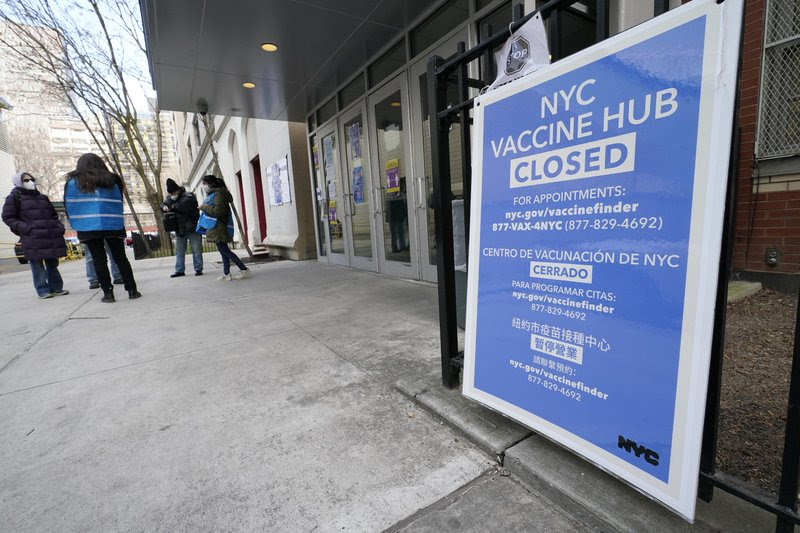
US boosting vaccine deliveries in ‘wartime effort’ amid complaints of shortages; Who goes first? Vaccine rollout forces stark moral choices

President Joe Biden says the U.S. is ramping up vaccine deliveries to hard-pressed states over the next three weeks and expects to provide enough doses to vaccinate 300 million Americans by the end of the summer or early fall.

Biden has called the push a “wartime effort,” adding that his administration is working to buy an additional 100 million doses of each of the two approved coronavirus vaccines,

Jonathan Drew and Zeke Miller report.

He acknowledged that states in recent weeks have been left guessing how much vaccine they will have from one week to the next. Shortages have been so severe that some vaccination sites around the U.S. had to cancel tens of thousands of appointments.

Biden called that “unacceptable” and said “lives are at stake.”

In the meantime, the president is dispatching America’s top scientists and public health experts to regularly update the public about the pandemic. Beginning today, the experts will host briefings three times a week on the state of the outbreak and efforts to control it.

Americans can expect a sharp contrast from the Trump administration’s briefings, when public health officials were repeatedly undermined by a president who shared his unproven ideas without hesitation.

Moral Dilemma: Oregon teachers are eligible for COVID-19 shots before senior citizens after Democratic Gov. Kate Brown decided to prioritize reopening schools. The decision has outraged older people and underscores the moral dilemma that state and local officials across the U.S. are facing as they decide who’s first in line for the vaccine.

Ethicists say America hasn’t faced such a stark moral calculus in generations. Everyone from the elderly and those with chronic medical conditions to communities of color and front-line workers are clamoring for the scarce vaccine. And each group has a compelling argument for why they should get priority, Gillian Flaccus and Sara Cline report from Oregon.

Parade-less Mardi Gras: You can’t keep a good city down, especially when Mardi Gras is coming. All around New Orleans, thousands of houses are being decorated as floats because the pandemic canceled the elaborate parades usually mobbed by crowds during the Carnival season and on Fat Tuesday. The “house float” movement started almost as soon as a city spokesman announced in November that parades were cancelled, Janet McConnaughey reports.

The post UK COVID Deaths More than WW2 Civilian Fatalities appeared first on The St Kitts Nevis Observer.

Dept. of Culture documenting, preserving local Intangible Cultural Heritage

BASSETERRE, St. Kitts — The St. Kitts and Nevis Department of Culture will explore additional strategies to preserve and promote the intangible cultural heritage (ICH) of the Federation when it meets with research and documentation teams on January 27.

ICH is described as the practice, representation, expression, knowledge, or skill considered to be a part of a country’s cultural heritage. Local examples of ICH include the story of the Mansion Bull, the dance and chants of the Masquerades, the method of making mauby, and more.

Marlene Phillips, Research and Documentation Specialist in the Department of Culture is spearheading the activities to safeguard ICH. She noted that an ICH project was launched in April 2019. Seven teams were trained in November 2019, and dispatched in July 2020 to various communities to research, identify, and digitally document aspects of ICH. The teams comprised a coordinator, researcher, interviewer, and videographer/photographer. Documentation was done via audio and video recordings as well as photography.

The team members will meet with Ms. Phillips and others involved with the project on Wednesday at the Players Dining Room at the Warner Park Cricket Stadium. They will share their experiences out in the field and recommendations on the way forward.

“We want suggestions on how to improve the process. We hope that the meeting will inform us where more training is necessary and we’ll also be discussing the future of the Secretariat,” said Ms. Phillip.

The participants who will attend the meeting will also discuss ideas to share their findings with the public during a seminar slated for February 2021.

Ms. Phillips said that the ICH project goes to the heart of what makes St. Kitts and Nevis and its people unique.

“The intangible part of our lives is our identity,” said Ms. Phillips. “It shapes the society, who the people are. If the elders or the people in the community, who are keeping it ICH alive decide to stop, then your culture is lost. So to safeguard, we need to identify what these beloved traditions are, see if they are in danger of becoming extinct, and discuss with the tradition bearers how we can pass it on to the next generation by involving them in the whole process.”

The post Dept. of Culture documenting, preserving local Intangible Cultural Heritage appeared first on The St Kitts Nevis Observer.
Barbados US Embassy cancels all Non-Immigrant Visa Appointments until further notice

BASSETERRE, St. Kitts — The Ministry of Foreign Affairs has informed the public that owing to changes in Barbados’s general COVID-19 posture, the US Embassy in Bridgetown, Barbados, has cancelled all non-immigrant visa appointments effective Thursday, January 28.

If any persons have an urgent matter and need to travel immediately, they are asked to please follow the guidance provided at https://ais.usvisa-info.com/en-bb or call (246) 623-9832 or (246) 623-9833 to request an emergency appointment. The Machine Readable Visa fee remains valid until September 30, 2022, and may be used for a visa application in the country where it was purchased.

The embassy will resume routine non-immigrant visa services as soon as possible, but is unable to provide a specific date at this time. The general public is asked to monitor the embassy’s website and social media for updates.

The post Barbados US Embassy cancels all Non-Immigrant Visa Appointments until further notice appeared first on The St Kitts Nevis Observer.

Two new COVID-19 cases reported

BASSETERRE, St. Kitts — The Federation of St. Kitts and Nevis continues to experience a gradual increase in the number of positive cases of COVID-19. As of Monday, January 25, the Federation confirmed two additional cases of coronavirus disease.

The international travellers landed in the Federation on January 10, 2021 from the United States. The patients have been in quarantine at one of the COVID-19 certified hotels since arrival. The patients were duly notified and are now in isolation.

These additional cases bring the total number of confirmed COVID-19 cases to 37 with 25 cases for St. Kitts and 12 cases for Nevis. Thirty-five cases have fully recovered with zero deaths. There are now two active cases. These patients are stable and are being monitored.

The risk of further cases occurring in the Federation remains very high. We continue to adhere to the ‘St. Kitts & Nevis Health & Travel Protocols’ which can be found at https://www.knatravelform.kn.

All front-line workers continue to adhere to the COVID-19 protocols along the corridor of containment between the ports of entry and hotel/accommodation sites.

The Ministry of Health assures the public that the following measures are being taken to restrict the spread of coronavirus:
• In-depth contact tracing to effectively assess the front-line workers with whom the recently diagnosed cases would have interacted.
• Quarantine, monitoring and testing of contacts as indicated.

The Ministry of Health-in particular-and Federal Government wish to assure all citizens and residents that every effort is being made to prevent the spread of this virus locally.

With reports of the SARS – CoV-2 variant in the region and with increase in cases locally more and more persons are adhering to the COVID-19 prevention and control measures. These include:
* Wearing a face mask when in public places;
* Maintaining good hand hygiene,
* Maintaining a physical distance of at least 6-feet from others when in public places; and avoiding crowds and events.

These control measures work and we are encouraging you to continue. Let us work together to maintain and protect the health and well-being of the people of the Federation.

The post Two new COVID-19 cases reported appeared first on The St Kitts Nevis Observer.