Tag Archives: caribbean

ILO Welcomes G-20 Human Centered Economic Recovery

GENEVA (ILO News) – The International Labour Organization (ILO) has welcomed the re-commitment by the G20 group of nations to a coherent and human-centred approach to recovery from the COVID-19 crisis that leads to greater social justice and decent work for all.

The G20 Labour and Employment Ministerial Declaration , issued following a full day of talks in Catania, Italy, echoes the Global Call to Action for a Human-Centred Recovery , adopted by delegates at the June session of the International Labour Conference  (ILC). The Call to Action outlines measures to create a human-centred recovery from the pandemic to avoid the long-term scarring of economies and societies.

In a speech to G20 Labour and Employment Ministers  at the meeting, ILO Director-General Guy Ryder welcomed the Ministers’ reaffirmed commitment to shaping a human-centred recovery that is inclusive, sustainable and resilient. He noted their renewed efforts to achieve more, better and equally-paid jobs for women, regulation of remote and digital platform work, and adequate social protection and safe and healthy working conditions for all.

He underlined the importance of strong social protection systems and enhanced coordination between social protection and labour market policies, to protect workers during the crisis and help them back into work.

“The crisis has impacted some sectors and groups much harder. In particular, it has hit women and youth, along with those in the informal economy,” he said. “Those are also the groups facing the most difficult situations today and the biggest risk of being left behind in the months and years ahead.”

Ryder outlined the cataclysmic impact of COVID-19, which has led to the loss of the equivalent of 161 million full-time jobs in the G20 nations. This, he said, represents a world of work crisis four times as severe as the one triggered by the financial crisis of 2008/09.

The recovery of recent months, he said, has been uneven and fragile, with developing countries likely to find the process more difficult.

“Unless deliberate action is taken, COVID-19 will make the world of work more unequal, more unjust, less resilient, less inclusive and ultimately less sustainable. We can do things differently. The crisis has shown us that long-established policy-settings and work arrangements can be modified in ways that were previously unimaginable.”

Governments, employers and workers must address the process of recovery, with the understanding that the future of work is not pre-determined, he said.

Ryder also highlighted the need to improve the quality of women’s employment. This would be vital if the G20 is to achieve the ‘Brisbane Goal’ of reducing the labour force participation gap by 25 per cent by 2025, he said.

At a presentation of a joint ILO-OECD report on Women at Work in the G20, Ryder told the ministers that women are twice as likely as men to be in low-paid jobs, and are more likely to be in informal employment and on temporary contracts. At the same time, women bear the brunt of unpaid work, largely due to care responsibilities.

A transformative agenda for gender equality needs greater investment in the care economy, employment policies that focus on women, universal access to comprehensive and adequate social protection, and equal pay for work of equal value, Ryder stressed. He also urged countries to ratify the ILO’s Violence and Harassment Convention, 2019 (No. 190) , noting that the problem had worsened during the pandemic.

Speaking to the G20 Joint Education and Labour and Employment Ministers Meeting on Transitions from School-to-Work , Ryder underlined the need to link education, employment and social policies.

Latest ILO estimates  show that, globally, youth employment fell 8.7 per cent in 2020, compared with 3.7 per cent for adults. In the G20 countries, youth employment declined by 11 per cent in 2020, almost four times more than for adults, Ryder said, adding that the impact on young women was even greater.

“The potential legacy of all this is frightening. This generation could be damaged for years to come, turning COVID-19 in to a multi-generational crisis,” he said.

Countries need to ensure that young people are able to develop their skills and find decent work when they complete their education and training, the ILO Director-General said. He cited the G20 Youth Roadmap 2025, which guides G20 members in strengthening their efforts to reduce the number of young women and men who are so-called NEETs (Not in Employment, Education, or Training).

Many of the issues highlighted by Ryder during the two ministerial meetings he attended were reflected in the two G20 Ministerial Declarations adopted in Catania. These point to the importance of effective social dialogue and the need to take into account ILO instruments and declarations on Social Protection Floors, Fundamental Principles and Rights at Work and the Future of Work.

The post ILO Welcomes G-20 Human Centered Economic Recovery appeared first on The St Kitts Nevis Observer.

Brazil Sets Single-Day 115K Record for Coronavirus Cases

RIO DE JANEIRO, June 23 (Reuters) – Brazil registered a single-day record of 115,228 new confirmed coronavirus cases in the past 24 hours, the Health Ministry said on Wednesday, as its outbreak shows new signs of accelerating despite long-delayed vaccination efforts finally gaining steam.

Brazil marked the milestone of 500,000 COVID-19 deaths over the weekend with nationwide protests against the government’s handling of the pandemic.

The country has been slow to roll out vaccines with only 12% of Brazilians fully immunized, according to Health Ministry data. Efforts have accelerated recently, with certain states such as Sao Paulo predicting shots for all adults by September.

The government of President Jair Bolsonaro is under scrutiny for delays and alleged misconduct in obtaining vaccines, having failed to respond to early offers from Pfizer (PFE.N) last year.

The government instead struck a deal for more a expensive vaccine made by India’s Bharat Biotech.

A Senate committee is probing allegations related to Bharat amid a wider investigation of the government’s response.

A Brazilian Health Ministry official told prosecutors he faced internal pressure from an aide to then-Health Minister Eduardo Pazuello to buy the Bharat shot. read more

In a press briefing on Wednesday, Bolsonaro’s Secretary of the Presidency Onyx Lorenzoni said there had been no influence peddling in the Bharat deal and the vaccines were not overpriced.

The Health Ministry did not respond to request for comment about the allegations.

On Wednesday, the committee also called representatives of Facebook (FB.O), Google (GOOGL.O) and Twitter (TWTR.N) to testify before the committee as it weighs possible crimes related to misinformation online about COVID-19. read more

Reporting by Pedro Fonseca Writing by Jake Spring Editing by Brad Haynes

The post Brazil Sets Single-Day 115K Record for Coronavirus Cases appeared first on The St Kitts Nevis Observer.

Canadian Indigenous Group Discovers Hundreds More Unmarked Graves

TORONTO, June 23 (Reuters) – A Canadian indigenous group announced on Wednesday the “horrific and shocking discovery” of hundreds of unmarked graves at the site of a former residential school, just weeks after the discovery of other children’s remains shook the country.

The Federation of Sovereign Indigenous Nations said in a statement that the number of newly found unmarked graves was “the most significantly substantial to date in Canada.” The statement did not specify numbers.

The group said it would announce at a news conference on Thursday morning “the horrific and shocking discovery of hundreds of unmarked graves at the site of the former Marieval Indian Residential School” in Saskatchewan.

The discovery weeks ago of the remains of 215 indigenous children at the site of another residential school for indigenous children in Kamloops, British Columbia, forced Canadians to confront the legacy of an abusive and assimilationist system.

Between 1831 and 1996, Canada’s residential school system forcibly separated about 150,000 indigenous children from their families. They were malnourished and physically and sexually abused in what the country’s Truth and Reconciliation Commission called “cultural genocide” in 2015.

Survivors who spoke with Reuters recalled perpetual hunger and haunting loneliness, and schools run under the threat and frequent use of force.

Canada’s federal government apologized for the system in 2008. The Roman Catholic Church, which ran most of the schools, has not apologized. Earlier this month, Pope Francis said he was pained, a statement dismissed by survivors.

Reporting by Anna Mehler Paperny; Editing by Peter Cooney

The post Canadian Indigenous Group Discovers Hundreds More Unmarked Graves appeared first on The St Kitts Nevis Observer.

Mexico Prison: Six Killed in Fight Between Rival Gangs

BBC- A fight between rival gangs in a prison in Mexico has left six inmates dead and at least nine injured, officials say.

The fight broke out in a jail in the city of Villahermosa in Tabasco state. Guards said rival groups armed with home-made weapons were fighting for control of the prison.

The prison has been the site of deadly fights in the past. In February, two inmates classed as “high risk” were killed in a confrontation.

Guards said Tuesday’s fight broke out in the prison courtyard when members of rival groups attacked each other with sticks and knives.

Relatives of inmates stand outside the penitentiary during a fight among inmates in Villahermosa, in Tabasco state, Mexico June 22, 2021image copyrightReuters
Relatives came to the prison to get news of their loved ones

Riot police were deployed to the jail and local media report that almost 80 officers entered the prison to re-establish control.

Prison fights are not unusual in Mexico. According to the National Human Rights Commission, there were almost 1,000 fights in state jails in 2020.

There have also been a number of high-profile prison breaks, including those of Mexican drug lord Joaquín “El Chapo” Guzmán, who managed to escape from two maximum-security jails before being extradited to the United States.

The post Mexico Prison: Six Killed in Fight Between Rival Gangs appeared first on The St Kitts Nevis Observer.

Illegal Gold Miners Stalk Amazon, Authorities Look Away

By Hugo Bachega
BBC News

At around midday on 11 May, Dario Kopenawa, an indigenous leader, received a desperate phone call from a remote village in the Brazilian Amazon. Palimiú has a population of about 1,000, and they live in large communal houses on the banks of a river called Uraricoera. You can only reach it by plane, or after a long journey on a boat.

Kopenawa, who is from the Yanomami tribe, is used to hearing pleas for help from communities in the rainforest, but this one was different.

“They attacked us,” a man said, “they almost killed us”. They, Kopenawa was told, were garimpeiros, or illegal gold miners, who had arrived on seven motorboats, some carrying automatic weapons, and started shooting indiscriminately.

Hiding behind trees, the Yanomami fought back, using shotguns and bows. An indigenous man was grazed by a bullet in the head, Kopenawa learned, and four miners were injured. The attackers left after half an hour, but threatened to come back for revenge. Terrified, women fled into the dense jungle with their children to seek refuge. It was chaotic, and two boys, aged one and five, drowned.

Palimiú, located deep in the state of Roraima, sits on Brazil’s largest indigenous reserve, which has an area similar to Portugal and 27,000 people. Mining is illegal there, but prospectors have always found ways to do their work. “Garimpeiros are all over the place,” Kopenawa said. He avoids going to areas where they are because of death threats and, after the call, he alerted the authorities, saying something had to be done.

The next day, a team of federal police travelled to Palimiú on a small plane, and were joined by Junior Hekukari, who heads the local indigenous health council. As he was leaving the area, Hekukari spotted some boats drifting with their engines switched off, and he guessed they were trying to avoid being noticed. As the men in the vessels approached, they shot multiple times at the village.

“The agents screamed ‘Police, police’,” Hekukari told me, “but they didn’t stop. They had no respect”. The officers responded, and there was an intense gun fight. The group left five minutes later and nobody was injured. When Hekukari reported what had happened, Kopenawa was stunned. If even the police were being attacked, he said, none of his people was safe.

Screengrabs of video of attack shared by the Hutakara Association
image captionA video shared by Junior Hekukari shows what appears to be a motorboat passing by Palimiú, when a shootout starts
1px transparent line

The intrusions by garimpeiros in indigenous reserves have intensified under far-right President Jair Bolsonaro, who plans to open some of the areas to mining and agriculture. Instituto Socioambiental (ISA), a non-profit group, estimates there are about 20,000 of them in the Yanomami territory alone, and Hekukari told me “they do what they want because they know nothing will happen to them”.

Alisson Marugal, the federal prosecutor in Roraima, said they had been encouraged by a surge in gold prices and an order by Funai, the government’s indigenous affairs agency, that limited field work because of the pandemic. “Illegal miners did not self-isolate or do social distancing,” he said. “In fact, they intensified their activities.”

The reserves are one of the most effective ways to protect the Amazon, the world’s largest rainforest and a huge carbon store that helps slow down global warming. But President Bolsonaro, a climate change sceptic who is supported by powerful agribusiness leaders, considers them too big for the number of people who live there and an obstacle to development.

The president, whose own father was a garimpeiro, is particularly critical of the extension of the Yanomami territory, established in 1992 in a region where vast mineral riches are located. Kopenawa, who lives in the state capital Boa Vista where he leads the indigenous association called Hutakara, said “Bolsonaro supports the garimpeiros” and had no interest in protecting the Yanomami. “Our territory is being disrespected,” he said. “And our calls for help are not being heard.”

In Congress, the Bolsonaro government is pushing an agenda that opponents warn poses an existential threat to the Amazon and, consequently, to indigenous people. The Chamber of Deputies is due to vote on a bill that would legalise the private occupation of public land. Another proposal could pave the way for the reduction of indigenous areas that already exist.

“Illegal miners have been emboldened… by a discourse that legitimises their work,” Prosecutor Marugal said. “Indigenous communities are under extreme pressure”.

Illegal mining camp near the Uraricoera riverimage copyrightChristian Braga/Greenpeace
image captionISA released pictures, taken in April, of the destruction caused by mining in the Yanomami reserve
Devastation caused by illegal mining in the Amazonimage copyrightChristian Braga/Greenpeace
image captionThe intrusions by illegal miners in protected reserves have increased under President Jair Bolsonaro
Presentational white space

‘It’s obvious there’s no political will’

Kopenawa is the son of the respected shaman and leader David Kopenawa, who led the campaign that resulted in the creation of the Yanomami reserve. Nicknamed the Dalai Lama of the Rainforest, he told me when we met in 2014: “White men who have money, want more. They want to destroy more. That’s their tradition: they’ve got no limit.”

Last year, illegal mining devastated an area equivalent to 500 football fields on Yanomami land, according to ISA, and is likely to result in even more destruction this year. Garimpeiros have also polluted rivers with mercury, which is used to separate gold from mud, and are blamed for bringing alcohol, drugs and, most recently, Covid-19, into the communities.

If it is no secret where they are, why are they not being removed? “It’s obvious there’s no political will,” a former official at Funai, who quit last year because he “couldn’t stand it anymore,” told me. “There are some powerful people involved in illegal mining who may be able to limit or prevent any action.”

Raids by Funai, which has suffered successive budget cuts, are carried out with the federal police, the army and Ibama, the environmental protection agency. They are so irregular, the former official added, that their impact is very limited and the garimpeiros quickly go back.

Joenia Wapichana, the only indigenous member of parliament and a representative of Roraima, pointed to an ideological change at the agency, currently led by a federal police officer with links to agribusiness. “Funai used to be a friend of the indigenous people,” she told me. Now, she said, they oppose demands by local communities and even ask the police to investigate indigenous leaders who are critical of them.

Funai said there was no-one available for an interview, and President Bolsonaro’s office did not respond to requests for comment.

Boat on the Uraricoera river carrying petrolimage copyrightChristian Braga/Greenpeace
image captionA boat carrying petrol and other goods crosses the Uraricoera river inside the Yanomami reserve

As the pandemic raged in the Amazon last year, the Yanomami created a barrier on the Uraricoera, Roraima’s longest river, in an effort to stop the transit of boats around Palimiú. They believe the May attack was in retaliation after they intercepted a vessel and seized petrol and equipment.

Audio messages shared in a WhatsApp group believed to be used by illegal miners suggested the attackers were affiliated to a facção, or criminal organisation. One of Brazil’s largest gangs, the First Command of the Capital, or PCC for its initials in Portuguese, is known to operate in Roraima, a sparsely populated state situated on drug trafficking routes.

Alisson Marugal said the suspicion was that criminals had been hired to protect the mining fields, and that they were believed to be behind the recent violence. “We’re seeing some heavy weapons arriving in the camps,” he told me. He described some areas as “no-man’s land”.

Five days after the police visit, Palimiú was attacked again, Kopenawa said. At night, people arrived on several boats and started shooting. They also fired what appeared to be tear gas, and the Yanomami despaired when they felt their eyes and throats burn. “My people thought they were being bombed,” he said.

Earlier, this week, the Supreme Court ordered the Bolsonaro government to take measures to protect the village and other indigenous communities, and to remove the garimpeiros from the areas.

But Kopenawa said the Yanomami were tired of waiting. “We’re under threat,” he said. “Our patience has ended.”

The post Illegal Gold Miners Stalk Amazon, Authorities Look Away appeared first on The St Kitts Nevis Observer.

Medical Official: Air Strike Kills at Least 43 in Ethiopia’s Tigray

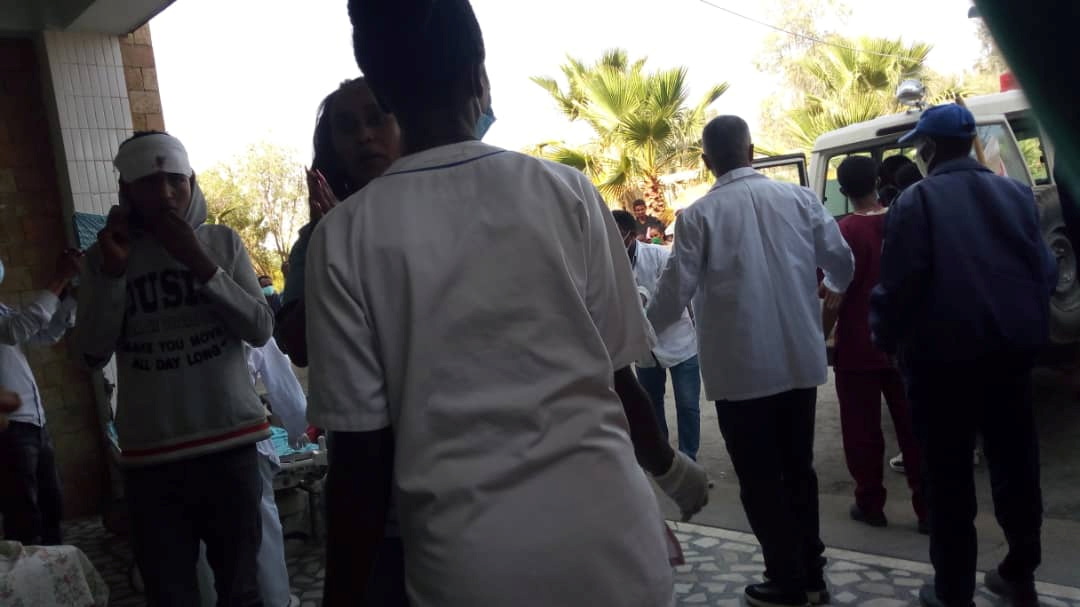
ADDIS ABABA June 23 (Reuters) – An air strike killed at least 43 people in the town of Togoga in Ethiopia’s Tigray region on Tuesday, a medical official told Reuters, after residents said new fighting had flared in recent days north of the regional capital Mekelle.

Ethiopian military spokesman Colonel Getnet Adane did not confirm or deny the incident. He said air strikes were a common military tactic and that government forces do not target civilians.

The bomb hit a market at around 1 p.m., according to a woman who said her husband and 2-year-old daughter had been injured.

“We didn’t see the plane, but we heard it,” she told Reuters on Wednesday. “When the explosion happened, everyone ran out. After a time we came back and were trying to pick up the injured.”

The woman said the market had been full of families, and she did not see any armed forces in the area. “Many, many” people had been killed, she said.

Reuters could not independently verify her account. She and other sources asked not to be identified for fear of reprisals.

The medical official confirmed at least 43 fatalities, citing witnesses and first responders.

A spokesperson for Prime Minister Abiy Ahmed and the head of a government task force on Tigray did not respond to requests for comment.

The U.S. State Department said it was concerned by reports of civilian deaths in the market attack and urged Ethiopian authorities to ensure full medical access for all the victims.

“We also call for an urgent and independent investigation, as well as remedial action, to hold those responsible for this attack accountable,” State Department spokesman Ned Price said in a statement.

U.N. Secretary-General Antonio Guterres is deeply alarmed by the reports of civilian casualties, U.N. spokesman Stephane Dujarric told reporters in New York.

“We have requested access to the area to assess the situation and see how we can provide assistance,” Dujarric said. “The situation in the area remains very, very volatile.”

The airstrike happened as Ethiopian officials counted ballots from national and regional parliamentary elections held this week in seven of the nation’s 10 regions.

1/2

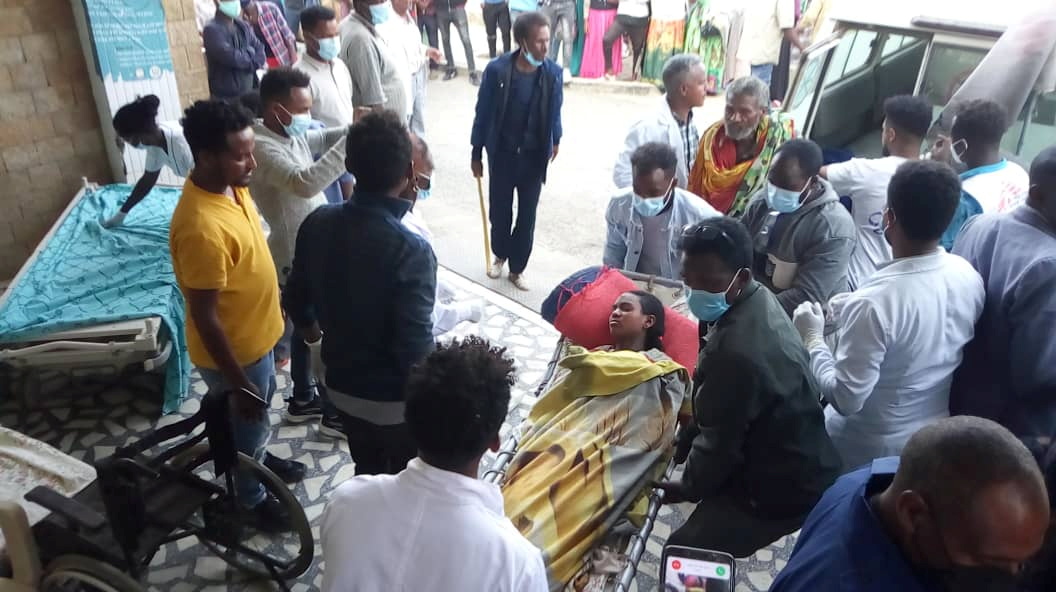
A woman is taken to Ayder Referral Hospital, in Mekelle, after an airstrike in Togoga, Ethiopia’s Tigray region June 22, 2021. Picture taken June 22, 2021. Tigray Guardians 24 via REUTERS

No voting was held in Tigray, where the military has been battling forces loyal to the Tigray People’s Liberation Front (TPLF), the region’s former ruling party, since November. Security concerns and problems with ballot papers also delayed voting in two other regions.

Residents reported that TPLF forces had entered several towns north of Mekelle in the past three days, withdrawing from one of them within hours.

AMBULANCES BLOCKED

The official and two other health workers helping with the response in Togoga told Reuters on Wednesday that Ethiopian soldiers were blocking the main road from Mekelle to the town and preventing ambulances from reaching the scene.

“Patients are dying right now,” the official told Reuters around midday.

He said two ambulances had been able to reach the town via a back road late on Tuesday but did not have the necessary equipment and were not allowed to leave.

He said the teams had counted at least 43 dead, and 44 critically wounded patients needing treatment.

One medical worker told Reuters he had tried to reach the scene six times over two days.

Finally around several ambulances reached Mekelle’s Ayder Referral Hospital as night fell. The oldest victim who arrived was 62, and the youngest was six, a doctor there told Reuters. Many had serious injuries, including a man whose brain was exposed, he said.

A doctor who had stayed at the scene overnight told Reuters it was “terrible” and shared pictures of people too wounded to move wrapped in blankets against the cold.

“We heard screaming and crying coming from houses where people died – one family lost four members,” she said. “All the houses around the market were flattened, apples and tomatoes lying everywhere.”

“Many people who were injured died before we could reach them … I felt so hopeless.”

Military spokesman Getnet denied that the military was blocking ambulances.

Reporting by Katharine Houreld; Editing by Toby Chopra

The post Medical Official: Air Strike Kills at Least 43 in Ethiopia’s Tigray appeared first on The St Kitts Nevis Observer.

India: ‘Black Fungus’ Epidemic Follows COVID Pandemic

The deadly disease has sickened former coronavirus patients across the country. Doctors believe that hospitals desperate to keep Covid patients alive made choices that left them vulnerable.

Mucormycosis patients and their relatives at Ahmedabad Civil Hospital in the Indian state of Gujarat.
Credit…Atul Loke for The New York Times


AHMEDABAD, India — In the stifling, tightly packed medical ward at Civil Hospital, the ear, nose and throat specialist moved briskly from one bed to the next, shining a flashlight into one patient’s mouth, examining another’s X-rays.

The specialist, Dr. Bela Prajapati, oversees treatment for nearly 400 patients with mucormycosis, a rare and often deadly fungal disease that has exploded across India on the coattails of the coronavirus pandemic. Unprepared for this spring’s devastating Covid-19 second wave, many of India’s hospitals took desperate steps to save lives — steps that may have opened the door to yet another deadly disease.

“The pandemic has precipitated an epidemic,” Dr. Prajapati said.

In three weeks, the number of cases of the disease — known by the misnomer “black fungus,” because it is found on dead tissue — shot up to more than 30,000 from negligible levels. States have recorded more than 2,100 deaths, according to news reports. The federal health ministry in New Delhi, which is tracking nationwide cases to allot scarce and expensive antifungal medicine, has not released a fatalities figure.

The coronavirus pandemic has drawn stark lines between rich nations and poor, and the mucormycosis epidemic in India stands as the latest manifestation. During the second wave, which struck India in April, its creaky, underfunded medical system lacked beds, oxygen and other necessities as infections and deaths soared.

The mucormycosis epidemic adds even more urgency to the difficult task of protecting India’s 1.4 billion people. Only a small fraction have been vaccinated against the coronavirus, and they remain vulnerable to a third wave and the consequences that could follow.

ImageDr. Ruchir Shah performing nasal endoscopic surgery on a patient with mucormycosis at Sterling Hospital in Ahmedabad.
Credit…Atul Loke for The New York Times 

“Mucormycosis will tail off and go back to baseline as the Covid cases subside,” said Dr. Dileep Mavalankar, an epidemiologist. “But it may come back in the third wave unless we find out why it is happening.”

Many doctors in India think they know why. The bone-and-tissue-eating fungus can attack the gastrointestinal tract, the lungs, the skin and the sinuses, where it often spreads to the eye socket and the brain if left untreated. Treatment for the disease involves complex, often disfiguring surgery and an uncommon and expensive drug, contributing to a mortality rate above 50 percent.

Mucormycosis is not passed from person to person. It develops from commonplace spores that sometimes build up in homes and hospitals. Doctors believe India’s crowded hospitals, and their dire lack of medical oxygen, left the fungus an opening.

Without enough oxygen to go around, doctors in many places injected patients with steroids, a standard treatment for doctors battling Covid globally. They can reduce inflammation in the lungs and help Covid patients breathe more easily.

Image

Dr. Devang Gupta examining a recovering mucormycosis patient at Ahmedabad Civil Hospital.
Credit…Atul Loke for The New York Times

Many doctors prescribed steroids in quantities and for durations that far exceed World Health Organization recommendations, said Arunaloke Chakrabarti, a microbiologist and the co-author of a study examining the causes of India’s mucormycosis outbreak. Those steroids may have compromised patient immune systems and made Covid-19 patients more susceptible to fungal spores.

The steroids may have also dangerously increased blood sugar levels, leaving people with diabetes vulnerable to mucormycosis. It could also increase the chance of blood clots, leading to malnourished tissue, which the “fungus attacks,” Dr. Prajapati said.

Desperate doctors may not have had the chance to ask patients about whether they had diabetes or other conditions before resorting to steroids.

“Doctors hardly had any time to do patient management,” Dr. Chakrabarti said. “They were all looking at how to take care of the respiratory tract.”

According to the health ministry, about four out of five mucormycosis patients have had Covid-19. More than half have diabetes.

Image

A mucormycosis patient at Ahmedabad Civil Hospital.
Credit…Atul Loke for The New York Times

Alok Kumar Chaudry, a 30-year-old engineer with surgical tape over his left eye and hooked up to an I.V. drip at Civil Hospital, is one of those with mucormycosis who first came down with Covid.

He was studying for India’s civil service exam in April in New Delhi when the second wave hit. After testing positive for the coronavirus, and with hospital beds, drugs and oxygen scarce, he jumped onto a train to his older brother’s home in rural Gujarat. There, his oxygen levels plummeted to a potentially lethal 54 percent.

After two weeks on oxygen support and steroids at a local hospital, he recovered from Covid-19 but developed an acute headache on the left side of his brain. Doctors thought that steroids may have caused it and that it would go away.

The post India: ‘Black Fungus’ Epidemic Follows COVID Pandemic appeared first on The St Kitts Nevis Observer.
301 active cases, 3 deaths and 47 recoveries

The outbreak of COVID-19 that has been spreading in St. Kitts and Nevis for the past four weeks continues to rise passing the 350 marks with over 201 cases currently active.

Chief Medical Officer Dr Hazel Laws said that they have been trying to contain this present COVID-19 outbreak first identified on May 19.

“Over this period over 351 cases have been added to the federations tally. Over this same period, 47 persons who have been diagnosed with COVID has since recovered within these four weeks.”
She said the case managers she said are monitoring 301 active cases.
“At present, we have seven individuals hospitalised on our COVID ward. An accumulative total of 23 hospitalisations over these four weeks.”
There have been three covid related deaths.
Dr Laws disclosed that the majority of the cases fall between the ages of 20 to 49 years. While the age range extends from childhood to persons over 60.
At the prisons, the cases have risen to 39 with two new cases recorded on June 19.

The post 301 active cases, 3 deaths and 47 recoveries appeared first on The St Kitts Nevis Observer.
Caribbean Airlines to Lay Off 25 Percent of Workforce

Caribbean Airlines (CAL) on Monday announced a loss of TT$172.7 million as well as a 75 percent decline in revenue, compared to the same period in 2020.

In a statement, the airline said that the figures represented its unaudited financial results for the first quarter of 2021. It has also announced a significant reduction in its workforce with at least 450 jobs being lost.

Caribbean Airlines said that the losses follow a similar downturn in 2020, which saw an operating loss of TT$738 million compared to operating profits for 2018 and 2019.

Since the beginning of the COVID-19 pandemic and the suspension of operations at its base in Trinidad and Tobago, the airline has seen passenger numbers plummet, and flight numbers reduced to less than 10 percent of normal operations

Despite this, the airline said it has continued to offer services on many of its routes and provided invaluable repatriation flights for Caribbean citizens.

The airline said that the recent announcement by Prime Minister Dr. Keith Rowley that the borders of Trinidad and Tobago may soon reopen “is welcome news, but all forecasts suggest that the recommencement of travel will not be in the same volumes as they were pre-COVID.

“Therefore, until air travel regains its pre-COVID momentum the airline will need to adjust its operations to cater for a reduced scale of demand after the opening of the borders. Put simply, passenger demand in the short to medium term is not going to recover sufficiently to support the existing company structure after the reopening of the borders.”

The airline said that as a consequence, it is required to take further steps to ensure it has a sustainable business model for 2021 and beyond. It said these steps include major cost reductions in all areas of the airline’s operations, specifically its human resource complement, its fleet and other assets, and its route network.

“As part of the streamlining strategy, the number of jets in the fleet will be reduced, for the time being, over the course of 2021. Its route network will also be adjusted to reflect the changing market. In terms of employees, the airline has determined that 25 percent of its workforce or about 450 positions throughout its network is surplus to its current needs.

“The Company will embark on consultation with the employees and other stakeholders, with respect to treating with this surplus labour situation,” the airline said in the statement.

Last week, Finance Minister Colm Imbert said that the government is hoping that the airline would return in a much more “efficient shape and form”.

CMC

The post Caribbean Airlines to Lay Off 25 Percent of Workforce appeared first on The St Kitts Nevis Observer.

Corona Effect: Steep Decline in US Birthrate During Pandemic

The Hill

The number of American women who gave birth last year fell precipitously over 2019, as provisional government data shows a national baby bust getting worse during the coronavirus pandemic.

A new report from the National Center for Health Statistics at the Centers for Disease Control and Prevention (CDC) found births in the United States declined 4 percent between 2019 and 2020, the steepest annual decline since 1973.

But there is evidence that even before the pandemic struck, birth rates were on pace for a steep decline: Birth rates dropped in every month of 2020, compared to 2019 — including in January, before the pandemic struck, and in the early months of a pandemic, well after parents would have chosen to conceive.

Most of the largest declines in birth rates, however, came in December, November and October, about nine months after the pandemic began and a sign that the crisis may have delayed some parents’ decisions to have children.

Just over 3.6 million births occurred in 2020, according to the preliminary data, which covers all but a small fraction of reported births in a few states. That is nearly 150,000 fewer births than occurred during 2019 and about 700,000 fewer births than occurred in 2007, the year in which births reached a record high.

The preliminary tally represents the steepest one-year decline in births since the first year in which members of Generation X were born and the ninth-fastest drop since records began. That puts the coronavirus pandemic on par with societal catastrophes like the Great Depression and World War II, and only slightly below the damage wrought by the Spanish Flu a century ago.

The ongoing baby bust that demographers have described in recent decades began as the average age of first-time mothers rose, and became more pronounced during the great recession more than a decade ago. Demographers have estimated that so many women have put off having children, because of financial, educational, professional or personal reasons, that there are as many as three million childless women today who might have been expected to have children by this point in their lives in earlier decades.

Today, lower birth rates are occurring across racial, ethnic and economic lines. Births among white women and Black women dropped 6 percent in the last half of 2020 compared with 2019; among Asian American women, births plummeted by 12 percentage points; and and births dropped by 5 percentage points among women of Hispanic descent.

The number of births dropped in the last half of last year in all 50 states and the District of Columbia, according to the CDC figures. Declines were just as steep in fast-growing states like Texas, Florida and Georgia as they were in states that have seen population declines in recent years, like Illinois, West Virginia and New York.

The post Corona Effect: Steep Decline in US Birthrate During Pandemic appeared first on The St Kitts Nevis Observer.