
The post Newspaper Cover for 16th April, 2021 appeared first on The St Kitts Nevis Observer.
The post Newspaper Cover for 16th April, 2021 appeared first on The St Kitts Nevis Observer.
(CNN) Brazil’s President Jair Bolsonaro has called for Joe Biden’s “personal engagement” in fighting deforestation in the Amazon rain forest, in a letter sent to the US President on Wednesday.









The post Brazil: Bolsonaro Wants Biden’s Help in Saving the Rainforest appeared first on The St Kitts Nevis Observer.
BBC- Volcanic eruptions on St Vincent have blanketed the Caribbean island in ash, forcing 16,000 residents from their homes and leaving many without power or running water.
Many of those there say they do not know when or if they will be able to return home.
Shellisa Nanton, 26, lives with her family in the red zone – the areas at highest risk – in Georgetown. She told the BBC they had just hours to leave before La Soufriere erupted on Friday.
“We felt tremors in the days leading up to the eruption but we were not told to evacuate until the last minute.
“We were frantic when we heard the call to leave. We had to gather our things so quickly,” she said.
Shellisa said it was painful to leave the home she shared with her mother, sister, her sister’s partner and their two-year-old child.
“We were all scrambling to get our belongings together and we could feel the heat. It was heart wrenching and overwhelming to just leave our home like that, leaving behind so many memories.
“We’ve had hurricanes before but nothing like this.”
 Reuters
Shellisa says they were lucky that they were able to leave the red zone in their truck. Many others did not have any transportation.
“When we finally got the truck going we passed many people on the narrow roads, who like us were leaving, but on foot and carrying what they could. It was so sad and depressing to see.
“We were on the road all night until we reached the south. I don’t know how many people made it out.”
Shellisa and her family are now living with a family friend in the south of the island in Campden Park. She says this is their home for now.
“We don’t know if we can go home. We don’t know if there’s a home to go back to.
“We are planning to stay here for at least a few months. We just don’t know yet the extent of the damage. It’s very sad.”
On the island’s green zone away from the La Soufriere volcano Shanniel Johnson lives with her extended family.
She told the BBC despite living in the safer’ green zone the ash from the eruption caused massive devastation which has only just improved somewhat thanks to the rain.
“Roofs caved in on homes because of the heavy ash fall. It’s been dark for a few days and there have been more eruptions since Friday,” she told the BBC.
Shanniel says the ash carpeting the island had left them without water to drink, cook or wash.
“The ash contaminated the water but thankfully it has rained recently so the ash is clearing in some areas.
“But we need humanitarian aid. A lot of people have been displaced and are in shelters.”
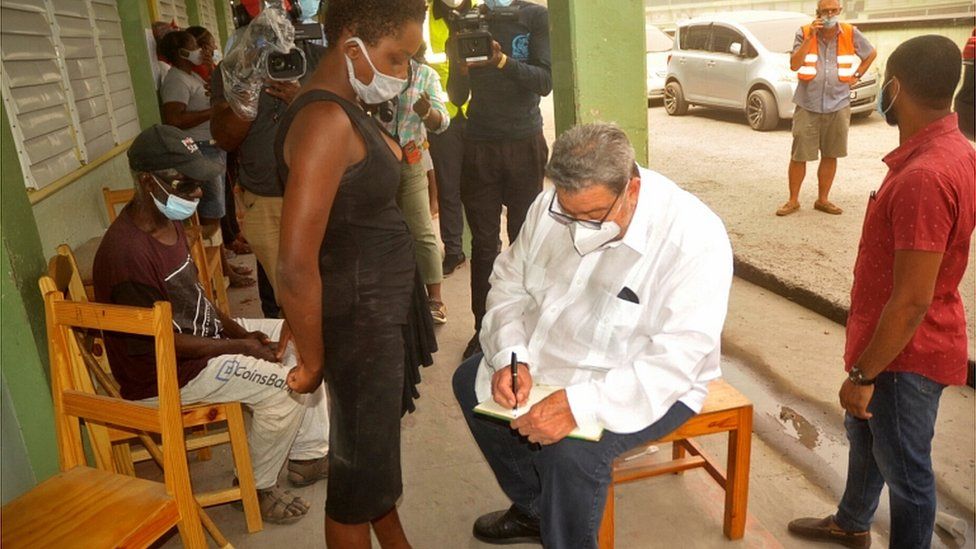 image copyrightReuters
“Many of my family members live in red zones in the north of the island and I’ve been helping them to move down south where I live,” Jomo Thomas told the BBC.
“It’s an horrific scene – since Friday there has been a series of eruptions,” the lawyer explained.
“About four or five thousand are in shelters. But the problem is that many of the shelters are schools and because they are in the tropics there is a lot of ventilation, so the dust can easily come through.”
Many of those who can are trying to leave the island.
Rhiannon West and her family are British nationals, living on the island under temporary residency rules.
The teacher hopes to return to the UK with her partner and six-month-old baby.
“We stood outside our home on Saturday and watched as the volcano erupted and a huge billowing cloud of ash was sent into the air. It was incredible but also terrifying.
“Since then we’ve been sheltering indoors with everything closed.
“It’s scary thinking about what we can do to protect the baby
“We keep losing electricity, have no water supply and no bottled water left at the closest shops.”
“This could go on for weeks and neither of us can work because of the power supply issues.
“The atmosphere is just very eerie.”
The post St. Vincent Residents: ‘When Can We Go Home?’ appeared first on The St Kitts Nevis Observer.
Disgraced financier Bernie Madoff died of natural causes yesterday at the age of 82 in prison..
His death came as he was behind bars serving a 150-year sentence for financial fraud totaling nearly $65B by one estimate, the largest scam of its type uncovered in US history.
Known early on as an investor whose advice regularly defied market dynamics, Madoff’s name eventually became synonymous with modern Ponzi schemes (how they work).
The specific type of fraud relies on using funds from new clients to generate returns for old clients—a base that grows over time—while masking the returns as investment profit. Though the scheme was long suspected by certain analysts and major Wall Street firms, the fraud wasn’t uncovered until 2008 during the Great Recession, when Madoff ran out of money to pay existing clients.
The post Ponzi Scheme Master Madoff Dies in Prison appeared first on The St Kitts Nevis Observer.
April 16, 2021

Eight people were killed in a late-night shooting at a FedEx facility in Indianapolis. Police say the shooter killed himself.
In Chicago, bodycam video appears to show that a 13-year-old boy dropped his gun and had his hands up when a police officer shot and killed him.
Another night of protests in a Minneapolis suburb, where Daunte Wright’s family demanded more severe charges against the white former police officer who fatally shot him.
Also this morning:
KARL RITTER
Southern Europe News Director
The Associated Press
Rome
|
|
The Rundown
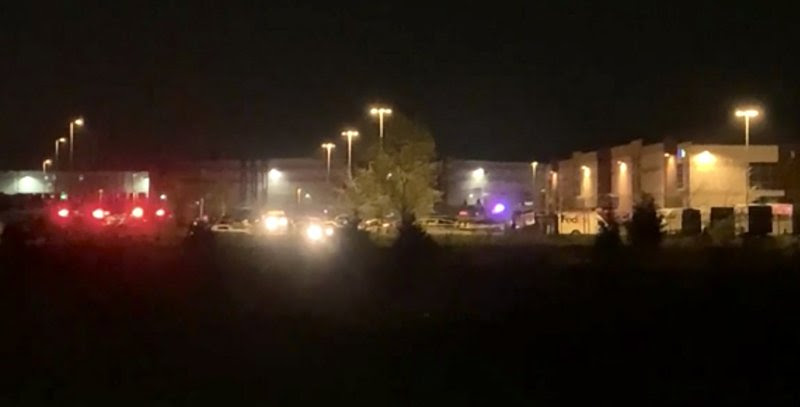
INDIANAPOLIS (AP) — A shooting has been reported late Thursday at a Fedex facility in Indianapolis. The Indianapolis Star reports police issued a news release around 11:30 p.m. saying……Read More

CHICAGO (AP) — Disturbing bodycam video released after public outcry over the Chicago police shooting of a 13-year-old boy shows the youth appearing to drop a handgun and begin raising hi…Read More

BROOKLYN CENTER, Minn. (AP) — Daunte Wright’s family joined community leaders in demanding more severe charges against the white former police officer who fatally shot the young Black man…Read More
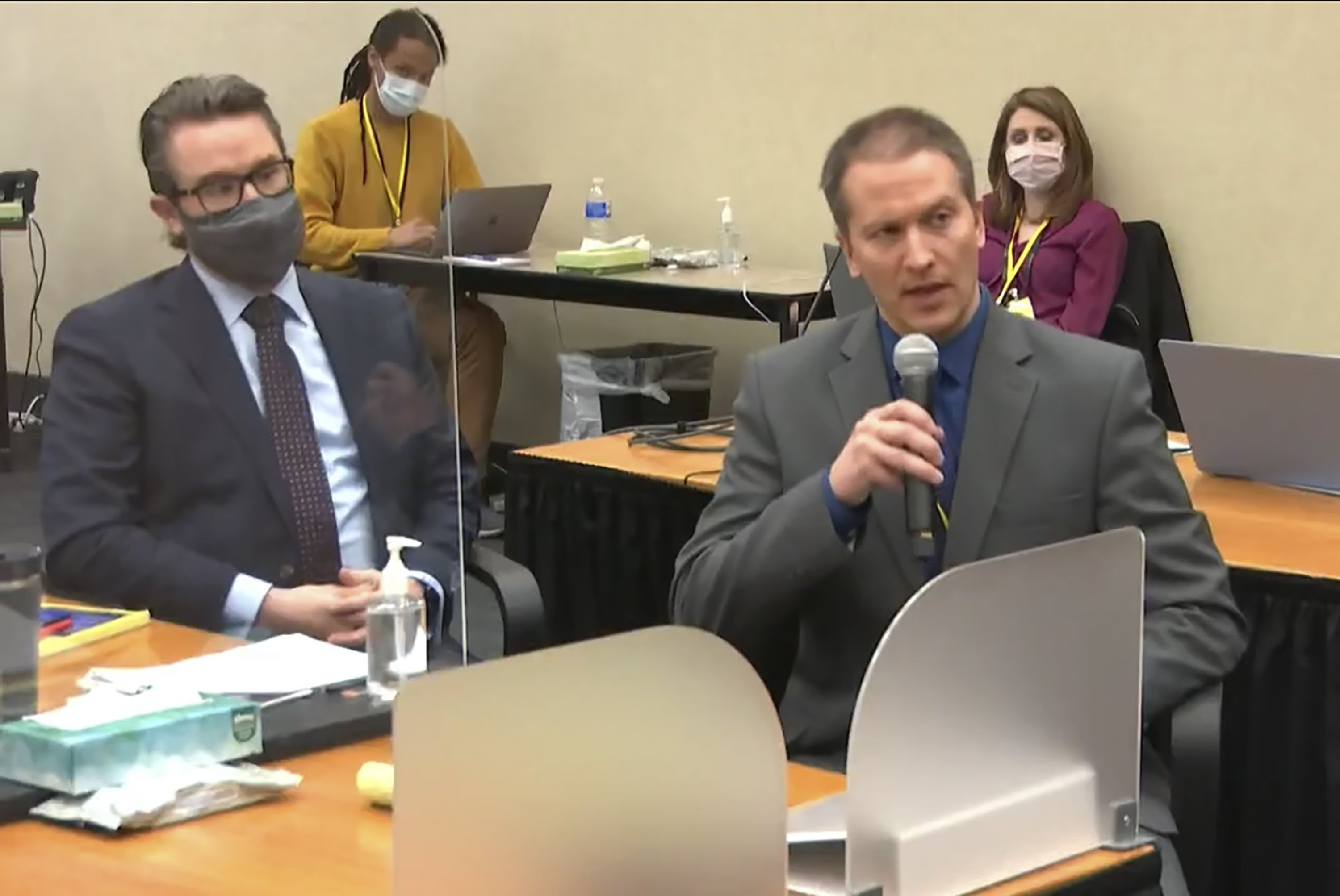
MINNEAPOLIS (AP) — Former Officer Derek Chauvin ‘s trial in George Floyd’s death will be in a jury’s hands by early next week, after his brief defense wrapped up with Chauvin passing on a…Read More
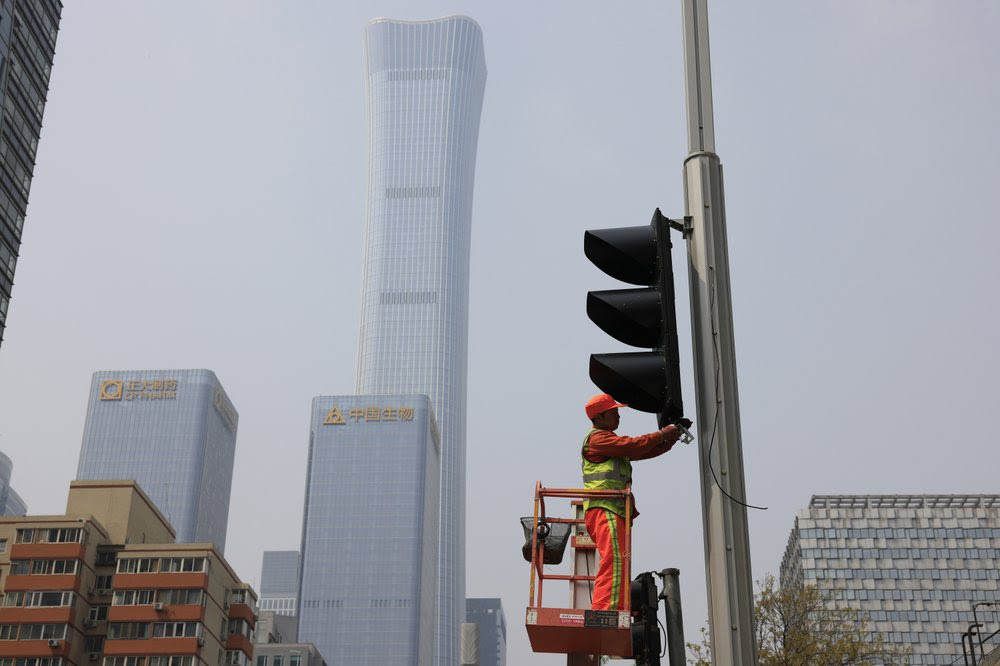
BEIJING (AP) — China’s economic growth surged to 18.3% over a year earlier in the first quarter of this year as factory and consumer activity recovered from the coronavirus pandemic. The…Read More
|
|
OTHER TOP STORIES
WASHINGTON (AP) — The Biden administration has announced the U.S. is expelling 10 Russian diplomats and imposing sanctions against dozens of people and companies, holding t…Read More
WASHINGTON (AP) — Throughout his decades in public life, Prince Philip was known for putting his royal foot in his mouth with occasional off-the-cuff remarks that could be …Read More
WASHINGTON (AP) — One by one, the Republican leaders of Congress have made the trip to Mar-a-Lago to see Donald Trump. Kevin McCarthy visited after the deadly Jan 6 Capitol…Read More
CANBERRA, Australia (AP) — Alex White thought he was watching a huge worm writhing in plastic-wrapped lettuce he’d just brought home from a Sydney supermarket — until a sna…Read More
|
|
The post World View: Another US Mass Murder, Chicago & Minneapolis Protests Over Killings by Cops, More appeared first on The St Kitts Nevis Observer.
BBC- Eight people have been killed and many injured in a shooting in the US city of Indianapolis, police say.
Witnesses heard several gunshots at a FedEx facility and one said he had seen a man firing an automatic weapon.
The gunman, thought to have been acting alone, is reported to have killed himself. Authorities said there was no further threat to public safety.
Police say several of the injured are in hospital. Flights from the nearby airport are not affected.
“As officers arrived, they came into contact with an active shooting incident,” city police spokeswoman Genae Cook said, adding that it had taken place at around 23:00 local time (03:00 GMT).
“After a preliminary search of the grounds, inside and out, we have located eight people at the scene with injuries consistent to gunshot wounds. Those eight were pronounced deceased here at the scene.

Ms Cook said four of the injured had been transported to hospital, one in a critical condition. Many others were treated at the scene or themselves sought treatment in hospital.
She said the motive for the killing was unclear.
Ms Cook paid tribute to the officers involved.
“It is very heart-breaking and, you know, in the Indianapolis Metro Police Department, the officers responded,… they went in and they did their job,” she said.
“And a lot of them are trying to face this because this is a sight that no-one should ever have to see.”
A FedEx statement said the company was aware of the shooting and co-operating with the authorities.
“Safety is our top priority, and our thoughts are with all those who are affected,” it said.
Local media quoted FedEx worker Jeremiah Miller as saying he had seen the gunman firing.
“I saw a man with a sub-machine gun of some sort, an automatic rifle, and he was firing in the open. I immediately ducked down and got scared,” he said.
Last week, President Joe Biden announced his first steps since taking office to tighten gun controls following a series of mass shootings.
It includes efforts to set rules for certain guns, bolster background checks and support local violence prevention.
The Gun Violence Archive puts the number of gun violence deaths from all causes at 12,395 so far this year in the US, of which 147 were in mass shootings. Last year saw a total of 43.549 deaths, and 610 in mass shootings.
The post Mass Murder: 8 Shot Dead at Indianapolis FedEx Depot appeared first on The St Kitts Nevis Observer.
RIO DE JANEIRO (AP) — Reports are emerging of Brazilian health workers forced to intubate patients without the aid of sedatives, after weeks of warnings that hospitals and state governments risked running out of critical medicines.

A 43-year-old patient suspected of having COVID-19 is transferred from an ambulance into the HRAN public hospital in Brasilia, Brazil, Wednesday, April 14, 2021. (AP Photo/Eraldo Peres)
One doctor at the Albert Schweitzer municipal hospital in Rio de Janeiro told the Associated Press that for days health workers diluted sedatives to make their stock last longer. Once it ran out, nurses and doctors had to begin using neuromuscular blockers and tying patients to their beds, the doctor said.
“You relax the muscles and do the procedure easily, but we don’t have sedation,” said the doctor, who agreed to discuss the sensitive situation only if not quoted by name. “Some try to talk, resist. They’re conscious.”
Lack of required medicines is the latest pandemic problem to befall Brazil, which is experiencing a brutal COVID-19 outbreak that has flooded the nation’s intensive care units. The daily death count is averaging about 3,000, accounting for a quarter of deaths globally and making Brazil the epicenter of the pandemic.
“Intubation kits” include anesthetics, sedatives and other medications used to put severely ill patients on ventilators. The press office of Rio city’s health secretariat said in an email that occasional shortages at the Albert Schweitzer facility are due to difficulties obtaining supplies on the global market and that “substitutions are made so that there is no damage to the assistance provided.” It didn’t comment on the need to tie patients to beds.
The newspaper O Globo on Thursday reported similar ordeals in several other hospitals in the Rio metropolitan region, with people desperately calling other facilities seeking sedatives for their loved ones.
It’s unclear whether the problem seen in Rio remains an isolated case, but others are sounding the alarm about impending shortages.
Sao Paulo state’s health secretary, Jean Carlo Gorinchteyn, said at a news conference Wednesday that the situation was dire in the hospitals of Brazil’s most-populous state. On Thursday, more than 640 hospitals were on the verge of collapse, with shortages possible within days, officials said.
“We need the federal government’s support,” Gorinchteyn said. “This is not a necessity for Sao Paulo; it is a necessity for the whole country.”
His state’s health officials sent nine requests for intubation medication to the Health Ministry over the past 40 days, according to a statement Wednesday. Its last delivery was enough to cover just 6% of monthly needs in the state’s public health network, officials told
Federal Health Minister Marcelo Queiroga, who took over the post last month, said Wednesday that a shipment of sedatives was expected to arrive in Brazil “in the next ten days.” It is the result of a contract signed with the Pan American Health Organization.
He said two separate efforts to acquire medications on the international market are underway “to end this day-to-day struggle.”
For many weeks, the ministry has also been facing logistical constraints on getting oxygen delivered to hospitals across the country. Queiroga said it remains “a daily concern.″
A more contagious coronavirus variant, known as P.1, has been spreading across Brazil this year. It may also be more aggressive than the original strain, and health workers have reported patients requiring far more oxygen than last year.
The private sector has stepped up to help address some of the supply shortfall. A group of seven large companies donated 3.4 million doses of intubation drugs — enough for the management of 500 beds for six weeks — to the Health Ministry.
A first batch of 2.3 million was scheduled to arrive from China late Thursday at Sao Paulo’s international airport and would be distributed to states with critical shortages, the ministry said in an emailed response to AP questions about supply bottlenecks.
Last month, the Health Ministry requisitioned intubation medications from laboratories, reportedly as a means to distribute to the neediest hospitals. That has caused others facilities’ stocks to dwindle, said Edson Rogatti, director of an association of more than 2,000 hospitals nationwide.
“If we run out, the health sector will be in chaos,” Rogatti said on Globo News TV.
Shortages aren’t limited to the public sector. Brazil’s private hospital association published a survey Thursday in which nine of 71 institutions reported having supplies for five days or less. About half said they had enough for a week.
Private facilities are looking to import medications from India, but still need regulatory approval, the association told AP.
The city of Itaiopolis in southern Santa Catarina state this week reported shortages of both sedatives and oxygen. Neighboring Rio Grande do Sul state also reported supplies running out.
“The situation is desperate,” Rio Grande do Sul’s health secretary, Arita Bergmann, said in a statement Thursday. “We urgently need the Health Ministry to replenish hospitals’ stocks, or else intubated patients can wake up without medication, and that would be terrible.”
================================================
Spike in Indian cases spurred by hundreds of positive tests at major religious gathering; Japan to extend Covid restrictions to 10 regions

Vietnam’s health ministry called for the acceleration of its Covid-19 vaccine rollout on Friday as the expiry date of the south-east Asian country’s first batch of jabs supplied through the Covax scheme approaches.
Since it began its vaccination programme last month, Vietnam has inoculated about 73,000 people despite receiving nearly 1m AstraZeneca doses, 800,000 of which were obtained via the Covax vaccine-sharing scheme.
“The [AstraZeneca] Covid-19 vaccine has a shelf life of six months but the batch delivered to Vietnam on 1 April under the Covax scheme only has two months left till expiration,” the ministry said in a statement on Friday.
“We have to speed up the inoculation. It is not acceptable that a single dose of the vaccine is thrown out because of a failure in the rollout,” the statement added.

The coronavirus lockdowns and restrictions that Michigan’s governor, Gretchen Whitmer, enacted in March last year were among the nation’s toughest, and the governor’s leadership is thought to have saved lives. It also drew high marks from many in the state.
The same approach proved effective last fall when the second wave hit. Now, as Michigan faces another surge of cases and hospitalizations, its worst yet, Whitmer has changed tack.
Despite past success and growing calls for another lockdown from public health experts, and doctors managing hospitals with Covid patients, the governor is resisting further restrictions, and is instead largely relying on a vaccination rollout and a voluntary suspension of in-person dining services.
Several factors are driving the new approach, experts say. Among them is a growing sense of pandemic fatigue, and sustained pressure from conservatives. Eroding support from independents and Whitmer’s looming 2022 re-election race have also played a role. Many of those bearing the economic brunt of her lockdowns are donors and influential business leaders, said Bill Ballenger, a Michigan political analyst, and the governor appears to have been “scared straight”.
“I really do think the constant pressure over the last year is catching up, not just from the right and conservatives, but there are a growing number of people in the population, including independents and business persons who are Democrats, who are really angry at Whitmer,” Ballenger said.
The pressure to remain open continues even as cases and hospitalizations rise, putting Whitmer in an exceedingly difficult position. The surge hit soon after she lifted restrictions in early March, and Michigan’s two-week per-capita caseload now leads the nation. The state reached a bleak mark on Tuesday when over 4,000 people were reported hospitalized – the highest daily total of the pandemic. A high number of cases from Covid variants is also fueling the surge.
Among supporters strongly urging the governor to once again put restrictions in place are Dr Abdul El-Sayed, the former director of the Detroit health department. He noted that an increase in deaths has followed spikes in caseloads and hospitalizations, and said a new lockdown “would have a profound impact over the next couple weeks”.
He said: “Governor Whitmer showed a tremendous level of leadership last spring and fall, and that came with a lot of political blowback from conservatives, but she did the right thing – evidence shows that she saved lives, and we need that leadership now.”
Read more of Tom Perkins’ report from Detroit: ‘Alarm is growing’: Michigan governor faces shutdown dilemma as Covid cases rise
The post Coronavirus: Brazil Running Out of Crucial Drugs, Pandemic Updates, World Stats appeared first on The St Kitts Nevis Observer.
BADIRAGUATO, Mexico (AP) — For the first time that María can remember, half of her marijuana harvest is still in storage on her ranch in Mexico’s Sinaloa state months after it should have been sold.
Sitting in her wooden house tucked into the same mountains that produced some of the world’s most notorious drug traffickers, including Joaquín “El Chapo” Guzmán, the 44-year-old mother of four thinks she knows why: expectations Mexico will soon legalize marijuana.
“It has never happened to us where we harvest and have it (stored) in sacks,” said María, who asked that her full name not be used and her exact location not be revealed because in the mountains surrounding Badiraguato, where organized crime controls everything, misspeaking can be dangerous.
Mexican legislation awaiting final Senate approval, which now may not come before September, would legalize pot production and sale for recreational use while creating a private market regulated by the government. Medicinal use is already legal.
The effort has generated uncertainty among families who have cultivated the crop for generations and throughout the trade. Growers expect the price of marijuana to drop further and think their trade will become economically unfeasible. They say in the past five years, the price they get has been halved. Everyone is waiting to see how the drug capos will respond to a new legal business. Meanwhile, half of María’s crop sits unsold.
Marijuana has become less lucrative each day compared to the cartels’ revenue from synthetic drugs like fentanyl. Demand and the price for pot fell when several states in the U.S. legalized it, though Mexico is still the top foreign supplier to U.S. consumers, according to a recent report by the U.S. Drug Enforcement Administration.
Here in Sinaloa’s mountains, some farmers have stopped growing marijuana. Others are focusing on higher-quality strains that fetch a higher price or they continue to grow it, but along with opium poppies, hoping at least one of them will keep them afloat.
María has been working between the tall leafy plants since she was 16 and says she even fell in love among them. At her house, surrounded by fruit trees and chickens, the family doesn’t lack food, but the income from marijuana pays for everything else over the course of the year, from clothing to cellphones to her children’s schooling. Her eldest just got his degree in computer science.
For her family and many others, the concern is not whether marijuana is legal, just that it keeps providing income.
“Since we heard they were going to legalize (marijuana) we began to make the poppy plots larger,” María said. But that didn’t work.
In February, their main poppy crop was destroyed. They had planned to live off the revenue from it for a year. Hearing the military helicopters approach, María took her picture of Saint Jude, the patron saint of lost causes, off the wall and ran to the field to place it among the red flowers. The saint couldn’t save them from the effects of the herbicide.
Two months later, María’s husband worked among marijuana plants more than 3 feet high planted among the dead poppies. It’s all they’re able to water with drip irrigation fed by extra water from the house.
“This little plot is from another seed and it is going to sell, they say, because it’s better quality,” María said.
The marijuana they managed to sell from the previous harvest yielded $500, or about $25 per kilogram. In contrast, the poppies that were destroyed would have produced about $5,000 worth of opium gum.
The drug trade has brought a lot of money to inhabitants of these mountains over the years, but also a lot of problems.
María remembers the years of bonanza when the family was able to buy some cows, which were later sold to pay for her children’s education. Her husband recalls periods of violence when rival groups killed and terrorized locals in an attempt to control the area.
The couple wants a different future for their kids. But asked if she can imagine a time when the mountains are no longer tied to drug trafficking, María’s 18-year-old daughter says, “never.”
The ties are strong and numerous.
Years ago, María’s husband smuggled marijuana across the U.S. border in a backpack. Her daughter’s boyfriend moved marijuana from Phoenix into the U.S. interior.
As María prepared chicken soup, “narcocorridos,” the ballads chronicling the exploits of drug traffickers, sang of the “heirs of Mr. Guzmán,” who is serving a life sentence in the U.S.
Guzmán’s sons control this area, according to experts.
Five days after an AP team visited the area, Mexican marines carried out an operation near the birthplace of Rafael Caro Quintero, another notorious trafficker released in 2013 from a Mexican prison where he was serving time for the murder of a DEA agent. But otherwise there was little government presence and the area appeared calm, though watched closely by lookouts.
One of the arguments Mexican politicians cite in their efforts to legalize recreational use of marijuana is reducing violence. Some experts are not so sure this will happen, but say shrinking the black market and the income of organized crime would be positive.
The objective “is not to end the illegal market, because that’s not going to happen in the first years,” but rather reduce it as much as possible, said Zara Snapp, an international drug policy consultant and co-founder of Instituto RIA, a public policy think tank in Mexico.
Nongovernmental organizations like Snapp’s believe there needs to be a stronger social justice component to Mexican legislation.
“If the communities decide not to (move to the legal market) it is because there aren’t sufficient economic reasons,” she said.
While María prays to St. Jude and hopes her small remaining plot of marijuana carries her family through, in another part of the mountains a skinny 39-year-old man has been growing a strain of marijuana that sells at 10 times the price of the traditional Mexican marijuana because it has a much higher psychoactive content.
If the man, who also requested anonymity, is able to get two harvests — and the army doesn’t find it like it did two years ago — he will have 110 pounds of high-quality marijuana that should yield $15,000. It’s not easy money.
“From the time you plant until you sell it, you’re fighting,” he said.
Water is scarce. He pays two workers to be on the ranch, look after the plants and later carefully cut the the strong smelling reddish buds that he and others will then weigh and package.
The man has been working in marijuana since he was 9 years old. His partner also comes from the business, but a different branch. “My dad was a money launderer,” he said casually.
Decades ago, marijuana was such big business that it was carried out of the mountains on airplanes that landed on dirt roads. Now the man and his partner drive it to the state capital of Culiacan and sell it there.
“You have to go to who’s in charge and give him half or sell it all to him” to avoid problems, he said.
For the man — as with María — the important question isn’t legalization but the numbers, income numbers.
“If they pay me the same — or almost — being legal, well great. You’ll work more at ease,” he said.
The post Mexican Grass: Growers Not Happy About Planned Canabis Legalization appeared first on The St Kitts Nevis Observer.
KINGSTOWN, St. Vincent (AP) — Officials in St. Vincent said they were extremely worried about a COVID-19 outbreak given the lack of water and more positive cases being reported as thousands of evacuees fleeing the erupting volcano crowd into shelters and private homes.
About a dozen cases have been reported in recent days, with at least five evacuees staying in two homes and one shelter testing positive, exposing at least 20 people to the virus, said Dr. Simone Keizer-Beache, chief medical officer on the Caribbean island.
Keizer-Beache said officials are preparing to do massive testing as part of contact tracing, a complicated undertaking given that between 16,000 to 20,000 people were evacuated before La Soufriere’s explosive eruptions started on Friday. She also urged people to keep wearing masks and asked them to cooperate, noting that some who arrive at shelters do not want to be tested, which is voluntary.
“Let us work together to prevent a second catastrophe,” she said in a press conference broadcast by local station NBC Radio.
Complicating efforts to fight COVID-19 is the lack of water in some communities given the heavy ashfall, with people walking or driving to spigots with buckets and jugs in hand as long lines formed.
Among those in line was Suzanne Thomas, a 46-year-old saleswoman from South Union, a community in eastern St. Vincent that has been hit with water shortages since Saturday. She had welcomed nine evacuees into her home who are huddled together, sleeping only on rugs and blankets.
“It’s real rough. We have to use one jug of water to shower, brush your teeth and flush the toilet,” she said, laughing as she added: “Water conservation.”
Others, like 17-year-old Kevin Sam, said they’ve had no water at all since Saturday: “I’m glad that these stand pipes are available, ’cause I don’t know what we would’ve done. It’s not easy to bathe with half a bucket.”
Meanwhile, supplies were non-existent or running low at some government shelters.
Lisa May, 36, said she and her three children were sleeping on the floor at a shelter in the capital of Kingstown and hoped they would soon have at least one mattress to share: “Any little help we get, we (would be) grateful.”
More than 4,000 people are staying in 89 government shelters. Meanwhile, the government so far has registered more than 6,000 evacuees in private homes, a number that keeps growing, said Prime Minister Ralph Gonsalves.
He said he worries about an uptick in COVID-19 cases in certain areas given dwindling water supplies or complete lack of water.
“If we’re not careful, we’re going to have a spike, which could create a real danger in addition to what we’re having with the volcano,” he said. “Washing your hands when you don’t have a lot of water is problematic.”
Garth Saunders, director of St. Vincent’s utilities company, said crews are still cleaning intakes of the island’s water and sewer system and expected water to reach more communities later Thursday, adding that ashfall has been very heavy. Neighboring islands and organizations also have shipped water to St. Vincent, where officials have distributed water bottles and dispatched water trucks.
Long lines formed at those trucks and at money transfer companies, with some standing for hours to retrieve cash from loved ones.
“I’ve been here since 4:30 this morning,” said Joseph King, a 67-year-old plumber, adding that he was tired and hungry.
La Soufriere is expected to keep erupting for days or even weeks, with a scientific team expected on Thursday to estimate the amount of gases expelled by the volcano and gather samples of pyroclastic flow material. Those analysis will tell scientists how the volcano is behaving and help them guess what it’s likely to do in the future, said Richard Robertson, who is leading the team for the University of the West Indies’ Seismic Research Center.
The volcano had a minor eruption in December, and prior to that erupted in 1979. A previous eruption in 1902 killed some 1,600 people.
_
Coto reported from San Juan, Puerto Rico.
The post St Vincent Fears COVID-19 Outbreak with Volcano Evacuations appeared first on The St Kitts Nevis Observer.
The White House has announced sanctions against Russia and the expulsion of Russian diplomats in response to Moscow’s interference in US elections and the cyber breach to vital federal government agencies last year.
The measures announced Thursday include sanctions on six Russian companies that support the country’s cyber activities and on 32 entities and individuals for disinformation campaigns and carrying on government interference in the 2020 US presidential election. The executive order also expels 10 Russian diplomats, some of whom are suspected intelligence officers.
The announcement includes the first retaliatory measures against Moscow for the cyberhack known as the “SolarWinds” breach, in which Russian hackers are believed to have used malicious code that enabled them to access the networks of at least nine US agencies and US companies. The US additionally named the Russian Foreign Intelligence Service and several connected entities as being responsible for SolarWinds. US officials believe this was an intelligence-gathering operation.
The post Biden With Stiff New Sanctions Against Russia for Cyber Attacks appeared first on The St Kitts Nevis Observer.




















 *****@
 *****@
 *****@
 *****@
 *****@
 *****@
 *****@
 *****@
 *****@
 *****@
 *****@
 *****@