Tag Archives: caribbean

St. Vincent Seeks Water, Funds as Volcano Keeps Erupting

By KRISTIN DEANE and DÁNICA COTO

  KINGSTOWN, St. Vincent (AP) — Leaders of volcano-wracked St. Vincent said Tuesday that water is running short as heavy ash contaminates supplies, and they estimated that the eastern Caribbean island will need hundreds of millions of dollars to recover from the eruption of La Soufriere.

Between 16,000 to 20,000 people have been evacuated from the island’s northern region, where the exploding volcano is located, with more than 3,000 of them staying at more than 80 government shelters.

Dozens of people stood in lines on Tuesday for water or to retrieve money sent by friends and family abroad. Among those standing in one crowd was retired police officer Paul Smart.

“The volcano caught us with our pants down, and it’s very devastating,” he said. “No water, lots of dust in our home. We thank God we are alive, but we need more help at this moment.”

Prime Minister Ralph Gonsalves said in a press conference on local station NBC Radio that St. Vincent will need hundreds of millions of dollars to recover from the eruption but did not give any details.

He added that no casualties have been reported since the first big blast from the volcano early Friday. “We have to try and keep that record,” he said. Gonsalves said some people have refused to leave communities closest to the volcano and urged them to evacuate.

Falling ash and pyroclastic flows have destroyed crops and contaminated water reservoirs. Garth Saunders, minister of the island’s water and sewer authority, noting that some communities have not yet received water.

“The windward (eastern) coast is our biggest challenge today,” he said during the press conference of efforts to deploy water trucks. “What we are providing is a finite amount. We will run out at some point.”

The prime minister said people in some shelters need food and water, and he thanked neighboring nations for shipments of items including cots, respiratory masks and water bottles and tanks. In addition, the World Bank has disbursed $20 million to the government of St. Vincent as part of an interest-free catastrophe financing program.

Adam Billing, a retired police officer who lived and tended to his crops on land near the volcano, said he had more than 3 acres of plantains, tannias, yams and a variety of fruits and estimates he lost more than $9,000 worth of crops.

“Everything that (means) livelihood is gone. Everything,” said Billing, who was evacuated. “We have to look at the next couple of months as it’s not going to be a quick fix from the government.”

The volcano, which had seen a low-level eruption since December, experienced the first of several major explosions on Friday morning, and volcanologists say activity could continue for weeks.

Another explosion was reported Tuesday morning, sending another massive plume of ash into the air. It came on the anniversary of the 1979 eruption, the last one produced by the volcano until Friday morning. A previous eruption in 1902 killed some 1,600 people.

“It’s still a pretty dangerous volcano,” said Richard Robertson with the University of the West Indies’ Seismic Research Center. “It can still cause serious damage.”

___

Coto reported from San Juan, Puerto Rico. Associated Press videographer Orvil Samuel contributed to this report.

The post St. Vincent Seeks Water, Funds as Volcano Keeps Erupting appeared first on The St Kitts Nevis Observer.

Haiti: Moise Vows to Get Kidnapped Priests Released

Haiti’s President Jovenel Moïse says he will “do everything the law allows” to secure the release of 10 people who were kidnapped by a gang in the town of Croix-des-Bouquets on Sunday.

All but three of those kidnapped are Catholic clergy, among them a French nun and a French priest. They were seized on their way to the installation of a new parish priest.

Kidnappings have surged in Haiti, with the Catholic Church describing the situation as “a descent into hell”. This is too much. The time has come for these inhuman acts to stop,” Bishop Pierre-André Dumas said.

Growing problem

The 10, among them five priests and two nuns, were kidnapped on Sunday morning, Father Loudger Mazile told Agence France-Presse (AFP) news agency.

The church of St Rock where one of the kidnapped priests lives and works is seen in Port-au-Prince, Haiti April 12, 2021The French priests are part of the France-based Society of Priests of St James

The kidnappers have demanded $1m (£727,000) in ransom. A police source told AFO that a gang calling itself 400 Mazowo was most likely behind the kidnapping.

Kidnappings like that on Sunday have become increasingly common in Haiti, with some figures suggesting they have risen by 200% over the past year.

While at first well-off businesspeople were the main targets, victims have come from all walks of life. Religious groups have not been spared.

On 1 April, armed men burst into a service at an evangelical church on the outskirts of the capital, Port-au-Prince, and abducted the pastor and three other people. The service was being live-streamed on social media at the time.

The four were released three days later after an undisclosed sum was paid in ransom but the brazenness of kidnapping a pastor in the middle of a service on Holy Thursday shocked many Haitians.

What’s the reaction been?

The Archdiocese of Port-au-Prince issued a strong statement in the wake of the latest kidnapping, saying that the levels of violence by armed gangs had reached “unprecedented levels”.

The statement also condemned what it described as a lack of action from officials: “The public authorities who are doing nothing to resolve this crisis are not immune from suspicion. We denounce complacency and complicity, wherever they come from.”

President Moïse responded by saying that he would “not give up” until the 10 had been freed. “I am aware that the state must make more of an effort in the battle against this disaster that is kidnapping and organised crime in the country,” he said.

French officials said the Central Office for the Fight against Organized Crime (OCLCO) had been mobilised.

The post Haiti: Moise Vows to Get Kidnapped Priests Released appeared first on The St Kitts Nevis Observer.

Volcano: SV&G PM’s Plea for Homeless Assistance, International Help Offered

KINGSTOWN, St Vincent (CMC) — SV&G Prime Minister Dr Ralph Gonsalves has made an impassioned plea for assistance for the homeless as the authorities continue to put measures in place to deal with the impact of an erupting La Soufriere volcano.

Gonsalves, speaking at the daily news conference aired on the State-owned NBC Radio, said there were many homeless people living on the streets of the capital and urged Vincentians to assist in their care.

“You know we have had a few of them around Kingstown and the ash would be making life difficult for them and it is an important category which has been identified and we have to take care of all human beings,” he said.

“But I would say to persons, if you know such individuals take them to a shelter, please, help in that way, be a good Samaritan because a lot of people are stretched doing a lot a lot of things. So I want to urge initiatives in that way also,” Gonsalves said, noting that the State cannot do everything regarding the disaster alone.

He said all hands must be on deck as the country deals with the catastrophe

So far there has been no reported casualties as a result of the eruptions caused by the volcano that last erupted in 1997.

United Kingdom assistance

Meanwhile, the United Kingdom yesterday said it is providing £200,000 emergency assistance to St Vincent and the Grenadines.

A statement from the British High Commission in Barbados said that the rapid crisis funds will help provide life-saving humanitarian supplies like shelter, sanitation kits and protective equipment.

It said urgently needed technical experts will support relief efforts on the ground, support emergency telecommunications, and restore critical lifeline facilities, like transport links

The UK said the initial funds are being made available through the Foreign, Commonwealth and Development Office to support the regional response, through the Barbados-based Caribbean Disaster Emergency Management Agency.

World Bank support

Also yesterday, the World Bank said it is providing US$20 million to support the St Vincent and the Grenadines Government as it responds to the crisis.

“Our hearts are with the people of St Vincent and the Grenadines during this crisis,” said Tahseen Sayed, World Bank country director for the Caribbean.

“We are committed to supporting the response efforts at this critical time when the country faces this new disaster while already managing the social and economic effects of the pandemic.”

The Washington-based financial institution said that the funds are being disbursed from a contingent credit line known as the Catastrophe Deferred Drawdown Option (Cat-DDO), approved in June 2020. The Cat-DDO instrument is designed to provide immediate liquidity to support a country’s efforts to recover from disasters triggered by natural hazards or a public health emergency.

Flights suspended

Meanwhile, the Antigua-based regional airline, LIAT, has announced the suspension of all flights in the southern part of its network due to the volcanic activity in St Vincent.

Trinidad-based Caribbean Airlines had also announced cancellations of several flights to Barbados, St Vincent, Dominica, Grenada, and Guyana over the last weekend.


The post Volcano: SV&G PM’s Plea for Homeless Assistance, International Help Offered appeared first on The St Kitts Nevis Observer.

World View: BLM Protests, Iran Attack, India Virus Surge, More

April 13, 2021

Alternate text

Police in Minneapolis have clashed with protesters for a second night after authorities said an officer intended to fire a Taser, not a handgun, in the fatal shooting of a Black man during a traffic stop.

Meanwhile, the defense for a former Minneapolis police officer charged in George Floyd’s shooting is set to start presenting its case.

India is battling against a surge in coronavirus infections

And in Tokyo things are starting to stir around Olympic venues.  

Also:

  • President Biden courts Republicans to back infrastructure plan.
  • Attack on Iranian nuclear plant muddies US-Iran talks.
  • Muslims open Ramadan with socially distanced prayers.

MIKE CORDER

The Associated Press

The Hague, Netherlands

The Rundown

I'm an image

BROOKLYN CENTER, Minn. (AP) — Police clashed with protesters for a second night in the Minneapolis suburb where a police officer fatally shot a Black man in a traffic stop over the weekend. The……Read More

I'm an image

MINNEAPOLIS (AP) — The defense for a former Minneapolis police officer charged in George Floyd’s death was set to start presenting its case Tuesday, following 11 days of a prosecution narrative……Read More

I'm an image

NEW DELHI (AP) — The Indian city of Pune is running out of ventilators as gasping coronavirus patients crowd its hospitals. Social media is full of people searching for beds, while relatives… …Read More

I'm an image

WASHINGTON (AP) — The attack on Iran’s Natanz nuclear facility is casting a major shadow over the resumption of indirect talks between the U.S. and Iran over resurrection of the international… …Read More

I'm an image

WASHINGTON (AP) — President Joe Biden has begun publicly courting Republicans to back his sweeping infrastructure plan, but his reach across the aisle is intended just as much to keep Democrats in…Read More

OTHER TOP STORIES

JAKARTA, Indonesia (AP) — Muslims in Indonesia began marking Ramadan with communal prayers Tuesday in a socially distanced contrast to the empty mosques of a year ago when…Read More

TOKYO (AP) — Japan’s government said Tuesday it has decided to start releasing massive amounts of radioactive water stored in tanks at the wrecked Fukushima nuclear plant …Read More

TOKYO (AP) — The Tokyo Olympics are getting closer and things are starting to stir around the venues, though not as much as you might expect. Many preparations are still u…Read More

PUERTO RICO DE GRAN CANARIA, Spain (AP) — When hotel director Calvin Lucock and restaurant owner Unn Tove Saetran said goodbye to one of the last groups of migrants stayin…Read More

The post World View: BLM Protests, Iran Attack, India Virus Surge, More appeared first on The St Kitts Nevis Observer.

Brazil: As Pandemic Worsens, Officials Ease Restrictions

Sao Paulo (CNN)Last week, Brazil saw its deadliest day since the start of the pandemic, with 4,195 people killed in just 24 hours. The state of Sao Paulo and the city of Rio de Janeiro rank among the worst in the country for Covid-19 deaths. Yet both plan to ease movement restrictions starting on Monday.

Sao Paulo will reopen state schools, sports events, and construction stores. Rio de Janeiro will allow bars and restaurants to operate again, overturning restrictions that have been in place since March.

Sao Paulo authorities justify the reopening by pointing out that occupancy rates in intensive care units in the state have fallen from crisis-level 90.5% to 88.6%.

“This measure clearly shows that the effort made in recent weeks is beginning to give results,” said Vice-Governor Rodrigo Garcia on a press conference on April 9.

But daily numbers are still very grim: On Friday alone, the state registered over 20,000 new cases.

Meanwhile, in the city of Rio de Janeiro, ICU occupancy rates are higher at 92%, but Mayor Eduardo Paes nevertheless has decided to ease restrictions. “This is an answer for anyone who thinks that restrictions are of no use by preventing parties and crowds. Our reality does not allow lockdown”, Paes said in a press conference held on Friday, adding that shop owners and the general population suffer economically from such measures. Still, he said, “This is no time to relax.”

Bolsonaro shrugs off criticism he is 'genocidal' as Brazil reports record 4,000 daily deaths

Bolsonaro shrugs off criticism he is ‘genocidal’ as Brazil reports record 4,000 daily deaths

Easing restrictions is the opposite of what many institutions and medical specialists say Brazil needs: a national and coordinated lockdown. At the moment Brazil has only fully vaccinated 2.8% of its population — just over 6 million people, in a country of 210 million.

Currently, Brazil’s public and private health systems are under immense pressure, with ICUs in at least 17 states overwhelmed with over 90% occupancy. Intubation medication and oxygen have repeatedly run low at points during the pandemic. On Thursday the National Council of Municipal Health Secretariats declared that about a fifth of all the country´s cities were at risk of running out of medical oxygen over the next ten days.

Only a lockdown can prevent April from becoming “even worse” than March — the country’s most fatal month of the pandemic so far, with 66,573 deaths recorded — according to the Oswaldo Cruz Foundation (Fiocruz), a public biomedical research center that is currently working with vaccine-maker AstraZeneca.

“Lockdowns are a bitter remedy, but they are absolutely necessary in times of crisis and collapse of the health system like the one the country is experiencing now. Just this will prevent more deaths and effectively save lives,” wrote Fiocruz scientists in a recent report.

The United Nations office in Brazil has also asked for the country to impose movement restrictions, warning that an accelerating death rate and absence of a national coordinated plan are “leading the country to a catastrophe.”

Brazil has never had a real lockdown

Since the pandemic began, Brazil has seen a patchwork of local restrictions on movement or activity, but they never really amounted to an effective broad lockdown, neuroscientist Miguel Nicolelis told CNN.

Nicolelis, a prominent Brazilian scientist, created one of the nation’s first scientific committees to study the coronavirus and develop tactics to counter the disease, and has advised on regional Covid-19 strategies. He and other medical experts and civil society groups are part of Brazil’s “April for Life” campaign, which is calling for the federal government to impose an immediate nationwide lockdown.

“Lockdown is when you restrict the flow of people — streets, roads, flights, in addition to achieving strict social isolation. That has never been achieved widely in Brazil, we had only a few exceptions,” said Nicolelis. “In general, we had the application of a few restrictive measures with low levels of adherence from people.”

April for Life estimates that a strict national lockdown for 30 days, with strict rules on the movement of people, could save 22,000 lives.

“If you look at the Brazilian curves in Rio de Janeiro and even in São Paulo, you see peaks and valleys. Death spikes, then they temporarily close a few things and you see a small fall, but the fall is not sustainable. In the end, you do not curb the transmission of the virus efficiently, but instead, you make an environment for new variants to arise,” said Nicolelis.

He says that Brazil needs greater federal leadership; an accelerated vaccine rollout; and a federally enforced national lockdown in which only essential services are allowed and most movement is banned.

“The virus is a collective organism, and it is only possible to fight it collectively. It is of no use to close one city if we are to leave the rest open, you need coordinated action, otherwise, the virus will keep growing back,” he says.

Traveling to Brazil during Covid-19: What you need to know before you go

Traveling to Brazil during Covid-19: What you need to know before you go

Yet Brazilian authorities have resisted adopting such measures to contain the spread of the virus. The country’s federal government, led by President Jair Bolsonaro, has in fact shown a fierce opposition to imposing any restrictions, out of concern for the economy.

“Whoever closed the markets and shops and obliged the people to stay at home, it wasn’t me,” Bolsonaro said on Saturday, during a visit to the periphery of Brasilia, dismissively referring to mayors and governors who have adopted local restrictive measures.

“I have the power of by signing a document to decree a lockdown in the whole country, but this will not be made, and our army will not go to the streets to impose people to stay at home,” the maskless President declared.

His newly appointed Health Ministry, Marcelo Queiroga, has also rejected the idea. “The (president’s) order is to avoid the lockdown,” Queiroga said on April 3.

Local lockdowns have worked

Three hours drive from Sao Paulo, Edinho Silva is one of few mayors in Brazil who have gone against the tide.

He imposed a full lockdown in the city of Araraquara, closing commerce including supermarkets and public transport, and forbidding the circulation of people for 10 days in February — a decision that prompted death threats against him.

He took the dramatic step after seeing hospitals in the agribusiness-oriented town start to fill up. The city of 250,000 people, was the first in the state of Sao Paulo to see its health system collapse under the weight of new Covid-19 cases, forcing it to transfer severe cases out of packed ICUs and into other cities.

“(Locking down) was a tough decision that required sacrifices, especially from small and medium businessmen, because there is no financial aid for them in Brazil. But with the contamination curve we had, I had nothing else to do,” said Silva.

Shortly after, he started to receive death threats from Bolsaro supporters, Silva told CNN. “Does anyone know where Mayor Edinho lives? I just want a (fight) round with him. Then I am going to stab him from the bottom to top,” one man said on social media, according to Silva. Police are now investigating the threats.

Despite the personal risks, Silva’s strict approach seems to have worked.

Since the end of the 10 day lockdown, some restrictions have remained on the city, including a night curfew from 9pm to 5am and limited hours for bars and restaurants — and Araraquara’s Covid-19 case numbers and deaths have steadily dropped.

For three consecutive days last week, Araraquara registered no deaths due to Covid-19. It’s a small sign of hope, but one that stands out amid Brazil’s accelerating coronavirus crisis.

“Lockdown is not a choice, it is imposed by reality,” says Silva. “If you don’t adopt it, you’ll pile up coffins, there’s no other way.”

The post Brazil: As Pandemic Worsens, Officials Ease Restrictions appeared first on The St Kitts Nevis Observer.

US: 40 Arrested at Protest of Another Cop-Black Man Killing

About 40 people were arrested just north of Minneapolis in a second night of unrest over the police shooting of a black man.

Protesters in the city of Brooklyn Center defied a curfew and threw objects at police, who responded with flash grenades and tear gas.

Police said Daunte Wright, 20, was shot and died after an officer mistook her gun for a Taser during a traffic stop.

The shooting came as the high-profile George Floyd murder trial continues.

In a courtroom just a few miles away, ex-police officer Derek Chauvin is charged with murdering the African American man in May last year.

Derek Chauvin’s defence team on Monday asked for the jury members to be sequestered – separated from other people – as they might be swayed by the latest events. The judge denied the request.

The officer who shot Mr Wright was named on Monday as Kim Potter, 48, who has worked for Brooklyn Center Police for 26 years.

Mr Wright was pulled over on Sunday for a traffic violation, but there was a struggle when he tried to get back into his car.

After mistakenly drawing her gun, the officer said: “Holy shit, I just shot him.”

What happened overnight?

The curfew went into force at 19:00 (midnight GMT) across four counties with a huge law enforcement deployment.

In a press briefing after midnight local time, Minnesota State Patrol colonel, Matt Langer, said officers had reached out to organisers of protests to try to keep them peaceful but “unfortunately those efforts weren’t successful and the organisers weren’t able to influence the desires of the crowd”.

Col Langer said officers had been “shelled pretty significantly with objects” including fireworks.

He said protesters had pushed against the fence of the Brooklyn Center police headquarters and a decision had been made to push back the crowd.

There were “sporadic” incidents of looting in the area and in other parts of Minneapolis and neighbouring St Paul.

In response to the unrest, US President Joe Biden said peaceful protest was “understandable” but added: “I want to make it clear again: there is absolutely no justification, none, for looting.”

Shortly before midnight, Brooklyn Center Mayor Mike Elliot issued a positive tweet, saying: “Our city is calm now, thank you all who came out to peacefully protest then went home.”

He also said he had spoken to Daunte Wright,’s father and would “do everything to ensure justice is served”.

The BBC is not responsible for the content of external sites.View original tweet on Twitter
Presentational white space
2px presentational grey line

‘You took his life, for what?’

BBC’s Barbara Plett-Usher reports from the scene

One sign at the protest captured the mood: “During the trial!!?” it read in bright orange letters.

“It’s ridiculous,” said the young man carrying it. “They know they have a delicate relationship with the black community right now and they should look to be making amends, not this.”

City officials had said the shooting could not have happened at a worse time, with tensions high over the George Floyd case.

Some protesters threw bottles and shot fireworks toward police lines. They vented their rage as officers in riot gear stood impassively. “You took his life, for what?” screamed a young woman.

“He was a son, he was a father, he was a black man that deserved to live.”

“Do you know the difference between a gun and a Taser?” shouted someone else. “Hell yeah,” roared the crowd, scorning the police chief’s belief that the shooting was a tragic mistake.

“There’s no room for accidents,” said one man. “The fact is that we lost another young black male to a police officer.’

2px presentational grey line

What happened to Daunte Wright?

Police Chief Tim Gannon gave details of the police action after officers pulled Mr Wright over, saying he believed the shooting that followed to be “an accidental discharge”.

During a news conference on Monday, he played a short video from the body camera worn by the policewoman which shows Mr Wright trying to get back into his car as officers attempt to handcuff him on the side of the road.

An officer can then be heard saying “Taser, Taser, Taser” – normal police procedure before firing one of the stun guns. Mr Wright is seen to get into his car and drive away, while the same officer admits, using an expletive, to having shot him.

Daunte Wrightimage copyrightKatie Wright
image captionDaunte Wright’s mother, Katie, said her son called her as he was being pulled over by police

Fatally wounded, Mr Wright crashed a few streets away.

“It is my belief the officer meant to deploy their Taser but shot him with a single bullet,” Chief Gannon said, adding: “There’s nothing I can say to lessen the pain.”

The officer has been placed on administrative leave – temporary leave with benefits and salary still paid.

Mayor Elliot has said she should be fired. He will make a decision on Tuesday about whether Chief Gannon will keep his job, the StarTribune reported.

Map
Presentational white space

Why Minneapolis is tense

The trial of Derek Chauvin over the death of George Floyd has been under way in the city for two weeks now.

Mr Chauvin was filmed kneeling on Mr Floyd’s neck for more than nine minutes during an arrest operation in Minneapolis last May. The footage of the incident sparked global protests against racism.

On Monday, Mr Chauvin’s lawyer Eric Nelson called for jury members to be asked about the Daunte Wright shooting to determine if what they had heard could affect their verdict.

He repeated a call for the jury to be kept separate from the public, but Judge Peter Cahill said full sequestering would only start when closing arguments began.

Law enforcement officials have been bracing for possible unrest once the jury reaches a verdict.

George Floyd’s death sparked waves of protests around the city, many peaceful but some violent with hundreds of buildings damaged.

The post US: 40 Arrested at Protest of Another Cop-Black Man Killing appeared first on The St Kitts Nevis Observer.

World’s Wealthy People at Heart of Climate Change

BBC- The world’s wealthy must radically change their lifestyles to tackle climate change, a report says.

It says the world’s wealthiest 1% produce double the combined carbon emissions of the poorest 50%, according to the UN.

The wealthiest 5% alone – the so-called “polluter elite” – contributed 37% of emissions growth between 1990 and 2015.

The authors want to deter SUV drivers and frequent fliers – and persuade the wealthy to insulate their homes well.

The report urges the UK government to reverse its decision to scrap air passenger duty on UK return flights.

And it wants ministers to re-instate the Green Homes Grant scheme they also scrapped recently.

The document has come from the UK-based Cambridge Sustainability Commission on Scaling Behaviour Change.

It’s a panel of 31 individuals who study people’s behaviour relating to the environment. They were tasked to find the most effective way of scaling up action to tackle carbon emissions.

Their critics say the best way to cut emissions faster is through technological improvements – not through measures that would prove unpopular.

But the lead author of the report, Prof Peter Newell, from Sussex University, told BBC News: “We are totally in favour of technology improvements and more efficient products – but it’s clear that more drastic action is needed because emissions keep going up.

“We have got to cut over-consumption and the best place to start is over-consumption among the polluting elites who contribute by far more than their share of carbon emissions.

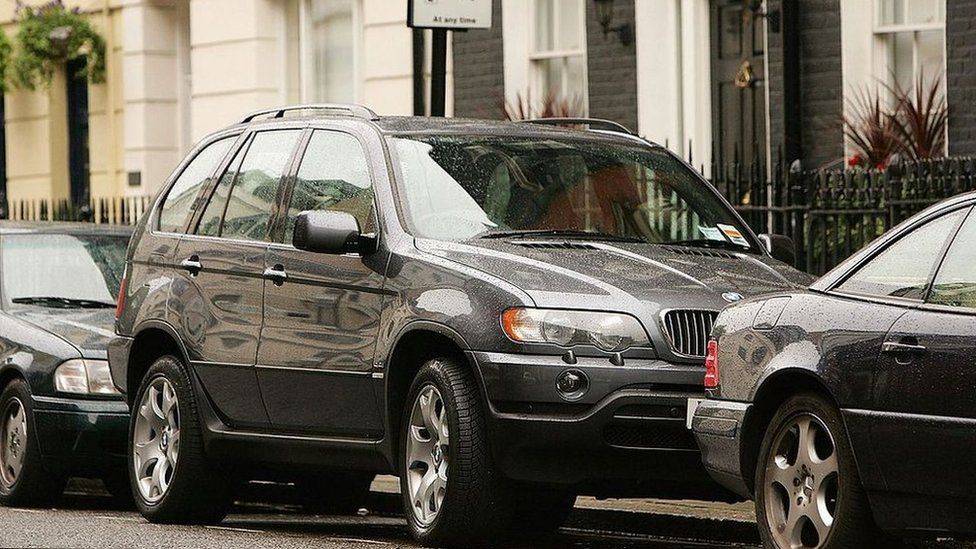
SUV car parked on a London street.image copyrightGetty Images

“These are people who fly most, drive the biggest cars most and live in the biggest homes which they can easily afford to heat, so they tend not to worry if they’re well insulated or not.

“They’re also the sort of people who could really afford good insulation and solar panels if they wanted to.”

Prof Newell said that to tackle climate change, everyone needs to feel part of a collective effort – so that means the rich consuming less to set an example to poorer people.

He continued: “Rich people who fly a lot may think they can offset their emissions by tree-planting schemes or projects to capture carbon from the air. But these schemes are highly contentious and they’re not proven over time.

The wealthy, he said, “simply must fly less and drive less. Even if they own an electric SUV that’s still a drain on the energy system and all the emissions created making the vehicle in the first place”.

Sam Hall, from the Conservative Environment Network, told BBC News: “It’s right to emphasise the importance of fairness in delivering (emissions cuts) – and policy could make it easier for people and businesses to go green – through incentives, targeted regulation and nudges.

“But encouraging clean technologies is likely to be more effective, and more likely to enjoy public consent, than hefty penalties or lifestyle restrictions.”

But Prof Newell said existing political structures allowed wealthy firms and individuals to lobby against necessary changes in society that might erode the lifestyles of the rich.

The recent report of the UK Climate Assembly, for example, proposed a series of measures targeting carbon-intensive behaviours such as shifting away from meat and dairy produce; banning the most polluting SUVs; and imposing frequent flyer levies.

The Treasury told BBC News that a frequent flyer levy might require the government to collect and store personal information on each passenger.

This could raise issues of data processing, handling and privacy issues. It would also be hard to keep track of people with multiple passports.

But the commission’s report said: “The goals of the Paris Agreement on climate change cannot be achieved without radical changes to lifestyles and shifts in behaviour, especially among the wealthiest members of society.

“If change across society is to be brought about at the speed and scale required to meet agreed climate targets, we need to shrink and share: reduce carbon budgets and share more equally.”

The report is the latest in a long-running dialogue over what it means to be “fair” while tackling climate change.

Poorer nations such as India have consistently argued that they should be allowed to increase their pollution because it’s so much lower per person than emissions from rich nations.

The issue forms part of the tangled tapestry of negotiations behind next week’s climate summit organised by President Biden and the COP climate summit in the UK scheduled for November.

Follow Roger on Twitter.

The post World’s Wealthy People at Heart of Climate Change appeared first on The St Kitts Nevis Observer.

Canada: China, Russia Singled Out for Espionage Activity

Foreign spying and interference in Canada last year hit levels not seen since the Cold War, in part because of vulnerabilities caused by the Covid-19 pandemic, the main Canadian spy agency said on Monday,

The Canadian Security Intelligence Service (CSIS) singled out Russia and China as particular causes for concern and said key national security threats such as violent extremism, foreign interference, espionage and malicious cyber activity grew in 2020 and “in many ways became much more serious for Canadians.”
In its annual report for last year, CSIS linked the jump in foreign spying to the increasing number of people working from home because of the Covid-19 pandemic.
“Foreign threat actors — including hostile intelligence services and those working on their behalf — have sought to exploit the social and economic conditions created by the pandemic” to gather valuable information, it said.
The report was the latest from Canada’s intelligence community to focus on Russia and China.
The head of CSIS said in February that China posed a serious strategic threat, while the signals intelligence agency last November identified state-sponsored programs in China, Russia, Iran and North Korea as cyber crime threats for the first time.
“In 2020, CSIS observed espionage and foreign interference activity at levels not seen since the Cold War,” CSIS said.
“China, Russia, and other foreign states continued to covertly gather political, economic, and military information in Canada through targeted threat activities in support of their own state development goals.”

The post Canada: China, Russia Singled Out for Espionage Activity appeared first on The St Kitts Nevis Observer.

Mexico Hands Over 30 Marines to Cops in People Disapperarance Cases

MEXICO CITY (AP) — Mexico’s navy said Monday it turned 30 marines over to civilian prosecutors to face justice in the cases of people who disappeared during anti-crime operations in the northern border city of Nuevo Laredo in 2014.

The navy said there were outstanding warrants for the 30 charging them with “acting in violation of their duty.”

The military personnel were handed over to the federal Attorney General’s Office late last week, the navy said.

Under Mexican law, military tribunals can hear only cases that involve violations of military code; . Offenses against civilians must be tried in civilian courts.

The city across from Laredo, Texas, has long been dominated by the Northeast cartel, an offshoot of the old Zetas gang.

For much of the 2000s, the fight against the cartel was largely entrusted to the marines, who frequently came under fire from heavily armed cartel gunmen. Marines were also accused of rounding up supposed suspects, some of whom were not heard from again. Through 2018, dozens of people disappeared in Nuevo Laredo.

The marines have largely been removed from land anti-cartel operations, and the army and the newly created National Guard has taken over some of the those duties.

The post Mexico Hands Over 30 Marines to Cops in People Disapperarance Cases appeared first on The St Kitts Nevis Observer.

Russian Gaining Foothold in Latin America Through Sputnik Vaccine

RIO DE JANEIRO (AP) — Russia has been trying to get its coronavirus vaccine Sputnik V into Brazilian arms for months, and been repeatedly frustrated by legal, regulatory and possibly even diplomatic obstacles.

That began to change as the South American nation played catch-up in the global race to snap up shots. Receiving little help from the U.S., which was struggling to get a handle on its own outbreak, Sputnik V seemed as good as any; Brazil’s federal government and a group of nine northeastern states signed two deals with Russia’s sovereign wealth fund, RDIF, for a total 47 million doses. The shot is moving toward regulatory approval.

The vaccine has now been purchased by at least nine Latin American nations, with Brazil its greatest uphill battle.

That growing adoption reflects Russia gaining a greater foothold in the region the U.S. has traditionally viewed as within its sphere of influence — and where the American government had boasted of steering Brazil away from Russian vaccines. It’s similar to China’s success in achieving wide use of its own vaccines in Latin America.

That has caused consternation in U.S. diplomatic circles, although it remains to be seen if Russia’s vaccine outreach will yield deeper partnerships.

Tom Shannon, a former undersecretary of state whose long diplomatic career included several stints in the region, told The Associated Press the U.S. has largely missed an opportunity to engage with Latin American governments during the pandemic, with the exception of a recently announced plan by President Joe Biden’s administration to provide Mexico surplus shots

“For the Kremlin, COVID was a godsend,” Shannon said of Russia’s vaccine outreach. “This was a chance for them to restart their diplomacy in the hemisphere with a whole new face of public health intervention and they are taking full advantage of it.”

“When you have 300,000 dead, you take the help where you can get it from,” he said of Brazil.

Russia’s presence in Latin America has been limited since the 1990s, and in recent years primarily entailed an alliance with Venezuela for provision of arms and energy projects, as well as Nicaragua for arms and building emergency response capabilities. But Latin America’s arms purchases plunged as its commodities boom ended and Venezuela economy melted down.

Russian ties were also strong with the government of Argentina’s Cristina Fernandez Kirchner from 2007 to 2015 and appear to be reviving. As current vice president, Kirchner spearheaded negotiations to buy Sputnik V even when local scientists initially were skeptical of the early experimental data reported by the Gamaleya Institute that developed the vaccine.

Argentina’s embrace of the vaccine helped convince Mexico — which had struggled to get vaccines from U.S. companies — to sign an agreement for 24 million doses, though they have been slow to arrive.

Bolivia’s previously tight relations with Russia had reversed under President Luis Arce’s right-wing predecessor, but Arce, who took office in November, agreed to buy millions of doses. After speaking with Putin by phone, he also announced reactivation of a Russian-led project to build a nuclear research and technology center.

U.S. vaccine outreach, meantime, has been almost entirely indirect, with a pledge of $4 billion to the World Health Organization’s COVAX program to provide shots to low- and middle-income countries. Recently, such shipments have been delayed.

The U.S. has snatched up more doses than it will eventually need, and Biden has repeatedly said his focus is vaccinating all Americans before sharing vaccines abroad. The U.S. has had almost three times as many COVID-19 deaths per capita as Russia and, even with one of the world’s fastest immunization rollouts, Americans have complained about the pace.

By contrast, Russia’s own vaccination program has lagged because of widespread skepticism of the vaccine — a February poll showed only 30% of Russians were willing to get the shot — and drug makers being slow to ramp up production.

Only recently did Biden’s administration agree to provide 2.7 million surplus AstraZeneca doses to Mexico. Brazil has been trying to negotiate the same for itself, according to its foreign ministry.

“Although I truly think that the U.S. and European countries are the preferred partners in the region, if there is a vacuum, there isn’t the slightest doubt that China and Russia will seek a way to take advantage,” Mauricio Claver-Carone, the head of the Inter-American Development Bank, told the AP.

The U.S. Department of Health and Human Services’ 2020 annual report said in a section titled “Combatting malign influences in the Americas” that it had convinced Brazil to not to buy the Russian shot. Kremlin spokesman Dmitry Peskov said March 16 other countries faced similar coercion, without naming them.

“The pressure has been unprecedented, tough and devoid of any diplomatic niceties,” Peskov said. “We are categorically against politicizing the situation with vaccines.”

Fabiano Mielniczuk, a professor who specializes in Russian international politics at Brazil’s Federal University of Rio Grande do Sul, said suspicion of Russia represents an outdated Cold War mentality, and sees its moves to introduce the shot “much more as market-oriented action than as geopolitical action.”

Despite the assertion in the “malign influences” section, it’s unclear what action the U.S. took. The U.S. embassy denied exerting any pressure regarding vaccines approved by Brazil’s health regulator, which has not yet signed off on Sputnik V. Brazil’s government denied even being consulted.

Frustrated by the speed and bureaucracy of health regulator Anvisa, the Russians conducted phase 3 trials of its vaccine elsewhere, according to Bahia state’s Gov. Rui Costa, who had worked closely with the fund. At the time, Brazil still required local phase 3 trials for regulatory approval.

In a last-ditch effort, RDIF’s director Kirill Dmitriev reached out to former President Luiz Inácio Lula da Silva, according to Alexandre Padilha, a lawmaker and former health minister who joined their subsequent meeting. That led to the nine states’ eventual deal for 37 million doses. RDIF declined to comment for this story.

“The northeastern governments already have various investment partnerships with the Chinese,” Padilha said. “I think without a doubt this can open doors for northeast governors to establish other partnerships and technology investments with the Russians.”

Putin meantime heaped flattery on Bolsonaro at a multinational summit in November, saying the Brazilian had “expressed the best qualities of masculinity and determination” by putting citizens’ interests before his own health. Bolsonaro posted video of the praise to social media.

Courting the rival former and current presidents simultaneously reflects Putin’s pragmatism, said Mielniczuk, the political science professor.

Brazil’s federal government agreed to buy 10 million doses.

Even after Anvisa dropped its demand for local phase 3 trials, the Brazilian lab that would produce Sputnik V locally — Uniao Quimica — struggled to clear hurdles.

RDIF’s Dmitriev told Brazilian magazine Veja in mid-March that he felt his vaccine was still facing political bias. But Anvisa said delays were technical, caused by lacking documentation, and on March 23 it held a five-hour meeting with Uniao Quimica and Gamaleya to iron out problems. A week later, Anvisa certified Uniao Quimica’s manufacturing practices.

On April 6, Bolsonaro spoke with Putin by video call and said afterward that his government was working to resolve “some obstacles″ to importing the shot. The leaders also discussed broader trade, defense industry cooperation and technology.

After the call was first reported, the former director of Brazil’s trade and investment promotion agency, Márcio Coimbra, said on Twitter, “Now distant from Washington, we may be closer than ever to Moscow.”

Some documentation is still missing, but Sputnik V is inching closer to approval in Brazil — and another soft-power score for Russia. It serves as a wake-up call, said Eric Farnsworth, who has developed and implemented U.S. policy in the region.

“We’re not the only ones that Latin America can interact with and they’re showing it right now,” said Farnsworth, vice president of the Council of the Americas, a New York-based organization promoting business in the region. “There is much ground to be recaptured, and the only way to do that would be to overwhelm the region with generosity in combatting the pandemic.”

___

Associated Press writer David Biller reported this story in Rio de Janeiro and AP writer Christopher Sherman reported from Mexico City. AP writers Josh Goodman and Gisela Salomon in Miami and Daria Litvinova in Moscow contributed to this report.

The post Russian Gaining Foothold in Latin America Through Sputnik Vaccine appeared first on The St Kitts Nevis Observer.