Tag Archives: caribbean

Choosing to take the COVID-19 vaccine protects oneself and others

BASSETERRE, St. Kitts — Choosing to take the AstraZeneca/Oxford University vaccine is choosing to protect oneself and others from the deadly COVID-19 virus, according to Chief Medical Officer in the Ministry of Health, Dr. Hazel Laws.

Dr. Laws explained this during her presentation at the National Emergency Operations Centre COVID-19 Press Briefing on February 17 at the National Emergency Management Agency (NEMA) Headquarters at Lime Kiln.

She revealed her decision to take the AstraZeneca/Oxford University vaccine, which is already in the Federation. Her decision to take the vaccine is because it minimizes her risk of becoming severely ill or dying.

“If I were to contract the disease, one of five things can happen to me,” said Dr. Laws. “I can recover without any symptoms; or I may develop mild symptoms via cough, runny nose, stuffiness and then recover; I can become moderately ill and recover, or I can become severely ill or die.

“If I decide to take the AstraZeneca/Oxford University vaccine, the scientists and the clinical data assure me that I will be protected from severe illness and death from COVID.

“Even when we vaccinate our people, we are going to have to continue adhering to the public health measures of wearing our face mask, maintaining adequate hand hygiene, and maintaining a safe distance from others when in public,” said Dr. Laws.

“We will have to continue these essential public health options until a significant proportion of our population has developed immunity against this virus, and until a significant proportion of our population has received the vaccine,” she concluded.

The post Choosing to take the COVID-19 vaccine protects oneself and others appeared first on The St Kitts Nevis Observer.

Reports of Gruesome Ethiopian Massacre by Eritrean Forces

An elderly woman who fled to the city of Axum in the Tigray region of Ethiopia to seek safety sits with her head bandaged after being wounded during an attack on the city, Monday, Nov. 30, 2020. She later died of her wounds. As Ethiopia’s Tigray region slowly resumes telephone service after three months of conflict, witnesses gave The Associated Press a detailed account of what might be its deadliest massacre, at the sacred Ethiopian Orthodox church in Axum. (AP Photo)

NAIROBI, Kenya (AP) — Bodies with gunshot wounds lay in the streets for days in Ethiopia’s holiest city. At night, residents listened in horror as hyenas fed on the corpses of people they knew. But they were forbidden from burying their dead by the invading Eritrean soldiers.

Those memories haunt a deacon at the country’s most sacred Ethiopian Orthodox church in Axum, where local faithful believe the ancient Ark of the Covenant is housed. As Ethiopia’s Tigray region slowly resumes telephone service after three months of conflict, the deacon and other witnesses gave The Associated Press a detailed account of what might be its deadliest massacre.

For weeks, rumors circulated that something ghastly had occurred at the Church of St. Mary of Zion in late November, with estimates of several hundred people killed. But with Tigray cut off from the world and journalists blocked from entering, little could be verified as Ethiopian and allied fighters pursued the Tigray region’s fugitive leaders.

The deacon, who spoke on condition of anonymity because he remains in Axum, said he helped count the bodies — or what was left after hyenas fed. He gathered victims’ identity cards and assisted with burials in mass graves.

He believes some 800 people were killed that weekend at the church and around the city, and that thousands in Axum have died in all. The killing continues: On the day he spoke to the AP last week he said he had buried three people.

“If we go to the rural areas, the situation is much worse,” the deacon said.

The atrocities of the Tigray conflict have occurred in the shadows. Ethiopian Prime Minister Abiy Ahmed, who won the Nobel Peace Prize in 2019 for making peace with neighboring Eritrea, announced the fighting as the world focused on the U.S. election. He accused Tigray’s regional forces, whose leaders dominated Ethiopia for nearly three decades before he took office, of attacking the Ethiopian military. Tigray’s leaders called it self-defense after months of tensions.

While the world clamors for access to Tigray to investigate suspected atrocities on all sides and deliver aid to millions of hungry people, the prime minister has rejected outside “interference.” He declared victory in late November and said no civilians had been killed. His government denies the presence of thousands of soldiers from Eritrea, long an enemy of the Tigray leaders.

Ethiopia’s narrative, however, has crumbled as witnesses like the deacon emerge. The foreign ministry on Thursday acknowledged that “rape, plunder, callous & intentional mass killings” could occur in a conflict where “many are illegally armed.” Its statement blamed Tigray forces for leaving the region “vulnerable” and said any serious offense will be investigated. It did not mention Eritrean soldiers.

Axum, with its ancient ruins and churches, holds major significance for the Ethiopian Orthodox faithful, who believe that the Ark of the Covenant, built to hold the tablets inscribed with the Ten Commandments, is located there.

“If you attack Axum, you attack first of all the identity of Orthodox Tigrayans but also of all Ethiopian Orthodox Christians,” said Wolbert Smidt, an ethnohistorian who specializes in the region. “Axum itself is regarded as a church in the local tradition, ‘Axum Zion.’”

In a normal year, thousands of people would have gathered at the Zion church in late November to celebrate the day Ethiopians believe the Ark of the Covenant was brought there after it disappeared from Jerusalem in ancient times.

Instead, the church had become a refuge for people who fled the fighting elsewhere in Tigray. They sheltered there as worship services were underway two days before the anniversary.

Eritrean and Ethiopian soldiers had arrived in Axum more than a week earlier, with heavy bombardment. But on Nov. 28 the Eritrean soldiers returned in force to hunt down members of the local militia who had mobilized against them in Axum and nearby communities.

The deacon recalled soldiers bursting into the church, cornering and dragging out worshippers and shooting at those who fled.

“I escaped by chance with a priest,” he said. “As we entered the street, we could hear gunfire all over.” They kept running, stumbling over the dead and wounded along with others trying to find places to hide.

Most of the hundreds of victims were killed that day, he said, but the shooting and looting continued the following day.

“They started to kill people who were moving from church to home or home to home, simply because they were on the street,” another witness, visiting university lecturer Getu Mak, told the AP. “It was a horrible act to see.” He watched the fighting from his hotel room, then ventured out as it eased.

“On every corner, almost, there was a body,” he said. “People were crying in every home.”

Another witness, who spoke on condition of anonymity for fear of retaliation, said soldiers killed a man at his home near the Zion church. “How can I tell you? So many dead,” said the man, who has since escaped to the Tigray capital, Mekele.

After the killings in Axum came an uneasy period with soldiers roaming the streets and families searching for loved ones. At night, hyenas descended from nearby hills.

The city began to smell of death as some bodies went untouched for days.

“I saw a horse cart carrying around 20 bodies to the church, but Eritrean soldiers stopped them and told people to throw them back on the street,” said Getu, the university lecturer.

Witnesses elsewhere in Tigray have reported being unable to bury bodies, calling it an added insult. They say soldiers tell them that “no one mourned our fighters, so why should we let you mourn?”

Finally, when the soldiers left the city to pursue other fighters, residents mobilized to bury the bodies, the deacon said.

“We could not do a formal burial,” he said. “We buried them en masse” in graves near the Zion church and others.

Some of the dead were among the hundreds of thousands of people in Tigray displaced by the conflict and not known to Axum residents. Their identity cards were collected in churches, where they await the discovery of loved ones.

The deacon said residents believe the Eritrean soldiers were taking revenge for the two-decade border war between Ethiopia and Eritrea that played out nearby and ended after Abiy became prime minister. Some of the soldiers told residents they had been instructed to kill people as young as 12, he said.

Another witness, a 39-year-old who gave only his first name, Mhretab, and escaped weeks ago to the United States, asserted that Ethiopian federal police did nothing to rein in the Eritrean soldiers.

“I said to them, ’Listen, you’re Ethiopian, they’re destroying Ethiopian cities. How is this possible?‴ Mhretab recalled.

”They said, ‘What can we do? This shouldn’t have happened from the beginning. This is from above,’” indicating that it had been decided by senior officials, he said.

He said he ferried bodies to a mass grave by the Zion church and estimated that he saw 300 to 400 there.

The deacon believes that the Eritrean soldiers, in their hunt for Tigray fighters, have killed thousands more people in villages outside Axum. “When they fight and lose, they take revenge on the farmers and kill everyone they can find,” he said. “This is what we’ve seen in the past three months.”

Getu echoed that belief, citing his uncle, who survived such a rural confrontation.

The deacon has not gone to the villages outside Axum. His work remains with his church, where services continue even as he says the Tigray conflict is as fierce as ever.

“We’re also protecting the church,” he said. “Even now, I’m talking to you from there. We are not armed. What we do is mostly watching. And, of course, praying that God protects us.”


The post Reports of Gruesome Ethiopian Massacre by Eritrean Forces appeared first on The St Kitts Nevis Observer.

UK PM Pledges Surplus Corona Vaccine to Poor Nations

UK PM Boris Johnson will lead efforts to fend off accusations that the world’s richest countries are hoarding Covid vaccines by pledging at a G7 summit that the UK will donate surplus doses to poorer countries and cut to 100 days the time it takes to produce new jabs.

Both Russia and China are threatening to win an escalating vaccine diplomacy war by sending their vaccines direct to Africa, while the G7 club of wealthy nations continues to pile up surplus supplies as insurance against stocks running out.

Johnson, who is chairing the first meeting of the G7 attended by new US president Joe Biden, found himself forced to share some of the limelight with the French president Emmanuel Macron. On Thursday Macron announced a parallel plan for 5% of Europe’s vaccine stocks to be sent to Africa now, saying his proposal had the backing of the German chancellor Angela Merkel.

Underlining the political and moral necessity of acting quickly, Macron said: “We are allowing the idea to take hold [that] hundreds of millions of vaccines are being given in rich countries and that we are not starting in poor countries.

“It’s an unprecedented acceleration of global inequality and it’s politically unsustainable too because it is paving the way for a war of influence over vaccines. You can see the Chinese strategy and the Russian strategy too.”

The UN secretary general António Guterres said on Wednesday that the distribution of vaccines across the globe was “wildly unfair and uneven”. Just 10 countries have administered 75% of all Covid-19 vaccines while more than 130 countries have not received a single dose. He said: “Those affected by conflict and insecurity are at particular risk of being left behind. At this critical moment, vaccine equity is the biggest moral test before the global community.”

It comes as charities claimed the nations of the G7 – Canada, France, Germany, Italy, Japan, the UK and the US – have collectively pre-ordered 1.5bn more vaccines than their population size justifies.

Christian Aid’s head of advocacy Fiona Smyth said: “We need the nations of the G7 to display values of equality and solidarity, and to stop hoarding excess supplies of vaccines. It’s time that they shared the vaccine recipes with the world so we can make enough vaccines for the world – not just for the richest countries and people. The G7 should ensure that companies share their information, data, biological material, knowhow, technology and intellectual property.”

Johnson will say that the UK will share any surplus vaccines and vow to cut the time it takes to develop a vaccine from the unprecedented 300 days achieved last year to 100 days.

While the UK has seen one of the world’s highest coronavirus death tolls per capita, it has flourished in the development, purchase and distribution of vaccines, with one of the biggest orders of successful jabs.

Johnson confirmed he has asked Sir Patrick Vallance, the UK’s chief scientific adviser, to work with international partners, including the World Health Organization (WHO) and the Coalition for Epidemic Preparedness Innovations (CEPI) and industry and scientific experts, to advise the G7 on speeding up the process for developing vaccines, treatments and tests for common pathogens.

The development of a coronavirus vaccine in approximately 300 days has been generally regarded as a great global achievement but inter-company competition, different regulatory approval processes and commercial secrecy may have created delays. The ambition to cut the process to 100 days was proposed by CEPI earlier this year.

The UK believes greater international collaboration to intensify research and development, modernise medical trials and create more innovative vaccine manufacturing and supply chains could speed the process and save lives. Advanced western economies have not been able to find a way to suppress the virus except through near total shutdowns of their economies.

The UK, in common with the US, is listed as having ordered or pre-purchased four times as many vaccines as its population needs but officials said they will not be able to identify the true size of the surplus until much later in the year. Officials need to assess continued supply chain reliability and whether new vaccines are needed for variants or as a booster dose in the autumn. Countries say they “over-ordered” since there was no certainty that any particular vaccine would succeed or when it would be available so, rather than backing a single horse, countries are spreading their bets.

Macron’s initiative and accompanying interview in the Financial Times more directly acknowledges the damaging perception that the west is ignoring the plight of the poor, and as a result needs to move quickly by handing out 5% of its supplies. He described the plan as a “test of multilateralism. It’s not about vaccine diplomacy. It’s not a power game it’s a matter of public health.”

He argued that unless the vaccine is brought under control everywhere, the virus will mutate and return to Europe in new more virulent forms. He also broached the issue of ending pharmaceutical companies’ control of intellectual property rights saying he did not think the debate was helpful.

G7 nations, instead of sending vaccines direct to Africa, have been funding a complex scheme known as Covax to provide vaccines. All the vaccines that Covax bought first need WHO approval before distribution. Oxford/AstraZeneca, one of the vaccines on which Covax is relying, had to wait until this week to receive WHO approval.

The drug seemed the most suitable for countries such as those in Africa since it is easier to ship and store in a regular fridge than other vaccines, making it suitable for remote areas. Some 2.3bn doses of AstraZeneca’s two-shot regimen were pre-purchased. At least 50 countries had cleared it for use before WHO’s decision.

But questions have been raised about the shot’s effectiveness against some strains such as the one discovered in South Africa and some countries are limiting its use. Many African countries do not have the ability to detect the nature of the Covid strains active in their country. By contrast China has been sending its vaccine to the Sahel, Turkey, and Serbia.

Johnson will also be encouraging G7 leaders to increase their funding for Covax in support of equitable access to vaccines. The UK has already pledged £548m and Germany is expected to increase its funding at the summit.

=================================================

ON THAT NOTE–

The EU’s executive commission plans to double its contribution to the World Health Organization’s Covax programme, bringing the 27-nation bloc’s commitment to the initiative to deliver vaccines to poor nations to €1bn ($1.2bn).

The Associated Press reports:

The post UK PM Pledges Surplus Corona Vaccine to Poor Nations appeared first on The St Kitts Nevis Observer.

Associated Press World View: Texas Lights-Up, Biden on Iran, Climate Pact

Alternate text

AP MORNING WIRE

TED ANTHONY

Director of Digital Innovation

THE RUNDOWN

I'm an image

Lights come back on in Texas as water woes rise in the South

AUSTIN, Texas (AP) — Many of the millions of Texans who lost power for days after a deadly winter blast overwhelmed the electric grid now have it back, but the crisis was far from over in parts of……Read More

I'm an image

WASHINGTON (AP) — The Biden administration says it’s ready to join talks with Iran and world powers to discuss a return to the 2015 nuclear deal, in a sharp repudiation of former President Donald… …Read More

I'm an image

The United States is back in the Paris climate accord, just 107 days after it left. While Friday’s return is heavily symbolic, world leaders say they expect America to prove its seriousness… …Read More

I'm an image

For years, Facebook has been in a defensive crouch amid a slew of privacy scandals, antitrust lawsuits and charges that it was letting hate speech and extremism destroy democracy. Early Thursday,… …Read More

I'm an image

CAPE CANAVERAL, Fla. (AP) — A NASA rover streaked through the orange Martian sky and landed on the planet Thursday, accomplishing the riskiest step yet in an epic quest to bring back rocks that… …Read More

Other Top Stories

DALLAS (AP) — Texas Sen. Ted Cruz said his family vacation to Mexico was “obviously a mistake” as he returned stateside Thursday following an uproar over his disappearance du…Read More

WASHINGTON (AP) — Joe Biden will make his first big appearance on the global stage as president on Friday, offering Group of Seven allies and other foreign leaders a glimpse …Read More

WASHINGTON (AP) — Lawmakers in Washington are digging into the GameStop saga at a congressional hearing. The episode has been portrayed as a victory of the little guy over Wa…Read More

ANCHORAGE, Alaska (AP) — An Alaska woman had the scare of a lifetime when using an outhouse in the backcountry and she was attacked by a bear, from below. “I got out there an…Read More

The post Associated Press World View: Texas Lights-Up, Biden on Iran, Climate Pact appeared first on The St Kitts Nevis Observer.

Photo Contest Offering Free St. Kitts Vacation for 2

The post Photo Contest Offering Free St. Kitts Vacation for 2 appeared first on The St Kitts Nevis Observer.

NATO to Increase Troops In Iraq After Attack

NATO will expand its security training mission in Iraq by thousands of troops following a deadly rocket attack on a military airbase earlier this week.

The 30-member alliance will increase its personnel in Iraq from 500 to around 4,000, a move to prevent the war-torn country from becoming a breeding ground for terrorists, NATO Secretary-General Jens Stoltenberg announced Thursday.

“ISIS still operates in Iraq and we need to make sure they’re not able to return,” Stoltenberg told reporters at the end of a two-day virtual NATO defense ministers meeting.

What the increase means: He said NATO’s efforts will now include more Iraqi security institutions and areas beyond Baghdad, though their presence “is conditions-based and increases in troop numbers will be incremental.”

He added that the Iraqi government had made a request for the expanded mission, which will begin in the coming months.

The forces already there: NATO has been in Iraq since 2004 to train Iraqi security forces. Its current training mission, which began in 2018, is meant to help the Iraqi forces prevent ISIS from resurging. 

The increase in NATO troops could possibly ease pressure on U.S. forces in Iraq, where about 2,500 troops are based for a mission separate from the alliance.

Will the US also increase?: A senior Defense official told reporters earlier this week that the Pentagon “welcomes NATO’s increased focus on Iraq,” but would not say if the U.S. would add more troops to the training mission.

Response to attack: Plans for an expanded NATO footprint follows the rocket attack Monday on Erbil International Airport, a military airbase in northern Iraq, which killed a civilian contractor and injured nine people, including a U.S. service member.

The militant Shia group Saraya Awliya al-Dam claimed credit for the attack, though the Biden administration has not publicly confirmed who is responsible for the strike.

The State Department on Wednesday vowed “consequences for any group responsible for this attack.”


The post NATO to Increase Troops In Iraq After Attack appeared first on The St Kitts Nevis Observer.

Murders: 6,402 Innocent Civilians Killed by Colombian Military

An inquiry in Colombia has found that 6,402 civilians were killed by the military between 2002 and 2008 and falsely passed off as enemy combatants.

The number of killings, known as “false positives”, is almost three times higher than previous estimates.

The inquiry is by a special court looking into crimes committed during a half century of conflict between troops and left wing rebels.

A peace deal ending the conflict was signed in 2016.

What were the “false positives?

It is the name given to the killings of young men – mainly from poor families – carried out by the Colombian army.

Colombian Doris Tejada, whose son disappeared 12 years ago, and member of the Mothers of False Positives (Mafapo) civil organization, wears a face mask reading Who gave the order? against the spread of the novel coronavirus as she cries during an interview with AFP in Soacha, Colombia, on May 6, 2020.image copyrightGetty Images
image captionDoris Tejada’s son disappeared 12 years ago, her face mask bears the question “Who gave the order?”

The army’s aim was to pass them off as left-wing rebels from the Revolutionary Armed Forces of Colombia (Farc) to boost its kill rate and give the impression it was winning the armed conflict against the group.

2px presentational grey line

Read more about the “false positives”:

2px presentational grey line

Who’s behind the investigation?

It is being carried out by the Special Jurisdiction for Peace (JEP), which was set up as part of the peace process after the left-wing Farc rebels signed the 2016 peace deal with the government.

The JEP is a transitional court system which was put in place for a period of 10 years to try all participants in the conflict, be they rebels or state actors.

Those who admit to their crimes up front will avoid jail time, but will be required to contribute in other ways to reconciliation – such as participating in programmes to remove landmines, build key infrastructure or construct monuments.

What did the court find?

After having investigated kidnappings carried out by the Farc rebels, the court has now turned its attention to the “false positives” and crimes committed by government forces.

Colombia’s public prosecutor’s office had acknowledged that there had been 2,249 “false positives” between 1988 and 2014 in a report it handed to the JEP last year.

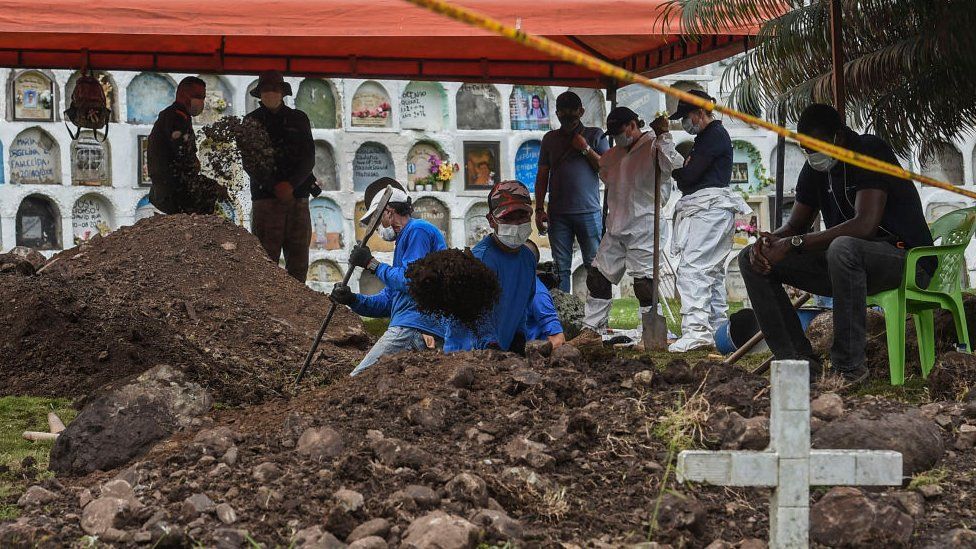
Gravediggers and forensic experts search for the remains of victims executed by members of the Colombian army during the Colombian armed conflict, at the cemetery in Dabeiba, Antioquia department, Colombia, on November 10, 2020. -
Investigators have been exhuming bodies in a cemetery in Dabeiba in their search for victims

The investigation suggests the real figure is almost triple that.

It also suggests that the majority of the “false positives” were carried out between 2002 and 2008, during the presidency of Álvaro Uribe.

What’s the background?

The “false positives” scandal first erupted in 2008, but the practice is thought to date back as far as the 1980s.

More than 1,700 people have been sentenced for their role in the false positives.

Members of the military have given evidence in a number of court cases over the past decade and told how they were pressured by their superiors to drive up their “kill rate” and how they would be rewarded by being given promotions or extra days off.

In one case, eight soldiers were jailed for taking four farmers from their homes by force, shooting them in the back and dressing them up as rebels.

In other instances, young men were lured from poor neighbourhoods of the capital, Bogotá, with promises of work, only to be murdered and dressed in rebel fatigues.

The JEP says it does not rule out that the total number of victims may be higher as its investigation is still in the early stages.

Related Topics

The post Murders: 6,402 Innocent Civilians Killed by Colombian Military appeared first on The St Kitts Nevis Observer.

Biden Stressing Human Rights in US-Saudi Relationship

This week President Joe Biden’s administration has given a further indication of how it plans to distance itself from the Middle East policies of his predecessor, President Donald Trump.

The White House Press Secretary, Jen Psaki, has said that the president intended to “recalibrate” his relationship with a key US ally, Saudi Arabia.

President Trump, through his son-in-law Jared Kushner, forged a close personal bond with the Saudi Crown Prince Mohammed bin Salman, giving him largely free rein in how he used US-supplied weaponry in Yemen. President Biden, it seems, prefers to deal with his father, King Salman, who is in his 80s and in poor health. And from now on, read a statement by the US State Department, US policy needed to prioritise the rule of law and respect for human rights.

So what does this mean for both countries and what are the risks here for Washington and Riyadh?

Tactical shifts

For the Saudi Crown Prince, known as MBS, it means the good times under President Trump are well and truly over.

For the Saudis to retain the US as their strategic partner and security “umbrella” in the longer term, concessions are having to be made to accommodate a very different way of thinking in the White House.

The Saudi-US alliance has deep roots. It dates back to a historic meeting onboard a US warship in 1945 between the founder of Saudi Arabia, King Abdulaziz and President Roosevelt.

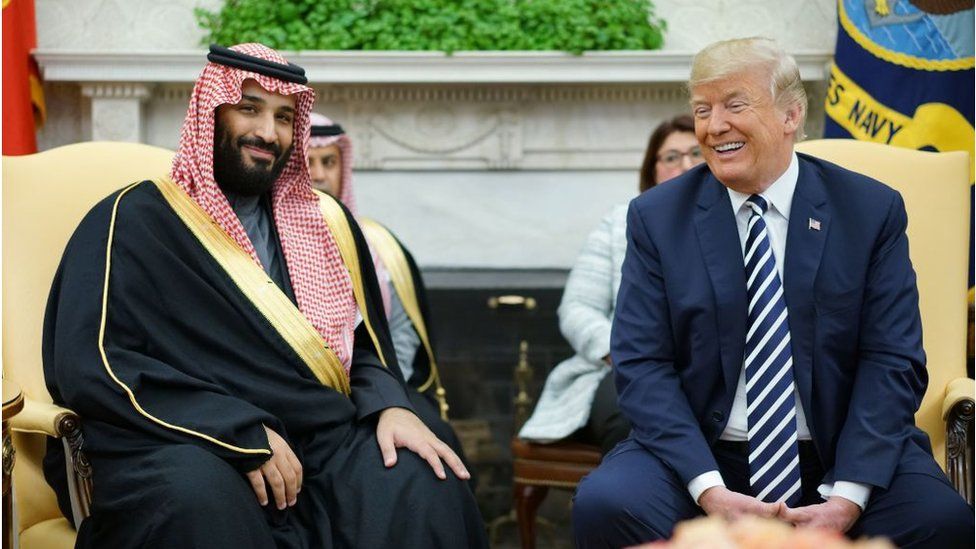
Mohammed bin Salman and Donald Trump, Sept 2018
President Trump developed a close relationship with Mohammed bin Salman

It has survived the upheavals of the 1973 oil embargo, the 1991 Gulf War and the 9/11 attacks of 2001, where most of al-Qaeda’s suicide hijackers were Saudi nationals. The Saudis may be feeling deeply uncomfortable about the new team in the White House – it took the leadership several days to congratulate Joe Biden – but they are not about to trade in the US for another partner overnight.

They know that if the massively powerful US Fifth Fleet were ever to pull out of the Gulf then Saudi Arabia’s arch-rival Iran would quickly fill the vacuum and become the dominant power in the region.

For now, the Biden administration has vowed to help Saudi Arabia defend itself against attack, including from the armed drones being launched by Houthi forces in Yemen.

Power behind the throne

For the US, there are risks in the Biden approach. King Salman is now too frail to take an active, hands-on role in the day-to-day running of Saudi Arabia. So in practice, Washington could well find itself dealing with his son, MBS, for several more decades, whether it likes it or not.

To most Western governments, MBS is still considered toxic, tainted as he is with the widely-held suspicion that he ordered the murder of journalist Jamal Khashoggi in 2018, which he denies. But inside Saudi Arabia MBS is largely popular, especially with the young, who welcome his social reforms.

At just 35 years old, he is far closer to the nation’s youth than the octogenarian rulers the country has grown used to. He also holds all the levers of power, having brought the armed forces, the Ministry of Interior and the National Guard under his direct control.

With almost Machiavellian cunning, he has dealt with all possible obstacles in his path, including locking up the man who was America’s favourite to be the next king: the quietly competent former Interior Minister and Crown Prince Mohammed Bin Nayef, deposed by MBS in a bloodless coup in 2017.

Delicate path

But when it comes to US pressure to influence affairs in Saudi Arabia things have not always turned out the way Washington wanted. As US Secretary of State in 2005, Condoleeza Rice denounced autocracy in the region and urged Saudis to embrace democracy and hold free elections. The Saudi rulers then dipped a tentative toe into democratic waters by allowing limited municipal elections.

The result? A resounding victory for conservative, mostly anti-Western, Islamist candidates. So, as the Saudi leadership said to its US allies afterwards: “Be careful what you wish for”.

The post Biden Stressing Human Rights in US-Saudi Relationship appeared first on The St Kitts Nevis Observer.

8-Year-Old Honduran Boy Drowns Crossing Rio Grande


MEXICO CITY (AP) — A Honduran boy drowned as he attempted to cross the Rio Grande dividing Mexico and the United States, Mexican immigration officials said Thursday.

The National Immigration Institute said in the statement that the 8-year-old “was in the company of various adults on a small island between the two countries, but couldn’t withstand the pounding water, which covered him and kept him submerged for several meters.” The migrants were attempting to cross the river at Piedras Negras, across the border from Eagle Pass, Texas.

His body was recovered, but attempts to revive him failed. The boy’s parents and sister made it to the U.S. side where they were apprehended by the Border Patrol and returned to Mexico to identify the body.

It happened Wednesday, the same day that Mexico’s immigration agency announced the death of a Venezuelan woman who died trying to cross the river there.

The flow of migrants to the U.S. border has increased after dropping sharply due in part to pandemic-related border restrictions for much of last year. Migrants’ hopes have also been buoyed by the new administration of U.S. President Joe Biden.

Drownings are just one of the dangers migrants face.

In late January, 19 bodies were found shot and burned in a vehicle near the town of Camargo, also across the border from Texas.

The Tamaulipas state prosecutor’s office said late Wednesday in a statement that authorities had identified 16 of them as Guatemalan migrants from the town of Comitancillo. They had previously arrested and charged a dozen Tamaulipas state police officers in connection with the case.

The post 8-Year-Old Honduran Boy Drowns Crossing Rio Grande appeared first on The St Kitts Nevis Observer.