Tag Archives: caribbean

Scholarships available in Italy

Community Notice

Nationals of St. Kitts and Nevis are invited to apply for scholarships to pursue University studies in Italy.

International students can access information on universities, scholarships, and other relevant information regarding studying in Italy via the following website www.uni-italia.net/scholarships-ita

To access the shortlist of universities and the courses that are available, click on the section at the bottom of the page that says “available HERE.’

The post Scholarships available in Italy appeared first on The St Kitts Nevis Observer.

OAS scholarships available

Community Notice

The Organization of American States invites nationals of member states to apply for scholarships to pursue online studies for Master’s Programmes and Certificate Courses.

Further information about the various scholarships offered from several Universities is available at www.oas.org/en/scholarships/default.asp

General questions about the application process, requirements and important dates about the scholarships should be emailed to sc**********@*as.org

Applicants should submit a copy of their application to the Human Resource Management Department at Government Headquarters in Basseterre. This is necessary for further processing and onward transmission to the OAS.

The post OAS scholarships available appeared first on The St Kitts Nevis Observer.

France, US announce support for Lebanese people

WASHINGTON, DC — Six months after the August 4 explosion which occurred in the Port of Beirut, causing hundreds of casualties and significant damage, France and the United States reiterate their full unambiguous support to the Lebanese people.

As we have done since the explosion, including with the United Nations, our partners and the Lebanese civil society at the August 9 and December 2 support conferences, France and the United States will continue to extend urgent assistance to the Lebanese people, including health, education, housing, and food support.

France and the United States also expect rapid results on the inquiry into the causes of the explosion. The Lebanese justice system must work transparently, removed from any political interference.

The six-month anniversary of this tragic event underscores the urgent and vital need for Lebanese stakeholders to finally act upon the commitments they have made to form a credible and effective government, and to pave the way for the implementation of necessary reforms, in accordance with the aspirations of the Lebanese people. Such concrete actions remain absolutely crucial for the engagement of France, the United States and their regional and international partners to provide additional, longer-term structural support to Lebanon.

The post France, US announce support for Lebanese people appeared first on The St Kitts Nevis Observer.

PM Harris Lauds CBI Program in Transforming SKN


LONDON, Feb. 4, 2021 /PRNewswire/ — In a recent webinar, Prime Minister Timothy Harris addressed some of the achievements contributed by St Kitts and Nevis’ Citizenship by Investment Programme both on the islands and in the broader investment migration industry.

Established in 1984, the Federation of St Kitts and Nevis was the first to birth the CBI concept. It operates the world’s longest-standing programme, opening its doors to foreign direct investment once applicants contribute via the Sustainable Growth Fund. The route, introduced in 2018, is considered the fastest and most straightforward path to a second citizenship.

According to PM Harris, the programme has been “integral” in the state’s response to enhancing the quality of life on the dual islands. CBI has helped the government improve various sectors of society, including education, telecommunications, housing and aviation.

St Kitts and Nevis also launched its Poverty Alleviation Programme with funds from the CBI Programme, enabling low-income families with a monthly stipend of $500. Most notably, since the global coronavirus outbreak, St Kitts and Nevis’ CBI Programme has also been instrumental in keeping the nation afloat.

More from AsiaOneRead the condensed version of this story, and other top stories with NewsLite.Aside from supporting citizens, the CBI Programme has witnessed a transformation over the last three decades that has contributed to it being recognised as a ‘Platinum Standard’ brand within the investment migration industry: “To have survived in an industry for over 30 years is no small achievement.

“So, we have the benefit of history, we have the benefit of being there longer, we have a better understanding of the marketplace, and we have become the most innovative in the marketplace and the most responsive. I think for all these, we are proud to say that we are what we really are – the Platinum brand, the oldest and the best and that certainly provides dividends for all who participate and of course for our country of St Kitts and Nevis,” PM Harris said.

Successful applicants under St Kitts and Nevis’ CBI Programme unlock increased global mobility with travel to 156 countries and territories, alternative business prospects and the ability to pass citizenship down for generations to come, establishing a future legacy for you and your family.

.

The post PM Harris Lauds CBI Program in Transforming SKN appeared first on The St Kitts Nevis Observer.

Indigenous Americans Have Highest COVID Death Rate in US

Covid is killing Native Americans at a faster rate than any other community in the United States, shocking new figures reveal.

American Indians and Alaskan Natives are dying at almost twice the rate of white Americans, according to analysis by APM Research Lab shared exclusively with the Guardian.

Nationwide one in every 475 Native Americans has died from Covid since the start of the pandemic, compared with one in every 825 white Americans and one in every 645 Black Americans. Native Americans have suffered 211 deaths per 100,000 people, compared with 121 white Americans per 100,000.

The true death toll is undoubtedly significantly higher as multiple states and cities provide patchy or no data on Native Americans lost to Covid. Of those that do, communities in Mississippi, New Mexico, Arizona, Montana, Wyoming and the Dakotas have been the hardest hit.

The findings are part of the Lab’s Color of Coronavirus project, and provide the clearest evidence to date that Indian Country has suffered terribly and disproportionately during the first year of the deadly coronavirus pandemic.

“Everyone has been impacted. Some families have been decimated. How can we go back to normal when we’ve lost so many after so many layers of trauma? It’s unbearable,” said Amber Kanazbah Crotty, a tribal council delegate in the Navajo Nation.

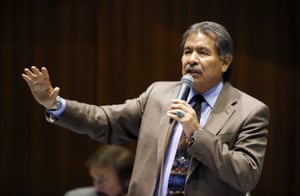
On Tuesday, the former Navajo president and Arizona state representative Albert Hale died from Covid, bringing the tribe’s death toll to 1,038, the equivalent of losing one in every 160 people on the reservation.

The figures show that even though multiple more infectious variants are yet to take hold in the United States, the situation has already wrought a devastating toll on Native communities and may get worse.

Last month was the deadliest so far in the US, with 958 recorded Native deaths – a 35% increase since December, a bigger rise than for any other group. For white Americans, deaths rose by 10% over the same period.

“Not only do Native people have the highest rate of Covid deaths, the rate is accelerating and the disparities with other groups is widening. This latest data is terrible in every way for indigenous Americans,” said Andi Egbert, senior analyst at APM Research Lab.

There are 574 federally recognized American Indian tribes and Alaska Native Villages in the United States. The Navajo Nation, the second largest by population, has suffered the greatest number of deaths, but smaller tribes are facing insurmountable losses.

In Montana, the Northern Cheyenne tribe has lost about 50 people to Covid so far – which is 1% of its total population of 5,000 people.

“Our collective grief is unimaginable. Losing 1% of our people is the equivalent of losing 3m Americans. Native Americans are used to dying at disproportionate rates and we’re used to scarcity but Covid is different, there’s a growing sense of hopelessness,” said Desi Rodriguez-Lonebear, an assistant professor of sociology and American Indian studies at the University of California.

Rodriguez-Lonebear added: “I fear the long-term impacts on mental health, our children, community resilience and cohesiveness. We’re in the middle of a massive storm and we’re not prepared for the aftermath.”

About a quarter of those who have died were native Cheyenne speakers. The tribal clinic is currently receiving 100 vaccine doses a week, at which rate it will take almost a year to vaccinate everyone.

“Our language, culture and traditions is what makes us Cheyenne, but we’re losing our teachers. How am I going to teach my son when I still have so much to learn? Indigenous communities are facing a cultural crisis that other communities are not.”

On Tuesday, the former Navajo president and Arizona state representative Albert Hale died from Covid. Photograph: Ross D Franklin/AP

In Oklahoma, the Cherokee Nation, the country’s biggest tribe, has suffered a relatively low death count thanks to a well-functioning tribe-led health service and a public health system that has pushed testing, contact tracing and consistent science-led messaging from day one, according to Chief Chuck Hoskin.

“We have one of the best public health systems in the country, which allowed us to be nimble when the worst crisis in modern memory struck … We’re a society, unlike the wider US, which believes in our citizens having access to healthcare at no costs,” said Hoskin.

Still, there have been significant losses. At least 35 of the remaining 2,000 fluent Cherokee speakers have died from Covid, undermining an ambitious programme launched in 2019 to stop the language dying out.

As a result, tribal leaders decided to prioritize fluent speakers, alongside frontline workers and elders, and about half have now been vaccinated. Overall, almost one in 10 citizens on the reservation have been vaccinated.

“So far we’ve led this country in getting the vaccine out in an efficient and effective way. The only question now is whether the US can keep up with the Cherokee Nation,” Hoskin added.

Anecdotal evidence from across the country suggests that tribal vaccination programs, which can include mobile clinics, home visits and drive-throughs, appear to be running more efficiently and effectively than in many states, though shortages are widespread.

Amid growing debate and concern about vaccine hesitancy in communities of color, the Urban Indian Health Institute (UIHI) conducted the first ever national survey to better understand Native Americans’ knowledge, attitudes, and beliefs.

About 75% of participants said they would be willing to receive a Covid vaccine – compared with just 56% of the general US population according to one large survey in December 2020. The vast majority view getting the vaccine as a community responsibility, even though three quarters have safety concerns. The survey included American Indians and Alaska Natives across 46 states–representing 318 different tribal affiliations.

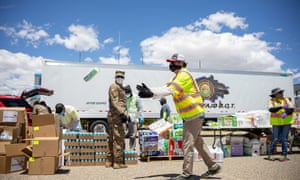
The Navajo Nation president, Jonathan Nez, helps distribute supplies to Navajo families on the Navajo Nation in May.

Pinterest
The Navajo Nation president, Jonathan Nez, helps distribute supplies to Navajo families on the Navajo Nation in May. Photograph: Sharon Chischilly/Getty Images

“The results show the danger in grouping all people of color together when deciding on public health messaging to overcome Covid vaccine hesitancy,” said Abigail Echo-Hawk, director of the national tribal epidemiology centre based in Seattle.

The findings, published last week, have since been incorporated into a public health campaign called “Be a Good Ancestor”, focusing on community responsibility over individualism.

Joe Biden’s national Covid strategy lays out plans to bolster federal resources to speed up the vaccine rollout in Indian Country, as part of the administration’s efforts to improve equity.

Overall, there is no race data for about 42,000 of America’s Covid deaths, which means we do not know the ethnic background of one in 10 people killed by the virus so far, according to the researchers. Perhaps 700 or more Native Americans are likely to be missing from the data.

“The structural racism in the data collection systems makes us invisible by hiding deaths, which perpetuates inequalities and leads to further deaths in our communities, as this information is used to allocate resources,” said Echo-Hawk. “The maze of missing data is part of the genocide that continues to be perpetrated against our people. Their final stories are being lost.”

The data issues have not been fixed over the past year. Instead, the same gaps are now hampering our understanding about the vaccine rollout: almost half the race and ethnicity data is missing from the vaccine recipients, according to the CDC, thwarting efforts to ensure equitable access and accountability.

In states with patchy or no data, it is extremely hard to know whether states and counties allocated vaccine doses for indigenous residents are using them appropriately.

Tribal leaders and health experts agree that while the excessive death toll is shocking, it’s hardly surprising given the chronic structural, economic and health inequalities – such as overcrowded housing, understaffed hospitals, lack of running water, and limited access to healthy affordable food – resulting from the US government’s failure to comply with treaty obligations promising adequate funding for basic services in exchange for vast amounts of tribal land.

After centuries of broken promises, expectations are high given that Native American voters helped Joe Biden win crucial swing states including Arizona, Wisconsin and Nevada to take the White House.

On Wednesday, Biden approved the Navajo Nation’s disaster declaration, which will result in additional federal resources for the tribe as Covid rates again climb.

But longstanding inequalities require transformational changes, and experts are calling on Biden to fully fund the Indian Health Service, for the first time in history, which would enable the yet-to-be-nominated new director to reduce chronic health disparities that have contributed to the high death toll.

“Native people showed up for Biden-Harris. Now it’s time to show up for them,” said Echo-Hawk.

Topics

The post Indigenous Americans Have Highest COVID Death Rate in US appeared first on The St Kitts Nevis Observer.

Premier Brantley reads to Charlestown Primary School students on ‘World Read Aloud Day’

CHARLESTOWN, Nevis — Nevis Premier, Hon. Mark Brantley, Minister of Education and Library Services in the Nevis Island Administration (NIA) visited the Charlestown Primary School (CPS) on February 3, to read for students there on the occasion of “World Read Aloud Day.”

The Premier outlined some of the advantages of reading to the rapt Grade Six class.

“Of course you understand the value of reading,” said Hon. Brantley. “Reading is very important. It allows you to experience things through books that are well beyond the boundaries of Nevis.

“Simply by reading you can transport yourself, you can imagine how things are, and that gives you an experience beyond your classroom, beyond your village, and beyond your island,” he said.

Premier Brantley read from a book entitled “Naughty Eddie Larue,” and cautioned the young students not to misbehave like the main character in the story.

He said later he felt it was important to make time in his busy schedule for an activity such as reading to children.

“I have always found inspiration in books and so I was delighted to participate in this activity,” he said. “Reading is fundamental and encouraging it in our youths should be our duty. Reading helps to widen our horizons and allows our youth to explore the full ambit of their imaginations.”

Hon. Troy Liburd, Junior Minister of Education and Library Services participated in the first production of “Read with me.”

Hon. Troy Liburd, Junior Minister of Education and Library Services also participated in reading activities with the youth.

On January 27, Hon. Liburd participated in the first instalment of “Read with me,” an interactive session of ‘read alouds,’ puppetry, and storytelling for parents and children up to five-years-old.
Continue reading Premier Brantley reads to Charlestown Primary School students on ‘World Read Aloud Day’ →

US Extends Start Nuke Treaty with Russia

The United States has officially extended its last remaining nuclear treaty with Russia for five years.

Secretary of State Antony Blinken announced the extension of the New START treaty in a statement Wednesday morning, two days before the agreement was set to expire.

“Especially during times of tension, verifiable limits on Russia’s intercontinental-range nuclear weapons are vitally important,” Blinken said. “Extending the New START Treaty makes the United States, U.S. allies and partners, and the world safer. An unconstrained nuclear competition would endanger us all.”

Background: New START, which was negotiated by the Obama administration, places caps on U.S. and Russian “strategic” nuclear weapons.

The Trump administration wanted to replace it with a treaty that included China, as well as Russia’s so-called tactical nuclear weapons. But China rejected joining the talks, and Russia wanted a clean five-year extension.

Shortly after taking office, President Biden announced he would pursue that clean five-year extension, which Russian President Vladimir Putin quickly agreed to.

What’s next: In his statement Wednesday, Blinken said the United States will work over the next five years to extend the parameters of the treaty to address all of Russia’s nuclear weapons while also pursuing arms control with China to reduce its nuclear arsenal.

“President Biden has made clear that the New START Treaty extension is only the beginning of our efforts to address 21st century security challenges,” Blinken said. “The United States is committed to effective arms control that enhances stability, transparency and predictability while reducing the risks of costly, dangerous arms races.”

Allies happy: In its own statement Wednesday morning, NATO’s North Atlantic Council said it “fully supports” the U.S. agreement with Russia.

“NATO allies believe the New START treaty contributes to international stability, and allies again express their strong support for its continued implementation and for early and active dialogue on ways to improve strategic stability,” the statement said.

But the alliance also warned that extending the treaty does not eliminate threats posed by Russia.

“Even as the United States engages Russia in ways that advance our collective interests, NATO remains clear-eyed about the challenges Russia poses. We will work in close consultation to address Russia’s aggressive actions, which constitute a threat to Euro-Atlantic security,” the council said in a statement.

The post US Extends Start Nuke Treaty with Russia appeared first on The St Kitts Nevis Observer.

Government to spend over $100 million for social safety support to enhance people’s dignity

BASSETERRE, St. Kitts – The welfare of the people is paramount and Prime Minister Dr. the Hon. Timothy Harris has assured that his Team Unity Administration, which cares for the poor and the vulnerable, will in 2021 spend over $100 million in social safety net support to empower the people and enhance their dignity.

“In 2021, we will spend $43 million to help the vulnerable, the indigent and at-risk members in our society,” said Prime Minister Harris as he addressed the Nation on Tuesday February 2. He updated the progress which his government is making in its endeavours to build a stronger and safer future.

“We could add another $60 million which will help maintain over 3,000 persons on the Skills Training Empowerment Programme (STEP),” said Hon. Dr. Harris. “The amount of over $100 million in the social safety net will be used to empower the people and to enhance their dignity.

“You begin to understand how much my government has done to protect our people from abject poverty and to empower them,” he said. “We do care for the poor and vulnerable.”

In addition to the assistance provided through the programmes the Prime Minister outlined, his Team Unity Administration is creating an environment that is conducive for increased employment opportunities. He assured that his government will always look after workers, noting that work gives people enhanced dignity and confidence.

“We will redouble our efforts to expedite the processing of severance claims,” said Dr. Harris. “To date from claims received as of January 31, 1,121 claims have been processed, and 1,093 have been paid out. Claims are being processed on a first come, first served basis.”

Dr. Harris was accompanied by members of the COVID-19 National Taskforce, Chief Medical Officer Dr Hazel Laws; Medical Chief of Staff at the Joseph N. France General Hospital Dr. Cameron Wilkinson; and Chairman of the National Covid-19 Taskforce Abdias Samuel.

The Prime Minister appealed to employers to pay over their deductions from employees’ payroll as soon as possible.

“Non-payment of contributions by employers is a major source of the delay in the processing of severance claims,” explained Dr. Harris. “Our employees must not wait until they are laid off to ask the Social Security to verify that their contributions were paid by their employers. You must do this regularly.”

Dr. Harris said the Government’s priority for 2021 is to continue protecting the people from the worst effects of COVID-19. He noted that the government’s focus will remain on protecting people’s health and jobs, and protecting their way of life from the Covid-19 ravages.

“Working with you, we will see this pandemic through,” concluded Dr. Harris. “We have a plan to come out the other side a stronger and more unified nation with a renewed sense of purpose. Your Team Unity Government comprising the Peoples Labour Party, the People’s Action Movement, and the Concerned Citizens Movement, is working with you to defeat COVID-19, to deliver better services, to protect jobs and to look after working families.”

The post Government to spend over $100 million for social safety support to enhance people’s dignity appeared first on The St Kitts Nevis Observer.

U.S., China Battling for Influence in Caribbean, Latin America

When Alex Almeida surveys his family farm in a rural corner of landlocked Paraguay, he sees mainly fields, punctuated by small houses with sheet-metal roofs and, in the distance, native lapacho trees blooming with bright yellow flowers.

But despite the isolation, there’s only one place in the world the 23-year-old feels truly cut off from. Paraguayan exports of cows and sheep, like the 130 or so Almeida raises, are locked out of the second largest economy in the world, a source of frustration for an ambitious young farmer and student of agriculture.

“The cell phone I’m speaking to you on now is from China,” he tells TIME from Caaguazú, a town some 100 miles east of the capital, Asunción. “The shoes and clothes that I buy and wear, it all comes from China. So why can’t we export food to China?”

The answer is that Paraguay is one of only 15 countries in the world–including nine in Latin America and the Caribbean–that still don’t recognize the government in Beijing.

In 1957, Paraguay’s recently installed right-wing dictator Alfredo Stroessner recognized Taiwan–an island that politically split from the mainland following China’s 1945–49 civil war, but which Beijing considers a breakaway province–as the “one true China.” In response, China limits trade and diplomacy with Paraguay, just as it does with any country that recognizes Taiwan. “It’s a political thing, and for many of us it’s absurd, really,” Almeida says. “Taiwan helps us a lot, sending donations and financing, but it doesn’t serve us at a great scale.”

In April 2020, as COVID-19 began to tear through Latin America, the leftist bloc in the Paraguayan Senate introduced a bill to open relations with Beijing–which would inevitably mean ending recognition of Taiwan. The Senators argued that the pandemic would make Chinese support–in the form of masks and ventilators, but also investment, trade and possibly a vaccine–crucial in the coming years.

In the end, the proposal was voted down, 25 to 16, in a Senate still controlled by the right-wing party Stroessner founded. Still, opposition lawmakers have forged ahead in deepening their institutional ties with China, eliciting what they described as the first-ever Chinese humanitarian aid to Paraguay in June, and vowing to recognize the country if the balance of power in Congress shifts.

The political debate in Paraguay reflects a broader battle raging across Latin America about China’s swelling influence. As countries in the region grapple with a cascade of challenges to their developing economies, they increasingly look not to the North but to the East. Today, China is South America’s top trading partner.

In 2019, Chinese companies invested $12.8 billion in Latin America, up 16.5% from 2018, concentrating on regional infrastructure such as ports, roads, dams and railways. Chinese purchases of minerals and agricultural commodities helped South America stave off the worst privations of the 2008 financial crisis.

And during COVID-19, Latin America is once again reliant on China, whose middle class drives demand for beef from Uruguay, copper from Chile, oil from Colombia and soya from Brazil. These are the commodities that will help Latin America weather the storm–and China will inevitably be the primary customer. “We’d rather not be so dependent on exports to China, but what is the alternative?” Paulo Estivallet, Brazil’s ambassador to China, tells TIME. “It’s just more profitable to sell here than anywhere else.”

A soybean plantation in Rondonia, Brazil. The country exports 80% of its soybean crop to China

A soybean plantation in Rondonia, Brazil. The country exports 80% of its soybean crop to China

For China, the investment brings political returns. In the past four years, the Dominican Republic, El Salvador and Panama have each switched their recognition from Taiwan to China. Gaining these kinds of alliances in Latin America offers Beijing invaluable votes at the U.N. and backing for Chinese appointees to multinational institutions. It also empowers China to embed standard-setting technology companies like Huawei, ZTE, Dahua and Hikvision–all sanctioned by the U.S.–in regional infrastructure, allowing Beijing to dictate the rules of commerce for a generation.

Already, 19 governments across Latin America and the Caribbean have joined Xi Jinping’s signature Belt and Road Initiative (BRI), a $1 trillion transcontinental trade and infrastructure network. Shanghai-based China Cosco Shipping is building a new $3 billion port at Chancay in Peru, while there are ambitious proposals for a transcontinental railway linking South America’s Atlantic and Pacific coasts from Brazil to Chile.

COVID-19 presented another opportunity. By late October, China had provided over 179 billion masks, 1.73 billion protective suits and 543 million testing kits to 150 countries and seven international organizations around the globe.

“The pandemic has opened up a diplomatic opportunity that China did not have before,” says Benjamin N. Gedan, a former South America director on the White House’s National Security Council, now with the Wilson Center. This has not gone unnoticed by Washington; the U.S. State Department’s J-Bureau–charged with “elevating and integrating civilian security in U.S. foreign policy”–has been parsing China’s mask diplomacy to decipher where Beijing is attempting to gain influence, sources involved tell TIME.

Globally, the lines of a new cold war are gaining definition: the U.S., Europe, India and Pacific allies on one side; China, Russia, Pakistan, Central and Southeast Asia on the other. It’s not yet clear where the “silk curtain” will fall in Latin America. But Beijing’s activity has Washington spooked.

“China is a malign influence,” a senior State Department official tells TIME on condition of anonymity. “This is part of the CCP’s global plan to export Chinese ideals and bad practices beyond the Asia-Pacific,” the official says, referring to the Chinese Communist Party. The question now–with a new occupant of the White House–is what the U.S. will do about it.

Lon Tweeten for TIME

The U.S. has long been chary of interlopers in its southern neighborhood. In 1823, the Monroe Doctrine drew a red line regarding European influence in the western hemisphere, and for decades in the 20th century the U.S. fought the Cold War with Soviet Russia on the turf of Latin nations attracted to Marxism. But President Donald Trump viewed Latin America largely through a caustic lens of drug lords, immigrant caravans and gang violence. His sole visit to the region was the 2018 G-20 summit in Buenos Aires.

Now, with Joe Biden in the White House, the battle for influence is likely to flare up once again. As Vice President, Biden visited the region a record 16 times, and he personifies the “good neighbor” approach to the region crafted by FDR. Biden was Barack Obama’s point person on initiatives to combat violence and drugs in Colombia, political corruption in Guatemala and more. “Joe Biden brings a deeper knowledge of Latin America and the Caribbean to the presidency than any U.S. leader since the end of the Cold War,” says Michael Camilleri, director of the Peter D. Bell Rule of Law Program at the Inter-American Dialogue.

U.S. ties run deep across Latin America, but perhaps deeper in Panama, where the U.S. dominated commerce and politics throughout the 20th century, and which has emerged as a battleground in the superpower contest.

The country’s namesake canal, through which trade flows between the Atlantic Ocean and the Pacific Ocean, was completed by the U.S. Army and controlled by Washington for almost the entire century. In the 1940s, the U.S. Department of Commerce helped set up a free-trade zone in Colón, a city near the canal’s entrance. The Colón Free Trade Zone (ZLC) quickly became a gateway for American firms such as Gillette, Coca-Cola and Pfizer to enter the Latin American market.

Yet today, seven decades later, things have changed in the ZLC. Across its 1,000-hectare sprawl of ports, warehouses and offices, Chinese companies dominate. “China accounts for the largest share of imports that come into the zone, 40% of the total,” says Giovanni Ferrari, manager of the zone. Ferrari says the surge of Chinese products began around 2010, and he expects it to grow as China seeks to boost its trade with the rest of the world in the wake of the pandemic. “China has identified the potential of Panama and [the ZLC] as a reference point for distribution.”

China’s growing commercial presence in the ZLC reflects the enthusiasm it has long had for Panama, which remains a strategic linchpin for Washington. In 2017, China Landbridge Group broke ground on a new $1 billion deepwater port and logistics complex on Panama’s Margarita Island, where the Panama Colón Container Port will take over land once occupied by a U.S. military base. Less than a week after work began, the government of Panama suddenly switched diplomatic recognition from Taipei to Beijing, blindsiding–and infuriating–its Washington allies.

“The United States created Panama and then built one of the engineering wonders of the world and gave it to the Panamanians,” says Thomas Shannon, former Under Secretary of State for Political Affairs from 2016 to 2018 and briefly Acting Secretary of State early in the Trump Administration. “One would hope that was a level of a relationship that allowed them to have a conversation with us to try to understand our point of view. But that didn’t happen.”

The U.S. may have “built” the Panama Canal, but Chinese migrant labor helped hew the 51-mile marvel of engineering from the earth, bestowing Panama with a significant ethnic-Chinese population and opportunities for CCP engagement. Even before the 2017 diplomatic switch, “Panama featured very prominently in Ministry of Commerce and other documents [produced by China] to guide Chinese companies to the region,” says Margaret Myers, director of the Asia and Latin America Program at the Inter-American Dialogue.

After 2017, there was a surge in Chinese investment and commercial deals in Panama amid a visit by Xi, with some 16 significant deals put on the table, including grand infrastructure projects.

Eddie Tapiero, a Panamanian economist who worked on the negotiating team for the Panama-China free-trade agreement (FTA), says the aim was to leverage Panama’s strategic position to boost regional trade. If they could persuade the large Neopanamax boats that deliver goods from

China to the U.S. to pass back through the Panama Canal–which can cost $1 million to traverse–instead of taking cheaper return routes via Europe while empty, they could assemble exports from across the continent in large quantities for dispatch to China. “We saw a big opportunity,” says Tapiero. “All that created a lot of enthusiasm, and we advanced rapidly in our relations.”

But in 2018, the U.S. woke up to what was happening in its backyard and began ratcheting up pressure on Panama. The revelations in the 2016 Panama papers, which exposed the shadowy offshore financial dealings of an elite Panamanian law firm, prompted the U.S. Treasury to place Panamanian businessman Abdul Waked on its “Clinton list” of individuals and businesses banned from dealing with Americans, leading to his bankruptcy.

In June 2019, the U.S. Financial Action Task Force added Panama to its “gray list” of countries not sufficiently tackling money laundering. The next month, a new government took office in Panama and adopted a warier stance on China. At least five of the 16 major Chinese infrastructure projects have since been nixed, according to Myers.

Evan Ellis, a professor of Latin American studies at the U.S. Army War College Strategic Studies Institute, who has advised Congress on China’s expansion in the region, says U.S. pressure helped slow Panamanian engagement with China. “It’s never been pressure to say, ‘You are not allowed to engage with China.’ It’s always been, ‘It’s important you maintain transparency, strong institutions, commitment to the rule of law and equal opportunity,’” he says.

The U.S. may have succeeded in putting a pause on the growth of Panama-China ties, but American diplomats say these kinds of setbacks won’t deter China from further geostrategic needling. “For China, the United States has its navy in the South China Sea, a military ally in Taiwan and has been harassing [them] about Hong Kong,” says Shannon. “So isn’t it great to have a dominant position in the greater Caribbean? That way China can show the United States that we can play in your neighborhood just how you play in ours.”

Taxi drivers in Mexico City protest on Oct. 12 over the rise of foreign ride-share apps including Uber and DiDi

Taxi drivers in Mexico City protest on Oct. 12 over the rise of foreign ride-share apps including Uber and DiDi
Alejandro Cegarra—Bloomberg/Getty Images

It wasn’t long after the embarrassment of Panama’s diplomatic switch that the Dominican Republic and El Salvador followed suit. Alarmed American officials in El Salvador, including U.S. Ambassador Jean Manes, began to speak out about what they described as China’s predatory, coercive dealings with the region.

U.S. diplomats helped expose deals that had been secretly negotiated between Chinese officials and the Salvadoran government, including plans for a special economic zone that would cover 14% of the nation’s territory and half of its coast, but which effectively excluded U.S. companies. When antiestablishment candidate Nayib Bukele won El Salvador’s February 2019 presidential election, he criticized his predecessor’s planned deals with China and renegotiated a much smaller package, according to analysts.

According to Ellis, the pushback in El Salvador had a chilling effect on the rest of the region, which until that point “hadn’t realized how much Washington cared” about deepening ties with China. Washington has also been amplifying criticism of Beijing’s early COVID-19 cover-up, faulty PPE and issues like illegal Chinese fishing off Chile, Peru and Ecuador.

Yet China has won influence not by wielding sticks but by deftly distributing carrots. In Brazil, the region’s largest economy, bilateral trade with China rose from $2 billion in 2000 to $100 billion last year. Today, Brazil sends 30% of all exports to China, including 80% of its soybean crop and 60% of its iron ore. These entanglements are typically tightest with nations with goods to sell; China has supplied over $17 billion in financing to Argentina since 2007, according to Inter-American Dialogue, and is the world’s top importer of Argentine soybeans and beef.

China is also now a preferred lender across the region. It hosts two international development banks–the Beijing-led Asian Infrastructure Development Bank (AIIB) and the New Development Bank (NDB) in Shanghai–that are both expanding their remit across the region. “Infrastructure development has shrunk the distance between Asia and Latin America,” AIIB president Jin Liqun tells TIME in his Beijing headquarters.

That said, plenty of Chinese-backed infrastructure projects have left host countries with regrets. In Costa Rica, a $1.5 billion project to modernize and expand an oil refinery in Moín was canceled in 2016 after local officials highlighted that environmental-impact and feasibility studies had been performed by a subsidiary of the Chinese partner, a clear conflict of interest that led to several arrests.

In Ecuador, a hydroelectric dam built by China’s Sinohydro Corp., with help from a $1.7 billion loan from China’s Export-Import Bank, turned into an environmental disaster after it opened in 2016 as upstream erosion from the dam’s basin contributed to oil spills from shifting pipelines. Most of the Ecuadorean officials involved in the project have been convicted of bribery, including a former Vice President, a former Electricity Minister and even a former anticorruption official.

But China’s clout in renewable energy has mostly won it advantages. “No country has put itself in a better position to become the world’s renewable energy superpower than China,” says a recent report by the Global Commission on the Geopolitics of Energy Transformation, chaired by former Iceland President Olafur Grimsson.

In Brazil, China’s State Grid Corp. is the largest power-generation and -distribution company, while China Three Gorges (CTG), the world’s largest hydropower provider, controls 17 out of a total of 48 hydro plants as well as 11 wind farms. “This is a country that has 200 million people, but energy consumption per person is still very small,” says CTG Brazil CEO Li Yinsheng. “So we see huge potential in terms of demand.”

The U.S. is not taking this lying down. In 2018, it launched its América Crece initiative as a direct competitor to Belt and Road. It helps countries attract private investment by establishing transparent rules according to international best practices. In January, the U.S. International Development Finance Corp. unveiled a $1 billion injection into Guatemala’s private sector to spur investment and create jobs, with the aim of catalyzing an additional $4 billion in private investment.

In September 2019, Ivanka Trump traveled to Paraguay to launch a trilateral commitment under the U.S. Overseas Private Investment Corp.–now the U.S. International Development Finance Corp.–that doubles an existing $500 million pledge of support for women and small and medium-size enterprises (SMEs), including a $138 million commitment from Taiwan.

To be sure, the U.S. also has over a century of trade, aid and investment to fall back on. Latin America has historically been the part of the world with the highest approval rating for the U.S., rooted in foreign assistance, law-enforcement cooperation, education and cultural ties. In 2019, China’s trade with the western hemisphere stood at $330 billion, with FDI stock at $180 billion. The U.S.’s was $1.9 trillion and $250 billion, respectively.

But perception is reality, and plenty were skeptical of the previous White House’s outreach in the last two years of Trump’s term. “The only way the Trump Administration saw Latin America is through the prism of competition with China,” says Gedan, of the Wilson Center. Trump’s more controversial moves also had deleterious side effects. Honduran President Juan Orlando Hernández in 2018 criticized U.S. cuts to Central American aid over migration policy, while saying he welcomed the “opportunity” China presented.

If, under Biden, the U.S. continues to push regional players into a corner, it’s no sure thing whom they would choose. “If you press these countries too hard, beware,” says Enrique Dussel Peters, an expert in China–Latin America relations at the National Autonomous University of Mexico. “They might say, ‘Huh, O.K., then I stick with China.’”

A grocery near a satellite-tracking station China opened in Argentina in 2018

A grocery near a satellite-tracking station China opened in Argentina in 2018
Mauricio Lima—The New York Times/Redux

The pandemic has opened up new avenues in the struggle for influence. Latin America and the Caribbean have only 8.2% of the world’s population but, as of late January, 18.2% of COVID-19 cases and 26% of fatalities. Shipments of Chinese aid have elicited fawning praise from previously China-skeptic leaders like Argentina’s President Alberto Fernández, who wrote a letter in January that “thanked China for supporting Argentina’s fight against COVID-19” and backed “building a community with a shared future for mankind, a notion put forward by Xi,” according to China’s state newswire Xinhua.

The U.S. State Department is engaged in its own counter-operation, sources tell TIME. By cross-referencing pure numbers of PPE dispatched by Beijing and private Chinese entities like the Jack Ma Foundation with medical need and existing cordial ties, Washington is learning where China is placing strategic bets and deciding where to send its own coronavirus aid to compete most effectively.

Of course, the prospect of a vaccine would be “an extraordinary diplomatic tool anywhere in the world, especially in Latin America,” says Gedan. China currently has at least four vaccines in advanced development, including SinoVac’s CoronaVac, which is undergoing Stage 3 trials in Brazil. “We will share our vaccine with the world,” SinoVac CEO Yin Weidong tells TIME in his Beijing office. Yet as the Chinese government is a key investor, it gets a say regarding distribution, Yin says.

In theory, every nation in Latin America could access the World Health Organization global vaccination pool known as COVAX (operated locally through the Revolving Fund of the Pan American Health Organization, or PAHO).

But on Jan. 18, WHO chief Tedros Adhanom Ghebreyesus said the world is on the brink of a “catastrophic moral failure” over COVID-19 vaccine distribution as he bemoaned how rich countries had hoarded supplies at the expense of equitable distribution schemes like COVAX. The U.S.’s refusal to join COVAX means the program may lack the necessary funds to meet its goal of 2 billion doses to distribute worldwide by the end of 2021.

China also declined to join COVAX, though it is instead using vaccines to build bridges where it feels most valuable. In September, São Paulo Governor João Doria said Brazil’s federal government had also agreed to buy 60 million doses of CoronaVac, later telling reporters it “is the safest, the one with the best and most promising rates.” On Jan. 6,

Peru’s President Francisco Sagasti announced the purchase of 38 million vaccine doses from state-run Chinese firm Sinopharm. Mexico has signed an advance-purchase agreement with another Chinese developer, CanSino Biologics, for 35 million doses of a single-dose immunization under development.

Admiral Craig S. Faller, who leads the U.S. military’s Southern Command, told a video meeting with members of the Defense Writers Group in December that China is actively making “deals to try to get the vaccine deployed and employed” around the globe, while Washington’s Operation Warp Speed is “looking at taking care of the U.S. first.”

Given delays and doubts regarding COVAX supply, Paraguay in January approved Russia’s Sputnik V vaccine for emergency use, despite questions over the rigor of testing, and it is currently in negotiation with two unnamed pharmaceutical firms about buying supplies directly.

Whether or not a Chinese vaccine makes it into Paraguay will intensify arguments about the merits and pitfalls of politically sidelining Beijing, not least as China starts rewarding its closest allies. On Jan. 21, Pakistan’s Foreign Minister revealed that China has agreed to provide his nation with half a million doses of Sinopharm’s vaccine free of charge, with further supplies promised.

That generosity won’t go ignored in Latin America as the human and economic toll from the pandemic mounts. In January, Sixto Pereira, an opposition Senator in Paraguay who earlier coordinated the Chinese donation of PPE, accused the country’s government in local media of bowing to U.S. pressure in rejecting offers of vaccine support from China.

“We must overcome political and ideological barriers if we’re going to fight the evil of the pandemic,” he says. It may be a simple reading of geopolitics, but it’s a frustration that many in Latin America are feeling as the region navigates not only its path out of COVID-19, but also its road to future trade and development in the emerging world order. “The Berlin Wall fell, the Cold War finished,” Pereira says. “In this globalized world, we don’t want to be any country’s backyard.”

With reporting by Madeline Roache/London

This appears in the February 15, 2021 issue of TIME.

S

The post U.S., China Battling for Influence in Caribbean, Latin America appeared first on The St Kitts Nevis Observer.
CARICOM in Worldwide COVID Vaccine Quest

Caribbean Community countries are shopping around the globe to acquire doses of the COVID-19 vaccine, with some nations eying supplies from Cuba, China and the Middle East while hoping that the World Health Organization (WHO) could also help them obtain the medicine to begin vaccinations in the coming weeks.

The 15-nation bloc has even called for a global summit on the issue “to discuss equitable access and distribution of the COVID-19 vaccines,” saying that “the reality is that small states will find it difficult to compete in the marketplace to ensure equitable access for vaccines.

“The inextricable link economically, socially, and by virtue of travel with our neighbors and the wider international community, makes it imperative for Caricom member states to be afforded access to vaccines as a matter of urgent priority. This action will be mutually beneficial in breaking the transmission of the virus,” the bloc said in a recent statement.

Most of the larger nations, including The Bahamas, Jamaica, Trinidad, Barbados, Guyana and Suriname have stepped up efforts to fly in supplies and some leaders like Prime Minister Mia Mottley of Barbados have moved to lead by example taking the first dose from a small number of supplies the island acquired in the last month.

Trinidadian colleague Keith Rowley has, as well, publicly vowed to also lead the way when doses arrive in his oil and gas-rich twin island republic with Tobago. In most of the countries in the region, leaders have already said that taking the stab in the arm would not be in any way mandatory.

Over the weekend, Guyanese President Irfaan Ali says authorities are working toward eventual herd immunity even as China has offered to donate 20,000 doses of its version of the COVID-19 vaccine.

“We are pursuing all avenues to get as much vaccines to cover the population as quickly as possible. China has confirmed that it will be donating 20,000 doses of vaccines to Guyana. Discussions are ongoing and arrangements to acquire vaccines from these countries will be finalized shortly.” Distribution will be free Ali said.

In neighboring Trinidad, PM Rowley urged locals to prepare to take the vaccine, reminding citizens that they have nothing to fear.

“As long as it is signed off by WHO as the scientific product for this purpose, I have no hesitation in taking it myself or recommending it for my family. There is nothing that you can offer to the world that will get 100% support from the human population and therefore, I will not be fazed by the comments about what vaccines we can and cannot get.”

Meanwhile, the Inter-American Development Bank (IDB) has approved a $20 million loan to The Bahamas to acquire stocks and improve institutional capacity to deal with the pandemic IDB President Mauricio Claver Carone said.

“This will facilitate access to the vaccine, it will also create an executing agency for it that is going to strengthen the Ministry of Health. Of that $20 million, $4.5 million is to be directly allocated to the purchase of the vaccine and the remainder will go toward the infrastructure surrounding its distribution. We feel very confident. We have been working very closely with the Bahamian authorities in order to execute this plan. We don’t want it to be reactive, we want to be proactive.”

The efforts to acquire vaccines comes as several countries including Suriname, St. Vincent, Barbados and The Bahamas have either extended nighttime curfews or have moved to tighten regulations regarding commercial and social activities among their citizens as positive numbers have spiked in the days after the Christmas holidays.

For those largely dependent on tourism, mass cancellations of tourists and business flights from Canada and The United Kingdom have only served to pile on the economic fallout from the pandemic as commercial activities have been severely reduced.

The post CARICOM in Worldwide COVID Vaccine Quest appeared first on The St Kitts Nevis Observer.