Tag Archives: caribbean

Mexican Criminal Gangs Exploiting Agony of Virus Patients

MEXICO CITY (AP) — Mexico continued to post near-record rates of coronavirus deaths Tuesday, and the huge demand for oxygen canisters has led to frauds, robberies and other crimes against families trying to care for relatives at home.

Mexico posted a near-record 1,743 newly confirmed COVID-deaths, bringing the total to over 152,000, and 7,165 new infections.

Hospitals in some parts of Mexico are almost 90% full, forcing families to treat their relatives at home. But the oxygen tanks they rely on have been the object of thefts, hijackings and fraud.

President Andrés Manuel López Obrador continued fighting the virus in isolation at his apartment, and Assistant Health Secretary Hugo López-Gatell said he was doing well and “has minimal symptoms.”

“On Sunday he had a headache, but apart from that he hasn’t had any other symptom” besides a low fever, López-Gatell said.

While the president was getting care from a team of top doctors, and the country’s richest man quickly was admitted to a top hospital, treatment for average Mexicans remained difficult and dangerous.

The head of the country’s consumer protection agency, Ricardo Sheffield, reported Tuesday that hundreds of ads have been found offering industrial oxygen cylinders — used by torch and welding operators — for medical use.

“These are stolen cylinders, for industrial use, you can’t use them to breathe,” Sheffield said. In other cases, fraudsters advertised tanks or oxygen concentrators at excessive prices, or accepted deposits and then disappeared.

“You are throwing away your money and they probably won’t deliver anything,” he said.

Sheffield said police have forced the removal of 700 Facebook pages and 100 internet offers that were found to involve fraudulent or abusive offers of oxygen equipment. There have been several armed robberies of oxygen cylinders in recent weeks in Mexico, and hijackings of trucks delivering the canisters.

And on Tuesday, Mexico City police arrested a couple who posed as sellers of disinfectant liquids and gels whose use has skyrocketed in the pandemic. Once a potential customer showed up to the apartment they were using, the man and woman would kidnap the person and demand a ransom. Police believe they were involved in at least three such crimes.

Sheffield said the government had reached an agreement with companies that produce oxygen to purify and certify their product so that as much as 70% of what normally goes for industrial use, could be used to treat patients instead.

He also said that northern states could start to import oxygen from the United States.

Most of all, he urged Mexicans who bought canisters as a precaution, or who had finished using them, to turn them in so others could use them, noting “Returning a tank saves lives.”

While there are long lines at oxygen-refill outlets, authorities have said the bigger problem is a lack of tanks to store the gas in.

The post Mexican Criminal Gangs Exploiting Agony of Virus Patients appeared first on The St Kitts Nevis Observer.

Int. Holocaust Memorial Day & Plans for a New Ukraine Memorial

Today marks Holocaust Memorial Day. But for many of the people and nations commemorating it this year, it will be an Internet event. In Ukraine, 2021 has a special significance.

A foundation established to commemorate one of the most horrific massacres of the Second World War at Babyn Yar in Ukraine has unveiled its construction plans for one of the world’s largest Holocaust memorial centres, which is to include a synagogue, church and mosque, a research centre and two museums to commemorate both the atrocities at the site and the wider genocide against Eastern European Jews.

In an announcement to coincide with International Holocaust Remembrance Day, the Babyn Yar Holocaust Memorial Center said it plans a dozen buildings at the site on the outskirts of Kiev to remember the 100,000 victims shot there by the Nazis, including Jews, Ukrainians, Roma and the mentally ill.

The new plan for a complex replaces an initial concept for one large museum at Babyn Yar, says Robert Jan Van Pelt, a professor at the University of Waterloo in Canada, who chaired the group behind the master plan for the museum at Auschwitz and is now a member of the architectural board for Babyn Yar.

The site on the outskirts of Kiev will commemorate the 100,000 victims shot there by the Nazis © Manuel Herz Architekten.

The initial concept entailed a museum on the scale of the Museum of the History of the Polish Jews in Warsaw in an imposing building designed by a star architect, Van Pelt says.

“For many reasons it appeared that in the end, it was the wrong program, and what the foundation has been doing in the past year is to rethink again from scratch,” he says. “This will be a number of smaller projects, that that will go over time—there will be a 10-, 15-, 20-year kind of horizon not necessarily to make a really big statement. This also allows us to work more experimentally.”

“One of the principles the architectural board has established now is that we’re not going to really penetrate the site, we do not want to excavate, we do not want to create a big building that sits heavily on it.” He says a synagogue that is scheduled to open later this year, designed by Manuel Herz, “touches very lightly” on the site of what the foundation describes as Europe’s largest mass grave.

Herz says he has obtained a construction permit for the synagogue and plans to start building soon, with completion due by late spring or early summer. The design resembles a flat vertical book that unfolds into a space of about 80 sq. m. Its inspiration, Herz says, is a pop-up book that reveals “a whole new world, a cabinet of wonder.”

This year marks the 80th anniversary of the murder of 33,771 Jews in just two days at Babyn Yar in September 1941, one of the earliest massacres of the Holocaust. But for Van Pelt, it is also important to commemorate Jewish life in Ukraine, given that the region was, he says, “the heartland of European Jewry for many, many centuries.” The site will also address the denial of Jewish history since 1945, he says.

“After 1945, the Soviet regime had a vested interest in suppressing the history of the Holocaust in the Soviet Union as a Jewish tragedy,” he says. “They always coded the murder of the Jewish simply as the murder of Soviet citizens. So the Soviet regime didn’t want to do anything with this site.”

It is the day we remember the millions of people who died during the Holocaust, under Nazi persecution, and in the genocides that followed in Cambodia, Rwanda, Bosnia and Darfur.

Held every year, it falls on the anniversary of the liberation of the Auschwitz-Birkenau concentration camp, where more than a million people died during the Second World War.

The theme for this year is ‘Be the Light in the Darkness’.

It encourages us all to reflect on the depths humanity can sink to, but also the ways individuals and communities resisted that darkness to ‘be the light’ before, during and after genocide.

The post Int. Holocaust Memorial Day & Plans for a New Ukraine Memorial appeared first on The St Kitts Nevis Observer.
NIA advises on beautification of public spaces

CHARLESTOWN, Nevis — A notice from the Premier’s Ministry in the Nevis Island Administration (NIA) encourages the beautification of public spaces.

“The Nevis Island Administration commends acts of volunteerism by civic minded individuals or groups in our communities,” said the notice. “We are mindful that such participation should be encouraged.

“The Administration, however, reminds the public that all plans for beautification or modification to public spaces or infrastructure must be in keeping with the law and must first be approved by the relevant ministries.

“Everyone is asked to be guided accordingly.”

The post NIA advises on beautification of public spaces appeared first on The St Kitts Nevis Observer.

Youth Empowerment Department calls for youth organizations to register before Jan. 31

BASSETERRE, St. Kitts — Youth-oriented and youth-led organizations in St. Kitts and Nevis are strongly encouraged to register or re-register in some cases, with the Department of Youth Empowerment on or before January 31.

Fifty-three organizations completed the hassle-free registration in 2020. They had access to numerous opportunities: access to technical expertise; networking opportunities with other organizations and agencies; and access to materials and resources. In the past, organizations received assistance with cots, stoves, easels, and projectors.

“We know that there are several groups that exist that did not register with the department and we would love to welcome them under our tent,” said Maluska Douglas, who is spearheading the registration effort.

She said each registered group is now provided with a certificate from the Department of Youth Empowerment that they can proudly display. The certificate proves registration, which is required by some regional and international agencies.

Another benefit of registration is access to grant funding opportunities from various institutions. Registrants can also apply for duty-free concessions from the Ministry of Finance through the Department of Youth Empowerment.

Registration can be completed at the Department of Youth Empowerment located on the top floor of the Cable Building on Cayon Street. Information can be obtained by calling 467-1393, or on Facebook @SKBYouthEmpowerment.

The post Youth Empowerment Department calls for youth organizations to register before Jan. 31 appeared first on The St Kitts Nevis Observer.

Venezuela: Maduro Touts Secret Corona Miracle Cure

CARACAS, Venezuela (AP) — Venezuela’s President Nicolás Maduro appears to be counting on yet another “miracle” to save his citizens from COVID-19, promoting a secretive solution with no published scientific evidence he claims will conquer the new coronavirus.

“Ten drops under the tongue every four hours and the miracle is done,” Maduro said in a televised appearance on Sunday. “It’s a powerful antiviral, very powerful, that neutralizes the coronavirus.”

But his government has released no evidence. He even kept secret the name of the “brilliant Venezuelan mind” behind it, saying he needed to protect them. Scientists at home and abroad remained skeptical. The local National Academy of Medicine said it appeared be derived from the common herb thyme.

It’s not the first time the Venezuelan leader has promoted a cure. In October, he notified the Pan American Health Organization that Venezuelan scientists discovered a molecule that nullifies the replication capacity of the new coronavirus. He hasn’t spoken of that development since. He’s also promoted a special herbal tea he claims can fend off the virus and other ailments.

Other leaders too have embraced solutions dismissed by scientific studies. Former U.S. President Donald Trump and Brazil’s Jair Bolsonaro both stubbornly touted an antimalarial drug despite repeated studies finding it ineffective and possibly dangerous.

The new coronavirus hasn’t hit Venezuela as hard as other South American countries such as Brazil, Ecuador and Peru, though many experts say that’s likely because sanctions against Maduro’s government have sharply limited travel there.

Maduro said the treatment, which he called carvativir, has been under testing for nine months among Venezuelans ill with the coronavirus. He said he plans to distribute it nationwide and to other nations as well.

Dr. David Boulware, professor of medicine and an infectious diseases physician at the University of Minnesota Medical School, noted the lack of scientific evidence.

“This is, just as with other things, people trying to sell, you know, some magic beans as the solution to a complex problem,” Boulware told The Associated Press on Tuesday. “This would be great if it worked, but I would like to see the data.”

Venezuela’s National Academy of Medicine said “it’s prudent … to wait for more data from the carvativir tests according to international protocols.”

Since October, Venezuela has been part of trials for the Sputnik V vaccine from Russia, a staunch ally of Maduro’s government. Venezuela signed a contract in December with Russia to buy the vaccine, but inoculations aren’t scheduled to start until April.

Rosa Colina, 58, said authorities should do more to get Venezuelans vaccinated sooner. She said colleagues at a local health center and some neighbors have died from COVID-19.

“I’m of the mind that we need the vaccine, not these droplets,” she said. “I think that won’t have any effect.”

The post Venezuela: Maduro Touts Secret Corona Miracle Cure appeared first on The St Kitts Nevis Observer.

New Poll: Climate Change a Global Emergency

Despite the pandemic, almost two thirds of people around the world now view climate change as a global emergency.

That’s the key finding from the largest opinion poll yet conducted on tackling global warming.

More than a million people in 50 countries took part in the survey, with almost half the participants aged between 14 and 18.

Conserving forests and land emerged as the most popular solution for tackling the issue.

So who has taken part?

The poll, called the “People’s Climate Vote”, has been organised by the United Nations Development Programme in conjunction with Oxford University.

The organisers distributed poll questions through adverts in mobile gaming apps across 50 countries, between October and December last year.

strikeimage copyrightNurPhoto
image captionHuge numbers of 14-18 year olds took part in the poll

Around 1.22 million people of all genders, ages, and educational backgrounds took part, but with significant numbers of younger people.

Some 550,000 people aged 14-18 took part.

What were the key findings?

Across all countries, 64% of participants saw climate change as an emergency, requiring urgent responses from countries. The margin of error was +/- 2%.

This result varied somewhat by age and location.

In the UK and Italy, 81% agreed with the question, while this dropped to 50% among those responding from Moldova.

Newly installed US President Joe Biden can take some comfort that 65% of those in the US taking part now view climate change as an emergency.

firesimage copyrightGetty Images
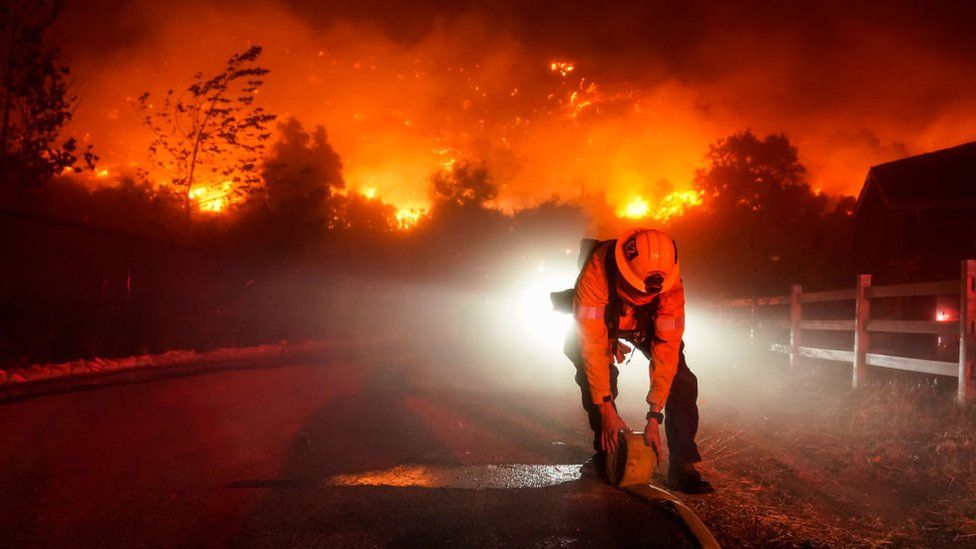
image captionFires in California and Australia have influenced people’s views on climate change

Overall, younger people were more likely to agree with the view that rising temperatures were an emergency, with nearly 70% in favour.

For people over the age of 60, this dropped to 58%.

“People are scared, they are seeing the the wildfires in Australia and California, they’re seeing the category five storms and in the Caribbean, they are seeing flooding in in Southeast Asia,” said Cassie Flynn, strategic adviser to the UNDP.

“And they’re looking around them and they’re saying, this is a real problem. We have to do something about this.”

Most popular policies

The actions that people tend to favour when it comes to tackling climate change depend, to some extent, on where people live.

In eight of the 10 countries with the highest emissions from generating electricity, there were majorities in favour of using more green energy.

Kerryimage copyrightGetty Images
image captionFormer Secretary of State John Kerry is the new climate czar in the Biden administration

But in countries with bigger emissions from deforestation and land use changes, there was majority support for conserving forests and land.

This emerged from the overall survey as the most popular policy for dealing with climate change, by a narrow margin.

2px presentational grey line

Top four policies to tackle climate change:

  1. Conserve forests and land (54%)
  2. Use solar, wind and renewable power (53%)
  3. Climate friendly farming techniques(52%)
  4. Investing more money in green businesses and jobs (50%).

The post New Poll: Climate Change a Global Emergency appeared first on The St Kitts Nevis Observer.

COVID: US Disease Center Urges Schools to Reopen, Jan. Deadliest Month

In the US, where cases have fallen by about 30% over the past two weeks (see previous write-up), the Centers for Disease Control and Prevention called for schools to begin returning students to the classroom.

The decision cited accumulating evidence in districts where schools have opened that in-person learning has not contributed meaningfully to community spread of the virus, assuming mitigation measures were in place. See an overview of the data here.

However, January has already become the worst month for US Covid-19 deaths since the start of the pandemic.

As of Tuesday, there have been more than 79,000 coronavirus fatalities, topping the previous record set in December by more than a thousand, according to data from Johns Hopkins University.
The grim milestone underpins the growing demand from state officials for more vaccines so that Americans can be inoculated more quickly.

The total number of COVID-19 cases reported worldwide has surpassed 100 million, with more than 2.1 million deaths (see dashboard). Five countries—the US (25 million), India (11 million), Brazil (8.8 million), Russia (3.7 million), and the UK (3.7 million)—make up more than half of all reported cases.

Separately, Johnson & Johnson said it was on track to produce 100 million doses of its COVID-19 vaccine by June, and would present efficacy data early next week. Pending approval, it would become the third available vaccine in the US. Unlike the existing two vaccines, it requires only one shot and can be stored at standard refrigerator temperatures for up to three months (how it works).

As of this morning, the US had distributed more than 44 million vaccine doses, with about 23.5 million administered. Roughly 4,100 COVID-19 deaths were reported yesterday, bringing the total in the US to just over 425,200. See rolling averages for cases and deaths.

The post COVID: US Disease Center Urges Schools to Reopen, Jan. Deadliest Month appeared first on The St Kitts Nevis Observer.

Caribbean Story and Author in Book of Year Win

BBC- The Mermaid of Black Conch, a dark love story about a fisherman and a mermaid torn from the sea, has won the Costa Book of the Year award.

Trinidadian-born British writer Monique Roffey beat four other contenders with her sixth novel to scoop the £30,000 prize.

Judges said the book was “utterly original… and feels like a classic in the making”.

A “delighted” Roffey said her win was a vote for Caribbean literature.

“A huge thank you to the judges for exposing my book to a wide readership. I’ll be pinching myself for weeks to come,” she added.

Based on a Taino legend of a beautiful woman transformed into a mermaid, the story is set in the Caribbean village of St Constance.

David, a fisherman, unexpectedly attracts the attention of Aycayia, a mermaid who is drawn to his singing. When she is captured from the sea during an annual fishing competition, he does all he can to save her, with dramatic consequences.

Professor Suzannah Lipscomb, chair of judges, said: “The Mermaid of Black Conch is an extraordinary, beautifully written, captivating, visceral book – full of mythic energy and unforgettable characters, including some tremendously transgressive women.”

line

Analysis from Rebecca Jones, BBC Arts correspondent

The Costa Book Awards have a reputation for picking popular reads: books you would recommend to a friend. And I would definitely recommend The Mermaid of Black Conch.

At first, the novel might sound a bit odd. Set on a Caribbean island in the 1970s, it is a bittersweet love story between a beautiful young woman cursed to live as a mermaid and a fisherman.

Based on a legend passed down by the indigenous people of the Caribbean, the Taino, there are touches of magic and snippets of poetry. The book was also shortlisted for the Goldsmiths Prize last year, which rewards fiction that breaks the mould or extends the possibilities of the novel.

But while it is unusual it is also a joy to read, brimming with memorable characters and vivid descriptions.

We see the mermaid’s “hair flying like a nest of cables” while we are told “sea moss trailed from her shoulders like slithers of beard” and “barnacles speckled the swell of her hips.”

For me, this was a hugely entertaining and thought-provoking novel and a worthy winner.

line

Caribbean representation

Roffey, a senior lecturer in creative writing at Manchester Metropolitan University, secured her publishing deal through Peepal Tree Press, an independent publisher supporting Caribbean writers.

She then crowd-funded her publicity campaign with the support of fellow authors.

Monique Roffey's book coverimage copyrightCosta Awards
image captionThe Mermaid of Black Conch is set in the Caribbean

Roffey’s entry was also named Costa’s Novel of the Year earlier this month, alongside winners from four other categories:

  • First Novel Award – Love After Love by Ingrid Persaud
  • Children’s Book Award – Voyage of the Sparrowhawk by Natasha Farrant
  • Poetry Award – The Historians by Eavan Boland
  • Biography Award – The Louder I Will Sing by Lee Lawrence

The Mermaid of Black Conch is the thirteenth novel to take the overall prize. Days Without End by Sebastian Barry was the last novel to be named Costa Book of the Year in 2016.

Tuesday’s virtual ceremony also saw London-based writer Tessa Sheridan receive the 2020 Costa Short Story Award.

Sheridan won the public vote and £3,500 for her story, The Person Who Serves, Serves Again.

The Costa Book Awards, formerly the Whitbread Book Awards, were established in 1971 to encourage, promote and celebrate the best contemporary British writing.

It is open to UK and Irish authors.

Seamus Heaney, Ted Hughes and Sebastian Barry are among the authors to have won the book of the year award more than once.

line

The post Caribbean Story and Author in Book of Year Win appeared first on The St Kitts Nevis Observer.

Coronavirus: Barbados Returns to Lockdown

The Caribbean island nation of Barbados will return to a two-week lockdown next Wednesday, which includes wearing a face mask in all public places, as part of an initiative to curtail a rise in COVID-19 cases.

Prime Minister Mia Mottley announced Tuesday night that from February 3 to February 17, a 7:00 pm to 6:00 am curfew will be in effect.

She also announced that the country had confirmed three cases of the easily spread British strain of the virus.

Motley said the rise in COVID-19 cases coupled with the deaths of three elderly people within a week prompted her to bring back the restrictions.

Essential businesses such as supermarkets, pharmacies and gas stations will continue to operate during the lockdown.

Supermarkets will only open from 8:00 am to 3:00 pm Monday through Friday during the lockdown.

All other businesses, including bars, restaurants and gyms will close during the lockdown. Banks are excepted, shutting down for just six days, February 3 to 9.

Barbados has recorded more than 1,400 COVID-19 infections and 10 deaths, according to Johns Hopkins University COVID Resource Center.

The post Coronavirus: Barbados Returns to Lockdown appeared first on The St Kitts Nevis Observer.

Trump Likely to Skate Free at 2nd Senate Trial

Senate Republicans seem ready to hand former President Trump his second acquittal in an impeachment trial in a little more than a year after just five GOP senators on Tuesday rejected a motion that the trial was unconstitutional.

Most GOP senators haven’t formally announced how they will vote on convicting Trump, and, in a shift from 2020, most are not rushing to defend him after a mob, egged on by the then-president, sacked the Capitol.

But Tuesday’s vote, which sidelined the effort from Sen. Rand Paul (R-Ky.), sends a clear signal to everyone in Washington that the trial is highly unlikely to end with a Trump conviction vote.

At least 17 GOP votes to convict would be needed to reach the two-thirds majority.

“I can’t see how you get 17. I think that that was a test vote,” said Sen. John Boozman (R-Ark.) after 44 GOP senators sided with Paul.

While it is possible senators could change their minds, few think that is likely.

Sen. Mike Rounds (R-S.D.) said the Tuesday vote was a “pretty good indication” that most Republicans don’t believe the trial is constitutional.

“It would really surprise me if any of those individuals decided that it was appropriate to move forward with an impeachment,” Rounds said.

Sen. James Inhofe (R-Okla.) said the vote was a “good indication” of where the final vote on convicting Trump would end up, while Paul declared the chances that Trump would become the first president to be found guilty “dead on arrival.”

The vote comes as Republicans have been increasingly signaling they view the impeachment trial as unconstitutional. Trump will be the first president to have a trial after leaving office, but the Senate previously held a trial for a Cabinet official who was no longer in office.

“We’re now being asked to convict a president who’s been impeached and he’s no longer in office. To me, this lacks legitimacy as I read the Constitution,” said Sen. John Barrasso (Wyo.), the No. 3 GOP senator.

Sen. Joni Ernst (R-Iowa) said in a statement that while Trump’s rhetoric on Jan. 6 showed “poor leadership,” she was also concerned that “the president is no longer in office” and Congress could be “opening itself to a dangerous standard.”

Asked about the upcoming trial, Ernst told reporters that Tuesday’s vote shows “they’ve got a long ways to go to prove it.”

Barrasso and Ernst joined with every other member of GOP leadership to vote against tabling Paul’s efforts to deem the impeachment trial unconstitutional.

Senate Minority Leader Mitch McConnell (R-Ky.), who said last week that Trump “provoked” the mob, supported Paul’s efforts.

Some Republicans cautioned against mapping the vote total on Paul’s effort as a direct correlation of what the breakdown will be on the final vote on convicting Trump.

Sen. John Thune (R-S.D.) called Tuesday’s vote “indicative of where a lot of people’s heads are” but stressed that he didn’t think it binded anyone into voting to acquit Trump at the end of the trial.

“I think most of us thought that the threshold issue of whether or not you can remove, as the Constitution suggests, somebody who’s no longer in office … from a constitutional standpoint, it’s on really shaky ground,” Thune said.

Sen. Rob Portman (R-Ohio), who voted against tabling Paul, said he wasn’t voting to say a trial would not be constitutional but was voting to say the issue should be discussed. Tuesday’s vote effectively pigeonholed Paul.

“I mean, I’ve the same position Mitch McConnell has. He didn’t do that to be tabled either, even though he wants to have, you know, a fulsome discussion,” Portman said.

He added that he viewed Tuesday’s vote and whether he would ultimately vote to acquit Trump as “a totally different issue, as far as I’m concerned.”

Republicans have questioned if the Senate, by moving forward, would be setting a precedent under which Republicans, once they are back in the majority, could reach back and try to impeach former presidents, in a warning shot to Democrats.

“Could we go back and try President Obama?” asked Sen. John Cornyn (R-Texas), an adviser to McConnell.

Sen. Thom Tillis (R-N.C.) told reporters that Republicans were looking at the “broader issue” about impeaching a private citizen and viewed the current discussion as “kind of laying down a marker.”

Republicans got a closed-door briefing on Tuesday from legal professor Jonathan Turley, where they quizzed him and discussed the constitutionality of holding an impeachment trial after a president has left office.

Sen. Lisa Murkowski (R-Alaska) appeared frustrated by the decision to force a vote, a move that appeared to catch GOP senators off guard, without more briefings and discussion within the caucus.

“Whether or not you’re going to see members change their mind after they’ve already taken a vote? I think that’s hard for people to do,” Murkowski added.

Asked about the implications for the outcome of the Senate trial, Sen. Susan Collins (R-Maine), who was also one of the five to oppose Paul, replied, “Just do the math.”

“It is extraordinarily unlikely the president will be convicted,” Collins said.

The GOP strategy is a sharp shift from 2020, when Republicans were pledging publicly that they would acquit Trump and defended him publicly throughout the trial.

Republicans fumed after Trump urged his followers to march to the Capitol, repeating his false claims that the election was “rigged.” And McConnell disclosed on Tuesday that he hadn’t spoken to Trump since Dec. 15.

But Democrats are worried that the argument that the trial is unconstitutional is giving Republicans an option that GOP senators view is politically safe because it allows them to vote against convicting Trump, without having to specifically endorse his Jan. 6 rhetoric.

Sen. Tim Kaine (D-Va.), who has floated trying to bar Trump from office through the 14th Amendment, warned that the constitutional argument, which Sen. Tom Cotton (R-Ark.) articulated weeks ago, was emerging as a “safe harbor” for Republicans.

“I think Cotton has given Republicans a safe place to land. ‘I don’t like the behavior, but I’m not sure you can convict.’ And whether or not that’s the right legal answer or not I think that’s a safe harbor,” Kaine said.

The post Trump Likely to Skate Free at 2nd Senate Trial appeared first on The St Kitts Nevis Observer.