Tag Archives: caribbean

NIA announces National Day of Prayer and Thanksgiving

CHARLESTOWN, Nevis — The following is an announcement from the Premier’s Ministry in the Nevis Island Administration regarding a National Day of Prayer and Thanksgiving.

Thursday, January 28, 2021, has been designated as a National Day of Prayer and Thanksgiving to express gratitude to Almighty God for His providence and goodness during the past year, and to plead for His continued guidance and protection in 2021.

All churches on the island of Nevis will therefore be open on January 28 from 8:00 a.m. until 8:00 p.m. to allow the general public to enter, throughout the day, for the purpose of individual prayer.

The post NIA announces National Day of Prayer and Thanksgiving appeared first on The St Kitts Nevis Observer.

Battle Royal Shaping Up for Trump Senate Trial

Allies of former President Trump are waging an intense pressure campaign aimed at convincing GOP senators to vote against his conviction in next month’s impeachment trial.

The message to wavering GOP senators is that anyone who votes to convict Trump is guaranteeing a tough primary challenge that could end their political career.

The message is directed not only to red-state GOP senators who might be thinking of moving the party away from Trump, but to GOP leaders who might want to break with the president after a pro-Trump mob ransacked the Capitol on Jan. 6.

“There are several incumbent Republicans up in 2022 that would be vulnerable in a primary, from Roy Blunt to Todd Young and John Thune and many others,” said one prominent operative in Trump’s orbit. “The last thing these guys need is a pissed off Trump gunning for them.”

The warnings come as Congress is ramping up for an impeachment trial set to begin on Feb. 8.

House Democrats on Monday sent their single impeachment article against Trump to the Senate, officially putting the former president on trial for his role in the deadly mob attack.

Few think a trial will end with Trump’s conviction. This would take at least 17 GOP votes if every Democrat votes to convict, and GOP sources told The Hill last week that only five or six GOP senators would likely vote to convict Trump.

Nonetheless, Trump allies are taking nothing for granted.

They are publicly challenging the 10 House Republicans who joined Democrats to impeach Trump, sending an implicit message of what will come to GOP senators who vote to convict.

Rep. Matt Gaetz (R-Fla.), a top Trump ally, will travel to Wyoming this week to denounce Rep. Liz Cheney (R-Wyo.), who voted to impeach Trump and is the third-ranking House Republican. The trip by a rank-and-file member to criticize a leader of his own House caucus is strikingly unusual and comes amid an effort by pro-Trump House members to remove Cheney from GOP leadership.

Trump’s former strategist Stephen Bannon, who was pardoned by Trump in his last days in office, has been featuring GOP primary challengers on his podcast.

He recently interviewed Tom Norton, the Afghanistan War veteran who is challenging first-term Rep. Pete Meijer (R-Mich.), who voted to impeach Trump. Norton called for the other nine members to be primaried as well.

The threats to the GOP House members, and the vows to go after senators, are intended to convince members such as Senate Minority Leader Mitch McConnell (R-Ky.) to oppose convicting Trump.

McConnell has not said how he will vote in the impeachment trial, but there have been reports that he has told associates he believes the president committed impeachable offenses when he told a crowd to march on the Capitol before the riot, which led to five deaths.

“It’s incumbent on party leadership to recognize that and to put their own personal vendettas with Trump aside and to work to unite the party,” the GOP operative said. “The Republican Party will not be a national party for much longer if our representatives in Washington don’t stop disrespecting their voters. So work with Trump to grow the party, or go to war with him and watch it explode in your face. It’s up to you.”

There has also been talk of Trump starting a third party, something associates say is not being actively planned but suggest could become a reality if the GOP breaks further with the former president.

“There’s nothing that’s actively being planned regarding an effort outside of that, but it’s completely up to Republican senators if this is something that becomes more serious,” said Jason Miller, a campaign aide who is now advising Trump on impeachment.

Miller says the president’s plan for now is to work with Republicans to help win back the House and Senate in 2022.

While Trump retains enormous support within the GOP, plenty of Republicans also think he’s leading their party down the drain.

Trump entered power with House and Senate majorities but lost the House in 2018 and the Senate in 2020 — after the GOP lost two runoff races in Georgia as Trump was focused on conspiracy theories surrounding his own electoral loss.

Rural voters have come out in force for Trump, but his brand has sullied the GOP image in the suburbs, where women, independents and centrist GOP voters have increasingly abandoned him.

The GOP is also concerned with the suspension of donations by corporations to Republicans after the storming of the Capitol.

It’s unclear how long this will last or whether it will be focused on those lawmakers who backed challenges to the Electoral College, but it is a subject of angst in GOP circles.

“It’s the ultimate challenge,” said veteran GOP operative Ed Rollins, who managed President Reagan’s 1984 reelection campaign. “You can’t win presidential races losing women by 15 percent. You need the MAGA voters, and 50-plus percent of independents. The Trump coalition doesn’t alone get you there, as proven by 2020 and losing a majority of voters in 2016. Angry, white, non-college males don’t get you there alone. You need to add to Hispanic numbers and clearly close the gap with women.”

Former Republican National Committee Chairman Michael Steele urged GOP senators to fight without fear of Trump or his base, saying that the former president is weaker than he appears.

“We’re trusting our elected officials to stand up and lead,” he said. “You’ll have a tough primary, but we’ll rally to your support and be behind you if you stand and fight for us now. Don’t be scared off by their threats.”

The announcement Monday by Sen. Rob Portman (R-Ohio), a pragmatic centrist, that he will retire at the end of the Congress is being seen by some as a sign of the party’s evolution — and that some Bush-era Republicans might no longer see a place for themselves. Portman is a former trade representative and budget director for former President George W. Bush.

Former Sen. Judd Gregg (R-N.H.) is worried about his party’s future.

“The Republican Party is in disarray, and it’s not a majority party because it’s abandoned the ability to attract the independent vote, especially from educated women and Hispanic voters who are the swing voters in every state,” he said. “The Trump base will be there, but it’s not as critical to building a majority. I think Trump will dissipate on his own anyway, and we’ll be looking back at the invasion of Capitol Hill and asking ourselves why we’re the party that allowed that to happen.”

The post Battle Royal Shaping Up for Trump Senate Trial appeared first on The St Kitts Nevis Observer.

Nevis Water Department announces one-day closure

CHARLESTOWN, Nevis — The following is a notice from the Nevis Water Department in the Nevis Island Administration.

The Nevis Water Department will be closed on Tuesday, February 2. However, normal operating hours will resume on Wednesday, February 3.

We apologise for any inconvenience this may cause to the general public.

Thanks for your understanding.

The post Nevis Water Department announces one-day closure appeared first on The St Kitts Nevis Observer.

Mexico: Massacre of Migrant Guatemalans?

GUATEMALA CITY (AP) — Relatives of migrants from Guatemala said Monday they believe that 13 of the 19 charred corpses found in a northern Mexico border state could be their loved ones and the country’s Foreign Ministry said it was collecting DNA samples from a dozen relatives to see if there was a match with any of the bodies.

If true, the killings would revive memories of the 2010 massacre of 72 migrants in the same gang-ridden state of Tamaulipas.

Ramiro Coronado told The Associated Press by telephone that he had a relative among a group of 13 migrants who left the province of San Marcos and were travelling together before family members lost contact with them on Thursday.

Mexican authorities said they are not sure the bodies are those of migrants. The Guatemalan Foreign Ministry wrote in a press statement that “Mexican authorities are in the phase of conducting tests for identification, and for that reason they are not able to confirm their identities at this time.”

Camargo, the area where the bodies were found, has long been the scene of turf battles between rival drug gangs, and authorities said three rifles were found in the pickup truck where the bodies were piled.

The National Immigration Institute said it was working with foreign consulates in Mexico, but the bodies were so badly burned they cannot immediately be identified. Melted remains of what appear to be cellphones were also found.

Coronado said his nephew, Adán Coronado, 31, had left for the United States along with other migrants in the San Marcos group about two weeks ago.

“They were a group that travelled together,” Coronado said, and they kept in contact with family members back home. But they were apparently in or near Tamaulipas at the time, and since Thursday there had been no word from them.

“It was the first time he had gone (to the U.S.). He said he wanted a better life situation for himself and his family,” Coronado said.

Mario Gálvez, a congressman who represents San Marcos, wrote in his social media accounts that the missing migrants included 10 men and three women.

“We have contacted the relatives, they say that the bodies found are those of their relatives, they have information that it was that group,” Gálvez wrote. “We have asked the Foreign Ministry to help the families with the repatriation of the bodies.”

“They cannot find development opportunities in their hometowns, which have historically been totally abandoned by the government,” Gálvez wrote. “The dream of our children and youths has become to reach the United States.

The Tamaulipas state prosecutor’s office said the bodies were discovered along a dirt road outside Camargo late Friday after residents reported a burning vehicle. Four bodies were found in the cab and near the vehicles, and the other 15 were piled in the bed of the truck.

All had been shot, but shell casings were not found at the site, leading investigators to believe they were killed somewhere else.

A repeat of the 2010 massacre has long been one of the Mexican government’s worst nightmares. In 2019, President Andrés Manuel López Obrador said, “We do not want a repeat of horrendous, regrettable acts like San Fernando.”

In August 2010, Zetas cartel members stopped two tractor-trailers carrying dozens of mostly Central American migrants and took them to a ranch in Tamaulipas town of San Fernando. After the migrants refused to work for the cartel, they were blindfolded, tied up on the floor and shot dead.

Camargo is a major smuggling transit point for drugs and migrants. Organized crime groups covet control of stretches of the border because they make money off everything that crosses the border.

Camargo is near the edge of territory historically controlled by factions of the Gulf cartel and in recent years a remnant of the Zetas known as the Northeast cartel has tried to take over.

In January 2020, 21 bodies, most burned, were found in various vehicles near the neighboring town of Ciudad Mier. Days later the Mexican army killed 11 alleged gunmen in the area.

The post Mexico: Massacre of Migrant Guatemalans? appeared first on The St Kitts Nevis Observer.

Negative COVID-19 test required for travel to the US beginning today

WASHINGTON, DC — A spokesperson for the U.S. Department of State and U.S. Centres for Disease Control and Prevention (CDC) remind all travellers that beginning today, January 26, all air passengers two-years-of-age or older arriving to the United States must provide proof of a negative COVID-19 test or proof of recovery from COVID-19 before boarding. This order applies to both foreign nationals and U.S. citizens.

For more information about the testing requirement, visit: Requirement for Proof of Negative COVID-19 Test or Recovery from COVID-19 for All Air Passengers Arriving in the United States | CDC.

U.S. citizens should reconsider non-essential travel abroad. Those that must travel abroad following the implementation of this order should carefully consider the following:
• You could have difficulty accessing a test. Testing availability and turnaround times vary widely around the world. Check the U.S. Embassy website for your planned destination(s) for information about testing options. What plan do you have to ensure you can get a test that meets the requirement in order to come home on time?
• You could test positive and have to stay abroad. Many individuals infected with the virus that causes COVID-19 are asymptomatic and unaware they carry the virus. If you test positive, you will not be able to return home as planned. What plan do you have in case you cannot come home for several weeks? Where will you stay? How will you finance your stay?
• You could have difficulty accessing or financing medical care. Travelers should be aware that the availability and quality of healthcare varies around the world, and that private health insurance may not cover expenses incurred abroad. Will your health insurance cover your hospitalization or other medical expenses abroad? Do you have travel insurance that covers medical evacuation to the United States, and does it include COVID-19 as a covered item?
1. The Department and the CDC continue to strongly recommend U.S. citizens to reconsider travel abroad, and postpone all non-essential travel. If you must travel overseas, you should review the entire State Department Travel Advisory for your destination(s) on travel.state.gov and enrol in the Smart Traveller Enrolment Program (http://STEP.state.gov) to receive important updates from the nearest U.S. Embassy or Consulate.

You should obtain travel insurance that will cover medical evacuation, including for COVID-19, to the United States, in the event you become seriously ill. We also urge those contemplating travel abroad to review CDC’s country-specific travel recommendations and their overall guidance during the COVID-19 pandemic, available at https://www.cdc.gov/coronavirus/2019-ncov/travelers/index.html. U.S. citizens abroad should also closely monitor guidance from local public health and immigration authorities at their location.

The post Negative COVID-19 test required for travel to the US beginning today appeared first on The St Kitts Nevis Observer.

WHO recommends follow-up care, low-dose anticoagulants for COVID-19 patients

GENEVA — The World Health Organization (WHO) recommends that patients who have COVID-19 – both confirmed and suspected – should have access to follow-up care if they have persistent, new or changing symptoms.

This is one of the recommendations made by WHO in revised clinical management guidelines.

Evidence was gathered on the post-COVID condition, so-called ‘long COVID,’ where people who have recovered from COVID-19 continue to have longer-term issues like extreme fatigue, persistent cough and exercise intolerance.

Understanding this condition is one of WHO’s priority areas of work. In February 2021, WHO will organize a series of consultations to reach consensus on a description of this condition and its subtypes, and case definitions. This scientific understanding will inform the name of the condition. The consultations will include a broad range of stakeholders, including patient groups.

For COVID-19 patients at home, WHO suggests the use of pulse oximetry to measure oxygen levels in the blood. This needs to be coordinated with other aspects of home care, such as education for the patient and care provider and regular follow-up of the patient.

For hospitalized patients, WHO suggests the use of low dose anticoagulants for preventing the blood clots forming in blood vessels (thrombosis).

For hospitalized patients who are taking supplemental oxygen (including high-flow nasal oxygen) or non-invasive ventilation, WHO suggests positioning patients on their stomachs to increase oxygen flow (awake prone positioning).

The guidelines also include recommendations on the use of care bundles to systematize care provision for COVID-19 patients, as well as a recommendation to favour clinical judgement over models in making decisions for the patient’s care.

The recommendations were made by an independent panel of experts, the Guideline Development Group, on the basis of detailed rapid reviews of all available evidence.

The guidelines are a living document, updated regularly as more data becomes available. Read the guidelines: https://www.who.int/publications/i/item/WHO-2019-nCoV-clinical-2021-1.

The post WHO recommends follow-up care, low-dose anticoagulants for COVID-19 patients appeared first on The St Kitts Nevis Observer.

Guyana Condemns “Illegal” Detention of Local Fishing Boats, Crews by Venezuela by Venezuela

The Minister of Foreign Affairs and International Cooperation in Guyana, Hugh Todd on Monday issued a protest note firmly condemning the illegal detention of the captains and crews of two Guyanese registered fishing vessels, and calling for their immediate release.

He issued the note when he called in Chargé d’Affaires of the Venezuelan Embassy Moses Chavez, and used the opportunity to voice his concerns, saying “the action coming out of Caracas is distasteful”.

Todd added that based on latitude and longitude, the two vessels, the Lady Nayera and the Sea Wolf, were well within Guyana’s territory.

The government said they were operating off the coast of Waini Point, within Guyana’s Exclusive Economic Zone, when they were intercepted by Venezuelan naval vessel, Commandante Hugo Chavez GC 24, on January 21.

The captains of both fishing vessels were instructed to chart a course to Port Guiria, Venezuela where the boats and crew have been detained.

Minister Todd on Monday called for Venezuela to operate in a manner consistent with international rule of law.

He reiterated Guyana’s commitment to the International Court of Justice (ICJ) as a means of bringing to a close the Guyana-Venezuela border controversy.

The incident comes on the heels of Venezuela’s President Nicolas Maduro declaring he would reconquer the disputed Essequibo region which is at the center of the neighbours’ decades-old dispute.

Earlier this month, Maduro issued a decree to unilaterally extend Venezuela’s maritime boundary into the Essequibo and establish a new territory in the area, even though the dispute is currently engaging the attention of the ICJ.

CMC

The post Guyana Condemns “Illegal” Detention of Local Fishing Boats, Crews by Venezuela by Venezuela appeared first on The St Kitts Nevis Observer.

Water Shortage a Growing Caribbean Problem

Noreen Nunez lives in a middle-class neighborhood that rises up a hillside in Trinidad’s Tunapuna-Piarco region.

Accessed by a long, winding road bordered by trees, the houses, built in the 1970s and 1980s, are mainly painted in pastel shades. Dotted among fruit trees in their sizeable backyards are huge water tanks, mounted on concrete slabs.

The tanks are evidence that even this affluent community is not insulated from the water-stress experienced across the Caribbean.

Residents fill the tanks from the main pipes to use during scheduled outages by the water authority. But the supply is often unreliable and further impacted by low pressure for those living further up the hill.

Nunez says outages have become a regular occurrence, with water often shut off for all but a few hours during the night.

“Most of the time you have to buy food from outside or have food catered and buy bottles of water to drink,” she said. “You use disposable dishes.”
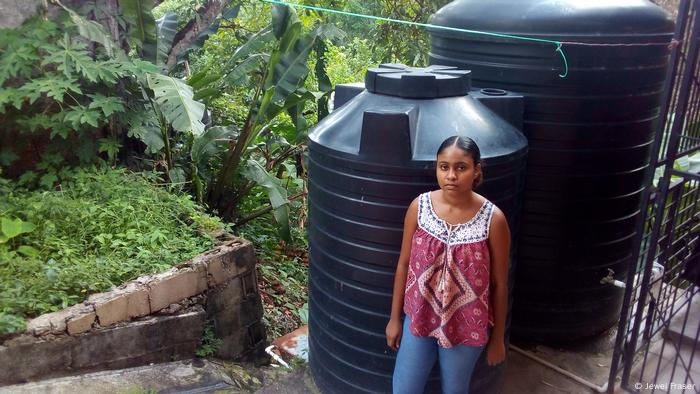
A neighbor of Noreen Nunez in the St. Augustine neighborhood of Trinidad stands next to her water tanks A neighbor of Noreen Nunez stands next to her water tanks, which have become a vital necessity for dealing with water shortages

Patchy infrastructure and leaky pipes

Antigua and Barbuda, St. Vincent and the Grenadines, and St. Kitts and Nevis are all classed as water scarce, which the UN defines as countries with less than 1000 cubic meters per capita of renewable water resources a year.

Barbados’ situation, with only 350 cubic meters per capita, is especially grave, according to Keithroy Halliday, general manager of the Barbados Water Authority.

While most people outside of rural mountainous areas in the Caribbean are connected to the public water supply, they frequently face outdated infrastructure in need of repair, resulting in major losses of drinking water.

Alan Poon King, head of Trinidad and Tobago’s Water and Sewerage Authority (WASA), says the utility loses as much as 60 million gallons of water each day from leaking infrastructure — and that much again is wasted by problems like leaking taps on private properties.
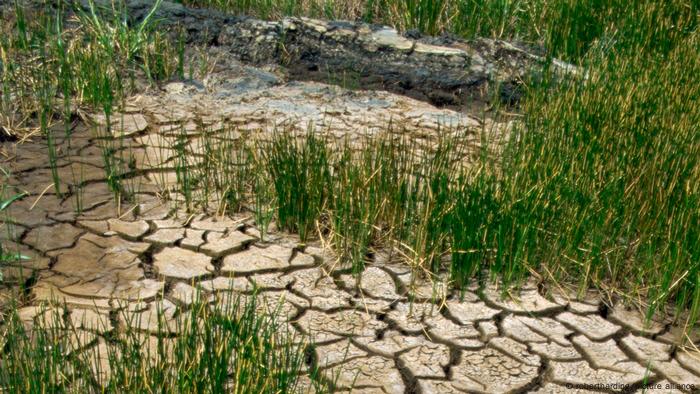
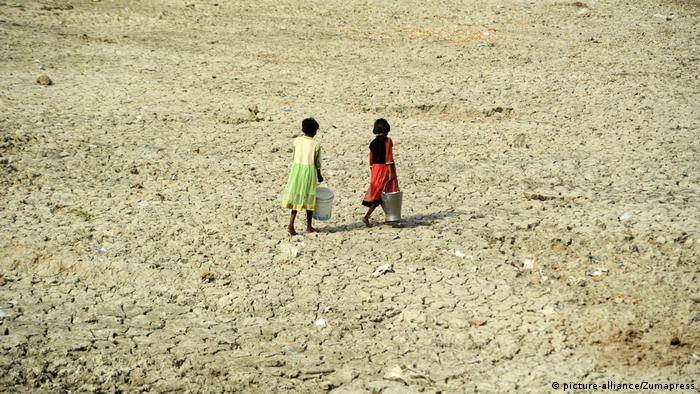
Dry ground near the Pitch Lake, Trinidad, West Indies, Caribbean, Climate change has increased drought which is exacerbating water problems on the islands

The picture is similar in Jamaica, which Peter Clarke, managing director of the country’s Water Resources Authority, says suffers from “a serious loss of water that has been produced and is supposed to be delivered, but it is not reaching the end user because of the aging infrastructure — it’s leaky, it’s perforated.”

Climate change increases pressure

If these structural problems are left unaddressed, things are only likely to deteriorate as the planet heats up.

“There are many other problems that are facing the water sector in the Caribbean and climate change is exacerbating those existing, underlying conditions,” said Adrian Cashman, who sits on the global technical advisory committee for the Global Water Partnership.

Officials say drought conditions across the region over the past couple of years mean there just hasn’t been enough rain to replenish aquifers at the usual rate.

“This past summer [in Jamaica] we went through a significant drought,” said Clarke. “It really was challenging for the water supply providers.”

In Trinidad and Tobago, Poon King said it was difficult to quantify the impacts of climate change, but that it was an ongoing challenge: “We’ve seen reduced precipitation that could be anywhere in the range of 10-20% in the dry season.”
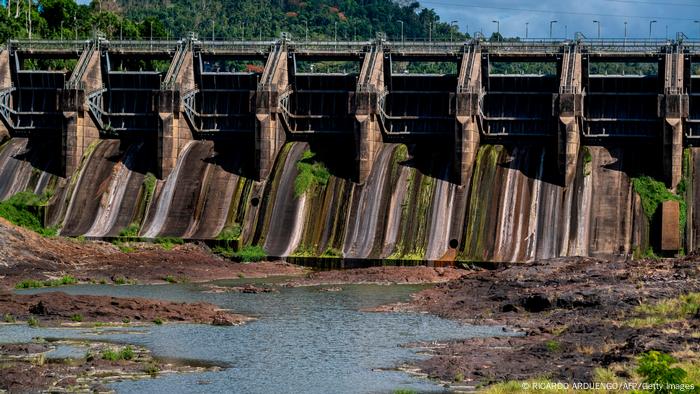
The Carraizo dam in Puerto Rico in 2020 show the impact of drought. Last year Puerto Rico experienced water rationing following a drought

Halliday said climate change has already “significantly impacted” Barbados’ water supply, too. All of Barbados’ internal renewable water resources come from rainfall, he explained, and in 2019 the country saw its lowest recorded levels since 1947.

Climate finance and water-wise living

The Caribbean region enjoys relatively high standards of living, with most countries defined by the UN as “upper-middle income.” This excludes them from much international development funding. At the same time, high levels of public debt combined with their vulnerability to climate change makes it difficult to secure investment in infrastructure.

However, one of the region’s first major water projects financed by the Green Climate Fund (GCF), which was set up to help developing countries cope with the changing climate, is currently underway in Grenada.

Water – a scarce resource

Project head Hans-Werner Theisen says about half of the €45 million the GCF has allocated to the project will be spent improving infrastructure like water tanks, reservoirs and pipes. There will also be financial incentives to cut water waste from sectors like agriculture and tourism, which are among the biggest consumers of water.

Encouraging the public to use water more carefully is key to the project in Grenada, too. “What I think is very important is that everyone, every citizen, can contribute to water-saving measures, so we have to be water-wise in day-to-day living,” Theisen said.

Elsewhere, Barbados has passed laws prohibiting the use of potable water for washing cars, gardening, filling swimming pools and similar activities. As in Jamaica, people are encouraged to use wastewater for such activities.

Water, water everywhere…
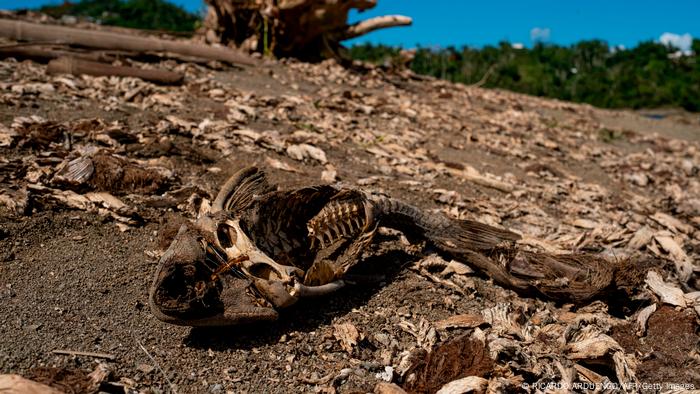
A dried fish carcass is seen on banks of unusually low reservoir in Puerto Rico, 2020. Barbados and Jamaica encourage residents to be very careful with their water use

Despite day-to-day water outages, a 2017 UN Water report showed most people in the Caribbean have access to a safe — if irregular — water supply.

But in Trinidad, Nunez is infuriated living on an island with 360-views of the turquoise waters and nothing coming out of the tap.

“Water and air are things that humans need to live,” she added. “I can’t understand how on an island surrounded by water, they can’t find some way of using — desalinating — the water.”

According to 2019 figures, the region gets some 12% of its water supply from desalination. Poon King said in Trinidad and Tobago that figure is 20% but expanding this is problematic due to high energy costs.

For Nunez, water shortages are out of step with her country’s development status. Trinidad and Tobago have profited from its oil reserves. Yet despite its high income, it struggles to adequately supply this most basic of necessities.

“There are glass buildings and universities and huge international airports and everything like this, but there is no water,” she said. “We’ve got the latest architectural structures and homes and houses, but it seems like indoor sanitary ware and kitchens are just for show.”

The post Water Shortage a Growing Caribbean Problem appeared first on The St Kitts Nevis Observer.
More Anti-Lockdown Rioting Sweeps Holland

A third night of rioting has shaken the Netherlands as protesters rampaged through towns and cities around the country after government introduced a night-time curfew.

About 150 people were arrested on Monday in Amsterdam and Rotterdam, where shops were vandalised and looted, and the mayor, Ahmed Aboutaleb, issued an emergency decree giving police broader powers of arrest.

“These people are shameless thieves, I cannot say otherwise,” he said. “I had to threaten them with the use of teargas – a far-reaching measure. I find that sad, because I have never had to do that in my entire career as mayor.”

But trouble also flared in smaller centres around the country such as Den Bosch, Zwolle, Amersfoort, Alkmaar, Hoorn, Gouda – where several cars were set on fire – and Haarlem, where police were attacked with stones.

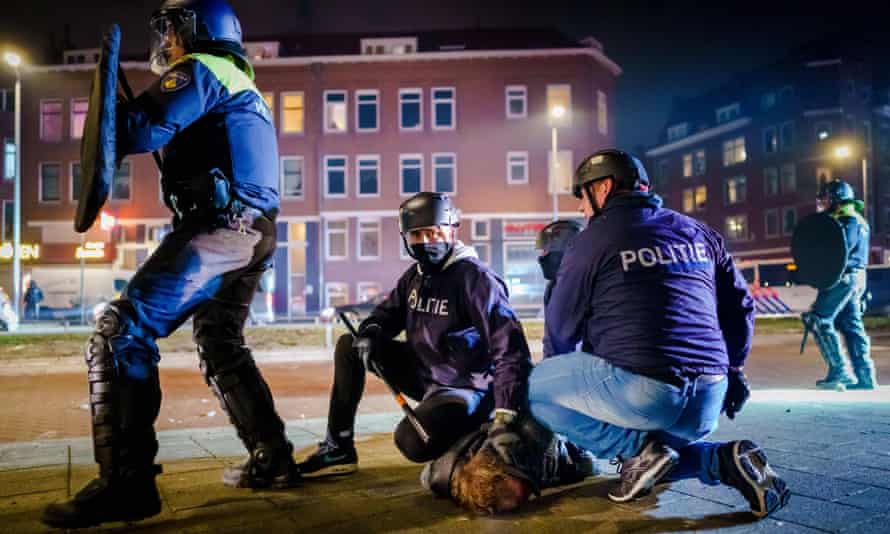
Police officers arrest a man during clashes in Beijerlandselaan.
Police officers arrest a man during clashes in Beijerlandselaan. Photograph: Marco de Swart/ANP/AFP/Getty

Officials said the rioters, who reportedly used social media apps to organise, were overwhelmingly teenagers, and questioned the extent to which they were motivated by opposition to the 9pm curfew, which came into force on Saturday.

“This is serious disturbance of public order,” said the mayor of Haarlem, Jos Wienen. “The measures are tough for everyone, we all want to be free to move. But that does not entitle anyone to start fires, let off fireworks and commit vandalism.”

The prime minister condemned the weekend riots in which anti-lockdown protesters attacked police and set cars on fire. “What motivated these people has nothing to do with protest; this is criminal violence,” Mark Rutte said.

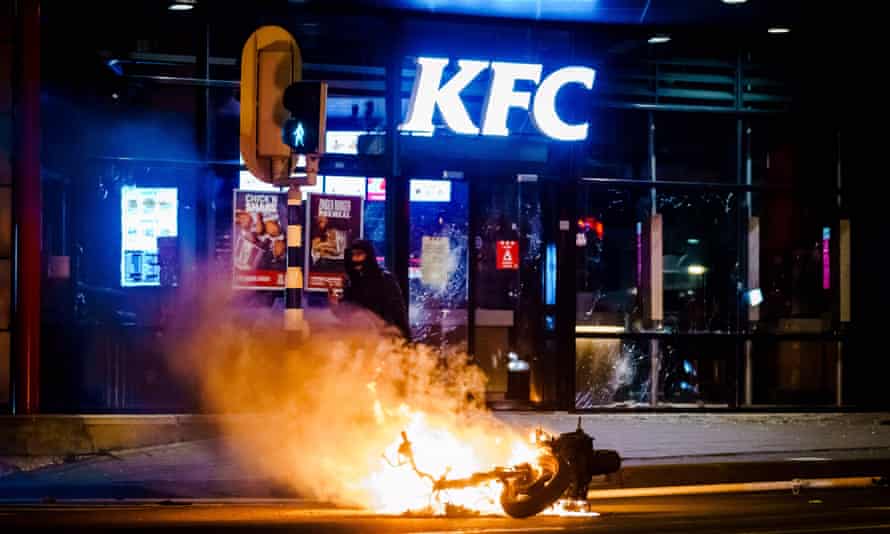
A vehicle burns after being torched by protesters in Beijerlandselaan in Rotterdam.
A vehicle burns after being torched by protesters in Beijerlandselaan in Rotterdam. Photograph: Marco de Swart/ANP/AFP/Getty

Police said 300 people were detained on Saturday and Sunday after youths threw rocks and in one case knives at officers, attacked a hospital and burned down a Covid testing station. More than 5,700 fines were issued for breaking the curfew.

Bars and restaurants have been shut in the Netherlands since October, with schools and non-essential shops following suit in mid-December. Infection numbers are falling but authorities fear the possible faster spread of the UK variant of the virus.

Rutte’s government is acting in a caretaker capacity before the election, scheduled for 17 March, after resigning last week over a child benefit scandal.

Koen Simmers, the head of the national police union, told Dutch television officers were prepared should the rioting continue. “I hope it was a one-off but I’m afraid it could be a harbinger for the days and weeks to come,” he said.

The post More Anti-Lockdown Rioting Sweeps Holland appeared first on The St Kitts Nevis Observer.
Mexican President & Country’s Richest Person have COVID

Carlos Slim and his family are worth an estimated $52bn (£38bn), according to Forbes magazine

Latin America’s richest man Carlos Slim has tested positive for Covid-19. The 80-year-old Mexican telecommunications billionaire was only showing “light symptoms” and was doing “very well”, his son wrote in a tweet.

Mexico is among the world’s worst hit nations, with more than 1.7 million confirmed cases since the pandemic began, and over 150,000 deaths.

In Monday’s tweet, Mr Slim’s son Carlos Slim Domit wrote that his father was “making very good progress with Covid-19 after more than a week of minor symptoms”.

Carlos Slim had been seen at Mexico’s National institute of Nutrition for clinical analysis, the tweet added.

The tycoon and his family, who control Mexico’s largest telecoms provider America Movil, are worth an estimated $52bn (£38bn), according to Forbes magazine’s list in 2020.

Mexico continues to experience its worst moment since the pandemic reached the country last year, the BBC’s Mexico correspondent Will Grant reports. Hospitals in the capital Mexico City are overflowing, and the infection rate shows little sign of slowing down.

President López Obrador announced that an agreement had been reached with Russia for delivery of 24 million doses of the Sputnik V vaccine in the next two months – but in the short term the outlook for many Mexican families remains bleak, our correspondent says.

The post Mexican President & Country’s Richest Person have COVID appeared first on The St Kitts Nevis Observer.