Tag Archives: caribbean

Ministry of Health urges: Stay calm, safe as influenza season pick’s up

Chief Medical Officer Dr. Hazel Laws

BASSETERRE, St. Kitts — Health authorities in St. Kitts and Nevis are noting a gradual increase in persons exhibiting flu-like symptoms. Chief Medical Officer Dr. Hazel Laws said that this is common as the country is in the midst of the influenza season that typically runs from October to April.

“We want to reassure the public there is no need to get fearful or be alarmed that they have COVID,” explained Dr. Laws, during the January 20 National Emergency Operations Centre COVID-19 Briefing. “Remember that we are in the middle of the influenza season and so my recommendation to you is if you are experiencing the symptoms of the flu, make contact with your regular physician.”
Continue reading Ministry of Health urges: Stay calm, safe as influenza season pick’s up →

Physical Planning and Environment Department strives for efficiency in 2021

CHARLESTOWN, Nevis — A programme of efficiency to ensure timeliness in its assessment approval process will be implemented in 2021 according to Deora Pemberton, Director of the Department of Physical Planning and Environment in the Nevis Island Administration.

“The Department of Physical Planning and Environment plays a critical role in our national development,” said Pemberton, who was appointed to head the department in September 2020. “We are engaged in an efficiency programme to guide sustainable physical development. This is a key factor to sustainable economic and financial prosperity for Nevis and all Nevisians. We aim to undertake our duties diligently and professionally to ensure timeliness in our assessment approval process.”

Pemberton outlined key areas in which the Department hopes to make headway during the year, including legislation for governing protected areas on Nevis.

“This legislation aims to sustainably manage the natural resources and rich biodiversity by protecting its forest, inland waters, coastal and marine areas,” said Pemberton. “Under this legislation, any building development above the 1,000 feet contour is prohibited, expectation applies for existing communities.

“Other development activities such as agriculture, animal husbandry and recreation are stringently managed for sensitive areas of the Camps River watershed, Boggs and other environmentally sensitive areas,” said Pemberton.

He also spoke of plans to revise and obtain Cabinet’s approval for the Nevis Physical Development Plan.

“This important planning document provides a vision for the future of Nevis, the foundation for sustainable development and land use policies for the next 25 years and beyond,” said Pemberton. “Pressing environmental concerns, economic opportunities, the need to improve quality of life and, both current and future challenges are all matters to be addressed.

“The policies set out in this development plan aim to provide for economic growth, but not at the expense of our environment and culture,” he said. “It is imperative to note that the future decisions though important, may be difficult but having a strong land use policy document will greatly assist in the decision-making process.”

The department will also conduct training sessions with various sectors including service providers, architects, plumbers and contractors.

They will also increase public awareness of planning laws, regulations and procedures,” concluded Pemberton. “Their proper implementation will benefit the public and private sectors in their development activities. To this end, the department hopes to see an increase in compliance and collaboration.”

The post Physical Planning and Environment Department strives for efficiency in 2021 appeared first on The St Kitts Nevis Observer.

Federation’s National Report highlighted during UNHRC Review

BASSETERRE, St. Kitts — St. Kitts and Nevis participated in the January 19 virtual session of the Third Universal Periodic Review (UPR) at the 37th Session of the United Nations Human Rights Council (UNHRC), based in Geneva.

Ms. Kaye Bass, Permanent Secretary in the Ministry of Foreign Affairs, head of the delegation, introduced St. Kitts and Nevis’ National Report and highlighted, inter alia, St Kitts and Nevis’ response to Covid19.

In her intervention during the interactive dialogue, Ms. Bass highlighted human rights-related initiatives the government has undertaken within the last four-and-a-half-years on social protection, gender empowerment, education, health, and its fulfilment to obligations under Human Rights Instruments which it has ratified.

At the end of the review, St. Kitts and Nevis received recommendations from 63 UN Member states which will be considered.

“The timely submission and content of our current National Report and our participation in this important review, reiterate St Kitts and Nevis’ commitment not only to this process but to human rights in general,” said Mrs. Bass.

“This is evidenced by St. Kitts and Nevis’s diligent efforts and subsequent success in implementing more than half of the recommendations of its previous review,” she said. “This is a significant achievement for the smallest country in the Western Hemisphere and considering the ongoing exogenous and economic challenges it continues to face.”

This unique UPR process involves a periodic review of the human rights records of all 193 UN Member States. It began in April 2008 to 2011 (First Cycle) followed by another from 2011-2016 (2nd Cycle). At each successive cycle, states are expected to highlight the steps they have taken to implement recommendations supported during their previous reviews, as well as to highlight recent human rights developments in the country.

Other members of the delegation included: Ms. Janelle Lewis, Permanent Secretary in the Ministry of Community Development, Gender Affairs and Social Services; Ms. Asha DeSuza, Second Secretary at the Permanent Mission of St. Kitts and Nevis to the UN; Mr. Sheldon Henry, and Mrs. Natasha Burt, Foreign Service Officers.

The post Federation’s National Report highlighted during UNHRC Review appeared first on The St Kitts Nevis Observer.

Late Butch Stewart’s Son Takes Over Sandals Resorts

Adam Stewart, the son of late Jamaican tourism pioneer and businessman Gordon ‘Butch’ Stewart, has succeeded his father as executive chairman of Sandals Resorts International.

He assumes the role after working alongside his father for more than two decades, during which time he served as chief executive officer and most recently deputy chairman.

Stewart, who becomes just the second chairman in the company’s 40-year history, said he was committed to honouring his father’s legacy of innovation.

“Some people are dreamers, and some are doers; my dad was the magical combination of both. He was fiercely passionate about offering a product that would exceed expectations, and we are incredibly honoured to continue his pursuit of innovation, raising the bar, and creating landmark moments for our valued guests,” said Stewart.

Sandals Resorts International has plans to extend throughout the Caribbean, including the recent announcement of two new island resort destinations – the future Sandals Curaçao and Beaches Resorts in St. Vincent.

Stewart also assumes Executive Chairmanship of the Jamaica-based ATL Group, one of the largest private-sector groups in the Caribbean.

“My father’s shoes are impossible to fill, but we will follow in his ground-breaking footsteps to continue the important work we all set out to do together. As a company and as a team, we are poised for the future. We are already leading the industry in recovering from the greatest setback in the history of travel. We will continue to lead not just by saying, but by doing. And at the heart of it all, we are solely focused on what we do best: delighting our guests,” he concluded.

Stewart will also continue to serve as President of the Sandals Foundation which he launched in 2009, with a mission to lift communities through education, healthcare, and environmental protection.

He has been recognized by several organizations for his leadership in the travel industry and his substantial contributions to the destinations where Sandals Resorts International operates. In 2016, he was bestowed the national honour of the Order of Distinction, Commander Class by the Government of Jamaica for outstanding contribution to tourism.

CMC

The post Late Butch Stewart’s Son Takes Over Sandals Resorts appeared first on The St Kitts Nevis Observer.

Entire Cuban Population to Get Homegrown Corona Vaccine

Cuba is aiming to vaccinate its population this year with its own vaccine, which would be the first developed in Latin America.

The country claims it can make 100 million doses of Soberana 2, its most advanced vaccine candidate, in 2021.

“If all goes well, this year the entire Cuban population will be vaccinated,” said Dr Vicente Vérez, director of the Finlay Vaccination Institute.

Cuba has got off relatively lightly compared to many of its neighbours so far in the pandemic, with 19,122 cases and 180 deaths confirmed by the government.

This week Soberana 2 moved onto phase two testing, involving 900 volunteers, and if successful will move onto phase III with 150,000 volunteers in March.

Dr Vérez said the aim was to launch a vaccination campaign in the first half of the year, and it could also be offered as an “option” to tourists.

Cuba “was the first candidate in Latin America and the Caribbean to have a vaccine in the clinical phase,” said José Moya, local representative of the World Health Organization (WHO), who is “optimistic”.

The reason for his optimism is that “Cuba has more than 30 years’ experience in producing its own vaccines and almost 80% of the vaccines in the national immunisation programme are produced in the country.

Under a US embargo since 1962, Cuba has often had to find its own remedies.

As early as the 1980s, it relied on biotechnologies, discovering in particular the first vaccine against meningococcus B,” says Nils Graber, a researcher in health anthropology at the University of Lausanne.

“The aim was both to improve the national health system and to be exported,” he added, citing the shipment of Cuban treatments to Latin America, Asia and Africa.

The post Entire Cuban Population to Get Homegrown Corona Vaccine appeared first on The St Kitts Nevis Observer.

COVID: Brazil Officials were Warned a Week Before Manaus Oxygen Ran Out

(CNN) Local and federal officials in Brazil were warned of looming oxygen shortages nearly a week before crisis struck in the city of Manaus, the country’s Solicitor General has revealed.

In a country already hard-hit by the coronavirus, oxygen shortages and soaring Covid-19 cases have pushed Manaus, the capital of Amazonas state, into a healthcare crisis. Nurses in the city have been quoted in local news reports as saying patients have died of asphyxiation in the city’s hospitals because there is no oxygen to give them. Some relief has come from Venezuela.

SAO PAULO (AP) — Five trucks carrying oxygen from Venezuela arrived at Manaus, a city of 2 million people in the Brazilian rainforest where the local health system has collapsed amid a devastating second wave of COVID-19 and a severe shortage of oxygen for breathless patients.

Venezuela’s consul in Manaus, Patricia Silva, said the trucks delivered 132,000 liters of oxygen late Tuesday. They came from the state of Bolivar in southern Venezuela and travelled more than 1,500 kilometers (930 miles) to Manaus, the capital of Brazil’s Amazonas state.

“We, as the Bolivarian government, defend our principles of cooperation and solidarity. Solidarity among peoples will save us, especially in this terrible pandemic,” Silva told journalists in Manaus.

The Brazilian government has come under sharp criticism over its handling of the crisis. Last week, Supreme Court judge Ricardo Lewandowski ordered the government to present a response plan to solve the oxygen shortage, citing the Jair Bolsonaro administration’s “omissive behavior” in addressing the emergency.

On Sunday, Bolsonaro’s Solicitor General José Levi do Amaral sent a 16-page report defending the government’s response to the court. The report discloses that the federal health ministry knew about the crisis six days before the situation became critical on January 14.

It also stresses that the local government in Amazonas did not inform federal authorities about the looming oxygen shortage. “The Health Ministry…became aware on (January) 8th through an e-mail sent by the product manufacturer,” the report states. The provider, named in the report as White Martins, first notified the Amazonas State government, and then federal authorities, the report says.

It is not clear why notifying the federal government of oxygen shortages was allegedly left to a private contractor. According to the Solicitor General’s report, the Manaus health department had been aware that the city’s health system was on the verge of collapse since early January.

Manaus City officials did not respond to a request for comment from CNN.

An Amazonas’ state government spokesperson told CNN they would provide “clarifications” to the Prosecutor General’s office, and added that the state continues to work to mitigate the crisis, including, “the transport of oxygen from other states to Manaus, the installation of mini oxygen in hospitals, the transfer of patients for assistance in other states and the requisition of all production from local oxygen suppliers.”

Brazil’s General Prosecutor Augusto Aras has ordered the Health Ministry to open a probe into the collapse of Manaus’ health system, in addition to a separate investigation examining potential negligence by state and city officials.

But the Solicitor General’s report raises questions about why the federal Health Ministry was not able to help prevent the collapse of Manaus’ healthcare system, after it received advance notice. Officials from the Ministry traveled to Manaus in the beginning of January, and Pazuello personally visited the city from January 11 to January 13.

Disaster struck the city’s hospitals the next day. On January 14, Amazonas state officials announced that Manaus hospitals and emergency rooms faced crippling shortages of oxygen, amid soaring Covid-19 cases. “We are facing a lot of difficulty in getting medical supplies. And as everyone is following, our main difficulty now has been getting oxygen,” Governor Wilson Lima told reporters.

Though the Brazilian air force responded by delivering emergency supplies of liquid and gaseous oxygen, shortages continue. Logistical problems have compounded the crisis, as Manaus’ supplies mainly enter the city via the Amazon River. There is only highway out of the city, which connects it to the neighboring state of Amapá.

Health Minister Eduardo Pazuello has defended his agency’s response. “We took action immediately,” he said at a press briefing in Brasilia on Monday. “There was no indication of lack of oxygen from our meetings in early January. The rise of the cases was very fast,” he said.

“When we [visited Manaus] on [January] 4, the problem was not oxygen. The problem was bed structure, the number of Covid-19 patients, the queues,” Pazuello also said.

Bolsonaro’s appointment of Pazuello, a former military commander, to lead the Health Ministry, have been heavily criticized by opponent as Brazil’s Covid-19 death toll remains second highest in the world, behind only that of the United States.

Bolsonaro himself rejected any responsibility for the city’s lethal crisis. “There is a problem in Manaus … We mourn the deaths from asphyxiation, from lack of oxygen, and people blame the government. We have allocated billions to the states, but those responsible for the lack of medication are the state and municipal health secretaries,” he told supporters on Monday.

His statement followed Vice President Hamilton Mourão’s claim last week that no one could have foreseen the city’s health system collapse.

“You cannot predict what would happen with this (virus) strain that is occurring in Manaus. Totally different from what had happened in the first half,” Mourão said

The post COVID: Brazil Officials were Warned a Week Before Manaus Oxygen Ran Out appeared first on The St Kitts Nevis Observer.

More Haiti Protests Against Pres. Moise

PORT-AU-PRINCE, Haiti (AP) — Hundreds of people marched through Haiti’s capital in another protest demanding the resignation of President Jovenel Moïse.

The crowd clashed with police, and one woman was shot in the arm but was expected to recover. Several people also were wounded by rubber bullets.

Opposition leaders organizing the protests are pushing for Moïse to step down in early February as Haiti’s economic and social woes deepen. Moïse, meanwhile, has said his term ends in February 2022, though his administration has said he remains open to dialogue with the opposition.

A handful of opposition leaders reached the U.S. Embassy in Tabarre on Wednesday and called on the administration of new U.S. President Joe Biden to improve conditions in Haiti and demand that legislative and presidential elections be held earlier than those scheduled for late 2022.

The post More Haiti Protests Against Pres. Moise appeared first on The St Kitts Nevis Observer.
Jamaica Seeks Closer Ties With USA

The Government of Jamaica has signalled an intention to deepen its ties with the United States following the inauguration of a new Administration yesterday.

In extending congratulations to the 46th President of the United States Joseph R Biden Jr and Vice-President Kamala Harris on their formal assumption of duties , Minister of Foreign Affairs and Foreign Trade Kamina Johnson Smith said: “The Government and people of Jamaica look forward to the further deepening of this strong and active partnership, under the Biden-Harris Administration.

Today’s (yesterday) inauguration reaffirms the strong democratic foundation on which the United States of America is built and for which it has had a long and distinguished tradition. The occasion is special and historic,” said Johnson Smith in a release.

“Even as we renew engagement with President Biden, previously a vice-president, we also look forward to building new relations with the vice-president. Indeed, it is of special significance to Jamaica that Vice-President Harris is the first female vice-president of the United States of America, a woman of colour and the child of Jamaican and Indian immigrants.

“We, therefore, join in acknowledging this important milestone and note with pride her own inspiring assertion that while she is the first, she expects that many more will follow her,” added Johnson Smith.

She said Jamaica values its close friendship with the US which is a key ally and a major development partner.

“It is a relationship that has been shaped by mutually beneficial cooperation, deep historical and cultural ties, mutual respect for the rule of law and human rights, as well as the large Jamaican Diaspora in the United States.

The post Jamaica Seeks Closer Ties With USA appeared first on The St Kitts Nevis Observer.

Pres. Biden in Record Setting First Day in Office

US President Joe Biden has begun to undo some of Donald Trump’s key policies, hours after being sworn in.

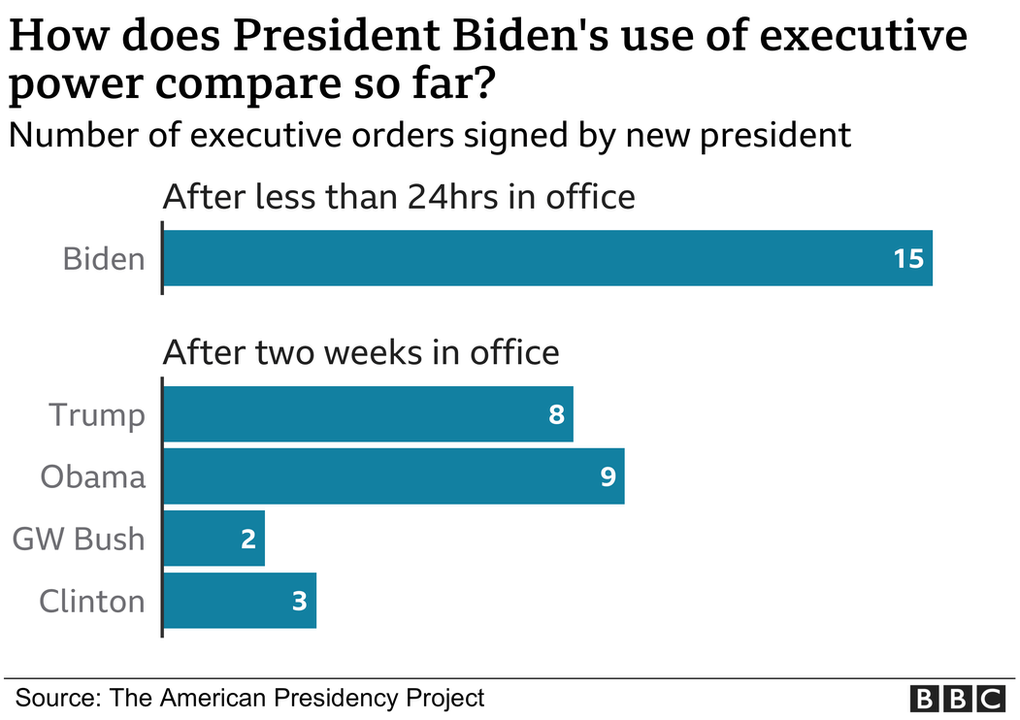
In his initial acts as the 46th US president, he signed 15 executive orders – the first to boost the federal response to the coronavirus crisis.

Other orders reversed the Trump administration’s stance on climate change and immigration.

President Biden set to work at the Oval Office having been sworn in earlier on Wednesday at the US Capitol.

The inauguration was unlike any other due to coronavirus restrictions, with few present to witness the oaths and ceremonies.

Donald Trump – who has still not formally conceded the presidency to Mr Biden – snubbed the event in a departure from longstanding precedent.

What orders has Biden signed?

“There is no time to waste when it comes to tackling the crises we face,” President Biden tweeted as he headed to the White House following his inauguration.

President Biden “will take action – not just to reverse the gravest damages of the Trump administration – but also to start moving our country forward,” a statement detailing his executive orders said.

A graphic comparing Joe Biden's use of executive power with his predecessors
1px transparent line

On coronavirus, a series of measures will be enacted to tackle the pandemic which has claimed more than 400,000 lives in the US.

There will be a mandate to wear masks and practise social distancing on all federal government property.

A new office will be set up to co-ordinate the response to the pandemic and the US will halt the process – begun by the Trump administration – of withdrawing from the World Health Organization (WHO).

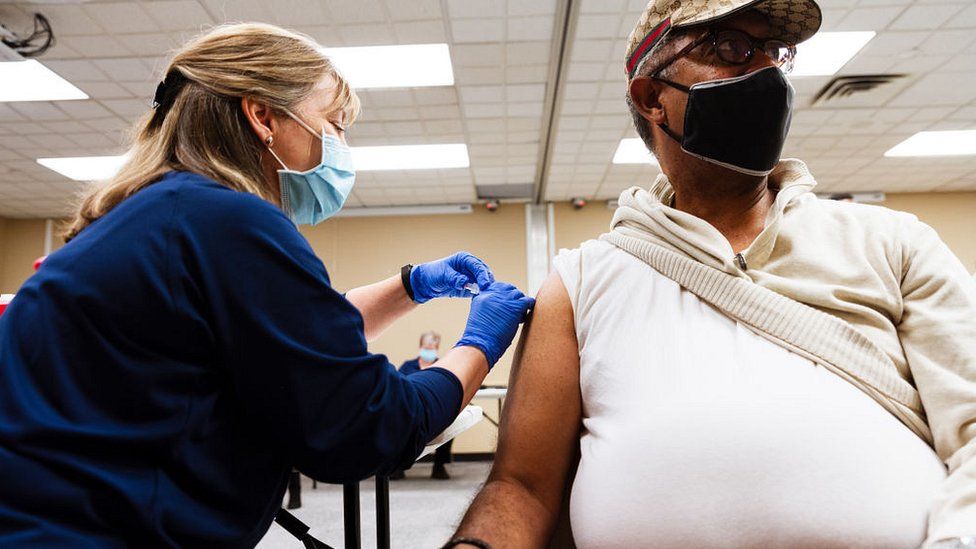
Vaccine is administered at the Louisville Urban League on January 20, 2021 in Louisville, Kentuckyimage copyrightGetty Images
image captionMr Biden wants to inoculate 100 million Americans within his first 100 days in office

The move to re-engage with the WHO was welcomed by UN Secretary-General Antonio Guterres who said it was “absolutely critical” for a more co-ordinated global response, his spokesman Stéphane Dujarric said.

Mr Biden has also pledged to make the fight against climate change a top priority of his administration.

He signed an executive order beginning the process of rejoining the 2015 Paris climate agreement, from which Mr Trump formally withdrew the US last year.

Mr Biden’s climate envoy, former US Secretary of State John Kerry, tweeted that the commitment set “a floor, not a ceiling” for America’s climate leadership and urged international co-operation ahead of the UN Climate Change Conference (Cop26) in Glasgow in November.

The BBC is not responsible for the content of external sites.View original tweet on Twitter
White space

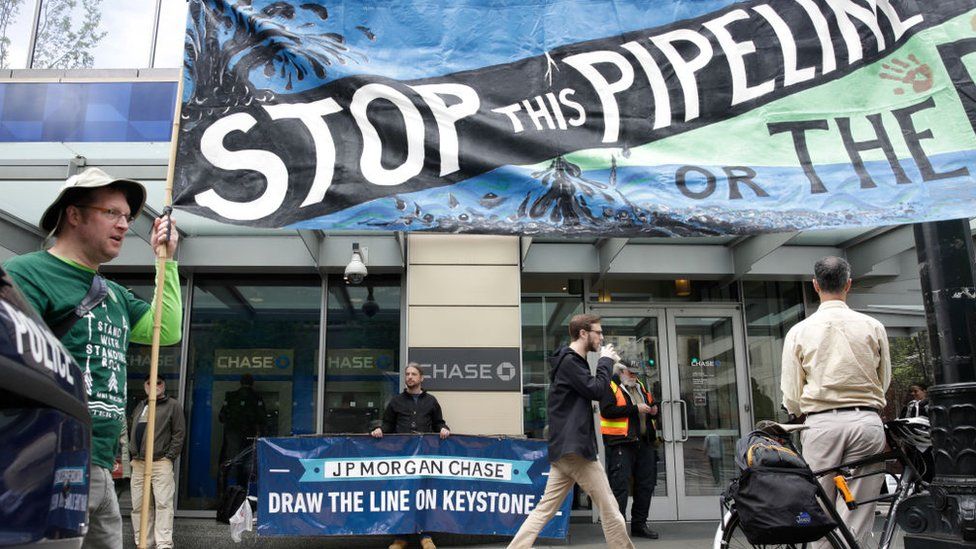
Mr Biden has also revoked the presidential permit granted to the controversial Keystone XL Pipeline, which environmentalists and Native American groups have fought for more than a decade.

The move will be discussed when Mr Biden makes his first phone call to a foreign leader – Canadian Prime Minister Justin Trudeau – on Friday, White House press secretary Jen Psaki said.

Activists disrupt business at a Chase Bank branch in Seattle on May 8, 2017image copyrightGetty Images
image captionThe Keystone XL Pipeline project has led to years of protests

The privately financed pipeline – estimated to cost about $8bn (£5.8bn) – would carry about 830,000 barrels of heavy crude a day from the oil sands of Alberta, in Canada, to Nebraska.

Barack Obama vetoed a bill approving construction of the pipeline in 2015 but the decision was overturned by President Trump.

On immigration Mr Biden has revoked the Trump administration’s emergency declaration that helped fund the building of a wall along the Mexican border and also ended a travel ban on some majority-Muslim countries.

Other orders cover race and gender equality.

2px presentational grey line
Analysis box by Anthony Zurcher, North America reporter

This is the (relatively) easy part

Joe Biden and his presidential team have had nearly three months to plan out his first actions upon taking the oath of office. Donald Trump had used his executive authority broadly, to advance large swaths of his political agenda, so how – and when – Biden would begin undoing those actions would have particular importance.

It didn’t take long for the newly inaugurated president to show his hand. He targeted, in particular, some of the most controversial portions of Trump’s agenda. The Biden administration also will freeze all of Trump’s last-minute regulations pending further review.

Executive action is the (relatively) easy part, however. For Biden to make lasting change – policies that can’t be undone by future presidents – he will have to work with Congress to pass legislation on issues like pandemic relief, citizenship for undocumented migrants, healthcare reform and voting-rights protections.

He also declined, for now, to take other executive actions, like cancelling student loan debt, lifting Mr Trump’s trade restrictions or enacting new criminal justice measures.

With Democrats in control in the House of Representatives and Senate, Biden has a window for accomplishments, although it will require surmounting Republican procedural obstacles and keeping his party in line. The president’s decades of experience as a legislator could come in useful.

2px presentational grey line

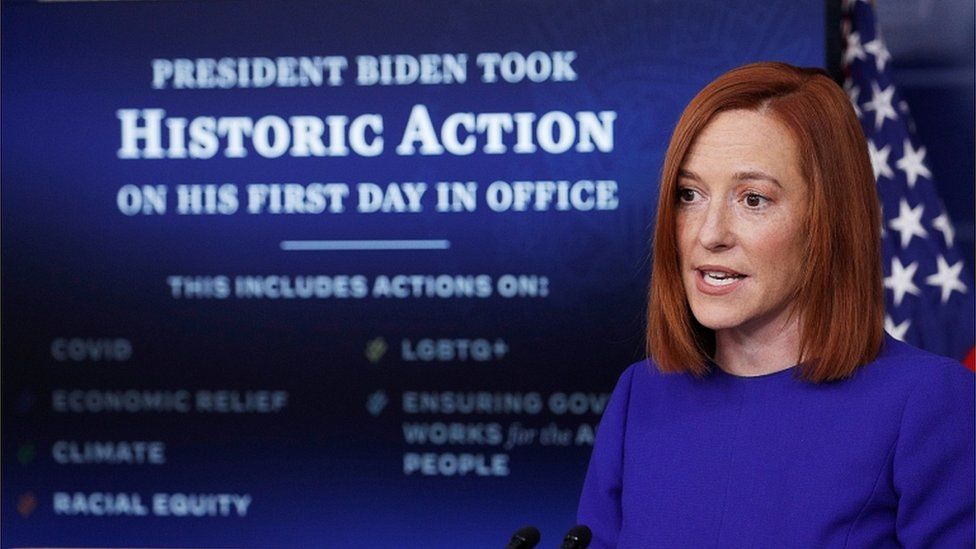
At the first news conference of the Biden presidency, press secretary Jen Psaki was asked if her priority was to promote the interests of President Biden, or provide “the unvarnished truth”.

She said she had “deep respect for the role of a free independent press” and that she would join the president in bringing “transparency and truth back to government”.

President Trump – and his press secretaries – often had a combative relationship with the media.

White House Press Secretary Jen Psaki speaks after the inauguration of Joe Biden, January 20, 2021image copyrightReuters
image captionThe White House has a new press secretary – Jen Psaki

What happened at the inauguration?

“Democracy has prevailed,” President Biden said after taking the oath of office with Chief Justice John Roberts on stage in front of the US Capitol.

Delivering a message of unity after the turbulent Trump years, he promised to be a president “for all Americans” – including those who voted against him.

Three of his predecessors attended the ceremony: Barack Obama – under whom Mr Biden served for eight years as vice-president – Bill Clinton and George W Bush, as well as Mr Trump’s vice-president, Mike Pence.

Kamala Harris was sworn in as vice-president ahead of Mr Biden. She is the first woman – and the first black and Asian-American person – to serve in the role.

There was extra-tight security for the ceremony after the US Capitol was stormed by violent pro-Trump protesters on 6 January.

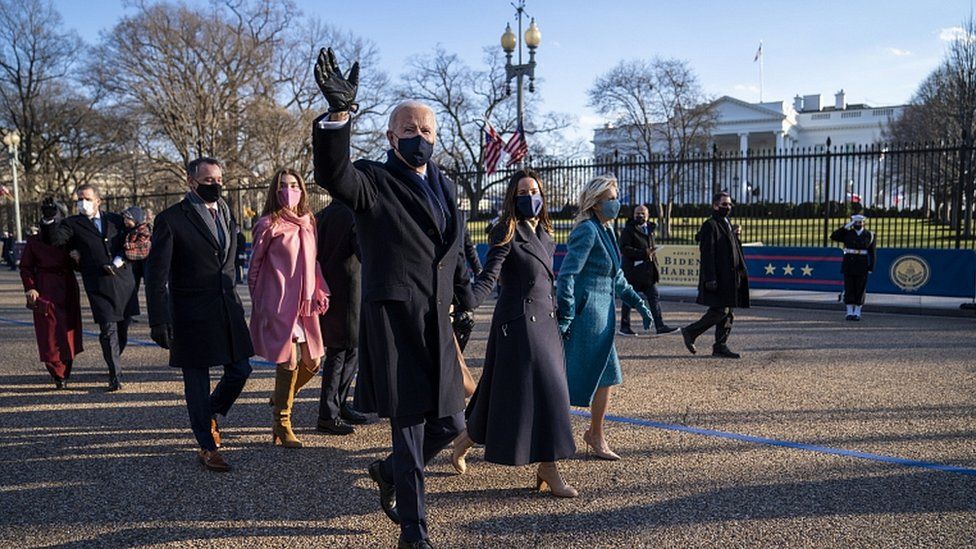
Mr Biden and First Lady Jill Biden, together with Ms Harris and her husband Doug Emhoff, then walked down Pennsylvania Avenue to the White House, greeting friends and supporters.

US President Joe Biden and First Lady Jill Biden walk along Pennsylvania Avenue in front of the White House, in Washington, DC, 20 January 2021image copyrightEPA
image captionPresident Joe Biden and First Lady Jill Biden walked part of Pennsylvania Avenue to the White House

The inauguration ceremony included musical performances by Lady Gaga – who sang the national anthem – as well as Jennifer Lopez and Garth Brooks.

Amanda Gorman, America’s first-ever National Youth Poet Laureate, recited her work The Hill We Climb.

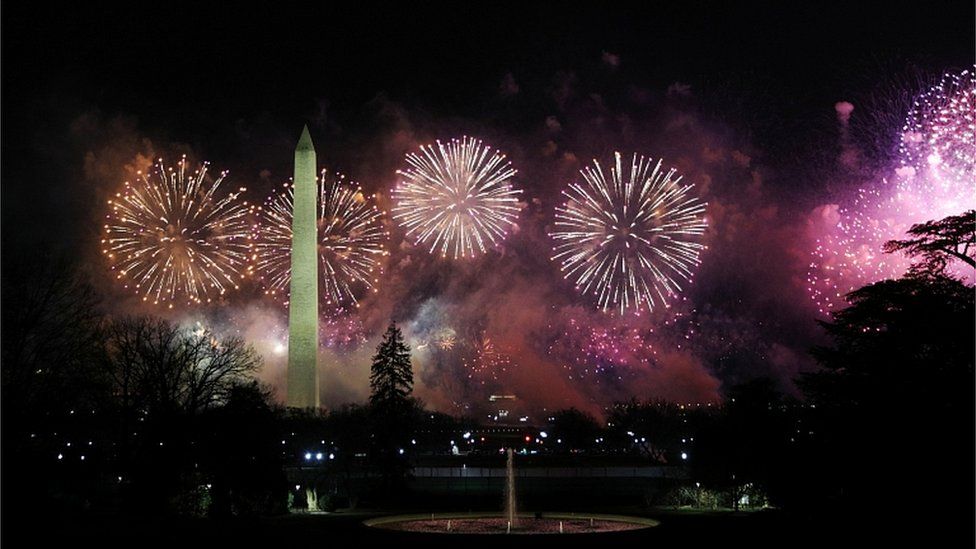
A 90-minute televised evening concert entitled “Celebrating America” was staged at the Lincoln Memorial in the city. Hosted by Tom Hanks, it featured Bruce Springsteen, John Legend, Jon Bon Jovi, Justin Timberlake, and Demi Lovato and culminated in a spectacular fireworks display.

Fireworks burst over the Washington Monument during the "Celebrating America" event in Washington, DC., January 20, 2021image copyrightReuters

What about Donald Trump?

Mr Trump was the first president not to attend his successor’s inauguration since 1869. He left the White House early on Wednesday, and flew to the nearby Andrews Air Force base.

In his farewell address at the base, he highlighted what he regarded as the successes of his presidency. “What we’ve done has been amazing by any standard,” Mr Trump said.

The 74-year-old then left for his Mar-a-Lago golf club in Florida, where he arrived later in the morning.

In his last hours as president, Mr Trump granted clemency to more than 140 people, including his former adviser Steve Bannon, who had been facing fraud charges.

The political drama surrounding Mr Trump is far from over. The US Senate is expected to put him on trial soon, following his record second impeachment by the House of Representatives for allegedly inciting the Capitol riot.

On Tuesday, the Senate’s Republican leader, Mitch McConnell, said the mob had been provoked by Mr Trump and fed lies.

The post Pres. Biden in Record Setting First Day in Office appeared first on The St Kitts Nevis Observer.
US VP Harris’ Uncle: ‘You’ve Been Doing Fine, Keep it Up’


Hours before Kamala Harris’s historic inauguration as US Vice President, her ancestral village in Tamil Nadu celebrated with firecrackers, sweets and customized calendars of their most famous face.

Kamala Harris’s uncle, an academic who lives in Delhi, had advice for her.

“There’s no message I can give, I didn’t help her become Vice President. She did all on her own. All that I’ll tell her is ‘do whatever Shyamala (Kamala Harris’ mother) taught you. You’ve been doing fine so far, keep it up.’ It’s all I can say,” G Balachandran told news agency ANI.

Mr Balachandran had also spoken to Kamala Harris, his sister’s daughter, after Joe Biden won the presidential race in November.

Kamala Harris’s maternal grandfather was born over a century ago in Thulasendrapuram, a village about 320 km from Chennai.

Kamala Harris’s uncle G. Balachandran is an academic who lives in Delhi

Kamala Harris was born to an Indian mother, Shyamala Gopalan, and a Jamaican father, both of whom immigrated to the United States to study. She visited Thulasendrapuram when she was five and has recalled walks with her grandfather on the beach at Chennai.

Later tonight, she becomes the first woman, first Black American and first Asian American to win the second highest US office.

Newsbeep

The post US VP Harris’ Uncle: ‘You’ve Been Doing Fine, Keep it Up’ appeared first on The St Kitts Nevis Observer.