Tag Archives: oceania

Family ‘angry, broken’ after Coffs Harbour tradie with ‘heart of gold’ stabbed

The relatives of a young tradie who was stabbed to death moments after emerging from the surf at a Coffs Harbour beach early yesterday say they are "broken" and "angry".

The 22-year-old, who is yet to be publicly identified, was found suffering multiple stab wounds on Ocean Parade at Coffs Harbour about 6.50am and later died in hospital.

It is believed he was attacked during an altercation that occurred shortly after leaving the water.

READ MORE: Three arrested in search for Australian brothers missing in Mexico

https://omny.fm/shows/ben-fordham-full-show/i-m-angry-uncle-of-latest-stabbing-victim-demands/embed

His uncle, known only as Ralph, has this morning called for Jack's Law to be extended to New South Wales to help stop such knife crimes from reoccurring.

Ralph said his nephew, who worked as a stone mason and loved to surf, was "a lovely young man".

"He definitely had a mischievous side to him – he loved a laugh," he told 2GB's Ben Fordham this morning.

"More than anything else, he just had a heart of gold, he really did. A gentle, caring nature was his greatest asset.

"We're just broken at the moment."

Coffs Harbour stabbing at Ocean Parade

Queensland passed new laws in March last year allow police officers to "wand" or move a detector over a person at designated public zones such as transport hubs.

They've been dubbed Jack's Law as Brett and Belinda Breasley campaigned for them in honour of their 17-year-old son Jack, who died on the Gold Coast in 2019.

READ MORE: Chani was stuck in a rut, so she bought a $20,000 house in Japan

"I'm angry, obviously, at this attacker but I'm angry at our politicians," an emotional Ralph told Ben Fordham.

"Where have they been on Jack's Law? How long do we have to wait here in New South Wales? This will save lives."

"He was just coming back from the surf – stabbed eight times. What on Earth is going on?"

NSW Premier Chris Minns agreed to meet Brett Beasley last week to discuss Jack's Law following a string of knife attacks in the state, including Sydney's Bondi Westfield massacre.

Over 30,000 to miss flights after Bonza grounding extended

The extension of Bonza's fleet grounding into next week will reportedly leave over 30,000 customers out of pocket.

Bonza suddenly cancelled all services on Tuesday this week, leaving customers stranded without warning around the country.

It entered voluntary administration the same day.

READ MORE: Three arrested in search for Aussie brothers missing in Mexico

Originally, it was confirmed by administrators Hall Chadwick that the Bonza fleet would remain grounded until at least this morning.

But in a statement issued yesterday afternoon, Hall Chadwick flight operations would not resume "up to and including" Tuesday, May 7.

"Customers scheduled to travel during this time are requested to make alternative arrangements with other airline carriers," the statement read.

READ MORE: Chani was stuck in a rut, so she bought a $20k abandoned house in Japan

"The Administrators and the Company appreciate the impact this is having on customers and employees."

It's understood that negotiations are continuing with the lessor of Bonza's aircraft, whose attempt to seize the fleet prompted the sudden shutdown on Tuesday.

Hall Chadwick has also told disgruntled customers the airline is not able to provide refunds at this point.

That amounts to more than 180 scrapped flights, which will leave more than 33,000 customers with a useless booking, the Sydney Morning Herald has reported.

The federal government's hotline for stranded Bonza customers will close down after 5pm today.

READ MORE: Hamas sends delegation to Gaza peace talks in sign of progress

But Transport Minister Catherine King said hotlines to Qantas, Virgin Australia, and Jetstar, would remain in operation.

King thanked those airlines for helping stranded Bonza customers reach their destination.

As of 3pm yesterday, Jetstar had made more than 1780 re-bookings for Bonza passengers, while Virgin re-booked more than 1250, and Qantas about 560.

The government hotline had received about 2800 calls.

FOLLOW US ON WHATSAPP HERE: Stay across all the latest in breaking news, celebrity and sport via our WhatsApp channel. No comments, no algorithm and nobody can see your private details.

Chani was stuck in a rut, so she bought an abandoned house in Japan

Last year, Chani was working 10 hours days as a Japanese teacher in a Brisbane high school.

She was "stuck in a rut" and, at 49 years old, just couldn't imagine how she would keep going. 

"I had actually hit a massive wall, I had these feelings of wanting to make a major change," Chani, who asked for her surname to be withheld, told 9news.com.au.

READ MORE: Sydney garage with a $1.2m price guide is marketed as a home

Craving a change, Chani packed up and moved to Japan last April.

With her adult children now grown, she had the freedom to take a leap of faith.

The idea of moving to Japan, a country she loved, and buying an abandoned home had been forming for some time, Chani said.

Although it's hard to fathom in a country like Australia – where crippling housing shortages and skyrocketing real estate prices are the norm – Japan's dwindling population has led to a huge, and growing, number of empty homes.

The latest government figures, released this week, show there are now about 11 million vacant homes, known as akiya, in Japan.

This accounts for 14 per cent of all houses in Japan.

The Nomura Research Institute estimates that figure will reach 30 per cent in the next decade.

Many akiyas are in rural areas, with younger generations preferring to leave inherited homes empty rather than move out of the city. 

For Chani, who lived in the Japanese countryside for 18 months as a teenage exchange student, the idea of a rural akiya appealed to her.

She began doing her homework.

READ MORE: Terrorised tenant wins $5500 compensation over neighbours' abuse

Chani, pictured outside the abandoned home she bought in Wakayama for $20,000.Chani, pictured with her cat Millie. Typical of many Japanese homes, Chani's house only has a very small outdoor area.

"I was on the real estate sites," Chani said.

"I was watching the area I wanted to buy in to get a feel for the house prices and how quickly they were selling or not selling."

Chani, who documented the process of buying her akiya on her YouTube channel Chani Japan, was looking at properties in the Wakayama area, which is around an hour south of Osaka.

"I chose Wakayama because I can get to the airport within 40 minutes if I need to go home urgently, which I hope never happens," Chani said.

"Also, I'm in the countryside, but I'm an hour train ride from the second-largest city in Japan. 

I'm not isolated as such, I didn't want to be full rural."

After managing to line up a job teaching English and a working visa, Chani flew out to Japan in April last year.

Buying a property in Japan can be difficult if you don't speak Japanese, Chani said, adding that most Japanese real estate agents did not speak English and preferred to do business in person at a slow pace.

"It took a long time to establish a relationship with the real estate agent," Chani said. 

"They don't just do it on the phone and they don't do it online.

"They meet in person. They tell you to go away, come back. 

"It's a gradual process to get to know them before they're willing to do business with you. 

"Are you, or are you not, a tyre-kicker – that's what they want to know."

"It's not impossible if you have someone who can speak Japanese. But you can't expect the agent to be speaking English and helping you out. It's not going to happen."

READ MORE: Harry Potter cover art expected to set new record

The property needed about $15,000 worth of renovations.

While some akiyas are being offered up for free, or almost free, in certain parts of Japan, Chani said she steered clear of those properties because of the pitfalls they often came with.

"The free ones are not usually habitable. You know there's going to be some problem," Chani said. 

"Then the other side of the really cheap $5000 ones is they're filled with people's belongings which are very hard to get rid of. 

"I knew if I paid a bit more it would be cheaper in the long run because I didn't have to do major works. I just had to do some cosmetic, minor things."

The $20,000 house Chani settled on was a 100 square-metre, two-storey house that was built in the 1980s.

Although the house appeared to be in excellent condition, with only minor renovations required to suit her needs, Chani was hit with an unpleasant surprise almost immediately after she signed the contract.

When the water was turned on, a leak was discovered in the pipes underneath the bathroom. 

Termite damage was also detected in the house.

Although the news was upsetting, it was understandable that there would be problems give the home's age, Chani said.

"It is an old house, built in the '80s, you can't expect it to be perfect," Chani said.

The living room and kitchen area in Chani's house.The front entrance to Chani's house and her renovated bathroom.

Luckily, the renovations needed to fix the damage were not too expensive, with a local handyman offering to install a new bathroom for just $7000.

"It was so cheap. The bathrooms here are unit baths. They come in a kit and you just put it straight in," she said.

"The cost of living is so low in Japan that that follows through to the cost of renovations as well."

Chani also installed a new garage door and moved the laundry inside the house, bringing the total cost of her renovations to $15,000.

It's now been almost exactly a year since Chani moved to Japan, with the teacher saying she had no regrets about her decision.

Working part-time, around six hours a day, five days a week, left her plenty of time to explore and enjoy the experience, Chani said.

"I am still very much in the honeymoon phase and there are still lots of things I want to do," she said. 

"I'm excited about what is coming. That rut is a distant memory and every day that goes past it becomes more distant."

Steve Cunnigham is another Australian who has bought an akiya in Japan.

Before making the move to Japan in 2019, Cunningham was living in Tasmania with his Japanese-born wife Kuminko.

Unhappy in his job as an immigration officer, Cunningham had a dream to quit and start up a cat cafe.

However, after his bank rejected his loan application for the business, Cunningham and his wife decided to do it in Japan instead.

The couple sold their house and ditched their mortgage.

They settled in Nagano, north of Tokyo, where the lush surrounds and cool climate are similar to Tasmania.

Cunningham ended up buying a 140-year-old house for $30,000.

The Meiji-era home had enough room to run a cafe on the ground floor.

The couple then spent about $150,000 on renovations.

Steve Cunningham has been farming the land which came with his property.

As an added bonus, it also came with acres of farmland, which Cunningham is using to grow produce for the cafe.

Cunningham, who shares his insights into life in Japan on YouTube, said many foreigners went about finding an akiya in the wrong way, by using websites known as "akiya banks" which are set up by local authorities to sell vacant houses.

"They go online to places like an akiya bank and they buy a house somewhere," Cunningham said. 

"They don't know the area. They don't know anything – and that is how they fail," he said, adding he had seen many foreign-owned properties becoming akiyas again.

The best properties in the best areas were not listed on akiya banks and needed to be unearthed with local connections, Cunningham said.

"The way I bought my place is I did not even touch the internet at all," Cunningham said.

"I contacted all the councils in the area I wanted to buy and two came back. I spoke with a guy from the council who was the fixer." 

Inside Steve Cunningham's renovated 140-year-old Japanese home.

Cunningham said another thing Australians failed to understand about housing in Japan is that it depreciates, as most Japanese people prefer to live in new homes which are more comfortable and energy efficient.

Thinking about housing in Japan required a change in mindset, he said.

"For these old houses in Japan – even putting a lick of paint on it will mean you've over-capitalised.

"Aussies can't see that.

"They might buy a $10,000 house, put $200,000 into it in renovations, and they are thinking they will get their money back.

"But they won't, you would be lucky to get 20 per cent of it back."

However, Cunningham said the move had been right for him and his wife.

Next April, Cunningham plans to expand his pizza cafe to include cats.

"I've got three rescue cats and I'm going to rescue some more and have an outdoor cat cafe," he said.

Contact reporter Emily McPherson at em********@******om.au

Scientists reveal face of Neanderthal who lived 75,000 years ago

A 40-something woman was buried in a cave 75,000 years ago, laid to rest in a gully hollowed out to accommodate her body.

Her left hand was curled under her head, and a rock behind her head may have been placed as a cushion.

Known as Shanidar Z, after the cave in Iraqi Kurdistan where she was found in 2018, the woman was a Neanderthal, a type of ancient human that disappeared around 40,000 years ago.

READ MORE: Entire state to get $1000 off energy bills under $2.5 billion scheme

Scientists studying her remains have painstakingly pieced together her skull from 200 bone fragments, a process that took nine months.

They used the contours of the face and skull to guide a reconstruction to understand what she may have looked like.

The striking recreation is featured in a new documentary Secrets of the Neanderthals produced by BBC for Netflix, which is available for streaming on Thursday.

With pronounced brow ridges and no chins, the skulls of Neanderthals look different from those of our own species, Homo sapiens, said Dr Emma Pomeroy, a paleoanthropologist and associate professor with the University of Cambridge's department of archaeology who unearthed the skeleton and appears in the new film.

The Shanidar Z facial reconstruction suggests that these differences might not have been so stark in life, Pomeroy said.

"There is some artistic license there, but at the heart of it is the real skull and real data on what we know about (these) people," she said.

"She's actually got quite a large face for her size," Pomeroy added.

READ MORE: Hunt for killer after surfer stabbed to death in Coffs Harbour

"She's got quite big brow ridges, which typically we wouldn't see, but I think dressed in modern clothes you probably wouldn't look twice."

Neanderthals lived across Europe, the Middle East and Central Asia Mountains for around 300,000 years, overlapping with modern humans for 30,000 years or so.

Analysis of DNA from present-day humans has revealed that, during this time, Neanderthals and Homo sapiens occasionally encountered one another and interbred.

New analysis

When Pomeroy first excavated the skeleton, its sex wasn't immediately obvious because only the upper half of the body was preserved.

It lacked tell-tale pelvic bones.

The team that initially studied the remains relied on a relatively new technique involving the sequencing of proteins inside tooth enamel to determine Shanidar Z's sex, which is revealed for the first time in the documentary.

Those researchers from the universities of Cambridge and Liverpool estimated the specimen's height to have been around 1.5 metres by comparing the length and diameter of her arm bones with data on modern humans.

READ MORE: Young travellers from interstate among victims of Brisbane tunnel crash

An analysis of wear and tear on teeth and bones suggested she was in her mid-40s at the time of her death.

"It's a reasonable estimate, but we can't be 100 per cent sure, actually, that they weren't older," Pomeroy said.

"What we can say is this is someone who had lived a relatively long life. For that society, they probably would have been quite important in terms of their knowledge, their life experience."

The cave where Shanidar Z was buried is well-known among archaeologists because a Neanderthal grave discovered there in 1960 led researchers to believe that Neanderthals may have interred their dead with flowers — the first challenge to the prevailing view that the ancient humans were dumb and brutish.

Subsequent research by Pomeroy's team, however, has cast doubt on that flower burial theory.

Instead, they suspect the pollen discovered among the graves may have arrived via pollinating bees.

Still, over the years scientists have found increasing evidence of Neanderthals' intelligence, sophistication and complexity, including art, string and tools.

Neanderthals repeatedly returned to Shanidar Cave to lay their dead to rest.

The remains of 10 Neanderthals have been unearthed at the site, half of which appear to have been buried deliberately in succession, research has found.

Neanderthals may not have honoured their dead with bouquets of flowers, but the inhabitants of Shanidar Cave were likely an empathetic species, research suggests.

For example, one male Neanderthal buried there was deaf and had a paralysed arm and head trauma that probably rendered him partially blind, yet he lived a long time, so he must have been cared for, according to research.

Shanidar Z is the first Neanderthal found in the cave in more than 50 years, Pomeroy said, but the site could still yield more discoveries.

During the filming of the documentary in 2022, Pomeroy uncovered a left shoulder blade, some rib bones and a right hand belonging to another Neanderthal.

"I think our interpretation at the moment," she said, "is that actually this is probably the remains of a single individual, which has then been disturbed."

Reconstructing the skull

Pomeroy described reconstructing Shanidar Z's skull, which had been crushed relatively soon after death as a "high-stakes 3D jigsaw puzzle."

The fossilised bones were hardened with a glue-like substance, removed in small blocks of cave sediment and wrapped in foil before researchers sent them to the University of Cambridge for analysis.

In the Cambridge lab, researchers took micro-CT scans of each block and used the scans to guide extraction of bone fragments.

Pomeroy's colleague Dr. Lucía López-Polín, an archaeological conservator from the Catalan Institute for Human Palaeoecology and Social Evolution in Spain, pieced over 200 bits of skull together by eye to return it to its original shape.

The team scanned and 3D-printed the rebuilt skull, which formed the basis of a reconstructed head created by Dutch paleoartists Adrie and Alfons Kennis, twin brothers who built up layers of fabricated muscle and skin to reveal Shanidar Z's face.

Pomeroy said the reconstruction helped "bridge that gap between anatomy and 75,000 years of time."

FOLLOW US ON WHATSAPP HERE: Stay across all the latest in breaking news, celebrity and sport via our WhatsApp channel. No comments, no algorithm and nobody can see your private details.

Gold Coast duo charged after 1.7 million hit with scam texts

A Gold Coast man and woman have been charged over an alleged online phishing scam that allegedly sent out 1.7 million toll-related scam texts.

The pair, both aged 37, are accused of orchestrating a mass text message scam, which directed victims to fake websites for the purpose of stealing money and identity information.

On March 23, police conducted a raid on a Southport residence on the Gold Coast, where two Subscriber Identity Module (SIM) boxes and a number of SIM cards were located.

READ MORE: Surfer stabbed to death in Coffs Harbour, police hunt for attacker

SIM boxes are devices which are capable of sending bulk text messages across the Australian telecommunications network.

It's alleged the SIM boxes had been used to send 1.7 million toll-related scam messages pretending to be from legitimate organisations over a two-week period in February.

As a result of subsequent investigations, a man and a woman were arrested at the same Southport address on April 18.

The pair, who are Chinese nationals, have both been charged with obtaining or dealing with identification information and using a telecommunications network with the intention to facilitate the commission of a serious offence.

READ MORE: Desperate search underway for WA brothers missing in Mexico

They are expected to appear in Southport Magistrates Court today.

Queensland Police has advised residents to delete messages received from unknown senders, not to click on links sent via text messages or emails and to never send money to a web page or company that originated from a text message.

"If it is too good to be true, then it probably is," Queensland Police said.

NAB’s new chief executive expects interest rates cut by November

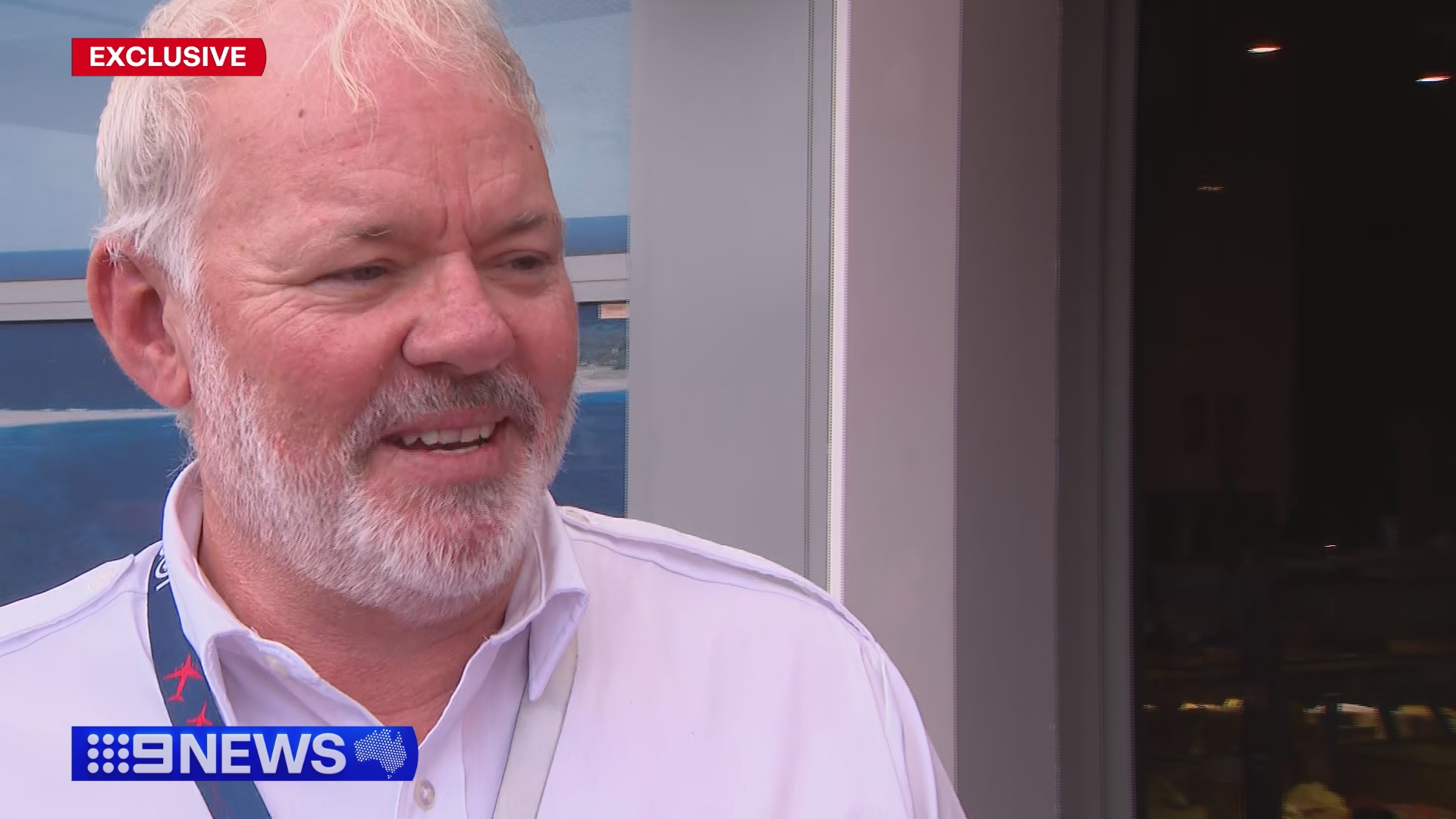
NAB's new chief executive Andrew Irvine has given a sense of clarity to Australian homeowners, saying he expects an interest rate within the next seven months.

Speaking exclusively to 9News, Irvine revealed while rates could come down in November, the RBA may wait until 2025 to make its first cut.

"The Australian economy is proving to be pretty resilient," he said.

READ MORE: Interest rate cut set to come later than hoped despite record spending slowdown

"Inflation is proving to be a little bit stubborn, particularly services inflation. We will have to see how things play out.

"Our view as a bank is that we won't see rates go up, hopefully that gives some comfort to people but it will still be a while until we see them come down, our guess is maybe November but that could easily turn into February.

"That all depends on inflation."

READ MORE: Desperate search underway for WA brothers missing in Mexico

NAB announced today that it had reported a 12.8 per cent drop in cash earnings to $3.5 billion for the six months to March.

It's the first results for Irvine, who took charge of the nation's second-biggest bank at the start of last month.

He said it's been "so far so good", since taking over from former boss Ross McEwan.

"The bank is going okay, when I talk to our customers most are getting by, they aren't having fun but they are getting by and those who are struggling we are helping them," Irvine said.

Father convicted of murdering three sons prepares third fight for freedom

A father who was sentenced to life in prison for murdering his three sons nearly two decades ago is preparing a fresh fight for freedom using laws introduced in Victoria more than four years ago.

Robert Farquharson, 54, has been found guilty twice for murdering his children after he was behind the wheel of a car that crashed into a dam near Winchelsea on Father's Day in 2005.

His three sons, Jai, 10, Tyler, seven and Bailey, two – drowned in the car, while Farquharson swam to safety.

READ MORE: Desperate search underway for WA brothers missing in Mexico

Robert Farquharson

The 54-year-old has always argued that he had a coughing fit and blacked out in the lead-up to the crash.

Farquharson was found guilty of murdering his children by separate juries in 2007 and 2010.

He is now preparing a fresh bid for freedom under new Victorian laws passed in 2019, which allows a second appeal if there is fresh and compelling evidence that shows a substantial miscarriage of justice has occurred.

Dr Chris Steinfort believes the 54-year-old is innocent.

He assessed Farquharson before his trial and has remained adamant that the crash was caused by a cough-induced fainting condition known as cough syncope.

"I think there has been a significant miscarriage of justice and I believe Robert is innocent," Seinfort said.

"I believe he did have an episode of cough syncope. He was not in control of himself when the car left the road, ran into the damn and his three children drowned."

READ MORE: Surfer dies after stabbing in Coffs Harbour, police hunt for attacker

Jai, Tyler and Bailey died at Winchelsea when their father drove a car off the Princes Highway and into a dam.The dam in Winchelsea where Robert Farquharson's car crashed. (9NEWS)

Farquharson's solicitor, Luke McMahon released a statement, stating that his client's story had not changed.

"As time evolves, we collectively gain a better understanding of both the science and better tools to be able to undertake analysis of the evidence," the statement said.

"Robert has always, consistently maintained his innocence.

"His story has not changed."

The mother of the three boys, Cindy Gambino-Moules died in 2022. Her family told ABC's 7.30 they did not support the new appeal.

The official application is expected to be lodged later this year.

Teen terror plot accused deemed ‘unacceptable risk’ to the public

An alleged terrorism conspirator who claimed to be mates with another teenager accused of stabbing a bishop during a live-streamed sermon has been denied bail and deemed an "unacceptable risk" to the community.

The 15-year-old, who cannot be named, was charged on Friday with conspiring to engage in an act in preparation for, or planning, a terrorist act.

Magistrate James Viney denied the teenager bail on the basis that exceptional circumstances did not exist to secure his release.

READ MORE: Brisbane single mum's $200 bill shock in cost-of-living crisis

"There is an unacceptable risk to the protection of the community," he told Parramatta Children's Court on Thursday.

The magistrate said this was of "paramount consideration" and found the boy's alleged explicit threats to stab Jewish or Assyrian people and a previous alleged assault to be "gravely concerning".

The court previously heard the boy had been involved in an encrypted chat group titled Plans where he talked with co-conspirators who were planning an upcoming attack targeting Jewish people.

Prosecutor Rebekah Rodger said the boys were not just talking and knew people who had acted on threats.

The magistrate detailed messages allegedly sent by the teenager between April 20 and April 21.

READ MORE: Two dead, two in hospital after crash in major Brisbane tunnel

"Don't youse want to do any attack … what about Jews brother what about Palestine? … I am so cut, I want to do it so bad," the teenager allegedly wrote in one message.

"I really want to do an attack now because I have so much hatred for these kuffar (non-Muslims) its not funny, I want to do jihad now," another message read.

"The messages clearly set up the young person wanting to do something catastrophic," Viney told the court.

The boy's lawyer Ahmed Dib previously told the court his client had a history of behavioural issues, lacked confidence and had low self-esteem.

He said the teenager put on a macho performance in messages about performing an attack and refuted that any such plan was in motion.

READ MORE: Millions of Aussies exposed in 'deeply concerning' data breach

Two hand-drawn ISIS flags were found in the boy's bedroom when police raided the family's home in April, the court previously heard.

The boy propped his head up with his hand for much of the hearing as he watched on from custody via videolink, as his parents sat in court.

His mother left in tears.

The matter is set to return to court on June 21.