Tag Archives: oceania

OceanGate's vessel used materials that 'simply didn't work': expert

Stockton Rush wore a hard-hat and stood next to one of his submersible crafts last year full of enthusiasm as he told a bunch of students about the thrills and perils of being a deep-sea explorer.

"The key element in any expedition is you got to be thinking, what could go wrong? What can I do to mitigate that risk," Rush told the students via a live web stream prior to one of his voyages. Despite such planning, he conceded, "something always bites you that you didn't expect."

Rush, the CEO of OceanGate and the pilot of the ill-fated Titan submersible that imploded this week diving to the Titanic wreckage, understood the dangers of his endeavours.

READ MORE: Cost of Titan sub search will easily stretch into millions of dollars

And his comments to the students seem tragically prophetic.

A US Coast Guard official said Thursday authorities had begun to map the debris of his vessel about 500m from the Titanic wreck. However, since the catastrophe occurred in international waters, authorities are discussing how an investigation would unfold, the official said. But experts agree that any inquiry is sure to question the design of the craft, the materials used to build it and whether Rush and his company should have done more to avert such a deadly outcome.

A CNN review of OceanGate's marketing material, public statements made by Rush and court records show that even as the company touted a commitment to safety measures, it rejected industry standards that would have imposed greater scrutiny on its operations and vessels. The company also boasted of collaborations with reputable institutions that have since denied partnering with OceanGate on the submersible in question.

Some industry experts said OceanGate's operations were known to be risky.

"This was a company that was already defying much of what we already know about submersible design," Rachel Lance, a Duke University biomedical engineer who has studied physiological requirements of survival underwater, said on CNN Thursday. She noted some of the vessel's design materials "were already large red flags to people who have worked in this field."

OceanGate declined to comment on its safety record.

READ MORE: Questions raised over eight-hour delay in sub search

'Once in a lifetime opportunity'

To the public, OceanGate's marketing sought to appeal to potential customers' sense of adventure while also assuring them the adventure was safe. They featured scientists or explorers praising the company's innovations. One flashy promotional video, published last year, opens with a voiceover boasting an unforgettable—but safe—voyage: "OceanGate Expeditions offers you the once-in-a-lifetime opportunity to be a specially trained crew member safely diving to the Titanic wreckage site."

That video also features explorer Paul Henri-Nargeolet, who was among those who died this week, praising the design of the doomed vessel.

"The sub, for me, it's very well done because it's simple," Nargeolet said. "Usually they have a lot of equipment and a lot of switches, and on this one you don't have because you work with a screen and a keyboard and it's very easy to do that."

That simplicity was highlighted late last year when Rush invited CBS News reporter David Pogue on a voyage, in which Rush admitted that he bought parts for his craft off-the-shelf at stores such as Camping World.

In online videos, Rush explained the Titan's unconventional design, which he said included carbon fibre to increase the vessel's buoyancy. It "hasn't been used in a crewed submersible ever before," he said in a video last year.

The Titan also included an "unparalleled safety feature" that monitored the integrity of the vessel's hull during each dive, according to OceanGate's website. A 2021 press release highlighted its "multiple, redundant safety systems."

But in a separate interview with Pogue, Stockton seemed dismissive of safety.

"At some point, safety just is pure waste," Stockton said. "I mean, if you just want to be safe, don't get out of bed. Don't get in your car. Don't do anything."

The five aboard were pilot Stockton Rush, the CEO of OceanGate; French explorer and Titanic expert Paul-Henry Nargeolet; British adventurer and billionaire Hamish Harding; and Pakistani businessman Shahzada Dawood and his son Suleman.

READ MORE: Missing Titanic sub crew dead after 'catastrophic implosion'

Two former Oceangate employees separately voiced safety concerns about the Titan. David Lochridge, who worked as the director of marine operations between 2016 and 2018, claimed in court filings that he had expressed apprehension about the submersible's design and the company's testing of its hull before he was terminated.

Lochridge also questioned OceanGate's plans to install a monitoring system on the vessel to detect the start of hull breakdown. His court filing argued "this type of acoustic analysis would only show when a component is about to fail—often milliseconds before an implosion—and would not detect any existing flaws prior to putting pressure onto the hull."

Court filings from OceanGate suggest there was additional testing after Lochridge left the company. It's unclear whether his concerns were addressed. OceanGate terminated his employment and sued Lochridge in 2018, arguing he shared confidential information and used the company for immigration assistance then manufactured a reason to be fired. The company's suit stated Lochridge is not an engineer but a submersible pilot and diver.

Another former employee who worked briefly for the company as an operations technician during the same time period as Lochridge also had concerns about the hull's thickness and adhesion, he said, speaking to CNN on the condition of anonymity.

Lance, the Duke University professor, echoed some of these concerns. She said the unconventional combinations of materials used in the Titan posed safety risks because "over the course of repeated pressurizations, they tend to weaken."

"This is not exactly what, in my opinion, would be innovation because this is already a thing that has been tried and it simply didn't work," she said.

It's unclear how many total deep-sea voyages the Titan took, though a court filing from a company adviser in November said the five-person submersible had taken 28 people to the Titanic last year.

OceanGate appears to have also overstated its relationships with two institutions widely respected for their innovation: Boeing and University of Washington.

OceanGate's website touted a partnership with Boeing, stating that its Titan was "designed and engineered by OceanGate Inc. in collaboration [with] experts" from Boeing and other entities. Similarly, OceanGate claimed in a 2021 court filing that the Titan was built with the help of University of Washington's Applied Physics Laboratory.

OceanGate CEO Stockton Rush.

READ MORE: James Cameron on 'surreal' similarities between sub and Titanic

Both Boeing and UW denied partnering with OceanGate in the development of the Titan.

OceanGate had partnered with UW to create a different submersible before parting ways, the university said in a statement. The company also used testing tanks at the UW School of Oceanography for nine tests between 2016 and 2022, according to Victor Balta, the spokesperson for UW. The tanks were used on a contract basis and no university researchers were involved in those tests and "UW personnel did not provide any verification or validation of any OceanGate equipment as a result of those tests," Balta added.

OceanGate co-founder Guillermo Sohnlein, who left the company in 2013 and wasn't involved in the development of Titan, cautioned Friday against jumping to conclusions on what caused the catastrophic loss of the submersible.

"Safety was always number one priority for us and for Stockton in particular—he was a very strong risk manager and I believe that he believed that every innovation that he created whether technologically or within the dive operations was to both expand the capability of humanity exploring the oceans while also improving the safety of those doing it," he told Anderson Cooper on CNN This Morning.

Breaking the rules

Rush appeared to enjoy pushing boundaries. While he sometimes spoke about exercising caution, he viewed industry standards as a roadblock to technological advancements in the field of exploration and he once acknowledged to a YouTuber that he had "broken some rules" to build the Titan.

His company also alarmed industry veterans by declining to class the Titan, a routine inspection process that would have provided a layer of oversight. "You are taking on a lot of risk and the risk you are taking might affect the entire industry," said the president of the industry group Marine Technology Society's submarine committee, Will Kohnen, who recalled to CNN concerns he conveyed to OceanGate founder Rush in 2018.

If OceanGate had pursued a certification review "some of this may have been avoided," Kohnen told CNN on Wednesday.

Because the Titan was diving in international waters, the vessel appeared to operate in a regulatory gap.

"It is a grey area that is being exposed to the light of day," said Sal Mercogliano, a professor at Campbell University in North Carolina and maritime historian.

The Titan's lack of credentials was noted in legal waivers OceanGate asked customers to sign before voyages. The company reportedly warned that its newest submersible had "not been approved or certified by any regulatory body" and that a dive "could result in physical injury, disability, emotional trauma or death."

Mike Reiss, who was one of Rush's clients, said he was aware of the perils.

"Before I boarded the sub, I signed a lengthy waiver detailing all the ways this trip could kill me: asphyxiation, electrocution, drowning, crushing — death was mentioned three times on the first page," Reiss wrote in an op-ed for CNN. "I kissed my wife goodbye before I left, thinking I might never see her again."

It's still unclear what led to the catastrophic implosion that killed Rush and his passengers. But a US Coast Guard official suggested in a news conference Thursday that existing safety rules would be reviewed.

"This is an incredibly difficult and dangerous environment to work in out there," Rear Adm. John Mauger said.

Rush had no illusions about those challenges.

"You've just got to roll with the punches," he told students in the live-stream video last year. "That's the attitude we really look for with people who join us, is (to) see a problem as a challenge, not as a reason to hide."

Sign up here to receive our daily newsletters and breaking news alerts, sent straight to your inbox.
Girlfriend of the dentist who killed his wife on safari sentenced to 17 years

The girlfriend of a dentist convicted of murdering his wife on an African safari was sentenced Friday to 17 years in prison for being an accessory to the crime during a hearing where relatives of the slain woman told her she had destroyed their family.

Ana Rudolph, daughter of 57-year-old victim Bianca Rudolph, said that Lori Milliron, 65, had “plotted to eliminate” her mother.

“Lori, you have taken my parents,” Rudolph said directly to Milliron, but “despite everything you have done you will never take my soul, this might be difficult to understand… because you don’t have one.”

READ MORE: Breast cancer survivor wants $7000-a-month wonder drug to be more readily available to patients

Dentist Larry Rudolph was found guilty of murder and mail fraud in the 2016 shooting death of his wife in Zambia.

Milliron was convicted last year of perjury, being an accessory to a murder after the fact and obstructing a grand jury in a case that’s garnered national attention.

She was charged alongside Lawrence "Larry” Rudolph, a US dentist who was convicted last year of fatally shooting his wife while on a 2016 hunting trip in Zambia.

His sentencing, originally set for this week, has been postponed.

John Dill, an attorney for Milliron, said the prison sentence was longer than what is typically dolled out for such charges, calling it “excessive” and vowing to appeal.

Dill argued that the convictions were merely based on Milliron's perjury charges and do not implicate her in the execution of the crime.

READ MORE: Defecting army enters Russian city of Rostov without resistance

Lawrence Rudolph's defense investigator, left, heads into federal court in Denver along with the dentist's children in 2022.

Standing in front of the judge on Friday, Milliron insisted she was innocent of the crimes but said she was “sympathetic” to the Rudolph family.

Judge William J. Martínez argued that the long sentence was deserved because evidence pointed to Milliron “encouraging” the crime.

Martínez added that Milliron seemed “unrepentant” in part because he judged her emotionally unmoved when she was shown graphic images and listened to wrenching testimony during the trial.

After Bianca Rudolph's death in 2016, Lawrence Rudolph claimed his wife accidentally shot herself while packing to leave Zambia for the United States.

Later, Rudolph collected millions in accidental death insurance payments.

After an FBI investigation, however, authorities charged Rudolph in 2021 with her murder.

Rudolph maintains that his late wife of 34 years accidentally killed herself, but prosecutors countered that evidence showed that that was impossible because the wound to her heart came from a shot fired from 60 centimeters to 1 metre away.

Sign up here to receive our daily newsletters and breaking news alerts, sent straight to your inbox.

Who is the head of the group calling for an armed rebellion?

The head of the private military contractor Wagner called Friday for an armed rebellion aimed at ousting Russia’s defence minister.

Russian security services reacted immediately by opening a criminal investigation into Yevgeny Prigozhin.

He has previously bashed the country's military leadership for failures in the war in Ukraine, and is known for his long-running feud with the Defence Ministry.

Here is a look at the 62-year-old Prigozhin and Wagner’s role in the war.

READ MORE: Tourist dies in Queensland scooter crash

Wagner boss Yevgeny Prigozhin furthered his dispute with Russian military leaders on June 23.

What did Prigozhin say?

Prigozhin posted a series of angry video and audio recordings in which he accused Defence Minister Sergei Shoigu of ordering a rocket strike Friday on Wagner’s field camps in Ukraine, where his troops are fighting on behalf of Russia.

Prigozhin said his troops would now punish Shoigu in an armed rebellion and urged the army not to offer resistance.

“This is not a military coup, but a march of justice,” Prigozhin declared.

The Defence Ministry denied carrying out the rocket attack.

The National Anti-Terrorism Committee, which is part of the Federal Security Services, or FSB, said he would be investigated on charges of calling for an armed rebellion.

The FSB urged Wagner’s contract soldiers to arrest Prigozhin and refuse to follow his “criminal and treacherous orders.”

It called his statements a “stab in the back to Russian troops” and said they amounted to fomenting an armed conflict in Russia.

Riot police and the National Guard have been scrambled to tighten security at key facilities in Moscow, including government agencies and transport infrastructure, Tass reported.

What's Prigozhin's background?

Prigozhin was convicted of robbery and assault in 1981, and sentenced to 12 years in prison.

Following his release, he opened a restaurant business in St Petersburg in the 1990s.

It was in this capacity that he got to know now-President Vladimir Putin, then the city’s deputy mayor.

Prigozhin used that connection to develop a catering business and won lucrative Russian government contracts that earned him the nickname “Putin’s chef.”

He later expanded into other areas, including media and an infamous internet “troll factory” that led to his indictment in the US for meddling in the 2016 presidential election.

In January, Prigozhin acknowledged founding, leading and financing the shadowy Wagner company.

READ MORE: Union outraged after maggot-filled steak served to mine workers

Russian President Vladimir Putin delivers a speech as he attends a ceremony to receive credentials from newly appointed foreign ambassadors to Russia, at the Kremlin, in Moscow, Russia, Wednesday, April 5, 2023

Where has Wagner operated?

Wagner was first seen in action in eastern Ukraine soon after a separatist conflict erupted there in April 2014, in the weeks following Russia’s annexation of Ukraine's Crimean Peninsula.

While backing the separatist insurgency in the Donbas, Ukraine’s eastern industrial heartland, Russia denied sending its own weapons and troops there despite ample evidence to the contrary.

Engaging private contractors in the fighting allowed Moscow to maintain a degree of deniability.

Prigozhin’s company was called Wagner after the nickname of its first commander, Dmitry Utkin, a retired lieutenant colonel of the Russian military’s special forces. It soon established a reputation for brutality and ruthlessness.

READ MORE: Air Force chief announced as first National Cyber Security Coordinator

Wagner personnel also deployed to Syria, where Russia supported President Bashar Assad’s government in a civil war.

In Libya, they fought alongside forces of commander Khalifa Hifter. The group has also operated in the Central African Republic and Mali.

Prigozhin has reportedly used Wagner’s deployment to Syria and African countries to secure lucrative mining contracts.

US Undersecretary of State Victoria Nuland said in January the company was using its access to gold and other resources in Africa to fund operations in Ukraine.

Some Russian media alleged that Wagner was involved in the 2018 killings of three Russian journalists in Central African Republic who were investigating the group’s activities.

The slayings remain unsolved.

What is Wagner's reputation?

Western countries and UN experts have accused Wagner mercenaries of human rights abuses throughout Africa, including in Central African Republic, Libya and Mali.

In 2021, the European Union accused the group of “serious human rights abuses, including torture and extrajudicial, summary or arbitrary executions and killings,” and of carrying out “destabilizing activities” in Central African Republic, Libya, Syria and Ukraine.

Video has surfaced purporting to show some of the activities that have contributed to Wagner's fearsome reputation.

A 2017 online video showed a group of armed people, reportedly Wagner contractors, torturing a Syrian and beating him to death with a sledgehammer before mutilating and burning his body.

Russian authorities ignored requests by the media and rights activists to investigate.

In 2022, another video showed a former Wagner contractor beaten to death with a sledgehammer after he allegedly fled to the Ukrainian side and was repatriated.

Despite public outrage and demands for an investigation, the Kremlin turned a blind eye.

What's Wagner's role in Ukraine?

Wagner took an increasingly visible role in the war as regular Russian troops suffered heavy attrition and lost territory in humiliating setbacks.

Prigozhin toured Russian prisons to recruit fighters, promising pardons if they survived a half-year tour of front-line duty with Wagner.

In the interview in May, he said he had recruited 50,000 convicts, about 10,000 of whom where killed in Bakhmut; a similar number of his own fighters have died there.

He said he had 50,000 men at his disposal “in the best times,” with about 35,000 on the front lines at all times.

READ MORE: Breast cancer survivor wants $7000-a-month wonder drug to be more readily available to patients

An armoured personnel carrier  is seen on a street of the southern city of Rostov-on-Don, Russia.

He didn’t say whether these numbers included convicts.

The US has estimated Wagner had about 50,000 personnel fighting in Ukraine, including 10,000 contractors and 40,000 convicts.

A US official says nearly half of the 20,000 Russian soldiers killed in Ukraine since December have been Wagner’s troops in Bakhmut.

The US assesses that Wagner is spending about $100 million a month in the fight.

In December, Washington accused North Korea of supplying weapons, including rockets and missiles, to the Russian company in violation of UN Security Council resolutions. Both Wagner and North Korea denied the reports.

How has Prigozhin criticised Russia's military?

If the US accusation is true, Wagner’s reach for North Korean weapons may reflect its long-running dispute with the Russian military leadership, which dates to the company’s creation.

Prigozhin claimed full credit in January for capturing the Donetsk region salt-mining town of Soledar in Ukraine and accused the Russian Defence Ministry of trying to steal Wagner’s glory.

He has repeatedly complained the Russian military failed to supply Wagner with sufficient ammunition to capture Bakhmut and threatened to pull out his men.

Troops purported to be Wagner contractors in Ukraine recorded a video in which they showered the chief of the Russian military’s General Staff, General Valery Gerasimov, with curses and accusations of failing to provide ammunition.

Prigozhin also has singled out Shoigu for withering criticism while accusing Russian military leaders of incompetence.

His frequent complaints are unprecedented for Russia’s tightly controlled political system, in which only Putin could air such criticism.

John Kirby, spokesman for the White House National Security Council, said last month that Prigozhin’s remarks critical of the war “could be a sort of morbid way of him… claiming credit for whatever they’ve been able to achieve in Bakhmut, but also trying to publicly embarrass the Ministry of Defence further that the cost was borne in blood and treasure by Wagner, and not by the Russian military."

Once a shadowy figure, Prigozhin has increasingly raised his public profile, boasting almost daily about Wagner’s purported victories, sardonically mocking his enemies and complaining about the military brass.

Asked recently about a media comparison of him with Grigory Rasputin, a mystic who gained fatal influence over Russia’s last czar by claiming to have the power to cure his son’s hemophilia, Prigozhin snapped, “I don’t stop blood, but I spill blood of the enemies of our Motherland.”

Sign up here to receive our daily newsletters and breaking news alerts, sent straight to your inbox.

Man charged with murder after elderly woman found dead in home

A man has been charged with murder after an elderly woman was found dead in home in Melbourne's north west.

The 81-year-old was found dead inside a home on Macedon Street in Maribyrnong about 5.40pm on June 12.

Victoria Police said the arrested a 55-year-old man early this morning at a South Yarra address.

READ MORE: Tourist dies in Queensland scooter crash

A man has been charged with murder after an elderly woman was found dead in home in Melbourne's north west.

"He has been charged with one count of murder," Victoria Police said in a statement.

He is behind bars and is expected to appear before Melbourne Magistrates' Court in October.

Sign up here to receive our daily newsletters and breaking news alerts, sent straight to your inbox.
Australia places sanctions on people involved in downing of MH17

Sanctions have been placed on people involved in the Russian downing of flight MH17, which killed 298 people, including 38 Australians in Ukraine 2014.

The Australian government imposed financial sanctions and travel bans on those who were convicted by the District Court of the Hague in November 2022 of murdering all on board.

Foreign Affairs minister Penny Wong confirmed Sergey Dubinskiy and Leonid Kharchenko have been sanctioned after The Hague found them guilty.

READ MORE: Fears civil war brewing in Russia after calls for rebellion against Russian defence chief

MH17 five year anniversary

"The third convicted perpetrator Igor Girkin, was sanctioned by Australia in 2014 for supporting separatist activity in eastern Ukraine," Wong's office said in a statement.

"Australia has also sanctioned Sergey Muchkaev, a Colonel with the Russian Armed Forces who in July 2014 was the Commander of the 53rd Anti-Aircraft Missile Brigade, which supplied the Buk-TELAR that downed Flight MH17."

Wong said the three new sanctions were on people who "actively supported actions and policies that threatened the sovereignty and territorial integrity of Ukraine".

READ MORE: Tourist dies in Queensland scooter crash

"These sanctions demonstrate the Australian Government's ongoing commitment to hold to account those responsible for the downing of Flight MH17.

"Our thoughts remain with those who lost their lives, their families and loved ones."

Australia worked with the Netherlands and European Union to coordinate the sanctions.

Sign up here to receive our daily newsletters and breaking news alerts, sent straight to your inbox.
Woman charged over role in deadly crash NSW Riverina

A woman has been charged over her alleged role in a crash which killed a woman and three young boys in the NSW Riverina region.

NSW Police allege the incident began when a resident was threatened after their door was kicked in on Cudgel Street in Yanco, near Griffith, just after 11pm on April 4.

"About 15 minutes later, a vehicle being driven along Research Road left the road and crashed," NSW Police said in a statement.

READ MORE: Man charged with murdering woman, attempting to kill two girls in NSW car crash

A man charged with the murder of a 71-year-old woman in 2018 is expected to appear in Wagga Wagga Local Court today.

"The occupants of the vehicle – a 36-year-old woman and three boys aged 10, 11 and 12 – all died at the scene."

A 32-year-old man has already been charged and is before the courts.

"A 50-year-old woman was arrested at Griffith Police Station about 1pm yesterday," police said.

"She was charged with predatory driving, driver not disclose identity of driver/passenger as required and hinder investigation serious indictable offence of other."

The woman was refused bail and is expected to appear in Wagga Wagga local court today.

Sign up here to receive our daily newsletters and breaking news alerts, sent straight to your inbox.

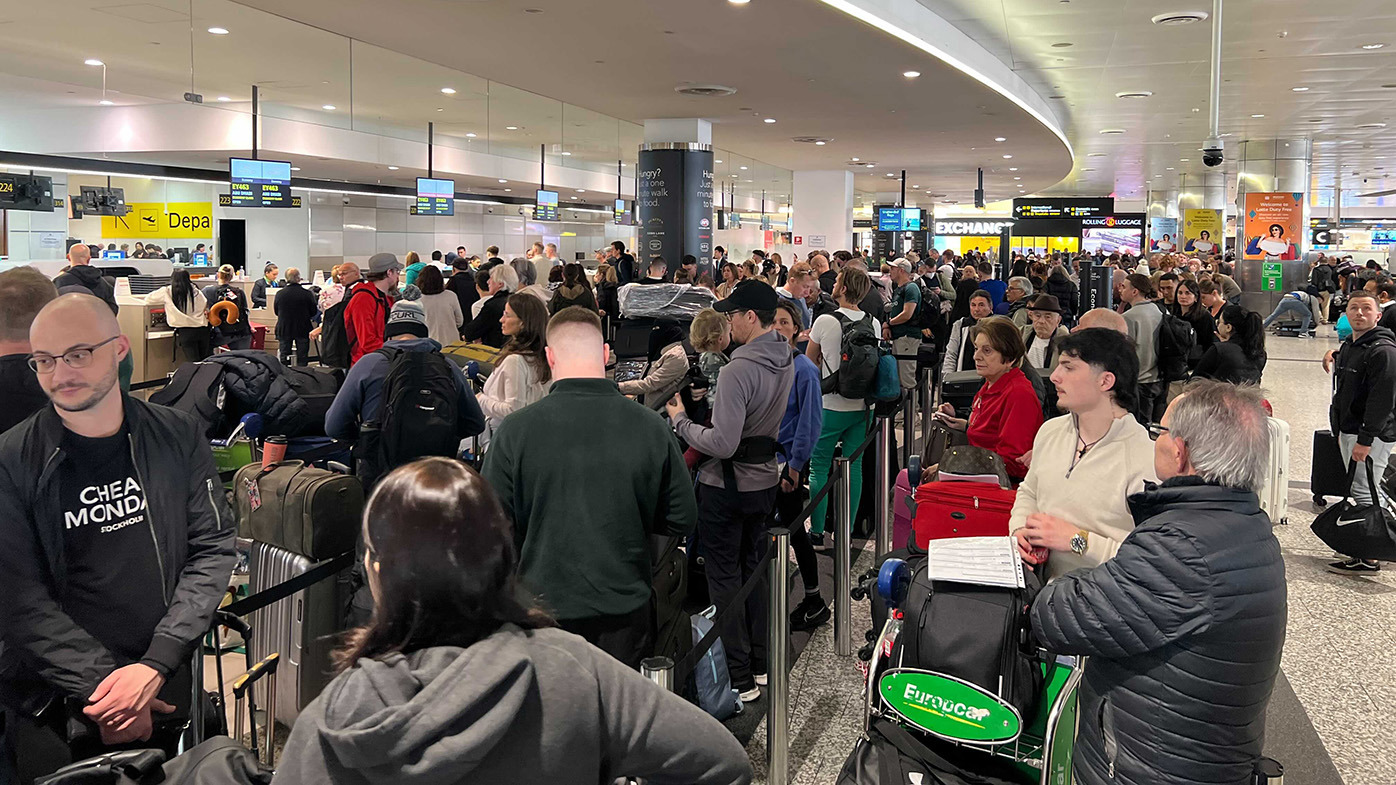
Sydney Airport travellers warned with no trains running this weekend

No trains will be running at Sydney Airport's domestic and international stations this weekend, as lines across the network undergo "essential trackwork".

Replacement buses will be running between Glenfield and Sydenham and between Sydenham and Central, including the airport stations, as part of the Rail Repair Plan.

The works will begin just before midnight on Friday and run until the first service on Monday morning.

READ MORE: US Navy detected 'anomaly' that was likely Titan imploding days ago

Early morning commuters at Central Station. Metro trains are back running at reduced capacity today, with services on most lines departing every 30 minutes. 22 February, 2022. Photo: Brook Mitchell

The T2, T4 and T5 lines will also be affected.

Transport for NSW is urging commuters to allow extra time this weekend.

Below is what we know about the works.

T2

On the T2 Inner West and Leppington line, buses will replace trains between Leppington and Glenfield, and between Ashfield and Central Stations.

Trains will also run to a changed timetable between Macarthur, Glenfield and Central via Granville due to the trackwork.

T5

Buses replace trains between Leppington and Glenfield on the T5 Cumberland Line as well.

Trains run to a normal timetable between Liverpool and Schofields.

READ MORE: Crane slams into Ipswich home after falling off truck

T4

In the city, City Circle stations at Museum, St James and Circular Quay will be closed, but trains will continue to run between Central, Town Hall and Wynyard while T4 Eastern Suburbs trains will still run to Martin Place.

Light rail services will be operating as normal in the city.

Different train lines are expected to be impacted across the weekend.

T8

Buses will replace scheduled train services on the T8 Line between Glenfield and Sydenham and between Sydenham and Central, including the Domestic and International Airport Stations.

Buses will also replace trains from North Sydney between Tallawong and Epping as part of metro upgrades.

About 1500 track workers across 200 sites will be fixing the "high-priority" defects.

Sign up here to receive our daily newsletters and breaking news alerts, sent straight to your inbox.

Tourist dies after crashing while riding scooter in Queensland

A Belgian tourist has died after crashing into a street sign while riding a motorised scooter on a North Queensland island.

The 26-year-old was riding the scooter on Horseshoe Bay Road on Magnetic Island eight kilometres off Townsville's coast when she hit the street sign about 3pm.

Queensland Police said members of the public gave her first aid while emergency services arrived.

READ MORE: Murder charges after country NSW crash

Police said she was taken to Townsville University Hospital where she had emergency surgery.

"The rider succumbed to her injuries around 9pm," Queensland Police said in a statement.

"Authorities are working with DFAT to notify family in Belgium."

Magnetic Island is a small island popular among tourists.

Sign up here to receive our daily newsletters and breaking news alerts, sent straight to your inbox.
What we know about the 'catastrophic implosion' on Titan sub

What was supposed to be a 10-hour journey to the Titanic shipwreck ended in tragedy, with all five passengers on the missing submersible killed in a catastrophic implosion.

Their deaths were confirmed Thursday, concluding a week-long search for survivors that was closely watched around the world.

The US Navy detected a sound that would match an implosion on Sunday, the day it went missing, and search teams have since found fragments of the Titan submersible, confirming those on board have perished.

READ MORE: Teen was 'terrified' in lead up to doomed Titanic sub trip

Titanic sub search

But many questions still remain as authorities continue searching for debris, including when the implosion happened and what exactly went wrong with the sub.

Here's what we know so far.

What is a catastrophic implosion?

An underwater implosion refers to the sudden inward collapse of the vessel, which would have been under immense pressure at the depths it was diving toward.

It's unclear where or how deep the Titan was when the implosion occurred, but the Titanic wreck sits nearly 4000 metres below sea level. The submersible was about 1 hour and 45 minutes into the roughly two-hour descent when it lost contact.

At the depth the Titanic rests, there is around 5600 pounds per square inch of pressure – several hundred times the pressure we experience on the surface, according to Rick Murcar, the international training director at the National Association of Cave Divers.

A catastrophic implosion is "incredibly quick", taking place within just a fraction of a millisecond, said Aileen Maria Marty, a former Naval officer and professor at Florida International University.

"The entire thing would have collapsed before the individuals inside would even realise that there was a problem," she told CNN.

"Ultimately, among the many ways in which we can pass, that's painless."

Experts say it is unlikely any bodies will be recovered.

The US Coast Guard said on Thursday it will continue the search in an effort to recover what it can, but warned it was "an incredibly unforgiving environment down there on the sea floor".

READ MORE: Did initial delays in communication hamper tourist sub search?

What's next for the search effort?

Besides searching for the passengers, authorities will also continue to search the sea floor in hopes of discovering more information about what led to the implosion.

It will take time to put together a specific timeline of events, the US Coast Guard said Thursday, calling the underwater environment "incredibly complex".

So far, they have located the Titan's nose cone and one end of its pressure hulls in a large debris field, and the other end of the pressure hull in a second, smaller debris field.

"What they would do now is go back to that site and, like cookie crumbs, try to find a trail as to where that would lead," said Tom Maddox, CEO of Underwater Forensic Investigators, who took part in a Titanic expedition in 2005.

He added that the debris pieces could still be "slightly buoyant" and be carried further away by ocean currents.

"So the big project right now is going to be trying to collect those parts," he said.

"They'll mark them, they'll indicate where they were, and they'll lay out a map of where those parts were found."

READ MORE: How the wreck of the Titanic was first rediscovered

What is the timeline of the disaster?

The expedition set out from Newfoundland, Canada, on June 16, with the Polar Prince support ship carrying participants to the site of the Titanic wreck.

Then on Sunday, June 18, the five passengers began the dive in the submersible, launched from the support ship, which remained on the surface.

They began the dive around 9am, with their last communication to the surface at 11.47am, according to Miawpukek Maritime Horizon Services, which co-owns the Polar Prince.

They were expected to resurface at 6.10pm, but were not seen; authorities were notified at 6:35pm and the rescue operations launched, according to Maritime Horizon.

There seemed to be a brief window of hope after reports emerged that search teams on Tuesday heard banging every 30 minutes, though they were unable to locate the source of the noise.

READ MORE: Years before sub went missing, letter warned of 'catastrophic' design

Missing Titanic Titan sub

But the submersible had only been equipped with 96 hours of oxygen, setting Thursday as a key target to locate and retrieve the submersible. By Thursday afternoon, authorities confirmed the submersible had imploded, saying there does not seem to be a connection between the banging noises and where the debris was found.

A senior US Navy official told CNN the noises were likely some form of natural life or sounds given off by other ships and vessels that were part of the search effort.

It's still not clear when exactly the vessel may have imploded. The Navy detected a sound that was "consistent" with an implosion on Sunday, but it was determined to be "not definitive", so the search for survivors or remains of the vessel continued.

The US Coast Guard said on Thursday it had set up sonar buoys in the water for at least the last 72 hours – meaning from at least Monday onward – but they did not record any sign of an implosion.

READ MORE: Director says 'surreal' similarities between Titanic and destroyed sub

The submersible, known as Titan

Who was on board?

The five men on board included the CEO of the tour operator, a British businessman, a renowned French diver, and a Pakistani billionaire and his son.

OceanGate Expeditions, the Titan's operator, said Thursday it believed CEO Stockton Rush and the other passengers to be "lost", adding that the company's employees were "exhausted and grieving deeply over this loss".

Rush, 61, founded OceanGate in 2009 with a stated mission of "increasing access to the deep ocean through innovation". In a series of interviews, Rush said he believes deeply that the sea, rather than the sky, offers humanity the best shot at survival when the Earth's surface becomes uninhabitable.

As CEO, Rush, who graduated from Princeton in 1984 with a degree in aerospace engineering, oversaw the company's "financial and engineering strategies" and provides a "vision for development" of crewed submersibles, according to his bio.

READ MORE: Russia launches legal bid against Australia over cancelled embassy

Titanic Titan missing sub

But in his eagerness to explore, Rush often appeared skeptical, if not dismissive, of regulations that might slow innovation.

British businessman and adventurer Hamish Harding was also on board. Based in the United Arab Emirates, he was the chairman of Action Aviation, an aircraft brokerage, but was better known for his various expeditions.

He was part of a flight crew that broke the world record for the fastest circumnavigation of the globe via both poles; was one of the first people to dive to the Challenger Deep in the Pacific Ocean, widely believed to be the deepest point in the world's oceans; he went to space on the Blue Origin flight; and was part of two record-breaking trips to the South Pole.

French diver Paul-Henri "PH" Nargeolet had decades of experience exploring the Titanic. He served as the director of underwater research at RMS Titanic Inc., the company that has exclusive rights to salvage artefacts from the ship.

According to his biography on the company's website, Nargeolet completed 35 dives to the Titanic wreck and supervised the recovery of 5000 artefacts. He also spent 22 years in the French Navy.

In a statement, his family called him one of the greatest deep-sea explorers in history, adding: "But what we will remember him most for is his big heart, his incredible sense of humour and how much he loved his family."

Lastly, Shahzada Dawood and his son, Suleman Dawood, were from a prominent Pakistani business family.

Dawood Hercules Corp., their business, is among the largest corporations in the country, with a portfolio spanning energy, petrochemicals, fertilisers, information technology, and food and agriculture.

In a statement online, the family patriarch Hussain Dawood and his wife, Kulsum Dawood, said: "Please continue to keep the departed souls and our family in your prayers during this difficult period of mourning."

Sign up here to receive our daily newsletters and breaking news alerts, sent straight to your inbox.