Tag Archives: oceania

What the Titanic sub saga and Greek migrant shipwreck say about us

Across the span of nearly a week, the saga of a lost submersible that had gone into the depths of the ocean to see the Titanic wreckage rippled across the global conversation — culminating in news that the craft had imploded and its five occupants were dead.

But a far bigger disaster days earlier, the wrecking of a ship off Greece filled with migrants that killed at least 80 people and left a horrifying 500 missing, did not become a moment-by-moment worldwide focus in anywhere near the same way.

One grabbed unrelenting, moment-to-moment attention. One was watched and discussed as another sad, but routine, news story.

READ MORE: What's next in the search for the imploded submersible?

What makes these two events at sea different in how they were received? Viewed next to each other, what do they say about human reactions to tragic news? And why did the saga of the submersible grab so much attention?

There was an unknown outcome and (we thought) a ticking clock

By the time the world learned about the Greek shipwreck, the event had already taken place and, to some extent, the outcome was already known. All that was left was the aftermath.

Conversely, the Titan (the world thought) was an event in the process of happening — something that unfolded in real time with a deadline attached. As with any narrative, a ticking clock increases tension and attention.

The fact that no one could communicate with the submersible — or learn anything about what the people inside were experiencing — only added to the potential for close attention.

And the possibility of a happy ending — at least for a while — also helped sustain attention, said Jennifer Talarico, a psychology professor at Lafayette College in Pennsylvania who studies how people form personal memories of public events.

READ MORE: Canada investigating why Titanic-bound submersible imploded

A renowned historical tragedy was back in the news

Before anything even went awry, the Titan was already venturing into a realm of existing high interest — the wreck of the Titanic, itself the archetype of modern disasters long before James Cameron's popular 1997 film. So there was an interest already baked in that had nothing to do with the submersible itself.

Cameron's reaction to the Titan disaster only intensified that connection.

He told the BBC in an interview broadcast on Friday that he "felt in my bones" that the Titan submersible had been lost soon after he heard it had lost contact with the surface during its descent to the wreckage of the ocean liner at the bottom of the Atlantic Ocean.

He said focus in the media over the next few days about the submersible having 96 hours of oxygen supply — and that banging noises had been heard — was a "prolonged and nightmarish charade".

READ MORE: OceanGate's vessel used materials that 'simply didn't work': expert

Director James Cameron spoke about the loss of the five people aboard the Titan sub.

Class and race played a role

Many reactions and memes this week centred around the notion — fair or not — that one event involved rich people using the ocean as a playground, while the other was a sadly frequent recurrence of misfortune befalling people who lack status, resources or even a voice in the modern marketplace of ideas.

Apryl Alexander, a public health professor at University of North Carolina-Charlotte who has studied trauma and survivors, said the migrants on the ship in Greece didn't seem to engender the same interest from the public as did the wealthy individuals who paid $US250,000 ($374,000) apiece to explore the Titanic.

That reminded Alexander of the differences in news coverage of crime in the United States. Crimes get more attention when the victim is white and wealthy compared to a person of colour in poverty, Alexander said.

READ MORE: Teen was 'terrified' in lead up to doomed Titanic sub trip

A small group of people had the media's ear

Tim Recuber, an assistant professor of sociology at Smith College who studies mass media, digital culture and emotions, said people tend to be drawn to stories that allow them to empathise with the suffering of others — and that it's easier to empathise when there are smaller numbers of people involved.

"I think some people are calling out this time around the sort of inequalities that are baked into it around class," Recuber said.

"We are able to learn who the people on the sub are because of who they are. They're wealthy and they have access to the press.

"Divisions of race and national identity matter in terms of who gets empathised with."

The public lives vicariously through the risks others take

Individuals who choose their risks have grabbed headlines almost since there have been headlines. So the public was likely enthralled about others cheating death by doing something dangerous, said Daryl Van Tongeren, a psychology professor at Hope College in Michigan who has studied the meaning around big events and their effect on people.

In other words, he said, readers and viewers can feel alive by living vicariously through others who are taking risks.

"There's this fascination with people who engage in these high-risk experiences," Van Tongeren said.

"Even though we know that death is the only certainty in life, we invest in these activities where we get close to death but overcome it. We want to demonstrate our mastery over death," he said.

The five aboard were pilot Stockton Rush, the CEO of OceanGate; French explorer and Titanic expert Paul-Henry Nargeolet; British adventurer and billionaire Hamish Harding; and Pakistani businessman Shahzada Dawood and his son Suleman.

Disaster fatigue is a factor, too

The pandemic. Mass shootings. Economic problems. War. Climate change. It can be hard for another piece of bad news to punch through.

"People are starting to tune out," Alexander said.

In the end, she said, she'd like to see the same level of societal interest in human tragedies regardless of race, religion, demographics, or other factors.

"For all of us, we hope that if any of our loved ones go missing that the media and the public would pay the same attention to all stories," she said.

Sign up here to receive our daily newsletters and breaking news alerts, sent straight to your inbox.

Revolt fizzles out but big questions remain about Putin's power

Within a remarkable day and a half, Russia faced the very real threat of an armed insurrection, with President Vladimir Putin vowing to punish Wagner fighters marching toward Moscow and occupying cities along the way – before a sudden deal with Belarus seemed to defuse the crisis as rapidly as it emerged.

But much remains uncertain, with experts warning the rare uprising isn't likely to disappear so quickly without consequences down the line.

Putin must now navigate the aftermath of the most serious challenge to his authority since he came to power in 2000, following a series of dizzying events that was closely – and nervously – watched by the world and cheered by Ukraine.

READ MORE: The 'serious challenges' now facing Putin's regime

Russian President Vladimir Putin.

Outspoken Wagner boss Yevgeny Prigozhin is being sent to Belarus, apparently unscathed, but he may have painted a target on his own back like never before.

Here's what we know.

What's the latest?

Prigozhin, the bombastic head of the Wagner group, agreed to leave Russia for neighbouring Belarus today, in a deal apparently brokered by Belarusian President Alexander Lukashenko.

The deal includes Prigozhin pulling back his troops from their march toward the capital, said a Kremlin spokesperson.

The criminal charges against him will be dropped, said the spokesperson.

Wagner fighters will face no legal action for their part in the insurrection, and will instead sign contracts with Russia's Ministry of Defence – a move Prigozhin had previously rejected as an attempt to bring his paramilitary force in line.

READ MORE: Stolen ATM turns up empty on South Australia country road

Wagner boss Yevgeny Prigozhin

Wagner troops previously claimed they had seized key military facilities in two Russian cities; by Saturday, videos showed Prigozhin and his forces withdrawing from one of those cities, Rostov-on-Don.

It's not clear where Prigozhin is now.

The Kremlin is unaware of his whereabouts, the spokesperson said.

How did this happen?

The crisis in Russia erupted on Friday (local time) when Prigozhin accused Russia's military of attacking a Wagner camp and killing his men – and vowed to retaliate by force.

Prigozhin then led his troops into Rostov-on-Don and claimed to have taken control of key military facilities in the Voronezh region, where there was an apparent clash between Wagner units and Russian forces.

Prigozhin claimed it wasn't a coup but a "march of justice."

But that did little to appease Moscow, with a top security official calling Prigozhin's actions a "staged coup d'état," according to Russian state media.

READ MORE: Two dams close to overflowing in South Australia

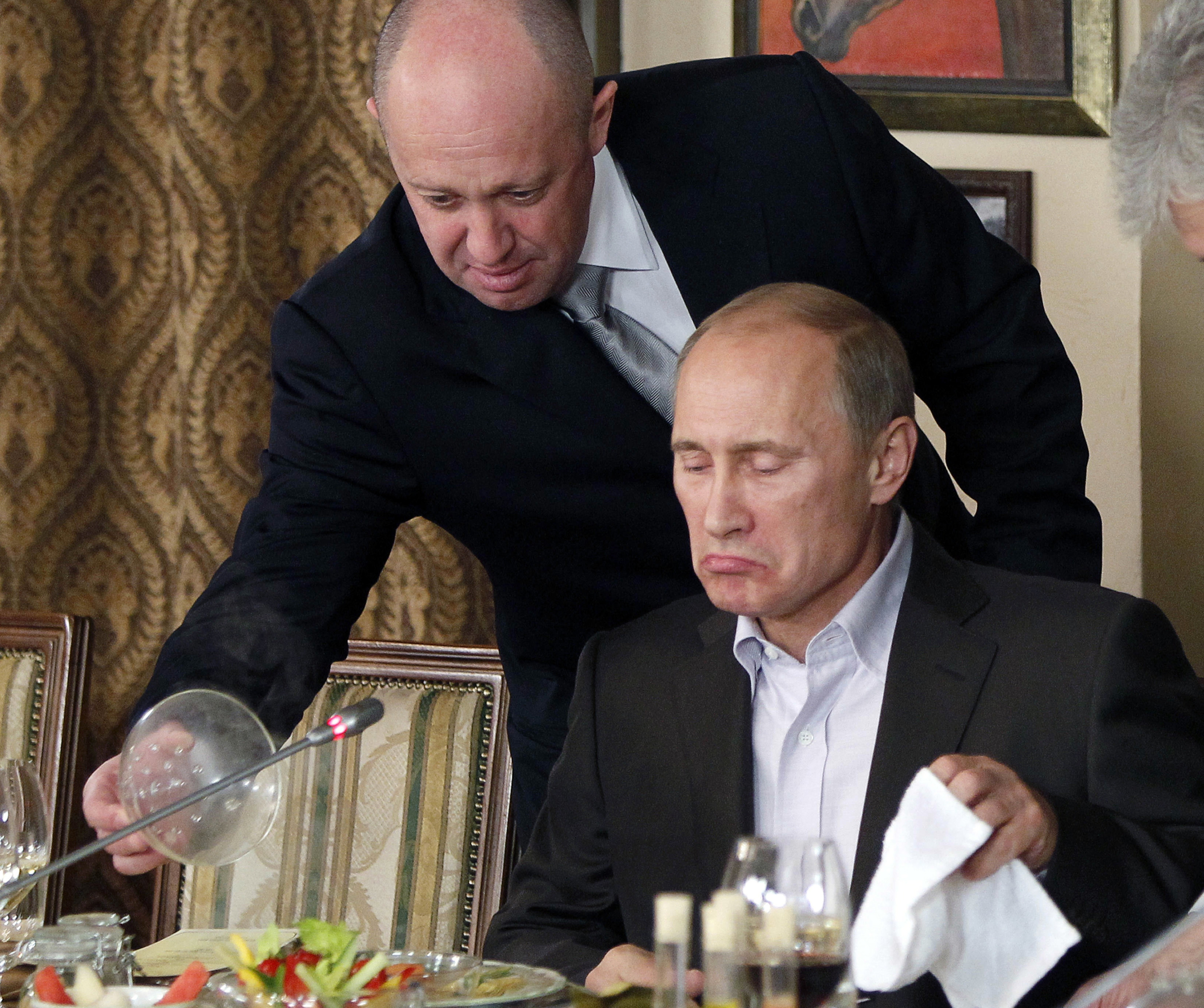
Yevgeny Prigozhin serves food to then-Russian Prime Minister Vladimir Putin at Prigozhin's restaurant outside Moscow, Russia during 2011.

Russia's Defence Ministry denied attacking Wagner's troops, and Russia's internal security force opened a criminal case against Prigozhin.

Then came a remarkable national address from Putin.

In a speech that was broadcast across Russia on Saturday morning local time, a visibly furious Putin vowed to punish those "on a path to treason."

Wagner's "betrayal" was a "stab in the back of our country and our people," he said, likening the group's actions to the 1917 Russian Revolution that toppled Tsar Nicholas II in the midst of WWI.

Things were tense on the ground, with civilians in Voronezh told to stay home.

Meanwhile, Moscow stepped up its security measures across the capital, declaring Monday a non-workday.

Russian President Vladimir Putin speaks with Russian Defence Minister Sergei Shoigu.

Photos show Russian forces in body armour and wielding automatic weapons near a highway outside Moscow.

All signs pointed to an impending armed confrontation in the capital as rumours and uncertainty swirled.

Then almost as suddenly as it began, the short-lived mutiny fizzled out with the Belarus deal seeming putting out the fire – at least for now.

What's next for Prigozhin and Wagner?

Much remains unclear, such as what will happen to Prigozhin's role within Wagner and the Ukraine war, and whether all his fighters will be contracted to Russia's military.

The Kremlin spokesperson said today he "cannot answer" what position Prigozhin will take in Belarus.

Prigozhin himself has provided little detail about his agreement to halt the advance on Moscow.

The Wagner group is "an independent fighting company" with different conditions than the Russian military, said retired US Army Maj. Mike Lyons.

For instance, Wagner fighters are better fed than the military – meaning a full assimilation would be difficult.

Handout photo taken from video released by Prigozhin Press Service on Friday, March 3, 2023

"Maybe some will splinter off," he added.

"Those people are loyal to the man, Prigozhin, not to the country, not to the mission. I think we've got a lot more questions that are not answered right now."

The danger isn't over for the Wagner boss, either, experts say.

"Putin doesn't forgive traitors. Even if Putin says, 'Prigozhin, you go to Belarus,' he is still a traitor and I think Putin will never forgive that," said Jill Dougherty, CNN's former Moscow bureau chief and a longstanding expert on Russian affairs.

It's possible we could see Prigozhin "get killed in Belarus," she added – but it's a tough dilemma for Moscow because as long as Prigozhin "has some type of support, he is a threat, regardless of where he is."

What does this mean for Putin?

Putin now faces real problems, too.

Multiple experts told CNN that while the Russian president survived the stand-off, he now looks weak – not only to the world and his enemies, but to his own people and military.

That could pose a risk if there are skeptics or rivals within Moscow who see an opportunity to undermine Putin's position.

"If I were Putin, I would be worried about those people on the streets of Rostov cheering the Wagner people as they leave," said Dougherty.

READ MORE: Tech giants could be fined billions in fake news crackdown

One video, geolocated and verified by CNN, showed crowds cheering as Prigozhin's vehicle departed Rostov-on-Don.

The vehicle stopped when one individual approached and shook Prigozhin's hand.

"Why are average Russians on the street cheering people who just tried to carry out a coup?" Dougherty said.

"That means that maybe they support them or they like them. Whatever it is, it's really bad news for Putin."

Who is Prigozhin? Why would he do this?

Prigozhin has known Putin since the 1990s, and was nicknamed "Putin's chef" after winning lucrative catering contracts with the Kremlin.

But Russian-backed separatist movements in Ukraine in 2014 set the foundation for Prigozhin's transformation into a warlord.

Prigozhin founded Wagner to be a shadowy mercenary outfit that fought both in eastern Ukraine and, increasingly, for Russian-backed causes around the world.

Wagner was thrust into the spotlight during the Ukraine war, with the fighters appearing to win tangible progress where regular Russian troops failed.

However, its brutal tactics are believed to have caused high numbers of casualties.

As the war dragged on, Prigozhin and Russia's military leadership have engaged in a public feud, with the Wagner boss accusing the military of not giving his forces ammunition and bemoaning the lack of battlefield successes by regular military units.

He was repeatedly critical of their handling of the conflict, casting himself as ruthless and competent in comparison.

Prigozhin was always careful to direct his blame towards Russia's military leadership, not Putin, and had defended the reasoning for the war in Ukraine.

That was, until Friday as the insurrection kicked off.

In a remarkable statement, Prigozhin said Moscow invaded Ukraine under false pretences devised by the Russian Ministry of Defence, and that Russia was actually losing ground on the battlefield.

Steve Hall, a former CIA chief of Russia operations, said even seasoned Russia watchers were taken aback by recent events.

READ MORE: Fire destroys home in Sydney's south west, hours after police raid

Fighters of Wagner private mercenary group stand guard in a street near the headquarters of the Southern Military District in the city of Rostov-on-Don, Russia, June 24, 2023. REUTERS/Stringer

"Everybody is scratching their heads," he said.

"The only sense I can make from a day like today, you have two guys who found themselves in untenable situations and had to find their way out."

Hall said Prigozhin may have felt he had bitten off more than he could chew as his column of troops marched towards Moscow.

But at the same time Putin faced the very real prospect of having to defeat some 25,000 Wagner mercenaries.

Sending Prigozhin to Belarus was a face saving move for both sides.

But Hall said Putin comes out ultimately worse off and weakened.

"Putin should have seen it coming literally months ago. We'll see how it ends up. I don't think the story is over yet," Hall said.

Sign up here to receive our daily newsletters and breaking news alerts, sent straight to your inbox.
The Aussie invention trying to help to save the world with seaweed

Plastic made from seaweed and milk that doesn't come from a cow.

Those ideas may once have been seen as fanciful science fiction, but a boom in Australian biotechnology is making these discoveries, and more, the way of the future.

Seaweed could revolutionise how humans make all kinds of plastic product, according to Perth-based start-up ULUU.

READ MORE: The serious challenges now facing Putin's regime

Seaweed could revolutionise how humans make all kinds of plastic product, according to Perth-based start-up ULUU.

Founded by Dr Julia Reisser, the company has found a way to turn natural farmed seaweed into pellets that can then be extruded into any plastic form.

"It mimics plastic very well so it can really replace plastic at scale with a material that's good for the world," Reisser told 9News.

The pellets can be used in all kinds of products, from cosmetics to fabrics and packaging.

Unlike plastic, the seaweed version is completely recyclable and biodegradable, meaning it will simply break down if it ends up in landfill or back in the sea.

Seaweed farms also offset more carbon than they emit and clean pollutants from the ocean.

"It's going to help us tackle plastic pollution, climate change and ocean health," Reisser said.

The venture capital firm Main Sequence, which was founded by CSIRO, is backing start-ups like ULUU and also Eden Brew.

Eden Brew has worked out how to make milk proteins in the same way a cow does in its stomach.

But unlike a dairy milk or plant-based milk, biotechnology uses fewer resources.

Eden Brew's process requires very little land, produces none of the methane gases cows do, and uses significantly less water.

READ MORE: Stolen ATM turns up empty on South Australia country road

Chief executive Jim Fader expects demand for dairy, beef, pork, lamb and chicken to rise by 50-100 per cent over the next 30 years.

"So we need to find modern and safe ways to make the foods we know and love," he said.

Fader said Eden Brew is not trying to replace traditional milk supply, but just augment it.

There is great potential for the technology to help reduce the cost of milk and provide stable supply, he said.

Eden Brew is working on scaling up production to a commercial level and expects to be selling its milk and ice cream in 18 months time.

READ MORE: Fire destroys home in Sydney's south west, hours after police raid

Stolen ATM turns up empty on SA country road

An ATM stolen in an audacious ram raid on a South Australian pub has turned up empty on a rural road.

The cash machine was lifted out of a licenced premises at Cudlee Creek, east of Adelaide, in the Adelaide Hills early on Saturday morning.

Police said the machine, which had been broken apart and emptied of cash, only contained a small amount of money.

READ MORE: Two dams close to overflowing in South Australia

The ATM stolen in an early morning ram raid has been located

CCTV revealed the break-in happened around 4.30am.

A white Mazda was used to crash into the front doors of the pub and two people were seen stealing the cash machine, police said.

About 5.30am police were called to Angas Creek Road, around 10km east of Cudlee Creek, after reports of a white Mazda on fire.

READ MORE: The 'serious challenges' now facing Putin's regime

A stolen white Mazda slams into the pub, and was later found burned out by police.A hooded figure gets to work on stealing the ATM

Police checks revealed the car had been stolen from a northern Adelaide suburb last week.

A few hours later, a member of the public called police to say they had seen the front of an ATM on Tippett Road, Millbrook, 15 minutes from where the rest was found.

Sign up here to receive our daily newsletters and breaking news alerts, sent straight to your inbox.