Tag Archives: oceania

Man charged after woman suffers burns during car explosion

A man has been charged after a woman was rushed to hospital with severe burns when her car exploded into flames in Perth's outer-east.

The mother-of-three is fighting for her life and suffered burns to nearly 40 per cent of her body when her blue Commodore caught alight in Mount Helena, about 6.30pm last night.

READ MORE: Man breaks into family home, watches daughter sleep

A man has since been charged with one count of Aggravated Grievous Bodily Harm.

No one else was injured.

The car has been seized by police.

The 42-year-old man is due to appear in Perth Magistrates Court today.

Two humpback whales found dead off US coast suffered 'blunt force trauma'

Two humpback whales have been found dead off the coasts of New York and New Jersey, according to local officials.

The National Oceanic and Atmospheric Administration announced the presence of the two whales in a Wednesday Facebook post. One whale was off Wainscott, New York, and the other in Raritan Bay, New Jersey, the agency said.

The Atlantic Marine Conservation Society and Marine Mammal Stranding Center performed necropsies on both whales, according to a Friday update from NOAA.

READ MORE: Prime Minister Anthony Albanese to discuss trade with key leaders in Vietnam

The first whale, which drifted into Shinnecock Inlet and was brought to shore in Southampton, was a 47-foot-long male, the agency reported. The cause of death was "suspected blunt force trauma."

"While this carcass was heavily decomposed, scientists observed bruising in the blubber and muscle on both sides of the head," the post said.

Samples were collected for further analysis and the whale was buried on the beach.

The second whale was a 28-foot-long female, the post said.

The US Army Corps of Engineers and New Jersey Fish and Wildlife Service towed the whale from Raritan Bay to Gateway National Recreation Area in Sandy Hook, New Jersey, where the necropsy was performed.

This whale seemed to have been struck by a vessel, according to the post. It had "bruises, lacerations & fractures in several places across its body, including fractures on its skull & left pectoral fin, which had been severed."

The cause of death was identified as "suspect blunt and sharp force trauma consistent with vessel strike," the post said. Samples were collected and the whale was buried on the beach.

The two strandings were not related, according to the agency.

Humpback whale deaths on the East Coast have been on the rise since January 2016, according to National Oceanic and Atmospheric Administration records.

The agency declared a "Humpback Whale Unusual Mortality Event Along the Atlantic Coast" in April 2017.

A total of 23 humpback whales have been stranded so far in 2023, including five in New York and seven in New Jersey, the agency reported.

READ MORE: More than 280 killed, 900 injured in India's deadliest train crash in decades

The agency said while more research is needed to fully understand the cause of the deaths, 40 percent of whales that underwent necropsies showed "evidence of human interaction, either ship strike or entanglement."

The massive sea creatures live in all the world's oceans, according to the agency. Humpback whales can weigh up to 40 tonnes, be as long as 60 feet, and live up to 90 years old.

The whales' population was seriously depleted by whaling up until the practice was banned in 1985, the agency noted.

The species is still protected under the Marine Mammal Protection Act in the US, but vessel strikes and entanglement in fishing gear continue to pose serious threats.

Sign up here to receive our daily newsletters and breaking news alerts, sent straight to your inbox.

NSW residents on high alert for meningococcal symptoms after death

People living in New South Wales have been told to be on alert for symptoms of meningococcal after three cases and one death.

NSW Health confirmed a Sydney woman in her fifties died after contracting the disease, while two others, a teen living in Sydney and a person in their sixties from the Central Coast, were diagnosed with the illness.

The two cases are now recovering, and authorities do not believe they are linked.

READ MORE: 'It's a year of pain': Warning for Sydney commuters using public transport

New South Wales central coast residents are asked to be on alert for symptoms of meningococcal disease.

NSW Health is urging the community to be on alert for symptoms of meningococcal disease after 19 cases were reported in the state this year – the majority the meningococcal B strain of the infection.

While the disease is uncommon, it can be fatal among high-risk age groups, including babies, toddlers, adolescents and young adults, NSW Health Director Dr Christine Selvey said.

"If symptoms rapidly worsen call Triple Zero (000) or go straight to your nearest emergency department, do not delay," Dr Selvey said if the illness that can turn deadly within hours if left untreated.

"Meningococcal disease can be very serious, but early treatment is life-saving so it is important that symptoms are recognised early," she said.

"We are urging the NSW community to be vigilant for symptoms, even if they have been vaccinated, and to seek medical assistance early if they are concerned."

Indicators of serious illness include fever, a fast heart rate, cold hands and feet or a mottled look to the skin, difficulty waking or increased lethargy or confusion.

Symptoms of the disease include:

  • Severe, unexplained limb pain
  • Difficulty waking up
  • High-pitched crying in babies
  • Severe headache
  • Upset by bright lights
  • Stiff neck
  • Red-purple rash which doesn't disappear when pressed with a glass

Sign up here to receive our daily newsletters and breaking news alerts, sent straight to your inbox.

PM Anthony Albanese to discuss trade with key leaders in Vietnam

Prime Minister Anthony Albanese will meet with key leaders in Vietnam today to discuss trade and expand economic ties.

Albanese arrived in Hanoi on Saturday, where he was met by media and locals while tucking in to local classics at a banh mi restaurant.

He will meet with Vietnamese Prime Minister Pham Minh Chinh today, along with Communist Party general secretary, the president and the chairman of the national assembly.

READ MORE: More than 280 killed, 900 injured in India's deadliest train crash in decades

The trip marks a decades-long milestone of diplomatic relations between Australia and Vietnam.

"I'm very pleased to be here on my first official visit to Vietnam as Australia's Prime Minister, to mark the 50th anniversary of our diplomatic relationship," Albanese said.

"We are strategic partners and we've been enduring friends over that 50 years."

https://twitter.com/AlboMP/status/1664897848092024839?ref_src=twsrc%5Etfw%7Ctwcamp%5Etweetembed%7Ctwterm%5E1664897848092024839%7Ctwgr%5Eb172116c7c7a3794e9a9a73f84c1f54052035cff%7Ctwcon%5Es1_&ref_url=https%3A%2F%2Fwww.abc.net.au%2Fnews%2F2023-06-04%2Fprime-minister-anthony-albanese-visits-vietnam%2F102437786

The prime minister is also expected to discuss defence and security, with the leaders of Vietnam, which shares a border with China.

"(Australia) and Vietnam share a view on the South China Sea, and that the Convention on the Law of the Sea needs to be upheld and maintained," he told media in Hanoi.

Albanese is expected to arrive back in Australia tomorrow morning.

Sign up here to receive our daily newsletters and breaking news alerts, sent straight to your inbox.

'It's a year of pain': Grim warning for train commuters in Sydney

Sydney train commuters have been warned of a "year or more of pain" as the government fast-tracks a major $97 million maintenance blitz.

The blitz was prompted by a major review into the system, which found a huge maintenance backlog led to equipment failures causing major shutdowns.

Commuters will be most affected on the weekends, with significant work to be completed on every line across the Sydney Trains network.

READ MORE: Expert reveals why Australia can be at risk from large earthquakes – and what cities are most in the firing line

Transport Minister Jo Haylen said it was the "biggest coordinated program of rail maintenance" ever undertaken in Sydney.

"We have to fix our rail network and it's going to take a massive effort," Haylen said.

"People have lost faith in the system. They've been burnt too many times. We simply must take this on and get it done. Continuing system failures and meltdowns are not an option."

The network has been plagued with a series of failures over the past several years, including three in March this year alone.

READ MORE: Teen arrested after man dies following alleged stabbing in Melbourne

The Sydney Rail Repair Plan will see work completed around the clock for the next year, from midnight Friday to midnight Sunday.

"I want to be totally honest with everyone, for the next year or so we are going to massively disrupt the network on weekends while our crews get in and fix it," Haylen said.

"We have no choice. It's the only way to get it fixed and have reliable trains again. If you use trains on weekends, I'm sorry but you're going to find yourself on buses – a lot.

"We will keep people constantly updated, every week, with reports on how this immense repair project is progressing."

Sign up here to receive our daily newsletters and breaking news alerts, sent straight to your inbox.

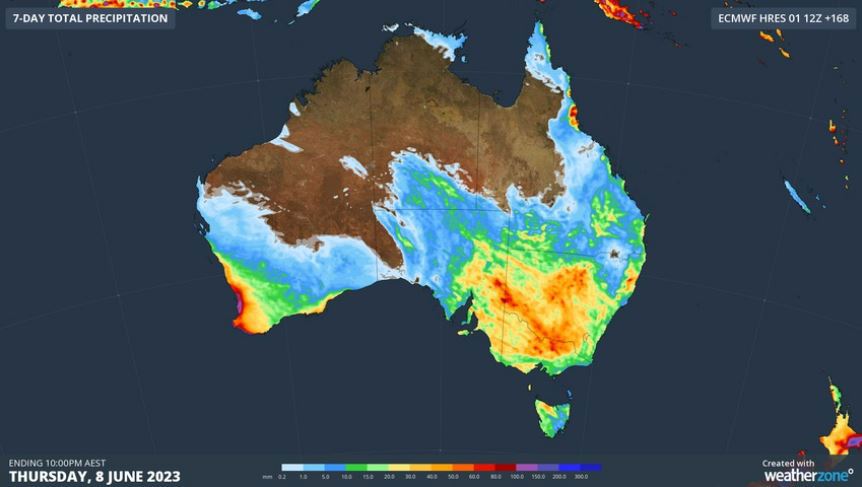
Millions warned to brace for storms and hail as warmest start to winter is over

Large swathes of NSW have experienced the warmest start to winter in up to 69 years, but those temperatures will come to end this week with a rainbomb set to explode over the country.

Residents in every state and territory have been warned to brace as storms, powerful winds and possible hail are set to hit southern WA before drifting east over the coming week.

Rain is expected to pour over the country for the next seven to 10 days, with the wild conditions predicted to lash the east coast from Wednesday.

READ MORE: Expert reveals why Australia can be at risk from large earthquakes – and what cities are most in the firing line

Weatherzone has warned of "dangerously foggy" mornings and nights, as pockets of high humidity settle due to lack of winds.

Mascot recorded its warmest day since 2004 yesterday, with 24.2 degrees.

Meanwhile Gunnedah, in the state's north-east recorded 24.7 degrees, the highest June temperature in 69 years.

There is a growing likelihood of an El Niño, with the Bureau of Meteorology (BoM) predicting low rainfall and above-average temperatures in its long-range forecast.

Melbourne can expect a top of 19 degrees today, with morning fog and sunny skies.

A shower or two will develop in both Perth and Adelaide, but it will remain warmer than average, with a maximum of 21 degrees.

Similar conditions are expected for Brisbane with 23 degrees and Darwin, with 31 degrees.

Hobart will feel to brunt of winter, with a chilly 13 degrees forecast, along with Canberra with 15 degrees.

READ MORE: Teen arrested after man dies following alleged stabbing in Melbourne

Sign up here to receive our daily newsletters and breaking news alerts, sent straight to your inbox.

Teen arrested after man dies following alleged stabbing in Melbourne

A teenager has been arrested after a man died following an alleged stabbing in inner-Melbourne.

Emergency services found the body of a 34-year-old Ripponlea man after they being called to an address on Surrey Road in South Yarra at about 8pm.

A 17-year-old Frankston boy was arrested last night and is assisting Homicide Squad detectives with their enquiries.

READ MORE: Man breaks into family home, watches daughter sleep, cracks open beer

Anyone who witnessed the incident or with information or CCTV footage is urged to contact Crime Stoppers on 1800 333 000 or submit a confidential report at www.crimestoppersvic.com.au

Sign up here to receive our daily newsletters and breaking news alerts, sent straight to your inbox.

Expert reveals why Australia can be at risk from large earthquakes

Although rare, "earthquakes can occur anywhere in Australia," a senior seismologist with Geoscience Australia says, before adding the country "can be at risk of large earthquakes," too.

That matter-of-fact comments come after Melbourne was rattled by what was initially believed to be a 3.8-magnitude quake on Sunday, the city's largest in more than 120 years.

This was later upgraded to 4.0-magnitude and comes two years after Woods Point in Victoria's east, was struck by a 5.8-magnitude quake; Victoria's largest ever recorded.

READ MORE: History of Australia's most destructive earthquakes

The National Seismic Hazard Assessment map predicts the areas most at risk of quakes.

Professor Phil Cummins, a senior seismologist at Geoscience Australia, listed three more cities he believes are most at risk of quakes.

"Adelaide springs to mind," Cummins told 9news.com.au.

"That's in one of these elevated seismic zones, there are some known active faults near Adelaide.

"Canberra also. It's a bit unusual in that after the last assessment it's hazard went up as we realised earthquakes have occurred on the Lake George fault.

"(But) probably the capital that experiences the most shaking is Darwin and that's due to the earthquakes in Indonesia, which happen fairly often.

"They could get big enough to cause minor damage maybe, but I think it's a big enough distance that we will just see shaking that frightens people."

READ MORE: What is behind this NSW lake's great disappearing act?

Cummins added the Australian National Seismic Hazards Assessment map thinks 7.5-magnitude quakes are possible on our golden soil.

"That's a pretty big earthquake, not quite as big as the ones you'd get in the United States and Los Angeles, but it's quite large," he said.

"Larger than anything we've experienced so far.

"We think it's possible to get earthquakes that big, and we do think there's evidence in the geological record that such earthquakes have happened in the geologic past, but not in the historic past."

Cummins then pointed to the South Australian town of Cadell, which lies next to a sharp twist on the Murray River.

"That bend is caused by a huge crustal block that popped up due to a pretty large earthquake," he said.

Cummins added the Australian building code now factors this quake assessment into construction and planning.

"The building code does require seismic resilience be built into modern homes," he said.

"(But) that only happened in 1989 after the Newcastle earthquake.

"The problem is there are many homes, particularly in the cities, built prior to that, that weren't built for this kind of shaking.

"You can see this in the Woods Point earthquake, the things that failed were typically older heritage-type buildings, particularly brick buildings and structures."

READ MORE: What makes earthquakes such a deadly natural disaster?

So what causes Australian earthquakes?

Cummins said there's a widely held misassumption that earthquakes can only occur on the "Ring of Fire", a seismologically active arc along the Pacific Ocean rim, far from Australia.

"The problem is that can actually be more dangerous because people aren't used to earthquakes so they don't build buildings to be resilient to quakes," he said, before explaining how Australian earthquakes develop.

"Australia is a stable continental plate, so it doesn't have active plate boundaries but the forces exerted on the plate boundaries – which are New Zealand, Papua New Guinea and even stretching as far away as India – the strong forces exerted there result in stressors.

"These get transmitted through the plate, to the plate interior, although these stressors are very small, they build up slowly.

"Eventually they will exceed the frictional strength of faults in the earth's crust and those faults rupture and earthquakes happen – even though they are not near plate boundaries.

"That's the same thing happening near Melbourne now, I don't think there's anything else that's causing them to cluster."

READ MORE: How Australia is protected against tsunami threat

On December 28, 1989 a 5.6- magnitude quake hit Newcastle, in NSW. Thirteen people were killed and there was an estimated $4 billion in damage caused over an area extending 9000 square kilometres.

Unfortunately predicting where earthquakes will strike ahead of time "is too hard".

"There's too much variability," Cummins said.

"It's really, really hard to do it in a timeframe with the type of precision that helps people to evacuate buildings.

"Also, when an earthquake does happen the general advice is duck, cover and hold – so try and duck under something that can protect you and then hold on so you don't get shaken out.

"Don't run out on the street as you're more likely to get hit by debris."

Sign up here to receive our daily newsletters and breaking news alerts, sent straight to your inbox.


Fears rise for civilian safety as Ukraine investigates locked air-raid shelters

Concerns around civilian safety spiked in Ukraine on Saturday, as officials announced that an inspection had found nearly a quarter of the country's air-raid shelters locked or unusable, just days after a woman in Kyiv allegedly died waiting outside a shuttered shelter during a Russian missile barrage.

The Ukrainian interior ministry said through its press service on Saturday that of the "over 4800" shelters it had inspected, 252 were locked and a further 893 "unfit for use".

That same day, the Kyiv regional prosecutor's office reported that four people were detained in a criminal probe into the 33-year-old's death on Thursday outside the locked shelter. The prosecutor's office said that one person, a security guard who had failed to unlock the doors, remained under arrest, while three others, including a local official, had been put under house arrest.

READ MORE: City of Melbourne cuts ties with Russian city following protest

According to the prosecutor's office, the suspects face up to eight years in prison for official negligence that led to a person's death.

Also on Saturday, Kyiv mayor Vitali Klitschko said that city authorities have received "more than a thousand" complaints regarding locked, dilapidated or insufficient air-raid shelters within a day of launching an online feedback service.

In a Telegram update, Klitschko reported that "almost half" of the complaints concerned facilities being locked, while about a quarter had to do with them being in poor condition. Some 250 Kyiv residents wrote in to complain of a lack of nearby shelters.

The interior ministry said that over 5,300 volunteers, including emergency workers, police officers and local officials, would continue to inspect shelters across Ukraine.

Russia on Thursday launched a pre-dawn missile barrage at the Ukrainian capital, killing a 9-year old, her mother, and another woman, in what was the highest toll from a single attack on Kyiv over the past month. A 33-year-old woman died as she and others waited to enter a locked shelter, which left the group at the mercy of falling missile fragments, her husband told Ukrainian media.

READ MORE: Russia issues arrest warrant for US Senator over Ukraine comments

Elsewhere, Ukrainian regional officials reported Saturday morning that Russian shelling had killed at least four civilians across the country in the previous 24 hours. A 67-year-old man died in the early hours of Saturday as Russian forces shelled the northeastern Kharkiv region from mortars, local Gov. Oleh Syniehubov said on Telegram. According to Syniehubov, two other civilians were killed on Friday and overnight, while six more, including a 3-year-old boy, suffered wounds.

In the frontline Kherson region in the south, two boys aged 10 and 13 were hospitalised with "serious" injuries after an explosive device detonated Saturday in a village playground, regional Gov. Oleksandr Prokudin reported. Prokudin also said that five others, including two children, were wounded by Russian shelling over the previous day.

In the Sumy province further west, a Russian mortar shell killed an 85-year-old man as he sat by the orchard outside his house, the Ukrainian prosecutor general's office reported Saturday. Shelling also killed two people in Russia's Belgorod region just across the border, including an elderly woman who died on the spot, according to local Gov. Vyacheslav Gladkov. Gladkov added that another woman had been hospitalised with injuries, and blamed Ukraine for the attack.

It was not immediately possible to verify the above claims by regional authorities in Ukraine and Russia.

Man breaks into family home, watches baby girl sleep

A man has broken into a family's home and watched their six-month-old daughter sleep in a "scary" incident caught on CCTV cameras.

The uninvited visitor let himself into Tom and Isabella Ridgewell's Tweed Heads home while they were sleeping last night.

He stood over six-month-old Amora's crib watching her as she slept in her parents' room.

READ MORE: Partner charged with murder over alleged stabbing of Melbourne mum

The man was then captured on CCTV cameras as he walked into the kitchen, grabbed himself a beer and a block of parmesan cheese and settled in on the couch.

"He had every opportunity to take what we have and [he took] nothing," Mr Ridgewell said.

"It was almost like he was at home with how he was acting."

The man then returned to the bedroom where he awoke Mr Ridgewell, who chased him out of the house with a baseball bat that he keeps next to his bed.

READ MORE: Handcuffed prisoner escapes from Queensland hospital

The parents say they have no idea how the man got into their home.

Police say they are investigating the unusual incident.

In a statement to 9News, police said officers had been sent to the area as they try to establish who the person was who was involved.

Anyone with information can call Crime Stoppers on 1800 333 000.