Tag Archives: oceania

La Niña and El Niño: Will we switch from one to the other in 2023?

Over the last three years, the La Niña weather event brought cool temperatures and record-breaking rain to Australia's east, but there's now a good chance we'll move straight into an El Niño event this summer.

The Bureau of Meteorology (BoM) is anticipating La Niña will finish in February, and long-term models indicate conditions in the Pacific will get hotter and drier as the year goes on.

So what exactly is going on with Australia's weather, and what is going to happen next? We answer all of your La Niña and El Niño questions.

READ MORE: The global water cycle is changing and that spells bad news
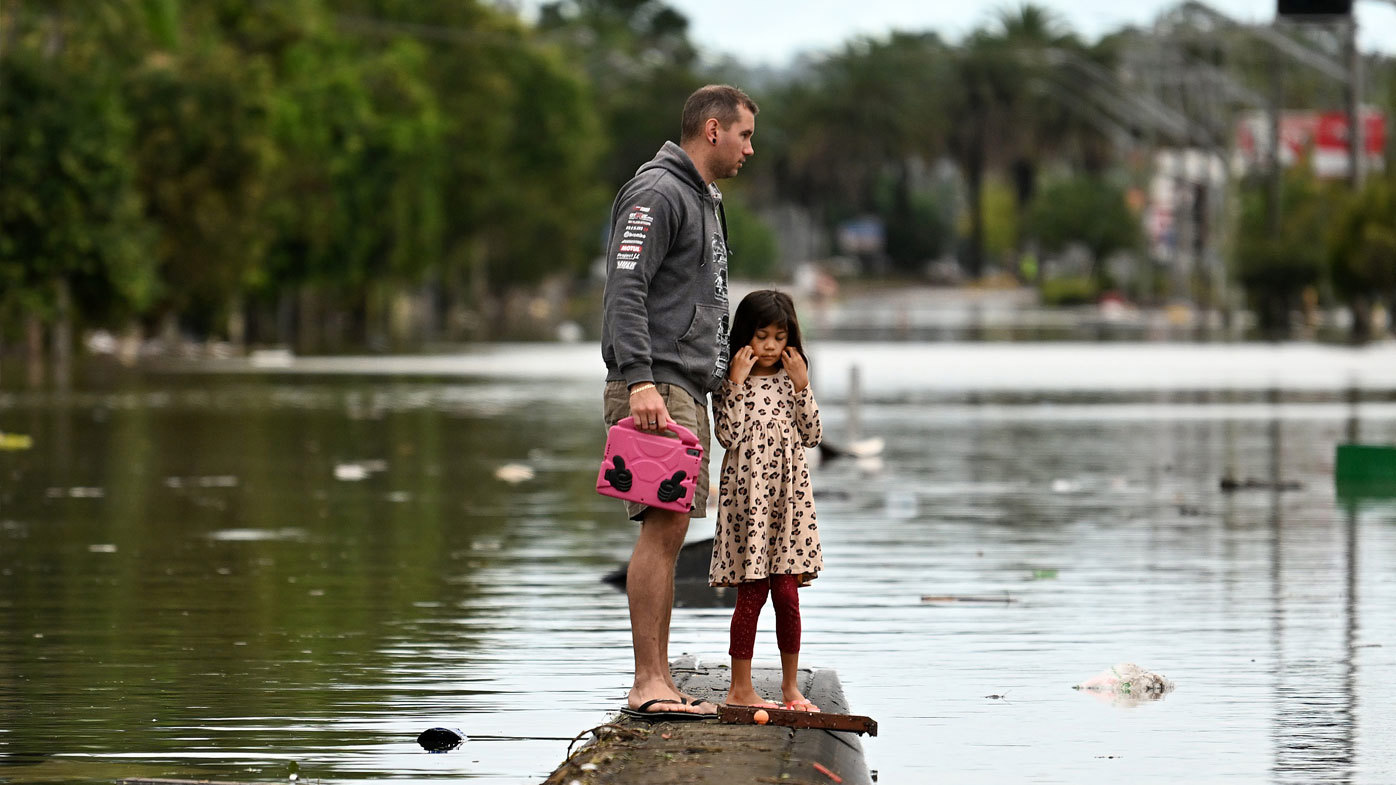
Deadly flooding crisis grips Northern NSW, Southern Queensland

Has La Niña ended in Australia?

Not yet, but it's not far away. The BoM says the third consecutive La Niña will probably end this month.

In their latest climate driver update, published on January 31, it anticipates the system will ease during the last few weeks of summer.

"While ocean temperatures have eased from La Niña thresholds, the atmosphere has yet to respond, and remains La Niña-like," it said.

"All models anticipate sea surface temperatures in the central Pacific will return to neutral ENSO levels during February, with neutral conditions (neither La Niña nor El Niño) anticipated until at least mid-autumn."

How long has Australia had La Niña?

La Niña has been declared the in each of the last three summers, with conditions returning to neutral in between every time.

In most cases, La Niña events will appear for one summer, or sometimes twice in a row. This summer's third consecutive event was only the third time since 1950 there has been a "triple-dip" La Niña.

READ MORE: Dramatic climate swing 'likely' for next summer

What to expect from Australia's weather in 2023

With La Niña expected to subside over the coming weeks, the long-term weather forecast suggests things could go back to "normal" – although we'll get warmer than usual temperatures soon.

The BoM predicts that most of the country will likely see "higher than median temperatures between March and April". The exception will be the Central Coast of NSW, which should be slightly cooler than average.

But with La Niña over, an average of international models suggests its hot, dry counterpart, El Niño, could be close to returning in June, when sea surface temperatures are predicted to be 0.6°C above average.

If that prediction comes true, there may be below-average rainfall over the winter and spring of 2023.

Click through the interactive below to see the BoM's predictions for La Niña and El Niño throughout the year.

READ MORE: 2022 was fifth or sixth warmest on record as Earth heats up

What is El Niño and how is it different to La Niña?

The cycle of La Niña and El Niño – known as ENSO, or the El Niño-Southern Oscillation index – works a bit like a pendulum. 

La Niña occurs when water in the eastern tropical region of the Pacific Ocean is cooler than average as the "trade winds" – the planet's prevailing east-to-west winds – strengthen, creating warmer-than-normal water around Indonesia and Australia's east coast.

This leads to increased rainfall and brings the risk of heavy flooding in Australia.

However, when those conditions are reversed – trade winds are weaker, and water is warmer than average in the eastern tropical Pacific but cooler close to Australia – an El Niño is declared, and our continent will experience hot, dry conditions and come under the threat of drought.

When the "pendulum" sits in the middle and ocean temperatures are closer to average, it is referred to as "neutral" ENSO conditions – and it is more likely to bring less extreme weather conditions.

And, if you're wondering what the two terms actually mean, "La Niña" is Spanish for "the girl" or "little girl", while "El Niño" translates to "the boy" or "little boy".

READ MORE: Australia's public holidays for 2023 and 2024 – Make the most of your annual leave
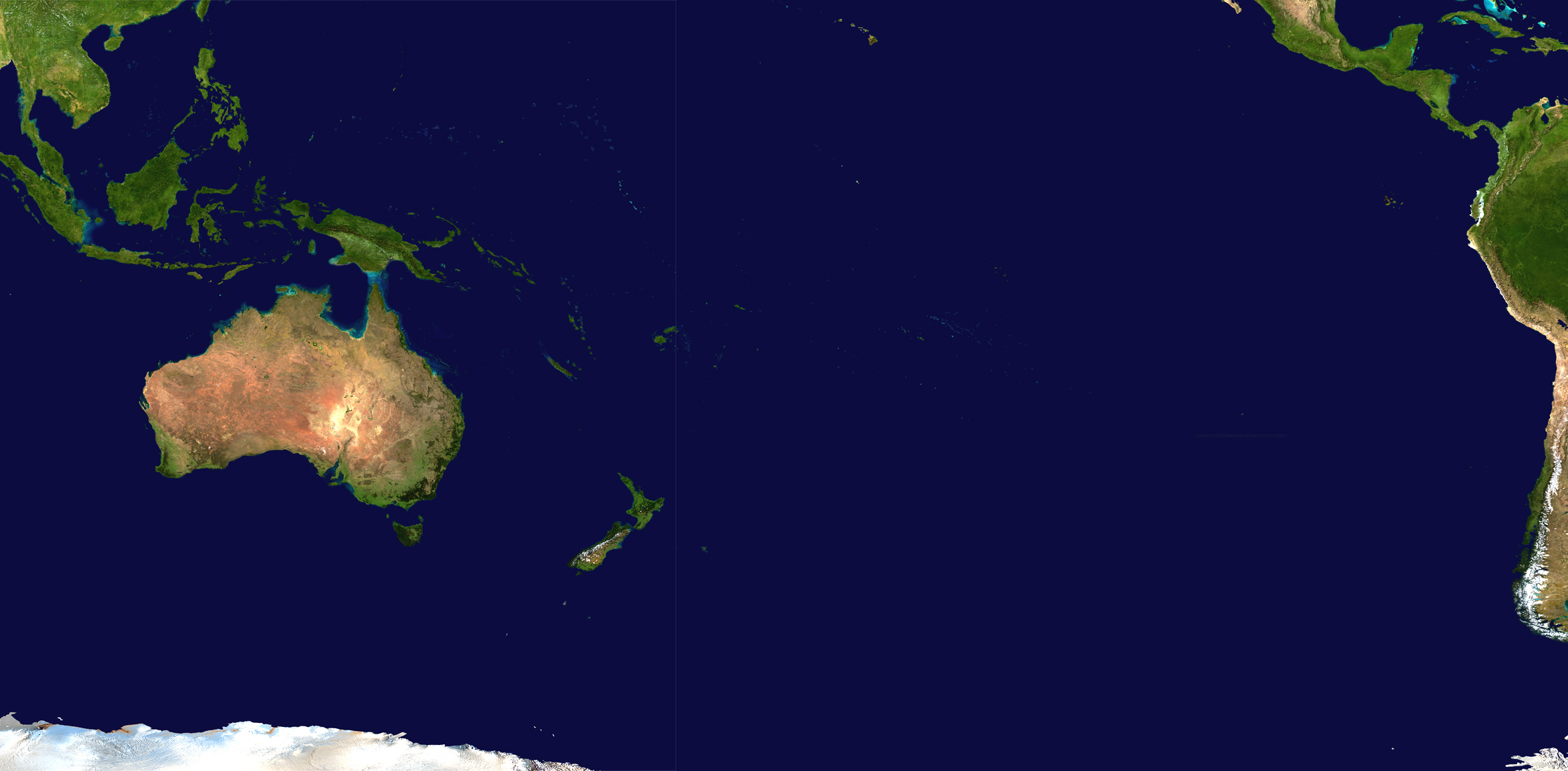
Masses of warm water move from one side of the pacific ocean to the other in a cycle known as the El Nino Southern Oscillation.

Will 2023 be an El Niño year for Australia?

There is some evidence indicating an El Niño will be declared by summer 2023.

The BoM says international modelling indicates water temperatures will be 0.6°C above average in June, putting the Pacific on the verge of an El Niño. 

According to one climate expert, this could lead to a summer of drought, heatwaves and bushfires at the end of the year. 
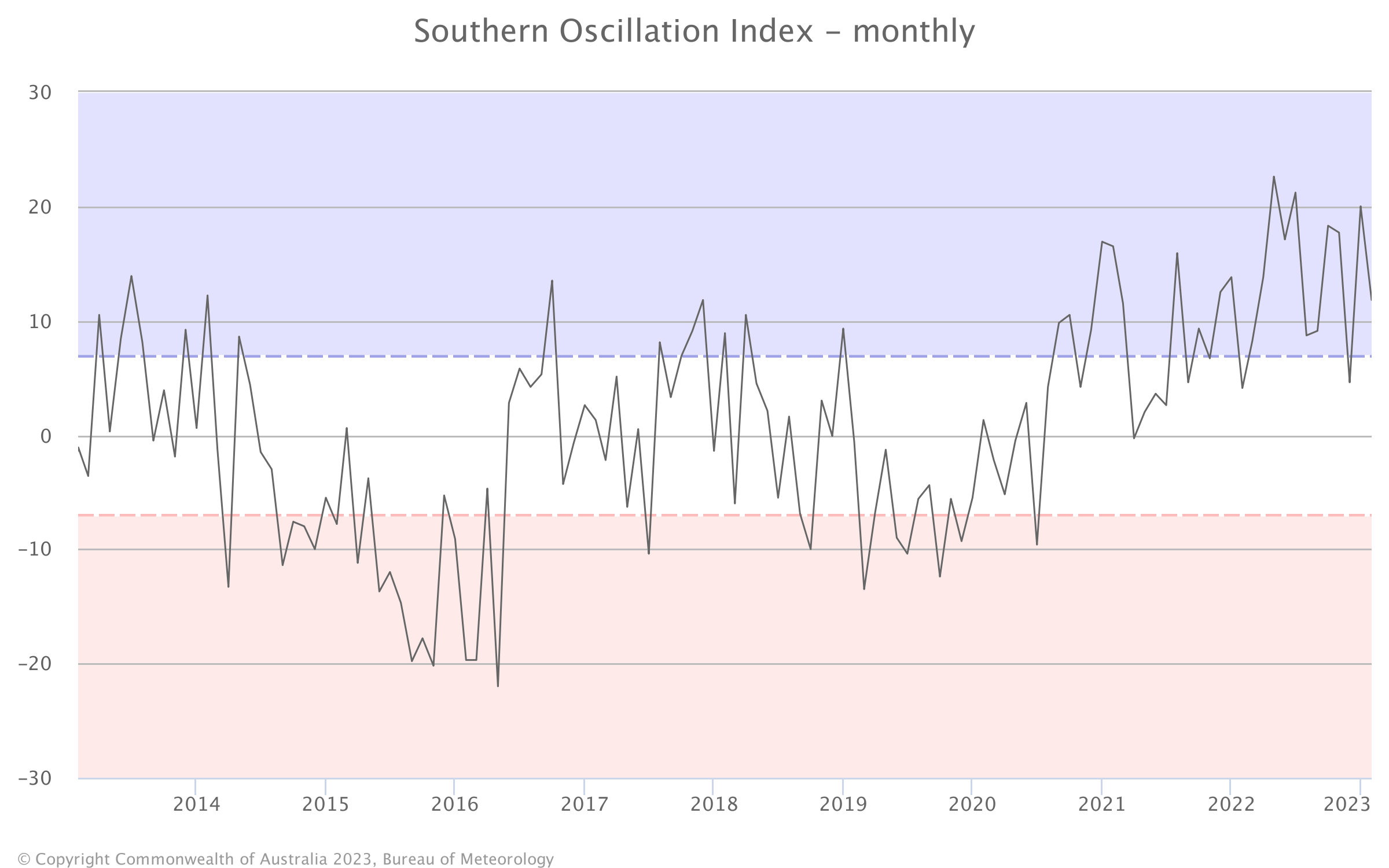
A Graph tracking the strength of El Nino and La Nina over the last 10 years.

When was the last time Australia had an El Niño?

Australia's last El Niño event occurred during the summer of 2019/2020.

The country had a severe drought throughout 2019, and the strong El Niño system was partly responsible. The 2019 drought was measured by the Bureau of Meteorology to be Australia's most intense ever recorded.

It was then followed by one of the most dangerous bushfire seasons.

Before 2019-20, the previous strong El Niño event impacted Australia from 2014 to midway through 2016.

Cockatoos can not only use tools, they can carry whole toolkits

The ability to solve problems with multiple tools is a rare talent in the animal kingdom, but according to new research, cockatoos are the first birds on the block to carry and use a tool kit to suit their needs.

Using 10 Goffin's cockatoos, researchers from Austria and the UK made their discovery after carrying out three experiments as published in the journal Current Biology on Friday.

Goffin's cockatoos are small white parrots native to the Tanimbar Islands in Indonesia.

READ MORE: Melbourne mum diagnosed with stage four melanoma after paralysis

Cockatoos can not only use tools, they can carry whole toolkits

They were chosen after the researchers spotted them using a "tool set" in the wild. In this study, cockatoos from the Goffin Lab in Vienna were used.

"We've seen them use a complex tool set (in the wild), but we did not know if they were aware they were using one, or if it was just a chain of single tool uses in a sequence," Antonio Osuna Mascaró, an evolutionary biologist at the University of Veterinary Medicine Vienna and lead study author, told CNN.

Sign up here to receive our daily newsletters and breaking news alerts, sent straight to your inbox.

Previously, the only non-human animal known to use a toolkit was the chimpanzee, specifically the Goualougo Triangle chimpanzee from the northern Republic of Congo, according to the study.

Inspired by the chimpanzees' two-tool, termite-fishing process of making holes in a termite mound with a blunt stick and then inserting a different stick to fish the termites out, Osuna Mascaró and his team devised experimental designs that mimicked this process.

READ MORE: Toddler pulled out alive after 79 hours under the rubble

Cockatoos can not only use tools, they can carry whole toolkits

Describing the first experiment, Osuna Mascaró said: "We gave them a problem in which they had to fish cashews out of a box, by first poking a hole in the membrane that blocked it with a short, pointy stick and then getting it out with a longer, flexible stick."

To the researchers' surprise, some of the cockatoos solved the problem very quickly, with one taking just 31 seconds to do so in its first try.

Mark Briffa, associate head at the School of Biological and Marine Sciences at the University of Plymouth, told CNN that basic tool use is common in animals, but using "a tool set implies the ability to solve problems through flexibly applying some insight of a given situation … (which) this study convincingly shows." Briffa was not involved in the study.

Four cockatoos failed to complete the first experiment successfully, and one dropped out after showing a lack of interest.

Five, however, progressed to the next stage of the study.

Briffa said it would be interesting to find out why some of the birds failed the task.

Cockatoos can not only use tools, they can carry whole toolkits

The second experiment looked at tool use flexibility – whether or not the cockatoos would choose the right tool or tools for the right task.

READ MORE: Perth valet driver damages two Lamborghinis owned by billionaire

This was done by randomly giving the cockatoos a box that required either a single tool or two tools to extract the nuts, according to the study.

The cockatoos aced this test, too.

The final experiment included an extra challenge, the addition of different phases to reach the box of cashews, tools in tow – climbing, horizontal flight and vertical flight– to see whether the birds transported one tool at a time or saved energy by taking both together.

The box, which was visible to the cockatoos from the outset, required either one tool or both.

The researchers saw that four cockatoos were eventually able to transport both tools together when needed, even when flying, with three birds "remarkably" managing it consistently.

READ MORE: Australia recession risk linked to one country's collapse

This suggests they learned to take both tools together and saw them as a set, something Briffa said is "relevant to questions about the evolution of tool use and the cognitive abilities that underpin it."

Overall, Osuna Mascaró said that by showing that cockatoos plan their tool use according to the requirements of the situation, the study is the start of looking at their cognitive abilities.

Talking about the next steps, Osuna Mascaró said one possible avenue would be comparing the birds to human children.

"We noticed that each cockatoo had a different way of carrying and using the tool sets, which is interesting because cockatoos learned it through play and being curious, like humans do," he said.

Talking about the wider implications, Briffa said the study is relevant to questions about animal sentience – the level of awareness and insight animals have about their world.

Perth fisherman defends releasing bull shark back into river

A Perth fisherman who caught a bull shark in the Swan River on Thursday morning, has defended re-releasing the three-metre beast back into the water.

Kai Boyle accidentally hooked the shark onto his fishing rod in East Fremantle, near the site a 16-year-old girl was mauled to death in a shark attack just last week.

"It's the biggest bull shark I've caught in Western Australia, I was like yeah this is a potential man-eater," the 21-year-old told 9News.

READ MORE: Uni grads offered $200,000 salaries at Aussie trading company

21-year-old Kai Boyle accidentally hooked the three-metre bull shark onto his fishing rod on Thursday morning in East Fremantle and then re-released it into the Swan River.

His decision to release it back into the river caused outrage from some, angry that he freed the "predator" back into the river where a shark of the same species killed Stella Berry.

However, the law requires fishermen to release bull sharks back into the water, and Boyle agrees, saying he "does not agree with killing or hurting sharks".

The fisherman also "doesn't think it's the same shark" that killed Berry, saying he's seen rising population numbers of bull sharks in the Swan River.

READ MORE: Police rules were unclear when Melissa Caddick vanished, detective says

21-year-old Kai Boyle accidentally hooked the three-metre bull shark onto his fishing rod on Thursday morning in East Fremantle and then re-released it into the Swan River.

The catch prompted the closure of Freemantle beach on Thursday, and it remained closed to swimmers today.

"The Swan River is a bull shark breeding ground," Boyle said.

"Fisheries have to go out there and put some effort in I think and go put some tags into some sharks in the river and monitor them."

Melbourne medical centre removes skin cancers without surgery

A painless procedure to remove skin cancers using a 'radioactive paste' instead of surgery has become available in Melbourne.

The first patient to have the treatment has had remarkable results.

With skin cancer deep in his ear, Frank Pattison was struggling to use his hearing aid and faced aggressive surgery to have the tumour extracted.

READ MORE: Melbourne man convicted of elderly mother's murder maintains innocence

"He was basically looking at surgical options where he would have lost a large part of his ear, Dr Myn Lee from Avion Medical Skin Centres explained.

That was when his daughter, Marita Pattison, took him to see Dr Lee at Avion Medical Skin Centres in North Melbourne.

She removed the 94-year-old's cancerous lesion with a quick, non-invasive procedure that has left his ear intact.

"There was no pain, no pain whatever," Frank told 9News.

Marita said it was like her father had "a brand new ear".

"It is absolutely amazing," she said.

Frank can now comfortably wear his hearing aid.

For the Rhenium treatment, which is only for non-melanoma skin cancers, the patient has a plastic foil placed over their lesion, then a radioactive resin is painted onto the foil which is directly over the skin cancer.

Radiation particles penetrate through the foil and skin to a depth of three millimetres, targeting the tumour but preserving healthy tissue.

"Even after you don't get an actual surgical wound," Lee explained.

The treatment is a private procedure, meaning patients pay the full cost, which is determined on a case-by-case basis.

Sign up here to receive our daily newsletters and breaking news alerts, sent straight to your inbox.

Canberra Raiders hooker considers legal action against NSW Police

Canberra Raiders hooker Tom Starling is considering legal action against NSW Police after he was cleared over a violent street fight.

A court found police were not acting in their duty when they punched him in the face multiple times.

The 25-year-old NRL star and his brothers Jackson, 26, and Josh, 21, brawled with NSW police officers at a Central Coast pub in December 2020.

READ MORE: Melbourne mum diagnosed with stage four melanoma after paralysis

CCTV played to court shows brawl involving NRL player Tom Starling in 2020.

Starling said he was very happy with the outcome outside court.

"I always said I did nothing wrong that night," Starling said.

Starling and Jackson, 26, were charged with hindering police while youngest brother had been charged with common assault of a security guard, assault of two officers and resisting police.

The charges have been dropped after magistrate Daniel Covington found the police were not acting within their duty.

Police were seen in CCTV footage repeatedly striking Starling in the head, a scene that Covington described as a "free for all".

"One that is more typically seen in a street fight as opposed to officers in their duty," Covington told Downing Centre Local Court on Friday.

"Clearly what occurred was nothing other than Tom being assaulted himself."

Senior Constable Daniel Drew also admitted to the court that he had "no reason to punch" Starling, the judge said.

Covington acknowledged Josh was acting in self-defence of his brother.

Josh, who was handcuffed, allegedly kicked and punched police officers while Jackson was held back by another police officer, having tried to intervene.

Starling was held back and could not defend himself, according to Covington.

The brothers had been celebrating a friend's 21st that night.

The 25-year-old allegedly left the stage area when he witnessed police escort Josh outside of the venue.

READ MORE: Toddler pulled out alive after 79 hours under the rubble

Josh had been arrested after he had allegedly pushed Khan Morris, a security guard, who called his mother a "slut".

Morris denied the slur, but Covington said this denial "flies in the face of the objective evidence".

"Josh is clearly enraged by something said by Morris," Covington told the court.

"All of the evidence clearly points to the fact that Morris had called Josh's mother a slut."

READ MORE: Perth valet driver damages two Lamborghinis owned by billionaire

Regardless, Covington found the youngest Starling guilty of common assault against Morris and resisting police.

Josh Starling was sentenced to an 18-month conditional release order without conviction.

Their friend Jesse Byrne was also involved but assault and hindering charges against him were dismissed.

NSW Police said investigations by the professional standards command were ongoing.

Sign up here to receive our daily newsletters and breaking news alerts, sent straight to your inbox.

Plea to help find Melbourne dad in earthquake zone as death toll rises

A Melbourne woman is demanding more be done to help find her dad, who is one of two Australians still missing in the earthquake zone in Turkey as the death toll of the catastrophe rises past 21,000.

Imren Bayram has not heard from her father, 69-year-old Suat Bayram, a Melbourne resident who was visiting Turkey, since the earthquake and aftershocks struck.

"We're desperate, we're desperate to find my dad," she told 9News.

READ MORE: Melbourne Turkish community secures charter flight to send donations to earthquake disaster zones

"He's the centre of our family. We just want him home, we just want him safe."

One Australian caught up in the catastrophic earthquake that hit Turkey and Syria earlier in the week is safe and accounted for, according to Foreign Minister Penny Wong,

One other Australian man, Can Pahali, has been killed.

"I am pleased I can say one of those Australians in the region is accounted for and safe," Wong said from Adelaide.

"Two people are unaccounted for. One person has been reported as having died in these earthquakes.

"We are working to confirm those reports, and I extend my condolences, and as a consequence of those reports, I extend to all those waiting for news my sympathy and expression of support. Not just personal but on behalf of the government of Australia."

Minister for Foreign Affairs Penny Wong during a press conference at Parliament House in Canberra on Monday 8 August 2022. fedpol Photo: Alex Ellinghausen

Wong's update comes as rescuers continue to pull more survivors from beneath collapsed buildings.

Hopes of finding many more people alive more than three days after the quake and its aftershocks are starting to fade.

The quake that razed thousands of buildings was one of the deadliest worldwide in more than a decade. The deaths have surpassed the toll from a 2011 earthquake off Fukushima, Japan, that triggered a tsunami, killing more than 18,400.

While some survivors were still being rescued across the region, some family members of those buried in the rubble have begun to lose hope after waiting for days.

READ MORE: More interest rate rises likely in coming months: RBA

Australian rescue team on the way

Australian search and rescue experts have departed for the earthquake impact zones as part of a giant international aid effort.

Australia is sending 72 personnel and 22 tonnes of equipment including first aid supplies, tools, cameras, and sub-ground listening equipment to allow them to search for any possible survivors.

They flew out from RAAF base Richmond in New South Wales at 9am.

The NSW government has also confirmed it will provide an additional $1 million to this search and rescue mission.

The first Australian death was confirmed by the federal government yesterday.

Can Pahali, who had been living in Glebe in Sydney, was holidaying in the province of Hatay when the two quakes struck the region on Monday.

A relative who flew across from Germany found Pahali's body among the rubble and retrieved it.

READ MORE: How you can help earthquake survivors as rescuers continue to sift through rubble

Grim reality on sets in on the ground

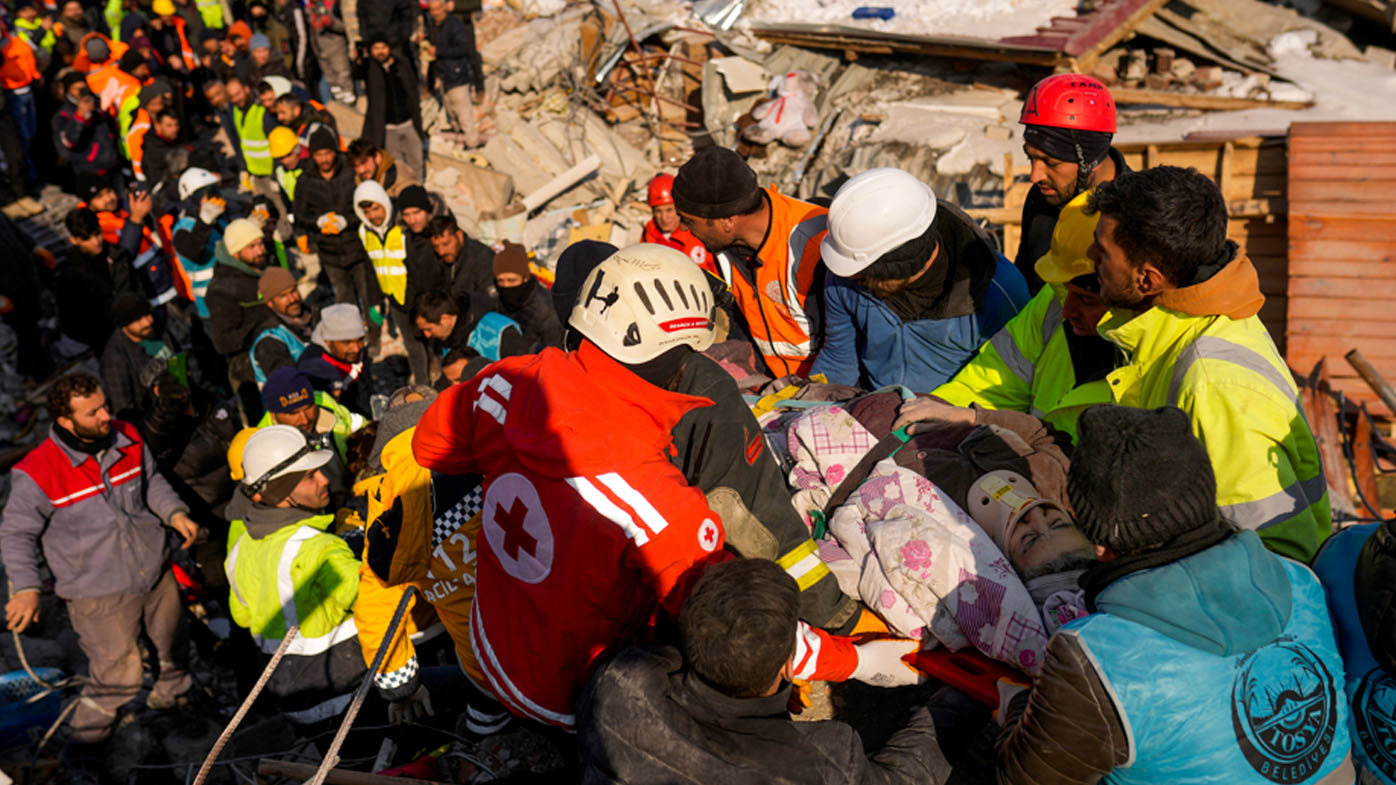
Emergency crews used pick axes, shovels and jackhammers to dig through twisted metal and concrete — and occasionally still pulled survivors out.

But in some places, they switched the focus to demolishing unsteady buildings.

While stories of miraculous rescues briefly buoyed spirits, the grim reality of the hardship facing tens of thousands who survived the disaster cast a pall.

In north-west Syria, the first UN aid trucks to enter the rebel-controlled area from Turkey since the quake arrived — underscoring the difficulty of getting help to people in the country riven by civil war.

In the Turkish city of Antakya, meanwhile, dozens of people scrambled for aid in front of a truck distributing children's coats and other supplies.

One survivor, Ahmet Tokgoz, called for the government to evacuate people from the devastated region. While many of the tens of thousands who have lost their homes have found shelter in tents, stadiums and other temporary accommodation, others have spent the nights outdoors.

READ MORE: Social media 'fight club' puts South Australian community on edge

"Especially in this cold, it is not possible to live here," he said. "If people haven't died from being stuck under the rubble, they'll die from the cold."

Winter weather and damage to roads and airports have hampered the response in both Turkey and Syria, where a civil war that displaced millions has further complicated efforts.

Some in Turkey have complained the response was too slow — a perception that could hurt President Recep Tayyip Erdogan at a time when he faces a tough battle for reelection in May.

In the Turkish town of Elbistan, rescuers stood atop a high stack of rubble from a collapsed home and fished out an elderly woman who had been submerged.

Teams urged quiet in the hopes of hearing stifled pleas for help, and the Syrian paramedic group in the rebel-held northwest known as White Helmets noted that "every second could mean saving a life."

READ MORE: Man jailed for 'savage and cowardly' murder of stranger

But more and more often, the teams pulled out dead bodies from under the rubble. In Turkey's Antakya, over 100 bodies, covered by blankets and awaiting identification, lay in a makeshift morgue outside a hospital and in refrigerated trucks.

With the chances of finding people alive in the rubble dwindling, teams in some places began demolishing buildings. In others, they simply had to move on.

In Adiyaman, Associated Press journalists saw a local resident plead with rescuers to come and sift through the rubble of a building where relatives were trapped. The crew refused, saying there was no one alive there, and they had to prioritize areas where there may be survivors.

READ MORE: Severe thunderstorm barrels through NSW south coast

A man, who gave only his name as Ahmet out of fear of government retribution, later spoke to the AP.

"How can I go home and sleep? My brother is there. He may still be alive," he asked.

In Nurdagi, throngs of onlookers — mostly family members of people trapped inside — watched as heavy machines ripped at one building that had collapsed, its six floors pancaked together.

Mehmet Yilmaz watched from a distance, estimating that around 80 people were still beneath the rubble — but that it was unlikely any would be recovered alive.

"There's no hope," said Yilmaz, 67, who had six relatives, including a three-month-old baby, trapped inside.

"We can't give up our hope in God, but they entered the building with listening devices and dogs and there was nothing."

Authorities called off search-and-rescue operations on Thursday in the cities of Kilis and Sanliurfa, where destruction was not as severe as in other impacted regions.

Aid slower to come to civil war-torn Syria

Across the border in war-riven Syria, assistance trickled in. Smaller aid organisations have sent in shipments to Syria's rebel-held north-west, but the first UN trucks arrived on Thursday.

The U.N. is only authorised to deliver aid through one border crossing and road damage has prevented that thus far.

UN officials said more was needed, and they pleaded for humanitarian concerns to take precedence over politics.

The scale of loss and suffering to tend to remained massive. Turkish authorities said Thursday that the death toll had risen to more than 16,100 in the country, with more than 64,000 injured. On the Syrian side, which includes in government-held and rebel-held areas, of the border, more than 3100 have been reported dead and more than 5000 injured.

It was not clear how many people were still unaccounted for in both countries.

Among the missing were members of a high-school volleyball team from northern Cyprus, as well as teachers and parents who had been staying in a hotel that collapsed, said Nazim Cavusoglu, the education minister in the breakaway Turkish Cypriot north, on Turkey's NTV television.

Turkey's disaster management agency said more than 110,000 rescue personnel were now taking part in the effort and more than 5,500 vehicles, including tractors, cranes, bulldozers and excavators had been shipped. Teams from places as diverse as Poland, Switzerland, Israel and the West Bank were contributing to the deployment to Turkey.

But international aid for Syria was far more sparse, where efforts have been hampered by the ongoing war and the isolation of the rebel-held region along the border that is surrounded by Russia-backed government forces. Syria itself is an international pariah under Western sanctions linked to the war.

Erdogan, who continued touring devastated areas Thursday, has sought to deflect criticism of the response — and vowed it was improving.

He renewed a promise to quake survivors that destroyed homes would be rebuilt within a year. He has said the government will distribute 10,000 Turkish lira ($760) to affected families.

Sign up here to receive our daily newsletters and breaking news alerts, sent straight to your inbox.

Norfolk Island braces as cyclone intensifies

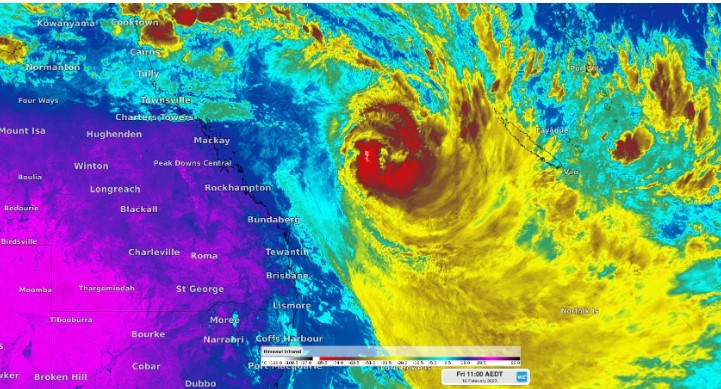
Norfolk Island is on alert as Tropical Cyclone Gabrielle reaches category three severity off Queensland's coast.

Category three is the first of three severe tropical cyclone categories, on a five-level scale, reserved for weather systems with top wind speeds over 117km/h.

A cyclone watch has been declared for the island, with the Bureau of Meteorology saying Gabrielle is headed toward it, with a peak wind speed of 120km/h this morning.

READ MORE: China spy balloon 'contained tech to monitor communication signals'

It's expected to make landfall tomorrow.

When it does, it will drop to a category two weather system, but will still cause destructive gale-force winds, abnormally high tides and heavy rain.

There is still uncertainty about the direction of the cyclone, the forecast suggesting it could transition into a strong extra-tropical cyclone, bringing severe weather to New Zealand's North Island from Sunday.

https://twitter.com/BOM_au/status/1623856948260007936

A hazardous surf warning is in place from the Capricorinia coast down to the Gold Coast.

It comes after a sudden storm hit the New South Wales coast yesterday, cutting off roads and leaving drivers stranded.

READ MORE: Qantas plane met by fire crews as storms delay flights

The South Coast was hit first, followed by Illawarra and then Sydney.

The SES responded to more than 1600 calls for help and carried out 65 flood rescues, as drivers continue to dare flooded roads.

There's more rain forecast for today, though it's hoped it won't be as heavy.

Sign up here to receive our daily newsletters and breaking news alerts, sent straight to your inbox.