CCTV footage shows people had “ripped him out of the ground, taken him and run”.
Tag Archives: oceania
'Millions of lives at risk': WHO flags rise of superbugs
A worrying new report has revealed humans are becoming more resistant to antibiotics, putting the lives of millions around the world at risk of dangerous "superbugs".
The research – conducted by the World Health Organisation (WHO) – surveyed people in more than 80 countries and found that common bacterial infections are becoming increasingly resistant to treatments.
Over 60 per cent of people surveyed who had contracted gonorrhoea, a common sexually transmitted disease, showed resistance to one of the most used oral antibacterials, ciprofloxacin.
READ MORE: Week of 'unsettled' weather on the cards for Australia's east-coast

Over 20 per cent of E.coli cases – the most common pathogen in urinary tract infections – were resistant to both first-line drugs and second-line treatments.
WHO Director General, Dr Tedros Adhanom Ghebreyesus, said more data is desperately needed to address the growing crisis.
"Antimicrobial resistance undermines modern medicine and puts millions of lives at risk," he said.
READ MORE: NSW parents given $150 'back to school' vouchers in cost of living boost
"To truly understand the extent of the global threat and mount an effective public health response to AMR, we must scale up microbiology testing and provide quality-assured data across all countries, not just wealthier ones."
The report suggests that although most resistance trends "have remained stable" over the past four years, "bloodstream infections due to resistant Escherichia coli and Salmonella spp. and resistant gonorrhoea infections increased by at least 15 per cent compared to rates in 2017".
More research is needed to identify the reasons behind the observed increase and to what extent it is related to raised hospitalisations and increased antibiotic treatments during the COVID-19 pandemic, WHO said.
Freed Russian dealer called 'Merchant of Death' breaks silence
Freed Russian arms dealer Viktor Bout said on Saturday he "wholeheartedly" supports Moscow's so-called "military operation" in Ukraine and that if he had the opportunity and necessary skills, he would "certainly go as a volunteer."
Bout, nicknamed the "Merchant of Death" by his accusers, was released on Thursday from US detention in a prisoner swap for US basketball star Brittney Griner.
Bout made the remarks in a video interview with Kremlin-controlled TV network RT. He was interviewed by Maria Butina, a Russian gun-rights enthusiast-turned TV personality who now works for the network.
READ MORE: Week of 'unsettled' weather on the cards for Australia's east-coast

In the interview, he denied any connections with the Taliban and that he supplied arms to Afghanistan.
When asked if he had a portrait of President Vladimir Putin in his prison cell, Bout said:
"Yes, always. Why not? I'm proud that I'm Russian and that our president is Putin."
The former Soviet military officer was serving a 25-year prison sentence in the United States on charges of conspiring to kill Americans, acquire and export anti-aircraft missiles, and provide material support to a terrorist organisation.
Bout, who had maintained his innocence, is believed to be in his 50s, with his age in dispute because of different passports and documents.
READ MORE: Memorial to American writer Grant Wahl placed at World Cup game

Griner, 32, returned to the United States early Friday after being released from custody in an exchange for an international arms dealer.
She was "in good spirits" and "incredibly gracious," National Security Council spokesperson John Kirby told CNN.
Griner – who had played in the off-season for a Russian women's basketball team – was arrested on drugs charges at an airport in the Moscow region in February. Despite her testimony that she had inadvertently packed the cannabis oil found in her luggage, she was sentenced to nine years in prison in early August and moved to a penal colony in Mordovia in mid-November after losing her appeal.
The swap, which US President Joe Biden confirmed on Thursday, did not include another American that the State Department has declared wrongfully detained, Paul Whelan. Whelan was arrested on alleged espionage charges in 2018 and sentenced to 16 years in prison in a trial that US officials have called unfair.
The families of Griner and Whelan had urged the White House to secure their release, including via prisoner exchange if necessary.
Australians bracing for week of 'unsettled' weather
"Unsettled" weather is about to lash the east coast of Australia with storm and shower activity expected across multiple states for most of the week.
The mix of weather is due to a cold front passing over the country's south-east, which will cause temperatures to plummet.
Several weather warnings are current for NSW with the state's west today bracing for the potential of severe storms. From Monday morning, damaging winds are expected across central and southern NSW.

READ MORE: The devastating natural disaster that's going to get more intense
https://twitter.com/bom_nsw/status/1601745685401026563?s=46&t=lhKQLGQq0i06BcKr5rtLUg
Melbourne is tipped to return to winter-like conditions with snow forecast to fall in alpine regions. Warm and windy weather has been felt in Victoria today, with the state reaching a top 27C.
However by Wednesday, Melburnians might need their puffer jackets as rain and possible hail will cross the state with temperatures dropping to 15C.
Similar conditions will play out across NSW.
A mix of weather is expected, including warm, stormy conditions in many areas, before the gusty cool change.
"It will feel more like winter again in the south. Showers, storms and Alpine snow in south-east Aus with maximum temperatures 6 to 16C below average," the BoM said.
READ MORE: Households 'better than they have been' under new energy plan
https://twitter.com/BOM_au/status/1601714688559124482
It comes as Western Australians swelter through an extreme heat wave; some towns are forecast to reach 45-48C today.
Temperatures in Adelaide will remain in the low 20s for most of the week, a the a heatwave that's gripped the south-western states eases.
Queensland will revel in sunshine for the next couple of days with much of the state experiencing 30C weather.
Rain will cross the state from next weekend.
Three arrested over alleged importation of at least $4m of drugs
Three alleged members of a multinational crime group have been arrested in the Philippines over their involvement in the importation of almost two tonnes of illegal drugs into Australia.
Police allege the three men – a French national, aged 41; a Canadian, aged 33; and a Filipino, aged 42 – imported 1.5 tonnes of methamphetamine and 450 kilograms of cocaine into Australia across the last 18 months.
A joint operation conducted by the Australian Federal Police (AFP) in collaboration with the Philippine Drug Enforcement Agency (PDEA), resulted in the recent raids of two homes in Manila.
READ MORE: Memorial to American writer Grant Wahl placed at World Cup game

Police allege one of the properties was home to an undercover meth lab.
A total of 22 kilograms of meth, 770 grams of cocaine, chemicals, drug-making equipment, mobile phones, several ID cards and financial documents were seized during the raids.
The street value of the meth is estimated at over $4 million alone.

Police say as a result of the seizures the Australian community have been spared over $900 million in "drug-related harm".
"Organised crime groups may think they can avoid police scrutiny when they operate across multiple countries – but they are wrong," AFP Senior Officer in Manila, Detective Superintendent Andrew Perkin said.
READ MORE: Woman loses home after insurer turns down brain tumour claim

"This operation again highlights how law enforcement agencies share intelligence across borders to cause maximum damage to these transnational criminal networks.
"The Australian Federal Police has members in 33 countries around the world and we will continue to use our international networks to ensure drug syndicates do not profit at the expense of our communities."
A PDEA spokesperson alleged the men had linked to Mexican, Australian and Canadian drug trafficking groups.
"We will allege this group was manufacturing methamphetamine in a residential neighbourhood without any regard for the welfare of children and adults living nearby," the spokesperson said.
Memorial to writer placed at World Cup game after sudden death
American soccer writer Grant Wahl was honored with a tribute from FIFA on the desk where he was due to work Saturday at the World Cup quarterfinal match between France and England.
A posy of white lilies and a framed photograph of Wahl taken in Qatar was left at the media seat that had been assigned to the 49-year-old journalist who died at the World Cup in the early hours of Saturday.
“Tonight we pay tribute to Grant Wahl at his assigned seat in Al Bayt Stadium. He should have been here,” FIFA said in a statement.
“Our thoughts remain with his wife Céline, his family, and his friends at this most difficult time.”
READ MORE: The devastating natural disaster that's going to get more intense


About 20 minutes before the match started, the photograph of Wahl was displayed on big screens in two corners of the stadium. An announcement about his death was made to fans who applauded him.
Wahl fell ill while working during extra time of the Argentina-Netherlands game on Friday at Lusail Stadium.
Wahl fell back in his seat in a section of the venue reserved for journalists during extra time of the game, and reporters adjacent to him called for assistance.
READ MORE: CCTV vision released after hit-run victim threatened with tomahawk

Emergency services workers responded very quickly, treated him for 20 or 30 minutes on site and then took him out on a stretcher, said Keir Radnedge, a veteran British sports journalist who was working nearby at the time.
The World Cup organising committee said he was taken to Doha's Hamad General Hospital, but it did not state a cause of death.
"We are in touch with the US Embassy and relevant local authorities to ensure the process of repatriating the body is in accordance with the family's wishes," it said in a statement.
Wahl, who wrote for Sports Illustrated for more than two decades and then started his own website, was a major voice informing an American public of soccer during time of increased interest after the US hosted the 1994 World Cup.
He also brought a critical eye to the organisational bodies of the international sport.
Woman loses home after insurer turns down brain tumour claim
When Amber Denney bought life and critical condition insurance from Bank of New Zealand, she thought it would help pay her mortgage, if she ever fell so seriously ill she could not work.
But when she contracted a debilitating and life-threatening brain tumour, BNZ's insurance proved worthless.
Denney was diagnosed with a pituitary tumour in 2020, and underwent brain surgery, several years after symptoms emerged, including rapid weight gain, muscle loss, brain fog, fatigue, depression and severe headaches.
READ MORE: The devastating natural disaster that's going to get more intense

But despite her neurosurgeon saying Denney fitted the criteria to succeed in her A$49,000 claim, BNZ Life Insurance declined the claim, after taking six months to come to a decision.
As a result of her illness, Denney was unable to work, and lost the home she bought when she was 21. She wonders to this day, if the insurance money would have allowed her to save it.
At a time Denney, now aged 26 and renting in Hamilton, was losing her home, banks were working to make sure people did not lose their homes in the economic disruption of the COVID-19 pandemic.
BNZ refused to comment on whether the insurance it sold had failed Denney in her time of need. But Partners Life, which bought BNZ Life Insurance after her claim was decided has promised to take a fresh look at her case.
Denney has yet to concede defeat to her insurer, and may take a claim to the Banking Ombudsman claiming service failure by BNZ, and the Insurance and Financial Services Ombudsman over the decision by BNZ Life to decline her claim.
But she says she is speaking out to warn others that their insurance may be much more limited than they think, and fail them at their time of direst need.
Her cluster of debilitating symptoms resulting from the pituitary tumour is called Cushing's Disease.
"I'm not the only Cushing's person who has had this trouble with the insurance companies," she says.
"The endocrinologist told me about all the other people who have been struggling," says Denney, who before her illness was fit enough to climb mountains and shear sheep.
There were several critical failures of the critical condition insurance BNZ sold her, according to Denney and insurance lawyer Tim Gunn, who is helping Denney pro bono.
While the BNZ Life policy did cover pituitary tumours, there were two caveats.
READ MORE: CCTV vision released after hit-run victim threatened with tomahawk

First, it had to produce neurological damage, and functional impairment, which a specialist considered to be permanent.
Second, it had to be removed by a craniotomy, surgery that requires cutting through the skull.
Gunn says the requirement for a craniotomy is unreasonable, unfair and outdated.
In recent decades the primary surgical option for pituitary tumours was not a craniotomy, but keyhole surgery, which was used to save Denney's life.
"The method of surgery to remove the tumour was the most current and accepted method," Gunn said, and was now used in 95 per cent of pituitary tumour surgeries.
Craniotomy surgery carries a higher risk and was not as effective, he says, and requiring it was unreasonable.
But Denney and Gunn say the policy was also fatally flawed because it could not do what she was sold the policy for in the case of a policyholder contracting a pituitary tumour.
It takes so much time for medical specialists to conclude that damage is permanent after an operation, that paying a claim in time to help save a policyholder's home is not possible, Denney maintains.
One communication from BNZ Life dated September 2021, told Denney that despite her being diagnosed in July 2020, operated on in September 2020 during the level four lockdown, proof of permanency had still not been established.
Denney says she has been left with permanent memory loss, severe headaches, and other symptoms of Cushing's Disease, and can't understand why BNZ Life is not paying.
"It's blatantly obvious. I'm struggling. I just don't get it. It's extremely unfair," she says.
"BNZ has failed in their responsibility to ensure that Ms Denney was adequately protected," Gunn says.
Denney says one horrified BNZ worker told her not to let the bank win.

"She advised me, it was her exact words, 'If you have the energy to fight, fight them until the end'," she says.
BNZ would not answer the allegations, saying only that all BNZ Life's records had moved to Partners Life, though Denney remains a BNZ customer.
BNZ had sold the business to Partners Life, which has in turn been sold to Japanese insurer Dai-ichi Life.
Partners Life has promised to review the decision taken by BNZ Life to turn Denney's claim down.
READ MORE: Portion of cliff collapses onto Californian beach

It said BNZ Life's conclusion was that while the condition Denney suffered was most certainly traumatic, it was not covered under the definitions in the policy wordings.
Critical condition (often called critical illness) insurance was not designed to cover every possible health emergency, it said, but did not comment on the specific allegations Denney and Gunn have made, as it had only been alerted to them by Stuff.
It said it would contact Denney about the review of BNZ Life's decision to decline her claim.
Partners Life says its claims philosophy is that, "if it's grey, we pay", and "where the medical information is unclear or conflicting, we will remove the uncertainty and simply pay your claim".
Denney said her surgery saved her life, and her weight has dropped by 35kg.
Doctors told her in 2020 that without the surgery she would have two years to live.
"I've passed that two years now, so every day's given to me now," she says.
At its worst, Denney's symptoms were so bad, she was unable to work for nearly two years, though her life is on the up, and she is once again dreaming about buying a home.
She has landed a job at a supportive employer in Hamilton.
This story originally appeared on stuff.co.nz and has been republished with permission
The most stunning photos of the Northern Lights captured this year
The surreal and enchanting northern lights can only be seen in the most remote parts of the world. These are the most dazzling photos of the northern lights this year.
Portion of cliff collapses onto Californian beach
No injuries were reported after part of a cliff collapsed onto a beach Friday in coastal Palos Verdes Estates in Los Angeles County, the Southern California city said in a statement.
The landslide, at 10 am local time, forced the closure of the beach and comes as an atmospheric river event – or a plume of moisture streaming in from the Pacific Ocean –is expected to bring heavy rain up and down the West Coast over the weekend.
The potent storm system could mean more danger in the area in the coming days, geologist Pat Abbott told CNN affiliate KCBS-TV.
READ MORE: The devastating natural disaster that's going to get more intense

"Sea levels are rising, gravity is pulling, and now when you talk about heavy rains coming in this week, might that be a danger? Oh definitely. That's going to add to the problem," Abbott said.
Abbott told the station a big landslide is typically followed by "a lot more landslides." His advice to locals: "Back off."
READ MORE: Pet dogs save owners from house fire

KCBS-TV footage showed part of the hillside crumbling onto the beach, unleashing a massive dust cloud as rocks and debris pushed a pickup truck across the sand. The pickup was unoccupied. At least one home was evacuated, the station reported.
City officials and geologists were reviewing "soil, rock, and groundwater conditions to evaluate the safety of the area and nearby structures," according to the statement.
Most coastal communities will pick up 2.5 to 7.6 centimetres of rain through the weekend, and some areas of northern and central California could receive 7.6 to 12.7 centimetres of rain in total.
Coastal erosion and flooded roadways are a major concern.
The devastating natural disaster that's going to get more intense
In this explainer series, 9news.com.au is examining the concerns and fears around natural disasters, examining potential impacts on Australia.
Tropical cyclones have killed hundreds of Australians and caused billions of dollars in damage – and we've been warned they're only going to get worse.
With another cyclone season upon us, what lies ahead for our region in the coming months?
We explore the impacts of cyclones and what's in store for the future, with the help of experts.
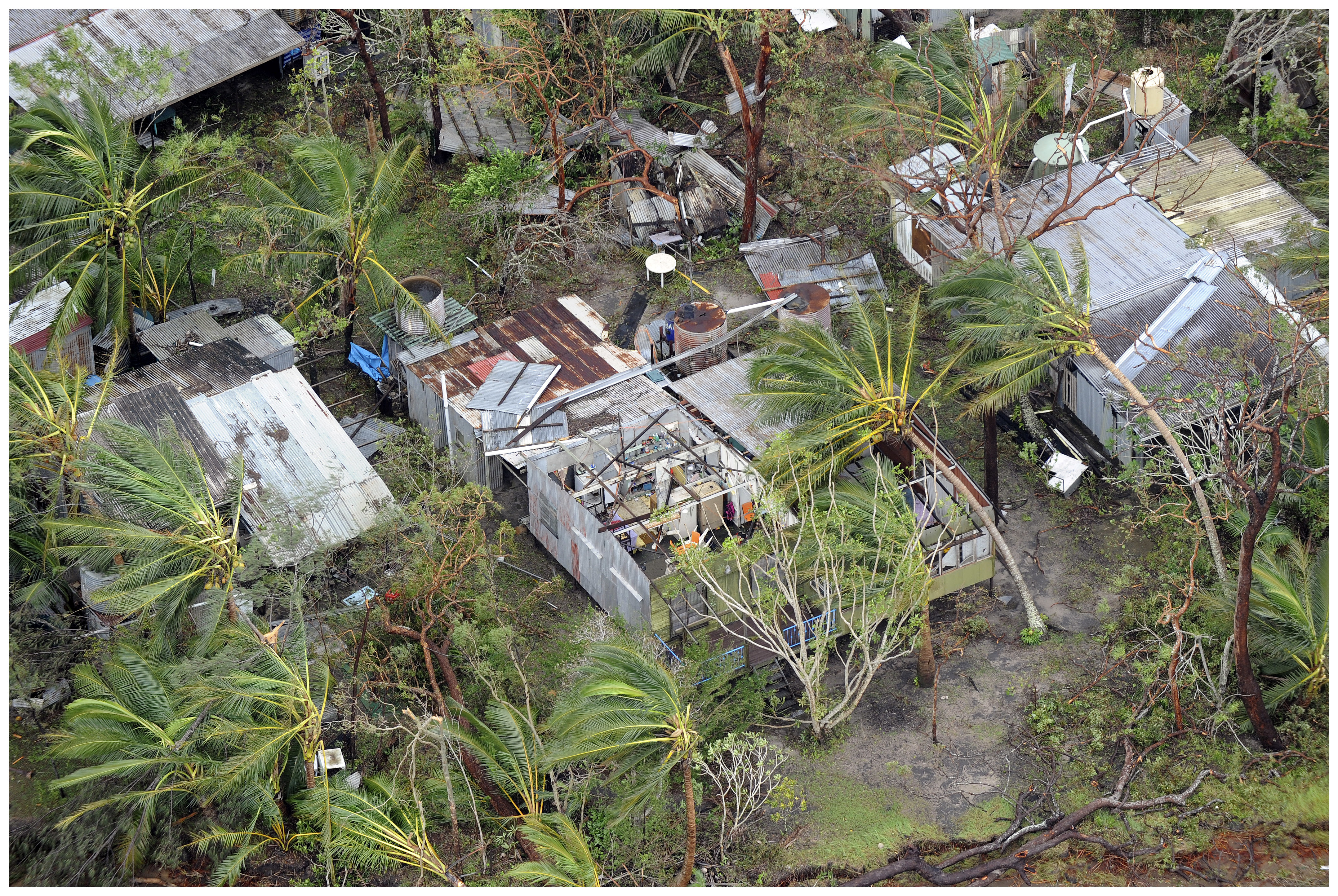
How many people have died in Australia due to tropical cyclones?
An estimated 206 tropical cyclone-related deaths have been recorded in Australia between 1970 and 2017.
This is based on data in a report published by the Bushfire and Natural Hazards Cooperative Research Centre.
The report also noted there were an estimated 1593 fatalities from tropical cyclone winds and floods from 1830 to 1989, but these figures are imperfect due to flaws and inaccuracies in historical records.
The records show over time tropical cyclone fatalities and death rates have dropped due to more efficient warning systems.
But research notes that the trend may cease or be reversed with any increase to the storms' frequency or intensity, as well as increasing populations on Australia's tropical coastlines.
How much does tropical cyclone damage cost?
Tropical cyclones are one of the costliest natural disasters that impact Australia.
Cyclone Tracy, which devastated Darwin in 1974, is Australia's most expensive with an insurance damage bill of more than $5 billion.
While Cyclone Dinah resulted in $4.68 billion in insurance payments – the nation's second most expensive – after the weather system smashed the southern coasts of Queensland and New South Wales in 1967.
Below is a summary of Australia's top 20 most expensive cyclones:
The costs associated with extreme weather hazards and disasters are likely to change in the future due to increasing greenhouse gas emissions.
Under a low emissions scenario, where timely action will see emissions start to fall and reach zero by 2100, the cost of natural disasters to the Australian economy will rise to at least $73 billion annually by 2060.
This is according to a report by Deloitte Access Economics, published in 2021.
The report noted the cost will "increase significantly" under the alternative emissions scenarios.
"Increasing costs will be driven by a combination of climate change, growth in population in exposed areas and the real value of property," the report said.
How many cyclones have hit Australia?
On average, about 11 cyclones move into the Australian region annually, but the exact figure varies from year to year due to climate drivers.
For example, fewer systems occur during El Nino years compared to La Nina years.
Around four systems cross the Australian coast during each cyclone season, which typically runs from November 1 to April 30.
Nine tropical cyclones moved through the Australia region in the 2021/2022 season, according to Weatherzone.
READ MORE: 'Nobody left to tell the story': Why sailors will always fear the legendary rogue wave

Comparatively, there were eight in the 2020/2021 season and seven in the 2019/2020 season.
This includes systems that did and did not make landfall.
The region includes Australian, Papua New Guinea, and Indonesian areas of responsibility.
The area between the Cape York Peninsula in Queensland and the Pilbara Coast in Western Australia typically experiences the most cyclones in a season.
Is the number of cyclones predicted to increase due to climate change?
The total number of cyclones in Australia is predicted to decrease – but that's not the full story.
Climate models project an increase in the proportion of high-intensity storms, with stronger winds and higher rainfall, according to the Earth Systems and Climate Change Hub.
University of Melbourne expert Professor Kevin Walsh agrees with the modelling.
READ MORE: The explosive truth about 'supervolcanoes'

"The most likely outcome for the future frequency of tropical cyclones in the Australian region is a slight decrease," Walsh said.
"There is likely, though, to be an increase in the maximum possible tropical cyclone intensity, as there are good theoretical reasons why that should happen.
"Another prediction that has decent confidence is an increase in tropical cyclone rainfall."
Will the changes pose a risk to Australians?
It is difficult to predict whether changes in cyclone formation and behaviour will pose a risk to Australia, according to Walsh.
"The crucial factor is whether there will be an increase in intense tropical cyclones striking the coast, as they are the ones that do most damage," he said.
"These are rare and therefore difficult to predict."
A likely increase in tropical cyclone rainfall is a flood risk.
"The possibility exists that tropical cyclones might strike slightly further south than they do at present, but the most vulnerable regions will still remain the more populated regions of the tropical coasts," he said.
"Storm surge is a risk in coastal regions and this is projected to increase due to sea level rise, a highly confident prediction of climate change.
"Although there is a fair range of predictions of future sea level rise, due to lack of information on future greenhouse gas emissions and some scientific uncertainty regarding their effects on sea level."