A woman who rang 111 five times on Christmas Eve claiming children were at risk of harm had her calls deemed low priority by police, despite a man later being fatally stabbed at the address the same afternoon. An Independent Police…
Tag Archives: oceania
Formerly on-the-run sex offender will have to wear GPS tracker after prison release
A child sex offender who went missing for nearly two years spent that time “living rough” on the East Coast. Lars Marlon Peka, 49, appeared in the Napier District Court on Tuesday for sentencing on three charges of breaching an…
Two 'clashing' jet streams causing dangerous mix of weather
Two jet streams clashing above the country is causing an "unseasonable mix" of dangerous weather across nearly all states and territories.
Australia has two main jet streams; the polar jet, and the subtropical jet.
These two systems have collided above the east coast, fuelling more unstable weather and resulting in several weather warnings.
READ MORE: Thousands of Aussies on precipice of $99 billion fixed rate 'cliff'

"This setup is allowing very cold polar air to interact with much warmer air sitting over the Australian continent, creating a large contrast in temperature and air mass density," Weatherzone explained.
"That is producing a dangerous mix of weather."
Satellite imagery provided by the weather service showed the large meandering cloud band as it moved up from the Southern Ocean on Tuesday morning.
"This specked cloud has formed in a large pool of cold air that has been dragged north from the fringes of Antarctica by a bend in the polar jet stream," it said.
READ MORE: China's fury over reports of US plans in Australia

Weather warnings issued amid dangerous conditions
Dangerous winds are lashing Sydney and its surrounds, with weather authorities warning there's more to come.
A young boy has been injured by a falling tree branch in Sydney's north-west and a severe weather warning remains in place over NSW's Hunter and Illawarra regions.
There were a number of flood rescues south of Sydney after an intense storm passed through Yass and the surrounding regions.
READ MORE: Trump Organisation faces criminal tax fraud trial over perks
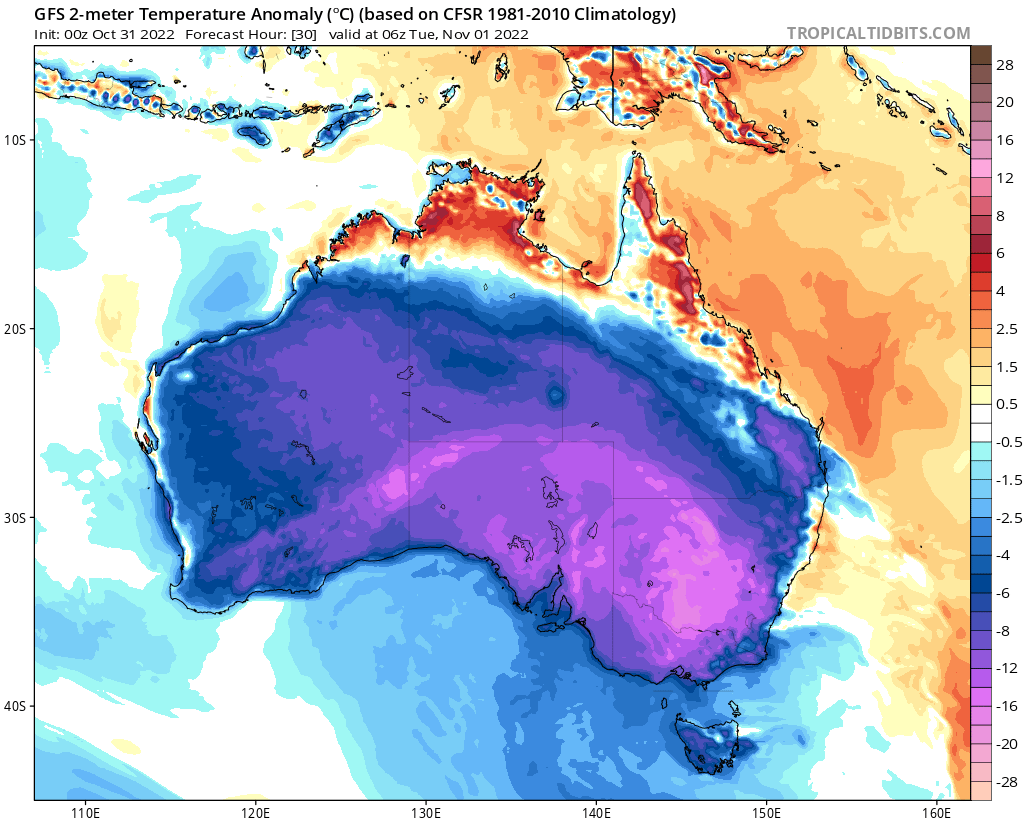
A massive cold front moving across the south-east is also expected to see temperatures drop up to eight degrees between now and Wednesday in Sydney's west.
And Perisher Ski Resort in the state's alpine regions has recorded rare November snow.
READ MORE: Just 137 Seoul police assigned to crowd of 100,000

In Melbourne, it's forecast to be just 14C, with rain, storms and even possible hail forecast – the coldest Cup Day since 1995, according to the Bureau of Meteorology.
The cold temperatures, widespread showers, and Alpine snow are forecast until mid-week, all of which are unseasonal for November.
Today, cold, wet, and windy weather will spread across much of South Australia, Victoria, Tasmania, and southern NSW.
Weatherzone said temperatures of 10C-15C below normal.
Widespread showers are possible with hail and thunder, strong and gusty winds and snow falling to as low as 600m in Tasmania, 700m in Victoria and 800m in NSW by Tuesday night and Wednesday morning.
Snow is also possible around the NSW Central Tablelands, and the Northern Tablelands.
READ MORE: China slams reported plan for US B-52 bombers in Australia

Snow flurries above 900m are also possible for the Flinders Ranges in South Australia.
Drivers are warned to be careful on the road under icy, snowy conditions.
Major flood warnings are current in parts of NSW, Victoria, and Queensland, with renewed flooding expected from upcoming rainfall.
Meanwhile, as the south-east shivers, much of the country's north is facing ongoing heatwave conditions, with temperatures forecast to be 2C-6C above average in the high 30C to low 40C range.
The heat in the Top End and northern Queensland will combine with heavy humidity, bringing rain and some relief from the heat, but high to extreme fire danger ratings will remain in place for the NT, South Australia, western Queensland and parts of Western Australia.
Shakespeare Rd fatal crash: Napier police appeal for sighting of 'car driving at speed'
Police are asking for any witnesses who may have seen a vehicle “driving at speed” before a fatal crash on Bluff Hill in Napier on Saturday night to come forward.An overloaded car with nine occupants flipped after hitting a parked…
Santa is getting ready to send more letters in te reo Māori than ever before – ka pai!
Santa is catching up with the rest of Aotearoa – he’s going bilingual.The white bearded one will reply to letters from tamariki in English and te reo Māori.NZ Post and Hana Kōkō (Santa) understand the importance…
Wellington man sentenced for causing victim to lose eye in Te Aro Park scuffle
An 11-second scuffle in a central Wellington park caused one man to lose an eye and left another with a conviction for wounding.Victor Jason Te Pania was today sentenced to home detention for stabbing the victim in the eye in a…
Climate change: NZ banks, homeowners exposed to rising flood risk
River and surface flooding may pose an even bigger threat to our banks’ mortgage portfolios than that from the sea, a Reserve Bank analysis reveals. Results from preliminary climate-related “stress-testing” – and part of a wider…
Lawyer and former Vic Uni lecturer Caroline Sawyer struck off and fined $31k for 'unacceptable conduct'
A former senior law lecturer at Victoria University has been struck from the bar and fined $31,000 for abusing the court process and accusing rival lawyers who won against her of corruption. Caroline Sawyer didn’t engage in the…
Out of sight, the dangerous Islamic State is rebuilding in Africa
Cutting off the head of the snake has long been a wartime strategy.
Get rid of the enemy's leadership, so the saying goes, and you'll shorten hostilities.
But the war on terror is an unconventional fight, against a new and dangerous foe.
READ MORE: Plan to bring Islamic State fighters back to Australia

Yes, the daring raids and devastating drone strikes taking out leaders and senior figures of al-Qaeda and Islamic State (IS) have been of vital importance.
But history has also proven those high-profile killings have had little impact on the longer term survival of both groups.
America's gruelling 20-year conflict in Afghanistan, which included the hunting down of Osama bin Laden, lasted longer than both world wars and Vietnam combined.
And in the three years since IS was ousted from the last of the territory it had seized across Syria and Iraq, and despite multiple fatal hits on its leadership, the terror group has been quietly and steadily rebuilding in sub-Saharan Africa.
"Killing leadership figures in jihadist groups does not accelerate their demise," Michael S. Smith, a US-based al-Qaeda and IS terror expert, told 9news.com.au.
"Several weeks after bin Laden's death, the prevailing assumption was that his death and the so-called sweeping changes taking place during the Arab Spring spelled a diminished threat posed by al-Qaeda and other groups inspired by that same Salafi-jihadist ideology.
"But what you saw within a couple of years was a doubling in the ranks of those groups."
Smith has a grim assessment to anyone wondering what has happened to IS since the fall of the self-declared caliphate in Syria and Iraq in March 2019.
"I hate to say it, but for the wider Salafi-jihadist movement the future looks very bright."
READ MORE: How 'The Rock' broke the news bin Laden was dead

READ MORE: What happened to the kids in famous 9/11 photo
As its last strongholds were falling in Syria and Iraq, where for several years it had ruled with medieval violence, IS was already moving its focus into Africa.
Estimates are rough, but there may be as many as 10,000 IS-affiliated fighters across Mozambique, Nigeria, Benin, Ghana and Togo.
Crucially, Smith said, under Joe Biden the US has changed tack over how it now plans to tackle the jihadist threat.
The US had stepped back from "leading" global initiatives against IS and al-Qaeda and was now adopting an "enabling" strategy "alongside" its allies, Smith said.
The shift in semantics, he said, was important and will carry consequences for global security.
"There is a vastly diminished national will to fight in the US," Smith concluded.
"What is well understood within the intelligence and defence community, perhaps not so well understood among politicians, is that the more time and space you give these groups the more opportunity they have to plan, organise and attempt to mobilise attacks against the West.
"ISIS couldn't have a better set of opportunities than they do right now."
READ MORE: What happened to some of 9/11's biggest names


READ MORE: Snow coming to south-east as Australia's north battles heatwave
Without a more attentive and aggressive approach from the West, Smith said IS would be free to build support in Africa in ways that could sustain the group for decades to come.
"What you end up doing, inadvertently perhaps, is creating the optic of durability, because local populations are sensitive to whether or not the most capable powers in the world are inclined to try and blunt this."
The other dangerous element in all of this, Smith said, was the chaotic and divisive state of politics in the US and UK since Trump's election and Brexit in 2016.
"What is essential to (Salafi-jihadist ideology) is the demonisation of the West," he said.
"That is really one of the biggest master narrative components for all of these groups.
"When you look at the United States today, what do you see? Do you see a country that looks strong, that looks together? Or do you seen a very divided country?"
Amidst the rise of partisan politics, which reached a nadir with the January 6 insurrection, Smith said the West risked losing control of the fundamental assumption in counterterrorism: deterrence.
"What are we all doing, civilisationally, with all of this infighting? It certainly does not create an effective deterrence."
READ MORE: The journalist who met 'sly fox' Osama bin Laden three times

READ MORE: Thousands of Aussies on precipice of $99 billion fixed rate 'cliff'
One thing the US continues to do exceptionally well is the tracking down and killing of IS leaders and senior figures in the group.
Shane Healey, a former ADF soldier and special operations intelligence analyst, said being the Islamic State leader is "the most dangerous job on Earth" because the Americans will always want to kill him.
Healey, who fought against insurgents in Iraq, said it's foolish to think IS have gone away just because attacks against the West have for now gone quiet and the so-called caliphate had been defeated in Iraq and Syria.
"They still believe in their fight, and that is never going to die," he said.
"They're a high threat because they still have the intent to kill anyone who is not onboard.
"Depending on where in the world they are depends on what capability they have."


READ MORE: China's fury over reports of US plans in Australia
According to the United Nations, there are still around 10,000 IS fighters dispersed across Iraq and Syria.
But an even bigger conundrum are the massive refugee camps in Iraq and Syria where hundreds of thousands of displaced people are living, including IS-cloaked fighters, and wives and children of jihadists who have been killed by US-led forces.
It is a multi-generational challenge.
Despite concern from some, Healey believes the federal government should start bringing home select Australian women and children so they can be integrated very carefully back into the community.
Healey, an expert in analysing the threat posed by terrorist organisations, said many IS-linked women in the camps could likely be regarded as "high risk but low threat".

"You can mitigate any risk (the women and children pose) to the point you don't repatriate a specific individual if their risk is too great," he said.
"It's their threat level that counts."
An individual's threat to conduct violence against the Australian community was the key factor that must be assessed, he said.
Someone's risk calculation is based on vulnerability and motivation, he said, while threat level is about capability and intent.
Healey said the extremist IS ideology was rampant in the camps.
Smith agreed, saying there were "thousands of people" living in camps "who had a taste" for the IS doctrine.
"What that speaks to is that there is a real durability for the allure of what (IS) has accomplished in the past," he said.
Since 2020, IS have claimed responsibility for 17 terror attacks around the world, significantly down from the dozens launched between 2015-2018.
'Planet killer' asteroid spotted hiding in sun's glare
Astronomers have spotted three near-Earth asteroids that were lurking undetected within the glare of the sun.
One of the asteroids is the largest potentially hazardous object posing a risk to Earth to be discovered in the last eight years.
The asteroids belong to a group found within the orbits of Earth and Venus, but they're incredibly difficult to observe because the brightness of the sun shields them from telescope observations.
READ MORE: Snow coming to south-east as Australia's north battles heatwave

To avoid the sun's glare, astronomers leaped at the chance to conduct their observations during the brief window of twilight. An international team spied the space rocks while using the Dark Energy Camera located on the Víctor M Blanco four-metre Telescope located at the Cerro Tololo Inter-American Observatory in Chile.
Their findings were published Monday in The Astronomical Journal.
One of the asteroids, called 2022 AP7, is 1.5km wide and has an orbit that could bring it within Earth's path in the future, but it's difficult for the scientists to know when.
"Our twilight survey is scouring the area within the orbits of Earth and Venus for asteroids," said lead study author Scott S Sheppard, an astronomer at the Earth and Planets Laboratory of the Carnegie Institution for Science in Washington, DC, in a statement.
READ MORE: Thousands of Aussies on precipice of $99 billion fixed rate 'cliff'
"So far we have found two large near-Earth asteroids that are about 1km across, a size that we call planet killers."
Scientists determined that the asteroid crosses Earth's orbit, but it occurs when Earth is on the opposite side of the sun – this pattern will continue for centuries since it takes the asteroid five years to complete an orbit around the sun.
But over time, the asteroid's orbital movement will be more in sync with Earth's. Scientists don't know the asteroid's orbit with enough precision to say how dangerous it could become in the future, but for now, it "will stay well away from Earth," Sheppard said.
A near-Earth asteroid measuring 1km or larger "would have a devastating impact on life as we know it," he said. Dust and pollutants would fill the atmosphere for years, cooling the planet and preventing sunlight from reaching Earth's surface.
READ MORE: China's fury over reports of US plans in Australia
"It would be a mass extinction event like hasn't been seen on Earth in millions of years," Sheppard said.
The team expects to find more planet killer asteroids in their survey over the next couple of years. Scientists believe there are about 1000 near-Earth objects larger than 1km in size, and surveys over the last decade have found about 95 per cent of them.
The other two asteroids, 2021 LJ4 and 2021 PH27, are on much safer orbits that don't pose a risk to Earth.
Astronomers are intrigued by 2021 PH27, however, because it's the closest known asteroid to the sun. As the space rock moves closer to our star, its surface reaches temperatures hot enough to meld lead.
Asteroid-hunting astronomers face quite a challenge if they want to find space rocks within the inner solar system – which includes Mercury, Venus, Earth, Mars and the main asteroid belt. In order to avoid the harsh light of the sun, they only have two 10-minute windows each night to sweep the area with ground-based telescopes.
During twilight, astronomers still face the complications of a bright sky in the background due to the sun. And in order to search the inner solar system, their telescopes must focus near the horizon, which means they have to peer through Earth's thick atmosphere and its blurring effects.
If things sound complicated for ground-based telescopes, observations of the inner solar system are impossible for space-based telescopes like Hubble and James Webb because the sun's heat and intense light could fry their instruments, which is why both space observatories are pointed away from the star.
The Dark Energy Camera's wide-field capability helped astronomers overcome their observational challenges and they were able to sweep vast stretches of the night sky in detail.
"Large areas of sky are required because the inner asteroids are rare, and deep images are needed because asteroids are faint and you are fighting the bright twilight sky near the Sun as well as the distorting effect of Earth's atmosphere," Sheppard said.
"DECam can cover large areas of sky to depths not achievable on smaller telescopes, allowing us to go deeper, cover more sky, and probe the inner solar system in ways never done before."
Near-Earth objects are asteroids and comets with an orbit that places them within 48.3 million kilometres from Earth. Detecting the threat of near-Earth objects that could cause grave harm is a primary focus of NASA and other space organisations around the world.
No asteroids are currently on a direct impact course with Earth, but more than 27,000 near-Earth asteroids exist in all shapes and sizes.
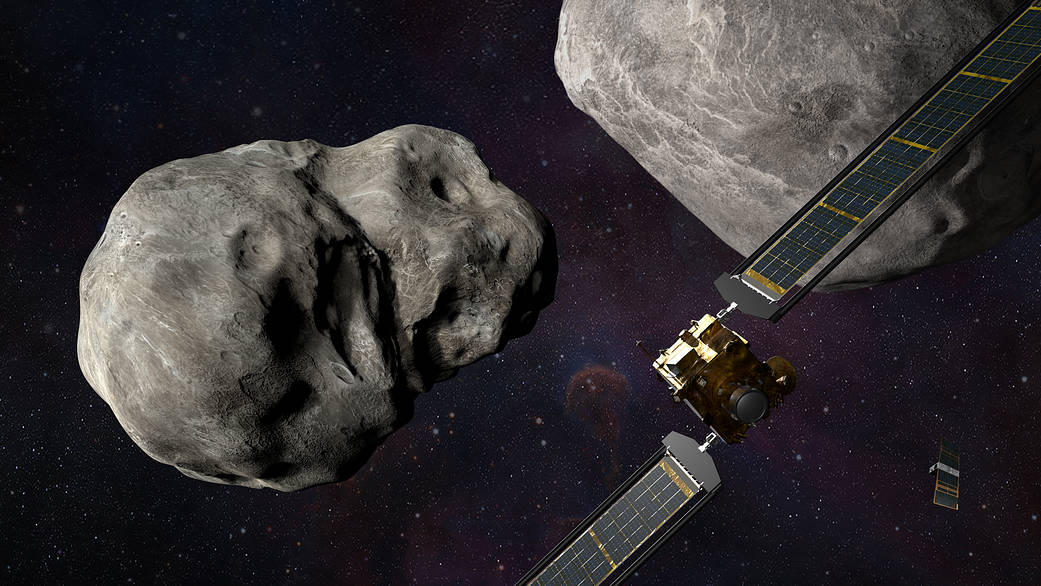
While NASA recently proved it can successfully alter the motion of an asteroid in space with September's Double Asteroid Redirection Test, or DART mission, astronomers first must find space rocks that pose a threat to our planet.
Instruments like the Dark Energy Camera, as well as future space-based observatories like the Near Earth Object Surveyor, can pinpoint previously unknown asteroids.
Studying and understanding asteroid populations will also help scientists learn the distribution and dynamics of space rocks – like how the heat of the sun can fracture and fragment them over time.
"Our DECam survey is one of the largest and most sensitive searches ever performed for objects within Earth's orbit and near to Venus's orbit," Sheppard said.
"This is a unique chance to understand what types of objects are lurking in the inner Solar System."