Two people are in custody after being apprehended in relation to a break-in this morning at a central Auckland coffee shop, police have confirmed.A Police spokesperson said they responded to reports of a burglary on Pt Chevalier…
Tag Archives: oceania
$16 million Lotto jackpot winner remains a mystery
After a life-changing $16 million Lotto win was confirmed yesterday, the lucky winner is yet to claim their prize.The winning numbers for this week’s Powerball Lotto draw were: 10, 12, 17, 25, 30 and 32.The Bonus Ball was 23,…
Boat skipper who killed friend Wei Chen on Motutapu dive trip to pay $150,000 reparation to family
The day after her ex-husband was killed on a dive trip, Nan Jiang called the boat’s skipper to ask what happened – only to get through to a man who sounded relaxed about it all.”Wasn’t he on your boat?” she asked Zhenhua Yang, the…
Police alarmed by brazen driving offences near school, risking lives
Police are alarmed by the number of people seen breaking road rules and threatening lives near a primary school during an operation last week. Counties Manukau Police saw 23 red light runners or people speeding up to get through…
Money Matters: Can hairdressers charge twice for the same haircut?
Every week we will break down, debunk and demystify your rights as a shopper in Australia. This week we are looking at a specific question sent in by a reader about charges made by hairdressers.
We all know life is getting more expensive than ever before, and how important it is to stretch every dollar you make.
That's why each week we'll answer a question surrounding what shoppers are – and aren't – entitled to when dealing with retailers and manufacturers.
MONEY MATTERS: The supermarket scanning error 'urban myth' laid bare

TWICE THE CHARGE FOR ONE HAIRCUT?
Hi Stuart,
My son recently went to get his haircut at a local salon. When the hairdresser finished, she showed him the result (in the mirror) and asked if it was ok.
He said he wanted it shorter, so she proceeded with the cut without a word. At the end, she asked him to scan his bank card for payment without saying she had charged him for two cuts – totalling $60.
There were no notices in the shop, and no discussion prior to her proceeding with the cut to state he would be liable to pay for a "second" cut.
We managed to get a refund for the second cut after speaking with the manager, as we found out from online reviews this hairdresser had done the same to other clients.
My question: Do they have the right to charge twice without notice, when the cut needs adjustment?
Hi there,
The simple answer is no, particularly if the haircut was specifically asked to be short upon entering the salon.
MONEY MATTERS: Help! I bought a second-hand car that's a lemon

According to Australian Consumer Law (ACL), businesses must display clear and accurate prices, and must not mislead consumers about their prices.
Of course there is so much nuance with hair cuts, as the end result of the "service" is highly subjective.
One man's glorious mullet is another man's madness.
Fundamentally your son's consumer guarantees still apply: consumers are entitled to a repair, replacement or a refund if a service they buy doesn't meet what is reasonably expected or advertised.
I would describe a haircut needing to be shorter as a "minor problem" with the service.
According to the Australian Competition and Consumer Commission (ACCC), "when a product or service has a minor problem, the business must fix the problem or repair the product for free".
MONEY MATTERS: Is it legal for shops to offer discounts for cash?

The business does not have to offer a replacement or refund for a minor problem, although it can choose to do this.
The ACCC even provides an example of this – although this scenario could very well be described as a "major" problem.
"You go to a hairdresser and ask for a cut and colour. The hairdresser accidentally uses peroxide instead of the colour you asked for and bleaches your hair," the watchdog posts in one example.
"In this case the hairdresser has not used care and skill when colouring your hair and you should use your rights."
I think you were well within your consumer rights to contest the charges for your son's haircut.
Do you have a consumer issue you need answered? Get in touch with Stuart at sm****@******om.au.
The information provided on this website is general in nature only and does not constitute personal financial or legal advice. The information has been prepared without taking into account your personal objectives, financial situation or needs. Before acting on any information on this website you should consider the appropriateness of the information having regard to your objectives, financial situation and needs.
Woolworths ditches iconic 99 cent product
Woolworths has begun phasing out the popular 99c green shopping bag in favour of a new-look recycled version, which have already been rolled out in some parts of the country.
Synonymous with the supermarket giant, the "Bag for Good" has long been a staple in aisles, but Woolies says the time has come to make room for a new, more sustainable version.
"We have been gradually running down stock of our green Bag for Good totes, with a sturdy new-look 99-cent tote bag set to take its place," a Woolworths spokesperson told Nine.
READ MORE: Liz Truss quits as UK PM after less than seven weeks in the job

"Our new reusable 99-cent bag is made from 70 per cent recycled material and has already started to roll out across stores. Our paper shopping bags and other bag options continue to be available to customers as well.
"We've seen a significant shift in shopping habits in recent years with 80 per cent of our customers now bringing their own bags to shop."
READ MORE: Severe storms threaten three states

The updated design has already been spotted at some branches in NSW, Victoria, Queensland, Western Australia and Tasmania and the supermarket hopes to roll them out in South Australia and the Northern Territory in the coming weeks.
The bag redesign is the latest in a string of new sustainability moves from Woolworths, after installing vertical herb gardens and self-serve BYO packaging bars in select stores.
READ MORE: Powerball jackpot booms to biggest prize in Aussie history

"We're growing greener across our stores by reducing plastic packaging, phasing out plastic shopping bags, saving food waste and switching to green electricity," a Woolworths spokesperson said.
Mike Williams: When it come to politics advancing age doesn't matter
OPINION: There was so much political action during the last two weeks that it’s hard to know where to start.Britain’s Prime Minister Liz Truss announced her resignation after just 45 days in office, the final results of the local…
Local Focus: Hawke's Bay eateries still struggling to find staff
If you’re looking to go out for dinner on a Monday night in Hawke’s Bay, you might be out of luck. And while most restaurants are closed for the night, some are now closed for much longer. A staffing shortage in the region is forcing…
Why Aussie waters have become ideal hunting ground for great whites
Australian waters are providing ideal hunting grounds for two "target" shark species and La Niña could play into the number of bites on swimmers increasing, a marine biologist has claimed.
Great white sharks have been responsible for 334 incidents since the 1900s, according to a database collated by the Taronga Conservation Society Australia, while tiger sharks and bull sharks trailed behind with 206 and 148 incidents respectively.
Taronga Conservation Society classifies a shark "incident" by three factors. These include; whether the person is alive at the time of the incident, the person is in the water or using a small watercraft, and there's a determined attempt by a shark to bite a person, equipment worn or being used, or the small watercraft.
The interaction is recorded in the database regardless of whether the bite is successful.
Great whites, tigers and bull sharks are in the "top three" target species involved in the most serious bites around the nation, however data shows from roughly 2009 the number of run-ins with great whites jumped substantially.
And an increasing trend has been mirrored for bull sharks from 2020.
READ MORE: Liz Truss quits as UK PM after less than seven weeks in the job
Dr Leonardo Guida, a shark scientist and conservationist at the Australian Marine Conservation Societym said run-ins with these sharks are likely to become more common.
'The overall general pattern is, and you can't argue against it, is there is an increase in shark bites … But if you drill into the details you can get a sense of why'
There has also been a population increase over the past 20 years on the Australian coastline.
"In NSW for example, between 2007-2017, roughly in that period where there is quite a bit of an increase, the state's population grew by about one million people," Guida said.
"Outside of Sydney, most of that growth occurred in areas like Newcastle, the Illawarra and Central Coast – so these coastal areas.
"In short, generally around Australia, with a population increase, you're likely to see an increase in shark bites."
Guida said changes in water temperatures are also likely to play a part.
READ MORE: What we know about shark attack occurrences around Australia
"Climate change could also be influencing the risk of shark bites," he said.
"With climate change we can see movement patterns in sharks change.
"So bull sharks for example, are projected to head further south down the NSW coast as the East Australian Current (EAC) drives warmer water further south.
"They are projected to hang around even a bit longer.
"These movements might overlap for more periods overtime with beaches that are popular with people."
Guida said changes to the EAC is also influencing great white shark movements, as the current creates cold water eddies.
"These are kind of like the off-spurts," he explained.
"We know from tracking studies that white sharks love cold water eddies because they tend to be more productive in foods.
"So it's also a possibility that as the current brings warmer waters further down the coast, these cold water offshoots, or eddies, could be pushed closer to shore.
"Do these cold water eddies overlap with areas that are popular with people? We don't quite know.
"(But) ultimately an increase in bites potentially in the future can relate to population change, compounded by warming waters, and changing movement patterns."
READ MORE: Severe storms threaten multiple states

Why east coast waters are the perfect hunting grounds
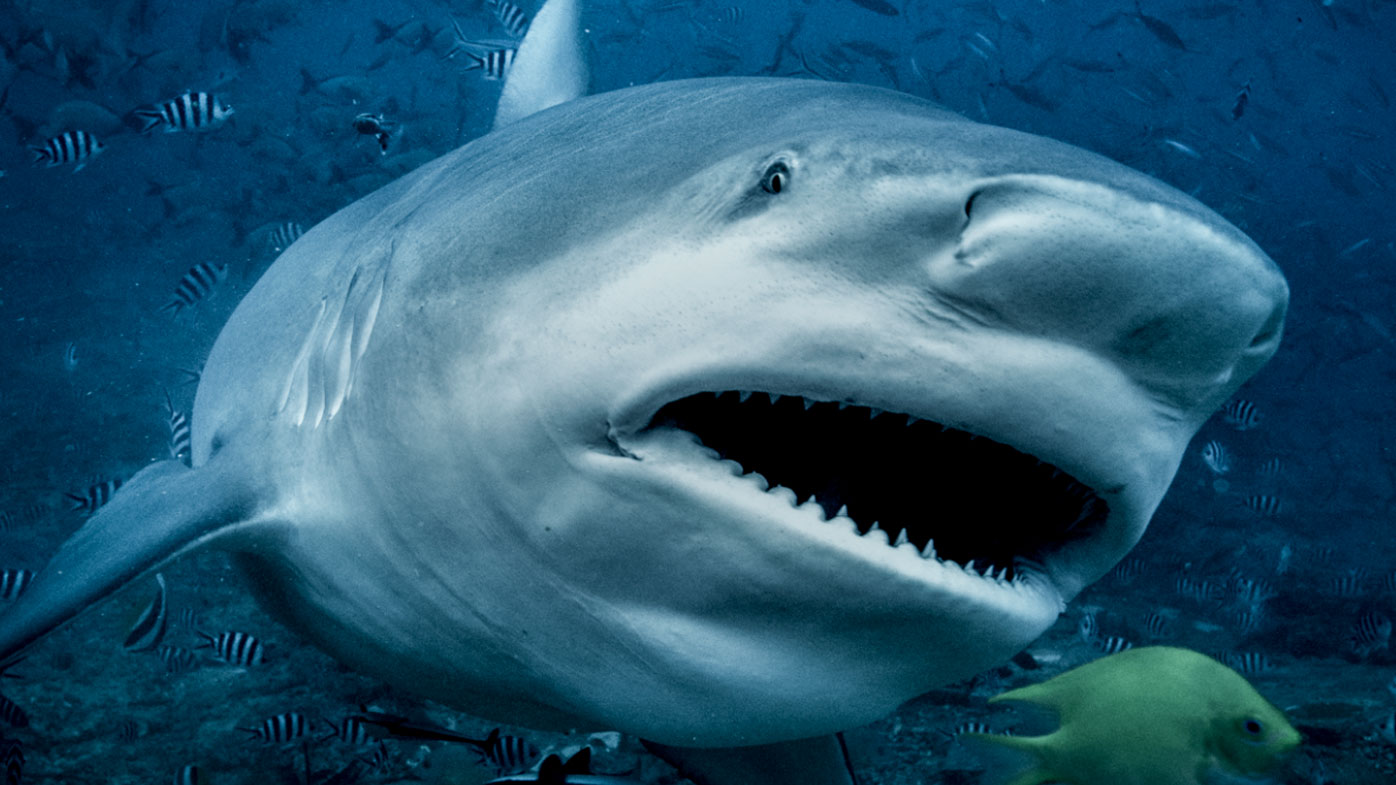
Guida said the waters off Australia's east coast are providing ideal hunting grounds for both great white sharks and bull sharks.
To understand why these waters are ideal, one must first know how the animals prefer to hunt.
READ MORE: 'Curious' great white tails kayaker off murky South Australian beach

"Bull sharks tend to favour murky and turbid waters," Guida said, adding stormy weather and La Niña is providing this in droves.
"We know from scientific research, particularly at river mouths, they like to hang around there during and shortly after storms.
"What we're seeing over the last couple of years with La Niña patterns, is public warnings from bodies like NSW Government, saying 'there's a lot of rivers near popular surf spots, so heads up, perhaps avoid the water'.
Guida said the waters off the Hunter coast, around Newcastle and Port Stephens, is a known great white shark nursery with another at "the furthest edge of the Victorian inlet".
READ MORE: Powerball jackpot booms to biggest prize in Aussie history
"We actually think juvenile white sharks migrate up and down the coast," he said.
"They favour these coastal waters as there's relatively high food abundance, with fish populations like Australian salmon and stingrays.
"But also it's relatively sheltered compared to the open ocean where the big adults tend to be.
"Being juveniles on the east coast there's obviously a high overlap with area that are also popular with humans, whether it be bathing, swimming, surfing."
Great white sharks have been responsible for all fatal NSW attacks for the past two years, with the state clocking the highest number of attacks in the nation over this period.
The reason for the severity of great white attacks is the animals have an "ambush" hunting method.
"They come up unannounced," Guida said.
"And what we roughly know is they favour low light conditions, as it helps this ability to be hidden from potential prey.
"Another really interesting thing they've found with white sharks is they actually hunt in orientation to the sun. The glare actually hides them, in a similar way to how fighter pilots hide themselves."
Despite spike attacks fatalities remain stable
Guida said it's important not to be alarmed by the data set, explaining that while shark incidents are increasing – fatalities are not.
"That trend has remained relatively stable at about one-and-a-half people per year," he said.
"What that says is despite more people going into the water and interactions increasing there also seems to be better emergency responses.
"This speaks to why it's so important to have non-lethal mitigation strategies – for instance more lifeguards, better medical training, more watching towers, more drones – so if there's an incident there's more chance of someone getting life-saving treatment."

Guida outlined the steps someone should take should they find themselves an unwilling witness to an attack.
"If you're out surfing with your mate at a remote beach and you have a surf rope you should use that as a makeshift tourniquet," he said, adding most bites typically occur on the legs or lower portion of the body.
"That speaks to the 'ambush nature' of a shark.
"If you don't have a rope and you can rest them on a surfboard, or you can get them close to the beach, put your fist between their hip and their bits and push down to stem the blood flow."
Missing Belgian backpacker Theo Hayez is dead, coroner rules
A coroner has concluded Belgian backpacker Theo Hayez is dead but she is unable to determine the cause or manner of his death.
State Coroner Teresa O'Sullivan said suicide appeared to be highly unlikely and there was no reason for the 18-year-old to intentionally vanish.
But she could not make a finding on the two competing theories put forward at the inquest into his disappearance more than three years ago.
READ MORE: 'Credible leads' may yet solve Théo Hayez mystery

They were that he had a terrible accident as he tried to climb towards the lighthouse at Byron Bay or that one or more persons caused his death and disposed of his body.
"Sadly, there is just insufficient evidence before me to substantiate or exclude either theory," she said on Friday.
He was reportedly last seen about 11pm on May 31, 2019 when he was ejected from the Cheeky Monkeys bar in Byron Bay.

Police were alerted six days later, when he failed to return to his hostel and could not be found or contacted.
A large-scale search was launched, with only a hat believed to belong to Theo located.
Police in February announced a $500,000 reward for anyone with significant information about Theo's case.
"I hope if there is any further information to be known, the reward would provide a motivation to come forward and contact Crime Stoppers," the coroner said.
READ MORE: Severe storms threaten three states

O'Sullivan acknowledged the sadness and loss experienced by Theo's family and friends, some who travelled from Belgium to Byron Bay for the inquest.
"It is obvious from the evidence he had a bright future ahead of him," she said.
She concluded by making recommendations to cut the red tape involved in searching for missing persons.